
Types of Concrete: Definition of High Performance Concrete, Precast, Gunite and More
Photo: U.S. Army / Monique Freemon, Wikimedia Commons, public domain
Quick Answer
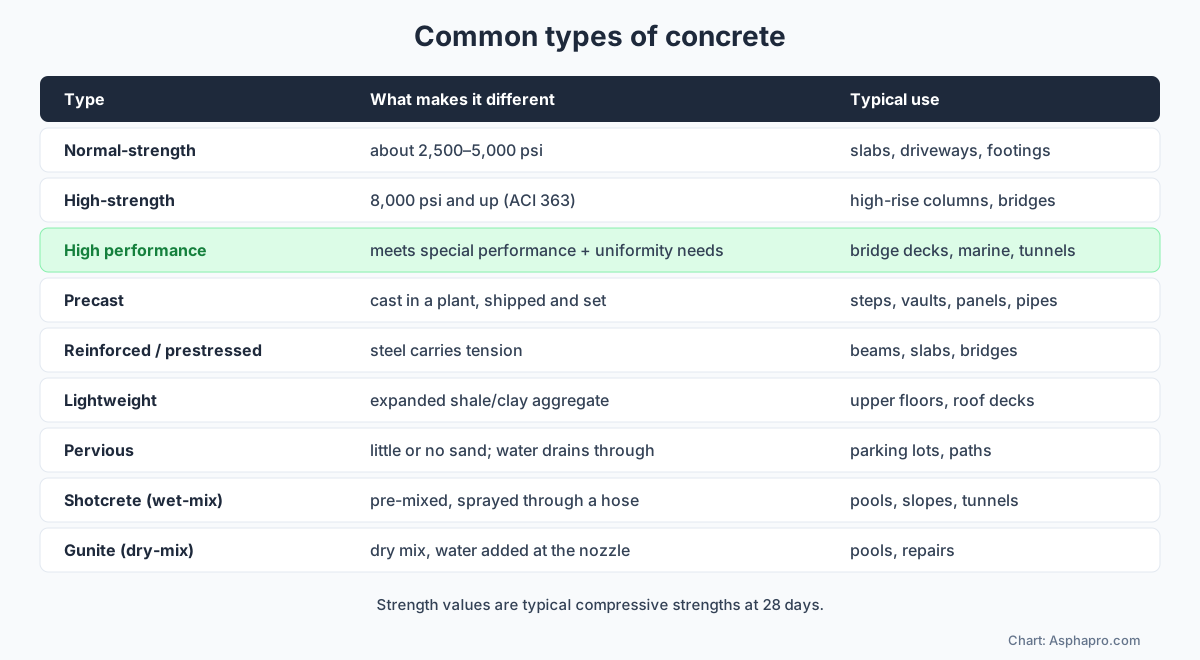
The main types of concrete include normal-strength concrete, high-strength concrete, high performance concrete, reinforced and prestressed concrete, precast concrete, ready-mix, lightweight, pervious, air-entrained, rapid-set, decorative, self-consolidating, and sprayed concrete (shotcrete and gunite). The American Concrete Institute's definition of high performance concrete is concrete meeting special combinations of performance and uniformity requirements that cannot always be achieved routinely using conventional materials and normal mixing, placing and curing practices. Precast concrete is cast and cured in a factory, then delivered and installed. Gunite vs concrete: gunite is concrete too, a dry-mix sprayed concrete where water is added at the nozzle, commonly used for pools.
All concrete starts from the same basic recipe of cement, water, sand and stone. But by changing the ingredients, adding steel, using admixtures, or changing how it is placed, engineers create many different types of concrete for different jobs. The concrete in a backyard patio is very different from the concrete in a bridge deck or a swimming pool shell.
This guide explains the common types of concrete, gives the definition of high performance concrete, explains what precast concrete is, compares gunite vs concrete and shotcrete, and helps you understand which type fits your project.
How Types of Concrete Are Classified
There is no single list of concrete types because concrete can be grouped in several ways at once. A precast, prestressed, high performance concrete girder belongs to three categories. The main ways to classify concrete are:
- By strength: normal-strength, high-strength, ultra-high performance.
- By density: lightweight, normal-weight, heavyweight.
- By reinforcement: plain, reinforced, prestressed, fiber-reinforced.
- By where it is made: ready-mix, site-mixed, precast.
- By placement: poured, pumped, sprayed (shotcrete and gunite), roller-compacted, self-consolidating.
- By special property: air-entrained, pervious, rapid-set, high performance.
- By finish: broom, troweled, stamped, stained, polished, exposed aggregate.
How Concrete Strength Is Measured
When people talk about types of concrete by strength, they mean compressive strength, measured in pounds per square inch (psi) in the U.S. or megapascals (MPa) elsewhere. Technicians cast test cylinders, usually 4 by 8 or 6 by 12 inches, from the fresh concrete, cure them in standard conditions, and crush them in a testing machine at specific ages, most often 28 days, following ASTM C39. The specified strength, written as f'c, is the target the mix must reliably meet. Roughly, 1,000 psi is about 6.9 MPa, so 4,000 psi concrete is about 28 MPa and 8,000 psi is about 55 MPa.
Strength depends mainly on the water-cement ratio, the cement and supplementary materials, the aggregates and the curing. That is why the definition of high performance concrete focuses on controlled ingredients and practices rather than any one number.
Precast Products Homeowners Use
Precast concrete is part of many homes, even when it is not obvious:
- Septic tanks and distribution boxes: delivered and set by crane.
- Precast steps: a quick replacement for crumbling cast-in-place steps.
- Window wells, catch basins, trench drains and other drainage structures.
- Segmental retaining wall blocks and pavers: machine-made precast units; see concrete blocks.
- Concrete block (CMU): technically a precast masonry unit; see cinder block vs concrete block.
- Lintels, sills and caps: over windows and on walls.
- Precast foundation walls: panels set on a gravel base, used by some builders.
Gunite Pools: How It Works
In a gunite pool, the crew excavates the pool shape, installs plumbing and a rebar cage, and then sprays dry-mix concrete through a hose, adding water at the nozzle. The nozzle operator builds up the walls and floor to the planned thickness, while finishers trim and shape the surface. Material that bounces off, called rebound, should be removed, not left in the shell. The shell then needs to be kept wet, often by watering it several times a day for a week or more, before tile, coping and plaster or pebble finish are applied. Because gunite is placed without inner forms, it allows free-form shapes, benches, steps and beach entries. Shotcrete pools use the same steps with a wet-mix delivered by truck.
Other Concrete-Like Materials
- Autoclaved aerated concrete (AAC): a lightweight, factory-made block or panel with many tiny air cells, cured with steam under pressure. Good insulation and fire resistance.
- Insulated concrete forms (ICF): foam blocks filled with reinforced concrete, giving insulated walls; see insulated concrete forms cost.
- Hempcrete: hemp hurds and lime binder. Not structural; used as insulating infill.
- Lime concrete: traditional concrete using lime instead of portland cement, used in some restoration work.
Cost Differences Between Types
Normal-strength ready-mix is the most economical type of concrete for most projects. Costs rise with higher strength, special admixtures, fibers, colored or decorative finishes, lightweight aggregates and pumping or spraying. High performance concrete and UHPC cost much more per cubic yard but can save money over a structure's life by lasting longer. Precast items cost more per cubic yard of concrete than site-cast, but save labor, forming and time on site. For residential pricing, see concrete cost per square foot.
1. Normal-Strength (Plain) Concrete
The everyday concrete used for sidewalks, patios, driveways, footings and slabs. Typical compressive strength is about 2,500 to 5,000 psi at 28 days. It is made of portland cement, water, sand and gravel, usually delivered as ready-mix or mixed from bags for small jobs. Without reinforcement, it is called plain concrete. See what concrete is made of.
2. High-Strength Concrete
Concrete with much higher compressive strength than normal mixes. ACI Committee 363 has defined high-strength concrete as concrete with a specified compressive strength of 8,000 psi (55 MPa) or more. It uses a low water-cement ratio, superplasticizers, and often silica fume or fly ash. It allows smaller columns in tall buildings and longer spans in bridges.
3. High Performance Concrete (HPC)
The ACI definition of high performance concrete is: concrete meeting special combinations of performance and uniformity requirements that cannot always be achieved routinely using conventional constituents and normal mixing, placing and curing practices.
In plain terms, high performance concrete is defined by what it does, not just by strength. A mix can be "high performance" because it is:
- Very durable: low permeability to resist chlorides, sulfates and freeze-thaw damage.
- High in early strength: for fast construction or quick reopening of roads.
- Very stiff: a high modulus of elasticity to limit deflection.
- Low in shrinkage or heat: for massive pours or crack-sensitive decks.
- Easy to place: such as self-consolidating concrete for congested reinforcement.
High performance concrete often includes supplementary materials like fly ash, slag and silica fume, chemical admixtures, a low water-cement ratio and careful curing. The Federal Highway Administration has promoted HPC for bridges because longer-lasting decks and girders reduce lifetime costs.
Ultra-high performance concrete (UHPC)
UHPC is a special class with very high compressive strength, often above about 20,000 psi, very low porosity and steel fibers. It is used for bridge deck connections, thin precast elements and repairs. It is expensive and requires special mixing and curing.
4. Reinforced Concrete
Concrete is strong in compression but weak in tension. Reinforced concrete adds steel bars (rebar) or welded wire mesh that carry tension, making beams, slabs, walls and foundations that resist bending and cracking. Almost all structural concrete is reinforced.
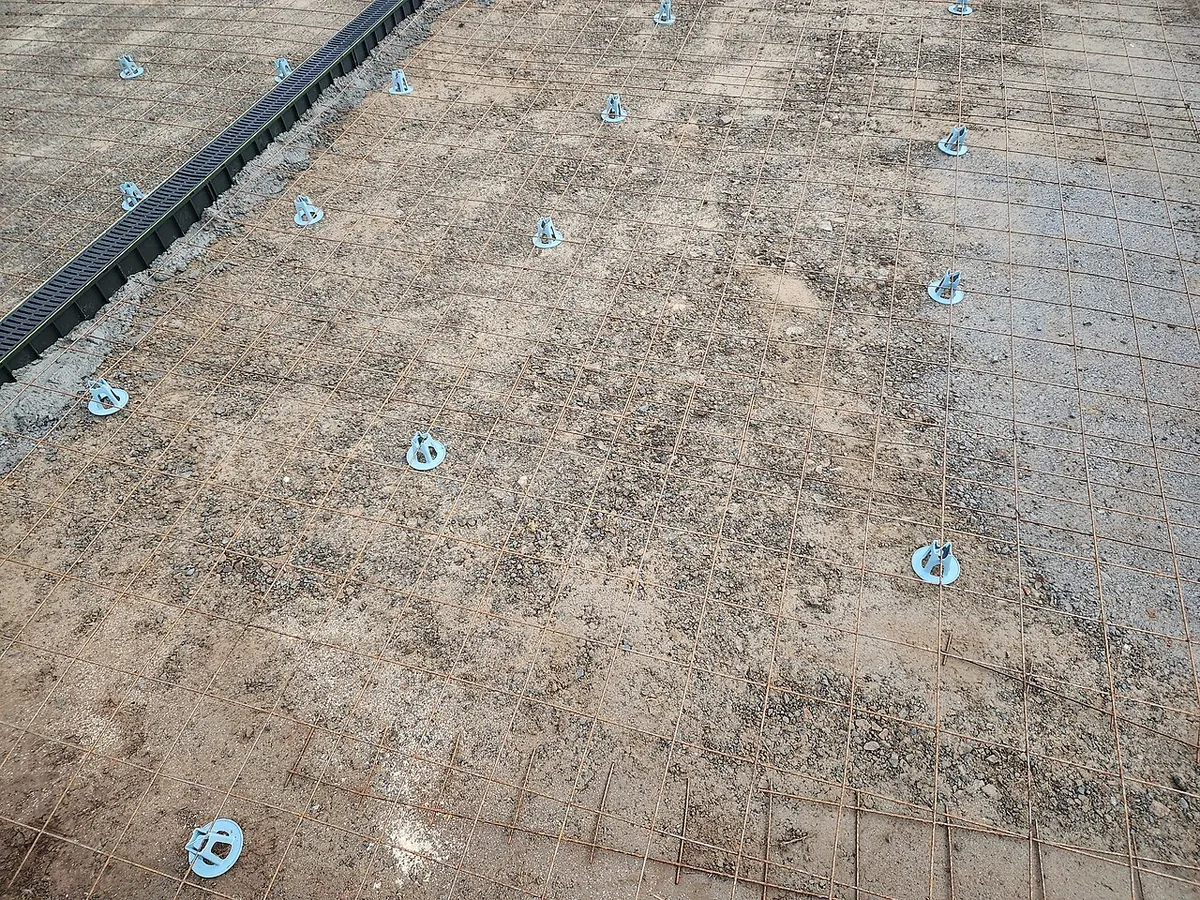
Photo: Panamitsu, Wikimedia Commons, CC BY-SA 4.0
5. Prestressed Concrete
Prestressed concrete uses high-strength steel strands tensioned to squeeze the concrete before it carries loads, which counteracts tension and allows longer, thinner members.
- Pre-tensioned: strands are stretched in a factory bed, concrete is cast around them, and the strands are released once the concrete is strong. Common in precast beams, hollow-core planks and bridge girders.
- Post-tensioned: tendons in ducts or sheathing are tensioned after the concrete hardens. Common in parking garages, high-rise floors and some residential slabs. Never cut or drill post-tensioned slabs without locating tendons; see how to cut concrete.
6. What Is Precast Concrete?
Precast concrete is concrete cast into reusable molds and cured in a controlled factory setting, then transported to the job site and installed, usually by crane. Because it is made in a plant, quality, finish and curing are well controlled, and production is not affected by weather.
Common precast products include steps, septic tanks, manholes, culverts, pipes, burial vaults, wall panels, hollow-core floor planks, bridge girders, parking garage double-tees, retaining wall blocks, pavers and barriers. Precast is the opposite of cast-in-place (site-cast) concrete, which is poured into forms where it will stay. Precast steps, for example, can be set in a day instead of building forms and waiting for concrete to cure; see concrete steps cost.
7. Ready-Mix Concrete
Concrete batched at a central plant to a specific mix design and delivered in a rotating drum truck. Most residential slabs, driveways and foundations use ready-mix. See how many yards of concrete are in a truck and concrete price per yard.
8. Lightweight Concrete
Made with lightweight aggregates such as expanded shale, clay or slate, structural lightweight concrete weighs roughly 90 to 115 pounds per cubic foot compared with about 145 to 150 for normal concrete. It reduces dead load in upper floors, roof decks and long-span structures, and improves fire resistance and insulation. Non-structural lightweight concretes, such as cellular or foamed concrete, are even lighter.
9. Air-Entrained Concrete
Concrete with an air-entraining admixture that creates tiny, evenly spaced bubbles, typically 4 to 7% of volume. The bubbles protect against freeze-thaw damage and deicing salts. Exterior slabs and driveways in cold climates should almost always be air-entrained. See does salt damage concrete.
10. Pervious Concrete
Made with little or no sand, pervious concrete has connected voids that let water pass straight through to the ground. It reduces runoff and is used for parking lots, paths and some driveways in stormwater-sensitive areas. It needs a proper stone base and periodic vacuuming to prevent clogging.
11. Shotcrete and Gunite (Sprayed Concrete)
Sprayed concrete is pneumatically projected at high speed onto a surface, compacting itself as it hits. It is used for pools, tunnels, slope stabilization, retaining walls, domes and repairs. There are two processes:
- Shotcrete (wet-mix): fully mixed concrete is pumped through a hose and sprayed with compressed air at the nozzle.
- Gunite (dry-mix): dry cement and sand are blown through the hose, and water is added at the nozzle. The nozzle operator controls the water.
Gunite vs concrete
Gunite is not an alternative to concrete; it is a type of concrete placed by spraying. Compared with conventional cast-in-place concrete:
| Factor | Gunite (dry-mix sprayed) | Cast-in-place concrete |
|---|---|---|
| Placement | Sprayed onto a surface, no inner form needed | Poured into forms |
| Shapes | Free-form curves, pools, slopes | Mostly flat or formed shapes |
| Water control | Added at nozzle by operator | Set at the plant |
| Rebound waste | Some material bounces off | Minimal |
| Strength | Can be high when done well | As specified |
| Skill dependence | Very high (nozzle operator) | Moderate |
For in-ground pools, gunite and shotcrete are the two main shell methods. Both can make excellent pools; quality depends heavily on the crew, curing and design.
12. Decorative Concrete
Concrete finished or colored for appearance: stamped, stained, colored, exposed aggregate, polished and overlays. See stamped concrete vs pavers, polished concrete cost and types of concrete finishes.
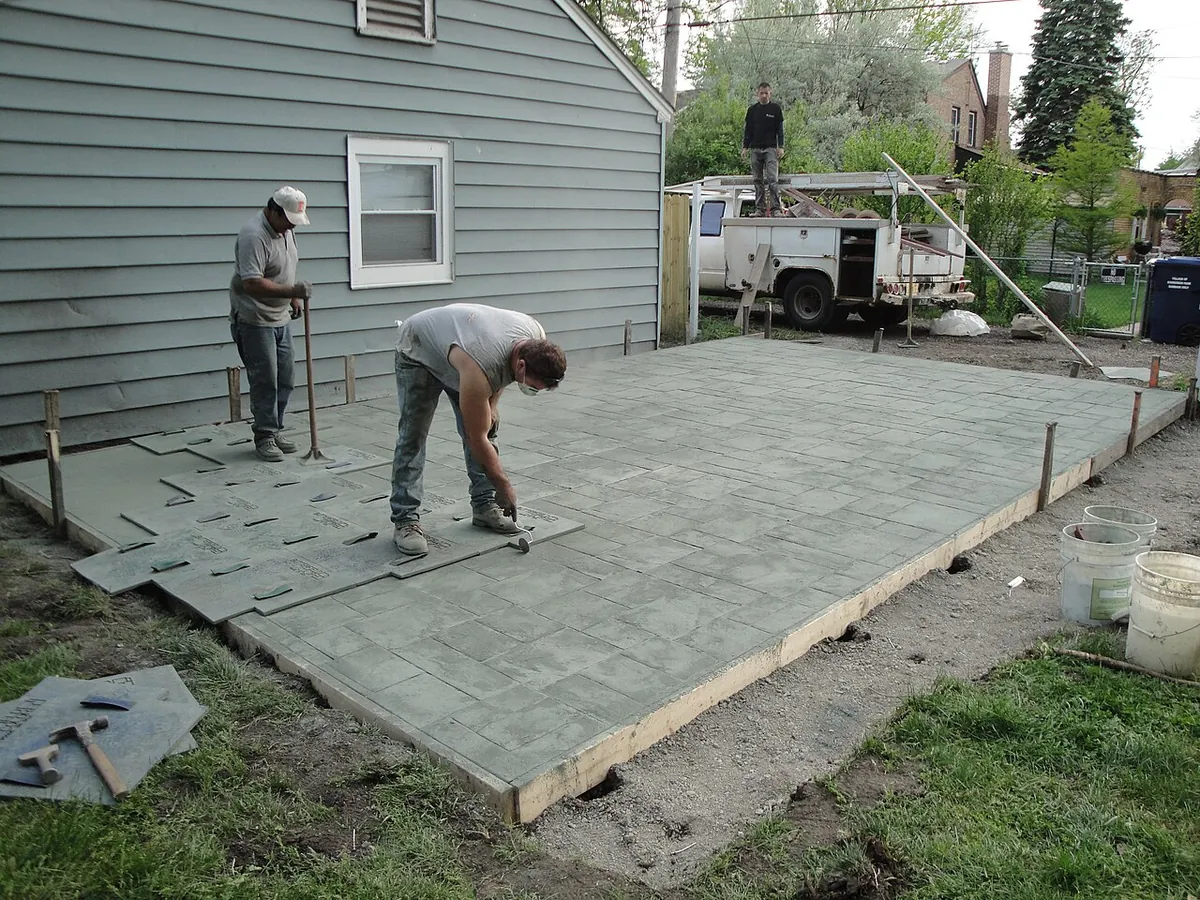
Photo: ChicagoConcrete, Wikimedia Commons, CC BY-SA 3.0
13. Self-Consolidating Concrete (SCC)
A very fluid concrete that flows into forms and around dense reinforcement under its own weight, without vibration, and without separating. It uses superplasticizers and viscosity-modifying admixtures. SCC is common in precast plants and in heavily reinforced walls and columns, and it is often part of a high performance concrete specification because it improves surface finish and placement quality.
14. Rapid-Set and High-Early-Strength Concrete
Concrete that reaches usable strength in hours instead of days, using Type III cement, accelerators or special calcium sulfoaluminate cements. Used for highway repairs, airport pavements and fence posts set from a bag. Fast-setting bagged mixes let you set a post without bracing in minutes; see how much a bag of concrete costs.
15. Fiber-Reinforced Concrete
Concrete with short fibers of steel, glass, synthetic polymer or natural material mixed in. Synthetic microfibers mainly control plastic shrinkage cracking in slabs. Steel and macro-synthetic fibers can replace some reinforcement in industrial floors and shotcrete. Glass-fiber reinforced concrete (GFRC) is a thin, strong material used for decorative panels, countertops and facades; see concrete countertops.
16. Roller-Compacted Concrete (RCC)
A very stiff, zero-slump concrete placed with asphalt pavers or spreaders and compacted with rollers. It is fast and economical for heavy-duty pavements such as ports, distribution yards and some roads, and for dams.
17. Mass Concrete
Any large volume of concrete, such as dams, thick foundations and bridge piers, where heat from cement hydration must be controlled to prevent thermal cracking. Mixes use low-heat cement, fly ash or slag, and sometimes cooling pipes or chilled water.
18. Heavyweight Concrete
Made with dense aggregates like barite or iron ore, heavyweight concrete can weigh well above normal concrete. It is used for radiation shielding in hospitals and nuclear facilities and for counterweights.
19. Polymer Concrete
Uses a polymer resin binder, such as epoxy or polyester, instead of portland cement. It cures quickly, resists chemicals and is used for drains, trench covers, overlays and repairs. See concrete overlay cost.
A Note on "Asphalt Concrete"
Asphalt concrete, also called asphaltic concrete or blacktop, uses asphalt binder instead of cement. It is a different material from portland cement concrete, though both use aggregate. See asphaltic concrete and asphalt vs concrete driveway cost.
Precast vs Cast-in-Place Concrete
| Factor | Precast concrete | Cast-in-place concrete |
|---|---|---|
| Where it is made | Factory, controlled conditions | On site, in forms |
| Weather | Little effect on production | Rain, heat and cold affect pours |
| Speed on site | Fast installation | Forming, pouring and curing time |
| Quality control | High, consistent | Depends on crew and conditions |
| Transport | Limited by size and weight; needs cranes | No transport of finished pieces |
| Shapes and connections | Joints between pieces | Monolithic, continuous |
| Best for | Repeated units: steps, vaults, panels, beams | Slabs, driveways, custom foundations |
Where High Performance Concrete Is Used
- Bridge decks and girders: low permeability slows chloride penetration from deicing salts and extends service life.
- Marine structures: piers, seawalls and docks exposed to seawater.
- Parking garages: salt-laden water from cars attacks normal concrete and rebar.
- High-rise buildings: high strength and stiffness for columns and cores.
- Tunnels and underground structures: durability and low permeability.
- Pavements that must reopen fast: high early strength.
For most homeowners, high performance concrete is not necessary. A well-designed normal-strength mix with the right water-cement ratio, air entrainment and good curing gives excellent results for driveways and patios. But the principles behind the definition of high performance concrete, such as low water content, good curing and durable ingredients, apply to every slab.
Which Type of Concrete Do You Need?
| Project | Typical type |
|---|---|
| Patio, sidewalk | Normal-strength ready-mix, air-entrained in cold climates, with fibers |
| Driveway | 3,000–4,000 psi ready-mix, air-entrained; reinforced |
| House foundation | Normal-strength reinforced cast-in-place |
| Fence and deck posts | Fast-setting bagged mix |
| Steps | Precast or cast-in-place reinforced |
| Pool shell | Gunite or shotcrete |
| Countertops | GFRC or countertop mix |
| Stormwater-friendly paving | Pervious concrete |
| Bridge deck, parking garage | High performance concrete |
See concrete driveway cost and concrete slab cost for prices on common residential types.
Choosing the Right Type: Questions to Ask
When you talk to a ready-mix supplier or contractor, these questions help you land on the right type of concrete for your project:
- What loads will it carry? Foot traffic, cars, trucks or a building? Heavier loads need thicker slabs, more reinforcement or higher strength.
- What exposure will it face? Freezing and thawing, deicing salts, seawater or sulfate soils call for air entrainment, a lower water-cement ratio and sometimes special cements.
- How fast do you need it? Rapid-set or high-early-strength mixes cost more but let you use the concrete sooner.
- How will it be placed? Chute, pump, wheelbarrow or spray? Pumped concrete often needs smaller stone and a pump-friendly mix.
- What finish do you want? Broom, smooth, stamped, colored or exposed aggregate may change the mix, such as adding color or choosing a decorative stone.
- Is speed on site more important than material cost? If so, precast may make sense.
- Are there drainage rules? Some areas encourage or require pervious paving to reduce runoff.
For the vast majority of driveways, patios and sidewalks, the answer is a well-proportioned, air-entrained, normal-strength ready-mix with fibers or reinforcement, placed and cured properly. Exotic types are tools for special problems, not upgrades that every home project needs or benefits from.
Common Misunderstandings
- "High performance concrete just means strong concrete." Strength is only one possible requirement; durability, workability and early strength count too.
- "Gunite is weaker than concrete." Properly placed and cured gunite can reach high strength; quality depends on the crew.
- "Precast is cheap concrete." Precast is often higher quality than site-cast because of factory control.
- "Cement and concrete are types of each other." Cement is an ingredient, not a type of concrete; see what concrete is made of.
How Concrete Types Changed Over Time
For most of the 1900s, concrete was mainly a matter of cement, sand, stone and water, with strength set by how much cement went in. Air entrainment arrived in the 1930s and 1940s and transformed pavements in cold climates. Water-reducing admixtures followed, then superplasticizers in the 1970s, which made very low water-cement ratios workable and opened the door to high-strength concrete. Fly ash, slag and silica fume became common ingredients for durability. By the 1990s, engineers and agencies such as the Federal Highway Administration were promoting high performance concrete for bridges, and the definition of high performance concrete shifted the focus from strength alone to long-term performance. Self-consolidating concrete and ultra-high performance concrete came next. Today, lower-carbon blended cements like portland-limestone cement are changing everyday ready-mix too.
For homeowners, the practical result is that even ordinary concrete today can be more durable than it was a generation ago, if the mix is ordered correctly, placed with care and cured well for at least the first week.
Knowing the main types of concrete makes it easier to read a quote, talk with a contractor or supplier, and spot when a bid uses the wrong mix for the job. If a quote does not list strength, air content and slump for an outdoor slab, ask for them. Those three numbers tell you most of what you need to know about the concrete you are buying, and they cost nothing to request.
Frequently Asked Questions
What is the definition of high performance concrete?
Per ACI, concrete meeting special combinations of performance and uniformity requirements that cannot always be achieved routinely with conventional materials and normal practices.
What is precast concrete?
Concrete cast and cured in factory molds, then delivered and installed on site, such as steps, vaults, panels and beams.
What is the difference between gunite and concrete?
Gunite is concrete placed by spraying a dry mix, with water added at the nozzle. Regular concrete is premixed and poured into forms.
What is the strongest type of concrete?
Ultra-high performance concrete, with compressive strengths often above about 20,000 psi.
What type of concrete is used for driveways?
Normal-strength ready-mix, typically 3,000 to 4,000 psi, air-entrained in cold climates.
Is shotcrete the same as gunite?
Both are sprayed concrete. Shotcrete usually means wet-mix; gunite means dry-mix with water added at the nozzle.
Is high performance concrete the same as high-strength concrete?
No. High-strength concrete is defined by strength. High performance concrete is defined by meeting special performance needs, which may include durability, early strength or workability, not only strength.
Is precast concrete stronger than poured concrete?
Often it is more consistent because it is made and cured in a factory, but both can be designed to the same strength.
Which is better for a pool, gunite or shotcrete?
Both make strong pool shells. Quality depends more on the crew, rebound control and curing than on the method.
How many types of concrete are there?
There is no fixed number. Concrete is classified by strength, weight, ingredients, reinforcement, placement method and finish, giving dozens of types.
Sources
- American Concrete Institute, Concrete Terminology (definition of high performance concrete). concrete.org
- ACI Committee 363, high-strength concrete (8,000 psi and above).
- Federal Highway Administration, high performance concrete and UHPC programs. highways.dot.gov
- Portland Cement Association, concrete types and air entrainment. cement.org
- Image credits: placement photo U.S. Army (public domain); reinforcement photo by Panamitsu (CC BY-SA 4.0); stamping photo by ChicagoConcrete (CC BY-SA 3.0), all Wikimedia Commons; chart by Asphapro.com.
Checked November 2026.
Related Guides
- What is concrete made of? — cement, water, sand, gravel and air
- Types of concrete finishes — broom, trowel, stamped, polished