
Density of Concrete, Concrete Modulus of Elasticity, and Is Concrete a Rock?
Quick Answer
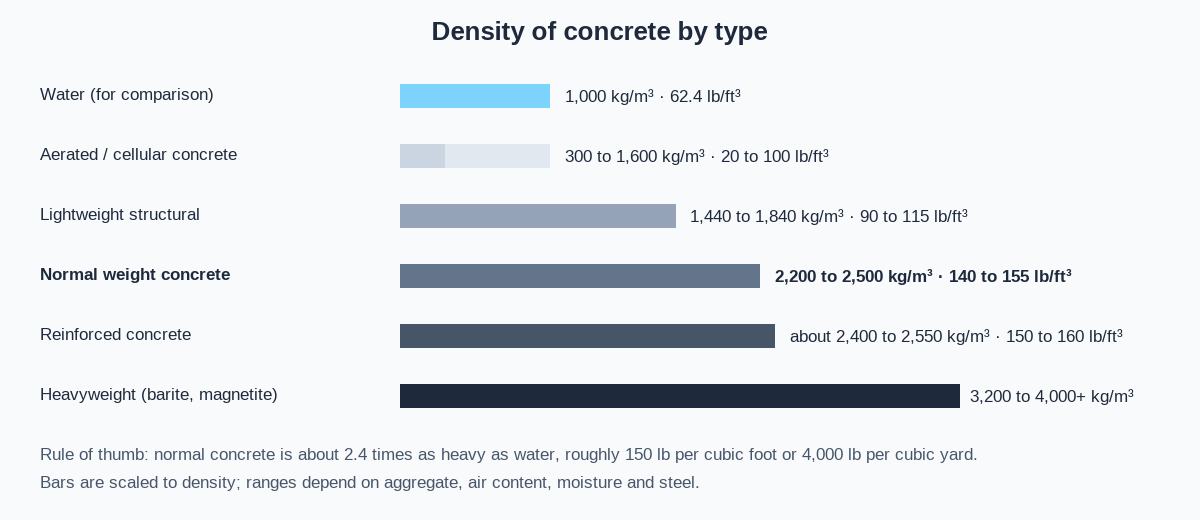
The density of concrete for ordinary normal weight concrete is about 2,400 kg/m³ (150 lb/ft³), with a typical range of 2,200 to 2,500 kg/m³ (140 to 155 lb/ft³). Reinforced concrete is a little heavier, about 2,500 kg/m³ (155 to 160 lb/ft³). Lightweight structural concrete is about 1,440 to 1,840 kg/m³ (90 to 115 lb/ft³), aerated concrete can be as light as 300 kg/m³, and heavyweight concrete for radiation shielding reaches 3,200 to 4,000+ kg/m³. The modulus of elasticity of concrete, its stiffness, is commonly estimated as Ec = 57,000 √f'c psi (or 4,700 √f'c MPa), about 3.6 million psi (25 GPa) for 4,000 psi concrete. And is concrete a rock? Not a natural one, but it is often described as an artificial rock, very similar to a conglomerate.
Whether you are designing a footing, ordering concrete, estimating the weight of a slab on a truck, checking whether a deck can carry a hot tub, or studying for an engineering exam, the density of concrete is one of the most useful numbers to know. Closely related is the concrete modulus of elasticity, which tells engineers how much concrete deflects and shortens under load. This guide explains both, with values in metric and US units, how they are measured, what changes them, and how they are used. It also answers a question that comes up surprisingly often: is concrete a rock?
What Is the Density of Concrete?
Density is mass per unit volume. For concrete, it is usually given in kilograms per cubic meter (kg/m³) or pounds per cubic foot (lb/ft³, also written pcf). In the concrete industry, density is often called unit weight, and for fresh concrete it is measured on site to check that the mix is correct. The density of concrete depends mostly on the aggregates, which make up 60 to 75 percent of its volume, and on the amount of air and water in the mix.
The chart above shows typical ranges. Normal weight concrete, made with ordinary sand, gravel or crushed stone, has a density of about 2,200 to 2,500 kg/m³, with 2,400 kg/m³ (150 lb/ft³) the standard design value in most codes and textbooks. That makes concrete about 2.4 times as dense as water. In practical terms, one cubic foot of normal concrete weighs about 150 pounds, one cubic yard about 4,000 pounds (2 tons), and one cubic meter about 2.4 metric tonnes. See how much does a yard of concrete weigh.
Density of Concrete by Type
| Type of concrete | Density (kg/m³) | Density (lb/ft³) | Typical uses |
|---|---|---|---|
| Aerated or cellular concrete | 300 to 1,600 | 20 to 100 | Blocks, insulation, fill |
| Lightweight structural concrete | 1,440 to 1,840 | 90 to 115 | Upper floors, bridge decks, precast |
| Normal weight concrete (plain) | 2,200 to 2,500 | 140 to 155 | Slabs, foundations, walls, paving |
| Reinforced concrete | 2,400 to 2,550 | 150 to 160 | Beams, columns, structural members |
| High-strength concrete | 2,400 to 2,600 | 150 to 162 | Tall buildings, bridges |
| Heavyweight concrete | 3,200 to 4,000+ | 200 to 250+ | Radiation shielding, counterweights |
Normal weight concrete. Most concrete in driveways, slabs, foundations and walls is normal weight. Its density varies with the rock used: limestone and granite aggregates give slightly different values, and dense trap rock gives higher ones. For general calculations, 150 lb/ft³ or 2,400 kg/m³ is used.
Reinforced concrete. Steel is about 7,850 kg/m³, more than three times as dense as concrete. Typical reinforcement adds 50 to 150 kg/m³, so engineers commonly use 2,500 kg/m³ (25 kN/m³) or about 155 to 160 lb/ft³ for the self-weight of reinforced concrete. See rebar in concrete.
Lightweight concrete. Made with lightweight aggregates such as expanded shale, clay or slate, pumice or cinders, lightweight structural concrete reduces the dead load of floors and decks by about 20 to 35 percent while still reaching good strength. Insulating lightweight concretes and aerated concretes, which contain large amounts of air, are lighter still but much weaker. See lightweight concrete.
Heavyweight concrete. Made with dense aggregates such as barite, magnetite, hematite or steel shot, heavyweight concrete is used to shield against radiation in hospitals and nuclear facilities, and for counterweights and ballast.
Fresh vs Hardened Concrete Density
Fresh concrete and hardened concrete have slightly different densities. Fresh concrete contains all its mixing water. As concrete hardens and dries, some water evaporates, so air-dry hardened concrete is typically 1 to 3 percent lighter than when it was placed. The density of fresh concrete is measured on site using ASTM C138, the unit weight test: a calibrated container of known volume is filled with concrete in layers, rodded or vibrated, struck off level and weighed. The result is compared with the mix design to check the yield (whether the truck delivered the volume ordered) and the air content. Hardened concrete density is measured on cores or cylinders by weighing them and determining their volume, per standards such as ASTM C642. See concrete cylinder test and concrete slump.
What Affects the Density of Concrete?
Aggregate type. The biggest factor in the density of concrete. Dense rock makes dense concrete; lightweight and porous aggregates make lighter concrete. See concrete aggregate.
Air content. Air-entrained concrete, used for freeze-thaw resistance, typically contains 4 to 8 percent air, which lowers density by roughly the same percentage compared with non-air-entrained concrete. See concrete admixtures.
Water content. More water makes concrete slightly less dense once it dries, because the extra water evaporates and leaves tiny pores behind. It also lowers strength.
Cement and mix proportions. Cement is denser than water but less dense than most rock aggregates, so mixes with more paste and less stone are slightly lighter. See concrete mix ratio.
Compaction. Poorly consolidated concrete with honeycombing and voids is less dense and weaker. Vibration removes trapped air and increases density. See concrete vibrator and honeycombing in concrete.
Moisture. Saturated concrete is heavier than oven-dry concrete by a few percent, so the density of concrete measured on a wet core in a lab can differ slightly from the value of the same concrete in a dry building.
Reinforcement. Steel bars, mesh and fibers increase the overall density of concrete members, which is why reinforced concrete is assigned a higher design value than plain concrete.
How Density of Concrete Is Used
Weight and load calculations. Engineers use the density of concrete to calculate the dead load of slabs, beams, walls and columns, which is often the largest load on a structure. A 6 inch slab of normal concrete weighs about 75 pounds per square foot (150 lb/ft³ × 0.5 ft); a 200 mm slab weighs about 4.8 kN/m².
Ordering and yield. Ready-mix plants batch concrete by weight. Measuring the fresh density lets the plant and the contractor confirm that a truckload of 10 cubic yards really is 10 cubic yards. See how many yards of concrete in a truck.
Transport and lifting. Knowing the weight of precast elements, such as steps, vaults, barriers and panels, is essential for choosing cranes, trucks and rigging. See precast concrete.
Shielding and ballast. For radiation shielding, a specified minimum density ensures enough mass to absorb radiation. For buoyancy control of pipelines and tanks, density determines how much concrete is needed to keep them from floating.
Quick estimates. Multiply the volume by the density. A 10 × 10 foot slab 4 inches thick contains 33.3 cubic feet and weighs about 5,000 pounds. See how to calculate yards of concrete and volume calculator.
Worked Examples Using the Density of Concrete
Weight of a driveway slab. A driveway 20 feet wide, 40 feet long and 4 inches thick contains 20 × 40 × 0.333 = 267 cubic feet of concrete, or about 9.9 cubic yards. Using a density of concrete of 150 lb/ft³, it weighs about 40,000 pounds, or 20 tons. That is why demolition of even a small driveway fills several dump trucks. See concrete removal cost.
Weight of a precast step. A precast concrete step unit with 9 cubic feet of solid concrete weighs about 9 × 150 = 1,350 pounds, which explains why steps are delivered by a truck with a boom. See precast concrete steps.
Load of a slab on a floor. A 2 inch topping slab of normal concrete adds 150 × 2/12 = 25 pounds per square foot to a floor. On a wood-framed floor designed for about 10 pounds per square foot of dead load, that is a major addition and must be checked by an engineer. Lightweight concrete at 110 lb/ft³ would add about 18 pounds per square foot instead.
Metric example. A reinforced concrete beam 300 mm wide, 600 mm deep and 6 m long has a volume of 0.3 × 0.6 × 6 = 1.08 m³. At 25 kN/m³, its self-weight is 27 kN, or about 4.5 kN per meter of length, which the engineer adds to the floor loads the beam carries. See concrete beams and concrete columns.
Density of Concrete vs Other Building Materials
Comparing the density of concrete with other materials helps put it in context. Water is 1,000 kg/m³ (62.4 lb/ft³). Softwood lumber is about 400 to 600 kg/m³, so concrete is roughly four to six times heavier than wood. Brick is about 1,800 to 2,000 kg/m³. Asphalt pavement is about 2,240 to 2,400 kg/m³, very similar to concrete. Glass is about 2,500 kg/m³. Aluminum is about 2,700 kg/m³, close to granite. Steel is about 7,850 kg/m³, more than three times the density of concrete. Gravel and crushed stone in a loose pile are lighter than solid rock, about 1,500 to 1,800 kg/m³, because of the voids between pieces, and dry sand is similar. See asphalt weight per cubic yard and gravel calculator.
Density of Concrete Blocks and Products
Concrete masonry units are classified by the density of the concrete they are made from. Under ASTM C90, lightweight blocks have a concrete density below 105 lb/ft³, medium weight blocks 105 to 125 lb/ft³, and normal weight blocks 125 lb/ft³ or more. Because blocks are hollow, an 8 × 8 × 16 inch normal weight block weighs about 35 to 40 pounds, while a lightweight block of the same size weighs about 25 to 30 pounds. Autoclaved aerated concrete blocks are much lighter, around 30 to 50 lb/ft³, and can be cut with a hand saw. Pavers, which must resist traffic and freeze-thaw, are made from dense, low-absorption concrete, typically 140 lb/ft³ or more. Precast products such as pipes, vaults and barriers are usually made from dense, high-strength normal weight concrete. See how much does a concrete block weigh and concrete masonry unit.
Density of Concrete in Design Codes
Building codes give standard values for the density of concrete to use in design when the actual mix is not known. In the US, ASCE 7 lists plain normal weight concrete at about 145 lb/ft³ and reinforced concrete at about 150 lb/ft³ for dead load calculations, and ACI 318 defines normal weight concrete as roughly 135 to 160 lb/ft³ and lightweight concrete as 90 to 115 lb/ft³ for structural use. In Europe, Eurocode 1 uses 24 kN/m³ for normal weight concrete and adds 1 kN/m³ for reinforced or prestressed concrete, giving 25 kN/m³, and 1 kN/m³ more for fresh concrete. Eurocode 2 defines lightweight concrete as having a density of 800 to 2,000 kg/m³. Engineers use measured densities instead when a specific lightweight or heavyweight mix is specified.
Modulus of Elasticity of Concrete
The modulus of elasticity of concrete, also called Young's modulus or the elastic modulus and written Ec, measures how stiff concrete is: how much it shortens or stretches under a given stress while it behaves elastically. A higher modulus means a stiffer material that deflects less. Engineers use the concrete modulus of elasticity to calculate deflection of beams and slabs, shortening of columns, the share of load carried by steel and concrete in reinforced members, cracking, and the behavior of prestressed concrete.
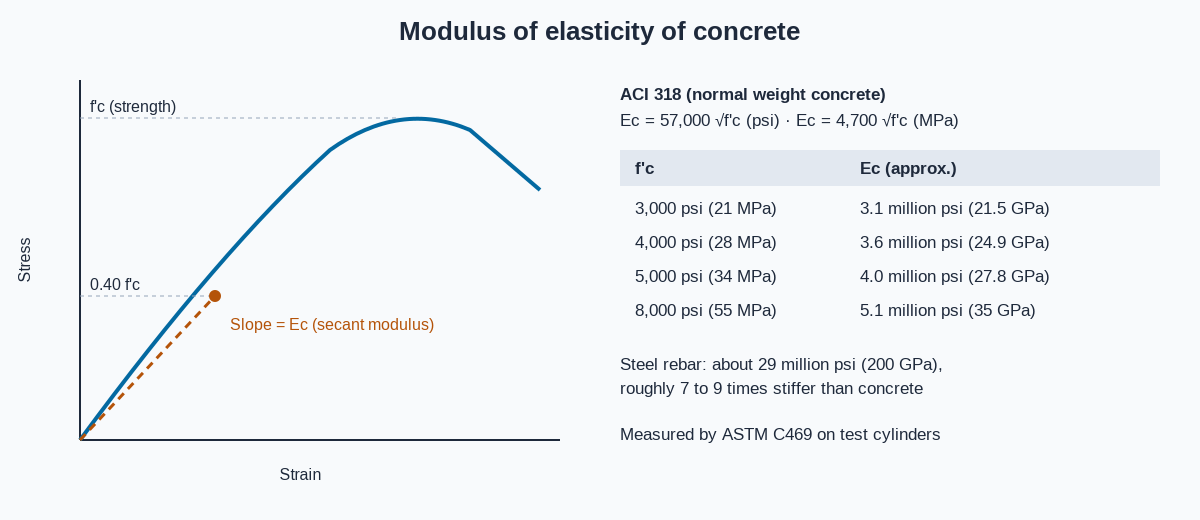
Concrete is not perfectly elastic. As the stress-strain curve in the diagram shows, the curve bends even at moderate stresses as microcracks develop. For that reason, the modulus of elasticity of concrete is usually defined as the secant modulus: the slope of a line from the origin to the point at 40 percent of the concrete's compressive strength. This is the value measured in the standard test, ASTM C469, on cylinders loaded in compression with strain gauges or a compressometer.
Formulas for the concrete modulus of elasticity
Because testing every mix is not practical, design codes give formulas based on compressive strength and density. In the US, ACI 318 gives:
- Ec = wc1.5 × 33 × √f'c (psi), where wc is the density of concrete in lb/ft³, valid for densities from 90 to 160 lb/ft³.
- Ec = 57,000 × √f'c (psi) for normal weight concrete.
- In SI units: Ec = 4,700 × √f'c (MPa) for normal weight concrete, or Ec = wc1.5 × 0.043 × √f'c with wc in kg/m³.
Eurocode 2 uses a different relationship, Ecm = 22 × (fcm/10)0.3 in GPa, where fcm is the mean compressive strength in MPa, giving similar values. All these formulas show that the modulus of elasticity of concrete rises with strength and with density: lightweight concrete is noticeably less stiff than normal weight concrete of the same strength.
Typical values
Using the ACI formula, the concrete modulus of elasticity is about 3.1 million psi (21.5 GPa) for 3,000 psi concrete, 3.6 million psi (24.9 GPa) for 4,000 psi concrete, 4.0 million psi (27.8 GPa) for 5,000 psi concrete, and about 5.1 million psi (35 GPa) for 8,000 psi high-strength concrete. For comparison, reinforcing steel has a modulus of about 29 million psi (200 GPa), so steel is roughly 7 to 9 times stiffer than concrete. This ratio, called the modular ratio n = Es/Ec, is used in the design of reinforced concrete. Wood is much less stiff, around 1.5 to 2 million psi, and aluminum about 10 million psi. See high-strength concrete.
What affects the modulus of elasticity of concrete?
The stiffness of the aggregate has a large effect: concrete made with stiff, dense rock such as basalt or trap rock has a higher modulus than concrete made with softer limestone or sandstone, even at the same strength. The amount of paste matters too, since cement paste is much less stiff than rock; mixes with more paste have a lower modulus. Age, curing, moisture content and temperature also play a role: the modulus increases as concrete gains strength, and moist concrete is slightly stiffer than dry. Under long-term load, concrete creeps, continuing to deform over months and years, so engineers use a reduced effective modulus for long-term deflection calculations. Poisson's ratio for concrete, the ratio of sideways expansion to lengthwise shortening, is typically 0.15 to 0.20.
Is Concrete a Rock?
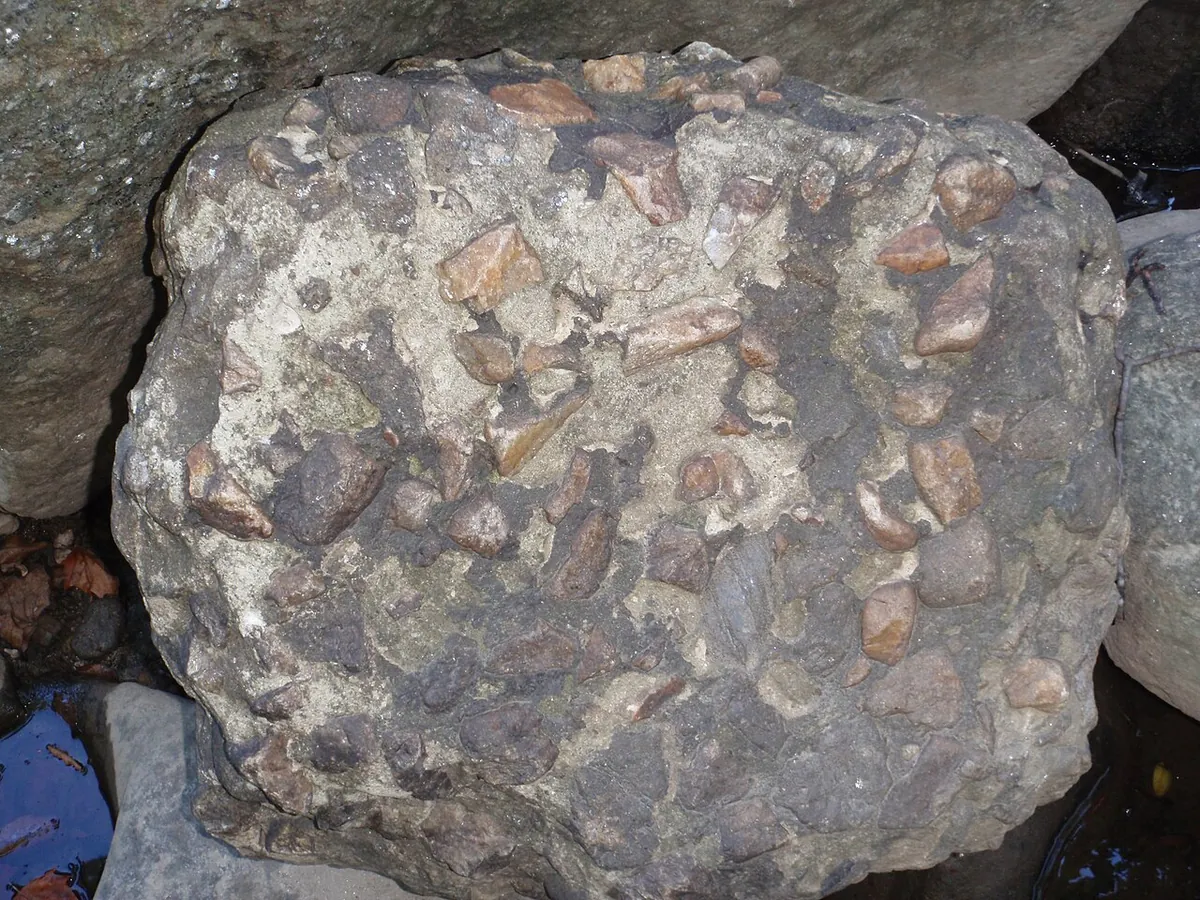
Photo: ZeWrestler, Wikimedia Commons, CC BY 3.0
Strictly speaking, no. In geology, a rock is a naturally formed solid made of minerals or mineral-like material. Concrete is made by people, so it is not a natural rock. But it behaves like one and is made of one. Most of concrete's volume is natural rock in the form of gravel, crushed stone and sand, held together by hardened cement paste, which is itself made of calcium silicate hydrate and other mineral compounds similar to those found in nature. The result closely resembles a natural sedimentary rock called conglomerate, like the boulder in the photo above: rounded pebbles cemented together in a finer matrix. Geologists sometimes call concrete an anthropogenic rock or artificial stone, and some old concrete structures have been studied alongside natural rocks for how they weather.
The density of concrete is also in the same range as many common rocks. Sandstone is typically 2,200 to 2,600 kg/m³, limestone 2,300 to 2,700 kg/m³, and granite 2,600 to 2,750 kg/m³, compared with about 2,400 kg/m³ for normal concrete. Concrete is weaker in tension than most solid rock and more porous, but in compression ordinary concrete is comparable to softer sedimentary rocks, and high-strength concrete approaches the strength of granite.
The phrases concrete rock and rock concrete are used in other ways too. In the trades, concrete rock often means the gravel or crushed stone used as concrete aggregate, also called concrete rock or concrete stone at supply yards. Crushed concrete rock means recycled concrete broken into gravel-sized pieces for road base and fill. And rock concrete sometimes describes concrete with large stones exposed at the surface, or rubble concrete with big rocks embedded in it, used in old walls, dams and foundations. See crushed concrete, exposed aggregate concrete and what is concrete made of.
Concrete and Rock: Key Differences
Comparing concrete and rock side by side helps explain how concrete behaves. Natural rock forms over thousands or millions of years under heat and pressure, so its minerals are well bonded and it can be very dense and strong. Concrete forms in hours to weeks through the chemical reaction of cement and water, called hydration, and keeps gaining strength slowly for years. Concrete has more pores than most solid rock, which is why it absorbs water and is vulnerable to freeze-thaw damage, salt and chemical attack unless it is well made, air-entrained and sealed. Concrete also shrinks as it dries, which causes cracking that natural rock does not have. On the other hand, concrete can be shaped into any form, reinforced with steel to carry tension, and produced almost anywhere from local materials, which no natural rock can match. See why does concrete crack and how long does concrete last.
Specific Gravity and Related Properties
Specific gravity is the ratio of a material's density to the density of water. For normal concrete it is about 2.3 to 2.5. The specific gravity of the individual ingredients is used in mix design: portland cement is about 3.15, most natural sand and gravel 2.6 to 2.7, and water 1.0. Mix designers use these values in the absolute volume method to work out how much of each ingredient fills one cubic yard or cubic meter. Other properties related to the density of concrete include thermal mass (denser concrete stores more heat), sound insulation (denser walls block more noise), and thermal conductivity (denser concrete conducts heat better, which is why lightweight concrete insulates better). Concrete's coefficient of thermal expansion is about 5.5 × 10⁻⁶ per °F (10 × 10-6 per °C), close to that of steel, which is one reason reinforced concrete works so well.
Unit Conversions for Concrete Density
- 1 lb/ft³ = 16.018 kg/m³
- 150 lb/ft³ = 2,403 kg/m³ = 4,050 lb per cubic yard
- 2,400 kg/m³ = 23.5 kN/m³ (using 9.81 m/s²); 2,500 kg/m³ = 24.5 kN/m³, often rounded to 25 kN/m³ for reinforced concrete
- 1 cubic yard = 27 cubic feet = 0.765 cubic meters
- 1 cubic meter of normal concrete ≈ 2.4 metric tonnes ≈ 5,290 pounds
See cubic yard calculator and how many bags of concrete in a yard.
Frequently Asked Questions
What is the density of concrete in kg/m³?
About 2,400 kg/m³ for normal weight concrete, with a range of 2,200 to 2,500 kg/m³. Reinforced concrete is usually taken as 2,500 kg/m³.
What is the density of concrete in lb/ft³?
About 150 lb/ft³ for normal weight concrete, or 145 to 155 lb/ft³ depending on aggregate and air content.
What is the modulus of elasticity of concrete?
Commonly estimated as 57,000 √f'c psi, about 3.6 million psi (25 GPa) for 4,000 psi concrete. It is measured by ASTM C469.
Is concrete heavier than rock?
Usually slightly lighter. Normal concrete is about 2,400 kg/m³, while granite is about 2,650 kg/m³ and limestone 2,300 to 2,700 kg/m³.
Is concrete a rock?
Not a natural rock, but an artificial one made mostly of natural rock aggregate bound by cement paste, much like a conglomerate.
Sources
- American Concrete Institute: ACI 318 building code, modulus of elasticity
- ASTM C138: density (unit weight), yield and air content of concrete
- ASTM C469: static modulus of elasticity and Poisson's ratio of concrete
- Portland Cement Association: Design and Control of Concrete Mixtures
- US Geological Survey: rock types and properties
Related Guides
- Concrete beam — beams, rebar and concrete details
- Concrete canoe — how a concrete boat floats and the ASCE competition