
Light Concrete: Light Weight Concrete Types, Weight, Strength and Uses
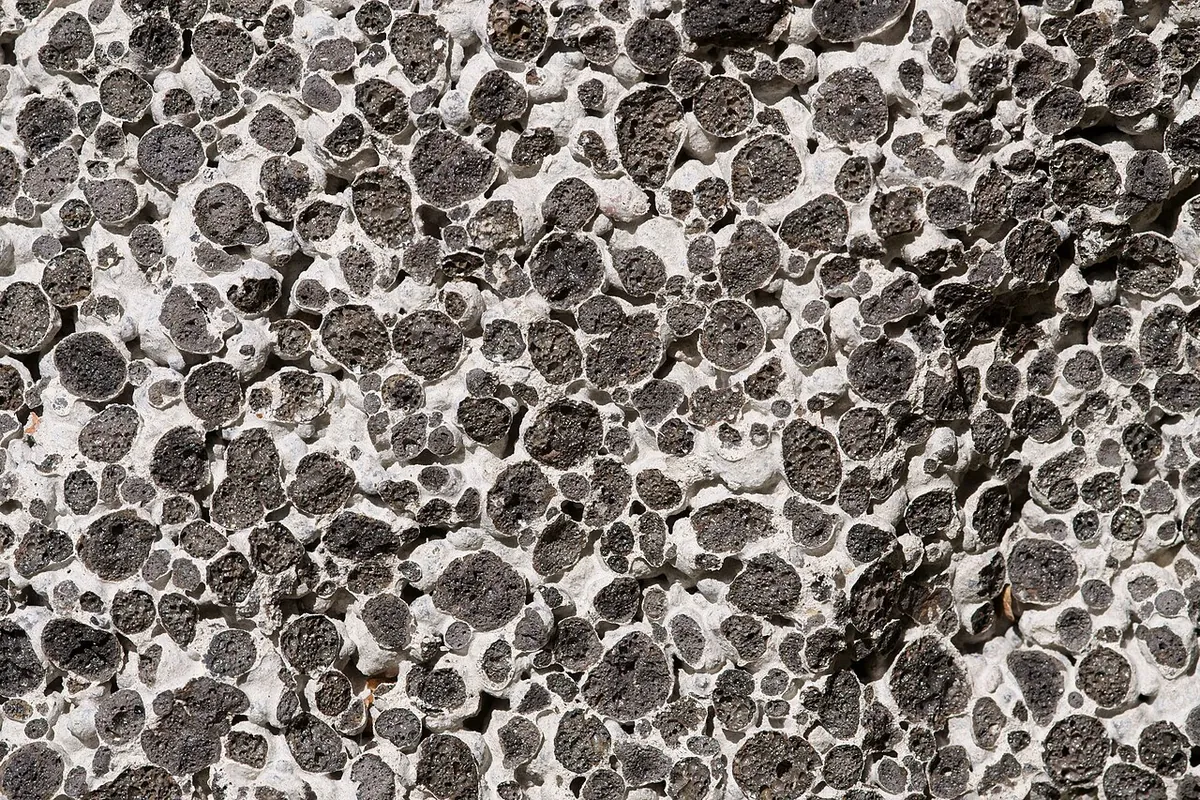
Photo: kallerna, Wikimedia Commons, CC BY-SA 3.0
Quick Answer
Light concrete, usually called lightweight concrete, is concrete that weighs noticeably less than ordinary concrete's 145 to 150 pounds per cubic foot. Structural light weight concrete uses expanded shale, clay or slate aggregate and weighs about 90 to 115 pounds per cubic foot while still reaching 3,000 to 5,000 psi or more; it is used for high-rise floors, bridge decks and precast. Insulating lightweight concrete, such as autoclaved aerated concrete (AAC), foam (cellular) concrete and perlite or vermiculite concrete, weighs as little as 20 to 60 pounds per cubic foot but is much weaker, and is used for blocks, roof fills, insulation and void filling. Lightweight concrete costs more per cubic yard than normal concrete but can save weight and structure.
Ordinary concrete is heavy. A cubic yard weighs about 4,000 pounds, a 4-inch slab about 50 pounds per square foot, and a tall building's floors add up to thousands of tons. Light concrete reduces that weight by replacing some of the dense stone with lighter materials or by filling the concrete with tiny air bubbles. Lighter concrete means smaller columns and foundations, longer spans, easier handling of precast pieces, and in many cases better insulation and fire resistance.
This guide explains what light concrete is, the main types of light weight concrete, how much each weighs and how strong it is, where lightweight concrete is used, its pros and cons, how to make simple lightweight mixes at home, and what it costs.
What Is Light Concrete?
Light concrete is any concrete with a density well below that of normal-weight concrete. Normal concrete made with sand and gravel or crushed stone weighs about 145 to 150 pounds per cubic foot (about 2,300 to 2,400 kilograms per cubic meter). Light weight concrete reaches lower densities in one of three ways:
- Lightweight aggregate: replacing some or all of the stone and sand with porous, lightweight particles such as expanded shale, clay, slate, pumice or perlite.
- Air or gas bubbles: creating millions of small closed bubbles in the cement paste, as in autoclaved aerated concrete and foam concrete.
- No-fines concrete: leaving out the sand so the coarse aggregate is bonded only at contact points, leaving open voids. It is light and drains freely.
The result ranges from structural light concrete that is nearly as strong as normal concrete to very light insulating materials that you can cut with a saw and that would never carry a heavy load.
Types of Light Weight Concrete
| Type | Density (lb/cu ft) | Typical strength | Main uses |
|---|---|---|---|
| Normal-weight concrete | 145–150 | 2,500–6,000+ psi | Most construction |
| Structural lightweight aggregate concrete | 90–115 | 3,000–6,000+ psi | High-rise floors, bridge decks, precast |
| Lightweight concrete block (CMU) | 85–105 (unit concrete) | Rated by block strength | Walls; lighter blocks to lift |
| Autoclaved aerated concrete (AAC) | 25–50 | 300–1,100 psi | Blocks and panels for walls and floors |
| Foam (cellular) concrete | 20–100 | 100–1,500 psi | Fill, roof decks, trench and void filling |
| Perlite or vermiculite concrete | 20–50 | Low | Insulating fills, fireproofing, planters |
| No-fines concrete | 100–125 | 500–2,500 psi | Drainage layers, pervious pavement |
Structural lightweight aggregate concrete
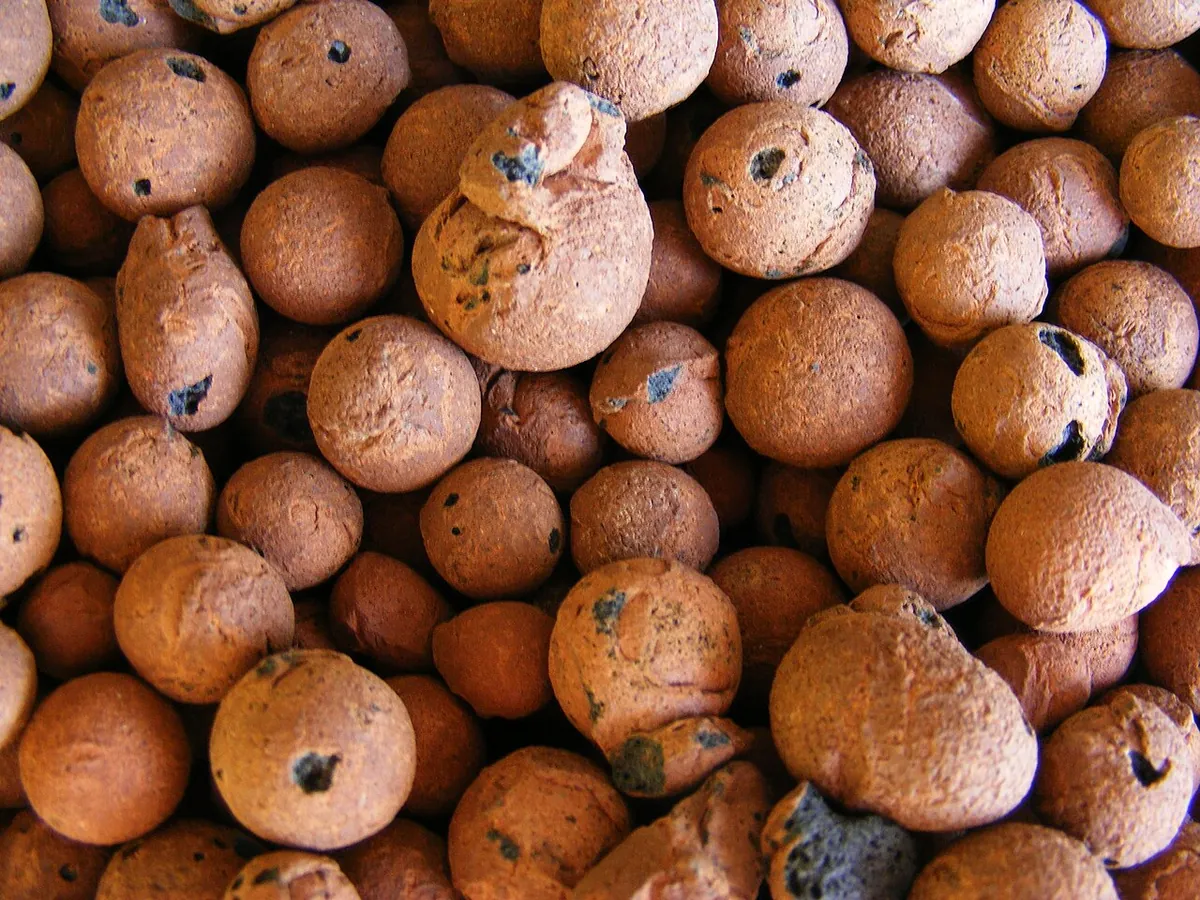
Photo: Lucis, Wikimedia Commons, CC BY-SA 3.0
The most important type of light concrete for buildings is made with expanded shale, clay or slate. These natural materials are crushed and heated in a rotary kiln to about 2,000°F, where gases inside them expand and form a honeycomb of tiny pores sealed by a hard ceramic shell. The resulting aggregate weighs about half as much as ordinary stone but is strong enough to make concrete of 3,000 to 6,000 psi or more. ASTM C330 covers lightweight aggregates for structural concrete, and the American Concrete Institute's ACI 213 guide describes structural lightweight aggregate concrete as having an equilibrium density of roughly 90 to 115 pounds per cubic foot. Many mixes use lightweight coarse aggregate with normal sand, sometimes called sand-lightweight concrete, at around 110 to 115 pounds per cubic foot.
Autoclaved aerated concrete (AAC)
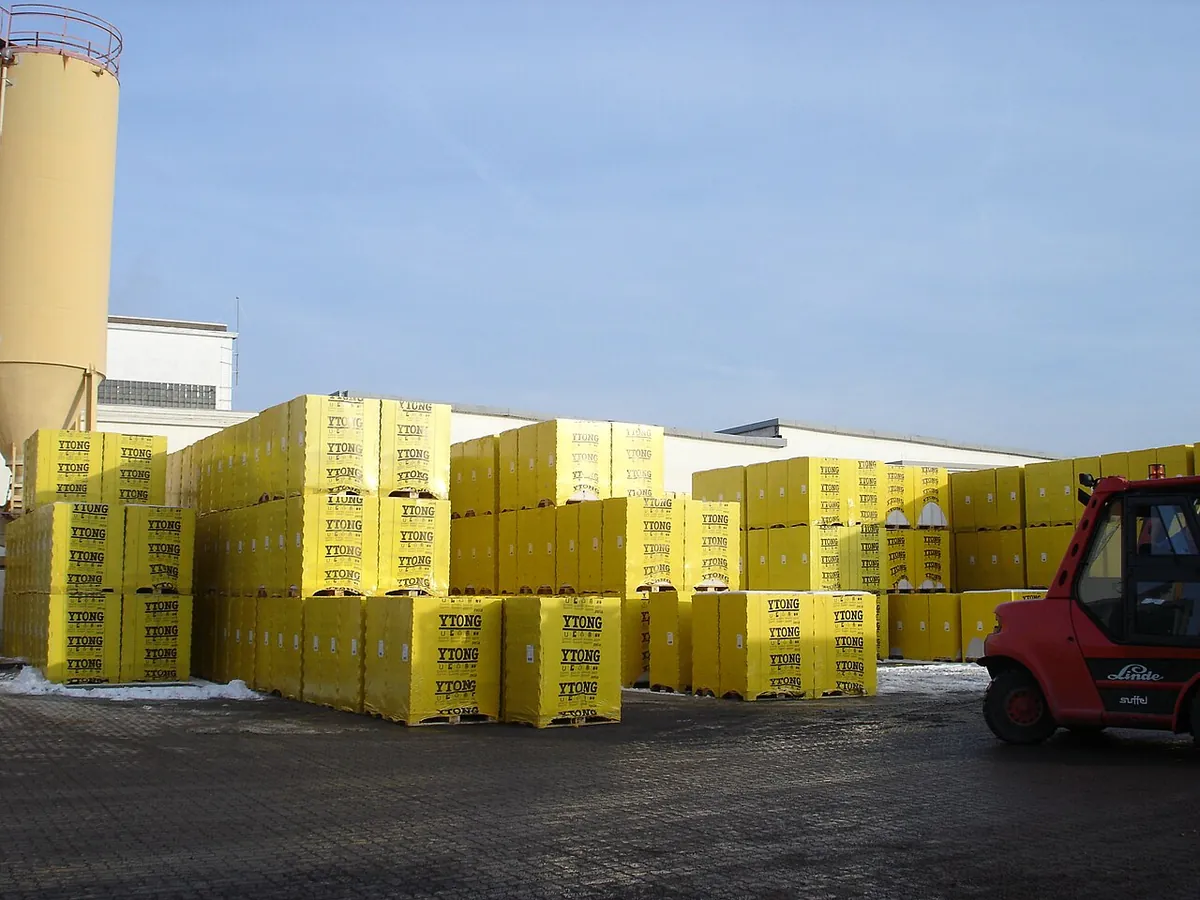
Photo: Bastian Lamprecht, Wikimedia Commons, CC BY-SA 2.5
AAC is made from cement, lime, fine sand or fly ash, water and a small amount of aluminum powder. The aluminum reacts in the wet mix to release hydrogen gas, which puffs the mix up like bread dough. After it stiffens, the cake is wire-cut into blocks or panels and cured under high-pressure steam in an autoclave. The finished material is about 80 percent air, weighs about a quarter as much as normal concrete, insulates far better, and can be cut, drilled and nailed with ordinary tools. AAC blocks are common in Europe, the Middle East and Asia for house walls, and AAC panels are used for walls, floors and roofs in some U.S. commercial buildings.
Foam and cellular concrete
Foam concrete is made by mixing a preformed foam, like shaving cream made from a foaming agent and water, into a cement slurry with no coarse aggregate. Adjusting the amount of foam sets the density, from very light insulating fill to denser material for roof decks. Because it flows like a liquid and needs no compaction, cellular concrete is used to fill abandoned pipes, tanks and voids, backfill trenches, build up grades over weak soils, and fill under slabs. It is weak compared with structural concrete, so it is used where its lightness and flow matter more than strength.
Perlite, vermiculite and other light mixes
Expanded perlite and vermiculite are volcanic and mineral materials heated until they pop into very light granules. Mixed with cement, they make insulating concrete for roof fills, fireproofing on steel, and lightweight garden planters. Pumice and scoria, natural volcanic stones full of gas bubbles, were used by the Romans in light concrete for the upper parts of domes, and are still used where they occur naturally. Expanded polystyrene beads make another very light concrete for non-structural uses.
Where Light Concrete Is Used
Light concrete earns its higher material cost when reducing weight saves money elsewhere or adds performance. The most common uses are:
- High-rise floor slabs on steel deck, where lighter floors reduce the size of beams, columns and foundations, and improve fire ratings for a given thickness.
- Bridge decks and widening projects, where lighter concrete lets existing girders and piers carry new decks or wider roads.
- Precast and prestressed members, where lighter pieces mean bigger units per truckload and smaller cranes. See precast concrete walls.
- Concrete masonry units, where lightweight blocks are easier for masons to lift all day. See concrete blocks.
- Roof decks and insulating fills, using cellular or perlite concrete over metal deck or existing roofs.
- Geotechnical fill over soft soil, behind retaining walls and on bridge approaches.
- Floating structures and marinas, where buoyancy matters.
- Home projects: lightweight countertops, planters, fire pits, garden ornaments and sculptures.
Pros and Cons of Lightweight Concrete
Pros
- Lower dead load, saving structure and foundations.
- Better thermal insulation than normal concrete, especially AAC and cellular concrete.
- Good fire resistance; lightweight aggregate concrete often earns a given fire rating with a thinner slab.
- Easier handling and lower shipping costs for precast and blocks.
- Internal curing from water stored in porous aggregate, which can reduce cracking.
Cons
- Higher material cost per cubic yard.
- Lower stiffness and, for very light types, much lower strength.
- Porous aggregate absorbs water, so it must be pre-wetted, and pumping needs care.
- Light aggregate can float to the surface during finishing if the mix is too wet.
- Longer drying times before moisture-sensitive flooring.
- AAC and foam concrete need protective finishes outdoors and are not for heavy loads.
How Light Weight Concrete Affects Design
Engineers treat structural light concrete a little differently from normal-weight concrete. Its lower stiffness means floors deflect slightly more under the same load, and its tensile and shear strength are somewhat lower for the same compressive strength, so design codes apply a reduction factor, called lambda in ACI 318, to some calculations. On the other hand, the lower self-weight often more than makes up for it, allowing longer spans or thinner members overall. Lightweight concrete also expands less with heat and conducts heat more slowly, which is why fire codes often allow thinner lightweight slabs than normal-weight ones for the same fire rating. For a homeowner, these details matter only on engineered projects; the main takeaway is that light concrete is a design choice, not a cheap substitute.
Working With Lightweight Concrete
Ready-mix plants that supply light concrete stockpile the lightweight aggregate and keep it wet, often with sprinklers, because dry aggregate would soak up mix water in the truck and stiffen the concrete. On site, light weight concrete is placed and finished much like normal concrete, but with a few differences. Finishers avoid overworking the surface, which can pull the light coarse aggregate up and leave a rough, uneven finish. Magnesium floats work better than wood floats. Pumping needs pre-saturated aggregate and sometimes a slightly different mix to avoid the aggregate absorbing water under pump pressure. Curing is still important, although the water stored inside the aggregate gives a built-in reserve that helps. Floors on lightweight concrete may need more drying time before flooring goes down, so moisture testing is common.
Making Light Concrete at Home
Homeowners mostly use light concrete for planters, garden ornaments, countertops and fire features. Several approaches are common:
- Perlite mix: equal parts portland cement and perlite, with water, for very light, insulating planters and fire pit shells. It is weak, so make walls thicker.
- Hypertufa: a mix of portland cement, peat moss and perlite (often 1:1.5:1.5 by volume) that looks like old stone and is popular for troughs and planters.
- Lightweight aggregate mix: cement, sand and expanded shale or clay pellets for stronger, lighter castings.
- Bagged lightweight concrete mixes: some brands sell lightweight or countertop mixes designed for thin, light pieces.
- GFRC: not lighter per cubic foot, but much thinner, so finished pieces weigh far less. See GFRC concrete.
Cure light weight concrete pieces slowly, wrapped in plastic for several days, and seal them if they will be outdoors. Wear a dust mask when handling dry perlite and cement, and wet the perlite slightly before mixing so it does not blow around or float to the top of the mix. See how to make concrete planters and how to make concrete.
A Short History of Light Concrete
Light concrete is older than most people think. Roman builders used pumice and other volcanic stone in the concrete of the Pantheon's dome, grading the mix so the lightest material sat near the top, which helped the dome survive for nearly two thousand years. Modern lightweight aggregate began in 1918, when Stephen Hayde patented a process in Kansas City for expanding shale and clay in a rotary kiln. During World War I and II, lightweight concrete was used to build ships when steel was scarce, and some of those concrete hulls still float as breakwaters today. In the decades after the war, structural light concrete spread into high-rise buildings and bridges, while autoclaved aerated concrete, developed in Sweden in the 1920s, became a major wall material across Europe. Today light weight concrete is a routine part of tall buildings, bridge rehabilitation and precast production.
Lightweight Concrete Blocks vs AAC Blocks
Two very different products are both sold as lightweight blocks. Lightweight concrete masonry units look like ordinary hollow concrete blocks but are made with expanded shale, clay, slag or pumice aggregate instead of sand and gravel. A standard 8 × 8 × 16-inch lightweight block weighs about 25 to 30 pounds, compared with roughly 35 to 40 pounds for a normal-weight block, which makes a big difference to a mason lifting hundreds a day. They are laid with mortar and reinforced and grouted like any block wall. See how much a concrete block weighs.
AAC blocks are solid, much larger and much lighter for their size, made of aerated light concrete. They are usually laid with thin-bed mortar, cut with hand saws, and plastered or rendered inside and out. An AAC wall can serve as both structure and insulation in a one- or two-story house. The trade-offs are lower strength, the need for weather protection and finishes, and limited availability in some regions, especially across much of the U.S. For block types, see cinder block vs concrete block.
Cellular Concrete for Fill and Repairs
Cellular light concrete solves problems that ordinary fill cannot. It flows into irregular spaces without compaction, so it can fill abandoned underground tanks, old sewer pipes, mine voids and the space between a new pipe and an old one. It weighs far less than soil, so it can raise the grade over soft ground or behind a bridge abutment without causing settlement. Because it sets into a solid that does not wash out, it is used under slabs, behind retaining walls and around utility lines where future erosion would be a problem. Contractors usually produce it on site, close to where it is needed, with special equipment that blends foam into a cement slurry and pumps it into place. Its strength is low, but for these uses, low weight and good flow matter more.
Durability, Freeze-Thaw and Moisture
Structural light concrete made with good lightweight aggregate and proper air entrainment has a good freeze-thaw record in bridge decks and parking structures. Its porous aggregate can even help, by giving freezing water some room and by releasing stored water for internal curing that reduces cracking. Very light insulating concretes are different: AAC and foam concrete absorb water readily and can be damaged by freezing if they stay wet, so they need protective coatings, renders or roofing outdoors and should not sit in standing water. Indoors, all light concrete holds more moisture than normal concrete when new and takes longer to dry, so moisture testing before flooring is important. See concrete moisture barrier.
Insulation Value of Light Concrete
Air is a good insulator, so the more air a concrete holds, the better it insulates. Normal concrete has an R-value of only about 0.08 per inch, meaning an 8-inch wall barely slows heat at all. Structural light concrete is a little better, around 0.2 to 0.3 per inch. AAC reaches roughly 1 to 1.25 per inch, so an 8-inch AAC wall is close to R-10, and very light cellular concrete can be higher still. That is why insulating light concrete is used as roof fill and why AAC walls are popular in hot climates. For cold climates, most designers still add dedicated insulation to meet energy codes, but light concrete reduces how much is needed.
Light Concrete in Renovation and Upper Floors
Renovations are one of the most practical places for light concrete. Old buildings often have floors and beams that were never designed for the weight of a new concrete topping, heated floor or tiled bathroom on a thick mortar bed. A light concrete topping or a lightweight leveling compound can add a solid, flat surface without overloading the structure. Rooftop terraces, green roofs and balconies are similar: every inch of normal concrete adds about 12 pounds per square foot, while an inch of insulating light concrete may add only 3 to 5. Engineers also use light weight concrete to fill old floors, encase pipes, and add fire protection to steel beams. In historic buildings, it can replace heavy rubble fills that were added over the decades and that now overload old timber joists. In each case, the choice should be confirmed by an engineer, who checks what the existing structure can carry.
Testing and Specifying Light Concrete
Because density is the whole point, light concrete is specified and tested by weight as well as strength. Specifications typically list an equilibrium density, the weight after the concrete has dried to a stable moisture content, along with compressive strength, air content and slump. On site, testers measure the fresh unit weight of each truckload with a calibrated bucket and scale, and cast cylinders for strength. A load that is too heavy may mean the plant used the wrong aggregate or that dry aggregate absorbed water; a load that is too light may be weaker than required. For AAC and cellular concrete, density classes are marked on the product or the mix ticket, and each class has a typical strength and insulation value.
Common Mistakes With Light Concrete
The most common mistakes come from treating light concrete like ordinary concrete. Adding water to a stiff load of lightweight aggregate concrete raises the water-cement ratio and can make the aggregate float. Using dry lightweight aggregate in a homemade mix lets it soak up the mix water and leaves a crumbly result. Overworking the surface pulls light particles up and leaves a rough finish. Using AAC or foam concrete outdoors without a protective finish lets it absorb water. And choosing light concrete where weight does not matter adds cost without benefit. Avoiding these mistakes is mostly a matter of following the supplier's instructions and keeping the mix and the job matched.
Environmental Notes
Manufacturing expanded shale and clay takes energy, since the raw material is fired in a kiln, so lightweight aggregate has a higher production footprint per ton than crushed stone. But because it reduces the weight of a structure, it can cut the total concrete, steel and foundation needed, and lighter loads mean fewer truck trips. AAC uses fly ash or sand, little cement per cubic foot and a lot of air, and it provides insulation in the same material. Cellular concrete fill can replace large volumes of imported soil and reduce settlement-related repairs. As with any material, the environmental case for light concrete depends on the project: it is strongest where weight savings ripple through the whole structure, and weakest where it simply replaces ordinary concrete in a slab on the ground. When in doubt, compare whole-project quantities rather than the material alone, and ask the supplier for environmental product declarations, which list the measured footprint of each mix.
How Much Does Lightweight Concrete Cost?
Prices vary widely by region and type, and lightweight aggregate is not available everywhere. As a rough guide, structural lightweight ready-mix often costs about 20 to 50 percent more per cubic yard than comparable normal-weight concrete, mostly because of the manufactured aggregate and its shipping. Cellular concrete for fill is priced per cubic yard placed and is often competitive with compacted soil fill when weight or access matters. AAC blocks cost more per block than ordinary concrete blocks but can replace both the block and separate insulation in a wall. Bags of perlite and lightweight mixes for DIY projects cost a few dollars to $20 or more each. For normal concrete prices, see concrete price per yard.
Light Concrete vs Normal Concrete: Which to Use?
For driveways, patios, footings, sidewalks and most home slabs, normal-weight concrete is the right choice: cheaper, stronger, stiffer and easier to buy. Light concrete makes sense when weight is the problem you are trying to solve, such as a rooftop deck, an upper-floor topping, a bridge deck, a planter that has to be moved, or a wall that needs insulation built in. It also makes sense where its other properties help, such as fire resistance or insulation. If you are not sure whether your project needs lightweight concrete, the answer for most home work is no; if an engineer or architect specified it, follow their mix and do not substitute.
Frequently Asked Questions
How much does light concrete weigh?
Structural light weight concrete weighs about 90 to 115 pounds per cubic foot, compared with 145 to 150 for normal concrete. Insulating types like AAC and foam concrete weigh 20 to 60 pounds per cubic foot.
Is lightweight concrete as strong as normal concrete?
Structural lightweight concrete can reach similar compressive strengths, about 3,000 to 6,000 psi or more. Insulating light concrete is much weaker and is not used for heavy loads.
What is light concrete made of?
Cement and water with lightweight aggregate such as expanded shale, clay, slate, pumice or perlite, or with air or foam bubbles instead of some of the solid material.
Can I use light concrete for a driveway?
It is not recommended. Normal-weight concrete is cheaper, stronger and more wear-resistant for driveways.
Does light weight concrete float?
Some very light types, like certain foam concretes and pumice concrete, can be lighter than water. Structural lightweight concrete is still heavier than water.
Sources
- American Concrete Institute: ACI 213R guide for structural lightweight-aggregate concrete
- Expanded Shale, Clay and Slate Institute: lightweight aggregate
- ASTM C330: Lightweight Aggregates for Structural Concrete
- Portland Cement Association: lightweight and cellular concrete
Related Guides
- Shotcrete vs gunite — sprayed concrete for pools and walls
- Pervious concrete — permeable paving that drains rainwater
- Concrete house construction — ICF, block, poured and prefab homes
- Density of concrete — unit weight and modulus of elasticity
- Metal decking for concrete — composite steel deck floors
- Roof cement and concrete roofs — flashing repairs, concrete tiles and tile replacement
- Concrete canoe — how a concrete boat floats and the ASCE competition