
Concrete Slide Guide: Hillside and Playground Slides, Plus Concrete Sliders
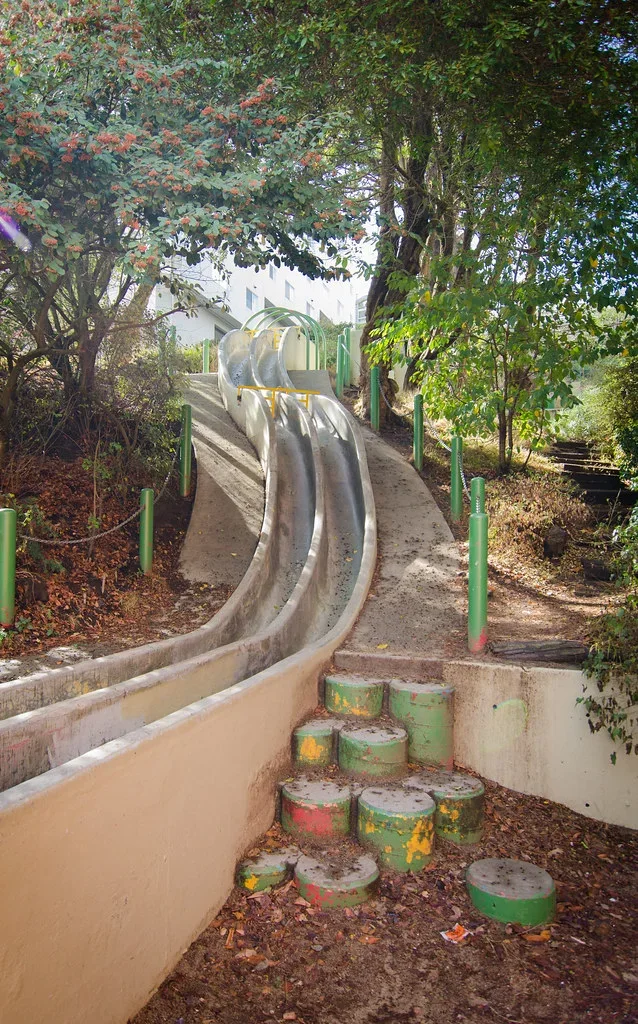
Photo: Franco Folini, Flickr, CC BY-SA 2.0 (cropped)
Quick Answer
A concrete slide is a slide cast in concrete, usually built into a hillside, embankment or playground mound, with a smooth, troweled or polished chute. Concrete slides are durable, vandal-resistant, stay cooler than metal in sun, and need no ladder because the hill provides the height. They are built by shaping the subgrade, setting reinforcement and forms or using shotcrete, then finishing the chute very smoothly and sealing it; many riders slide on cardboard to reduce friction. Public slides should follow playground safety guidance such as the CPSC Public Playground Safety Handbook and ASTM F1487. On job sites, concrete sliders mean something different: the knee board sliders that finishers kneel on to reach the middle of a wet slab, typically about 24 to 30 inches long and 8 to 10 inches wide, made of stainless steel, aluminum or plastic, and sold in pairs for roughly $50 to $250.
Few playground features are as memorable as a long concrete slide winding down a hillside. The twin chutes in the photo above, in a small city park on a steep hillside, are a good example: two smooth concrete slides follow the slope between trees, with stepping stones for climbing back to the top. Concrete slides are popular in parks around the world, from historic playgrounds to modern landscape designs, because they turn an awkward slope into play space and last for decades.
This guide covers concrete slide design, construction, finishing, safety and maintenance, famous concrete slides, backyard and pool slides, and then explains concrete sliders, the knee boards concrete finishers use. For finishing tools in general, see concrete finishing tools.
Why Build a Concrete Slide?
Uses the landscape. A concrete slide built into a hill or embankment needs no tall ladder or platform. Children climb the slope and slide down, which reduces fall height and fall risk compared with tall freestanding slides.
Durability. Concrete slides last for decades with minimal maintenance. They do not rust, rot or crack from sun the way metal and plastic slides can.
Cooler surface. Metal slides can become dangerously hot in summer sun. Concrete absorbs heat too, but light-colored concrete stays much cooler than bare steel, though it can still get warm.
Vandal resistance. A concrete slide is hard to damage or steal, which suits public parks.
Design freedom. Concrete can be shaped into curves, double and triple chutes, tunnels and wide slides for several children side by side.
Accessibility of terrain. Hill slides allow designers to use natural or built-up mounds, integrating play with landscaping.
Concrete Slide Design
Slope. The chute slope controls speed. Playground guidance generally limits the average incline of slide chutes to about 30 degrees, with steeper or longer slides moving too fast. Many hillside concrete slides use gentler slopes because concrete is more frictional than plastic or polished steel.
Chute profile. A U-shaped or curved cross-section with side walls keeps riders centered. Side walls typically rise at least several inches above the sliding surface, higher on curves.
Width. Single-rider concrete slides are often about 16 to 24 inches wide inside; wide slides for groups are much wider.
Start and exit. A level platform or sitting area at the top lets children sit before starting. At the bottom, a flatter exit region slows riders, ending close to the ground, with impact-absorbing surfacing beyond.
Drainage. Water must drain off the chute and from the base so the slide dries quickly and the subgrade does not wash out.
Climbing route. Steps, stepping stones, rope climbs or paths let children return to the top without climbing up the chute.
How a Concrete Slide Is Built
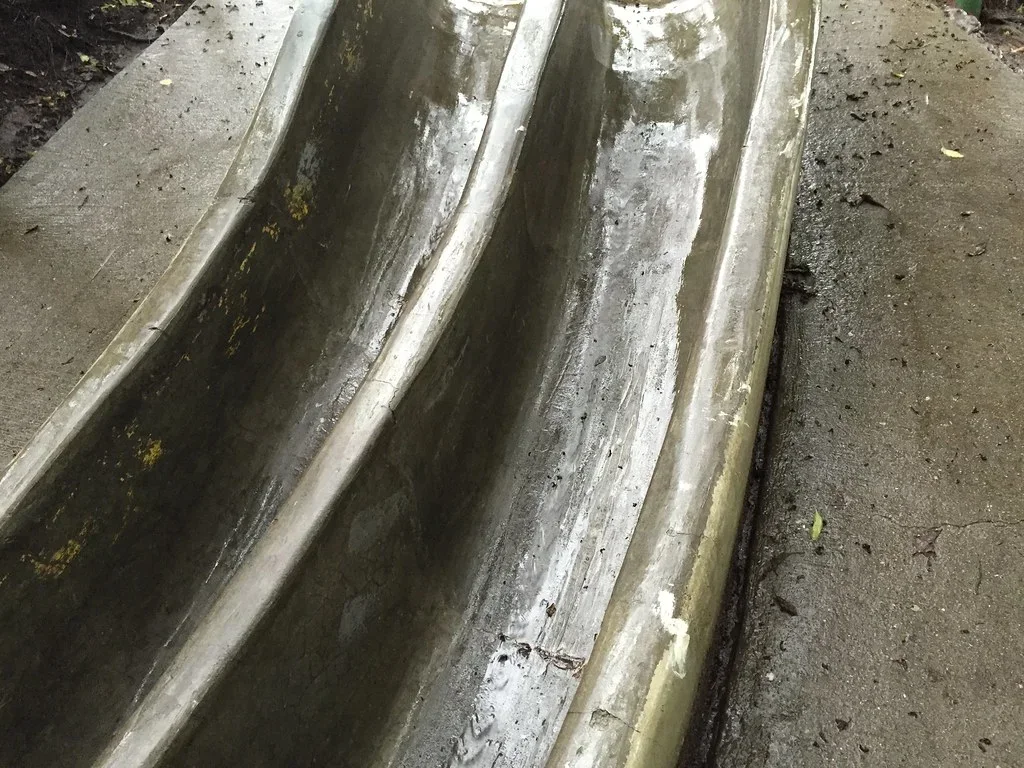
Photo: igb, Flickr, CC BY 2.0
The close-up above shows the curved, smooth chutes of a twin concrete slide. A typical construction sequence:
1. Shape the hill. Grade and compact the slope to the slide alignment, adding compacted fill or a gravel base where needed. See gravel base for concrete.
2. Drainage. Install drains under and beside the slide so water does not undermine it.
3. Reinforcement. Place rebar or welded wire mesh shaped to the curved profile, supported on chairs. See rebar in concrete.
4. Forms or shotcrete. Simple straight slides can be formed with plywood and bent hardboard; curved, freeform concrete slides are usually built with shotcrete sprayed over the reinforcement and shaped by hand, like a swimming pool or skatepark bowl. See shotcrete vs gunite.
5. Shape and finish. Finishers shape the chute with templates and trowels, then hard-trowel the sliding surface very smoothly. Some designers grind and polish the chute after curing.
6. Cure. Moist cure the slide for at least 7 days to develop a dense, wear-resistant surface. See how long does concrete take to cure.
7. Seal. A penetrating sealer or densifier reduces dust, staining and wear.
8. Surround. Add impact-absorbing surfacing at the exit and landscaping around the slide.
Some concrete slides use a stainless steel or polymer liner set into the concrete for the sliding surface, combining concrete's durability with a faster, smoother slide.
Concrete Slide Materials and Mix
The sliding surface of a concrete slide takes constant abrasion from shoes, clothing, cardboard and grit, so the concrete mix matters. Designers typically specify a strong, dense mix of about 4,000 to 5,000 psi with a low water-cement ratio, small, hard aggregate near the surface, and air entrainment in freezing climates. Shotcrete used for curved slides is applied in layers and finished by hand. Some builders add a hard-wearing topping or a polymer-modified finishing coat to the chute, then densify and polish it, which makes the concrete slide both slicker and more durable. Integral color can be added to the mix for bright, playful slides, and rounded edges at the top of the side walls protect hands and legs. Stainless steel liners or embedded strips are sometimes used in the fastest sections.
Making a Concrete Slide Slippery Enough
Concrete has more friction than polished stainless steel or plastic, so concrete slide designers balance slope and smoothness. A hard steel-troweled or polished surface slides well, especially as it wears smooth over years of use. Riders at many concrete slides use pieces of cardboard, which reduce friction and protect clothing; some parks discourage cardboard because it litters or makes slides too fast. Wax and oils are not recommended because they make speed unpredictable and stain the concrete. A slide that is too slow frustrates children, while one that is too fast is dangerous, so test slides carefully before opening.
Concrete Slide Safety
Standards. In the United States, public playground slides are designed using the U.S. Consumer Product Safety Commission's Public Playground Safety Handbook and ASTM F1487, the standard for public playground equipment, which cover slide angle, side walls, exit regions and use zones. Many concrete slides predate these standards, and some older slides have been modified or closed.
Surface. Check for cracks, spalls, exposed rebar, sharp edges and rough patches that can cut or burn skin.
Heat. Even concrete gets warm in direct sun; test the surface before children slide on hot days.
Speed and exit. Make sure riders slow down before the exit and land on soft surfacing.
Clothing. Long pants or cardboard protect against abrasion on concrete.
Supervision. One rider at a time per chute, feet first, and keep the exit clear.
Building a Backyard Concrete Slide
A backyard hill can become a family concrete slide. The project is closer to building a small pool or skate bowl than pouring a patio, so plan carefully:
Choose the slope. A natural slope of roughly 20 to 30 degrees works best. Too gentle and the concrete slide is slow; too steep and it is dangerous.
Keep it low and short. For young children, a run of 10 to 20 feet with a total drop of a few feet is plenty.
Dig a trench along the slope. Shape it to the chute profile with extra depth for base and concrete, then compact.
Base and reinforcement. Add 3 to 4 inches of compacted gravel, then mesh or rebar bent to the curve.
Pour or pack the concrete. Use a stiff mix that holds on a slope, packing it by hand and shaping the chute with a curved template or a bent board. Chute walls 3 to 4 inches thick are typical for a small concrete slide.
Finish smooth. Trowel the sliding surface repeatedly as it stiffens to a hard, slick finish, rounding all edges.
Cure and seal. Keep it damp for a week, then seal.
Add a soft landing. Finish with grass, mulch or rubber at the exit.
Because a backyard concrete slide is permanent, check for utilities, drainage and property rules first, and consider hiring a pool or skatepark contractor for long or curved slides.
Concrete Slide Cost
A small backyard concrete slide built by a homeowner may cost a few hundred dollars in materials. A professionally built hillside concrete slide in a park, including grading, drainage, shotcrete, finishing, surfacing and safety review, can cost from several thousand dollars for a short single chute to tens of thousands for long, multi-lane or custom-shaped slides. Embankment slides made with stainless steel chutes set into concrete abutments cost more for the steel but less for shaping. Ongoing costs are low: occasional cleaning, crack repair and resealing.
Concrete Slides in Pools and Water Parks
Many pools feature rock-look or sculpted concrete slides built from shotcrete or glass-fiber reinforced concrete and finished with smooth plaster, tile or coatings so water can flow down the chute. Water reduces friction, so pool slides can be gentler than dry concrete slides. The sliding surface must be extremely smooth and free of joints, and the slide must exit into water of the correct depth. Most water park slides today are fiberglass, but concrete slides remain common in custom residential pools and themed attractions. See glass fiber reinforced concrete.
Maintaining and Repairing a Concrete Slide
Clean regularly. Sweep leaves, sand and debris, which speed wear and make the ride rough. Wash off dirt and graffiti with a pressure washer at moderate pressure.
Fix cracks early. Fill hairline cracks with a flexible crack sealer or epoxy, then grind flush so no lip catches riders. See epoxy concrete crack repair.
Repair spalls. Chip out loose concrete, treat any exposed rebar, and patch with a polymer-modified repair mortar troweled smooth.
Grind rough spots. A diamond grinder or polishing pads can restore a smooth sliding surface. See concrete polisher.
Reseal. Apply penetrating sealer every few years to resist water and staining.
Inspect. Check side walls, the exit area and surrounding surfacing regularly, and close the slide if exposed steel or sharp edges appear.
Concrete Sliders: Knee Boards for Concrete Finishers
Search for concrete sliders and you will mostly find a finishing tool, not a playground. Concrete sliders, also called knee boards, knee board sliders or kneeboards, are flat boards that finishers kneel on to reach the middle of a fresh slab without sinking into the concrete. They spread the finisher's weight over a large area so the surface is only slightly marked, and the marks are troweled out as the finisher works backward across the slab. You can see a finisher using one in the photo at the top of our concrete worker guide.
Sizes. Concrete sliders are usually sold in pairs, about 24 to 30 inches long and 8 to 10 inches wide. Common sizes are 28 x 8, 30 x 8 and 30 x 10 inches.
Materials. Stainless steel concrete sliders are durable, slide smoothly and do not rust. Aluminum ones are lighter. Plastic and polystyrene concrete sliders are very light and have rounded edges that do not dig in; they are popular for decorative and stamped work. Wood knee boards are the traditional, cheapest option.
Features. Look for turned-up edges so the board glides instead of digging, comfortable handles or straps, and foam pads for the knees.
Price. A pair of concrete sliders typically costs about $50 to $250, depending on material and brand.
How to Use Concrete Sliders
1. Wait for the right time. Use concrete sliders after the bleed water is gone and the slab is firm enough that a footprint sinks only about 1/4 inch or less. Too early and the boards sink and leave deep marks.
2. Place one board, then the other. Kneel on one concrete slider and rest your toes or other knee on the second, keeping weight spread.
3. Work from the far side back. Start at the far edge of the area, finishing with a float or trowel, then slide the boards back and finish the marks they left.
4. Move smoothly. Lift and set the boards gently, or slide them along with the handles, to avoid gouges.
5. Clean immediately. Wash concrete off the sliders before it hardens.
Concrete sliders are essential on slabs too wide to reach from the edges with hand tools. Larger slabs are finished with bull floats, fresnos and power trowels instead. See concrete bull float and concrete trowel.
Concrete Slide Design Ideas
Multi-lane racing slides. Two or three parallel concrete slides let children race each other down a hill.
Wide slides. A broad concrete slide lets several children slide together and suits slopes in nature play areas.
Tunnel slides. A concrete pipe or tunnel section partway down adds excitement, though tunnels need good drainage and visibility.
Embankment slides. Stainless steel chutes set into a concrete-lined embankment combine fast slides with a durable concrete structure.
Sculptural slides. Concrete slides shaped like animals, waves or dragons, popular in Japanese and European parks, double as public art.
Integrated landscapes. A concrete slide built into a mound with climbing boulders, rope nets and planting creates a whole play landscape from one slope.
Concrete Slides vs Metal and Plastic Slides
Durability. A concrete slide can last half a century. Plastic slides fade and crack in sun within 10 to 20 years; metal slides last long but can dent, rust or loosen at joints.
Heat. Stainless steel slides in full sun can reach temperatures that burn skin; many are now placed facing north or under shade. Concrete slides warm up but usually stay cooler than metal. Plastic slides stay coolest but still warm in sun.
Speed. Polished stainless steel is fastest; plastic is fast; concrete is slowest unless very smooth or ridden on cardboard.
Static electricity. Plastic slides can build static charge; concrete slides do not.
Design. Concrete slides can be shaped to any landscape; metal and plastic slides come in standard shapes from manufacturers.
Cost. Prefabricated plastic slides are cheapest; custom concrete slides cost more upfront but less over their long life.
Planning a Public Concrete Slide
Cities, schools and landscape architects planning a concrete slide usually follow these steps:
Site study. Assess the slope, soil, drainage, sun exposure and how children will reach the top.
Safety design. Apply CPSC guidance and ASTM F1487 for chute angle, side walls, exit height and use zones, and have the design reviewed by a certified playground safety inspector.
Accessibility. Provide an accessible route to the top where possible, and consider wide concrete slides where a caregiver can ride with a child, which suits children with disabilities.
Construction specs. Specify concrete strength, reinforcement, surface finish, tolerances, curing and sealing, and require mock-ups or test sections of the sliding surface.
Testing before opening. Test ride with weighted dummies or adults, measure exit speed, and adjust finish or slope as needed.
Maintenance plan. Schedule inspections and resealing for the life of the concrete slide.
Choosing the Right Concrete Sliders
Finishers have strong opinions about their concrete sliders. A few tips for picking a pair:
Match the work. Plastic concrete sliders are light and leave soft marks, ideal for decorative, colored and stamped slabs where marks show. Stainless steel concrete sliders are tough and slide easily on general flatwork.
Size. Wider 10 inch concrete sliders spread weight better on softer concrete; narrower 8 inch boards are lighter to handle.
Edges. Rolled or bent-up edges on all sides help the board glide in any direction.
Comfort. Padded tops or separate knee pads reduce fatigue on long pours.
Grip. Handles let you lift and place the board without touching the slab.
Many finishers keep two pairs of concrete sliders, one for general work and one clean pair for decorative jobs.
Concrete Slides and Skateparks
Concrete slides share their construction methods with concrete skateparks. Both use shotcrete or cast-in-place concrete over shaped subgrade and reinforcement, with hard-troweled, very smooth surfaces and carefully shaped transitions. Contractors who build skate bowls and pool-style ramps are often well suited to building custom concrete slides. Some modern parks combine slides, climbing features and skate elements in one sculpted concrete landscape.
Concrete Slides in Winter
In cold climates, a hillside concrete slide often becomes a winter attraction too, with children riding sleds or saucers down the chute when it is covered in snow. This can be fast and risky, because ice makes concrete slides far slipperier than in summer and the exit area may be frozen hard. Parks often close or sign concrete slides in icy weather. Freeze-thaw cycles also test the concrete itself: slides built with air-entrained concrete, good drainage and a penetrating sealer resist scaling and cracking, while water trapped in cracks or under the slab can lift and break sections. Clearing drains in fall and sealing every few years keeps a concrete slide in good shape through many winters. See pouring concrete in cold weather.
Reviving an Old Concrete Slide
Many communities have aging concrete slides that are rough, cracked or closed. Rather than demolishing them, parks often restore them: grinding and polishing the chute, rebuilding damaged side walls, adding a stainless steel liner over a worn sliding surface, improving the exit with new surfacing, and adding railings or steps to meet current guidance. A restored concrete slide keeps a beloved landmark while bringing it up to modern safety expectations, and it usually costs far less than a new custom slide. See concrete restoration.
Famous and Historic Concrete Slides
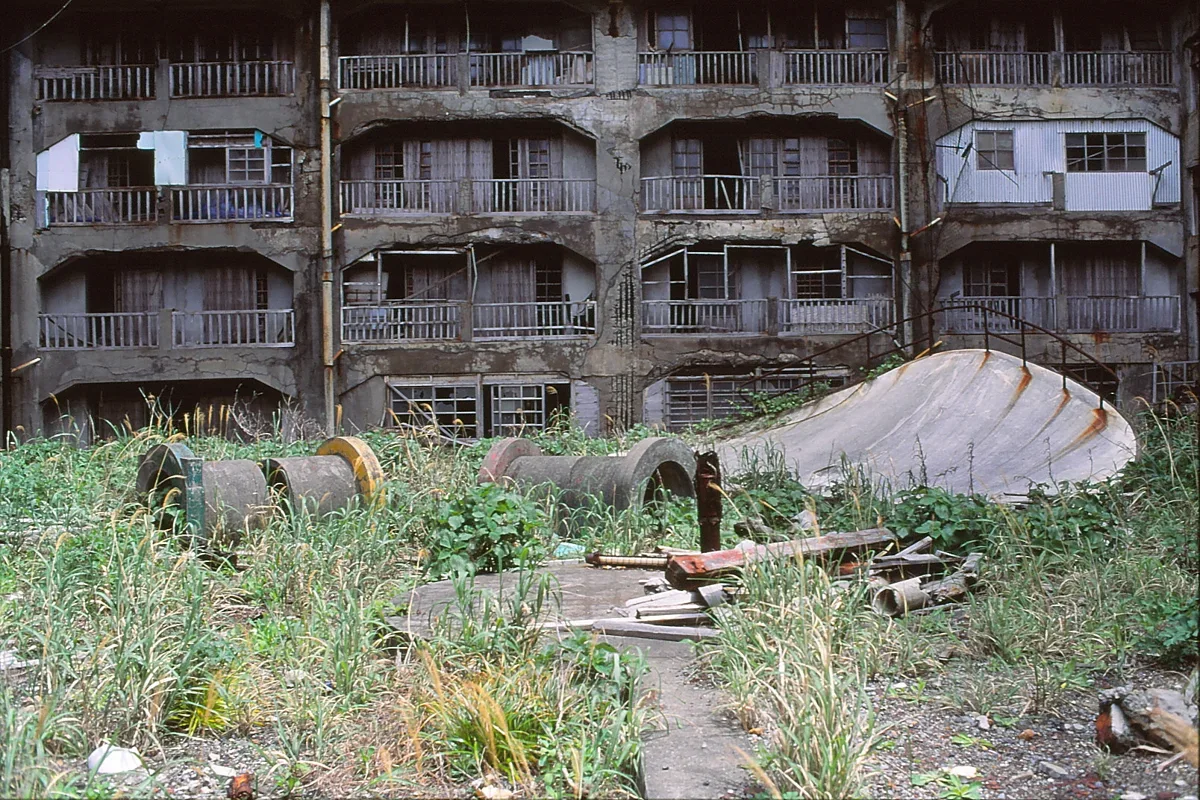
Photo: Gohachiyasu1214, Wikimedia Commons, CC BY-SA 4.0
Concrete slides appear in parks and playgrounds around the world, and some have become landmarks. San Francisco's Seward Street slides, a pair of long concrete slides built in the 1970s on a steep hillside lot, are a local favorite, and visitors bring cardboard to ride them. Japan has many concrete slides built into hillsides and play mounds, a common feature of Japanese parks. The photo above shows an old concrete slide in the overgrown playground of an abandoned apartment complex, a reminder of how long concrete play structures can outlast everything around them. Mid-twentieth-century playgrounds also featured concrete play sculptures, tunnels and mounds with slides, some of which are now preserved as examples of modernist landscape design.
Frequently Asked Questions
What angle should a concrete slide be?
Playground guidance generally limits average chute slope to about 30 degrees. Concrete slides often use somewhat gentler slopes for control, with a flatter exit at the bottom.
Can I build a concrete slide in my backyard?
Yes, on a suitable slope, with a gravel base, reinforcement, a smooth hard-troweled chute, proper curing and a soft landing. Long or curved slides are best left to a pool or skatepark contractor.
How much do concrete sliders cost?
A pair of concrete sliders, or knee boards, typically costs about $50 to $250, depending on whether they are plastic, aluminum or stainless steel.
When should you use concrete sliders on a slab?
After bleed water disappears and the slab is firm enough that the boards sink only slightly, usually when hand floating and edging begin.
Are concrete slides safe?
Well-designed, maintained concrete slides with gentle slopes, good side walls and soft exits are safe. Old slides with cracks or steep drops need repair.
Why do people use cardboard on concrete slides?
Cardboard reduces friction, making the ride faster and smoother, and protects clothing and skin from abrasion.
What are concrete sliders?
Knee board sliders that concrete finishers kneel on to work on a fresh slab. They spread the finisher's weight so the boards barely mark the surface, letting the finisher reach the middle of slabs too wide to finish from the edges.
How long do concrete slides last?
Often 40 to 60 years or more with occasional surface repairs and sealing. Many concrete slides built in the mid-twentieth century are still in use today, while the metal and plastic play equipment around them has been replaced several times. Good drainage, regular cleaning and early crack repair are what keep an old concrete slide safe and smooth.
Sources
- U.S. Consumer Product Safety Commission: Public Playground Safety Handbook
- ASTM F1487: consumer safety performance specification for playground equipment for public use
- American Concrete Institute: guide to concrete floor and slab finishing
- San Francisco Recreation and Parks Department