
DIY Inground Pool Kits: What They Cost and How to Build One
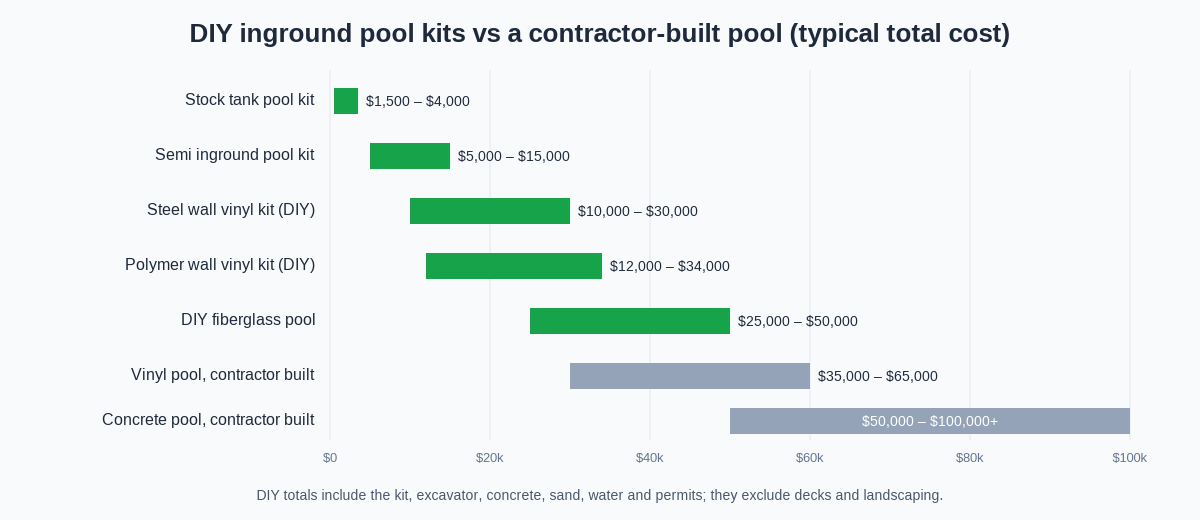
Chart: Asphapro.com
Quick Answer
DIY inground pool kits are packages of wall panels, bracing, a vinyl liner, a skimmer, returns, a pump and a filter that let a homeowner build an inground pool without a pool contractor. The kit itself usually costs $5,000 to $20,000, and the finished pool, with digging, concrete, sand, water and permits, typically costs $10,000 to $34,000, often 30% to 50% less than a contractor-built vinyl pool. Most inground pool kits use steel or polymer walls with a vinyl liner. DIY fiberglass pools (a one-piece shell you install yourself) cost about $25,000 to $50,000 in total. Expect 3 to 8 weekends of work, plus help from an excavator and a licensed electrician.
Building swimming pool projects through a contractor is expensive: an inground pool from a contractor often costs $35,000 to $65,000 or more for vinyl and far more for concrete. That price puts a pool out of reach for many families. DIY inground pool kits are the main way homeowners cut that cost: you buy the materials as a package and supply the labor yourself, hiring out only the jobs that need heavy equipment or a license.
This guide covers the types of inground pool kits, what is included in a kit and what is not, real costs, the steps of swimming pool construction from layout to fill, how long it takes, which jobs to hire out, and the most common mistakes. It also covers DIY fiberglass pools, semi inground pool kits and stock tank pool kits. If you want contractor prices to compare, see how much does a pool cost.
What Is a DIY Inground Pool Kit?
A DIY inground pool kit (also sold as an in ground pool kit or swimming pool kit) is a pool package sold directly to homeowners. It includes the parts that make up the pool structure and its basic equipment. You (or local hired help) dig the hole, assemble the walls, pour concrete, install the liner and fill it. Most kits include detailed instructions, plans, and phone or video support from the seller.
Kit makers sell to homeowners because the structure of a vinyl pool is a set of standard parts: wall panels, braces, coping and a liner. Installing those parts takes care and patience more than special skills. The hard parts of pool construction (digging, plumbing to code, electrical bonding) can be hired out separately.
Types of Inground Pool Kits
Steel wall vinyl pool kits
Steel wall kits use galvanized steel panels, usually 42 to 48 inches tall, bolted together and held up by A-frame braces. Steel is strong and has been used in vinyl pools for decades. It can rust over many years, especially in wet soils or with salt water systems, so look for heavy galvanizing and a protective coating. Steel wall kits are the most common DIY inground pool kits and usually the lowest-cost permanent option.
Polymer wall vinyl pool kits
Polymer (plastic) wall panels do not rust, are lighter to carry and suit salt water pools. They often cost a little more than steel. Many sellers offer both, so you can choose based on budget and soil conditions.
DIY fiberglass pool kits
A DIY fiberglass pool is a one-piece factory-made shell delivered on a truck and set into the hole with a crane. The "kit" includes the shell, plumbing parts and equipment. A diy fiberglass pool kit saves on labor, but the shell must be set perfectly level on a gravel base and backfilled carefully, and the delivery and crane must be timed with the dig. Many owners hire a fiberglass installer to set the shell and do the rest themselves. This is the fastest kind of DIY in ground pool once the hole is ready.
Semi inground pool kits
Semi inground pools are partly buried, with heavy walls that can stand on their own. They work well on sloped yards. DIY semi inground pool kits cost about $5,000 to $15,000 all in, and the dig is smaller than for a full inground pool.
Stock tank pool kits
A DIY stock tank pool kit turns a galvanized livestock water tank (usually 6 to 10 feet across) into a small plunge pool, with a pump, filter and fittings. The full cost is about $1,500 to $4,000. Stock tank pools sit above ground or partly in the ground and are popular for small yards.
What Comes in an Inground Pool Kit?
| Usually included | Usually not included |
|---|---|
| Wall panels (steel or polymer) and bolts | Excavation and soil removal |
| A-frame braces and bottom track | Concrete for the collar and deck |
| Vinyl liner (custom or standard) | Floor material (vermiculite, grout or sand) |
| Coping (aluminum or resin) and bead track | Electrical work and bonding |
| Skimmer, returns and main drain | Water to fill the pool |
| Pump and filter (sand or cartridge) | Permits and inspections |
| Steps (vinyl or acrylic), ladder or rails | Fencing required by code |
| Plumbing fittings and valves | Heater, cover and automation |
Compare pool kits on what is included. Pool kits inground and above ground both vary a lot in what comes in the box. A low price can hide missing parts like the main drain, steps or a quality filter. Ask whether the liner is custom-made for your pool or a stock size, and what thickness it is.
How Much Do DIY Inground Pool Kits Cost?
| Pool size | Kit price (steel or polymer) | Typical all-in DIY cost |
|---|---|---|
| 12 x 24 ft | $5,000 – $9,000 | $10,000 – $18,000 |
| 16 x 32 ft | $7,000 – $14,000 | $15,000 – $28,000 |
| 18 x 36 ft | $9,000 – $16,000 | $18,000 – $32,000 |
| 20 x 40 ft | $11,000 – $20,000 | $22,000 – $34,000+ |
The other costs of a DIY in ground pool
| Item | Typical cost |
|---|---|
| Excavation (operator and machine) | $1,500 – $5,000 |
| Soil hauling | $500 – $3,000 |
| Concrete collar around the walls | $800 – $2,000 |
| Floor material (vermiculite or grout) | $600 – $1,500 |
| Electrical (licensed electrician) | $1,000 – $3,000 |
| Permits and inspections | $200 – $2,000 |
| Water for the fill | $100 – $1,000 |
| Deck (concrete or pavers) | $4,000 – $15,000+ |
| Safety fence | $1,500 – $6,000+ |
The deck and fence are often left out of kit price comparisons, but most towns require a fence, and the deck finishes the pool. For deck prices, see concrete pool deck.
How to Build an Inground Pool With a Kit: Step by Step
Here is how to build a swimming pool from a kit, in the order most builders follow. Every inground pool DIY project uses these same eight steps, with small changes for fiberglass shells. If you have ever wondered how to make an inground pool on your own, this is the full process.
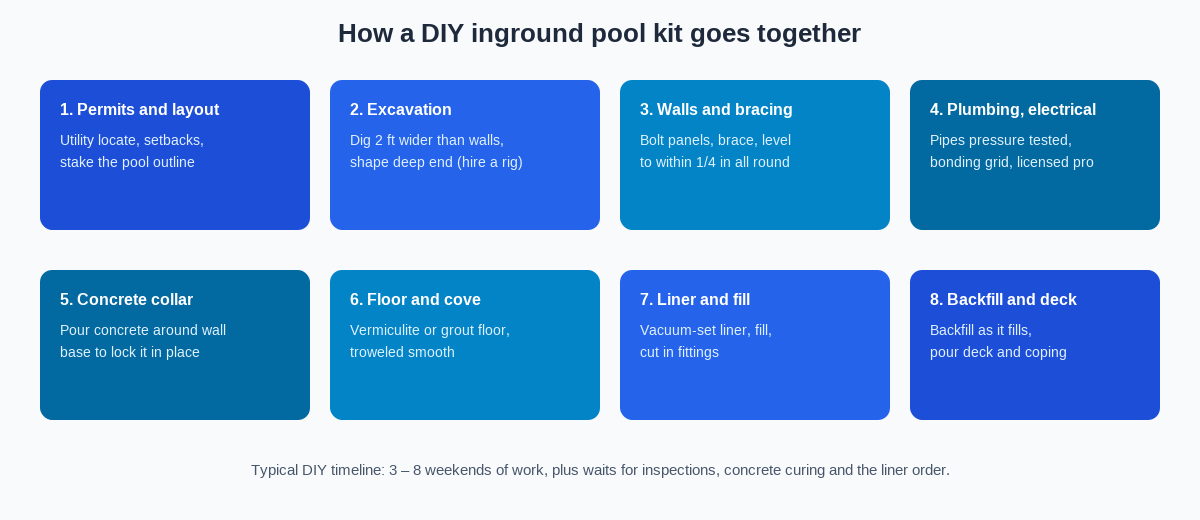
Diagram: Asphapro.com
1. Plan, permit and lay out the pool
Check your town's rules on setbacks from property lines, septic systems and the house, fence requirements and permits. Call 811 to have buried utilities marked. Choose a level, sunny spot with good drainage and access for an excavator. Stake out the pool outline using the kit plans, adding about 2 feet all around for working room.
2. Excavate the hole
Most people hire an excavator with an operator for this step. The dig is about 2 feet wider than the walls on all sides. The shallow area is dug to the wall height, and the deep end is shaped to the kit's plan, often a hopper or sport bottom. Keep the subsoil undisturbed where the walls will sit. Plan where the soil will go: a 16 x 32 pool removes about 100 to 150 cubic yards of soil.
3. Assemble the walls and braces
Set the wall panels on a level base of compacted soil or footer pads and bolt them together. Fasten the A-frame braces behind each panel joint. The walls must be level to within about 1/4 inch all the way around, square, and straight; this is the step that decides how good the finished pool looks. Take your time.
4. Install the plumbing and electrical
Install the skimmer, returns and main drain in the walls and floor, then run pipe to the equipment pad. Pressure test the pipes before you backfill. Electrical work, including bonding of the walls, the water and metal parts, must be done to code. Pool bonding and wiring are life-safety work; hire a licensed electrician.
5. Pour the concrete collar
Pour a concrete collar (a ring of concrete) around the outside base of the walls and braces. It locks the walls in place and keeps them from moving when the pool is filled and backfilled.
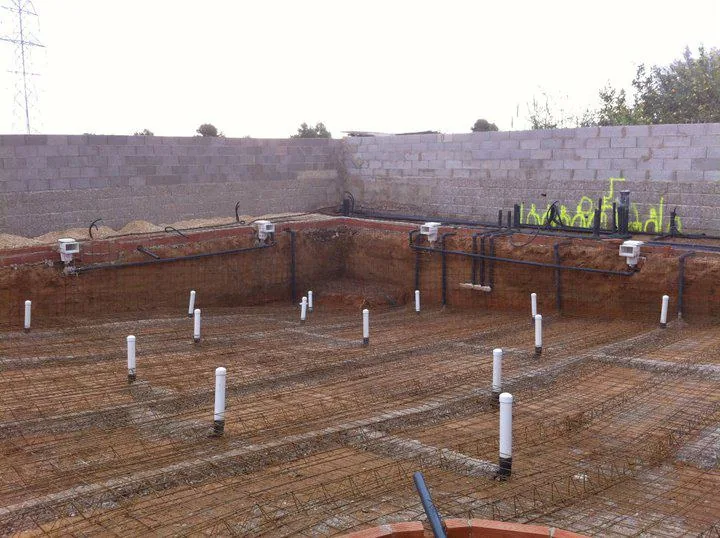
Photo: Matiasamerino / Wikimedia Commons, CC BY-SA 4.0
6. Build the floor and cove
Most vinyl pools have a floor of vermiculite mix or a sand-cement grout, troweled smooth over the soil. Build a cove at the base of the walls so the liner has a smooth curve to sit on. The floor must be smooth and free of stones; everything shows through the liner.
7. Install the liner and fill
Hang the liner in the bead track at the top of the wall. Use a shop vac or a vacuum pump behind the liner to pull it tight, then begin filling. Smooth out floor wrinkles with the first few inches of water. Cut in the fittings once the water is just below them, as explained in how to install above ground pool liner, which uses the same method.
8. Backfill and pour the deck
Backfill behind the walls with gravel or clean fill as the pool fills, keeping the backfill level close to the water level so the walls are not pushed out of shape. Then form and pour the deck, or set pavers. Install the coping, steps, ladder and fence.
How Long Does It Take to Build a DIY Inground Pool?
| Phase | Typical time |
|---|---|
| Permits and ordering | 2 – 8 weeks |
| Excavation | 1 – 2 days |
| Walls, braces and plumbing | 2 – 4 days |
| Concrete collar and cure | 1 – 3 days |
| Floor and liner | 2 – 3 days |
| Fill and backfill | 2 – 4 days |
| Deck and fence | 1 – 3 weeks |
Most people doing inground pool construction themselves, working weekends, finish in 3 to 8 weekends, plus time waiting for permits, inspections and the liner.
Which Jobs to Hire Out
A do it yourself inground swimming pool does not mean doing every job by hand. Most successful builders of an in ground DIY pool hire out the riskiest steps and keep the rest:
- Excavation: unless you have operated an excavator before, hire a rig and operator.
- Electrical and bonding: always a licensed electrician.
- Concrete deck: a large flatwork pour needs a crew.
- Fiberglass shell setting: many owners pay a pro to set and level the shell.
- Liner installation (optional): some kit sellers have installers who can do just this step.
DIY Fiberglass Pool vs Vinyl Kit
| Factor | Vinyl pool kit | DIY fiberglass pool |
|---|---|---|
| All-in DIY cost | $10,000 – $34,000 | $25,000 – $50,000 |
| Shapes and sizes | Many; custom shapes possible | Limited to factory molds; max width about 16 ft for shipping |
| Build difficulty | More steps, more labor | Fewer steps, but critical leveling and crane work |
| Long-term costs | New liner every 8 – 12 years ($3,000 – $5,000) | Low; gelcoat lasts 15 – 25+ years |
| Install time | Weeks | Days once the hole is ready |
For more on these two pool types, see concrete vs fibreglass swimming pool.
Inground Pool Construction: DIY vs Contractor
Every construction pool job, and all inground swimming pool construction, follows the same basic order whether a contractor or a homeowner does the work: design, permits, digging, structure, plumbing, electrical, floor, finish, fill, deck. The construction of pool shells from diy pool kits is no different in order. What changes with a kit is who does each step and who manages the schedule. Here is how inground pool construction compares:
| Step | Contractor-built pool | DIY in ground pool kit |
|---|---|---|
| Design and permits | Contractor draws plans and pulls permits | Kit seller supplies plans; you apply for permits |
| Excavation | Contractor's crew | Hired operator or rented machine |
| Walls and structure | Crew of 3 – 5 in 1 – 2 days | You and 2 – 3 helpers over a weekend |
| Plumbing | Contractor's plumber | You, following kit plans, then inspected |
| Electrical and bonding | Licensed electrician | Licensed electrician (same) |
| Floor and liner | Crew in 1 – 2 days | You, or a liner installer for this step |
| Deck | Contractor or concrete sub | Concrete contractor or pavers you set |
| Warranty | Workmanship warranty from the builder | Product warranties only |
A contractor's main value in the construction of swimming pools is speed, crew size and accountability. A kit's main value is cost. If you have a flexible schedule and reliable helpers, building the pool yourself is a realistic project. If you need the pool done by a fixed date or have a difficult site, the contractor route is safer.
How to Choose Swimming Pool Kits
Swimming pool kits vary a lot in quality, and many sellers market online. Compare in ground pool kits on these points before you buy:
- Wall material and thickness. Heavy-gauge galvanized steel or thick polymer panels with strong braces last longest.
- Liner. A custom liner made to your pool's measurements, 20 to 30 mil thick, with a decent warranty.
- Equipment. A variable-speed pump and a filter sized for the pool. Cheap single-speed pumps cost more to run.
- Complete parts list. Main drain, steps, skimmer, returns, coping, plumbing fittings and hardware all included.
- Plans and support. Clear engineering drawings for permits, step-by-step instructions, and real people to call during the build.
- Shipping. Freight is often extra and can cost $500 to $1,500. Make sure the truck can reach your driveway.
- Reviews from DIY builders. Look for build photos and stories from people who used the same inground swimming pool kits.
Do it yourself pool kits, and especially do it yourself inground pool kits sold at very low prices, often skip parts or use thin walls. A slightly higher price for a complete, well-supported kit usually saves money in the end. When comparing diy inground swimming pool kits, or any single diy pool kit, list every part and service included, then add the cost of anything missing.
Building a Swimming Pool on a Difficult Site
Not every yard is easy for building a swimming pool. Watch for these site problems before you buy a kit:
- Sloped yards: a slope needs a retaining wall or a semi inground design. DIY semi inground pool kits are often the best answer.
- Rock: hitting ledge rock during the dig can add thousands for breaking and hauling. A test hole before you order helps.
- High water table: groundwater in the hole makes building the pool harder and can float a pool or lift a liner. Plan for a sump or well point and a hydrostatic valve.
- Clay soil: clay swells when wet and shrinks when dry, which can push on walls. Use gravel backfill and good drainage.
- Poor access: if an excavator cannot reach the yard, digging by hand or with a mini excavator takes much longer.
DIY Fibreglass Swimming Pool: What to Know
A diy fibreglass swimming pool skips the wall, floor and liner steps entirely. The shell arrives in one piece, and the work is all about the hole and the base. To install a diy fiberglass swimming pool well:
- Dig the hole to the shell's exact shape, about 1 to 2 feet larger all around.
- Lay a compacted base of crushed stone or sand, level to within about 1/2 inch.
- Set the shell with a crane, check level, and adjust the base if needed.
- Connect the plumbing and pressure test it.
- Fill the shell with water and backfill with gravel at the same time, keeping the backfill level within a few inches of the water level.
- Pour a concrete bond beam around the top, then the deck.
Shipping limits fiberglass pools to about 16 feet wide, so large or custom shapes are not possible.
How to Make an Inground Swimming Pool Last
Learning how to make pool water and equipment last is the final step of the build.
Once you make a pool, keep it in good shape so the money you saved does not go into repairs. Keep the water balanced, run the pump enough each day to filter the water, clean the skimmer and filter, and close the pool correctly in cold climates. Inspect the liner each spring, and fix small tears quickly. For yearly costs, see cost to maintain a pool.
Is a DIY Swimming Pool Kit Right for You?
A diy swimming pool kit is a good fit if you:
- Have done projects like decks, sheds, concrete pads or plumbing before.
- Can count on two or three helpers for the wall and liner days.
- Have a reasonably level, accessible yard.
- Want to save money and are willing to manage the schedule.
It may not be right if you have a steep or rocky site, need the pool done fast, or do not want to coordinate trades and inspections. In that case, a contractor or a hybrid approach (contractor digs and sets walls, you finish) may be best.
Pros and Cons of DIY Inground Pool Kits
Pros
- Save 30% to 50% compared with a contractor-built pool.
- Choose your own timing, layout and finish.
- Many kits include support from the seller.
- You know exactly how your pool was built.
Cons
- A lot of hard physical work.
- Mistakes (out-of-level walls, a rough floor) are costly and hard to fix later.
- You coordinate excavation, concrete, electrical and inspections yourself.
- No installer warranty on workmanship.
- Some lenders and insurers treat DIY pools differently.
Common Mistakes When Building a Pool From a Kit
- Skipping the permit or the utility locate.
- Digging too deep at the walls and filling back with loose soil.
- Walls not level or not square.
- Backfilling before the pool has water in it, which can push walls inward.
- Not pressure testing plumbing before burying it.
- A rough floor that shows through the liner.
- Forgetting the cost of the deck, fence and landscaping.
- Ignoring a high water table, which can float a pool or cause liner problems; ask about a hydrostatic relief valve or well point.
DIY Inground Pool Kits: Key Points
- DIY inground pool kits include walls, braces, a liner, fittings and equipment.
- Kits cost $5,000 to $20,000; finished DIY pools cost about $10,000 to $34,000.
- DIY fiberglass pools cost $25,000 to $50,000 and install faster.
- Hire out the excavation and electrical work.
- Walls must be level and square; the floor must be smooth.
- Budget for a deck, a fence and permits.
Frequently Asked Questions
Are DIY inground pool kits worth it?
For handy owners with time and help, yes. They can save 30% to 50% compared with a contractor-built pool.
How much does a DIY inground pool cost?
About $10,000 to $34,000 for a vinyl kit pool, including digging, concrete and permits, but not a full deck or fence.
Can I do an in ground pool DIY project myself?
Yes, with a kit. Most owners hire an excavator and an electrician and do the rest themselves.
What is the cheapest inground pool to build?
A steel wall vinyl pool kit installed by the owner is usually the cheapest permanent inground pool.
How long do inground pool kits last?
The walls last 30 years or more; the vinyl liner needs replacing every 8 to 12 years.
Do I need a permit for a DIY pool?
Almost always. Most towns require building and electrical permits and a fence that meets code.
How do I build an inground pool on a budget?
Use a steel or polymer wall vinyl kit, keep the shape simple (rectangle), hire only the excavator and electrician, and build a modest deck. That is the lowest-cost way to build an inground pool that lasts.
How do you build an inground pool step by step?
Get permits, lay out the pool, excavate, assemble and level the walls, install plumbing and electrical, pour the concrete collar, build the floor, hang the liner, fill, backfill and pour the deck.
How to make an inground pool without a contractor?
Buy an inground pool kit with full plans, hire an excavator for the dig and a licensed electrician for bonding and wiring, and do the assembly, liner and finishing work yourself with helpers.
How to build a swimming pool cheaply in a small yard?
A DIY stock tank pool kit or a small semi inground pool kit is the cheapest option for small yards, at about $1,500 to $15,000.
Are in ground pool kits hard to install?
They take hard work and care, but not special skills. Getting the walls level and the floor smooth are the most important parts.
What size inground pool kit should I buy?
For most families, 14 x 28 ft to 16 x 32 ft is a good size. Bigger pools cost more to build, heat and maintain.
Sources
- HomeGuide: Inground pool cost
- Angi: Inground pool cost
- Fixr: Cost to build a swimming pool
- CPSC: Pool and spa safety
- Call 811: Know what is below