
In Ground vs Above Ground Pool: Costs, Pros, Cons and Which to Choose
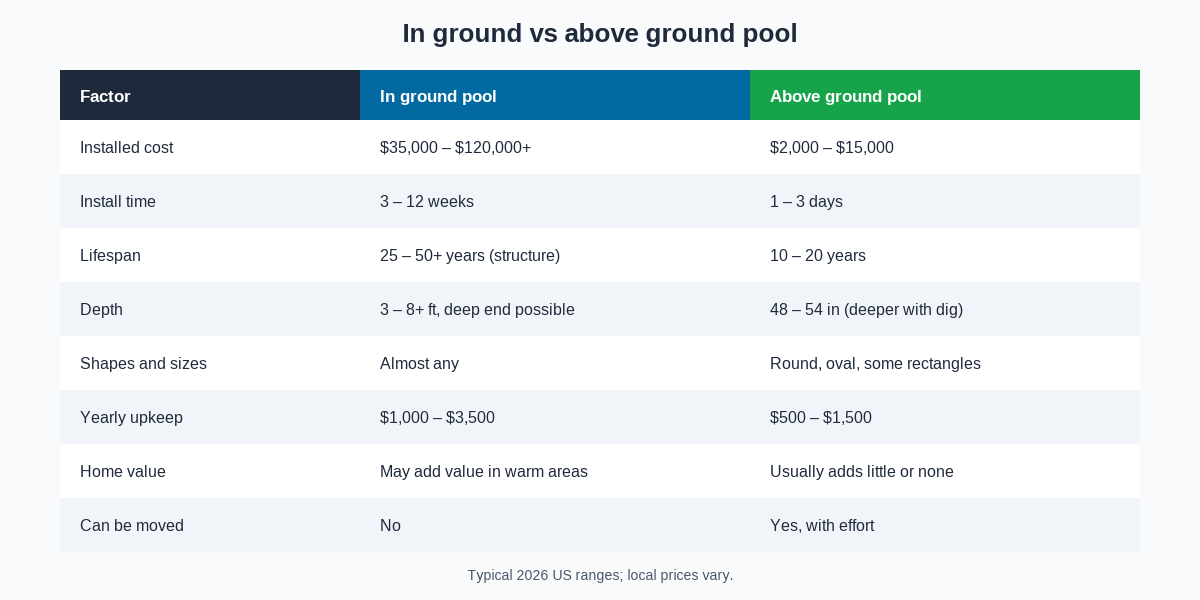
Chart: Asphapro.com
Quick Answer
In the in ground vs above ground pool choice, an above ground pool costs far less, about $2,000 to $15,000 installed, goes up in a few days and can be moved, but lasts 10 to 20 years, comes mostly in round and oval shapes and adds little to home value. An inground pool costs $35,000 to $120,000 or more and takes weeks to build, but lasts decades, can be any shape and depth, and can add value in warm markets. A middle option is a semi inground pool, or an above ground pool partially in ground, using walls rated for backfill. Never bury a standard above ground pool; its walls are not built to hold back soil.
Choosing between an in ground and an above ground pool is one of the first decisions every future pool owner faces. Budget usually leads the way, but it is not the only factor. How long you plan to stay in your home, how you will use the pool, your yard, your climate and local rules all matter. Both types can give years of fun if they match your needs.
This guide compares an in ground vs above ground pool on cost, install time, lifespan, maintenance, safety and value, and answers a common question: can you install above ground pool inground, or put an above ground pool partially in ground? For prices in more detail, see our guides on above ground pool installation cost and vinyl inground pool cost.
In Ground vs Above Ground Pool: Quick Comparison
Here is the short version of the above ground pool vs inground pool comparison. Above ground pools win on price, speed and flexibility. Inground pools win on looks, lifespan, design freedom, depth and long-term value. Semi inground pools sit between them. The chart above sums up the key differences, and the sections below explain each one in plain terms so you can weigh them for your own yard.
Cost: Above Ground Pool vs Inground Pool
Above ground pools cost about $1,000 to $5,000 for the pool kit and $2,000 to $15,000 installed, depending on size, wall type (steel, resin or hybrid), the liner, equipment and whether you add a deck. A basic 24-foot round steel pool installed on a level sand base may cost $4,000 to $7,000. Adding a deck can double that.
Inground pools cost much more. Vinyl liner pools typically run $35,000 to $65,000 installed, fiberglass $45,000 to $85,000, and concrete $55,000 to $120,000 or more. Decking, fencing, landscaping, lighting and extras can add $10,000 to $50,000. See fiberglass vs vinyl pool and our guide to the concrete pool.
In short, the price gap in an in ground vs above ground pool decision is usually $30,000 to $100,000. That gap shapes most buyers' choices.
Installation Time and Process
An above ground pool can be installed in one to three days once the site is level. The crew clears and levels the ground, lays a sand or foam base, assembles the wall and frame, hangs the liner, fills the pool and connects the pump and filter. Many handy owners install their own above ground pool over a weekend. See how to put up an above ground pool.
An inground pool takes far longer. Permits and design can take weeks. Then comes excavation, plumbing, electrical work, the pool shell, backfill, decking and finishing. Fiberglass pools can be done in two to four weeks of work, vinyl pools in three to six weeks, and concrete pools in eight to twelve weeks or longer. Weather, inspections and contractor schedules often add time. See how long does it take to build a pool.
Lifespan and Durability
Above ground pools usually last 10 to 20 years. Steel walls can rust, especially where the liner leaks or water sits against the wall. Resin pools resist rust and often last longer. Liners last 5 to 9 years. Frost, ground movement and poor bases shorten the life of any above ground pool.
Inground pool structures last much longer. Concrete shells can last 50 years or more with resurfacing every 10 to 15 years. Fiberglass shells last 25 years or more. Vinyl inground pools have walls that last decades, with liners replaced every 7 to 10 years. Over the long term, the inground pool spreads its higher cost over more years.
Size, Shape and Depth
Above ground pools come mostly in round and oval shapes from 12 to 33 feet across, with wall heights of 48 to 54 inches. Some makers offer rectangles. Many allow a "deep end" or "expandable liner" by digging a shallow bowl in the center, giving 6 to 7 feet of depth in the middle.
Inground pools can be almost any size, shape and depth. Concrete pools are fully custom. Fiberglass pools come in set shapes from each maker, and vinyl pools offer many shapes. Inground pools can include tanning ledges, built-in steps and benches, spas and deep ends. See inground pool ideas.
Photo: Georges Seguin (Okki), Wikimedia Commons, CC BY-SA 4.0
Maintenance and Running Costs
Both types need the same basic care: running the pump and filter, testing and balancing water, adding sanitizer, skimming and vacuuming, and opening and closing each season. Above ground pools hold less water, so they use fewer chemicals and less power, typically $500 to $1,500 a year. Inground pools hold more water and often have heaters, lights and larger pumps, costing $1,000 to $3,500 a year to run. Inground pools also face larger one-off costs: liner replacement ($4,000 to $8,000 for vinyl inground), resurfacing ($6,000 to $15,000 for concrete), and equipment upgrades.
Above ground pools are easier to clean in some ways because the walls are short and the floor is small, but debris can blow in more easily when there is no deck. Inground pools with decks and automatic covers can be easier to keep clean day to day.
Total Cost Over 20 Years
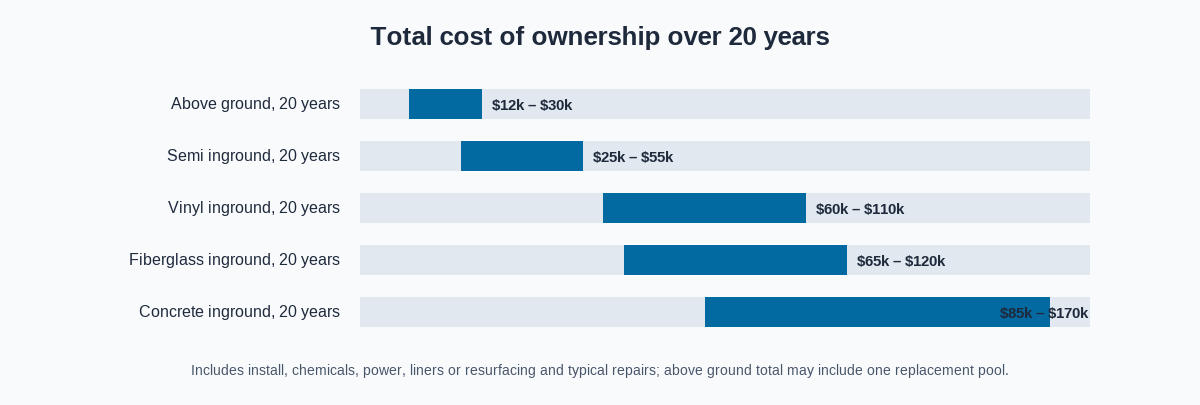
Chart: Asphapro.com
Looking at the full cost of owning a pool over 20 years gives a fairer picture than the install price alone. An above ground pool might cost $12,000 to $30,000 over 20 years, including one replacement pool, liners and running costs. A vinyl inground pool might cost $60,000 to $110,000, and a concrete pool $85,000 to $170,000. Even over the long term, the above ground pool is far cheaper, but the gap in cost per year narrows, and the inground pool may return some of its cost when you sell.
Home Value and Resale
Above ground pools are usually seen as personal property, like outdoor furniture. They rarely add value and some buyers ask for them to be removed. Inground pools are part of the property. In warm climates and higher-end neighborhoods where pools are common, a well-kept inground pool can add value and help a home sell. In colder areas, or where buyers worry about upkeep and safety, the value added may be small. Few pools return their full cost at sale. See how much value does a pool add to a home.
Safety
Above ground pools have a built-in barrier: their walls. With a removable or lockable ladder, children cannot easily get in. Still, many codes require a fence or barrier for any pool over 24 inches deep, and decks need gates. Inground pools are level with the yard, so a full fence with a self-closing, self-latching gate is essential and required in most places. Automatic safety covers add protection. For barrier costs, see pool fence cost.
Can You Install Above Ground Pool Inground?
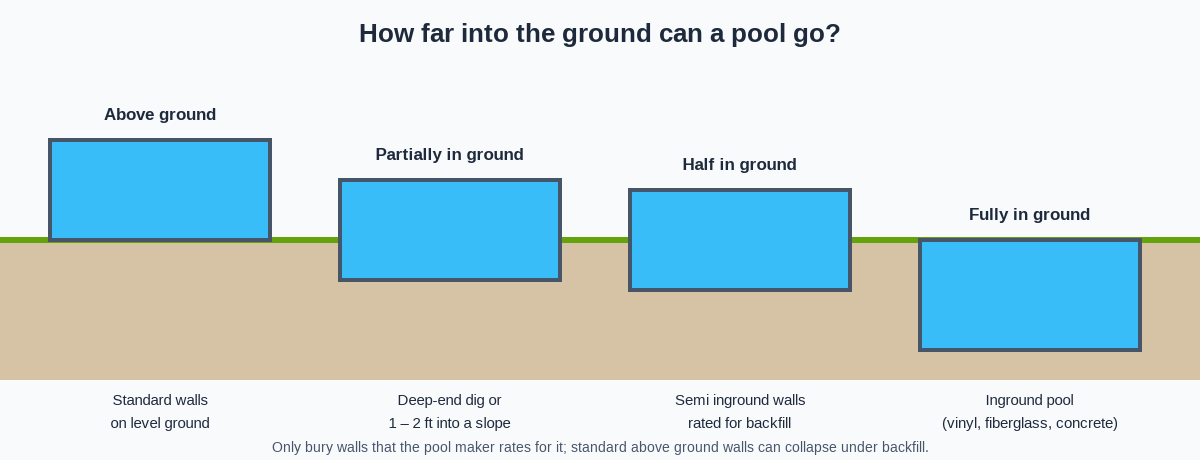
Diagram: Asphapro.com
Can you install above ground pool inground? Not a standard one. The walls of a normal above ground pool are designed to hold water pressure from the inside, with nothing pushing from the outside. If you bury them, the weight of soil, especially when wet or frozen, presses inward, and when the pool is drained even partly, the walls can buckle and collapse. Burying also traps moisture against steel walls, speeding rust. Most makers void the warranty if a standard pool is buried.
There are, however, safe ways to set a pool lower:
Deep-end dig. Many above ground pools allow digging a bowl in the center of the floor, with an expandable liner, so the walls stay fully above ground while the middle is deeper.
Semi inground pools. These use heavy-duty steel, aluminum or resin walls with extra bracing, rated to be buried part or most of the way. They are the right choice for an above ground in ground pool look. See cost of semi inground pool.
Slope installs. On a sloped yard, some pools rated for partial burial can be set into the slope on the high side, with a retaining wall built to hold the soil away from the pool wall.
Above Ground Pool Partially in Ground
An above ground pool partially in ground usually means the walls sit 6 to 24 inches below grade, often to level a sloped yard or lower the rim for a ground-level deck. This is only safe with a pool rated for partial burial, a gravel backfill that drains well, and a good drainage plan to keep water away from the walls. Some owners build a block or concrete retaining wall a few inches outside the pool wall, so the soil presses on the retaining wall instead of the pool. That design lets a standard above ground pool in ground sit lower without any soil touching it, though it costs more.
Above Ground Pool Half in Ground
An above ground pool half in ground, with about half the wall height buried, is a semi inground installation. It needs a semi inground pool model, a level base, backfill with gravel or stone, and often a deck built to the rim. The result looks much like an inground pool from the deck side at a fraction of the cost. Semi inground pools cost about $10,000 to $40,000 installed. When people search for an inground above ground pool, this is usually what they want.
Yard and Site Considerations
Your yard can make the in ground vs above ground pool choice for you. Inground pools need access for excavators and dump trucks, usually a path at least 8 to 10 feet wide, and a site without major underground utilities, septic fields or very high groundwater. Rocky ground can add thousands of dollars to digging costs. Steep slopes need retaining walls. If your yard has tight access, a small fiberglass shell may still be possible with a crane, but costs rise.
Above ground pools need a flat, firm, well-drained area. They can go in yards that excavators cannot reach, since the parts are carried in by hand. On sloped yards, you can dig into the high side to level the base, but you should not build up the low side with loose fill, which can settle and tilt the pool. Avoid placing any pool under trees, over buried pipes or near septic systems. Check setbacks from property lines and buildings with your local building office for either type.
Climate Considerations
In warm climates where pools are used most of the year, the longer life, better looks and higher value of an inground pool make more sense, and many buyers expect one. In cold climates with short swim seasons, the cost per swim of an inground pool is much higher, so many families choose an above ground pool or a semi inground pool. Both types need winterizing in freezing areas, but above ground pools are more exposed to ice damage and wind. Inground pools hold heat a little better since the ground insulates the walls. If you plan to heat the pool, the smaller volume of an above ground pool costs less to heat, but its exposed walls lose more heat per gallon.
Permits, Taxes and Insurance
Most towns require a building permit for an inground pool and often for larger above ground pools, plus an electrical permit and a barrier inspection. Permit fees range from about $100 to $2,000 depending on the project and location. Inground pools usually raise your property tax assessment because they are permanent improvements; above ground pools usually do not. Home insurance premiums may rise slightly for either type, and insurers often require a fence, a locking gate or a removable ladder. Talk to your insurer before you buy, especially if you add a diving board or slide, which can raise liability concerns.
DIY Options
One big difference in the above ground pool vs inground pool decision is how much you can do yourself. Many owners install an above ground pool themselves, saving $1,000 to $3,000 in labor, though leveling the base properly is critical and electrical work should be done by a licensed electrician. A DIY inground pool is rare. Some owners manage parts of a vinyl or fiberglass inground project, such as landscaping, fencing or decking, while hiring pros for excavation, plumbing, electrical and the shell. Mistakes on an inground pool are costly to fix, so most owners hire a reputable builder.
An Above Ground Pool With a Deck: The Middle Ground
For many families, an above ground pool with a good deck is the best of both worlds. A deck around part or all of the pool makes it easier to get in and out, gives space for loungers, hides the pool walls and gives a more built-in look, all for far less than an inground pool. Decks cost about $3,000 to $25,000 depending on size and material. Pairing a resin or hybrid pool, which lasts longer than steel, with a composite deck gives a long-lasting setup. When you compare an in ground vs above ground pool, include this option in your planning, since it closes much of the gap in looks and comfort. See above ground swimming pool deck ideas.
Heating and Swim Season
Heating extends the swim season for either type. Above ground pools can use small heat pumps, solar panels or solar covers at low cost. Inground pools often use larger gas heaters or heat pumps, which cost more to buy and run but heat more water. A solar cover is the cheapest heating upgrade for any pool, adding several degrees and cutting evaporation. See how much does it cost to heat a pool.
Common Regrets
Owners of above ground pools sometimes regret choosing a size that is too small, skipping a deck, or placing the pool on a poorly leveled base, which shortens its life. Some wish they had bought a stronger resin pool instead of the cheapest steel model. Owners of inground pools sometimes regret skipping features such as an automatic cover, lighting or a tanning ledge that are expensive to add later, or choosing a size that is too big for the yard. Others underestimate running and repair costs. Talking to friends and neighbors with each type of pool is one of the best ways to avoid these regrets before you decide on an in ground vs above ground pool.
Three Example Families
Family A: young children, tight budget. A family with two children under eight, a $10,000 budget and plans to move in five years chooses a 24-foot round resin above ground pool with a small deck and a lockable gate for about $9,000. It gives them several summers of fun, and they can sell or move it when they leave.
Family B: long-term home, warm climate. A couple in Texas planning to stay 20 years chooses a 15 x 30 foot fiberglass inground pool with a tanning ledge and a concrete deck for $70,000. They swim from April to October, and the pool fits the neighborhood, where most homes have one.
Family C: sloped yard, mid-range budget. A family in Pennsylvania with a sloped yard chooses a semi inground oval pool set into the slope, with a wraparound composite deck, for $32,000. It looks like an inground pool from the house side at about half the price.
Questions to Ask Before Deciding
Before you choose between an inground above ground pool option, a full inground pool or a standard above ground pool, ask yourself a few questions. How much can you spend in total, including decking, fencing and running costs? How long will you stay in the home? Who will use the pool, and how? Does your yard have the access, slope and space for each type? What do local codes require? How much maintenance are you willing to do? Clear answers to these questions make the right choice in the in ground vs above ground pool debate much easier to see.
Above Ground in Ground Pool Installs: Costs and Risks
Interest in an above ground in ground pool setup, where the pool is set partly or fully into the ground, has grown because it promises an inground look at an above ground price. The real cost depends on how it is done. A deep-end dig on a standard pool adds only $300 to $1,500 for extra excavation and an expandable liner. A semi inground pool, built for partial burial, costs $10,000 to $40,000 installed with a deck. Building a retaining wall around a standard pool, so no soil touches the pool wall, adds $3,000 to $10,000 or more. The cheapest approach, simply backfilling soil against a standard above ground pool in ground, is the most dangerous, and it is the one that most often ends with collapsed walls, a ruined liner and a voided warranty.
If you want an above ground pool partially in ground, buy a model whose maker states it can be installed that way, follow the maker's backfill and drainage instructions, and ask the dealer to show you installs they have done. Done right, an above ground pool half in ground can last as long as any above ground pool and look far better. Done wrong, it can fail within a season or two. The extra planning is worth it.
Water Volume and Chemical Use
A typical 24-foot round above ground pool holds about 13,000 to 15,000 gallons, while a 16 x 32 foot inground pool holds about 20,000 to 25,000 gallons. More water means more chemicals, more heating and a bigger pump. This is a quiet but steady part of the cost gap between an in ground vs above ground pool. Smaller pools also respond faster to chemical changes, so balancing them can be quicker, though they can also swing out of balance faster after heavy rain or a pool party.
Which Should You Choose?
Choose an above ground pool if: your budget is under about $15,000, you may move within a few years, you rent or plan to remove the pool later, your yard is small or has poor access for excavators, or you want a pool this summer.
Choose an inground pool if: you plan to stay many years, want a custom shape, depth or features, want the pool to blend with landscaping, and live where pools add value.
Choose a semi inground pool if: you want an inground look on a mid-range budget, have a sloped yard, or want more durability than a standard above ground pool.
In Ground vs Above Ground Pool: Key Points
- Above ground pools cost $2,000 to $15,000 installed; inground pools $35,000 to $120,000+.
- Inground pools last decades and allow any shape and depth; above ground pools last 10 to 20 years.
- Do not bury a standard above ground pool; use a semi inground model instead.
- Choose based on budget, how long you will stay, your yard and how you will use the pool.
Frequently Asked Questions
Is an above ground pool worth it?
Yes for many families. It gives most of the fun of a pool at a fraction of the cost.
Can you bury an above ground pool?
Not a standard one. Only semi inground models rated for backfill can be buried part way.
Which lasts longer, inground or above ground?
Inground pools last much longer, often 25 to 50 years or more for the structure.
Is an inground pool harder to maintain?
The tasks are the same, but inground pools hold more water and cost more to run.
Does an above ground pool add home value?
Rarely. Most buyers see it as personal property, and some ask for it to be removed before closing.
Do above ground pools need a fence?
Often yes, depending on local codes, especially with a deck. Check with your building office before you install.
Sources
- CPSC: Pool and spa safety
- CPSC: Safety barrier guidelines for residential pools
- Pool and Hot Tub Alliance
- ICC: International Swimming Pool and Spa Code