
Pool Deck Concrete: Concrete Pool Deck Installation, Finishes and Cost
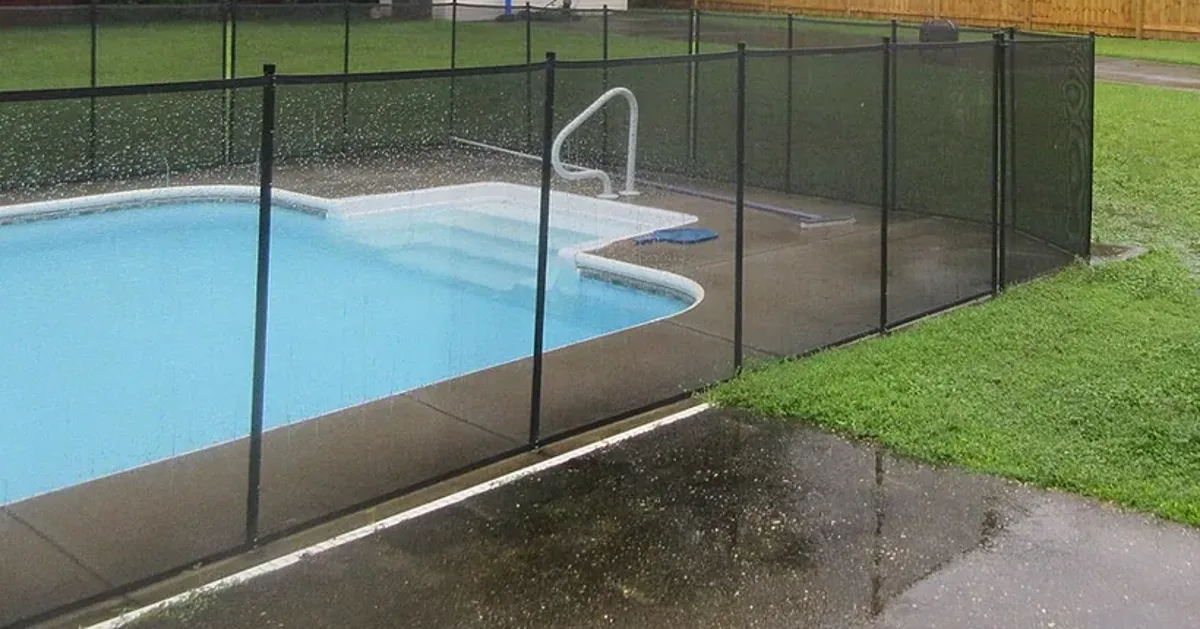
Photo: Infrogmation, Wikimedia Commons, CC BY-SA 4.0 (cropped)
Quick Answer
Pool deck concrete is the most common surface around inground pools because it is strong, affordable, easy to shape around curves and can be finished to be slip-resistant and cool underfoot. A typical concrete pool deck installation uses a 4 inch slab of 3,000 to 4,000 psi air-entrained concrete on a compacted gravel base, sloped 1/8 to 1/4 inch per foot away from the pool, with a flexible expansion joint at the coping and control joints every 8 to 10 feet. Finishes range from a light broom texture to exposed aggregate, stamped patterns and spray-on cool deck coatings. A plain broom-finished cement pool deck typically costs $8 to $15 per square foot installed, and decorative finishes $12 to $25 or more.
The deck around a pool takes more abuse than almost any other outdoor concrete. It is splashed with chlorinated or salt water every day, baked by the sun, walked on with bare wet feet, and in cold climates frozen and thawed all winter while soaked. It has to drain water away from the pool, stay comfortable to walk on, resist slipping, and look good next to the water. The backyard deck in the photo above shows the basic idea: a band of concrete wrapping the pool, sloped toward the lawn so rain and splash water run off, with a fence set into it for safety.
This guide covers why concrete is the go-to choice for pool decks, how concrete pool deck installation works step by step, the right thickness, slope, joints and reinforcement, finishes that are safe and cool, sealing and maintenance, how to choose pool concreters, and what a new deck costs. For problems with an existing deck, see our guides to concrete pool deck repair and concrete pool deck resurfacing.
Why Concrete Is the Most Common Pool Deck
Homeowners can choose from concrete, pavers, natural stone, tile, wood and composite decking around a pool, but poured pool deck concrete remains the most popular for several reasons.
Cost. A plain cement pool deck is usually the cheapest hard surface per square foot, often half the price of pavers or stone.
Shape. Concrete is placed as a liquid, so it follows freeform pool shapes, curves, steps and raised beds without cutting or wasted material.
Strength and durability. A well built concrete deck for pool areas lasts 20 to 30 years or more, handles furniture, foot traffic and maintenance equipment, and does not rot or splinter like wood.
Finish options. The same slab can be broom textured, exposed aggregate, stamped to look like stone or wood, stained, or coated with a textured cool deck finish.
Integration. Pool concrete decking can include deck drains, skimmer lids, light junction boxes, umbrella sleeves, fence post sleeves and handrail anchors, all cast in during the pour.
The trade-offs are that concrete can crack, can get hot in direct sun, and can be slippery if finished too smooth. All of these are controlled by design and finish choices, as covered below. For other materials, see stamped concrete vs pavers, paving stones vs concrete and cement tile.
Planning a Concrete Pool Deck
Good pool deck concrete starts with a plan that covers size, layout, drainage, features and local rules.
Size. A minimum of 3 to 4 feet of deck all around the pool is a common guideline for safe walking, and many codes and pool safety guidelines call for a continuous deck of at least 4 feet on part or all of the perimeter. Most homeowners want a larger area, often 8 to 15 feet on one or two sides, for loungers, a table and a grill. A common rule of thumb is a deck area at least equal to the water surface area, and often twice as much for entertaining.
Layout. Plan where furniture, shade, the pool equipment pad, the gate, the house door and the path to the bathroom will go, and connect them with the deck. Leave room for planting beds and avoid deep shade from trees that drop leaves into the pool.
Drainage. Decide where water will go before the forms go in. The deck must slope away from the pool, and water must then go somewhere: onto the lawn, into planting beds, into deck drains or a trench drain, or into a dry well. Never slope a deck toward the house foundation. See concrete trench drain.
Features. Mark locations for deck drains, umbrella sleeves, fence post sleeves, handrail and ladder anchors, lights, outlets and conduit, so they can be set before the pour.
Rules. Check local building codes and pool barrier requirements. Many areas require a permit for the deck, a minimum fence or barrier height around the pool, and specific gate hardware. Fence posts are often set in sleeves cast into the concrete deck for pool barriers.
Thickness, Base, Reinforcement and Concrete Mix
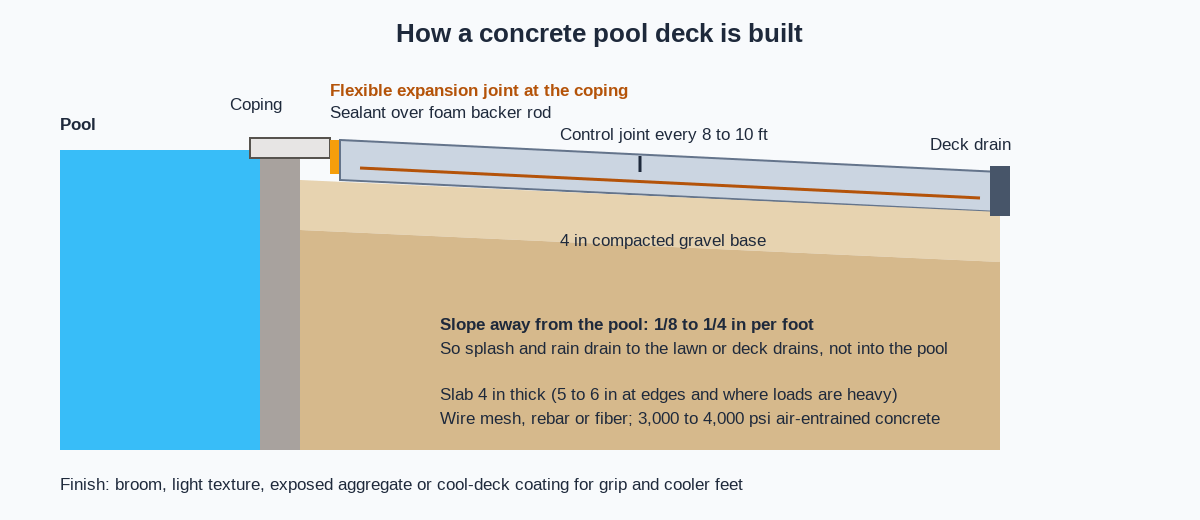
The cross section above shows the standard build-up of pool deck concrete. Most residential decks are 4 inches thick, thickened to 5 or 6 inches at edges, where heavy equipment will cross, and where the deck meets the pool beam. The slab sits on 4 inches or more of compacted crushed stone or gravel over firm, compacted soil. Soil around a new pool is often backfill that was dug out and replaced, which settles over time; it must be compacted in layers or allowed to settle and be watered in before the deck is poured, or the deck will sink and crack.
Reinforcement is usually welded wire mesh or #3 or #4 rebar on a grid of 18 to 24 inches, supported on chairs so it sits in the middle of the slab, often with synthetic fibers added to the mix to reduce surface cracking. Some pool builders tie the deck rebar to the pool bond beam; others keep the deck separate with an expansion joint. Local practice and the pool type decide. See rebar in concrete, wire mesh for concrete and fiber reinforced concrete.
The right concrete for pool deck slabs is usually a 3,000 to 4,000 psi mix with a low water-cement ratio, air-entrained in freeze-thaw climates. Salt water pools and areas that see deicing salt in winter benefit from 4,000 psi concrete and a good sealer, because chlorides attack concrete surfaces and steel. Avoid adding water at the truck to make the concrete easier to place; it weakens the surface, which is exactly the part that has to resist pool chemicals and wear. See concrete mix ratio, concrete slump and does salt damage concrete.
Pool Deck Concrete for Different Pool Types
The type of pool changes how the concrete pool deck is detailed. With a gunite or shotcrete pool, the shell is itself concrete, and the pool deck concrete is usually poured after the bond beam and coping are finished. Builders either separate the concrete pool deck from the bond beam with an expansion joint, or, in some regions, pour the deck over a cantilevered edge so the deck itself forms the coping. Either way, the joint between the moving parts is what keeps the concrete pool deck from cracking.
With a vinyl liner pool, the walls are steel or polymer panels with a concrete collar poured around the base, and the coping is usually an aluminum or extruded track that holds the liner. The concrete pool deck is poured against or over the coping track, and the backfill around the walls is often gravel or sand that must be compacted carefully. Settling backfill is the main cause of sunken pool deck concrete around liner pools. With a fiberglass pool, the one-piece shell is set on sand or gravel and backfilled, and the concrete collar and concrete pool deck are poured around it once the pool has been filled with water, so the shell is pushed into its final shape. Fiberglass pool builders often specify a concrete collar about a foot wide around the shell, tied to the deck.
Above ground pools usually sit on a level pad of sand, pavers or concrete rather than a deck, but some homeowners build a partial concrete pool deck around an above ground pool, with raised steps or a wood deck at the pool edge. The same rules for slope and drainage apply.
Pool Deck Concrete in Hot and Cold Climates
Climate shapes nearly every decision about pool deck concrete. In hot, sunny climates such as the Southwest, Texas and Florida, the priorities are keeping the surface cool and comfortable for bare feet and resisting UV and pool chemicals. That is why cool deck coatings, light-colored broom finishes and salt finishes dominate there, and why pool concreters in those regions often recommend light integral colors. Expansive clay soils in parts of Texas and the Southwest also call for careful moisture control, thicker slabs and more reinforcement in the concrete pool deck.
In cold climates, the concrete pool deck has to survive freezing and thawing while saturated with water, plus snow and the occasional deicing salt. Air-entrained concrete is essential, salt finishes are avoided, the surface should be sealed with a penetrating sealer, and the base must drain well so water does not freeze under the slab and heave it. Pool covers, winter water levels and snow removal around the pool all affect the deck too. Never use rock salt or calcium chloride on new pool deck concrete in its first winter. See pouring concrete in cold weather and best ice melt for concrete.
In coastal areas, salt air and salt water pools add chloride exposure, so a denser 4,000 psi concrete pool deck mix, adequate concrete cover over the steel and a good sealer extend the life of the deck. Rinse salt residue off the pool deck concrete regularly, especially near the waterline where splash dries and leaves crystals behind.
Slope and Drainage
Slope is the most important detail on a concrete pool deck. Pool deck concrete should slope away from the pool at 1/8 to 1/4 inch per foot, about 1 to 2 percent. That is enough for water to run off without being noticeable when you walk. Less slope leaves puddles that become slippery and grow algae; more slope makes furniture wobble and feels uncomfortable.
Sloping away from the pool keeps dirty runoff, lawn fertilizer, mulch and leaves out of the water and protects the pool's chemical balance. Where the deck is wide, sits between the pool and the house, or is surrounded by higher ground, deck drains or a slot drain collect the water. These are set in the forms before the pour, at low points, and piped to a safe discharge point. In areas with expansive clay soils, keeping water away from the pool shell and the deck base is especially important, because wet clay swells and lifts slabs.
Expansion Joints and Control Joints
Two kinds of joints keep a pool deck from cracking where it should not. The first is the expansion joint between the deck and the pool coping. Concrete pool decks expand and contract with temperature, and the pool shell moves differently from the deck. Without a flexible joint, the deck pushes on the coping as it expands in summer, cracking or popping coping stones loose. The joint is typically about 3/8 to 1/2 inch wide, filled with foam backer rod and a flexible, UV-resistant sealant made for pool decks, often a self-leveling polyurethane or polysulfide. The sealant needs to be replaced every several years. See concrete pool coping and concrete expansion joints.
The second kind is control joints, also called contraction joints, which are grooves cut or tooled into the slab to make it crack in a straight line inside the groove instead of randomly across the surface. On a 4 inch pool deck, control joints should be spaced about 8 to 10 feet apart, divide the deck into roughly square panels, and run from inside corners, where cracks like to start. They should be cut to at least a quarter of the slab depth, about 1 inch, within 6 to 18 hours of placing. Decorative finishes often use the joints as part of the pattern. See control joints in concrete.
Concrete Pool Deck Installation Step by Step
Concrete pool deck installation is usually done after the pool shell, plumbing, coping and equipment are in, and before the pool is filled with water or just after, depending on the pool type and builder. These are the typical steps.
1. Rough grade and compact. Remove topsoil and debris, bring the subgrade to the right height, and compact backfill around the pool in layers. Treat for termites if required locally.
2. Install underground work. Lay deck drain pipes, electrical conduit for lights and outlets, gas lines for heaters or fire features, and irrigation sleeves under the deck before the base goes in.
3. Place the base. Spread and compact 4 inches or more of crushed stone or gravel, graded to follow the final slope of the deck.
4. Set forms. Set edge forms with wood or flexible plastic forms for curves, staked firmly and set to the correct slope. Place foam or a bond breaker against the coping to create the expansion joint, and set fixtures such as drains, sleeves and anchors to their final height.
5. Place reinforcement. Lay rebar or mesh on chairs, tie it at intersections, and add dowels or ties where the deck connects to steps, walls or other slabs.
6. Pour and screed. Pour the concrete, often with a pump truck or buggies since trucks rarely reach a backyard pool, spread it, and screed it to the forms. See concrete pump truck cost and concrete screed.
7. Float and finish. Bull float the surface, wait for the bleed water to leave, edge along forms and joints, then apply the finish: a broom texture, exposed aggregate wash, stamping, or a smooth float finish ready for a cool deck coating. Never trowel a pool deck to a slick finish. See concrete bull float and types of concrete finishes.
8. Cut joints. Tool or saw control joints at the planned spacing as soon as the concrete is hard enough.
9. Cure. Keep the deck moist or apply a curing compound for at least 7 days, and keep heavy loads off it for a week or more. Proper curing makes the surface harder and more resistant to pool chemicals. See how long does concrete take to cure.
10. Seal and caulk. After the concrete has cured, typically 28 days, install the sealant in the expansion joint and apply a sealer or coating as specified.
Slip-Resistant Finishes for Cement Pool Decks
A concrete pool deck finish must give wet, bare feet good grip without being too rough to walk or sit on. These are the common finishes for cement pool decks.
Light broom finish. The simplest and cheapest finish, made by dragging a soft broom across the fresh concrete. A fine broom texture gives good grip and is comfortable on bare feet. See brushed concrete.
Salt finish. Coarse rock salt is pressed into the fresh surface and washed out after curing, leaving small pits that add texture and a stone-like look. It is popular around pools in warm climates. Salt finishes are not recommended in freeze-thaw climates, where water in the pits can freeze. See rock salt finish concrete.
Exposed aggregate. The top layer of cement paste is washed off to reveal pebbles or stones, giving a natural, very slip-resistant surface. Choose smaller, rounded stones for bare feet. See exposed aggregate concrete.
Stamped concrete. Patterns that imitate flagstone, slate, brick or wood are pressed into the surface and colored. Stamped pool decks look upscale, but deep, smooth textures can be slippery when sealed, so a grit additive in the sealer is important. See stamped concrete patio and stamped concrete patterns.
Cool deck and knockdown coatings. Spray-applied acrylic-modified cement coatings, often called cool deck or knockdown finishes, are applied to a new or existing deck in a splatter pattern and lightly troweled flat. They are lighter in color and slightly textured, which keeps them cooler in the sun and gives good grip. They are very common in hot climates such as Arizona, Texas and Florida.
Pavers or tile over concrete. Some homeowners pour a concrete base and set pavers, porcelain tile or stone on top. This combines a stable concrete base with a different finish. See can you lay pavers over concrete and tile over concrete.
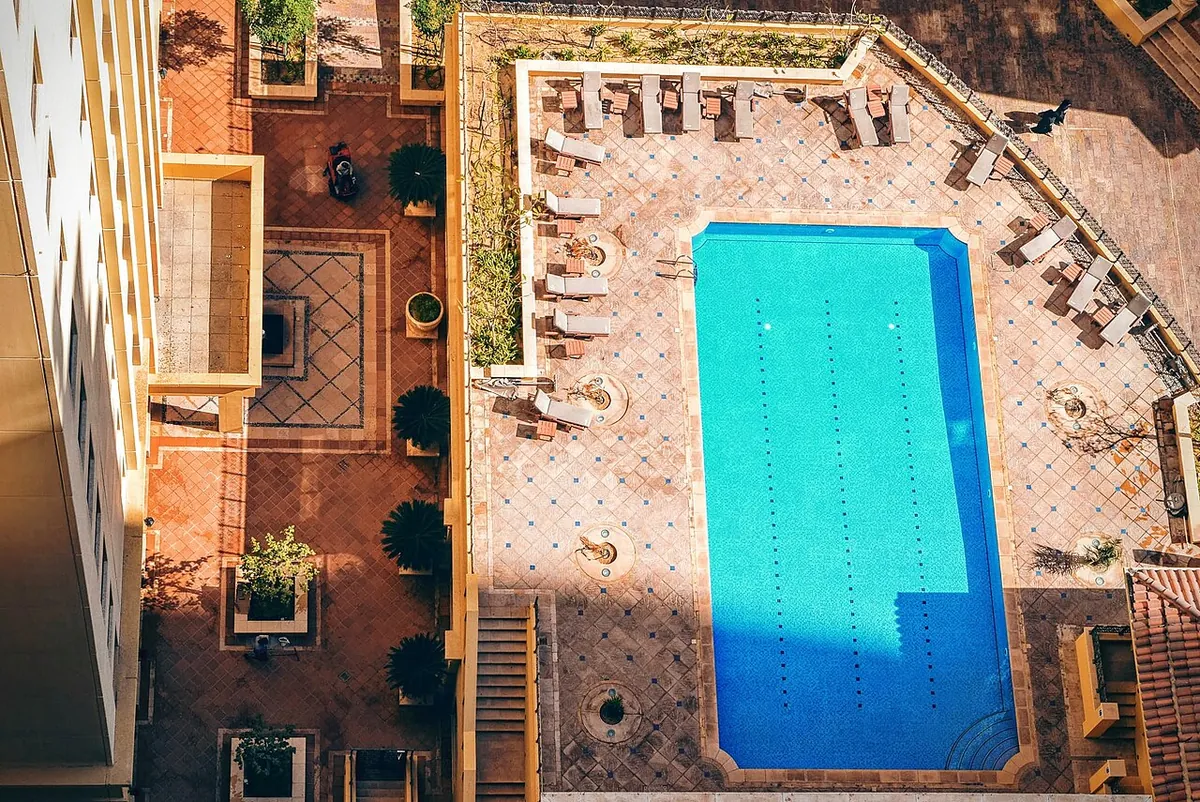
Photo: Tim Gouw, Wikimedia Commons, CC0
The aerial photo above shows a hotel pool where the structural concrete deck has been finished with patterned tile, a common choice for commercial pools. Whatever the surface, the pool deck concrete underneath is still a sloped slab with joints and drains, and the same rules apply.
Keeping Pool Deck Concrete Cool
A concrete pool deck in full sun can get hot enough to be uncomfortable for bare feet. Color matters most: light gray, white and light tan concrete stay much cooler than dark colors. Cool deck coatings, light-colored exposed aggregate and light stains all help. Avoid dark integral colors and dark sealers in sunny climates. Shade from umbrellas, sails and pergolas reduces surface temperature dramatically, and splashing water on the deck cools it quickly. Some cool deck coatings and sealers include reflective pigments that lower surface temperature further. See how to color concrete and concrete staining.
Sealing and Maintaining a Concrete Deck for Pool Areas
Sealing protects pool deck concrete and every concrete pool deck surface from water, chlorine, salt, stains and freeze-thaw damage. Penetrating sealers such as silane or siloxane leave the surface looking natural and do not make it more slippery, which makes them a good choice for broom-finished and exposed aggregate decks. Film-forming acrylic sealers enhance color on stamped and stained decks, but they can be slippery when wet, so a non-skid grit additive should be mixed in. Most sealers need to be reapplied every 2 to 4 years. See concrete sealer and how to seal concrete.
Routine maintenance includes rinsing the deck regularly to wash off chlorine and salt, sweeping leaves and debris so they do not stain, cleaning algae and mildew before they become slippery, checking and replacing expansion joint sealant every several years, and keeping water draining away from the pool. Salt water pools in particular need a good sealer and regular rinsing, because salt crystallizes in the pores of the concrete and causes surface flaking. See how to clean concrete, mold on concrete and concrete spalling.
Common Problems With Pool Concrete Decking
Cracking. Usually caused by settling backfill, missing or poorly spaced control joints, or a deck pushing on the coping. Hairline cracks are cosmetic; wide or uneven cracks indicate movement. See why does concrete crack.
Sinking or settling. Poorly compacted backfill around the pool settles, leaving low spots and gaps at the coping. Small areas can be raised by slab lifting. See concrete leveling cost.
Surface flaking and spalling. Caused by salt, freeze-thaw, overworked finishing or water added at the truck. See concrete pitting and flaking.
Slipperiness. Usually the result of an overly smooth finish, a glossy sealer without grit, or algae. Add grit to the sealer or apply a textured coating.
Coping damage. A missing or failed expansion joint lets the deck push the coping loose. Restore the joint and reset the coping.
Many of these problems can be fixed without tearing out the deck. See our detailed guides to concrete pool deck repair and concrete pool deck resurfacing.
Hiring Pool Concreters
Pool concreters are concrete contractors who specialize in pool shells, pool decks and the surrounding hardscape. Some pool builders have their own concrete crews; others hire independent pool concreters for the deck. When getting quotes, ask about experience with pool decks specifically, how they compact backfill, the slab thickness, base, reinforcement and concrete mix, how the deck will slope and drain, how the expansion joint at the coping will be detailed, the control joint layout, finish samples you can see and walk on, curing and sealing, permits, insurance and warranty. Ask to see pool decks they built several years ago, not just new ones, so you can see how they have held up. Get at least three written quotes covering the same scope. See concrete flatwork for general tips on hiring for slab work.
Pool Deck Concrete Cost
The cost of pool deck concrete depends on the size, the finish, access to the backyard, the site preparation and local labor rates. Typical installed prices in the US are:
| Finish | Installed cost per sq ft | Notes |
|---|---|---|
| Plain broom finish cement pool deck | $8 to $15 | Most affordable, good grip |
| Salt or light textured finish | $9 to $16 | Warm climates |
| Cool deck or knockdown coating | $10 to $18 | Includes slab and coating |
| Exposed aggregate | $12 to $20 | Very slip-resistant |
| Stamped and colored concrete | $14 to $25+ | Seal with grit additive |
A 600 square foot broom-finished concrete deck for pool areas typically costs about $5,000 to $9,000, while the same area in stamped concrete runs $8,500 to $15,000 or more. Extras include demolition of an old deck, deck drains, pumping when trucks cannot reach the backyard, steps, raised beds, permits and sealing. For general slab prices, see concrete cost per square foot, concrete slab cost and concrete pool for the pool itself.
Frequently Asked Questions
How thick should pool deck concrete be?
Usually 4 inches on a compacted gravel base, thickened to 5 or 6 inches at edges and where heavier loads will cross.
Which way should a pool deck slope?
Away from the pool, at 1/8 to 1/4 inch per foot, toward the lawn, planting beds or deck drains.
What is the best finish for a concrete pool deck?
A light broom finish, exposed aggregate or a cool deck coating gives the best grip. Stamped finishes look upscale but need a grit additive in the sealer.
How much does a cement pool deck cost?
About $8 to $15 per square foot for a plain broom finish, and $12 to $25 or more for exposed aggregate, cool deck or stamped finishes.
Why is there a joint between the pool deck and coping?
It lets the deck and pool move independently as temperatures change, so the deck does not crack or push the coping loose.
Sources
- Pool & Hot Tub Alliance: ANSI/APSP/ICC-5 residential inground swimming pools
- US Consumer Product Safety Commission: safety barrier guidelines for home pools
- American Concrete Institute: ACI 330 and 302 guides for slabs and finishes
- Portland Cement Association: decorative concrete and pool decks
- Concrete Network: concrete pool deck finishes and costs
Related Guides
- How to lay tile on concrete — floors, patios and grouting
- Brushed concrete — broom finish and concrete brushes
- Concrete fence — panel, poured and block fences
- Concrete decking — concrete decks vs wood
- Bleach on concrete — mix ratios for mold, mildew and algae
- Rock salt finish concrete — pitted decorative finish for pool decks and patios