
How Many Bags of Concrete on a Pallet? Counts, Pallet Weight and Yield
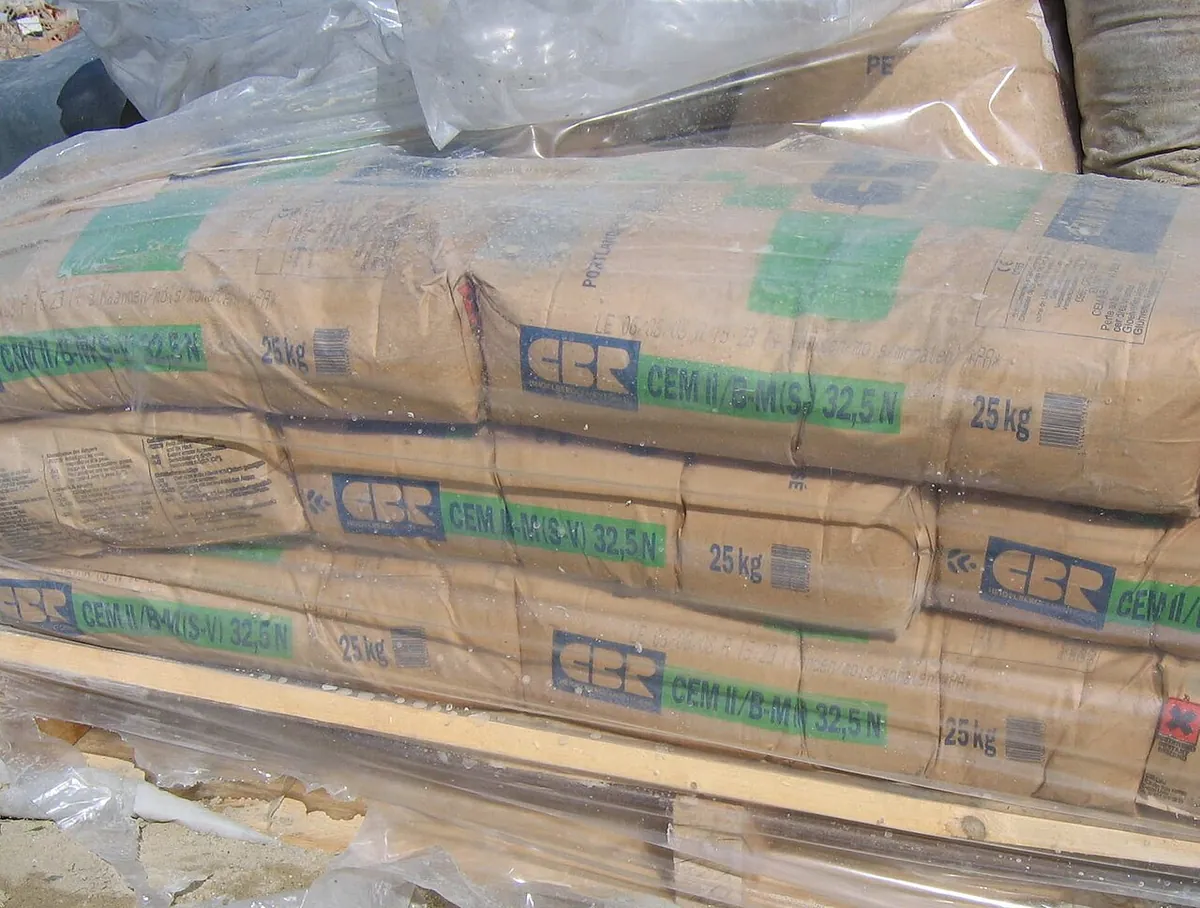
Photo: KVDP, Wikimedia Commons, public domain
Quick Answer
A standard pallet of Quikrete concrete mix holds 42 bags of 80 lb or 56 bags of 60 lb. Both pallets carry 3,360 pounds of concrete mix, plus the weight of the wooden pallet. Pallets of 50 lb bags commonly hold about 63 to 64 bags, and 40 lb bags about 80. A full pallet of 80 lb or 60 lb bags makes about 25 cubic feet, or 0.93 cubic yards, of concrete. Counts can vary by brand and plant, so check the store tag before you buy.
Buying concrete by the pallet is the easiest way to get enough bags for a small slab, a row of fence posts or several deck footings. Stores often give a lower price per bag when you buy a full pallet, and many will deliver it with a forklift or a truck-mounted lift. But a pallet of concrete is heavy, so it helps to know exactly how many bags you are getting, how much it weighs and how much concrete it will make.
This guide covers how many bags of concrete are on a pallet for each common bag size, how much a pallet of concrete weighs, how many pallets you need for typical projects, what a pallet costs, and how to handle, haul and store it safely.
Bags per Pallet by Size
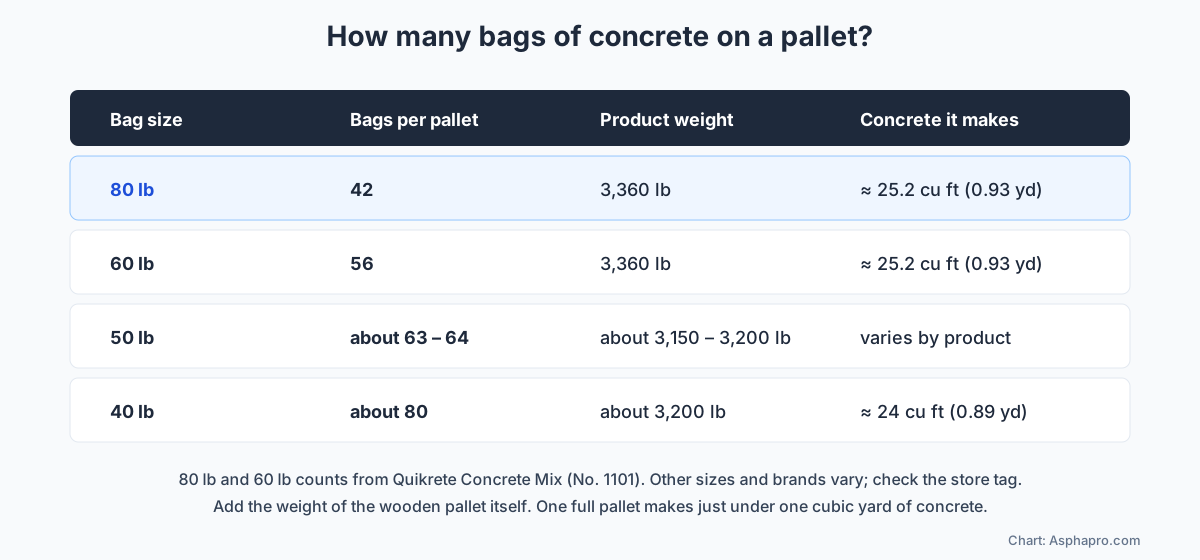
How many bags are in a pallet of concrete depends on the bag size, because suppliers stack pallets to roughly the same total weight. How many concrete bags on a pallet you get from a home center is usually printed on the pallet wrap or the shelf tag; the common counts are below.
| Bag size | Bags per pallet | Product weight | Concrete per pallet |
|---|---|---|---|
| 80 lb | 42 | 3,360 lb | about 25.2 cu ft (0.93 cu yd) |
| 60 lb | 56 | 3,360 lb | about 25.2 cu ft (0.93 cu yd) |
| 50 lb | about 63 – 64 | about 3,150 – 3,200 lb | depends on the product |
| 40 lb | about 80 | about 3,200 lb | about 24 cu ft (0.89 cu yd) |
The 80 lb and 60 lb counts come from Quikrete's listing for its standard Concrete Mix. Other products, such as fast-setting, high-strength or crack-resistant mixes, and other brands may ship in different counts. Some plants ship 80 lb pallets with 40 bags. Always check the pallet tag or ask the store.
How Many 80 lb Bags of Concrete on a Pallet?
How many 80lb bags of concrete on a pallet? For Quikrete and most big brands, 42. Some stores and brands stack 40 or 48, so if you are asking how many 80 pound bags of concrete on a pallet for an order, confirm the count with the store before you plan your project around it.
A standard pallet holds 42 bags of 80 lb concrete mix. That is 3,360 pounds of product. At about 0.60 cubic feet per bag, a pallet makes about 25.2 cubic feet of concrete, a little under one cubic yard. Since a yard takes about 45 bags of 80 lb mix, you need one full pallet plus about 3 bags for one cubic yard, or one pallet plus about 8 bags with 10 percent extra. Retail price breaks often line up with the pallet: the Home Depot listing for Quikrete 80 lb concrete mix showed a lower per-bag price for 42 or more bags.
How Many 60 lb Bags of Concrete on a Pallet?
How many 60lb bags of concrete on a pallet? Usually 56. The pallet weighs the same as an 80 lb pallet, 3,360 pounds of mix, just split into more, lighter bags.
A standard pallet holds 56 bags of 60 lb concrete mix, also 3,360 pounds. At about 0.45 cubic feet per bag, that is again about 25.2 cubic feet, or 0.93 cubic yards. So a pallet of 60 lb bags makes the same amount of concrete as a pallet of 80 lb bags; you simply handle more, lighter bags. Many homeowners prefer 60 lb bags for that reason, especially when bags must be carried across a yard or up stairs.
How Much Does a Pallet of Concrete Weigh?
A full pallet of 80 lb or 60 lb bags carries 3,360 pounds of concrete mix. The wooden pallet adds more, often a few dozen pounds, so a typical full pallet weighs roughly 3,400 pounds, or about 1.7 tons. Pallets of 40 or 50 lb bags weigh slightly less, around 3,200 pounds of product.
That is far more than most pickup trucks can carry. Many half-ton pickups have a payload under 2,000 pounds, and even many three-quarter-ton trucks are rated below the weight of a full pallet once passengers and fuel are counted. Check your truck's payload sticker on the door frame, and do not try to haul a full pallet in a light truck. Most stores offer delivery for full pallets.
How Much Concrete Does a Pallet Make?
One full pallet of 80 lb or 60 lb bags makes about 25 cubic feet of concrete. That is enough for roughly:
| Project | What one pallet covers (approx.) |
|---|---|
| 4 inch slab | about 75 sq ft, such as a 7 × 10 ft pad |
| Fence posts in 10 in. × 30 in. holes | about 20 – 22 posts |
| Deck footings, 12 in. × 4 ft tubes | about 8 footings |
| Concrete steps, 4 ft wide | about three solid steps with a little left over |
For your exact numbers, see how many bags of concrete are in a yard or use the volume calculator below.
How Many Pallets Do You Need?
| Project (4 in. slabs) | Concrete | 80 lb bags (+10%) | Pallets of 42 |
|---|---|---|---|
| 8 × 8 ft pad | 21.3 cu ft | 40 | about 1 |
| 10 × 10 ft pad | 33.3 cu ft | 62 | about 1.5 |
| 10 × 12 ft shed pad | 40 cu ft | 74 | about 1.8 |
| 12 × 12 ft patio | 48 cu ft | 88 | about 2.1 |
| 12 × 16 ft patio | 64 cu ft | 118 | about 2.8 |
Once a project needs more than about two pallets, compare the cost and labor with ordering ready-mix. Two pallets is about 1.9 cubic yards, and mixing 84 bags by hand is a long, hard day. See concrete price per yard.
How Much Does a Pallet of Concrete Cost?
Using the Home Depot listing for Quikrete 80 lb concrete mix at the time of writing, about $5.32 per bag at 42 or more, a full pallet of 42 bags would cost about $223 before tax and delivery. A pallet of 56 bags of 60 lb mix at about $4.03 each would be about $226. Prices vary by store, region and season, and specialty mixes cost more. Many stores charge a delivery fee, and some charge a refundable deposit for the wooden pallet or ask you to return it. See how much a bag of concrete costs.
| Option | Approx. concrete made | Approx. cost |
|---|---|---|
| 1 pallet, 42 × 80 lb | 0.93 cu yd | about $223 + delivery |
| 1 pallet, 56 × 60 lb | 0.93 cu yd | about $226 + delivery |
| 1 cu yd ready-mix | 1 cu yd | about $125 – $200 + short-load fee |
Why Pallets Hold 42 or 56 Bags
The counts come from two practical limits: weight and stacking. Manufacturers aim for a pallet that is heavy enough to be efficient but light enough for standard forklifts, store racks and delivery trucks. Both the 42-bag and 56-bag pallets carry exactly 3,360 pounds of mix, which suggests the weight target is the same for both sizes. Bags are stacked in interlocking layers, with a set number of bags per layer, so the load stays stable during shipping. Smaller bags fit more per layer and more layers, which is why 40 lb pallets often hold around 80 bags. Because each plant may use slightly different pallets and stacking patterns, the answer to how many bags of concrete on a pallet can change from one store to another.
Buying Less Than a Full Pallet
You do not need to buy a whole pallet. Most stores sell bags individually, and many offer a bulk price once you reach a certain number of bags, often around the pallet count. If you need 30 bags, ask whether the bulk price applies; sometimes buying a full pallet costs only a little more and leaves you with spare bags for later projects. If the store offers returns on unopened bags, buying a few extra is cheap insurance against running short mid-pour.
Planning a Project by the Pallet: Three Examples
Example 1: Backyard fence, 24 posts
Each 10 inch hole, 30 inches deep, with a 4 × 4 post needs about 1.1 cubic feet of concrete, or about two 80 lb bags. Twenty-four posts need about 48 bags, a little more than one pallet of 42. Buy one pallet plus about 8 bags, or use fast-setting post mix and check its yield on the bag.
Example 2: Shed pad, 8 × 10 ft, 4 inches
That is about 26.7 cubic feet, roughly 45 bags of 80 lb mix, or about 50 with waste. One pallet of 42 plus about 8 bags covers it. Mixing 50 bags is a long day for two or three people with a mixer, so line up help.
Example 3: Six deck footings
Six 12 inch tubes, 4 feet deep, need about 18.8 cubic feet, about 32 bags of 80 lb mix with a little extra. Most of one pallet is enough, with leftovers for the post bases or a small landing pad.
These examples show why the question of how many bags of concrete on a pallet matters: one pallet is roughly the right size for many weekend projects, and planning around it can save trips and money.
Fast-Setting and Specialty Mix Pallets
Fast-setting concrete for posts is usually sold in 50 lb bags and may come in different pallet counts than standard mix. It often yields less per bag, so you need more bags per post than with regular 80 lb mix. High-strength mixes, sometimes in 80 or 90 lb bags, also have their own counts and yields. Crack-resistant mixes contain fibers and are packed like standard mix. Before ordering a pallet of any specialty product, read both the pallet count and the yield per bag, then calculate how many bags your project needs.
Shelf Life of Bagged Concrete
Bagged concrete does not last forever. The paper bags let moisture from the air slowly reach the cement inside, and it starts to form lumps. Kept dry, off the ground and covered, bags often stay usable for months. Bags left in a damp garage, on concrete floors or in the rain can harden much faster. Test an older bag by squeezing it: if it feels like loose powder, it is fine; if it has hard lumps that do not crumble, do not use it for structural work. Rotate stock so older bags are used first.
What to Do With Leftover Bags
Leftover bags from a pallet are handy for small jobs: setting a mailbox post, repairing a step corner, making stepping stones or planters, or filling around a new gate post. Store them on a pallet or shelf, wrapped in plastic. If the store accepts returns of unopened bags, return extras promptly while they are still in good condition. Do not leave open bags outside; once they get wet, they set.
Empty Pallets: Returns, Deposits and Reuse
Some building suppliers charge a deposit for the wooden pallet and refund it when you bring the pallet back. Home centers often do not charge for the pallet but may take it back with the delivery truck. Ask when you order. If you keep the pallet, it can be reused for storing bags off the ground, but avoid burning treated pallets.
Delivery Checklist
- Confirm how many bags of concrete on a pallet your store is shipping, since counts can vary.
- Ask whether delivery includes a lift gate or forklift, and where it can set the pallet.
- Pick a firm, level spot close to the work area, away from soft lawn.
- Keep cars, kids and pets clear during unloading.
- Have a tarp ready to cover the pallet if rain is possible.
- Check the bags for tears or hard lumps before the driver leaves.
Pallet Delivery and Unloading
Most home centers and building suppliers deliver pallets by flatbed truck with a lift gate, a truck-mounted forklift or a boom. Ask where they can set the pallet. A driveway is usually best; soft lawns can rut under a forklift or a heavy pallet. A full pallet is not easy to move once it is down, so place it close to the pour. If you cannot get delivery to the exact spot, plan a cart or hand truck to move bags a few at a time.
Hauling a Pallet Yourself
If you plan to pick up a pallet, check three ratings: your truck's payload, your trailer's capacity, and your tow vehicle's towing limit. A full pallet of about 3,400 pounds usually needs a heavy-duty pickup or a trailer rated for the load with a suitable tow vehicle. Secure the pallet with straps so it cannot slide, keep speeds low, and leave extra stopping distance. Splitting the order into two trips with about 20 bags each is often safer in a half-ton truck.
Storing a Pallet of Concrete
- Keep the pallet off the ground on its wooden base, on a flat, firm surface.
- Cover it with a tarp to keep rain and sprinklers off, but allow some airflow.
- Do not stack pallets unless the supplier says it is safe.
- Use bags within a reasonable time; bagged concrete slowly absorbs moisture and can harden.
- Pull bags from the top layer first, keeping the stack stable.
Pallets of Other Concrete Products
Mortar mix, sand mix, fast-setting concrete, high-strength mix and Portland cement are also sold by the pallet. Bag sizes and counts differ by product, so the 42 and 56 counts above do not apply to every item. Portland cement bags, for example, are usually heavier and make concrete only when mixed with sand and gravel. If you are buying for a specific project, check the yield printed on the bag and the pallet count on the tag. For the difference between mortar and concrete, see mortar vs concrete; for what is in each, see what concrete is made of.
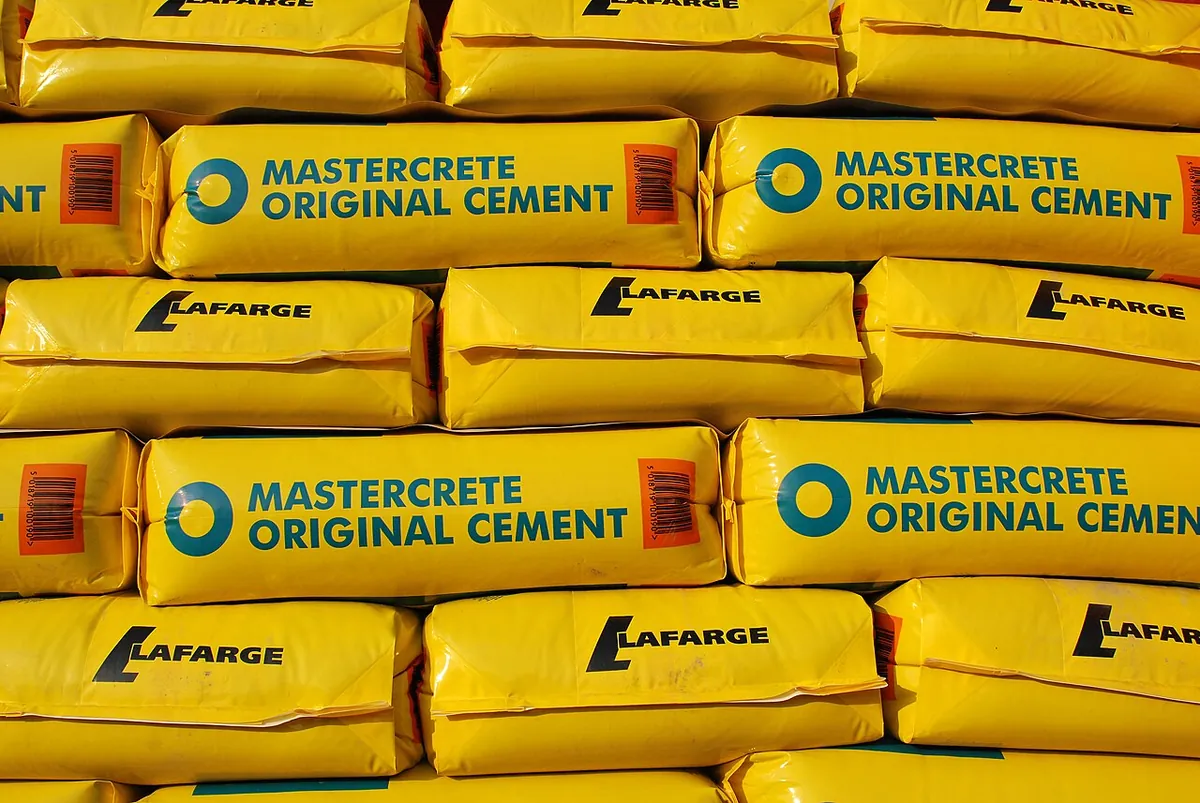
Photo: StaraBlazkova, Wikimedia Commons, CC BY-SA 3.0
Do Other Brands Use the Same Pallet Counts?
Major brands sell 40, 50, 60 and 80 lb concrete mixes, and many use similar pallet loads, but there is no single industry rule. A pallet from one brand or plant might hold 40 bags of 80 lb mix instead of 42, or a different count of 50 lb bags. Regional brands and store brands can also differ. When you compare prices between stores, compare the price per bag and the yield per bag, not just the price per pallet, so you know how much concrete you are really buying.
Pallet Math in Three Steps
- Find the concrete you need in cubic feet. For slabs, length × width × thickness in feet. For holes, 3.1416 × radius × radius × depth, minus the post.
- Divide by the bag yield (about 0.60 for 80 lb, 0.45 for 60 lb) and add about 10 percent.
- Divide by the pallet count (42 for 80 lb, 56 for 60 lb) to see how many pallets that is.
Shortcut: a full pallet of either size makes about 25 cubic feet. So divide your cubic feet by 25 to estimate pallets. A 50 cubic foot job needs about two pallets.
Bulk Orders for Bigger Jobs
Contractors who use bagged concrete regularly, for fence building or post setting, often order several pallets at a time from a building supplier, where pricing and delivery can be better than at a home center. If you are a homeowner with a big fence or many footings, ask a local supplier for a quote on multiple pallets delivered; it can beat buying bags in several trips. For jobs that need more than about two pallets in one pour, ready-mix is still usually the better choice.
Moving Bags Around the Site
Once the pallet is down, the real work is moving bags to the mixer and the holes. A hand truck carries several bags at once on smooth ground. A wheelbarrow works on grass but can tip with more than one or two 80 lb bags. For long distances, a garden cart with wide tires is easier. Stage bags near each group of post holes before you start mixing, so you are not walking back and forth with each bag. If a bag tears, scoop the dry mix into a bucket and use it right away.
Safety With Heavy Pallets
A pallet weighing over 1.5 tons can crush feet and hands if it shifts. Stay clear while it is lifted or set down. Never climb on a stacked pallet. When unloading bags, lift with your legs, keep your back straight, and do not twist while carrying. A hand truck, wheelbarrow or cart makes moving 80 lb bags far easier. Wear gloves, since torn bags release cement dust that irritates skin, and a dust mask when opening bags.
Mixing a Full Pallet: How Long It Takes
Mixing a full pallet of 42 bags of 80 lb concrete with one portable drum mixer usually takes a small crew several hours. A typical mixer handles one or two bags per batch, and each batch takes a few minutes to load, mix and dump. Add the time to wheel concrete to the forms, place it and finish it, and a single pallet can fill a long morning or most of a day. With 56 bags of 60 lb mix, you handle more bags but each is lighter, so the total time is similar. If you are working alone, plan on far longer and consider doing the job in smaller sections, such as a few posts or one slab panel at a time, so each part is finished before it starts to set.
Common Mistakes When Buying a Pallet
- Assuming every pallet is the same. Counts vary, so confirm how many bags of concrete on a pallet before paying.
- Buying the wrong mix. Mortar, sand mix and concrete look alike on a pallet; read the bag.
- Ignoring delivery access. A forklift may not reach a backyard; plan where the pallet goes.
- Leaving it uncovered. Rain can ruin the top bags overnight.
- Overloading a vehicle. A full pallet is heavier than many trucks can safely carry.
Pallet vs Ready-Mix: Which Should You Choose?
One pallet is a good fit for jobs up to about three-quarters of a yard of concrete: post holes, small pads, steps and repairs. Two pallets covers jobs up to about 1.9 yards, but that is a lot of mixing. Above that, ready-mix delivered by truck is almost always easier and often cheaper per yard, even with a short-load fee. See how many yards of concrete are in a truck.
Frequently Asked Questions
How many bags of concrete are on a pallet?
A standard Quikrete pallet holds 42 bags of 80 lb mix or 56 bags of 60 lb mix. 50 lb pallets often hold about 63 to 64 bags, and 40 lb pallets about 80.
How many 80 lb bags of concrete on a pallet?
42 bags on a standard pallet, for 3,360 pounds of mix. Some plants ship 40 bags, so check the tag.
How many 60 lb bags of concrete on a pallet?
56 bags on a standard pallet, also 3,360 pounds of mix.
How much does a pallet of concrete weigh?
About 3,360 pounds of mix for 80 lb or 60 lb pallets, plus the wooden pallet, for roughly 3,400 pounds in total.
How much concrete does a pallet make?
About 25 cubic feet, or 0.93 cubic yards, for a full pallet of 80 lb or 60 lb bags.
How many 50 lb bags of concrete are on a pallet?
Often about 63 to 64 bags, but counts vary by product and brand. Check the tag on the pallet.
How many 40 lb bags of concrete are on a pallet?
Usually about 80 bags, for roughly 3,200 pounds of mix.
Can a pickup truck carry a pallet of concrete?
Usually not safely. A full pallet weighs about 3,400 pounds, more than the payload of most half-ton pickups. Use delivery, a heavy-duty truck or a rated trailer.
How many pallets of concrete do I need for a cubic yard?
A little more than one. A pallet of 42 bags of 80 lb mix makes about 0.93 cubic yards, so one cubic yard takes one pallet plus about 3 bags, or plus about 8 bags with 10 percent extra.
Do stores sell concrete by the pallet?
Yes. Most home centers and building suppliers sell full pallets, often with a lower price per bag and an option for delivery to your home or job site.
Is a pallet of concrete enough for a 10x10 slab?
Not quite. A 4 inch 10 × 10 slab needs about 33 cubic feet, or about 56 bags of 80 lb mix plus extra, about 1.5 pallets.
How many bags on a pallet of concrete from Home Depot or Lowe's?
Home centers usually sell full pallets of 42 bags of 80 lb mix or 56 bags of 60 lb mix, the standard Quikrete counts. Many give a per-bag discount when you buy the full pallet.
How many concrete bags in a pallet of 50 lb or 40 lb mix?
Pallets of 50 lb bags commonly hold about 63 to 64 bags, and pallets of 40 lb bags about 80, depending on the brand and plant.
Sources
- Quikrete, Concrete Mix (No. 1101) product listing with bags per pallet. quikrete.com
- The Home Depot, Quikrete 80 lb Concrete Mix product listing (price snapshot). homedepot.com
- Retail and industry guides on 40 lb and 50 lb pallet counts (counts vary by product and plant).
- Image credits: pallet photo by KVDP (public domain) and bag photo by StaraBlazkova (CC BY-SA 3.0), via Wikimedia Commons. Chart by Asphapro.com.
Counts and prices vary by brand, plant and store. Checked November 2026.
Related Guides
- How to make concrete planters — DIY pots and white concrete
- How to make concrete stepping stones — molds, mix and setting a path
- Mortar vs concrete — differences and which to use
- How to use self leveling concrete — prep, pour and dry times