
How Many Bags of Concrete in a Yard? 40, 60 and 80 lb Bag Counts and Calculator
Quick Answer
A cubic yard of concrete is 27 cubic feet. It takes about 45 bags of 80 lb concrete mix, 60 bags of 60 lb mix or 90 bags of 40 lb mix to make one yard, based on typical yields of about 0.60 cubic feet per 80 lb bag, 0.45 cubic feet per 60 lb bag and 0.30 cubic feet per 40 lb bag. Add 5 to 10 percent for waste, so plan on about 48 to 50 bags of 80 lb mix per yard. One 80 lb bag makes about 0.022 cubic yards, or about 1/45 of a yard.
If you are pouring a small slab, setting fence posts or patching steps, bagged concrete is often the simplest choice. But the bag count adds up fast: a single cubic yard is more bags than most people expect, and it weighs close to two tons. Knowing exactly how many bags of concrete you need helps you buy the right amount, plan trips and decide when ready-mix delivery makes more sense.
This guide covers how many bags of concrete are in a yard for every common bag size, how many cubic feet are in a bag of concrete, how to work out how many bags you need for slabs, footings and posts, how much water each bag needs, and when to switch to ready-mix.
How Many Bags of Concrete Per Yard?
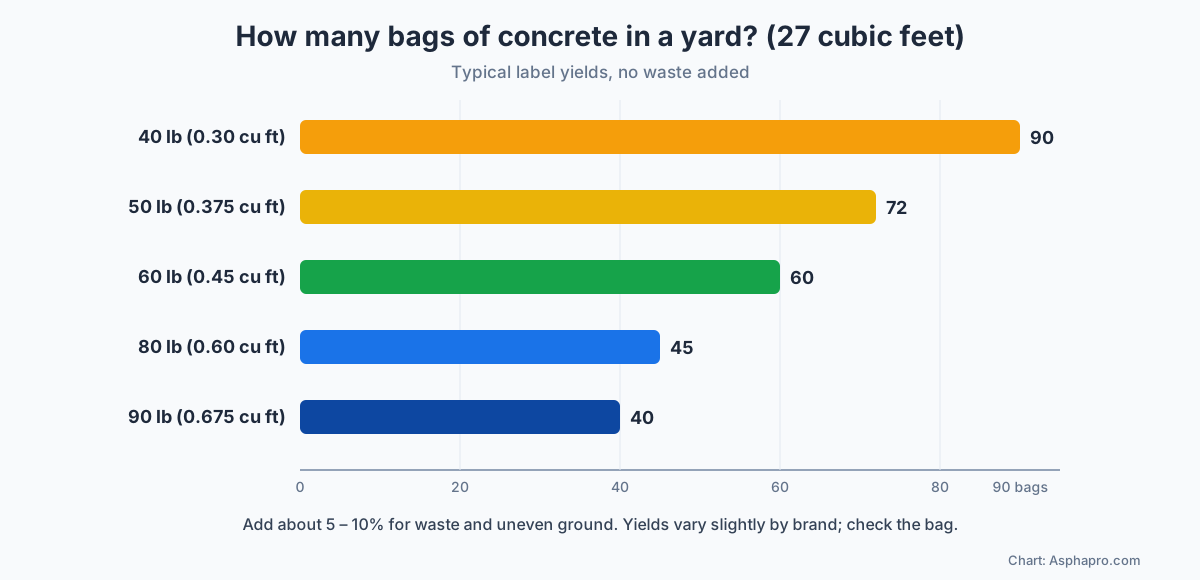
How many bags of concrete is a yard? It depends only on the bag size, because a cubic yard is always 27 cubic feet. How many bags of concrete in a cubic yard comes down to dividing 27 by the yield printed on the bag:
| Bag size | Typical yield | Bags per cubic yard | With 10% extra |
|---|---|---|---|
| 40 lb | about 0.30 cu ft | 90 | 99 |
| 50 lb | about 0.375 cu ft | 72 | 80 |
| 60 lb | about 0.45 cu ft | 60 | 66 |
| 80 lb | about 0.60 cu ft | 45 | 50 |
| 90 lb | about 0.675 cu ft | 40 | 44 |
The formula is simple: 27 ÷ yield per bag = bags per yard. Yields are printed on each bag and can vary slightly by brand and mix, so check the label of the product you buy.
How Many 80 lb Bags of Concrete in a Yard?
Bags are labeled "80lb" or "80 pound" depending on the brand, but the answer is the same. How many 80lb bags of concrete in a yard? About 45, since each bag yields about 0.60 cubic feet. How many 80 pound bags of concrete in a yard once you allow for waste? Plan on 48 to 50. If you are asking how many 80 lb concrete bags in a yard you can haul at once, that is about 3,600 to 4,000 pounds, far more than a half-ton pickup can carry in one trip.
It takes about 45 bags of 80 lb concrete to make one cubic yard. Each 80 lb bag yields about 0.60 cubic feet, and 27 ÷ 0.60 = 45. With 10 percent extra for waste and uneven ground, buy about 50 bags. The 80 lb bag is the most economical size for larger jobs, because you handle fewer bags and the price per cubic foot is usually lower than for smaller bags.
So how many bags of 80 lbs concrete for a yard? Plan on 45 to 50, which is about 3,600 to 4,000 pounds of dry mix. That is a lot to lift and mix by hand, so line up helpers and a mixer.
How Many 60 lb Bags of Concrete in a Yard?
How many 60lb bags of concrete in a yard? About 60, because each 60 pound bag yields about 0.45 cubic feet. So how many 60 pound bags of concrete in a yard after waste? Buy 63 to 66.
It takes about 60 bags of 60 lb concrete per cubic yard. Each 60 lb bag yields about 0.45 cubic feet, and 27 ÷ 0.45 = 60. With 10 percent extra, buy about 66 bags. Many people prefer 60 lb bags because they are easier to lift and carry, even though you need a third more bags than with 80 lb mix.
How Many 40 lb Bags of Concrete in a Yard?
It takes about 90 bags of 40 lb concrete per cubic yard, since each yields about 0.30 cubic feet. That is a lot of bags, so 40 lb bags are mainly used for small repairs, single post holes and jobs where every bag must be carried a long way by hand.
How Many Cubic Feet in a Bag of Concrete?
| Bag | Cubic feet | Cubic yards | Bags per cubic foot |
|---|---|---|---|
| 40 lb | about 0.30 | about 0.011 | about 3.3 |
| 60 lb | about 0.45 | about 0.017 | about 2.2 |
| 80 lb | about 0.60 | about 0.022 | about 1.7 |
So how much concrete is in an 80 lb bag? About 0.6 cubic feet, enough to fill a hole 12 inches square and about 7 inches deep, or about 1.8 square feet of a 4 inch slab. And 1 80 lb bag of concrete is how many yards? About 0.022 cubic yards, so 45 bags make one yard.
How Many Bags of Concrete Do I Need?
How many concrete bags do I need for a small job? Work out the volume in cubic feet first, then divide by the bag yield. For whole yards, how many bags for a yard of concrete is the simple rule: 45 bags of 80 lb mix or 60 bags of 60 lb mix.
Follow these steps for any project:
- Measure length, width and depth in feet. Convert inches to feet by dividing by 12.
- Find cubic feet: length × width × depth. For round holes, use 3.1416 × radius × radius × depth.
- Divide by the bag yield: 0.60 for 80 lb, 0.45 for 60 lb, 0.30 for 40 lb.
- Add 5 to 10 percent and round up.
Example: a 6 × 8 foot pad, 4 inches thick: 6 × 8 × 0.333 = 16 cubic feet. 16 ÷ 0.60 = 26.7, or 27 bags of 80 lb mix. Add 10 percent: about 30 bags.
Bags of Concrete Needed for Common Slabs (4 inches thick)
| Slab size | Cubic feet | 80 lb bags (+10%) | 60 lb bags (+10%) |
|---|---|---|---|
| 3 × 3 ft (AC pad) | 3.0 | 6 | 8 |
| 4 × 4 ft | 5.3 | 10 | 13 |
| 4 × 8 ft | 10.7 | 20 | 27 |
| 6 × 8 ft | 16.0 | 30 | 40 |
| 8 × 8 ft | 21.3 | 40 | 53 |
| 8 × 10 ft | 26.7 | 49 | 66 |
| 10 × 10 ft | 33.3 | 62 | 82 |
| 10 × 12 ft | 40.0 | 74 | 98 |
| 12 × 12 ft | 48.0 | 88 | 118 |
For a 12 × 12 slab, see the full breakdown in 12x12 concrete slab cost.
Bags of Concrete per Post Hole
| Hole size | Post | Concrete needed (hole minus post) | 80 lb bags | 50 lb fast-setting bags |
|---|---|---|---|---|
| 8 in. diameter × 24 in. deep | 4 × 4 | about 0.6 cu ft | about 1 | about 1 – 2 |
| 10 in. diameter × 30 in. deep | 4 × 4 | about 1.1 cu ft | about 2 | about 2 – 3 |
| 10 in. diameter × 36 in. deep | 4 × 4 | about 1.3 cu ft | about 2 – 3 | about 3 – 4 |
| 12 in. diameter × 36 in. deep | 6 × 6 | about 1.6 cu ft | about 3 | about 4 – 5 |
| 12 in. diameter × 48 in. deep (deck footing) | tube form, no post | about 3.1 cu ft | about 5 – 6 | — |
Fast-setting post mixes often yield a little less per pound than standard mix, so check the bag. For a fence with 20 posts in 10 inch holes 30 inches deep, plan on about 40 bags of 80 lb mix.
Why Bag Yields Vary
The yield on a bag is the volume of placed concrete you get after adding the recommended water. It is not exactly the same for every product. High-strength mixes contain more cement and can yield slightly less per pound. Fast-setting post mixes are made to be poured dry into a hole and watered in place, and they often list a lower yield per bag than standard mix. Lightweight mixes yield more volume per pound. Even within one product, using a little more or less water, packing the concrete into forms, and the shape of the hole all change how far a bag goes. That is why the 45, 60 and 90 bag counts are planning numbers: buy a few extra bags, and return the unopened ones if your store allows it.
Measuring Awkward Shapes
Not every pour is a neat rectangle. For irregular areas, break the shape into simple pieces, find the volume of each, and add them together.
- Circles and round pads: volume = 3.1416 × radius × radius × depth (all in feet). A 6 foot round pad, 4 inches thick, is 3.1416 × 3 × 3 × 0.333 = 9.4 cubic feet, or about 16 bags of 80 lb mix.
- Steps: treat each step as a box, but subtract the part already filled by the step below. Or find the side area of the whole stair profile and multiply by the stair width.
- Sloped ground: measure depth at several points and use the average.
- Thickened edges: add the extra depth along the perimeter as a separate strip.
- Holes with flared bottoms: add about 10 to 20 percent to the straight-hole volume.
For complex shapes, the volume calculator and how to calculate yards of concrete walk through each case.
Bags for Steps, Footings and Sonotubes
| Project | Approximate volume | 80 lb bags (+10%) |
|---|---|---|
| One step, 4 ft wide × 12 in. deep × 7 in. tall | about 2.3 cu ft | about 5 |
| Three solid steps, 4 ft wide | about 14 cu ft | about 26 |
| Sonotube, 8 in. × 4 ft | about 1.4 cu ft | about 3 |
| Sonotube, 12 in. × 4 ft | about 3.1 cu ft | about 6 |
| Continuous footing, 12 in. wide × 8 in. deep, per 10 ft | about 6.7 cu ft | about 13 |
For larger footings and steps, ready-mix may be easier; see concrete footing cost and concrete steps cost.
Worked Examples
Shed pad, 8 × 10 ft, 4 inches
8 × 10 × 0.333 = 26.7 cubic feet. That is about 1 cubic yard, so the question of how many bags of concrete in a yard answers it directly: about 45 bags of 80 lb mix, plus 10 percent, so about 49 or 50 bags.
Fence with 16 posts
Each 10 inch hole, 30 inches deep, with a 4 × 4 post needs about 1.1 cubic feet. 16 × 1.1 = 17.6 cubic feet, or about 30 bags of 80 lb mix with a little extra. With 50 lb fast-setting bags at a lower yield, plan on roughly 40 to 50 bags; check the yield on the bag you buy.
Two cubic yards for a patio
A 12 × 16 foot patio at 4 inches is about 2.4 cubic yards. That would take about 108 bags of 80 lb mix, plus extra, around 120 bags. At that size, ready-mix is usually the better choice.
How Much Water per Bag of Concrete?
Typical bag instructions call for roughly 3 quarts of water per 80 lb bag and proportionally less for smaller bags, about 2.25 quarts for 60 lb and 1.5 quarts for 40 lb. Always follow the label for your product. Start with less water than the maximum and add slowly; the mix should be like stiff oatmeal, holding its shape without being crumbly. Too much water makes concrete easier to place but weaker, more prone to cracking and dusting. If you are asking how many quarts for 80 lbs of concrete mix, the answer on most labels is about 3, but mix to a workable consistency rather than dumping it all in at once.
How Much Do Bags of Concrete Cost per Yard?
At the time of writing, a Home Depot listing for an 80 lb bag of Quikrete concrete mix showed about $5.91 per bag, or about $5.32 each when buying 42 or more, and a 60 lb bag about $4.48. Prices vary by region, store and season. Using those numbers:
| Bags for 1 cubic yard | Approximate cost |
|---|---|
| 45 × 80 lb at about $5.32 – $5.91 | about $240 – $265 |
| 60 × 60 lb at about $4.03 – $4.48 | about $240 – $270 |
| Ready-mix, 1 yard delivered | about $125 – $200 plus a short-load fee |
Bagged concrete costs more per yard than ready-mix, but for one yard or less it is often cheaper overall once you count short-load fees. See how much a bag of concrete costs and concrete price per yard.
Bags vs Ready-Mix: Where Is the Break-Even?
- Under about 1/2 yard (about 23 bags of 80 lb): bags are almost always easier and cheaper.
- 1/2 to 1 yard: bags usually win on cost; ready-mix wins on labor.
- 1 to 3 yards: compare a short-load ready-mix price with 45 to 150 bags and the labor to mix them.
- Over about 3 yards: ready-mix is almost always better.
Mixing more than about 40 or 50 bags by hand in one day is very hard work, and large slabs must be placed and finished before the first batches set. See how many yards of concrete are in a truck for ordering ready-mix.
Projects Where Bags Make Sense
Bagged concrete is the right choice for many small jobs around the house:
- Fence and mailbox posts, where each hole needs only one to three bags.
- Deck footings and sonotubes, poured one at a time.
- Small pads for air conditioners, trash cans, grills and generators.
- Steps and landings where a truck cannot reach.
- Repairs and patches on sidewalks and driveways.
- Stepping stones and planters; see how to make concrete stepping stones.
- Remote spots such as cabins and backyards far from the street.
Once a project needs more than about a yard, which is roughly 45 bags of 80 lb mix, the labor and time of mixing start to outweigh the convenience.
Hand Mixing vs a Mixer
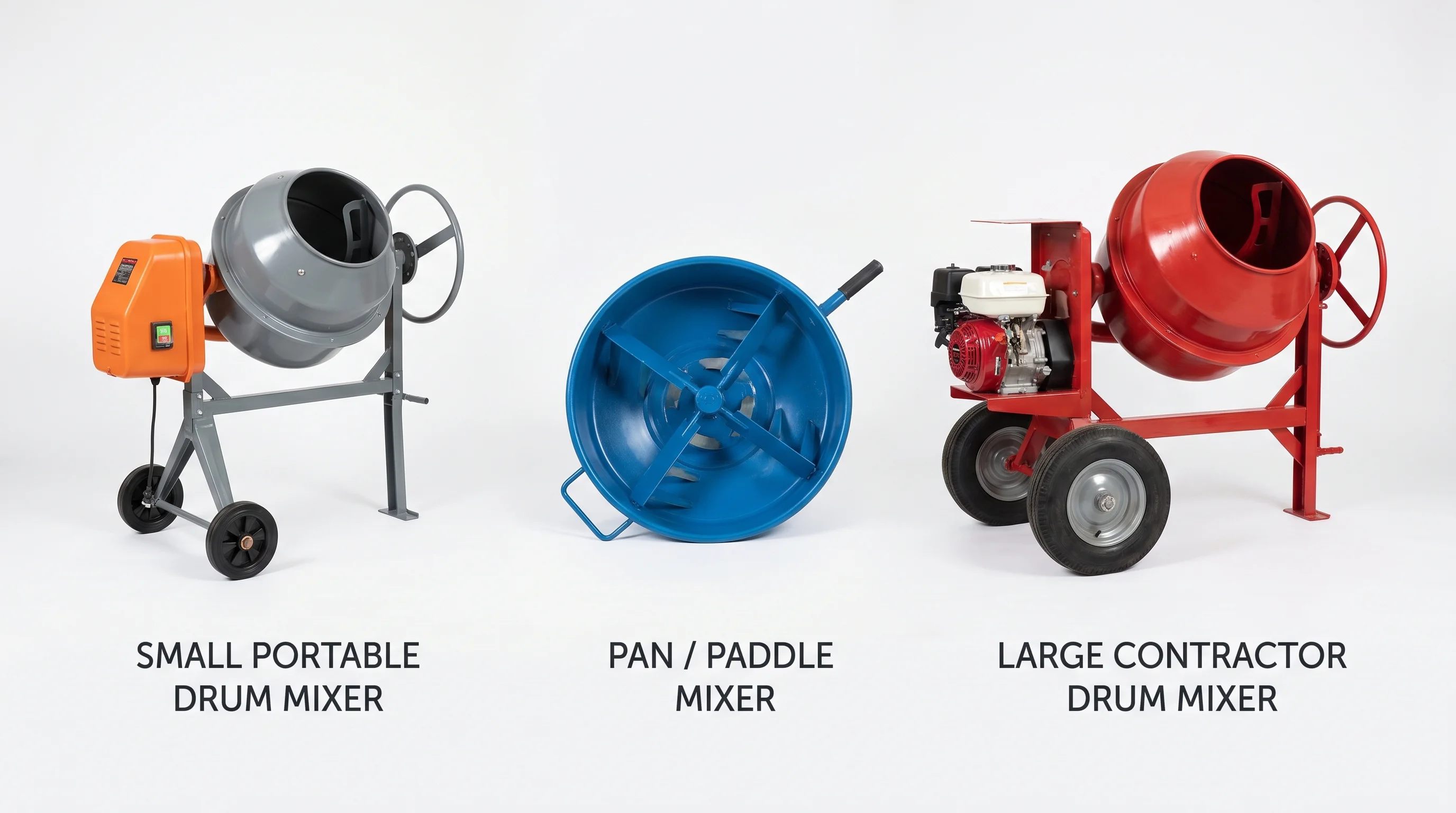
You can mix a few bags in a wheelbarrow or mixing tub with a hoe, adding water slowly and turning the mix until it is evenly wet. That works well for one to five bags. For a dozen bags or more, rent or buy a drum mixer. A typical portable mixer handles one or two 80 lb bags per batch and produces a more even, consistent mix with much less effort. For forty or more bags, set up an assembly line: one person loading bags and water, one dumping batches into wheelbarrows, and others placing and finishing. Without a mixer, a full cubic yard of bags can take a small crew most of a day.
Bags for Repairs and Patches
Repairs often use specialty bagged products rather than regular concrete mix. Thin patches on sidewalks and steps use patching compounds or resurfacers that bond in thin layers. Deeper repairs, such as a broken step corner or a hole in a slab, can use standard or high-strength mix if the patch is at least about 2 inches deep. For cracks, use crack fillers made for concrete. Each product lists coverage on the bag, usually in square feet at a given thickness rather than in cubic feet. See concrete repair cost and how to fix concrete steps.
Rule of Thumb: How Many Bags of Concrete in a Yard?
The fastest way to remember how many bags of concrete in a yard is to remember the 80 lb number: about 45. From there, 60 lb bags are a third more (60) and 40 lb bags are double (90). For a slab, every 81 square feet at 4 inches thick is one yard, so a 4 inch slab needs about one 80 lb bag for every 1.8 square feet. Round up, add about 10 percent, and you will rarely run short.
Tips for Mixing Many Bags
- Rent a drum mixer; most hold one or two 80 lb bags per batch.
- Set up near the pour, with bags stacked on a pallet and water close by.
- Use the same amount of water for every batch for an even color and strength.
- Have one person mixing while others place and finish.
- Pour in sections with screed boards so you finish one area before starting the next.
- Wear gloves, long sleeves and eye protection; wet concrete is caustic.
Safety When Working With Bagged Concrete
Dry concrete mix contains cement, which is alkaline and can irritate skin, eyes and lungs. Open bags carefully to limit dust, and wear a dust mask or respirator when pouring dry mix into a mixer. Wet concrete can cause chemical burns if it stays on skin, so wear waterproof gloves, long sleeves and boots, and rinse off splashes right away. Lift bags with your legs, not your back, and use a cart or hand truck to move them. Take breaks when mixing many bags; heat and fatigue make injuries more likely.
Planning a Bagged Concrete Pour Day
Before you open the first bag, have everything set up. Forms should be built, staked and checked for level. The base should be compacted and lightly damp. Lay out tools: mixer or wheelbarrow, hoe, shovels, screed board, floats, edger, groover and broom. Stack bags near the mixer and run a hose with a shutoff nozzle. Decide the order of work so the person finishing never falls far behind the people mixing. For slabs that will take more than about 30 bags, plan screed rails or temporary dividers so you can finish one section at a time. Cover the finished work as soon as it can be touched, and keep it moist for several days.
Bag Types and Which to Use
- Standard concrete mix: general slabs, steps and footings.
- High-strength mix: higher psi rating; often 80 or 90 lb bags.
- Fast-setting mix: posts and quick repairs; sets fast and usually needs no mixing for post holes.
- Crack-resistant or fiber mix: adds fibers to reduce surface cracking.
- Mortar and sand mix: not a substitute for concrete in slabs; see mortar vs concrete.
Storing and Hauling Bags
Bagged concrete absorbs moisture from the air and the ground. Store bags off the floor on a pallet, under cover and away from rain, sprinklers and damp concrete floors. A bag that has hardened into lumps should not be used for structural work. Keep stacks stable, and do not stack bags so high that they can fall. When hauling, spread the weight over the axle of your truck or trailer and stay within its payload; 30 bags of 80 lb mix is 2,400 pounds. Many stores will deliver a full pallet, which is often easier and safer than several trips in a pickup.
Mistakes When Buying Bags
- Counting by weight instead of yield. Two 40 lb bags are not always the same volume as one 80 lb bag of a different product; check the yield.
- Forgetting waste. Holes are never perfectly round, and slabs are never perfectly flat underneath.
- Buying mortar or sand mix by mistake. They look similar on the shelf but are not made for slabs and posts.
- Buying too few for one session. Running out halfway through a slab leaves a weak joint.
- Ignoring the vehicle limit. Overloaded trucks are dangerous to drive.
How Much Does a Yard of Bags Weigh?
45 bags of 80 lb mix weigh 3,600 pounds before water, and the finished concrete weighs about 4,000 pounds. That is more than the payload of most half-ton pickups, so plan several trips or delivery. A full pallet of 80 lb bags can weigh well over a ton. See how much a yard of concrete weighs and how many bags of concrete are on a pallet.
Frequently Asked Questions
How many bags of concrete in a yard?
About 45 bags of 80 lb mix, 60 bags of 60 lb mix or 90 bags of 40 lb mix, plus 5 to 10 percent extra.
How many 80 lb bags of concrete make a yard?
About 45 bags, since each yields about 0.60 cubic feet. Buy about 50 to allow for waste.
How many 60 lb bags of concrete in a yard?
About 60 bags at about 0.45 cubic feet each, or about 66 with waste.
How many cubic feet in an 80 lb bag of concrete?
About 0.60 cubic feet.
How many cubic feet in a 60 lb bag of concrete?
About 0.45 cubic feet.
How many bags of concrete do I need for a 10x10 slab?
At 4 inches thick, a 10 × 10 slab is about 33 cubic feet, so about 56 bags of 80 lb mix, or about 62 with 10 percent extra.
How many bags of concrete for a fence post?
Usually one to three 80 lb bags per post, depending on the hole size. A 10 inch hole 30 inches deep with a 4 × 4 post takes about two bags.
How many 40 lb bags of concrete make a yard?
About 90 bags, since each 40 lb bag yields about 0.30 cubic feet. With 10 percent extra, plan on about 99 bags.
How long does it take to mix a yard of bagged concrete?
With a drum mixer and a small crew, mixing and placing about 45 bags of 80 lb mix often takes several hours. By hand in a wheelbarrow, it can take most of a day, so plan the work, the tools and enough helpers before you start mixing.
Is it cheaper to use bags or ready-mix for a yard of concrete?
For one yard or less, bags are often cheaper because they avoid short-load fees. For larger jobs, ready-mix is usually cheaper per yard and far less work.
How many quarts of water for an 80 lb bag of concrete?
Most labels call for about 3 quarts. Add water slowly and follow the instructions on your bag.
1 80 lb bag of concrete: how many yards does it make?
One 80 lb bag makes about 0.022 cubic yards, or 0.60 cubic feet. That is about 1/45 of a yard, so it takes about 45 bags to make a full cubic yard.
Sources
- The Home Depot, Quikrete 80 lb Concrete Mix product listing (price snapshot and yield). homedepot.com
- Manufacturer bag labels for 40, 60 and 80 lb concrete mix (typical yields and water amounts).
- HomeGuide, "Concrete delivery cost." homeguide.com
- LawnStarter, "Concrete price per yard." lawnstarter.com
- Image credits: images and chart by Asphapro.com.
Yields and prices vary by brand and store. Checked November 2026.
Related Guides
- How to make concrete planters — DIY pots and white concrete
- How to make concrete stepping stones — molds, mix and setting a path