
How Many Yards of Concrete in a Truck? Capacity, Weight and Cost per Load
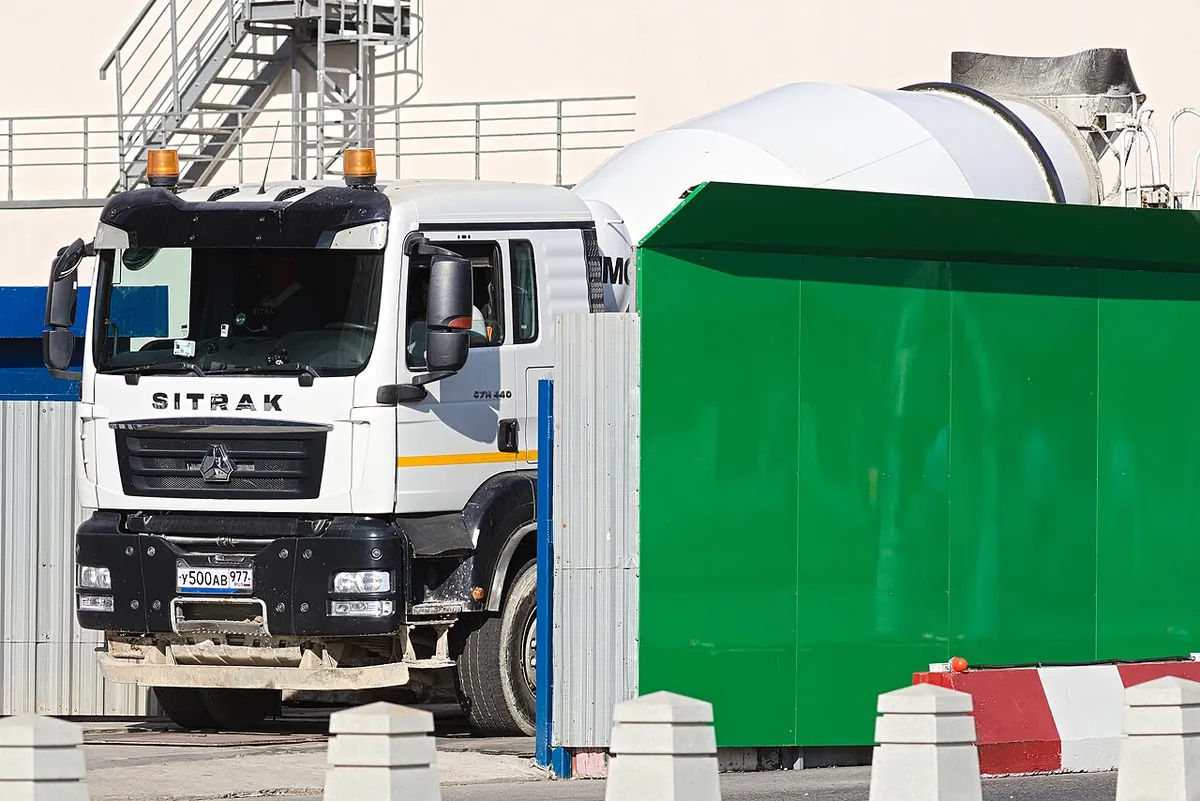
Photo: Retired electrician, Wikimedia Commons, CC0
Quick Answer
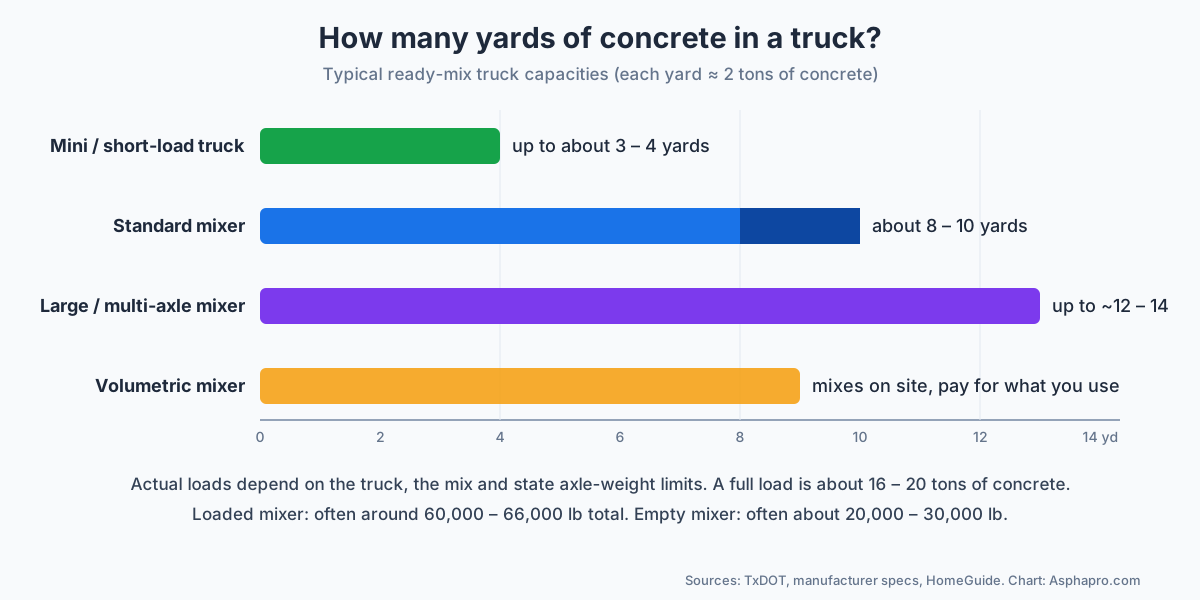
A standard ready-mix concrete truck holds about 8 to 10 cubic yards of concrete. Smaller "mini" or short-load trucks carry about 3 to 4 yards, and some large multi-axle mixers can haul around 12 to 14 yards where state weight limits allow. Because a yard of concrete weighs about 2 tons, a full 10-yard load is about 20 tons of concrete, and a loaded truck often weighs around 60,000 to 66,000 pounds. At about $125 to $200 per yard, a full truckload of concrete costs roughly $1,250 to $2,000.
If you are ordering concrete for a driveway, patio, slab or foundation, it helps to know how much concrete a truck holds. It tells you how many trucks to schedule, whether you will pay a short-load fee, and whether a truck can reach your site without damaging your property. The answer to "how many yards in a truck of concrete" is not one fixed number; it depends on the size of the drum, the truck's axles, the concrete mix and state road weight rules.
This guide explains how much concrete different mixer trucks hold, why trucks are rarely filled to their drum size, how much a concrete truck weighs empty and loaded, what a truckload costs, and how to plan deliveries for jobs of every size.
How Many Yards of Concrete Are in a Cement Truck?
Most people call it a cement truck, but the drum carries mixed concrete, not dry cement. Cement is only about 10 to 15 percent of the mix by volume; the rest is sand, stone and water. Ask a supplier how many yards of concrete in a cement truck they send to a house, and most will say 9 or 10. So how many yards of concrete does a cement truck hold? The same as any ready-mix truck: usually 8 to 10 cubic yards on a standard load, 3 to 4 yards on a mini mixer, and up to about 12 to 14 yards on the largest trucks where weight rules allow.
How Many Yards Does a Concrete Truck Hold?
| Truck type | Typical load | Best for |
|---|---|---|
| Mini mixer / short-load truck | about 3 – 4 cubic yards | Small pours, tight access, residential streets |
| Standard rear-discharge mixer | about 8 – 10 cubic yards | Most driveways, slabs and foundations |
| Front-discharge mixer | about 10 – 11 cubic yards, varies by model | Faster placement; driver controls the chute |
| Large multi-axle mixer | up to about 12 – 14 cubic yards | Big pours where state weight rules allow |
| Volumetric mixer | mixes on site from stored materials | Several small pours, uncertain quantities |
So when people ask how many yards are in a concrete truck, the usual answer is "about 9 or 10 yards." For example, the Terex Advance FDC300, a common front-discharge mixer, has a 10.5 cubic yard drum. International's lightweight mixer package is built to haul up to about 9.75 cubic yards while staying under a 66,000 pound gross vehicle weight.
Why Trucks Are Not Filled to the Drum Size
A mixer drum's nominal size is not the same as the amount of concrete it carries. Three things limit the real load:
- Mixing vs agitating. The Texas Department of Transportation notes that mixer trucks have two capacity ratings: one when the drum is actually mixing dry materials and water, and a higher one when it is only agitating concrete that was mixed at the plant. Its example is a truck rated for 6 cubic yards as a mixer and 8 as an agitator.
- Road weight limits. Each yard adds about 4,000 pounds. Federal and state rules limit axle and gross weights, so many trucks are legally limited to about 8 to 10 yards even if the drum could hold more.
- Spillage and slump. Wetter concrete sloshes more on hills and turns, so drivers may carry less of a very fluid mix.
How Many Yards of Concrete in a Truckload for Your Project?
To work out how many trucks your job needs, you first need to know how many yards of concrete per truck your supplier loads. Assuming about 9 to 10 yards per full truck, typical projects need:
| Project | Approximate concrete | Trucks needed |
|---|---|---|
| Shed pad, 10 × 12 ft, 4 in. | about 1.5 – 1.6 yards | 1 short load (or bags) |
| Patio, 16 × 20 ft, 4 in. | about 4.2 yards | 1 truck |
| Two-car slab, 24 × 24 ft, 4 in. | about 7.5 yards | 1 truck |
| Driveway, 20 × 40 ft, 5 in. | about 13 yards | 2 trucks |
| Shop floor, 30 × 40 ft, 6 in. | about 23.3 yards | 3 trucks |
| House slab, 2,000 sq ft, 4 in. plus thickened edges | about 28 – 32 yards | 3 – 4 trucks |
| Barn floor, 40 × 60 ft, 6 in. | about 46.7 yards | 5 trucks |
Calculate your own volume with the calculator below, then divide by about 9 to 10 to estimate the number of trucks. Your supplier will tell you exactly how much they load per truck for your mix.
How Many Square Feet Does a Truck of Concrete Cover?
Another way to think about how many yards of concrete in a truck is how much ground one load covers. One cubic yard covers about 81 square feet at 4 inches, 65 square feet at 5 inches and 54 square feet at 6 inches. So a full 10-yard truck covers roughly:
| Slab thickness | Area from an 8-yard truck | Area from a 10-yard truck |
|---|---|---|
| 4 inches | about 648 sq ft | about 810 sq ft |
| 5 inches | about 520 sq ft | about 650 sq ft |
| 6 inches | about 432 sq ft | about 540 sq ft |
| 8 inches | about 324 sq ft | about 405 sq ft |
These are ideal numbers on a perfectly flat base. Real jobs lose some concrete to uneven ground, thickened edges and spillage, so plan on a little less coverage per truck.
How a Concrete Mixer Truck Works
A ready-mix truck is a rolling mixer. The plant loads measured amounts of cement, sand, stone, water and admixtures into the drum, or loads concrete that was already mixed at the plant. Inside the drum, spiral fins push the concrete toward the back when the drum turns one way, keeping it mixed during the drive. At the site, the driver reverses the drum, and the same fins push the concrete up and out onto the chute. A water tank on the truck is used to wash the drum and chute and, only when the mix design allows, to adjust slump. Adding water beyond the design weakens the concrete, so many suppliers limit or record any water added on site.
Truck Weight Limits and Why Loads Vary
Road weight rules are the main reason the answer to how many yards of concrete in a truck is "8 to 10" in most places. Federal rules limit weight per axle and total weight, and states add their own rules and permits for heavy trucks. Mixer owners choose chassis and axle setups to carry as much concrete as possible within those limits, which is why some trucks have extra lift axles that drop down when loaded. In states that allow heavier vehicles, larger mixers can carry more; in others, the same drum may be legally limited to a smaller load. Your supplier knows exactly what their trucks can carry. If you ask a dispatcher "how many yards can a concrete truck hold?", expect an answer for their own fleet and your state's rules, not the drum size printed on the side.
Mixer Trucks vs Concrete Pump Trucks
A mixer truck carries and delivers concrete. A pump truck does not carry concrete at all; it receives concrete from mixers into a hopper and pumps it through a boom or hose to places the mixer chute cannot reach, such as backyards, basements, upper floors or long distances from the street. Angi puts concrete pumping at about $120 to $300 per hour, with minimum charges of roughly $400 to $1,500. On many residential jobs, one or two mixers feed a single pump, so the number of yards of concrete in a truck still decides how many mixer trips you need.
Can You Rent a Concrete Truck?
Homeowners generally cannot rent a ready-mix truck and driver the way they rent a trailer. Instead, you order concrete from a ready-mix supplier, and their driver delivers it. What you can rent are smaller tools: portable drum mixers for bagged concrete, towable mixers that hold a fraction of a yard, and, from some suppliers, trailers that carry about a yard of ready-mixed concrete. For anything more than a yard or two, ordering a truck is almost always easier.
How Weather Affects Concrete Truck Deliveries
Rain, heat and cold all change delivery plans. Heavy rain can cancel a pour, so ask about the supplier's cancellation policy. In hot weather, concrete sets faster in the drum, so suppliers may add a retarder and you need to be ready to unload quickly. In cold weather, plants may use heated water and accelerators, which cost extra per yard, and deliveries may start later in the morning. See pouring concrete in cold weather and can you pour concrete in the rain.
How Much Does a Concrete Truck Weigh?
Concrete trucks are among the heaviest vehicles on residential streets. Here is a typical breakdown:
| Item | Approximate weight |
|---|---|
| Empty mixer truck (chassis, drum, water tank) | about 20,000 – 30,000 lb |
| Example: Terex FDC300, empty | about 27,000 lb |
| Concrete, per cubic yard | about 4,000 lb |
| Concrete, 10 cubic yards | about 40,000 lb |
| Fully loaded truck | often around 60,000 – 66,000 lb or more |
So how much does a concrete truck weigh? Empty, often about 10 to 15 tons; loaded, often about 30 to 33 tons. See how much a yard of concrete weighs for more on concrete weight.
Protecting Your Property on Delivery Day
Because a loaded mixer can weigh 30 tons or more, plan where it will drive and park:
- Avoid existing driveways and sidewalks that you want to keep. Many residential driveways are not built for that load and can crack.
- Stay off septic tanks, leach fields and buried utilities. Mark them before the truck arrives.
- Avoid soft lawns after rain. Trucks can sink and leave deep ruts.
- Check overhead clearance for power lines and tree branches.
- Plan the chute reach. A rear-discharge truck chute with extensions typically reaches only a short distance behind the truck. Beyond that you need wheelbarrows, a conveyor or a pump.
- Plan a washout spot. Drivers rinse the chute after unloading; some areas require a washout container.
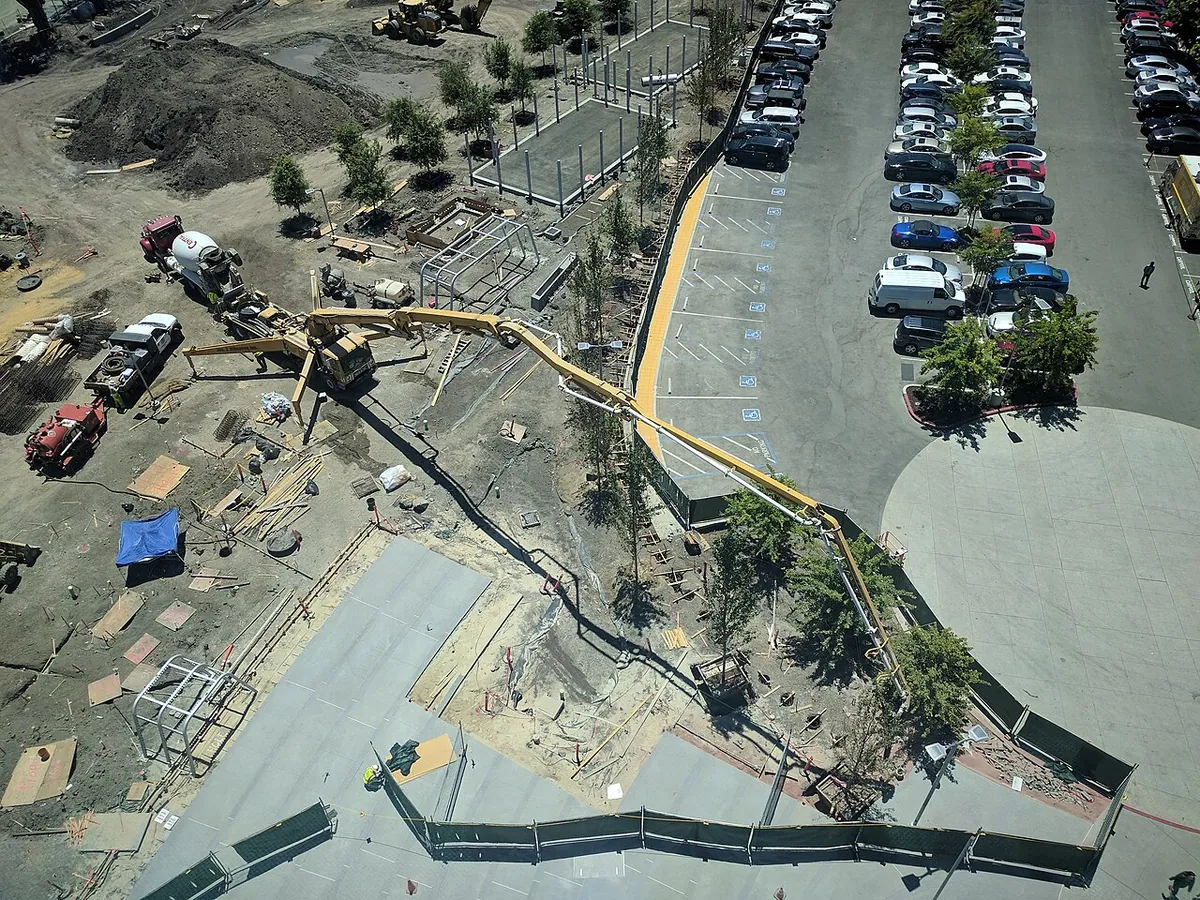
Photo: Grendelkhan, Wikimedia Commons, CC BY-SA 3.0
How Much Does a Truckload of Concrete Cost?
National cost guides put delivered ready-mix at about $125 to $200 per cubic yard for a full load, so:
| Load | Approximate concrete cost |
|---|---|
| Full 8-yard truck | $1,000 – $1,600 |
| Full 9-yard truck | $1,125 – $1,800 |
| Full 10-yard truck | $1,250 – $2,000 |
| Short load, 2 yards (with a fee) | $250 – $400 plus about $50 – $350 short-load fee |
Extra charges can include waiting time beyond the free unloading time, distance or zone fees, weekend delivery, and additives. See concrete price per yard for a full breakdown of the concrete delivery cost.
Short Loads and Minimum Orders
Ready-mix plants prefer full trucks, so many set a minimum order of about 3 to 4 yards and charge a short-load fee below that. That makes a small order expensive per yard. For example, at $150 per yard plus a $150 fee, 2 yards costs $450, or $225 per yard. If your project needs only a yard or two, compare:
- A short load from a standard plant, with the fee.
- A mini mixer service, which specializes in small loads and tight spaces.
- A volumetric mixer, which mixes on site and charges for what is used.
- Bagged concrete, about 45 bags of 80 lb mix per yard. See how many bags of concrete are in a yard.
- A rental trailer holding about a yard, if a supplier near you offers them.
Volumetric Mixer Trucks
A volumetric mixer carries sand, stone, cement and water in separate bins and mixes concrete at the job site as it pours. Instead of a fixed load, it produces as much as you need until the bins run out, and you pay for the amount used. That makes volumetric trucks handy when you are not sure of the exact quantity, when you have several small pours at different times, or when the site is far from a plant. Pricing is usually per yard plus a trip charge, so compare it with a ready-mix short load before booking.
How Long Does It Take to Unload a Concrete Truck?
Unloading time depends on how the concrete is placed. Pouring straight from the chute into nearby forms is fastest. Wheelbarrowing or pumping takes longer. Most suppliers include a set amount of free unloading time, often a few minutes per yard, and charge for waiting beyond that. Have the crew, tools and forms ready before the truck arrives. Concrete should generally be placed within about 90 minutes of batching, so long delays can also affect quality.
Scheduling Multiple Trucks
For pours larger than one truck, the supplier schedules trucks so the next one arrives as the previous one finishes. The goal is a continuous pour without cold joints, where fresh concrete is placed against concrete that has already started to set. Tips for multi-truck pours:
- Order the full amount up front, with a small extra margin, rather than calling for more at the end.
- Agree on the spacing between trucks based on how fast your crew can place and finish.
- Plan where trucks wait so they do not block each other or the street.
- Assign one person to talk with the drivers and the dispatcher.
- Hold the last load as a partial if your supplier allows "will call" for the final yards, so you only order what you need.
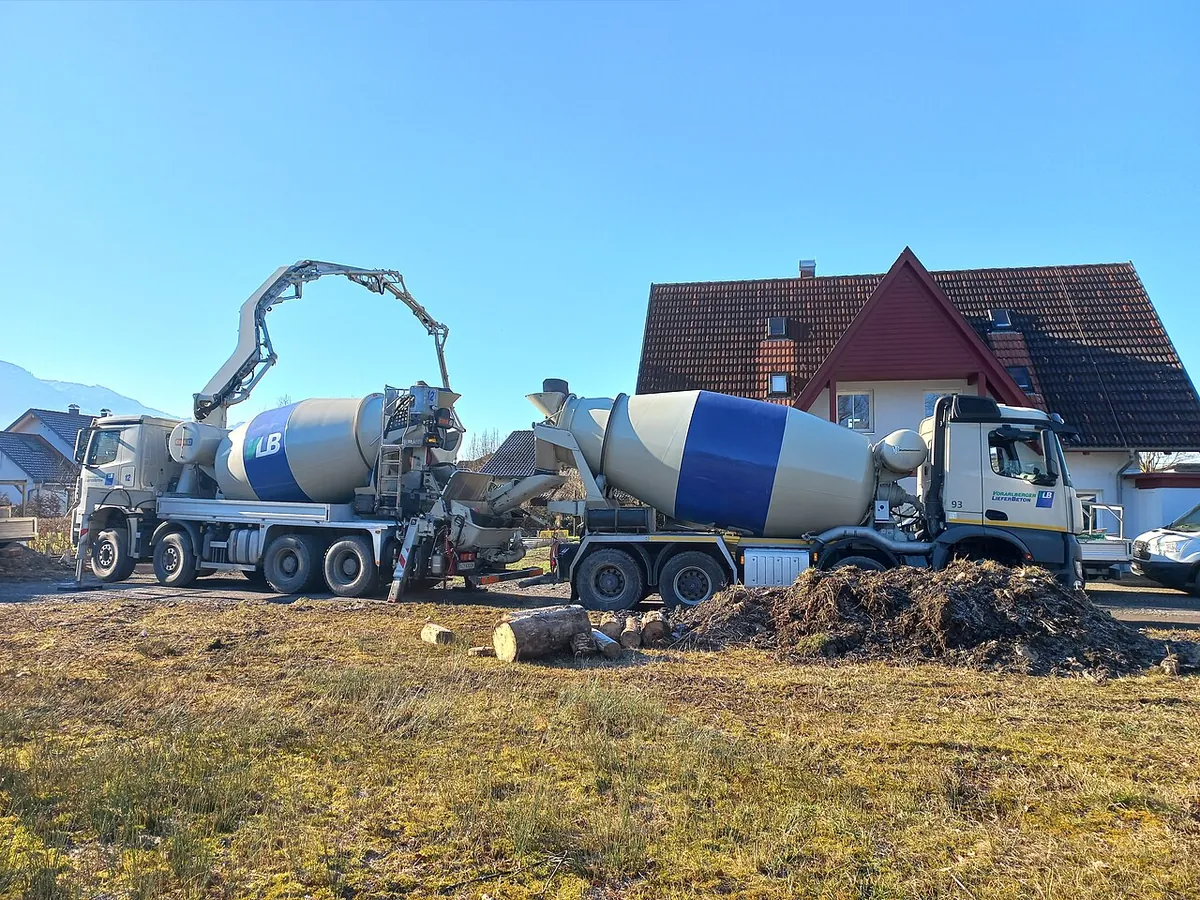
Photo: Asurnipal, Wikimedia Commons, CC BY-SA 4.0
Rear-Discharge vs Front-Discharge Trucks
The classic mixer has the chute at the back, so the driver backs up to the pour and a worker guides the chute. Front-discharge mixers place the chute over the cab, and the driver can steer and control the chute from inside, which can speed up placing on open sites. Both carry similar loads. Your supplier picks the truck; just tell them about access limits such as narrow driveways, gates, slopes and overhead wires.
Who Is on Site When the Truck Arrives?
For a typical residential pour, plan on the driver plus your own crew. The driver controls the drum and chute and decides where the truck can safely go. Your crew places the concrete with shovels and rakes, screeds it level, floats and finishes it, and cuts joints. For a 4 to 5 yard patio, three or four experienced people is common; for a full 10-yard truck, five or more is better. If you are not using a contractor, line up helpers well in advance and have every tool ready: wheelbarrows, rakes, a screed board, floats, an edger, a groover, a broom and a hose. The truck will not wait long without charging for the time.
How Far Can a Concrete Truck Travel?
Because concrete starts to set after it is mixed, ready-mix plants serve a limited radius, often within about an hour's drive. Sites farther away may pay a distance or zone fee, may need retarders in the mix, or may be better served by a volumetric truck. Rural customers should ask about delivery range when they call for quotes.
How to Order the Right Amount
- Measure carefully: length, width and actual depth, including thickened edges and footings.
- Calculate cubic yards: length × width × depth (in feet) ÷ 27. See how to calculate yards of concrete.
- Add 5 to 10 percent for uneven ground, spillage and form bulging.
- Round up to the nearest quarter or half yard your supplier sells.
- Ask the plant how much they load per truck for your mix, and plan your trucks around that.
What to Tell the Dispatcher When You Order
- The total cubic yards, and whether the last truck should be a "will call" partial load.
- The mix: strength (psi), slump, air entrainment and any fiber or color.
- The delivery address, a contact phone number and the exact pour location on the lot.
- Access limits: narrow streets, low branches, power lines, gates, slopes or soft ground.
- Whether a pump will be on site, and the pump company's arrival time.
- How fast your crew can place concrete, so trucks are spaced correctly.
- Where the driver can wash out.
Worked Example: How Many Trucks for a Driveway?
Say you are pouring a 24 × 50 foot driveway, 5 inches thick, with a 2 inch thickened edge along both sides. The main slab is 24 × 50 × (5 ÷ 12) = 500 cubic feet, or 18.5 yards. The thickened edges add roughly 2 × 50 × 1 × (2 ÷ 12) = about 17 cubic feet, or 0.6 yards. With about 7 percent extra for waste, the total is about 20.5 yards. At about 9.5 yards per truck, you would plan for two full trucks and a final partial load, often ordered as a "will call" so the crew can measure what is left before the plant batches it. At $150 per yard, the concrete would cost about $3,075, plus any fees.
Common Mistakes When Ordering Concrete Trucks
- Measuring only the surface. Forgetting thickened edges, footings or a low spot in the base can leave you a yard short.
- Assuming every truck is full. Ask how many yards of concrete in a truck your supplier actually loads for your mix; a "10-yard truck" may carry 9.
- Booking too few helpers. A full truck can unload in minutes; a small crew may not keep up, which leads to waiting charges or cold joints.
- Ignoring access. If the truck cannot get close, you need a pump or extra wheelbarrows lined up before it arrives.
- Ordering the last partial too late. Call for the final load early enough that it arrives before the placed concrete starts to set.
Delivery Options Compared
| Option | Typical load | Good when | Watch out for |
|---|---|---|---|
| Standard ready-mix truck | about 8 – 10 yards | Most jobs over 3 – 4 yards | Access and weight on driveways |
| Short load from a standard plant | 1 – 3 yards | Small slabs near the street | Short-load fees |
| Mini mixer service | about 3 – 4 yards | Tight access, small pours | Higher price per yard |
| Volumetric mixer | as needed | Uncertain quantities, several pours | Trip charges |
| Bagged concrete | a few bags to about a yard | Posts, small pads, repairs | Heavy labor, more cost per yard |
How Much Concrete Does a Truck Hold Compared With Bags?
One 10-yard truck delivers about the same amount of concrete as roughly 450 bags of 80 lb mix or about 900 bags of 40 lb mix. Mixing that many bags by hand would take a crew many hours, and the first batches would set long before the last ones were placed. That is why ready-mix is the standard for anything bigger than about a yard. See how much a bag of concrete costs to compare prices.
Frequently Asked Questions
How many yards of concrete are in a truck?
Most ready-mix trucks carry about 8 to 10 cubic yards. Mini trucks carry about 3 to 4 yards, and some large trucks carry up to about 12 to 14 yards where weight limits allow.
How much concrete does a truck hold in tons?
About 16 to 20 tons for an 8 to 10 yard load, since a yard of concrete weighs about 2 tons.
How much does a concrete truck weigh?
An empty mixer often weighs about 20,000 to 30,000 pounds. Fully loaded, it often weighs around 60,000 to 66,000 pounds or more.
How much is a full truck of concrete?
At about $125 to $200 per yard, a 10-yard truckload costs roughly $1,250 to $2,000 before extra fees.
What is the minimum amount of concrete a truck will deliver?
Many plants will deliver small loads but charge a short-load fee below a minimum that is often about 3 to 4 yards.
How many yards of concrete in a truck from a mini mixer?
Mini mixer and short-load trucks usually carry about 3 to 4 cubic yards. They are useful for small pours and tight access.
How many square feet does a truck of concrete cover?
A 10-yard truck covers about 810 square feet at 4 inches thick, 650 square feet at 5 inches and 540 square feet at 6 inches.
Can a concrete truck drive on my driveway?
It can, but a loaded truck weighing around 30 tons can crack many residential driveways. Ask the driver to stay on the street or use a pump if you want to protect existing concrete or asphalt.
How many yards in a truck of concrete for a driveway?
A typical 20 × 20 foot driveway at 4 inches needs about 5 yards, so one truck. A 20 × 40 foot driveway at 5 inches needs about 13 yards, so two trucks.
How many cubic yards in a concrete truck is a full load?
Usually 9 to 10 cubic yards. Most suppliers treat about 10 yards as a full load and add a short-load fee below a minimum that is often 3 to 4 yards.
How much concrete can a concrete truck hold at most?
The largest multi-axle mixers can carry about 12 to 14 cubic yards where state weight rules allow. Most trucks are loaded with 8 to 10 yards even when the drum is bigger, to stay under road weight limits.
How much concrete will a truck hold on a tight or hilly site?
Often less than a full load. Very fluid mixes slosh on hills and turns, so suppliers may send partial loads, and mini mixers carrying 3 to 4 yards are used where a full-size truck cannot fit.
Sources
- Texas Department of Transportation, Pavement Design Manual, "Concrete Mixing Trucks." txdot.gov
- Construction Equipment, "Terex Advance FDC300 Mixer" (drum size and weight). constructionequipment.com
- Trucking Info, "International introduces lightweight HV series mixer." truckinginfo.com
- HomeGuide, "Concrete delivery cost." homeguide.com
- LawnStarter, "Concrete price per yard." lawnstarter.com
- Image credits: truck photo by Retired electrician (CC0), pump photo by Grendelkhan (CC BY-SA 3.0) and unloading photo by Asurnipal (CC BY-SA 4.0), via Wikimedia Commons. Chart by Asphapro.com.
Truck capacities and weights vary by model and state rules. Checked November 2026.
Related Guides
- Insulated concrete forms cost — ICF wall prices
- What is concrete made of? — cement, water, sand, gravel and air
- Can you pour concrete in the rain? — risks and how to protect a pour
- Can you pour concrete in the winter? — cold weather rules and protection