
How Much Is a Bag of Concrete? 2026 Prices by Bag Size, Mix Type and Cost per Yard
Photo: Just a Man, Wikimedia Commons, CC BY 4.0
Quick Answer
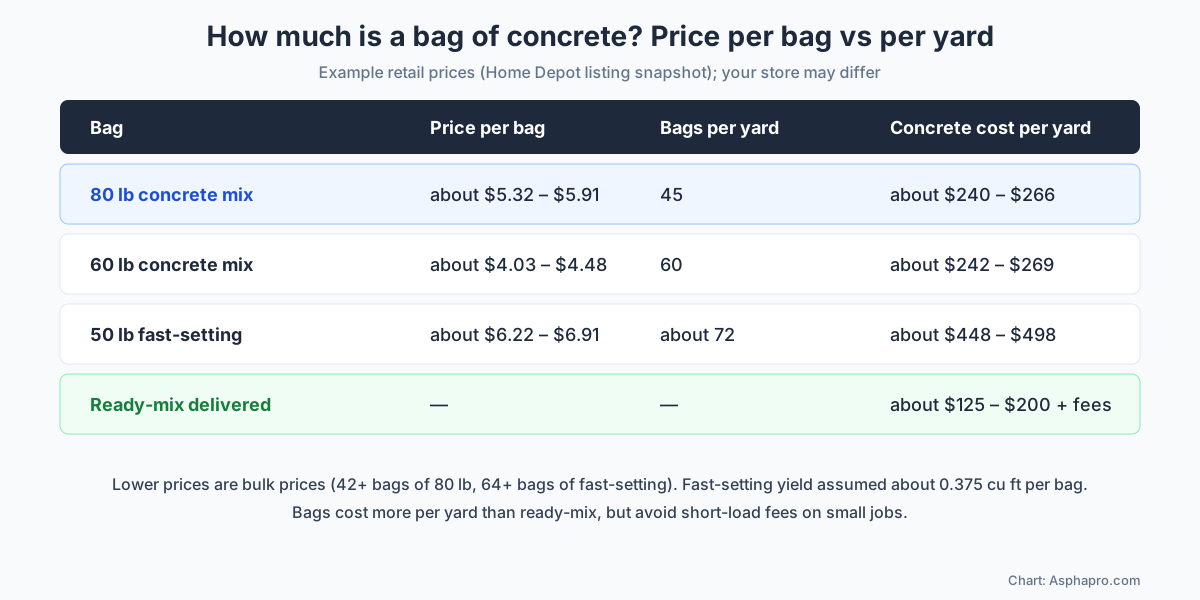
In 2026, a standard 80 lb bag of concrete costs about $5 to $7 at home centers. A Home Depot listing for Quikrete 80 lb Concrete Mix showed about $5.91 per bag, or about $5.32 each when buying 42 or more. A 60 lb bag costs about $4 to $5 (about $4.48, or $4.03 in bulk), and a 50 lb bag of fast-setting concrete about $6 to $7. One cubic yard made from bags costs roughly $240 to $270 for standard mix, compared with about $125 to $200 for delivered ready-mix. Prices vary by store, region and season.
Bagged concrete is the go-to choice for fence posts, small pads, steps and repairs. It is sold almost everywhere, keeps for months if stored dry, and lets you mix exactly as much as you need. But the price on the shelf is only part of the story. How much concrete a bag makes, which mix you choose, and how many bags your project needs all change the real cost.
This guide answers how much a bag of concrete costs in 2026 for each common size and type, how to compare prices by yield instead of weight, what one cubic yard costs in bags versus ready-mix, and how to save on your next project.
Concrete Bag Cost at a Glance
| Bag | Typical price per bag | Yield | Price per cubic foot |
|---|---|---|---|
| 80 lb standard concrete mix | about $5.32 – $5.91 (listing); about $5 – $7 typical | about 0.60 cu ft | about $8.90 – $9.85 |
| 60 lb standard concrete mix | about $4.03 – $4.48 (listing); about $4 – $5 typical | about 0.45 cu ft | about $8.95 – $9.95 |
| 40 lb standard concrete mix | usually a little less than a 60 lb bag | about 0.30 cu ft | usually higher per cubic foot |
| 50 lb fast-setting mix | about $6.22 – $6.91 (listing) | about 0.375 cu ft | about $16.60 – $18.40 |
| High-strength (5000 psi) mix | more than standard mix of the same size | see bag | higher |
Listing prices are from Home Depot product pages for Quikrete products at the time of writing. Lowe's, local building suppliers and other brands such as Sakrete sell similar products, often at similar prices, but prices change with region, promotions and the season.
How Much Is an 80 lb Bag of Concrete?
How much is an 80 pound bag of concrete at a home center? About $5 to $7 in 2026, with full-pallet discounts bringing it closer to $5. How much does a bag of concrete cost at a small hardware store or lumber yard? Often a dollar or two more, but they may deliver.
The 80 lb bag is the most common size for slabs and larger jobs. Expect to pay about $5 to $7 per bag in 2026. The Home Depot listing for Quikrete 80 lb Concrete Mix showed about $5.91, dropping to about $5.32 per bag when you buy 42 or more, which is the number of bags on a standard pallet. Each 80 lb bag yields about 0.60 cubic feet of concrete, enough for about 1.8 square feet of a 4 inch slab or most of a single fence post hole.
Because the 80 lb bag gives the most concrete per dollar among standard sizes, it is the best value when you can handle the weight. It is also heavy: 80 pounds is a lot to lift repeatedly, so plan for help and a cart.
How Much Is a 60 lb Bag of Concrete?
A 60 lb bag costs about $4 to $5. The Home Depot listing for Quikrete 60 lb Concrete Mix showed about $4.48, or about $4.03 in bulk. It yields about 0.45 cubic feet. Per cubic foot, 60 lb bags cost almost exactly the same as 80 lb bags, so choosing between them comes down to weight. Many homeowners prefer 60 lb bags because they are easier to carry, lift into a mixer, and move across a yard.
How Much Is a 40 lb Bag of Concrete?
40 lb bags are usually priced a little below 60 lb bags, which makes them more expensive per cubic foot. They yield about 0.30 cubic feet. They are best for small repairs, a single post, or jobs where you must carry each bag a long way or up stairs. For anything larger, 60 or 80 lb bags are cheaper.
How Much Is a Bag of Fast-Setting Concrete?
Fast-setting concrete, sold for fence posts and quick repairs, costs more. The Home Depot listing for Quikrete 50 lb Fast-Setting Concrete Mix showed about $6.91 per bag, or about $6.22 each for 64 or more. Its listing describes it as setting in about 20 to 40 minutes and reaching 4,000 psi at 28 days. Because a 50 lb bag yields less than an 80 lb bag of standard mix, the cost per cubic foot is roughly double. The benefit is speed and convenience: for posts, you typically pour the dry mix into the hole and add water, with no separate mixing.
How Much Is High-Strength Concrete Mix?
High-strength mixes, often labeled 5000 psi, cost more than standard mix of the same weight. A Home Depot listing showed a 50 lb 5000 psi mix at about $5.31. These mixes contain more cement and are made for heavy-use slabs, structural repairs and places that need extra strength. For most patios, walkways and posts, standard mix is enough. See types of concrete for when stronger mixes make sense.
Compare Prices by Yield, Not by Weight
How much concrete in a bag is what you are really paying for. An 80 lb bag makes about 0.60 cubic feet, a 60 lb bag about 0.45 cubic feet and a 40 lb bag about 0.30 cubic feet, so the yield, not the price tag, tells you which bag is the better deal.
The best way to compare bags is the price per cubic foot of finished concrete. Divide the price by the yield printed on the bag:
Price per cubic foot = price per bag ÷ yield per bag (cu ft)
Example: an 80 lb bag at $5.91 with a 0.60 cubic foot yield costs $9.85 per cubic foot. A 50 lb fast-setting bag at $6.91 with a 0.375 cubic foot yield costs $18.43 per cubic foot. Comparing this way also helps between brands, since yields can differ slightly.
How Much Does a Cubic Yard of Bagged Concrete Cost?
| Option for 1 cubic yard (27 cu ft) | Bags needed | Approximate cost |
|---|---|---|
| 80 lb bags at about $5.32 – $5.91 | 45 | about $240 – $266 |
| 60 lb bags at about $4.03 – $4.48 | 60 | about $242 – $269 |
| 50 lb fast-setting at about $6.22 – $6.91 | about 72 | about $448 – $498 |
| Ready-mix delivered | — | about $125 – $200, plus any short-load fee |
Bagged concrete costs more per yard than ready-mix, but ready-mix plants often add a short-load fee of about $50 to $350 for small orders below their minimum. For one yard or less, bags are often cheaper overall. Above about two or three yards, ready-mix almost always wins. See concrete price per yard and how many bags of concrete are in a yard.
What Projects Cost With Bagged Concrete
| Project | Approx. 80 lb bags | Approx. bag cost at $5.32 – $5.91 |
|---|---|---|
| One fence post (10 in. × 30 in. hole) | 2 | about $11 – $12 |
| Fence with 20 posts | 40 | about $213 – $236 |
| Mailbox post | 1 – 2 | about $6 – $12 |
| Deck footing, 12 in. × 4 ft tube | 5 – 6 | about $27 – $35 |
| AC pad, 3 × 3 ft, 4 in. | 6 | about $32 – $35 |
| Landing, 4 × 4 ft, 4 in. | 10 | about $53 – $59 |
| Shed pad, 8 × 10 ft, 4 in. | 49 | about $261 – $290 |
| Patio, 12 × 12 ft, 4 in. | 88 | about $468 – $520 |
Bag counts include about 10 percent extra. For the 12 × 12 patio, also see 12x12 concrete slab cost.
Photo: StaraBlazkova, Wikimedia Commons, CC BY-SA 3.0
Why Bag Prices Vary
Bag prices move with the cost of cement, which depends on energy and transport costs, and with local demand. Prices are usually higher in remote areas and in places where materials travel long distances. Home centers run promotions in spring and summer, and bulk pricing kicks in at pallet quantities. Specialty mixes such as fast-setting, high-strength, fiber-reinforced and quick-repair products always cost more than standard mix. Local building suppliers may have higher list prices than big-box stores but better pricing on multiple pallets, plus delivery.
Why Bags of Concrete Cost More Than They Used To
If you last bought concrete a decade ago, today's prices may surprise you. Cement is one of the most energy-intensive building materials to make, so its price follows fuel and electricity costs. Sand and gravel must be quarried, crushed and trucked, and diesel prices affect every step. Packaging, labor at plants and stores, and freight to retail locations have all become more expensive. Demand also matters: busy construction seasons and large infrastructure projects keep cement in demand. All of that feeds into the price of a bag of concrete on the shelf. For bigger jobs, the same forces raise ready-mix prices; see concrete price per yard for why concrete is so expensive.
Where to Buy Bagged Concrete
Home centers
Home Depot and Lowe's carry the most common sizes and brands and list prices online, which makes comparing easy. Both often offer bulk pricing at pallet quantities and delivery for full pallets.
Local building and masonry suppliers
Supply yards often carry more specialty products and may offer better prices on multiple pallets, plus delivery with a forklift. Prices for a single bag may be higher than at a home center, so ask for a quote on the full quantity.
Hardware stores and farm stores
Smaller stores are convenient for a few bags and often stock fast-setting post mix. Expect higher prices per bag.
Online and discount retailers
Some general retailers list bagged concrete online, but heavy bags are expensive to ship, and online listings can be confusing or out of date. For anything more than a few bags, buy locally.
Quikrete, Sakrete and Other Brands
Quikrete and Sakrete are the two best-known national brands in the U.S., and many regions have local brands and store brands. Their standard concrete mixes are similar: bags of cement, sand and gravel that make roughly 0.60 cubic feet per 80 lb bag. Differences show up in specialty products, such as fast-setting formulas, high-strength mixes and repair products, and in local availability. When comparing, look at the strength rating (often 4,000 psi for standard mix at 28 days), the yield per bag and the price. For most homeowner projects, the brand matters less than using the right type of mix and the right amount of water.
Specialty Bags and What They Cost
- Crack-resistant or fiber-reinforced mix: standard concrete with fibers to reduce surface cracking; usually priced a bit above standard mix.
- Countertop mix: formulated for smooth, dense finishes; costs much more per bag.
- Quick-setting repair cement and anchoring cement: sold in small bags or tubs for patches and setting bolts; expensive per pound but used in small amounts.
- Resurfacer and vinyl patcher: for thin overlays and repairs; sold by coverage area rather than volume.
- Mortar mix and sand mix: for masonry and thin toppings, not for slabs or posts.
For repairs, see concrete repair cost and concrete overlay cost.
Tips When Buying Bags
- Check that bags are dry and soft, with no hard lumps.
- Avoid torn or re-taped bags.
- Check the product type on every bag; mortar and concrete bags can look alike.
- Ask whether bulk pricing applies at your quantity.
- Ask about delivery for anything more than you can safely carry.
- Keep receipts so you can return unopened extras if allowed.
Is It Worth Buying a Mixer?
For a few bags, a wheelbarrow and hoe are enough. For 20 or more bags, a drum mixer saves a lot of effort and produces more even concrete. Renting a mixer for a day is often the best choice for a single project. If you do concrete work regularly, such as fence building or garden projects, buying a small electric mixer can pay for itself. See concrete cement mixers for types and features.
Quick Way to Price Your Project
To work out how much is a bag of concrete for your whole job, first find the volume in cubic feet, divide by 0.60 to get the number of 80 lb bags, add 10 percent, and multiply by your local price. For example, 30 cubic feet ÷ 0.60 = 50 bags, plus 10 percent = 55 bags. At about $5.32 to $5.91 per bag, that is about $293 to $325. If the total is more than about $400 to $500 in bags, also get a ready-mix quote, since one or two yards delivered may cost less and save hours of mixing.
Other Costs When Using Bagged Concrete
- Mixer rental or purchase: a drum mixer makes dozens of bags far easier.
- Tools: wheelbarrow, hoe, shovel, screed board, floats, edger, groover and broom.
- Forms and stakes: lumber for slabs and steps.
- Gravel base: crushed stone under slabs and in post holes.
- Reinforcement: wire mesh, rebar or fiber.
- Delivery: stores often charge to deliver a pallet.
- Your time: mixing a cubic yard of bags is a full day of hard work.
How to Save on Bags of Concrete
- Buy 80 or 60 lb bags rather than 40 lb for better value per cubic foot.
- Buy in bulk to reach pallet pricing when you need many bags.
- Use standard mix unless you truly need fast-setting or high strength.
- Measure carefully and add only about 10 percent extra.
- Return unopened extras if your store allows it.
- Switch to ready-mix once you need more than about 2 to 3 yards.
- Store bags dry so none are wasted to moisture.
Bags vs Ready-Mix: Three Cost Comparisons
Half a yard for a landing and steps
About 23 bags of 80 lb mix plus a few extra, roughly 25 bags, at about $5.32 to $5.91 is about $133 to $148. Ready-mix for half a yard would cost about $63 to $100 for the concrete but often $50 to $350 more in short-load fees. Bags win clearly.
One yard for a shed pad
About 50 bags with waste cost about $266 to $296. One yard of ready-mix at $125 to $200 plus a short-load fee often lands around $175 to $550. The costs are close, but bags mean a full day of mixing, while ready-mix arrives in minutes. Many people choose ready-mix here if a truck can reach the site.
Three yards for a patio
About 150 bags with waste would cost about $800 to $890 and an enormous amount of labor. Three yards of ready-mix at $125 to $200 is about $375 to $600, possibly plus a small fee. Ready-mix wins easily.
Seasonal and Regional Price Differences
The price of a bag of concrete is usually lowest at large home centers in metro areas with many stores competing, and highest in remote areas where freight costs more. Spring and early summer bring the most demand, and sometimes promotions on bulk purchases. In winter, some stores stock fewer pallets, and frozen or damp storage can damage bags, so check them carefully. If you are planning a large bag project, compare two or three stores and ask about pallet pricing and delivery fees before you buy.
Mistakes That Waste Bags
- Mixing too much at once. Concrete starts to stiffen within an hour or two; mix only what you can place and finish.
- Leaving opened bags outside. Humidity and rain harden them quickly.
- Overwatering. Wet mixes are weaker and shrink more, which can mean repairs and more bags later.
- Buying far too many. Extra bags may harden before your next project.
- Using the wrong product. Mortar or sand mix in a post hole or slab may fail.
Bagged Concrete vs Cement vs Mortar
Shoppers often confuse these products. Concrete mix already contains cement, sand and gravel; you add only water. Portland cement is just the binder; to make concrete from it, you add sand, gravel and water in the right proportions. Mortar mix contains cement and fine sand, and is made for laying blocks and bricks, not for slabs or posts. Sand mix or topping mix is for thin repairs. Buying the wrong product is a common and costly mistake. See mortar vs concrete and what concrete is made of.
Mixing a Bag of Concrete the Right Way
Getting full value from each bag means mixing it correctly. Pour the dry mix into a wheelbarrow, tub or mixer, make a hollow in the center, and add about three-quarters of the water listed on the bag. Mix thoroughly, scraping the corners, then add the rest of the water a little at a time until the concrete is like thick oatmeal: it should hold a shape when you cut a groove with a hoe, without being crumbly or soupy. Mix for a few minutes so all the cement is wet. Place the concrete within the working time on the bag, tamp or vibrate it to remove air pockets, and keep it moist while it cures. Concrete that is mixed with too much water may look easier to work, but it can lose a large share of its strength. See how long concrete takes to cure.
Is Bagged Concrete as Strong as Ready-Mix?
Standard bagged concrete mixes are commonly rated around 4,000 psi at 28 days when mixed and cured according to the instructions, which is similar to many residential ready-mix orders. In practice, ready-mix is often more consistent because it is batched by machine with measured water. Bagged concrete can be just as good if every batch gets the same amount of water and is mixed well. The biggest risk with bags is inconsistent mixing across dozens of batches, which can leave weaker spots in a slab.
How Many Bags Can You Carry?
Bag weight adds up fast: 10 bags of 80 lb mix weigh 800 pounds, and a full pallet of 42 bags weighs 3,360 pounds plus the pallet. Most half-ton pickups can safely carry only a portion of a pallet. Check your vehicle's payload rating, spread the load over the axle, and consider delivery for large orders. See how many bags of concrete are on a pallet.
Frequently Asked Questions
How much is a bag of concrete?
About $5 to $7 for an 80 lb bag, $4 to $5 for a 60 lb bag, and about $6 to $7 for a 50 lb bag of fast-setting mix, depending on the store and region.
How much does an 80 lb bag of concrete cost at Home Depot?
A Home Depot listing for Quikrete 80 lb Concrete Mix showed about $5.91 per bag, or about $5.32 each for 42 or more, at the time of writing.
How much concrete does one bag make?
About 0.60 cubic feet for an 80 lb bag, 0.45 for 60 lb and 0.30 for 40 lb.
Is it cheaper to buy bags or ready-mix?
Bags are often cheaper for jobs under about one cubic yard. Ready-mix is cheaper per yard for larger jobs, even with a short-load fee.
How much does a yard of bagged concrete cost?
About $240 to $270 using 45 bags of 80 lb or 60 bags of 60 lb standard mix at current listing prices.
How much is a 60 lb bag of concrete?
About $4 to $5. A Home Depot listing for Quikrete 60 lb Concrete Mix showed about $4.48, or about $4.03 each in bulk.
How much is a bag of concrete for fence posts?
A 50 lb bag of fast-setting concrete costs about $6 to $7. Most posts need one to three bags, depending on the hole size.
How much is a bag of concrete per cubic foot?
About $8.90 to $9.95 per cubic foot for standard 60 or 80 lb mix at current listing prices, and roughly $16 to $18 per cubic foot for fast-setting mix.
How many bags of concrete do I need for a small slab?
About one 80 lb bag for every 1.8 square feet of a 4 inch slab. A 6 × 8 foot pad needs about 30 bags with 10 percent extra for waste and uneven ground under the new slab.
Does a bag of concrete go bad?
Yes, slowly. Moisture makes it harden into lumps. Store bags dry and off the ground, and do not use bags with hard lumps for structural work.
Why is fast-setting concrete more expensive?
It contains special cements that set in minutes and yields less per bag, so it costs roughly twice as much per cubic foot as standard mix.
How much does a bag of concrete weigh?
Standard bags weigh 40, 50, 60 or 80 pounds, as printed on the bag. The 80 lb bag is the most common and the cheapest per cubic foot, but it is heavy to carry and mix by hand.
Sources
- The Home Depot, Quikrete 80 lb Concrete Mix listing (price snapshot). homedepot.com
- The Home Depot, Quikrete 50 lb Fast-Setting Concrete Mix listing. homedepot.com
- The Home Depot, concrete mix category (60 lb and 5000 psi listings). homedepot.com
- Quikrete, Concrete Mix (No. 1101) product listing (bag sizes and pallet counts). quikrete.com
- HomeGuide and LawnStarter, ready-mix price per yard and short-load fees. homeguide.com
- Image credits: store photo by Just a Man (CC BY 4.0) and stack photo by StaraBlazkova (CC BY-SA 3.0), via Wikimedia Commons. Chart by Asphapro.com.
Prices are retail snapshots and change often; check your local store. Checked November 2026.
Related Guides
- How to make concrete planters — DIY pots and white concrete
- How to make concrete stepping stones — molds, mix and setting a path
- What is concrete made of? — cement, water, sand, gravel and air
- Mortar vs concrete — differences and which to use
- How to use self leveling concrete — prep, pour and dry times