
Pool Water Delivery Cost: What It Costs to Have Water Trucked to Your Pool
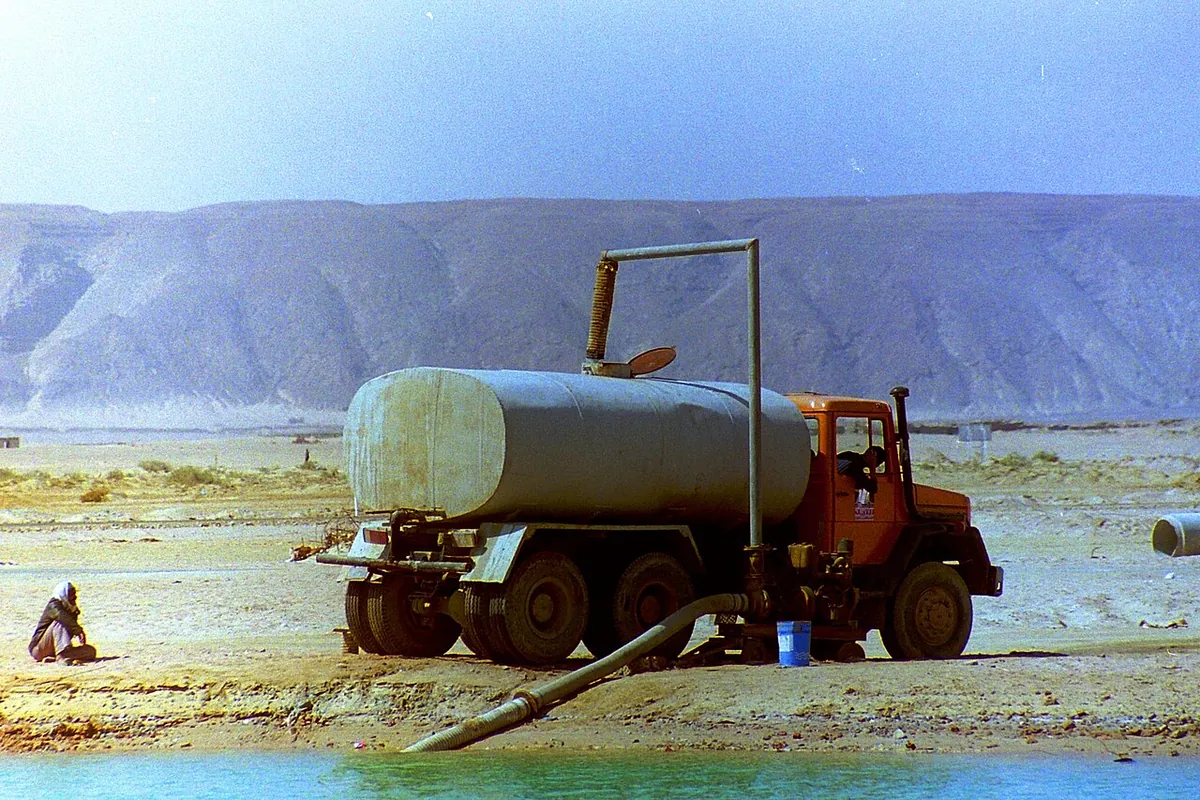
Photo: Spielvogel, Wikimedia Commons, CC0
Quick Answer
Pool water delivery cost is usually about $200 to $600 per truckload, which works out to roughly $30 to $100 per 1,000 gallons. Most water trucks carry about 6,000 to 8,000 gallons (some up to 9,000 or more), so a typical 15,000 to 20,000 gallon inground pool needs 2 to 4 loads and costs about $600 to $2,000 to fill by truck. A small above ground pool can often be filled with one load. Swimming pool water delivery costs far more than city water from a hose, but it fills the pool in hours instead of days, protects private wells, and is often the best choice for a new vinyl liner, fresh plaster, or during drought restrictions.
Most people fill a pool with a garden hose. It is cheap and simple, but slow, and not always possible. Homes on private wells can run their wells dry; new plaster must be filled without stopping; new vinyl liners should be filled quickly; and some towns restrict filling pools from the public supply in dry seasons. In all of these cases, pool water delivery solves the problem: a tanker truck brings thousands of gallons of clean water and pumps it straight into the pool.
This guide explains pool water delivery cost in detail: price per load and per gallon, how many loads your pool needs, what affects the price, how the delivery works, how to prepare, when trucked water is worth it, and how it compares with the hose. For the cost of filling with your own water supply, see swimming pool filling cost.
Pool Water Delivery Cost at a Glance
| Item | Typical cost |
|---|---|
| Price per truckload (about 6,000 – 8,000 gal) | $200 – $600 |
| Price per 1,000 gallons | $30 – $100 |
| Small above ground pool (about 5,000 gal) | $200 – $500 (one load) |
| Large above ground pool (about 12,000 gal) | $400 – $1,200 |
| Average inground pool (15,000 – 20,000 gal) | $600 – $2,000 |
| Large inground pool (30,000 gal) | $900 – $3,000 |
| Extra hose length, long distance or rush fee | $25 – $150+ per load |
These ranges come from HomeGuide, Angi and other national cost guides. Pool water delivery prices vary a lot by region: where water is scarce or haul distances are long, costs are at the top of the range or higher.
How Many Truckloads Does My Pool Need?
Divide your pool volume by the truck's capacity and round up. Ask the company exactly how many gallons each truck holds, because sizes vary from about 2,000 gallons for small trucks to 9,000 gallons or more for semi tankers.
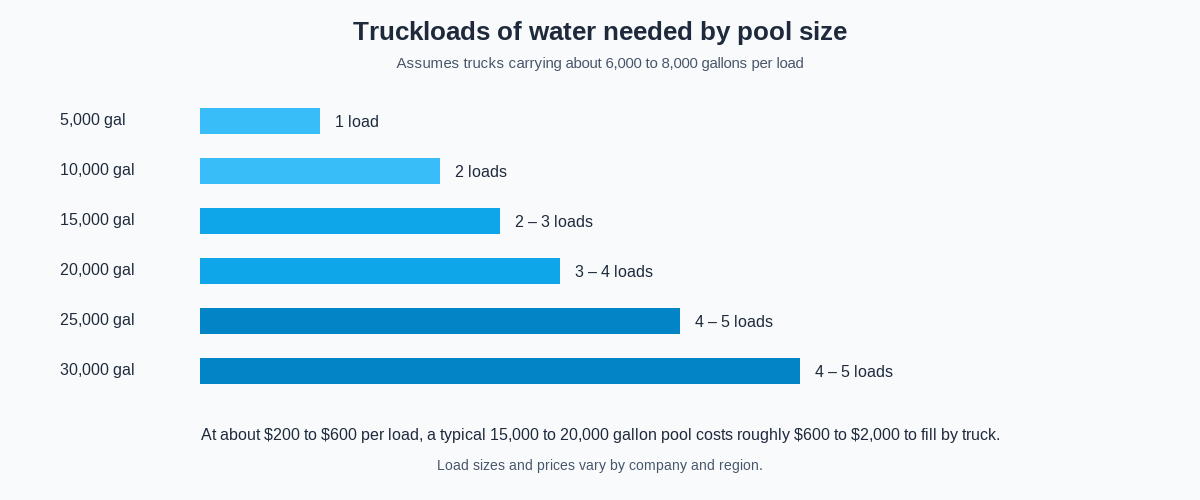
Chart: Asphapro.com
If you do not know your pool volume, use length × width × average depth × 7.5 for rectangular pools, or diameter × diameter × average depth × 5.9 for round pools. See how many gallons is my pool. Many owners order slightly less than the full volume and finish with a hose, so they do not pay for a whole extra load to top off the last few hundred gallons.
What Affects Swimming Pool Water Delivery Cost
- Pool volume: the number of loads is the biggest factor.
- Truck size: larger trucks cost more per trip but less per gallon.
- Distance: many haulers charge more beyond a set radius, or add a fuel surcharge.
- Water source: municipal potable water costs the hauler more than non-potable sources; for pools, potable water is usually required or strongly preferred.
- Local water supply: drought areas and remote areas pay more.
- Access: long hose runs, steep driveways or tight streets add time and may need extra hose.
- Timing: weekend, evening and rush deliveries cost more; spring opening season is busy.
- Minimums: many companies sell by the full load only.
How Pool Water Delivery Works
- Get a quote. Give the pool size, address, access details and whether you need potable water.
- Schedule. Book a date and confirm the number of loads.
- Prepare the pool. Make sure it is clean and ready to fill, with the liner or surface ready.
- Delivery. The truck parks as close as possible, runs a hose to the pool, and pumps the water. A load usually takes 20 to 60 minutes to unload.
- Repeat for additional loads; trucks may go back to refill between loads.
- Finish. Top off with a garden hose if needed, then start the pump and balance the chemistry.
A water hauler should use a tanker dedicated to potable water, not one that also carries other liquids. Ask how the tank is cleaned and where the water comes from.
Preparing for a Water Delivery
- Measure the hose run from where the truck can park to the pool, and tell the company. Many carry 100 to 200 feet of hose.
- Clear a path for the hose and protect landscaping and decks from the heavy hose.
- Open gates and keep pets inside.
- Check that the truck can park safely without blocking traffic or damaging soft ground; a loaded truck is very heavy.
- For vinyl liners, have the liner set and be ready to smooth wrinkles as the water rises.
- For fresh plaster, coordinate so water starts right after plastering and does not stop until the pool is full.
When Pool Water Delivery Is Worth It
Private wells. A household well might safely supply 5 to 10 gallons per minute. Filling a 20,000 gallon pool from a well can take days and risks drawing down the water table, pulling sediment or burning out the pump. Trucked water avoids all of that.
New vinyl liners. A new liner should be filled promptly. Bringing in a truckload or two covers the floor quickly, which helps the liner settle without wrinkles. See how to install an above ground pool liner.
New plaster or resurfacing. Plaster pools must be filled continuously to avoid a ring or streaks. Combining trucks with hoses gets the water in fast. See replaster pool cost.
Water quality problems. If your well water has iron or other metals that stain pools, trucked municipal water can prevent stains.
Drought restrictions. Some towns limit filling pools from the public system during droughts but allow trucked water from outside sources.
Time pressure. When you need the pool full for an event or to protect a new surface, a truck finishes in hours.
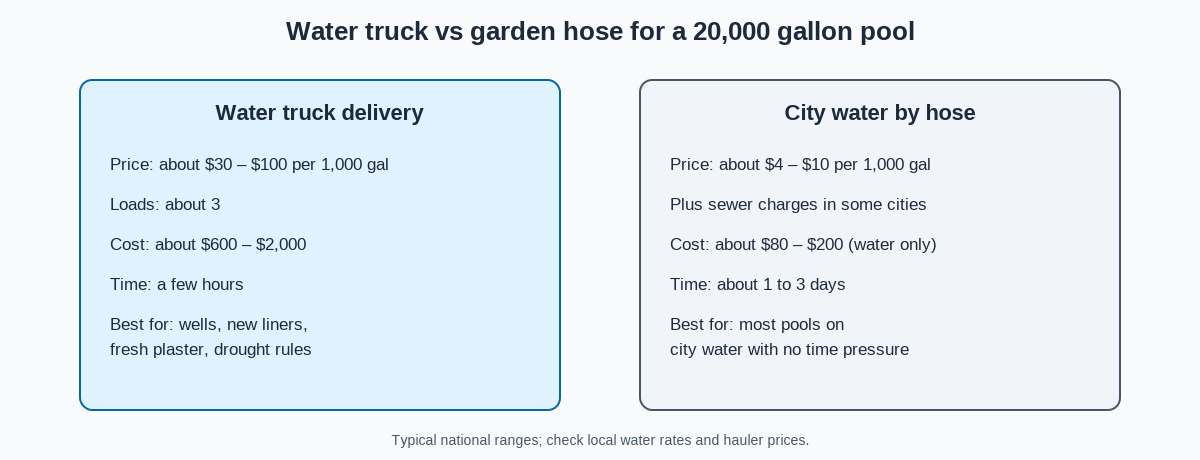
Chart: Asphapro.com
Pool Water Delivery vs Filling With a Hose
City water from a hose typically costs about $4 to $10 per 1,000 gallons, plus sewer charges in some cities, so filling a 20,000 gallon pool costs about $80 to $200 in water alone. Trucked water for the same pool costs about $600 to $2,000. The hose is almost always cheaper, but it can take one to three days. Many owners use both: a load or two of delivered water to start, then the hose to finish. For a detailed comparison, see swimming pool filling cost.
Water Delivery for Above Ground Pools
Above ground pools hold less water, so water pool delivery for an above ground pool is often a single load. A 15 ft round pool holds about 5,000 gallons and an 18 ft round pool about 7,000 gallons, which many trucks can fill in one trip. A 24 ft round pool at about 12,000 to 13,000 gallons usually needs two loads. Because above ground liners need careful smoothing in the first inches, ask the driver to start slowly. See how to put up an above ground pool.
Water Delivery for Hot Tubs and Spas
Hot tubs hold only 300 to 600 gallons or so, so they are almost always filled with a garden hose. Some companies offer small-load delivery for remote cabins or homes on limited wells, often with a minimum charge similar to a small load.
Chemistry After a Water Delivery
Trucked water is clean but not balanced for pools. After delivery:
- Start the pump and filter.
- Test and adjust alkalinity, then pH.
- Adjust calcium hardness, especially for plaster pools.
- Add stabilizer for outdoor chlorine pools.
- Add chlorine and test again the next day.
Start-up chemicals often cost $50 to $200. See how to raise alkalinity in a pool, how to add stabilizer to a pool and how to clean a pool.
Pool Water Delivery Prices by Region
Pool water delivery prices follow local water supply and hauling distances. In areas with plenty of municipal water and many haulers, such as much of the Midwest and Northeast, pool water delivery cost tends to sit near the lower end, often $200 to $350 per load. In the Southwest, the Rocky Mountain West and other dry regions, water is scarcer and haul routes are longer, so swimming pool water delivery cost per load is often $400 to $600 or more. Rural homes far from a filling station may pay extra mileage. Coastal and island communities, where fresh water is limited, can see the highest pool water delivery prices of all.
The best way to know the cost of pool water delivery where you live is to call two or three local haulers with your pool volume and address. Ask for the total for all loads, not just the price per load, so you can compare quotes fairly.
Pool Water Delivery Cost by Season
Spring is the busiest season for pool water delivery, because owners open pools, builders finish new pools, and pools that were drained for winter repairs need refilling. Haulers book up weeks ahead and some add peak-season pricing. Summer stays busy in hot regions where evaporation is high. Late summer and fall are often quieter, with more flexible scheduling. If you are planning a liner change or resurfacing, scheduling it for a slower season can lower the swimming pool water delivery cost and make it easier to get a truck on the exact day you need it.
Water Delivery for Pool Openings and Top-Ups
Not every water delivery for pool owners is a full fill. Pools that were lowered for winter need only the top 6 to 18 inches refilled, and pools that lose water over a hot summer may need a few thousand gallons. Many haulers sell partial loads, though often at a minimum charge. If your pool only needs a small top-up and you have city water, the hose is usually the better choice. If you are on a well with limited flow, a partial pool water delivery can save the well.
Pool Water Delivery for New Pool Construction
Pool builders often arrange pool water delivery as part of a new pool, especially for plaster and pebble finishes that must be filled immediately and continuously after application. Fiberglass pools are filled as they are backfilled, so the water level and backfill rise together; trucks can speed this up. Vinyl liner pools benefit from fast initial filling to set the liner. Ask your builder whether the contract includes the first fill and who pays for any trucked water. If it is not included, budget the swimming pool water delivery cost along with start-up chemicals.
Pool Water Delivery Cost Examples
| Pool | Volume | Loads (about 7,000 gal each) | Estimated pool water delivery cost |
|---|---|---|---|
| 18 ft round above ground | about 7,000 gal | 1 | $200 – $600 |
| 24 ft round above ground | about 12,500 gal | 2 | $400 – $1,200 |
| 14 x 28 ft inground | about 14,700 gal | 2 – 3 | $400 – $1,800 |
| 16 x 32 ft inground | about 19,200 gal | 3 | $600 – $1,800 |
| 20 x 40 ft inground | about 33,000 gal | 5 | $1,000 – $3,000 |
Actual pool water delivery prices depend on the truck size each company uses. Combining a few loads with hose water for the final top-off often brings the total down.
Common Problems With Pool Water Delivery
- The truck cannot reach. Low branches, narrow streets, soft lawns or steep driveways can keep a truck too far away. Measure the hose run in advance.
- Liner shifts during filling. Fast water flow can push a new liner. Ask the driver to start slowly and keep smoothing.
- Cloudy or tinted water. Usually from sediment stirred in the pool, or from metals in non-municipal water. Run the filter and use a metal sequestrant if needed.
- Hose damage. Heavy hoses can scuff decks and crush plants. Lay boards or mats along the path.
- Unexpected fees. Extra hose, waiting time and mileage charges. Get all fees in writing.
Is Swimming Pool Water Delivery Water Safe?
Reputable swimming pool water delivery companies use potable water from a municipal source and haul it in tanks used only for drinking-quality water. Once in your pool, it needs normal chlorination and balancing like any water. If a hauler offers non-potable water at a lower price, think carefully: it may carry bacteria, metals or other contaminants that are harder to treat and can stain surfaces. For a family pool, potable water is worth the small difference in pool water delivery cost.
Permits and Local Rules
Homeowners rarely need a permit to receive pool water delivery, but haulers may need permits to draw water from hydrants or filling stations. During droughts, some cities ban filling pools from the local system but allow trucked water from outside the area, which can raise the cost of pool water delivery. Check local rules before you schedule, especially in summer.
Questions to Ask Before Booking Pool Water Delivery
- How many gallons does your truck hold, and how many loads will my pool need?
- What is the price per load, and is there a minimum charge or partial-load option?
- Is the water potable, and where does it come from?
- Is the tank used only for drinking-quality water?
- How much hose do you carry, and is there a fee for extra length?
- Do you charge for mileage, fuel, waiting time or weekend delivery?
- How long does each load take to unload?
- Can you start slowly for a new liner or deliver on a fixed schedule for new plaster?
Clear answers make it easy to compare pool water delivery prices and avoid surprises on delivery day.
Water Delivery When Refilling After Repairs
Pools are often drained for resurfacing, liner replacement, leak repair or to correct very high calcium, stabilizer or dissolved solids. After these jobs, the refill can be done by hose, by truck, or both. If the repair involved new plaster, a continuous fill is important, and pool water delivery helps keep the water moving. If the pool was drained only partly, the hose is usually enough. Plan the water source as part of the repair, so the pool does not sit empty longer than necessary. See pool resurfacing cost and pool liner replacement cost.
Environmental Considerations
Trucking water uses fuel, and in drought regions every gallon matters. The most sustainable approach is to fill once and keep the water: maintain good chemistry so the pool rarely needs draining, use a cover to cut evaporation, and fix leaks fast. When you do need water delivery for pool filling, ordering exactly the loads you need and using the largest practical truck reduces trips. Some regions also allow reclaimed or non-potable water for certain uses, but potable water remains the standard for swimming pools.
Pool Water Delivery for Homes on Wells: A Closer Look
Homes on private wells are the most common customers for pool water delivery. A typical residential well and pressure tank are sized for household use: showers, laundry, dishes and some watering. Filling a pool is a very different demand. Running a hose for 24 to 72 hours can lower the water level in the well faster than it recharges, especially in late summer or in drought. When that happens, the pump can run dry and overheat, sediment can be pulled into the plumbing, and in shallow wells the water may turn cloudy for days.
For these homes, pool water delivery is often the safer option even though the cost of pool water delivery is higher than the cost of running the well. A middle path is to have one or two loads delivered and then top off from the well in short sessions, with rest periods in between. If you are unsure how much your well can supply, a well contractor can measure its flow rate and recovery.
Budgeting for Pool Water Delivery Over the Years
Most pools need a full fill only a few times in their life: at construction, after resurfacing or a liner change, and occasionally after a major water quality problem. If you are on a well or in a drought area, plan for each of those events to include swimming pool water delivery cost. For a typical 20,000 gallon pool, budgeting $1,000 to $2,000 per full refill is reasonable in many regions. Good water care, a cover and prompt leak repair reduce how often you need it.
How to Find and Compare Water Haulers
- Ask local pool builders and pool stores who they use.
- Search for bulk water delivery or potable water haulers in your area.
- Confirm the truck capacity, the price per load, and any minimums or fees.
- Ask whether the water is potable and where it comes from.
- Ask how long the hose is and how long each load takes to unload.
- Check availability in spring, when demand is highest.
- Get the quote in writing, including the total for all loads.
Ways to Save on Pool Water Delivery
- Combine truck and hose. Buy only the loads you need and top off with the hose.
- Book early and avoid rush or weekend fees.
- Choose larger trucks if access allows; the price per gallon is usually lower.
- Avoid draining when possible. Partial drains and water care reduce how often you need a full refill; see how to drain a pool.
- Use a cover to cut evaporation, so you need less top-up water.
- Fix leaks so you are not paying to replace lost water; see pool leak repair cost.
Pool Water Delivery Cost: Key Points
- Pool water delivery cost is about $200 to $600 per load, or $30 to $100 per 1,000 gallons.
- Most pools need 2 to 4 loads; above ground pools often need just one.
- Swimming pool water delivery is fastest and protects wells and new pool surfaces.
- A garden hose is far cheaper when you have city water and time.
- Ask for potable water, the truck size, all fees, and the total for every load before booking.
Frequently Asked Questions
How much does pool water delivery cost?
About $200 to $600 per truckload, or $30 to $100 per 1,000 gallons. A typical inground pool costs about $600 to $2,000 to fill by truck.
How many gallons are in a water delivery truck?
Most trucks used for pools carry about 6,000 to 8,000 gallons; some carry less, and semi tankers carry 9,000 gallons or more.
How long does it take to fill a pool with a water truck?
Each load usually takes 20 to 60 minutes to unload, so most pools are filled within a few hours, depending on how many loads you need and how far the truck must travel to refill.
Is delivered pool water safe to swim in?
Yes, once it is chlorinated and balanced. Ask for potable water from a municipal source in a clean, dedicated tank.
Is it cheaper to fill a pool with a hose or by truck?
The hose is almost always much cheaper. Trucks are faster and protect wells and new pool surfaces, which is why many owners use both.
Can I fill my pool with well water instead?
Often yes, if you fill in shifts and test for metals, but large pools can stress a well. Trucked water avoids that risk.
Can I order a partial load of pool water?
Many haulers sell partial loads for top-ups, though often with a minimum charge close to a small full load. For small top-ups on city water, a hose is cheaper.
Do I need to be home for pool water delivery?
It helps, especially for new liners or plaster, but many haulers can deliver if gates are open, the hose path is clear and they know exactly where the pool is.
What should I do right after a water delivery?
Start the pump and filter, test the water, and balance alkalinity, pH, calcium and stabilizer before adding chlorine. Brush new plaster daily for the first weeks.
Does pool water delivery cost more for an above ground pool?
Usually less, because above ground pools hold less water. Many need only one load, though some haulers charge a minimum that makes very small fills relatively expensive per gallon.
Will the fire department deliver water to my pool?
Rarely. Most fire departments do not fill private pools; use a licensed bulk water hauler.
Sources
- HomeGuide: Pool water delivery cost
- Angi: Pool water delivery
- HomeGuide: Cost to fill a pool with water
- U.S. EPA: Private drinking water wells