
How Much Does a Yard of Concrete Weigh? Weight of Concrete per Yard, Cubic Foot and Slab

Photo: woodleywonderworks, Wikimedia Commons, CC BY 2.0
Quick Answer
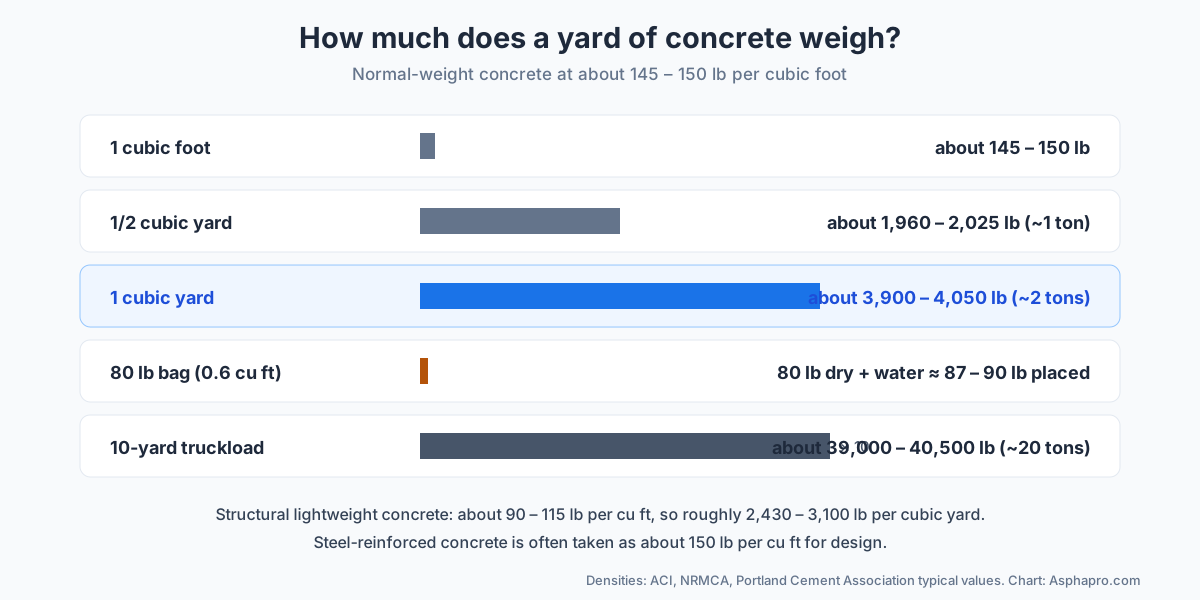
A cubic yard of normal concrete weighs about 3,900 to 4,050 pounds, or roughly 2 tons (about 1,770 to 1,840 kg). That comes from a unit weight of about 145 to 150 pounds per cubic foot, multiplied by the 27 cubic feet in a yard. Steel-reinforced concrete is often taken as about 150 lb per cubic foot. Structural lightweight concrete weighs much less, about 90 to 115 lb per cubic foot, or roughly 2,430 to 3,100 lb per yard. A full 10-yard ready-mix truck carries around 20 tons of concrete.
Knowing how much a yard of concrete weighs matters more often than you might think. It tells you whether your pickup or trailer can haul a load, how heavy a slab will be on a deck or a garage floor above a basement, how many tons of debris a removal job will create, and how much load a concrete truck puts on your driveway during delivery.
This guide covers the weight of concrete per cubic yard, per cubic foot and per cubic meter, why the weight varies, how wet and cured concrete differ, the weight of lightweight concrete, the weight of common slabs and truckloads, and simple formulas to work out the weight of any pour.
Weight of Concrete at a Glance
| Amount of concrete | Pounds | Tons (US) | Kilograms |
|---|---|---|---|
| 1 cubic foot | about 145 – 150 lb | about 0.07 | about 66 – 68 kg |
| 1/4 cubic yard | about 980 – 1,010 lb | about 0.5 | about 445 – 460 kg |
| 1/2 cubic yard | about 1,960 – 2,025 lb | about 1 | about 890 – 920 kg |
| 1 cubic yard | about 3,900 – 4,050 lb | about 2 | about 1,770 – 1,840 kg |
| 1 cubic meter | about 5,100 – 5,300 lb | about 2.6 | about 2,320 – 2,400 kg |
| 10 cubic yards (a full truck) | about 39,000 – 40,500 lb | about 20 | about 17,700 – 18,400 kg |
Weight of Concrete per Cubic Foot
How much does concrete weigh per cubic foot? Normal concrete weight per cubic foot is about 145 to 150 pounds, which is the number engineers start from. The weight of a cubic foot of concrete depends on the stone in the mix: dense granite or trap rock pushes it toward 150 pounds, while lighter limestone or added air pulls it lower.
A cubic foot of normal-weight concrete weighs about 145 to 150 pounds. Industry groups such as the NRMCA describe normal-weight concrete as falling in the range of about 140 to 150 lb per cubic foot. That is the "unit weight" or density engineers use. Many people simply use 150 lb per cubic foot as a round number, which is slightly high for plain concrete and about right for concrete with rebar in it.
To picture it: a block of concrete one foot on each side weighs about as much as an adult person. A standard 4 inch slab weighs about 50 pounds for every square foot of surface, because 4 inches is one third of a foot.
How Much Does a Yard of Concrete Weigh, and Why?
A cubic yard is 3 feet × 3 feet × 3 feet, or 27 cubic feet. Multiply 27 by the unit weight:
27 cu ft × 145 – 150 lb/cu ft = about 3,915 – 4,050 lb per cubic yard
So if you are asking how much does a yard of concrete weigh, the answer is close to 4,000 pounds, or 2 tons. That is a handy number to remember: one yard of concrete is about two tons. When you order 5 yards for a driveway, about 10 tons of material arrives on one truck.
What makes the weight vary?
- Aggregate. Stone and sand make up most of the volume. Dense stone like granite or trap rock makes heavier concrete than limestone or lightweight aggregates.
- Water content. Fresh concrete contains water, part of which evaporates as it cures.
- Air content. Air-entrained concrete for freeze-thaw areas has small air bubbles, often around 5 to 7 percent of the volume, which make it a little lighter.
- Steel. Rebar is much denser than concrete, so reinforced concrete weighs more per cubic foot.
- Mix design. High-strength mixes with more cement and less water can be slightly heavier.
Wet Concrete vs Cured Concrete Weight
Fresh concrete is a little heavier than the same concrete after it cures. Some of the mixing water reacts with the cement and becomes part of the hardened paste, but some evaporates over the following weeks. For lightweight concrete, the industry notes that equilibrium (air-dried) density is typically about 3 to 8 lb per cubic foot less than the fresh density. Normal concrete loses a similar small amount. For hauling and placing, use the fresh weight of about 145 to 150 lb per cubic foot. For long-term loads on a structure, engineers use the hardened density, usually still about 145 to 150 lb per cubic foot for normal concrete.
Concrete Unit Weight by Type
| Concrete type | Weight per cubic foot | Weight per cubic yard | Common uses |
|---|---|---|---|
| Normal-weight concrete | about 140 – 150 lb | about 3,780 – 4,050 lb | Slabs, driveways, footings, walls |
| Reinforced concrete (design value) | about 150 lb | about 4,050 lb | Structural beams, slabs, walls |
| Structural lightweight concrete | about 90 – 115 lb | about 2,430 – 3,100 lb | Upper floors, decks, roofs |
| Insulating and cellular concrete | much lower | much lower | Fill, insulation, non-structural uses |
| Heavyweight (high-density) concrete | much higher than normal | much higher than normal | Radiation shielding, counterweights |
Light Weight Concrete: How Much Less Does It Weigh?
Lightweight concrete replaces some or all of the normal stone with lighter aggregates such as expanded shale, clay or slate, which are heated until they puff up and become porous. The American Concrete Institute defines structural lightweight concrete by its air-dried density, generally not more than about 115 lb per cubic foot, and the common range is about 90 to 115 lb per cubic foot.
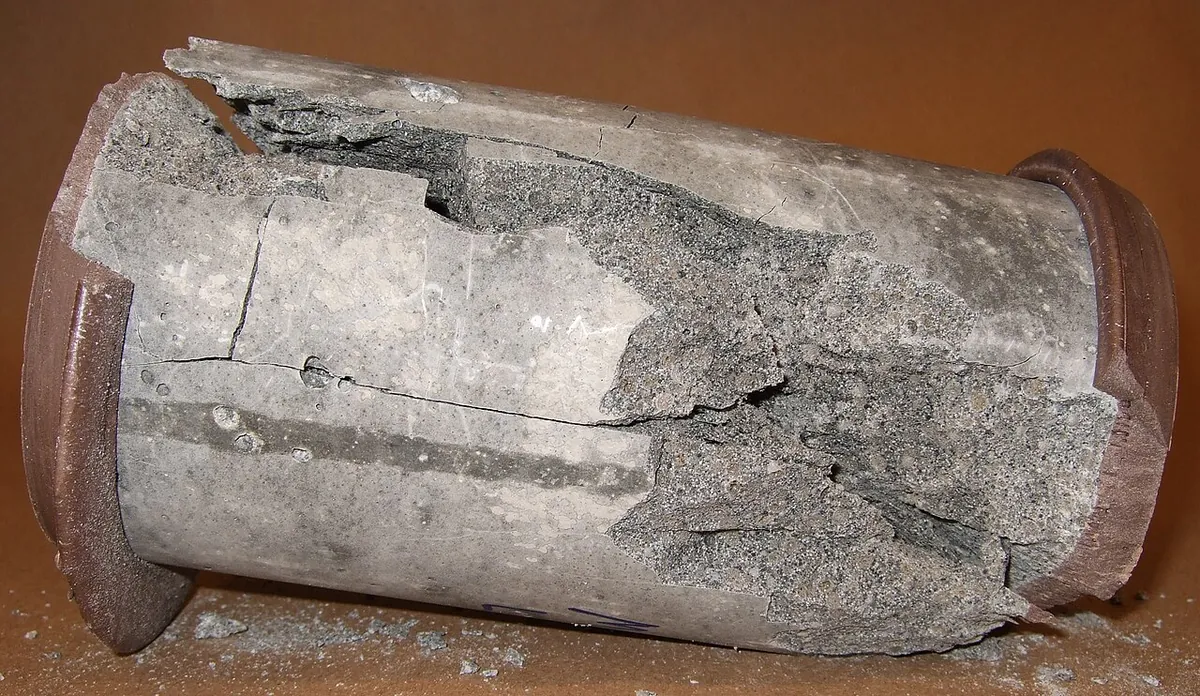
Photo: Xb-70, Wikimedia Commons, public domain
So a yard of lightweight concrete weighs about 2,430 to 3,100 pounds, roughly 25 to 40 percent less than normal concrete. That makes it useful for:
- Floors on upper stories of buildings, where less weight means smaller beams and columns.
- Topping slabs over steel decking.
- Bridge decks and parking structures.
- Roof decks and fill where weight is limited.
- Precast panels and some concrete blocks.
Lightweight concrete usually costs more per yard than normal concrete and is mostly used in commercial work. For a driveway, patio or footing on the ground, normal-weight concrete is the standard. See types of concrete for more mixes.
How Much Does a Concrete Slab Weigh?
For a slab, the weight per square foot depends only on thickness. At about 145 to 150 lb per cubic foot:
| Slab thickness | Weight per square foot |
|---|---|
| 3 inches | about 36 – 38 lb |
| 4 inches | about 48 – 50 lb |
| 5 inches | about 60 – 63 lb |
| 6 inches | about 73 – 75 lb |
| 8 inches | about 97 – 100 lb |
Here is the total weight of concrete for some common slabs:
| Slab | Volume | Approximate weight |
|---|---|---|
| Sidewalk panel, 5 × 5 ft, 4 in. | 0.31 cu yd | about 1,200 – 1,250 lb |
| Shed pad, 10 × 12 ft, 4 in. | 1.48 cu yd | about 5,800 – 6,000 lb (3 tons) |
| Patio, 12 × 12 ft, 4 in. | 1.78 cu yd | about 6,950 – 7,200 lb (3.5 tons) |
| Two-car slab, 20 × 20 ft, 4 in. | 4.94 cu yd | about 19,300 – 20,000 lb (10 tons) |
| Driveway, 20 × 40 ft, 5 in. | 12.35 cu yd | about 48,300 – 50,000 lb (25 tons) |
| Garage floor, 24 × 24 ft, 6 in. | 10.67 cu yd | about 41,800 – 43,200 lb (21 tons) |
To figure volume for your own slab, use the calculator below. Multiply the cubic yards by about 4,000 lb to get the weight.
Weight of Footings, Posts, Steps and Columns
Not every pour is a slab. Here is the approximate weight of concrete for other common shapes, using about 150 lb per cubic foot:
| Pour | Volume | Approximate weight |
|---|---|---|
| Fence post hole, 10 in. diameter × 3 ft deep | about 1.6 cu ft | about 245 lb |
| Deck footing, 12 in. diameter × 4 ft deep | about 3.1 cu ft | about 470 lb |
| Sonotube column, 8 in. diameter × 4 ft | about 1.4 cu ft | about 210 lb |
| Continuous footing, 1 ft wide × 8 in. deep, per 10 ft | about 6.7 cu ft | about 1,000 lb |
| One concrete step, 4 ft wide × 12 in. deep × 7 in. high | about 2.3 cu ft | about 350 lb |
| Three-step stoop, 4 ft wide, solid | about 14 cu ft | about 2,100 lb |
These numbers help when you are hauling bagged mix for posts, planning a crew for a set of steps, or figuring how much debris a demolition will produce. For footing prices, see concrete footing cost; for steps, see concrete steps cost.
Weight of Precast Concrete Pieces
Precast products are made from the same materials, so their weight follows the same unit weight, adjusted for any hollow cores:
- Concrete blocks (CMU): a standard hollow 8 × 8 × 16 inch block weighs much less than a solid piece of the same size because of its cores. Lightweight blocks weigh less again. See how much a concrete block weighs.
- Pavers: weight depends on thickness; thicker driveway pavers weigh more per square foot than patio pavers.
- Precast steps, parking stops and curbs: solid pieces, so use about 150 lb per cubic foot to estimate.
- Stepping stones: a 16 inch round, 2 inch thick stone is about 0.23 cubic feet, roughly 35 lb. See how to make concrete stepping stones.
What Concrete Is Made Of (and Why It Is So Heavy)
Concrete is mostly rock. By volume, a typical mix is roughly 60 to 75 percent sand and stone aggregate, about 10 to 15 percent cement, and about 15 to 20 percent water, plus a few percent air. Stone has a high density, and the cement paste fills the gaps between stones, so there is very little empty space. That is why a yard of concrete weighs about 2 tons, while a yard of loose gravel, which has air gaps between stones, weighs less. To learn more, see what concrete is made of.
How Much Does Rebar Add to the Weight of Concrete?
Steel is about three times denser than concrete, but rebar makes up only a small share of the volume in most slabs. A #4 bar (1/2 inch) weighs about 0.67 lb per foot, and a #3 bar (3/8 inch) about 0.38 lb per foot. A 20 × 20 foot slab with #4 rebar on a 24 inch grid uses about 440 feet of bar, roughly 300 pounds of steel, on top of about 10 tons of concrete. That is why engineers often round reinforced concrete up to about 150 lb per cubic foot: the steel adds a little, but not a lot, to the concrete unit weight.
Does Heavier Concrete Mean Stronger Concrete?
Not necessarily. Strength comes mainly from the cement content, the water-cement ratio and curing, not from weight alone. Lightweight structural concrete can reach strengths similar to normal concrete for many uses while weighing much less, and air-entrained concrete is slightly lighter but far more durable in freeze-thaw climates. When you order concrete, ask for the strength (psi) and air content you need; the weight will follow from the mix.
Handling Concrete Safely
The weight of concrete is a real safety issue on DIY jobs. An 80 lb bag is heavy enough to strain backs, and moving several tons of mix in an afternoon is exhausting. Lift with your legs, use a hand truck or cart for bags, split wheelbarrow loads, and work with helpers. Wear gloves, long sleeves and eye protection, because wet concrete is caustic and can burn skin. For larger jobs, ready-mix delivery or a pump is safer than hand mixing several tons of concrete.
Calculating Weight of Concrete
The concrete weight per yard is just the weight per cubic foot times 27. At 150 pounds per cubic foot, that is 4,050 pounds, so the weight per yard of concrete is about 2 tons. Use the same steps for any shape: find the volume in cubic feet, then multiply by 145 to 150.
Use one of these two formulas:
Weight (lb) = length (ft) × width (ft) × thickness (ft) × 150
Weight (lb) = cubic yards × 4,050
Remember to convert inches to feet by dividing by 12. Example: a 12 × 16 foot patio at 4 inches thick is 12 × 16 × 0.333 = 64 cubic feet. At 150 lb per cubic foot, that is about 9,600 pounds, or 4.8 tons. In cubic yards, 64 ÷ 27 = 2.37 yards, and 2.37 × 4,050 = about 9,600 pounds.
For round columns and footings, use the volume calculator, then multiply cubic feet by 150. For step-by-step volume math, see how to calculate yards of concrete.
How Much Does a Truckload of Concrete Weigh?
Ready-mix trucks commonly carry up to about 8 to 10 cubic yards, depending on the truck and state weight limits. At about 2 tons per yard, a full load is about 16 to 20 tons of concrete, plus the weight of the truck itself. That is why a loaded mixer is one of the heaviest vehicles on residential streets, and why drivers avoid backing over existing driveways, sidewalks, septic tanks and soft lawns.
Before delivery day, plan the truck route so it stays on strong pavement, or be ready for a pump or wheelbarrows. See how many yards of concrete are in a truck and concrete price per yard for more on ordering.
Can a Pickup Truck Carry a Yard of Concrete?
Usually not safely in one trip. A yard of concrete weighs about 4,000 pounds. Most half-ton pickups have a payload of well under that, and even many three-quarter-ton trucks are close to their limit. Some rental yards and suppliers offer small concrete trailers that hold about a yard; you still need a tow vehicle rated for the trailer plus about 2 tons of concrete. Check your truck's payload and towing ratings on the door sticker before you haul concrete or bags.
Weight of Bagged Concrete
Bagged concrete mix is sold in 40, 60 and 80 lb bags. The bag weight is the dry mix; adding water makes the placed concrete slightly heavier. Typical yields are:
| Bag size | Approximate yield | Bags per cubic yard | Dry weight per cubic yard |
|---|---|---|---|
| 40 lb | about 0.30 cu ft | about 90 | about 3,600 lb |
| 60 lb | about 0.45 cu ft | about 60 | about 3,600 lb |
| 80 lb | about 0.60 cu ft | about 45 | about 3,600 lb |
Notice that it takes about 3,600 lb of dry mix plus water to make a yard, which lines up with a finished weight of about 3,900 to 4,050 lb. A pallet of 80 lb bags can weigh well over a ton, so check delivery and vehicle limits. See how many bags of concrete are in a yard and how many bags of concrete are on a pallet.
Concrete Weight for Removal and Disposal
When an old slab is broken up and hauled away, the weight decides how many dumpsters or truckloads you need and what disposal costs. Broken concrete takes more space than solid concrete because of the gaps between pieces, but it weighs the same. A 4 inch slab produces about 50 pounds of debris per square foot, so:
- A 400 square foot patio, 4 inches thick, makes about 10 tons of concrete debris.
- A 600 square foot driveway, 4 inches thick, makes about 15 tons.
- Many roll-off dumpsters have weight limits, and some haulers require separate "clean concrete" containers.
Disposal is often priced per ton; LawnStarter lists concrete disposal at about $51 to $100 per ton. See concrete removal cost and how to remove concrete.
Concrete Weight on Decks, Balconies and Floors
Because the weight of concrete adds up fast, check the structure before pouring or placing concrete above the ground:
- Wood decks: a 4 inch slab adds about 50 pounds per square foot, more than many decks are designed to carry on top of people and furniture.
- Hot tubs: the tub, water and people can weigh several thousand pounds, which is why tubs usually sit on a ground-level slab.
- Upper floors: concrete toppings and gypcrete add weight that must be checked by an engineer.
- Concrete planters and countertops: large pieces can weigh hundreds of pounds; see how to make concrete planters.
How Much Does a Yard of Concrete Weigh When Hauling Bags?
If you plan to haul bagged mix instead of ordering ready-mix, the weight of concrete is still about the same, just spread across many bags. One cubic yard needs about 45 bags of 80 lb mix, which is about 3,600 pounds of dry material before you add water. That is more than most pickups can carry in one trip. A good rule is to split the load: for a yard of concrete, plan two or three trips in a half-ton pickup, or use a trailer rated for the weight. Spread the bags evenly over the axle, and do not stack a full pallet in a small truck bed.
Concrete vs Other Materials by Weight
| Material | Approximate weight per cubic yard |
|---|---|
| Normal concrete | about 3,900 – 4,050 lb |
| Compacted hot mix asphalt | about 3,900 – 4,000 lb |
| Gravel and crushed stone (loose) | about 2,400 – 3,000 lb, depending on type |
| Sand (dry, loose) | about 2,600 – 2,700 lb |
| Topsoil (dry) | about 2,000 – 2,200 lb |
| Water | about 1,685 lb |
Concrete and compacted asphalt weigh about the same per yard, which is why both are usually sold or estimated by weight in tons for hauling. See asphalt weight per cubic yard and the gravel calculator for comparisons.
Quick Rules of Thumb
- One cubic foot of concrete weighs about 150 lb.
- One yard of concrete weighs about 4,000 lb, or 2 tons.
- A 4 inch slab weighs about 50 lb per square foot.
- Each extra inch of slab thickness adds about 12 lb per square foot.
- A full 10-yard truck carries about 20 tons of concrete.
Metric Weight of Concrete
In metric units, normal concrete has a density of about 2,300 to 2,400 kg per cubic meter, often rounded to 2,400 kg/m³ for reinforced concrete in design. A cubic yard is about 0.765 cubic meters, so it weighs about 1,770 to 1,840 kg. Lightweight structural concrete is roughly 1,440 to 1,840 kg/m³.
Why the Weight of Concrete Matters on Delivery Day
- Truck access. A loaded truck can crack an older driveway or sidewalk. Lay out a route on strong ground.
- Forms. Wet concrete pushes hard on forms; stake them every few feet and brace tall forms well.
- Wheelbarrows. A full contractor wheelbarrow of concrete is often 300 to 400 lb or more. Do not overfill.
- Crew size. Moving 2 tons per yard by hand takes several people working fast.
- Pumping. For long distances or upper levels, a pump saves backs and time.
Frequently Asked Questions
How much does a yard of concrete weigh?
About 3,900 to 4,050 pounds, or roughly 2 tons, for normal concrete at 145 to 150 lb per cubic foot.
How much does a cubic foot of concrete weigh?
About 145 to 150 pounds for normal concrete. Reinforced concrete is often taken as about 150 lb per cubic foot.
What is the weight of one yard of concrete in tons?
About 2 US tons (4,000 pounds), or about 1.8 metric tonnes.
How much does lightweight concrete weigh?
Structural lightweight concrete weighs about 90 to 115 lb per cubic foot, or roughly 2,430 to 3,100 pounds per cubic yard.
How much does a 4 inch concrete slab weigh per square foot?
About 48 to 50 pounds per square foot.
How much does a 10-yard truck of concrete weigh?
The concrete alone weighs about 39,000 to 40,500 pounds, roughly 20 tons, plus the weight of the mixer truck itself.
What is the concrete weight per cubic meter?
About 2,300 to 2,400 kg per cubic meter for normal concrete, or roughly 5,100 to 5,300 pounds.
How much does a yard of concrete weigh compared with a yard of gravel?
A yard of concrete weighs about 4,000 pounds. A yard of loose gravel usually weighs less, roughly 2,400 to 3,000 pounds depending on the stone, because of the air gaps between pieces.
How much does a 12x12 concrete slab weigh?
At 4 inches thick, a 12 × 12 foot slab holds about 1.78 cubic yards of concrete and weighs roughly 7,000 pounds, or about 3.5 tons.
Is wet concrete heavier than dry concrete?
Yes, slightly. Fresh concrete contains water that partly evaporates as it cures, so hardened concrete weighs a few pounds per cubic foot less.
How much does 1 yard of concrete weigh?
One yard of normal concrete weighs about 3,900 to 4,050 pounds, roughly 2 tons. The weight of 1 yard of concrete is the same as a cubic yard, since a "yard" of concrete always means a cubic yard.
How much does a cubic yard of concrete weigh when it is lightweight?
Structural lightweight concrete weighs about 90 to 115 pounds per cubic foot, so a cubic yard weighs roughly 2,430 to 3,100 pounds instead of about 4,000. Its cubic yard concrete weight is lower because the stone is replaced with expanded shale, clay or slate.
What does a yard of concrete weigh in a wheelbarrow?
Much more than one load. A standard 6 cubic foot wheelbarrow full of wet concrete weighs about 870 to 900 pounds, so most people fill it only half or two-thirds. A yard is about 4.5 full wheelbarrows.
Sources
- NRMCA, "Concrete in Practice / Tip 9: Structural Lightweight Concrete." nrmca.org
- American Concrete Institute, FAQ on lightweight concrete density. concrete.org
- LawnStarter, "Concrete removal cost" (disposal per ton). lawnstarter.com
- HomeGuide, "Concrete delivery cost" (truck sizes). homeguide.com
- Image credits: truck photo by woodleywonderworks (CC BY 2.0) and cylinder photo by Xb-70 (public domain), via Wikimedia Commons. Chart by Asphapro.com.
Weights are typical values; actual weight depends on the mix. Checked November 2026.
Related Guides
- What is concrete made of? — cement, water, sand, gravel and air