
How to Calculate Yards of Concrete: Formula, Examples and How to Order
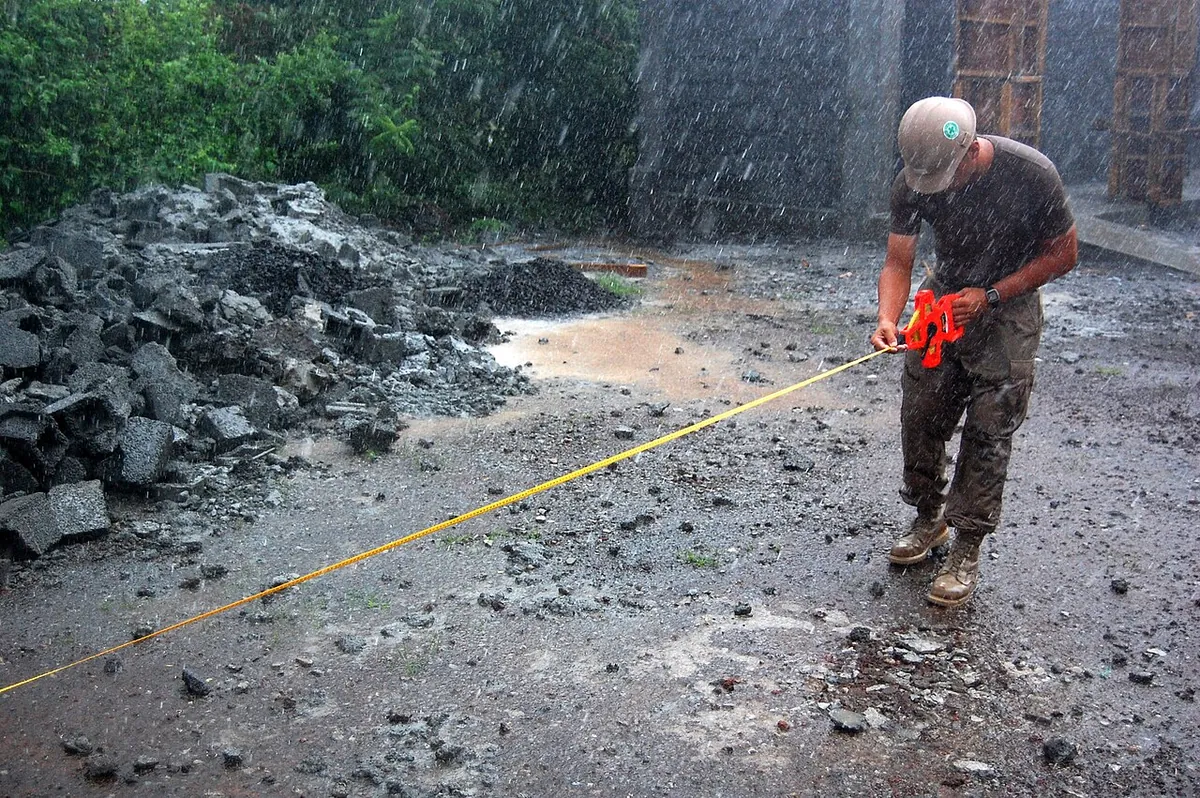
Photo: U.S. Navy / Erick S. Holmes, Wikimedia Commons, public domain
Quick Answer
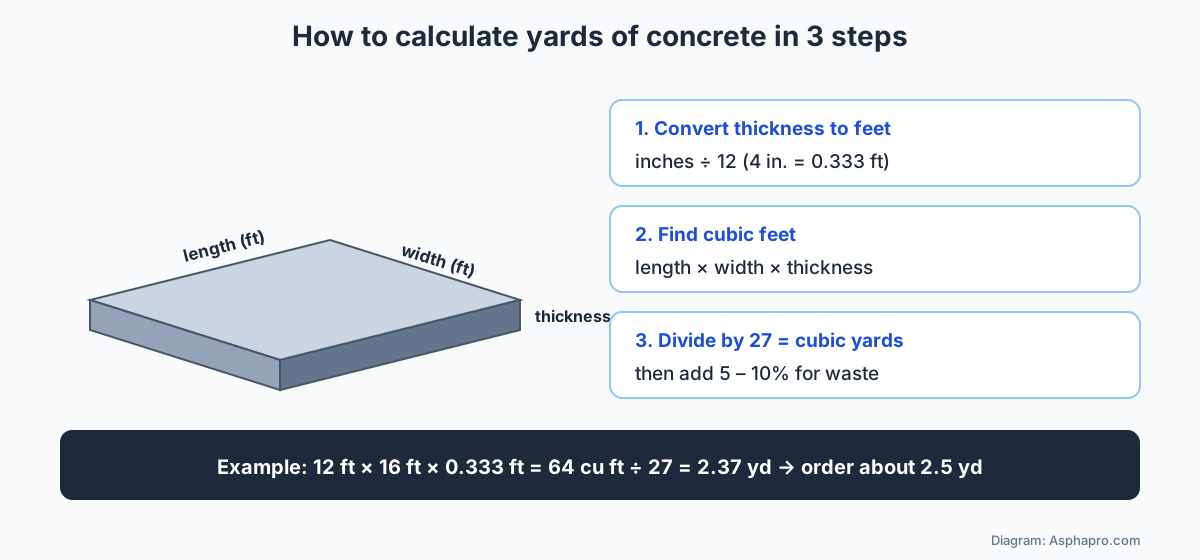
To calculate yards of concrete, measure the length, width and thickness in feet (divide inches by 12), multiply them to get cubic feet, then divide by 27, because one cubic yard is 27 cubic feet. Add 5 to 10 percent for waste and uneven ground. Example: a 12 × 16 foot patio, 4 inches thick, is 12 × 16 × 0.333 = 64 cubic feet; 64 ÷ 27 = 2.37 cubic yards, so order about 2.5 yards. A quick shortcut for slabs: at 4 inches thick, one yard covers about 81 square feet.
Ordering the right amount of concrete is one of the most important steps in any pour. Order too little, and you end up with a weak joint where the second truck's concrete meets concrete that has already started to set, plus a second delivery fee. Order too much, and you pay for concrete you have to throw away. Knowing how to calculate yards of concrete, sometimes called figuring concrete yardage, takes only a tape measure and a few minutes.
This guide shows how to measure yards in concrete for every common shape: slabs, driveways, sidewalks, footings, walls, columns, post holes, round pads and steps. It also covers how big a yard of concrete really is, how much extra to order, and what to tell the ready-mix plant when you order concrete.
The Basic Formula
Whether you call it figuring yardage, working out a pour or finding volume, how to work out concrete always comes down to one formula: length × width × thickness in feet, divided by 27. Here is how to figure concrete yardage step by step:
Cubic yards = length (ft) × width (ft) × thickness (ft) ÷ 27
- Measure the length and width in feet. Round up to the nearest inch, then convert inches to decimal feet.
- Convert thickness to feet by dividing inches by 12. A 4 inch slab is 0.333 feet; 6 inches is 0.5 feet.
- Multiply length × width × thickness to get cubic feet.
- Divide by 27 to get cubic yards.
- Add 5 to 10 percent for waste, spillage, form bulging and uneven ground.
- Round up to the nearest quarter or half yard your supplier sells.
Concrete Yardage Calculator
Prefer not to do the math by hand? Enter your measurements in the cubic yard calculator below. It converts inches, handles multiple sections and shows the result in cubic yards.
For round shapes and columns, use the volume calculator.
Inches to Feet Conversion for Thickness
| Thickness (inches) | Feet | Square feet covered by 1 cubic yard |
|---|---|---|
| 2 | 0.167 | 162 |
| 3 | 0.25 | 108 |
| 3.5 | 0.292 | 92.6 |
| 4 | 0.333 | 81 |
| 5 | 0.417 | 64.8 |
| 6 | 0.5 | 54 |
| 8 | 0.667 | 40.5 |
| 10 | 0.833 | 32.4 |
| 12 | 1.0 | 27 |
The coverage column gives a fast shortcut for slabs: divide the area by the coverage number. A 400 square foot slab at 4 inches needs 400 ÷ 81 = 4.94 yards.
How Big Is a Yard of Concrete?
A cubic yard is a cube 3 feet long, 3 feet wide and 3 feet tall, or 27 cubic feet. It weighs about 4,000 pounds. Spread out as a 4 inch slab, a yard of concrete covers about 81 square feet, roughly a 9 × 9 foot square. At 6 inches thick, it covers about 54 square feet. That is often less than people expect, which is why many first-time orders come up short. See how much a yard of concrete weighs.
How to Measure a Concrete Slab
How do you measure a yard of concrete on the ground? You don't measure the yard itself; you measure the space you will fill and convert it. How to measure for yards of concrete correctly is to take length and width at several points, because forms are rarely perfectly square, and check the depth in the middle as well as at the edges.
For a rectangular slab, measure the inside of the forms, not the outside, because the concrete fills the space between them. For thickness, measure from the top of the forms down to the compacted base at several points across the slab. If the base is uneven, measure in a grid, for example every few feet, and use the average depth. This step matters: a slab planned at 4 inches that averages 4.5 inches because of low spots in the base needs about 12 percent more concrete.
Example: patio
14 × 18 feet at 4 inches: 14 × 18 × 0.333 = 84 cubic feet. 84 ÷ 27 = 3.11 yards. Add 7 percent: about 3.33 yards. Order 3.5 yards.
Example: driveway
20 × 40 feet at 5 inches: 20 × 40 × 0.417 = 333 cubic feet. 333 ÷ 27 = 12.35 yards. Add 5 percent: about 13 yards, usually two trucks. See how many yards of concrete are in a truck.
Example: sidewalk
4 feet wide × 50 feet long × 4 inches: 4 × 50 × 0.333 = 66.7 cubic feet, or 2.47 yards. Add 10 percent for the many edges: about 2.75 yards.
Slabs With Thickened Edges
Garage slabs, driveways and building slabs often have edges that are thicker than the middle. Calculate the main slab first, then add the extra concrete along the edges as a separate strip.
Example: a 24 × 24 foot garage slab, 4 inches thick, with a thickened edge that is 12 inches wide and an extra 8 inches deep around the perimeter. The main slab: 24 × 24 × 0.333 = 192 cubic feet. The perimeter is about 96 feet; the extra edge volume is 96 × 1 × 0.667 = 64 cubic feet. Total: 256 cubic feet ÷ 27 = 9.48 yards, plus waste, about 10 yards.
Footings and Walls
For continuous footings and walls, use the same formula: length × width × depth (or height).
Example: footing
A footing 100 feet long, 16 inches wide and 8 inches deep: 100 × 1.333 × 0.667 = 88.9 cubic feet ÷ 27 = 3.29 yards, plus waste, about 3.5 yards.
Example: wall
A wall 40 feet long, 8 inches thick and 4 feet tall: 40 × 0.667 × 4 = 106.7 cubic feet ÷ 27 = 3.95 yards, plus waste, about 4.25 yards. For footing prices, see concrete footing cost.
Columns, Sonotubes and Post Holes
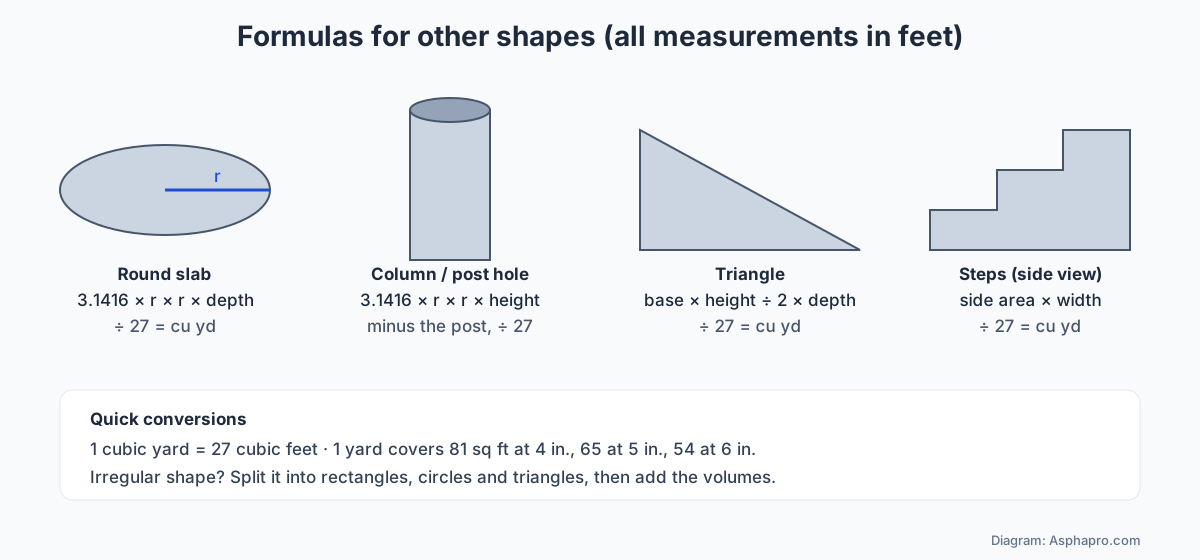
For round shapes, use the formula for the volume of a cylinder:
Cubic feet = 3.1416 × radius × radius × height
The radius is half the diameter, in feet. A 12 inch tube has a radius of 0.5 feet.
| Tube or hole diameter | Cubic feet per foot of depth | Cubic yards per foot of depth |
|---|---|---|
| 8 in. | 0.35 | 0.013 |
| 10 in. | 0.55 | 0.020 |
| 12 in. | 0.79 | 0.029 |
| 16 in. | 1.40 | 0.052 |
| 18 in. | 1.77 | 0.065 |
| 24 in. | 3.14 | 0.116 |
Example: ten 12 inch deck footings, each 4 feet deep: 0.79 × 4 × 10 = 31.6 cubic feet, or 1.17 yards. For post holes, subtract the volume of the post: a 4 × 4 post (3.5 inches square) takes up about 0.085 cubic feet per foot of depth. Small jobs like these are often done with bags; see how many bags of concrete are in a yard.
Round Slabs and Patios
For a round patio or pad, use 3.1416 × radius × radius × thickness. A round patio 14 feet across (radius 7 feet) at 4 inches: 3.1416 × 7 × 7 × 0.333 = 51.3 cubic feet, or 1.9 yards, plus waste, about 2 yards.
Steps
Steps are easiest to figure from the side. Draw the side profile, find its area in square feet, and multiply by the width of the steps.
Example: three steps, each 7 inches tall and 11 inches deep, 4 feet wide, on a solid base. The side profile is a stair shape made of three stacked rectangles: the bottom one is 33 inches deep × 7 inches, the middle 22 × 7, and the top 11 × 7. In square feet: (2.75 × 0.583) + (1.833 × 0.583) + (0.917 × 0.583) = 3.21 square feet. Multiply by 4 feet of width: 12.8 cubic feet, or 0.48 yards. Add the landing on top separately. See concrete steps cost.
Calculating Concrete for a Fence
Fence projects add up post by post. Figure the volume of one hole, subtract the post, then multiply by the number of posts. For a 10 inch diameter hole 30 inches deep, the hole is 3.1416 × 0.417 × 0.417 × 2.5 = 1.36 cubic feet. A 4 × 4 post takes about 0.21 cubic feet of that depth, leaving about 1.15 cubic feet of concrete. For 30 posts, that is 34.5 cubic feet, or 1.28 cubic yards, about 58 bags of 80 lb mix or a small ready-mix load if the truck can reach the line. Many fence builders prefer bags or fast-setting mix because the holes are spread out.
Does Rebar Change the Amount of Concrete?
Not in any practical way. Rebar and wire mesh take up only a tiny fraction of the slab's volume, far less than the normal waste margin. Calculate the yards as if the slab were solid concrete. The same goes for small embedded items like anchor bolts. Larger items, such as a drain box or a pipe sleeve, can be subtracted if they are big, but most homeowners simply ignore them and rely on the extra margin.
Filling Block Walls and Cores
When concrete or grout fills the hollow cores of a block wall, the volume depends on the block size, how many cores are filled and the wall height. Block manufacturers and masonry suppliers publish fill tables for their blocks, so use those numbers rather than a rough guess. For solid walls, footings and grade beams, the standard length × width × height formula applies. See concrete block wall cost for more on block walls.
Irregular Shapes
Break any irregular area into rectangles, triangles and circles. Calculate each one, then add them. For a triangle, the area is base × height ÷ 2. For curved patios, approximate the curve with a series of rectangles or a partial circle. When in doubt, round each piece up; it is better to have a small amount left over than to run short.
Worked Project: L-Shaped Patio, Steps and Footings
Real projects often combine several shapes. Here is how to calculate yards of concrete for a backyard project with an L-shaped patio, steps up to a door and four footings for a pergola, all poured on the same day.
- Split the L-shaped patio into two rectangles: 16 × 12 feet and 8 × 10 feet, both 4 inches thick. (16 × 12 × 0.333) + (8 × 10 × 0.333) = 64 + 26.7 = 90.7 cubic feet.
- Steps: two steps, 5 feet wide, each 7 inches tall and 12 inches deep, sitting on the patio. Side profile: bottom rectangle 2 × 0.583 feet, top rectangle 1 × 0.583 feet = 1.75 square feet. Times 5 feet wide = 8.75 cubic feet.
- Pergola footings: four 12 inch holes, 3.5 feet deep: 0.79 × 3.5 × 4 = 11.1 cubic feet.
- Total: 90.7 + 8.75 + 11.1 = 110.5 cubic feet ÷ 27 = 4.09 cubic yards.
- Add 10 percent for the many edges and holes: 4.5 yards. Order 4.5 yards, with the last half yard as a will-call load if your supplier allows it.
Writing each piece down this way makes it easy to check your math and to show the supplier exactly what you are pouring.
Why Accurate Yardage Matters
Concrete is sold by the cubic yard and must be placed within a short window after it is mixed. If you run short, the second truck may take an hour or more to arrive, and you pay a second delivery or short-load fee, often $50 to $350. Meanwhile, the concrete you already placed starts to set, which can leave a visible seam and a weak spot called a cold joint. If you order far too much, you pay for concrete you cannot use, and you need a place to dump it. A careful calculation with a sensible margin avoids both problems and keeps the pour on schedule.
Measuring an Existing Slab You Plan to Replace
When replacing old concrete, measure the area of the existing slab, then check its real thickness. You can often see the thickness at an edge, in a crack, or after the first section is broken out. Many older patios and walkways are thinner than modern standards, so plan the new slab at the thickness you want, not the old one, and calculate yards from that. If the new slab will be thicker, the excavation must also be deeper. For demolition, the old slab's volume tells you how many tons of debris to haul; see concrete removal cost.
Sloped Slabs, Ramps and Uneven Ground
For a ramp or a slab that is thicker at one end, use the average thickness. If a slab is 4 inches at one end and 6 inches at the other, the average is 5 inches. For ground that dips and rises, measure depth at several points in a grid and average them. For a slab on a slope where the forms step down, split it into sections at each change in height and calculate each section separately. Always check depth after the base is compacted, not before, because compaction lowers the base.
From Yards to Bags, Trucks and Tons
| Cubic yards | 80 lb bags | Ready-mix trucks (about 9 – 10 yd each) | Approximate weight |
|---|---|---|---|
| 0.5 | about 23 | short load or bags | about 1 ton |
| 1 | about 45 | short load or bags | about 2 tons |
| 3 | about 135 | 1 (possibly short-load fee) | about 6 tons |
| 5 | — | 1 | about 10 tons |
| 10 | — | 1 – 2 | about 20 tons |
| 20 | — | 2 – 3 | about 40 tons |
Once you know your cubic yards, this table shows whether bags are practical and how many trucks to schedule. See bags of concrete in a yard and yards of concrete in a truck.
Turning Yards Into a Price
Multiply your cubic yards by the local delivered price, about $125 to $200 per yard for a full load in 2026, then add any short-load fee, pump charge or additives. For a contractor-installed slab, it is easier to use the price per square foot, about $4 to $8 for plain concrete. For example, 4.5 yards at $150 is about $675 in concrete; the same patio installed would be roughly $1,200 to $2,400 depending on the finish and site. See concrete cost per sq ft and the cost to pour a concrete slab.
Tools for Measuring Accurately
- Tape measure of at least 25 feet, or a long 100 foot tape for big areas.
- String line and stakes to mark edges and check depth across the area.
- Level or laser level to check form height and slope.
- Measuring wheel for long driveways and sidewalks.
- Notepad or phone to sketch the shape and write each measurement.
How Much Extra Concrete to Order
How to figure yards of concrete needed in real life means adding a margin. Your measured volume is the minimum; the real pour always uses a little more, because the base is never perfectly flat.
| Situation | Extra to add |
|---|---|
| Flat, well-graded base, simple rectangle | about 5% |
| Typical residential slab or driveway | about 5 – 10% |
| Uneven base, many edges, curves or steps | about 10% |
| Footings dug in soil, post holes | about 10 – 15% |
| Pumped concrete (line and hopper) | add a little for what stays in the pump |
How to Order Concrete
Once you know how many yards you need, call your ready-mix supplier and have this ready:
- Total cubic yards, including your extra, rounded to the nearest quarter or half yard.
- Mix strength (for example 3,000, 3,500 or 4,000 psi), air entrainment for freeze-thaw areas, and any fiber or color.
- Slump, or how wet the concrete should be for your placement method.
- Delivery address, date and time, and access details for the truck.
- Placement method: chute, wheelbarrows or pump.
- Whether the last load is "will call", so you can measure what is left before the plant batches it.
Ask about the price per yard, minimum order and short-load fee, waiting time and any surcharges. See concrete price per yard.
Final Check Before You Call the Plant
- Every section is listed: main slab, thickened edges, footings, steps and landings.
- All thicknesses were converted from inches to feet.
- Depths were measured after the base was compacted, with low spots included.
- You added 5 to 10 percent and rounded up.
- You know how much the plant loads per truck and how many trucks that means.
- You have asked about minimums, short-load fees and will-call loads.
Doing this check once, on paper, is the simplest way to make sure your plan for how to calculate yards of concrete turns into the right order on pour day.
Common Mistakes When Figuring Concrete Yardage
- Forgetting to convert inches to feet. Multiplying by 4 instead of 0.333 gives an answer 12 times too large.
- Measuring the outside of the forms instead of the inside.
- Assuming the base is flat. Low spots add up fast.
- Leaving out thickened edges, footings or step landings.
- Forgetting waste. Some concrete always stays in the truck chute, wheelbarrows and on the ground.
- Mixing units. Keep everything in feet until the end, then divide by 27.
Planning Pours in Sections
Large or complicated jobs are often poured in sections on different days: a driveway in two halves, a patio and its steps separately, or footings before a slab. Calculate the yards for each section on its own, and order for each pour separately, each with its own waste margin. That way you never have to guess how much of one big order went into which part. It also makes it easier to stay above the plant minimum on each delivery: if one section is very small, consider combining it with another so you avoid a short-load fee. Sections should be separated by forms or construction joints planned in advance, not by running out of concrete.
Using Yards to Plan Your Crew
Your yardage also tells you how many people you need. A crew can place and finish roughly a few yards per hour on a simple slab with good truck access, and much less when every yard must be wheelbarrowed. A 4 yard patio is comfortable for three or four experienced people. A 10 yard driveway needs five or more, plus tools such as a power screed. Planning the crew from the yards you calculated keeps the pour from falling behind while the concrete starts to set.
Metric Conversion
If your plans are in meters, calculate cubic meters with length × width × thickness in meters, then convert: 1 cubic meter = 1.308 cubic yards, and 1 cubic yard = 0.765 cubic meters. A 10 cubic meter pour is about 13.1 cubic yards.

Photo: U.S. Navy / Jacob Johnson, Wikimedia Commons, public domain
Frequently Asked Questions
How do you calculate yards of concrete?
Multiply length × width × thickness in feet to get cubic feet, divide by 27 to get cubic yards, and add 5 to 10 percent for waste.
How do you figure concrete yardage for a 4 inch slab?
Divide the area in square feet by 81. A 20 × 20 foot slab is 400 ÷ 81 = 4.94 yards, about 5.25 yards with waste.
How big is a yard of concrete?
A cube 3 × 3 × 3 feet, or 27 cubic feet. It covers about 81 square feet at 4 inches thick and weighs about 4,000 pounds.
How many yards of concrete do I need for a 10x10 slab?
At 4 inches thick, about 1.23 cubic yards, or about 1.35 yards with 10 percent extra.
How do I measure yards in concrete for round holes?
Use 3.1416 × radius × radius × depth in feet to get cubic feet, subtract the post if there is one, and divide by 27.
How many yards of concrete for a 24x24 garage?
At 4 inches thick, about 7.1 cubic yards before thickened edges. With a thickened edge and waste, many 24 × 24 garage slabs need about 9 to 10 yards.
What happens if I order too little concrete?
You need a second delivery, which may come with an extra fee and a delay. The concrete already placed may start to set, leaving a weak cold joint, so it is better to order a little extra.
How many yards of concrete for a 20x20 slab?
About 4.94 cubic yards at 4 inches, 6.17 at 5 inches and 7.41 at 6 inches, plus 5 to 10 percent extra.
How do I calculate yards of concrete for a wall?
Multiply wall length × thickness × height in feet, divide by 27, and add about 5 to 10 percent. A 40 foot wall, 8 inches thick and 4 feet tall, needs about 4 yards.
Is it better to use a calculator or do it by hand?
Either works, and many contractors use both. A calculator is faster for multiple sections and round shapes, but knowing the formula lets you check the result and catch mistakes such as forgetting to convert inches to feet.
How do I figure yards of concrete needed for steps?
Find the area of the side profile of the steps in square feet, multiply by the width of the steps, and divide by 27.
Should I round up when ordering concrete?
Yes. Add 5 to 10 percent and round up to the nearest quarter or half yard. Running short costs more than a small surplus.
How do you figure yardage for concrete?
Multiply length by width by thickness, all in feet, to get cubic feet, then divide by 27. A 10 × 10 foot slab 4 inches thick is 10 × 10 × 0.333 = 33.3 cubic feet, or 1.23 cubic yards.
How to find yardage of concrete for a round slab or post hole?
Use 3.14 × radius × radius × depth, all in feet, to get cubic feet, then divide by 27. For many post holes, find one and multiply by the number of holes.
How to determine concrete thickness when measuring an old slab?
Drill a small hole or look at an exposed edge and measure from the top to the bottom. Check a few spots, because old slabs often vary by an inch or more, and use the average in your yardage math.
Sources
- Standard volume formulas and U.S. unit conversions (1 cubic yard = 27 cubic feet = 0.765 cubic meters).
- HomeGuide, "Concrete delivery cost" (ordering, minimums and short loads). homeguide.com
- Texas Department of Transportation, "Concrete Mixing Trucks" (truck capacities). txdot.gov
- Image credits: measuring photo by the U.S. Navy / Erick S. Holmes and screeding photo by the U.S. Navy / Jacob Johnson (public domain), via Wikimedia Commons. Diagrams by Asphapro.com.
Checked November 2026.
Related Guides
- How to build concrete forms — layout, stakes and slope