
Can You Pour Concrete in the Rain? What Rain Does and How to Protect a Pour

Photo: U.S. Air Force, Airman Sydney Franklin, Wikimedia Commons, public domain.
Quick Answer
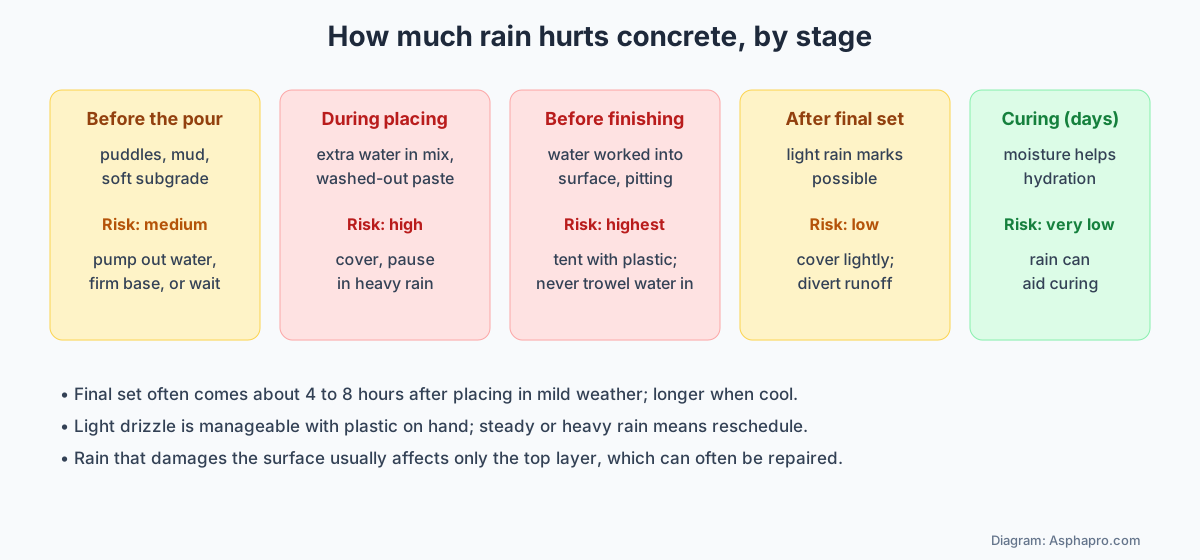
You can pour concrete in light rain if you are prepared, but heavy or steady rain should make you reschedule. Rain is most harmful during placing and before finishing, when extra water on the surface raises the water-cement ratio and leads to a weak, dusty, pitted or scaling surface. Before the pour, the base must be firm with no standing water or mud. During the pour, keep plastic sheeting ready to tent over the slab, and never work rainwater into the surface. Once concrete reaches final set, often about 4 to 8 hours after placing in mild weather, light rain does little harm and moisture even helps curing. The same answers apply if you are asking whether you can lay concrete in the rain.
Rain is one of the most common reasons concrete pours get postponed. Ready-mix trucks are booked, the forms are set, the crew is ready, and then the forecast changes. Do you pour anyway? The honest answer is that it depends on how much rain, when it falls, and how prepared you are to protect the concrete.
This guide explains what rain does to fresh concrete, when it matters most, how to protect a pour, what to do if rain hits your slab, how to fix rain damage, and how to decide whether to pour or wait.
What Rain Does to Fresh Concrete
Concrete strength depends largely on the ratio of water to cement. Ready-mix is designed with a set amount of water. When rain falls on fresh, plastic concrete, it adds water at the surface, which:
- Raises the water-cement ratio at the top: the surface layer becomes weaker than the rest of the slab.
- Washes out cement paste: heavy rain can wash away the fine paste, exposing sand and stone.
- Leaves pits and marks: raindrops dimple the surface.
- Leads to dusting: a weak surface wears into a powdery dust under traffic.
- Increases scaling risk: a weak, high-water surface is more likely to flake off in freeze-thaw and with deicers. See does salt damage concrete.
- Causes discoloration: uneven water affects color, especially in colored or stamped concrete.
The structural core of the slab is usually less affected than the surface, because rain mostly changes the top fraction of an inch. That is why most rain damage is a surface problem, but surfaces are what you see and walk on.
Why Water Content Matters So Much
To understand why rain on fresh concrete is a problem, it helps to know what water does inside concrete. Cement needs only a certain amount of water to fully react, roughly a water-cement ratio of about 0.25 by weight for complete hydration in theory. Real mixes use more, often around 0.40 to 0.50 for good exterior concrete, so the concrete is workable enough to place and finish. Every bit of water beyond what the cement uses leaves behind tiny pores when it evaporates. More pores mean lower strength, more permeability, and easier entry for water and salts.
When rain adds water to the surface of a slab, it raises the local water-cement ratio in the top layer, exactly where the slab faces traffic, weather and deicers. A surface that should have been dense becomes porous and weak. That is why the Portland Cement Association stresses that, everything else being equal, lower water content makes stronger concrete, and why finishing water into a surface, from rain or from bleed water, is such a common cause of surface problems. See what concrete is made of.
Rain and Concrete Sealers, Stains and Coatings
Decorative and protective products are even more sensitive to rain than the concrete itself. Acid stains, water-based stains, sealers and coatings need a clean, dry surface and dry weather while they cure. Rain soon after application can cause white haze, blushing, streaks or poor adhesion. Read the product label for the required dry time and forecast window, and plan these steps for dry stretches. If rain is due within a day, wait.
Rain Before the Pour
Rain the day before or the morning of a pour can soften the subgrade and fill forms with water.
- Standing water: pump or sweep it out of the forms. Never pour concrete into puddles; the water mixes into the bottom of the slab.
- Mud: remove mud and soft spots, or the slab will not have uniform support.
- Saturated base: a damp base is fine and even helpful, but a soft, pumping subgrade that ruts under foot is not. Compact and add gravel or wait for it to drain.
- Access: wet ground may stop trucks from reaching the site; check before the truck rolls.
A good compacted gravel base drains much better than bare soil, which is one reason base prep matters. See how to build concrete forms.
Rain During the Pour
Can concrete be poured in the rain once the trucks are on the way? In light rain, yes, if the crew keeps rain off the surface and does not work the water into it. Pouring concrete in rain that is steady or heavy is a bad idea, because water pooling on the slab weakens the top layer.
Light drizzle during placing is often manageable for an experienced crew. Steady or heavy rain is not. If rain starts:
- Keep placing and screeding quickly if the rain is light, so the concrete is consolidated and covered sooner.
- Unroll plastic sheeting over finished sections, keeping it off the surface if possible with boards or a frame, so it does not mark the concrete.
- If rain becomes heavy, stop placing if you can do so at a planned joint. A pour can be ended at a construction joint and continued another day.
- Do not add extra water to the truck to make up for anything; the mix is getting enough water from the sky.
Rain Before Finishing: The Worst Time
The most damaging time for rain is after the concrete is placed but before it is finished, when bleed water is rising and the surface is still soft. The biggest mistake is to keep finishing while water sits on the surface, because floating or troweling works the water into the top layer and makes a weak, dusty surface.
- Cover the slab immediately with plastic, ideally tented so it does not touch the surface.
- When rain stops, remove standing water by gently dragging a garden hose across the surface to push it off the edge, or by tilting a squeegee or float to lead it away, rather than floating it in.
- Let the surface lose its sheen, then finish as normal.
- Do not sprinkle dry cement on the surface to soak up water. It creates a thin, weak layer that tends to flake off later.
Rain After the Concrete Sets
Once concrete has finished and reached final set, it is hard enough that rain cannot easily mark it. In mild temperatures this often happens about 4 to 8 hours after placing, and longer in cool weather or with retarders. After that point, light rain mostly helps, because concrete needs moisture to keep hydrating and gaining strength. Heavy rain on a recently set surface can still leave light marks, so covering it for the first day is good practice. See how long concrete takes to cure.
How to Protect a Pour From Rain
- Watch the forecast closely: look at hourly rain chances for the pour day and the next 12 hours, not just the daily forecast.
- Have plastic on site: heavy polyethylene sheeting large enough to cover the whole slab, plus weights like boards or bricks to hold the edges.
- Build a frame: 2x4s across the forms or a simple tent keeps plastic off the surface.
- Divert runoff: make sure water from roofs, downspouts and slopes will not run across the fresh slab. Temporary sandbags or trenches help.
- Start early: an early start gives more time to finish before afternoon storms.
- Use accelerators carefully: in cool, damp weather, an accelerating admixture can shorten the time the surface is vulnerable. Talk to your supplier.
- Plan stopping points: know where you can end the pour if needed.
Photo: U.S. Army / Monique Freemon, Wikimedia Commons, public domain
Pour or Wait? A Decision Guide
When the forecast is uncertain, these questions help decide whether to pour concrete in the rain or reschedule:
- How much rain, and when? A 20% chance of a passing shower in the late afternoon is very different from a 70% chance of steady rain all morning. Look at hourly forecasts and radar on the morning of the pour.
- How big is the pour? A few post holes or a footing can be poured and covered quickly. A large driveway takes hours to place and finish, so the surface is exposed longer.
- What finish is planned? A plain broom finish tolerates minor rain marks better than stamped, colored or smooth-troweled concrete, where any blemish shows.
- Is the base ready? If the subgrade is already soft or puddled, adding more rain makes things worse.
- Can you cover the whole slab quickly? If you do not have enough plastic and people to cover the slab in minutes, do not risk it.
- What does the supplier allow? Ready-mix suppliers have cancellation windows and fees. Know the deadline for canceling without charge.
If more than one answer points to trouble, reschedule. A delay of a day or two costs far less than replacing a damaged slab.
How Rain Affects Different Projects
- Footings and foundations: the top surface is usually buried or covered, so minor rain on the surface matters less. Still, no standing water in trenches, and avoid mud mixing into the concrete.
- Fence and deck posts: small amounts of concrete set fast; light rain is rarely a problem once the top is sloped and smoothed. Fast-setting mixes help.
- Driveways, sidewalks and patios: large, exposed surfaces that people see and walk on. These are the most sensitive to rain. See concrete driveway cost.
- Stamped and colored concrete: very sensitive. Rain can wash color hardener, ruin stamp texture and cause blotchy color. Most decorative contractors will not pour if rain is likely. See stamped concrete vs pavers.
- Interior slabs: under a roof, rain is not a direct issue, but wet subgrades and access still matter.
How to Fix Rain-Damaged Concrete
If rain hit your concrete before it set, wait at least a week for it to cure, then assess the damage.
Assess the surface
- Scratch test: drag a key or screwdriver across the surface. If it gouges easily or leaves powder, the top layer is weak.
- Look for pits and exposed aggregate: washed-out paste leaves sand and stones exposed.
- Check for dusting: sweep an area; heavy dust that keeps coming means a soft surface.
Repair options
- Cosmetic marks only: if the surface is hard and only lightly pitted, leave it; marks often fade with weathering. A penetrating sealer can help even the look.
- Dusting surface: apply a liquid densifier or hardener made for concrete, which reacts with the surface to harden it. A sealer afterward helps.
- Weak or pitted top layer: grind or shot-blast off the weak layer, then apply a concrete resurfacer or overlay. See concrete overlay cost.
- Severe damage: if the surface keeps scaling or the slab is weak throughout, replacement may be needed. See concrete removal cost.
If a contractor poured in the rain against your wishes and the surface failed, document it with photos and dates and discuss it with them. Many contracts cover workmanship defects like scaling within the first year or two.
Rain in Cool vs Warm Weather
Temperature changes how long the concrete stays vulnerable. In warm weather, concrete sets faster, so the window for rain damage may be only a few hours. In cool, damp weather, concrete can stay soft for much longer, sometimes 8 hours or more, so a slab poured in the morning can still be damaged by an evening shower. Cool rain combined with near-freezing nights is the riskiest combination of all; see pouring concrete in cold weather.
In hot, humid climates with daily afternoon storms, crews pour early in the morning so slabs are finished and set before the usual storm time. In cool, wet climates, crews may use accelerators, warm concrete and covers to shorten the exposed period.
Rain After a Few Days: Curing and Sealing
Once concrete has set, rain over the following days is generally helpful because it keeps the slab moist for curing. The one exception is sealing. Most concrete sealers need a dry surface and a dry forecast for a day or more, and many manufacturers recommend waiting a set number of days, often around 28 days for new concrete, before applying film-forming sealers. If rain is coming, delay sealing. See how to reseal concrete.
Who Pays if a Pour Is Rained Out?
Contracts usually address weather. Common arrangements include:
- The contractor decides whether to pour based on weather and reschedules at no charge if it is unsafe.
- Ready-mix suppliers charge a fee if a truck is canceled after it is loaded or dispatched.
- If the homeowner insists on pouring in rain against advice, the contractor may exclude surface defects from the warranty.
Ask about rain policy before signing. A contractor who says they will pour in any weather is a red flag for flatwork.
Common Myths
- "Concrete cures underwater, so rain does not matter." Cement does hydrate underwater, and special underwater concrete exists, but rain on the surface of fresh flatwork still raises the surface water-cement ratio and damages the finish.
- "Sprinkling dry cement fixes a wet surface." It makes a thin, weak skin that tends to peel and dust.
- "If it looks fine the next day, it is fine." Weak surfaces often show up months later as dusting or scaling after the first winter.
- "Covering concrete with plastic causes damage." Plastic can leave discoloration if it touches the surface in spots, which is why tenting is better, but covering is far better than letting heavy rain hit it.
A Worked Example: Afternoon Storm on a Patio Pour
Say a crew starts placing a 12 by 16 foot patio at 8 a.m. on a mild day. The forecast shows a 40% chance of storms after 3 p.m.
- The crew has two 20 by 25 foot plastic sheets, boards and bricks staged beside the forms.
- Placing and screeding finish by 9 a.m. Bleed water rises and disappears by about 11 a.m.
- The crew edges, joints, floats and brooms the slab by noon, then applies a curing compound.
- At 2:30 p.m. dark clouds roll in. The crew lays 2x4s across the forms and drapes plastic over them, weighting the edges.
- Rain falls at 3:30 p.m. By then the concrete has reached final set, and the tented plastic keeps drops off. The next morning, the surface is clean.
If the same storm had arrived at 10 a.m., before finishing, the crew would have covered the slab, waited, removed standing water gently and finished late, or, if rain was heavy, accepted that the surface might need a resurfacer later.
Rain Supplies Checklist
- Heavy polyethylene sheeting, enough to cover the whole slab with overlap.
- 2x4s or a simple frame to keep plastic off the surface.
- Bricks, sandbags or boards to weigh down edges.
- Pump or wet vac and buckets to clear forms.
- Garden hose to gently push water off a surface.
- Extra hands; covering a slab quickly takes more than one person.
Rules of Thumb for a Rainy Pour
Experienced finishers have simple rules for deciding whether to pour concrete in the rain and how to handle it:
- No standing water, ever: do not pour concrete in the rain into forms that hold puddles, and do not finish a surface with rain on fresh concrete sitting on top.
- Drizzle is a yellow light, not a green one: you can lay concrete in the rain if it is a light drizzle and covers are ready, but watch it closely.
- Steady rain is a red light: steady or heavy rain on fresh concrete will likely damage the surface; reschedule.
- Cover first, decide later: when rain on concrete starts unexpectedly, cover the slab right away and then decide what to do.
- Never add water: rain is already adding water; the mix does not need more.
- Protect the edges: runoff from surrounding ground can wash under forms and erode edges; divert it.
- Plan the finish around the weather: choose a simple broom finish if you must pour concrete in the rain risk window; save stamped and colored work for dry days.
Ready-Mix Delivery on Rainy Days
Rain also affects the truck side of the job. Ready-mix drivers will not drive onto soft lawns or muddy ground, so plan where the truck can park and whether you need a pump or wheelbarrows. Wet ground increases the chance of a truck getting stuck and damaging your yard. If the truck has to discharge from the street, a concrete pump or line pump can place the concrete without driving onto wet ground; it adds cost but protects the site.
Talk with the supplier about the mix. On cool, damp days, a mix with an accelerator or a little more cement can shorten setting time and reduce the window when rain on fresh concrete can hurt it. Never ask the driver to add water to make the concrete flow better because the slab is wet; that only weakens the concrete further.
Can You Pour Concrete in the Rain for Small DIY Jobs?
For small DIY projects like setting posts, pouring a small landing or filling a footing, rain is easier to manage. Bagged concrete can be mixed under a canopy or in a garage. Posts can be set in light rain if the hole has no standing water; slope the top of the concrete away from the post so water runs off, and cover with a plastic bag or bucket. For a small slab, have a tarp and boards ready, and pick a time with at least a half-day dry window. If you are asking whether you can lay concrete in the rain for a small pad, the answer is usually: you can, but you will get a better surface if you wait for a dry afternoon. See how much a bag of concrete costs.
Signs Rain Has Damaged Your Concrete
- A rough, sandpaper-like surface where the paste washed away.
- Small craters or dimples from raindrops.
- Gray dust that comes off on shoes and brooms.
- Thin flakes peeling off in the first winter.
- Lighter or blotchy color in patches.
- Broom lines that are smeared or missing in places.
If you see these signs, follow the repair steps above. Most rain damage is limited to the top layer, and a densifier, resurfacer or overlay can restore the surface without replacing the whole slab.
So, can you pour concrete in the rain? With light drizzle, a ready crew and plastic on hand, a careful pour can turn out well. With steady rain in the forecast, the safer and cheaper choice is almost always to wait for a dry window, because the surface you get on pour day is the surface you live with for decades.
Frequently Asked Questions
Can you pour concrete in the rain?
In light rain, with plastic covers ready and no standing water, yes. In heavy or steady rain, reschedule.
Can you lay concrete in the rain?
The same rules apply: light drizzle can be managed, but never finish concrete with rainwater on the surface.
How long does concrete need before rain?
Ideally until it is finished and reaches final set, often about 4 to 8 hours in mild weather, longer when cool.
Will rain ruin fresh concrete?
Heavy rain on unfinished concrete can damage the surface. The slab underneath is usually sound, and surface damage can often be repaired.
Should I cover concrete if it rains?
Yes. Cover fresh concrete with plastic, preferably tented off the surface, until it has set.
Is rain good for curing concrete?
After the concrete has set, yes. Moisture helps hydration. Before set, rain is harmful.
What happens if it rains 2 hours after pouring concrete?
If the slab is not finished or set, rain can damage the surface. Cover it, wait for the rain to stop, remove standing water gently and finish once the sheen is gone.
Can you pour concrete footings in the rain?
Light rain is usually acceptable for footings if trenches have no standing water or mud, since the top surface is not a finished wear surface.
How do you fix concrete that got rained on?
Wait for it to cure, test the surface, then use a densifier for dusting, or grind and resurface a weak or pitted top layer.
Can I use a tarp instead of plastic sheeting?
Yes, if it is clean and kept off the surface. Colored tarps touching fresh concrete can leave marks.
Sources
- Portland Cement Association, finishing and curing concrete; water-cement ratio. cement.org
- American Concrete Institute, guidance on finishing flatwork and avoiding surface defects. concrete.org
- Image credits: pour photos U.S. Air Force and U.S. Army (public domain), Wikimedia Commons; chart by Asphapro.com.
Checked November 2026.
Related Guides
- Can you pour concrete in the winter? — cold weather rules and protection