
How to Clean Pool Water, Walls and Filters: A Weekly Pool Care Routine
Photo: Andrius v110, Wikimedia Commons, public domain
Quick Answer
How to clean a pool: (1) skim the surface with a leaf net and empty the skimmer and pump baskets; (2) brush the walls, steps and floor toward the main drain; (3) vacuum the floor with a manual, suction or robotic cleaner; (4) clean the filter when its pressure gauge reads 8 to 10 psi above its clean reading, by backwashing a sand or DE filter or hosing off a cartridge; (5) test and balance the water, keeping free chlorine about 1 to 3 ppm and pH about 7.2 to 7.8; (6) shock after heavy use, storms or when the water looks dull. Do the full routine once a week, skim daily in leaf season, and run the pump long enough to turn the water over at least once a day. A weekly pool cleaning service typically costs about $80 to $250 per month.
A clean pool is mostly about routine. Debris, oils, sunscreen and algae spores enter the water every day. If you remove them weekly, keep the filter working and hold the chemistry steady, the water stays clear with little effort. If you let it slide for a few weeks in summer, you can end up with a green pool that takes days to recover.
This guide shows how to clean a pool step by step: the weekly routine, the right tools, how to clean each type of filter, the basics of water chemistry, how to care for above ground and inflatable pools, how to clean a pool deck and a salt cell, and when it makes sense to hire a pool cleaning service instead.
Pool Cleaning Supplies and Equipment You Need
A basic pool cleaning kit costs less than a single month of a pool cleaning service and lasts for years. Here is what to keep on hand.
| Item | What it does | Typical cost |
|---|---|---|
| Telescopic pool cleaning pole | Holds the net, brush and vacuum head | $25 – $70 |
| Leaf skimmer net (flat) and leaf rake (bag) | Removes floating and sunken debris | $15 – $50 |
| Pool brush (nylon or stainless) | Loosens algae and dirt from surfaces | $15 – $40 |
| Vacuum head and vacuum hose | Manual vacuuming through the skimmer | $40 – $120 |
| Water test kit or test strips | Measures chlorine, pH, alkalinity and more | $15 – $80 |
| Chlorine (tablets, liquid or granular) | Sanitizes the water | Ongoing |
| pH and alkalinity chemicals | Balances the water | Ongoing |
| Tile and surface cleaner | Removes scum lines | $10 – $30 |
| Automatic or robotic pool cleaner (optional) | Vacuums the pool for you | $200 – $1,500+ |
Choose the brush for your surface: stainless steel bristles work on plaster and gunite pools but scratch vinyl and fiberglass, which need nylon brushes. Pool cleaning tools are sold as sets, but buying a good pole and brush separately often gets better quality.
How to Clean a Pool: The Weekly Routine
Step 1: Skim the surface
Start with the leaf net. Skimming takes out leaves, bugs and floating debris before they sink and stain the floor or break down and feed algae. Work across the pool in overlapping passes. A pool cleaning net with a deep bag, often called a leaf rake, is better for heavy leaf loads. In fall or near trees, skim every day; it only takes a few minutes and makes every other step easier.
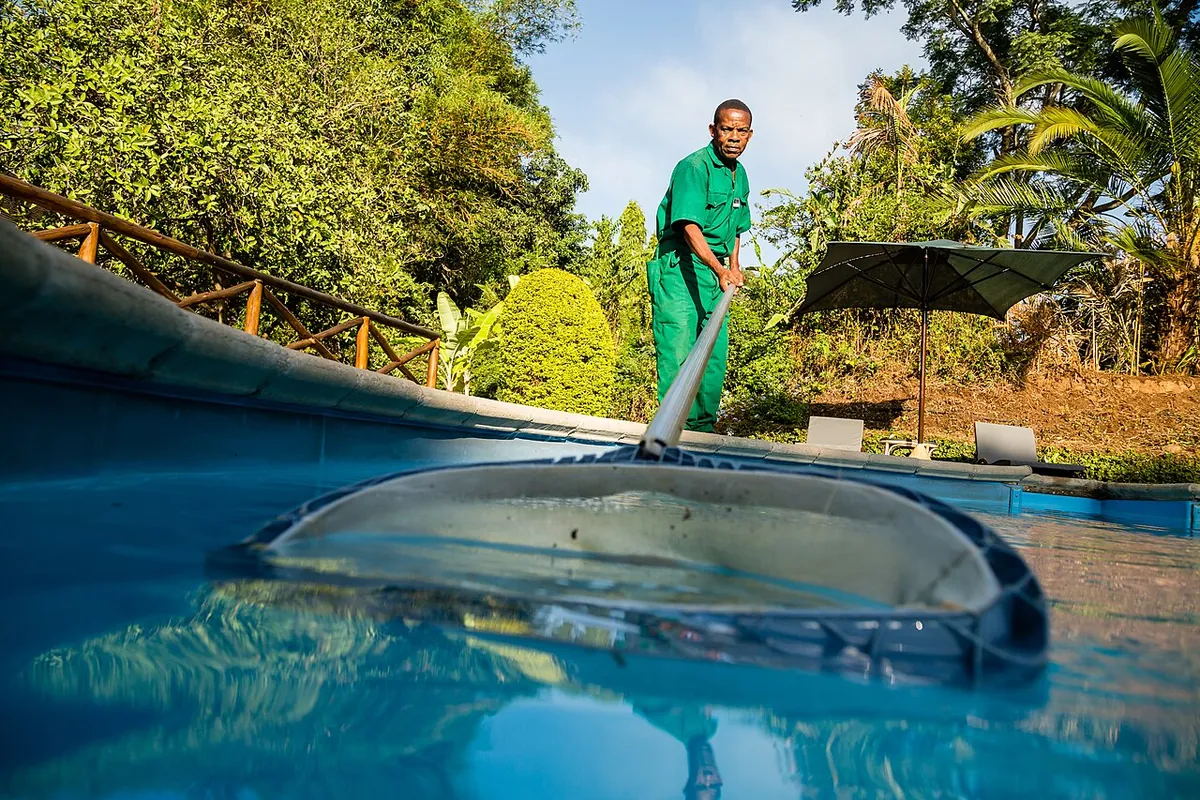
Photo: Sergei Andreichuk, Wikimedia Commons, CC BY-SA 4.0
Step 2: Empty the skimmer and pump baskets
Turn off the pump. Lift the skimmer lid, remove the basket, empty it and rinse it. Then check the pump strainer basket, which catches what gets past the skimmer. Full baskets reduce flow, which means weaker filtration and a hotter, harder-working pump. Close everything, then restart the pump and check that it primes.
Step 3: Brush the walls, steps and floor
Brushing is the step most people skip, and it is the one that prevents algae. Algae and biofilm cling to surfaces where water moves slowly: corners, steps, behind ladders and around lights. Brush the waterline first, then the walls from top to bottom, then the floor toward the main drain so debris ends up where the vacuum or drain can pick it up. Once a week is enough for most pools; brush daily while fighting algae.
Step 4: Vacuum the pool
Vacuuming removes the dirt that settles on the floor. With a manual vacuum, fill the hose with water to push out the air, connect it to the vacuum head and the skimmer suction, and move the head slowly in overlapping lines. Moving too fast stirs up dirt instead of picking it up. If there is a lot of debris or algae, vacuum to "waste" on a sand or DE filter, which sends the dirty water out instead of back through the filter. See how to vacuum an above ground pool for a full walk-through that applies to most pools.
Step 5: Clean the tile and waterline
Oils and sunscreen collect at the waterline and leave a scum line. Wipe it with a tile and vinyl cleaner made for pools, or a soft sponge. Avoid household cleaners, which can foam or upset the water balance. For calcium scale on tile, see how to clean pool tile.
Step 6: Test and balance the water
Clean surfaces only stay clean if the water chemistry is right. Test two or three times a week in summer. The main targets for most residential pools:
| Measure | Target range | Why it matters |
|---|---|---|
| Free chlorine | 1 – 3 ppm (higher with stabilizer) | Kills germs and algae |
| pH | 7.2 – 7.8 | Chlorine works best; comfortable for eyes |
| Total alkalinity | 80 – 120 ppm | Holds pH steady |
| Calcium hardness | 200 – 400 ppm | Protects plaster; prevents scale |
| Cyanuric acid (stabilizer) | 30 – 50 ppm for chlorine pools | Protects chlorine from sunlight |
Adjust one thing at a time, starting with alkalinity, then pH, then chlorine. The CDC's healthy swimming guidance uses a minimum of 1 ppm free chlorine and a pH of 7.2 to 7.8. For step-by-step fixes, see how to raise pH in a pool, how to lower pH and how much chlorine to add to a pool.
Step 7: Shock when needed
Shocking means adding a large dose of chlorine or a non-chlorine oxidizer to burn off contaminants. Shock after pool parties, heavy rain, very hot weather, or if the water looks dull or smells strongly of chlorine (a sign of chloramines). Shock in the evening so sunlight does not burn off the chlorine. See when to shock a pool.
Step 8: Run the pump and check the water level
Run the pump long enough to filter the whole volume at least once a day, often 8 to 12 hours in summer. Keep the water level about halfway up the skimmer opening: too low and the pump can suck air; too high and the skimmer cannot catch floating debris. See how long to run a pool pump.
How to Clean a Pool Filter
The filter is the pool's kidney. A clogged filter means cloudy water no matter how much chlorine you add. Watch the pressure gauge: when it reads about 8 to 10 psi above the reading after the last cleaning, clean the filter.
How to clean a sand filter for a pool
- Turn off the pump.
- Set the multiport valve to BACKWASH. Make sure the waste hose is rolled out to a safe drain area.
- Turn the pump on and run for 2 to 3 minutes, until the sight glass runs clear.
- Turn the pump off, set the valve to RINSE, and run for about 30 seconds to settle the sand.
- Turn off, set back to FILTER, restart and note the new clean pressure.
Cleaning a pool sand filter by backwashing does not clean the sand completely. Once or twice a year, a sand filter cleaner product helps remove oils, and the sand itself needs replacing every 5 to 7 years. See how to backwash a pool and cost to replace sand in a pool filter.
How to clean a cartridge pool filter
- Turn off the pump and open the air relief valve to release pressure.
- Open the filter tank and lift out the cartridge.
- Hose it off from top to bottom, spreading the pleats to rinse between them. Do not use a pressure washer, which damages the fabric.
- For oily or scaled cartridges, soak in a cartridge cleaning solution overnight, then rinse.
- Reinstall, close the tank, open the air relief and restart the pump until water comes out of the relief valve.
How do you clean a cartridge pool filter that still looks dirty after rinsing? Replace it; most cartridges last 1 to 3 years. Keeping a spare cartridge lets you swap and clean the dirty one at your own pace. See how to clean a swimming pool filter.
DE filters
DE filters are backwashed like sand filters, then fresh diatomaceous earth powder is added through the skimmer. Once or twice a year the grids should be taken out and hosed off. Follow local rules for disposing of used DE.
Photo: GEOGOZZ, Wikimedia Commons, CC BY-SA 4.0
Pool Cleaning Equipment: What Is Worth Buying
Pool cleaning equipment ranges from a $20 net to a $1,500 robot. If you are deciding where to spend, put money first into the parts you use every week.
- A strong telescopic pole. Cheap poles bend and the locking collars slip. A good pool cleaning pole makes skimming, brushing and vacuuming easier and lasts for years.
- A wide brush. An 18 to 24 inch pool cleaning brush covers more area with each stroke. Curved brushes reach into corners and along steps.
- A deep leaf rake. Swimming pool cleaning nets with a deep bag pick up far more leaves per pass than flat skimmers.
- A reliable test kit. Drop-based kits are more accurate than strips, especially for chlorine and alkalinity.
- An automatic cleaner if your time is limited or the pool collects a lot of dirt.
Pool cleaning accessories such as skimmer socks, enzyme products, and a spare filter cartridge are low-cost items that save time later. A complete pool cleaning kit with pole, net, brush and vacuum head is a good starting point for new owners.
Pool Cleaning Chemicals Explained
Pool cleaning chemicals do different jobs, and using the right one saves money:
- Chlorine (tablets, liquid or granular) is the main sanitizer that kills germs and algae.
- Shock is a high dose of chlorine or a non-chlorine oxidizer to break down contaminants.
- pH increaser (soda ash) and pH decreaser (muriatic acid or dry acid) adjust pH.
- Alkalinity increaser (baking soda) steadies pH.
- Calcium hardness increaser protects plaster surfaces.
- Stabilizer (cyanuric acid) protects chlorine from the sun in outdoor pools.
- Algaecide is a backup to prevent algae, not a replacement for chlorine.
- Clarifier helps the filter catch very fine particles that cloud water.
Most clean pool water problems come from low chlorine or poor filtration, not from a missing specialty product. Keep chlorine and pH right first, and the pool cleaning solution aisle becomes far less important.
How to Clean Pool Water That Has Gone Wrong
When the water turns cloudy or green, follow a recovery routine instead of the normal weekly one: test the water, raise or lower pH into range, shock with enough chlorine for the problem, brush everything, run the filter 24 hours a day, clean the filter often, and vacuum dead debris to waste. Repeat the shock and brushing until the water clears and holds chlorine overnight. This is the most reliable way to clean pool water that is badly out of balance.
Automatic and Robotic Pool Cleaners
Swimming pool cleaning robots and other automatic cleaners take most of the vacuuming off your list.
- Suction cleaners connect to the skimmer and use the pump's suction to crawl the floor. They are the cheapest automatic option but put debris into the filter.
- Pressure cleaners run off a return line or a booster pump and collect debris in their own bag. Good for leaves.
- Robotic pool cleaners have their own motor and filter, plug into a low-voltage power supply, and often climb walls. They cost the most but clean best and reduce filter load.
Even with a robot, you still need to skim, empty baskets, brush corners and steps, and manage the chemistry. A self-cleaning swimming pool with in-floor cleaning heads exists for new builds, but it is a costly system.
How to Keep a Pool Clean Between Cleanings
- Shower before swimming. It reduces oils, sweat and sunscreen in the water.
- Use a cover. A cover keeps out leaves and dirt and cuts evaporation. See pool cover cost.
- Trim plants that drop leaves or flowers near the pool.
- Keep the deck clean so dirt is not tracked in.
- Add a skimmer sock to trap fine debris.
- Hold the chemistry steady instead of making big corrections.
- Use an enzyme product if oils and scum lines are a recurring problem.
Pool Care for Beginners: A Simple First Month
If you just bought a home with a pool, here is how to clean pool surfaces and water in the first month without feeling overwhelmed.
- Week 1. Learn the equipment: where the skimmer, pump, filter, valves and breaker are. Clean the filter, empty the baskets, and get a baseline water test, ideally a free test at a pool store as well as your own kit.
- Week 2. Balance alkalinity, then pH, then chlorine. Start the weekly routine: skim, brush, vacuum, test.
- Week 3. Set the pump schedule and check that the filter pressure stays steady. Note how much chlorine the pool uses per day in your climate.
- Week 4. Test calcium hardness and stabilizer, and adjust if needed. By now the weekly pool care should take about an hour.
Keep a simple log of test results and chemicals added. It shows patterns, such as chlorine dropping after hot weekends, and makes it much easier to learn how to take care of a pool.
Pool Cleaning by Pool Type
Plaster and pebble pools. These rough surfaces give algae more places to grip, so brushing matters most. Use a stainless or combination brush on plaster, and keep calcium hardness in range to protect the surface.
Vinyl liner pools. Use nylon brushes only and avoid sharp tools. Keep pH from falling too low, which can make a liner wrinkle. Watch for small leaks around fittings when you clean.
Fiberglass pools. The smooth gelcoat resists algae and is the easiest to keep clean. Use soft brushes and avoid abrasive cleaners that dull the finish.
Saltwater pools. Cleaning is the same, but also check the salt level and inspect the salt cell for scale every few months.
How to Clean an Above Ground Pool
Cleaning an above ground pool follows the same steps, with a few differences. Use only nylon brushes, never steel, on vinyl liners. The vacuum hose connects to the skimmer or a dedicated vacuum port. Many above ground pools have smaller filters, so they clog faster and need cleaning more often. Check the liner for wrinkles and small leaks while you brush. See how to put up an above ground pool for setup and equipment.
How to Clean an Inflatable or Kiddie Pool
Small inflatable pools without a filter should be emptied, rinsed and dried often, ideally daily for a kiddie pool. To keep an inflatable pool clean between uses, cover it, skim out debris, and for larger inflatable pools with a filter pump, use a small amount of chlorine and test strips. To clean the inflatable pool itself, drain it, wash it with mild soap and water, rinse well and let it dry completely before storing to prevent mildew.
How to Clean a Pool Deck
Pool deck cleaning keeps dirt out of the water and prevents slips. Sweep or blow debris away from the pool, not into it. For concrete decks, scrub with a mild detergent or use a pressure washer at a moderate setting, rinsing away from the pool. For mildew, use a cleaner labeled for outdoor concrete and rinse well. For deck repairs and coatings, see concrete pool deck repair and concrete pool deck resurfacing.
How to Clean the Cell on a Saltwater Pool
Salt cells build up white calcium scale on their plates, which lowers chlorine output. Inspect the cell every few months. If scale is visible, turn off power, remove the cell, and soak it in a cell cleaning solution or a mild acid mix as the maker directs, then rinse and reinstall. Do not scrape the plates. See how to clean a salt water pool cell.
How to Take Care of a Pool Through the Season
| Frequency | Pool care tasks |
|---|---|
| Daily (summer) | Skim, check water level, check pump and baskets |
| 2 – 3 times a week | Test chlorine and pH, adjust |
| Weekly | Brush, vacuum, clean tile, test alkalinity, shock if needed |
| Monthly | Test calcium and stabilizer, inspect equipment, clean filter as needed |
| Each season | Open or close the pool, deep-clean the filter, inspect for leaks |
Pool care for beginners comes down to this weekly pool care schedule. Write it on a card near the equipment, or use a phone reminder. Fiberglass swimming pool care is the easiest because the gelcoat resists algae; plaster pools need more brushing; vinyl pool liner care means avoiding sharp tools and keeping pH from running low, which can wrinkle the liner. To open the pool in spring, see how to winterize a pool for closing and reopening.
Pool Cleaning Problems and Fixes
- Cloudy water. Usually poor filtration, high pH or low chlorine. Clean the filter, balance pH and shock. See how to clear a cloudy pool.
- Green water. Algae. Brush, shock heavily, run the filter around the clock and vacuum dead algae. See how to clean a green pool.
- Algae spots on walls. Brush hard, spot treat with chlorine, and check circulation. See how to get rid of algae in a pool.
- Debris returning to the pool while vacuuming. A damaged filter part or wrong valve setting.
- Strong chlorine smell or red eyes. Chloramines; shock to break them down.
Pool Cleaning Service: What It Costs and What You Get
If you would rather not do it yourself, a pool cleaning service handles the weekly routine. Most residential services visit once a week and skim, empty baskets, brush, vacuum, test and add chemicals. Filter cleaning, repairs, and opening and closing are often extra.
| Service | Typical cost |
|---|---|
| Weekly cleaning with chemicals | $80 – $250 per month |
| One-time cleaning | $100 – $300 |
| Green pool cleanup | $200 – $800+ |
| Filter cleaning | $75 – $200 |
| Opening or closing | $150 – $500 |
When comparing pool cleaning services, ask what is included, whether chemicals are part of the price, how they report water tests, and how they handle storms or algae. Commercial pool cleaning for apartment complexes and clubs is a separate service with health department testing requirements. See cost to maintain a pool, which also covers what a pool cleaning service charges.
DIY Pool Care vs a Pool Cleaning Service
Doing your own pool care costs mainly chemicals and an hour or two a week. A pool cleaning service costs more but saves time and brings experience, which helps with tricky water or new owners. Many owners split the work: they handle skimming and basic testing themselves and pay a pool cleaning service for monthly filter cleaning, opening, closing and problem visits. Whichever you choose, learning how to clean pool equipment and read a water test protects your investment, because you will spot problems early.
Safety When Cleaning a Pool
- Never mix pool chemicals, and always add chemicals to water, not water to chemicals.
- Store chlorine and acid apart, in a cool, dry, ventilated place out of children's reach.
- Wear gloves and eye protection when handling acid or shock.
- Turn off the pump before opening baskets or the filter.
- Keep the pool gate closed and supervise children while you work.
Frequently Asked Questions
How often should you clean a pool?
Do the full pool cleaning routine, including brushing, vacuuming and testing, once a week. Skim and check the baskets daily or every few days in summer and leaf season.
What is the fastest way to clean a pool?
A swimming pool cleaning robot for the floor and walls, plus quick daily skimming, saves the most time. Keeping chemistry steady prevents big cleanups.
How do you clean the bottom of a pool without a vacuum?
Brush debris toward the main drain and use a leaf rake to lift larger debris. A vacuum is still the best way to remove fine dirt.
How do you clean a pool after a storm?
Remove large debris with a leaf rake, empty baskets, brush, vacuum, test the water and shock. Knowing how to clean pool water after storms keeps a small mess from becoming algae. Clean the filter afterward.
Can I use household bleach to clean my pool?
Plain unscented household bleach is sodium hypochlorite, the same chemical as liquid pool chlorine but usually weaker. Pool chlorine is more concentrated and better value.
How much does a pool cleaning service cost?
Most weekly pool cleaning services cost about $80 to $250 per month, depending on pool size, region and whether chemicals are included.
What pool cleaning supplies do I need as a beginner?
A telescopic pole, skimmer net, brush, vacuum head and hose, a test kit, chlorine, pH and alkalinity chemicals, and a tile cleaner.
Sources
- CDC: Healthy Swimming
- CDC: Pool chemistry and operation guidance
- Pool & Hot Tub Alliance (PHTA)
- U.S. CPSC: Pool and spa safety
- HomeGuide: Pool cleaning service prices