
How to Vacuum Above Ground Pool Floors: Hook Up, Prime and Clean
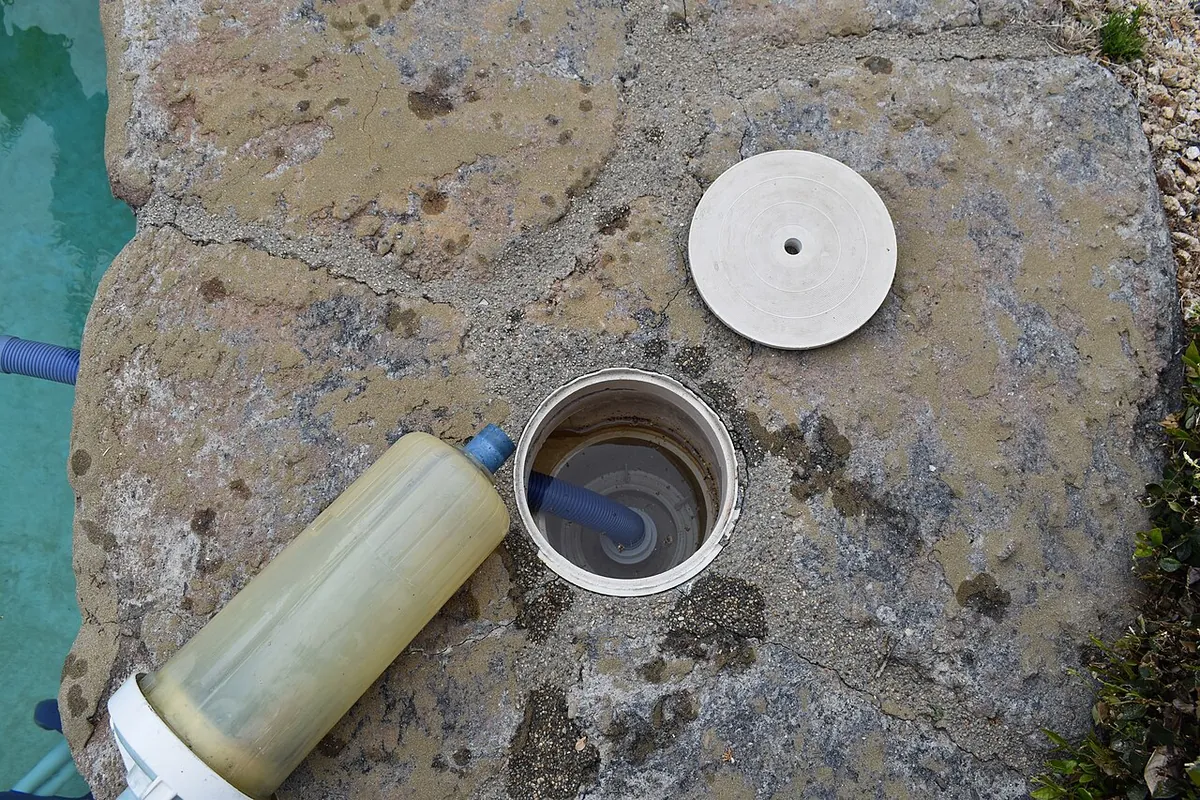
Photo: FASTILY, Wikimedia Commons, CC BY-SA 4.0
Quick Answer
How to vacuum an above ground pool: (1) attach the vacuum head to the telescopic pole and the vacuum hose to the head; (2) lower the head to the floor and feed the hose into the water so it fills completely and pushes out all the air; (3) with the pump running, cover the open end of the hose with your hand and connect it to the skimmer suction (through a skimmer plate or the suction port); (4) move the head slowly in overlapping lines across the floor; (5) empty the skimmer and pump baskets and check the filter pressure when you finish. For heavy dirt or algae, set a sand or DE filter to WASTE so debris leaves the pool instead of passing through the filter. Most pools need vacuuming once a week, more often after storms or algae.
Vacuuming is the step that removes the fine dirt, sand, dead algae and debris that settles on the pool floor. Skimming catches what floats and the filter catches what circulates, but a lot of material sinks and stays put. If it is left, it stains the floor, feeds algae, and uses up chlorine. Learning how to vacuum a pool properly takes about ten minutes, and after a few times the whole job takes 20 to 40 minutes for most backyard pools.
This guide covers how to vacuum an above ground pool step by step, how to hook up a pool vacuum, how to vacuum pool water to waste, how the process differs for inground pools, how to choose between manual, suction, pressure, robotic and handheld vacuums, and how to fix the common problems that make vacuuming frustrating. For the full weekly routine, see how to clean a pool.
What You Need to Vacuum a Pool
| Item | What it does | Tips |
|---|---|---|
| Telescopic pole | Holds and moves the vacuum head | Long enough to reach the far side of the pool |
| Vacuum head | Rides on the floor and pulls in debris | Use a soft-brush or wheel-less head for vinyl liners |
| Vacuum hose | Carries water and debris to the skimmer | Long enough to reach the farthest point, with a swivel cuff |
| Skimmer vacuum plate (vac plate) | Connects the hose to the skimmer over the basket | Keeps the basket in place to catch large debris |
| Leaf canister (optional) | Inline trap for leaves | Stops the pump basket clogging |
Above ground pool vacuum kits often include a head, a hose and a skimmer adapter. For a vinyl liner, avoid heads with hard plastic wheels or metal edges that can scratch, and use a brush-bottom head instead.
How to Hook Up a Pool Vacuum
Most problems with vacuuming come from air in the hose. Air makes the pump lose prime and suction drops to nothing. The goal when you hook up a pool vacuum is to fill the hose completely with water before it reaches the skimmer.
- Turn on the pump and make sure the skimmer is pulling water and the water level is about halfway up the skimmer opening.
- Attach the vacuum head to the pole, then push one end of the hose onto the head.
- Lower the head into the pool until it rests on the floor near the skimmer.
- Prime the hose. Feed the hose into the water hand over hand, so it sinks and fills. Or hold the free end over a return jet until no more bubbles come out of the vacuum head.
- Connect to the skimmer. Keeping the free end underwater, cover it with your hand, bring it to the skimmer, and attach it to the vacuum plate or suction port. You should feel the hose pull and the head grip the floor.
If you hear a loud gurgle at the pump or see air in the pump basket, the hose was not fully primed; disconnect, refill and try again. See how to prime a pool pump if the pump loses prime completely.
How to Vacuum an Above Ground Pool Step by Step
- Skim first. Remove floating leaves so they do not sink while you work.
- Brush the walls down toward the floor so the dirt is on the floor where the vacuum can reach it.
- Let debris settle for 15 to 30 minutes if the water is stirred up.
- Hook up and prime the vacuum as described above.
- Start at the shallow side or the area nearest the skimmer and work outward.
- Move slowly, about one foot per second or less, in straight, overlapping lines like mowing a lawn. Moving fast just clouds the water.
- Watch the filter pressure. If it rises a lot or suction weakens, stop, empty the skimmer basket and check the pump basket.
- Finish along the walls where the wall meets the floor (the cove), where debris collects.
- Disconnect by lifting the head out, then removing the hose from the skimmer.
- Clean up. Empty baskets, backwash or rinse the filter if pressure is high, and top up the water if you vacuumed to waste.
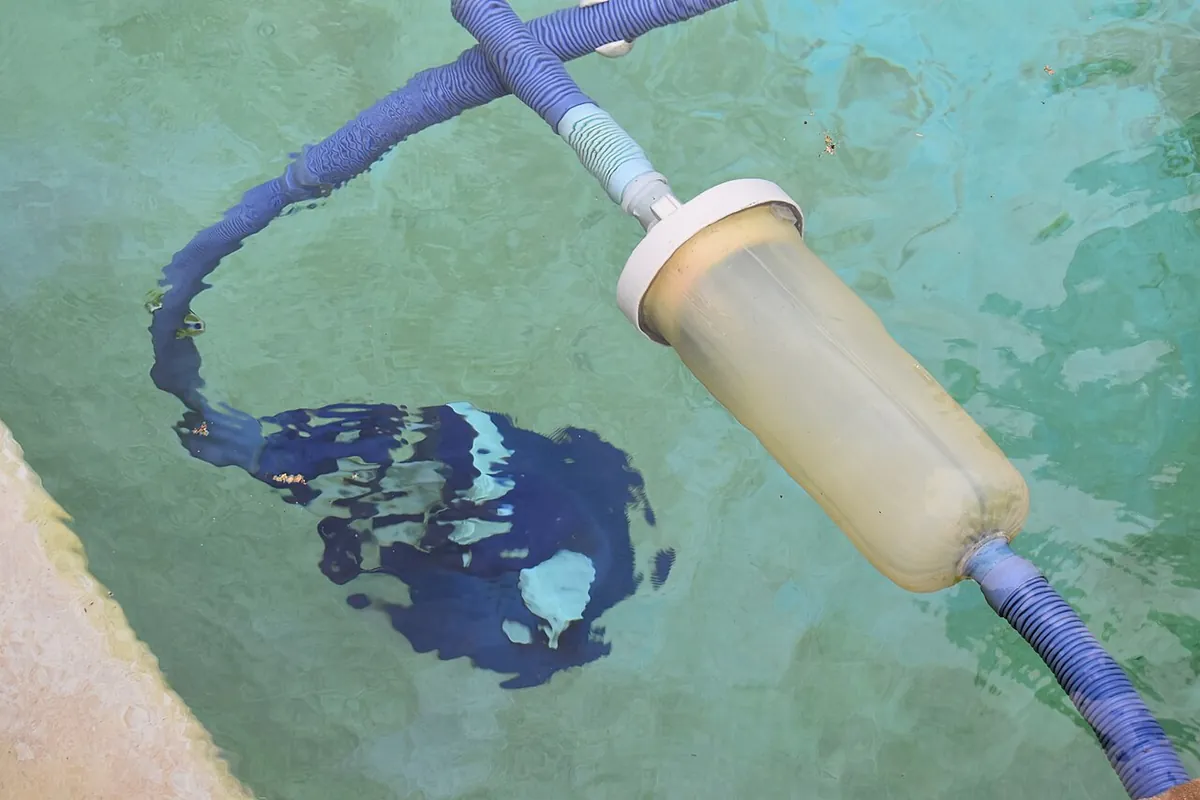
Photo: FASTILY, Wikimedia Commons, CC BY-SA 4.0
Vacuuming With a Sand, Cartridge or DE Filter
Sand filter. For normal vacuuming, leave the valve on FILTER. For heavy debris, algae or very fine silt, use WASTE, which sends water straight out the waste line, bypassing the sand. Watch the water level; vacuuming to waste drops it quickly.
Cartridge filter. Cartridge filters have no waste setting. Vacuum on normal filtration, but stop to rinse the cartridge if pressure climbs. For heavy algae or dirt, rinse the cartridge several times during the job, or use a filter bag on the return or a pump with a waste port if your system has one.
DE filter. Same as sand: filter for light debris, waste for heavy debris. Recharge with DE after backwashing.
How to Vacuum Pool to Waste
Vacuuming to waste is the best way to remove dead algae, sand, silt and debris you do not want back in the filter.
- Raise the water level a few inches above normal, because you will lose water quickly.
- Turn off the pump and set the multiport valve to WASTE. Roll out the backwash hose to a safe drain area.
- Hook up and prime the vacuum, then turn the pump back on.
- Vacuum quickly but smoothly; the water level drops fast.
- Stop before the water falls below the skimmer opening. Refill and continue if needed.
- When done, turn off the pump, set the valve back to FILTER, and restart.
Follow local rules for where pool water may be discharged; many areas ban sending chlorinated water into storm drains. For more on filter settings, see how to backwash a pool.
How to Vacuum an Inground Pool
Vacuuming an inground swimming pool works the same way, with a few differences. Inground pools often have a dedicated vacuum port in the skimmer or the wall, and a deeper floor with a slope to the main drain. Start in the shallow end and work toward the deep end, letting debris roll downhill toward you. On plaster pools, a weighted head with wheels or brushes works well; on vinyl and fiberglass inground pools, use a brush-bottom head. If the pool has a main drain valve, partially close it during vacuuming to increase suction at the skimmer.
Types of Pool Vacuums
Manual pool vacuums
A manual vacuum head, pole and hose use your pump's suction. They are inexpensive, work on every pool, and let you target exactly the spots that need it. They take your time each week.
Suction-side automatic cleaners
These connect to the skimmer or vacuum port and use the pump's suction to wander the pool floor. They cost less than robots and work well in above ground pools, but they send debris into the filter and can slow the pump.
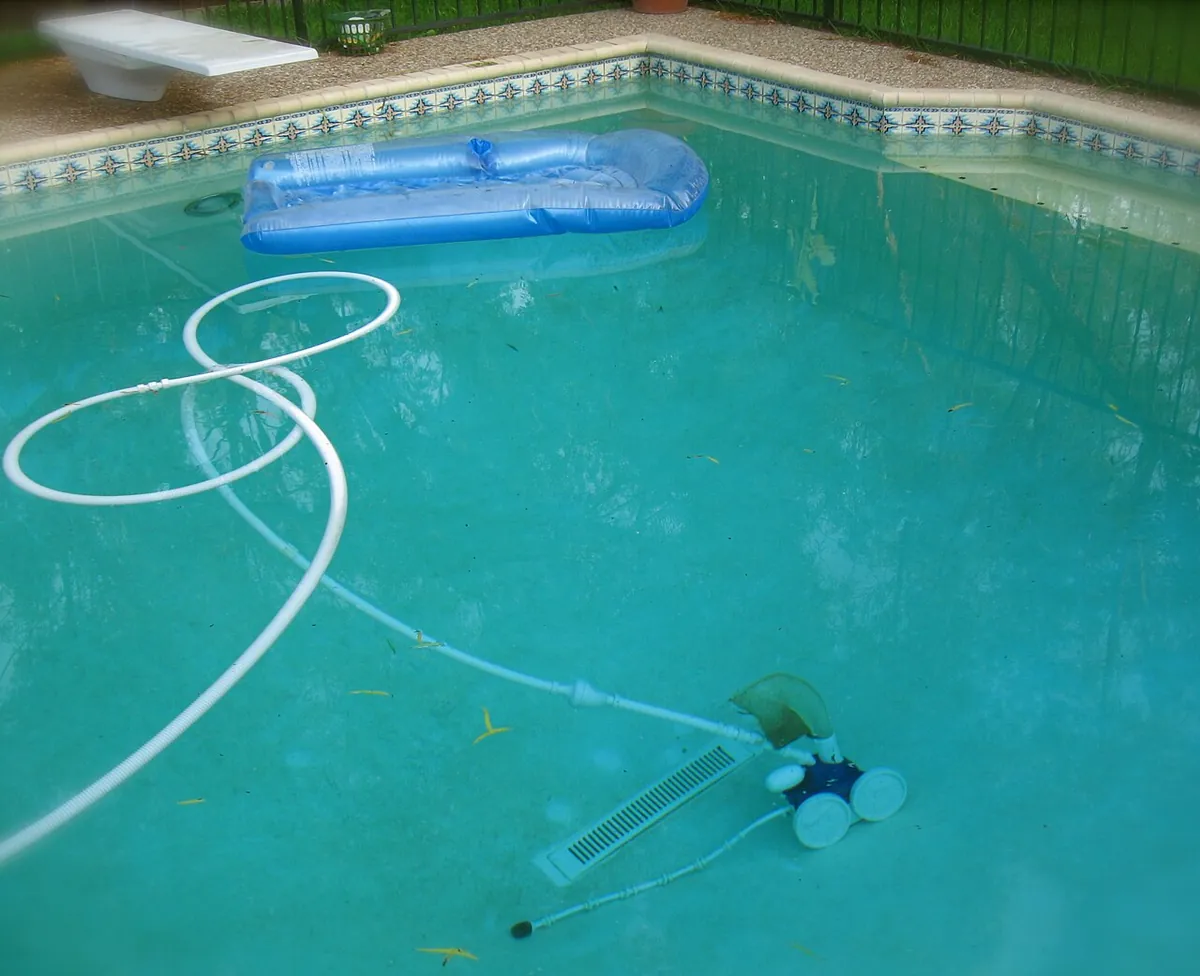
Photo: Bovineone, Wikimedia Commons, public domain
Pressure-side cleaners
Pressure cleaners connect to a return line or a booster pump and collect debris in their own bag. They are good for leaves and larger debris and do not load the filter. They are more common on inground pools.
Robotic pool vacuums
Robotic cleaners have their own motor, pump and filter and plug into a low-voltage power supply. They scrub the floor and often the walls, collect fine debris, and reduce filter work and chemical use. Robotic pool vacuums for above ground pools are smaller and lighter than inground models. They cost the most, typically a few hundred to over a thousand dollars.
Handheld and battery vacuums
Battery-powered handheld vacuums need no hose connection and are handy for spot cleaning, small pools, spas and steps. They have small debris bags and limited run time, so they are a supplement rather than a replacement for a full pool vacuum.
Garden hose (venturi) vacuums
These attach to a garden hose and use water pressure to lift debris into a bag. They work for small, soft-sided pools without a pump, such as easy-set pools, but are slower and less effective than a pump-powered pool vacuum.
Choosing a Good Above Ground Pool Vacuum
- Match the pool size. Check the maximum pool size and the hose length.
- Protect the liner. Choose soft brushes or rollers; avoid hard wheels.
- Check the pump. Suction cleaners need enough flow; small pumps on easy-set pools may not run them well.
- Consider debris. Leaves call for a leaf canister or a pressure or robotic cleaner with a large bag; fine dust calls for a robot with a fine filter.
- Think about time. A manual above ground pool vacuum is cheap but takes your time; an automatic or robotic cleaner saves time each week.
- Plan for storage. In winter, store vacuums and hoses dry and out of the sun.
How to Clean the Bottom of a Pool
If you want to know how to clean the bottom of a pool, vacuuming is the main tool, but brushing comes first. Brush the floor toward the main drain or into a pile, wait for it to settle, then vacuum. For stains, test the water and treat the cause: metal stains need a stain remover or sequestrant; organic stains from leaves usually fade with chlorine and brushing. For a sandy floor in above ground pools, vacuum to waste or use a fine filter bag on the vacuum. For more, see how to clean pool tile.
How to Keep an Above Ground Pool Clean Between Vacuuming
- Use a cover when the pool is not in use.
- Skim daily in leaf season and empty the skimmer basket often.
- Rinse feet before entering, or put a foot bath by the ladder.
- Keep chlorine and pH steady so algae cannot take hold.
- Run the pump long enough each day; see how long to run a pool pump.
- Trim trees and plants near the pool.
Above Ground Pool Vacuum Heads and Hoses
The right parts make an above ground pool vacuum far easier to use. Vacuum heads come in several styles:
- Brush-bottom heads glide on bristles and are the safest choice for vinyl liners.
- Flexible heads bend to follow the cove where the wall meets the floor.
- Weighted heads stay down on the floor better, useful with strong suction.
- Wheeled heads roll easily on plaster but can mark soft vinyl if the wheels are hard.
Pool vacuum hoses for above ground pools are usually 1 1/4 inch diameter; inground pools often use 1 1/2 inch. Choose a hose long enough to reach the far side of the pool from the skimmer, plus a few feet. A swivel cuff on one end stops the hose from twisting and kinking. Store hoses out of the sun and replace them when they crack, because a cracked hose sucks air and the pool vacuum loses suction.
Vacuuming Different Kinds of Above Ground Pools
Steel and resin wall pools. These have a standard skimmer and a pump strong enough for a manual vacuum or a suction cleaner. Follow the steps in this guide exactly.
Metal frame pools. Many frame pools come with small cartridge pumps. They can run a manual vacuum head through a skimmer adapter, but suction is weaker, so move slowly and rinse the cartridge often. A battery vacuum or small robot is often easier.
Inflatable easy-set pools. These pools often have no skimmer and a very small pump. A garden hose venturi vacuum or a handheld battery vacuum is the practical way to vacuum pool floors in these pools. Small vacuum kits sold with easy-set pools attach to a garden hose or to the filter pump.
Manual vs Automatic Pool Vacuum Costs
| Vacuum type | Typical price | Best for |
|---|---|---|
| Manual head, pole and hose | $50 – $150 | Every pool; targeted cleaning |
| Garden hose venturi vacuum | $20 – $60 | Small pools without a pump or skimmer |
| Battery handheld vacuum | $100 – $300 | Spot cleaning, steps, spas |
| Suction-side automatic cleaner | $150 – $500 | Above ground pools with a decent pump |
| Pressure-side cleaner | $400 – $900 | Leafy inground pools |
| Robotic pool vacuum | $300 – $1,500+ | Hands-off cleaning, fine debris, walls |
A manual pool vacuum for an above ground pool is the cheapest option; an above ground pool vacuum robot is the most convenient. Many owners keep a manual kit even after buying a robot, for spot cleaning and algae clean-ups.
Tips to Vacuum a Pool Faster and Better
- Vacuum in the morning, after debris has settled overnight and before swimmers stir it up.
- Keep the water level high enough that the skimmer never pulls air.
- Empty the skimmer basket first so suction is strong from the start.
- Overlap each pass by a few inches, so you do not leave stripes of dirt.
- Use a leaf canister in leaf season to keep the pump basket clear.
- Turn off automatic cleaners and fountains that stir up debris while you work.
- Clean the filter afterward if the pressure rose during vacuuming.
Vacuuming at Pool Opening and Closing
At spring opening, the floor usually holds leaves, silt and debris that got past the cover. Remove large leaves with a leaf rake first, then vacuum, often to waste. At closing, vacuum thoroughly so the pool goes into winter clean, which makes the spring opening much easier. See how to winterize a pool.
How to Vacuum Above Ground Pool Liners Without Damage
Vinyl liners are the main thing that makes vacuuming an above ground pool different from vacuuming a concrete pool. The liner is soft and thin, so careless vacuuming can scratch, stretch or pull it. To vacuum above ground pool liners safely:
- Use a brush-bottom or soft-roller vacuum head, never metal edges or hard wheels.
- Do not let the head stick hard to the floor; if suction is very strong, tilt the head slightly or open the pump's other suction line.
- Work gently along the cove where the wall meets the floor, where liners are most stretched.
- Never use a vacuum head or brush made for plaster pools.
- Check for small holes and wrinkles as you go; vacuuming is a good time to spot leaks early.
If you see a liner tear, stop and patch it before it grows. See pool leak repair cost for patching options.
Above Ground Pool Vacuum Robot Tips
A robotic pool vacuum for an above ground pool works best when you:
- Pick a model rated for your pool size, shape and floor type (flat or with a deep center).
- Lower it in gently, letting air escape before releasing it, so it sinks evenly.
- Keep the power supply at least the distance the maker requires from the water, and plug it into a GFCI-protected outlet.
- Empty and rinse its filter basket after every cycle.
- Untangle the cable regularly; a swivel cable reduces twisting.
- Store it out of the pool and out of direct sun when not in use.
Robots do not replace skimming, brushing corners and steps, or water testing, but they cut the weekly time to vacuum pool floors to almost nothing.
Common Vacuuming Problems and Fixes
| Problem | Likely cause | Fix |
|---|---|---|
| No suction | Air in hose, full basket, clogged filter | Re-prime hose, empty baskets, clean filter |
| Pump loses prime | Hose not primed, water too low, leak in hose | Refill hose, raise water level, replace hose |
| Dirt blows back into pool | Filter too dirty or damaged, wrong valve setting | Vacuum to waste, check filter parts |
| Cloudy water while vacuuming | Moving too fast, very fine debris | Slow down, use waste, add clarifier |
| Vacuum head sticks to the floor | Too much suction | Partly open the main drain or tilt the head |
| Hose floats or kinks | Air in hose, old stiff hose | Prime fully; replace cracked hoses |
Vacuuming Algae and a Green Pool
When the pool has gone green, vacuum after you have shocked the water and brushed, once the dead algae settles as gray or brown dust. Always vacuum algae to waste on sand and DE filters, because it clogs filters quickly and can pass through. With a cartridge filter, clean the cartridge often during the job. See how to clean a green pool and how to get rid of algae in a pool.
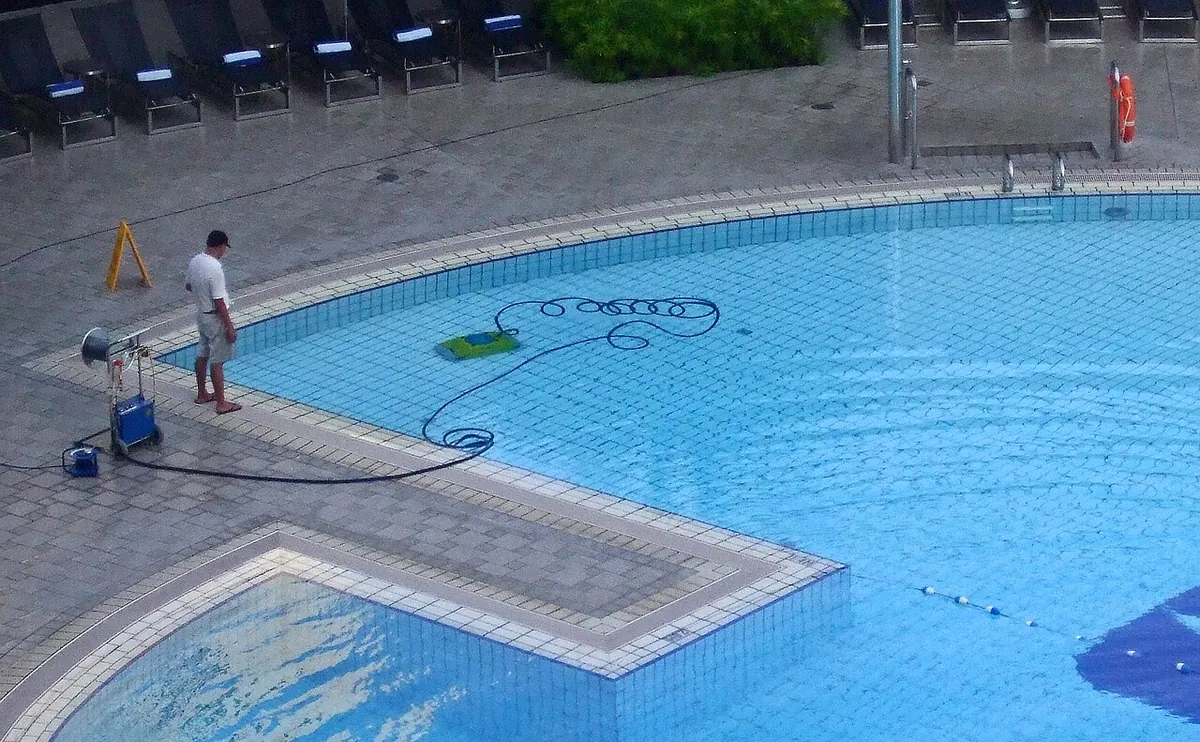
Photo: Martin Cooper, Wikimedia Commons, CC BY 2.0
Pool Hooks and Poles: Safety Equipment on the Same Pole
The telescopic pole you use to vacuum can also hold a pool hook, also called a shepherd's crook or swimming pool hook. A pool hook is a rescue tool: a large curved hook that lets someone on the deck pull a struggling swimmer to the side without entering the water. Many pool codes require a rescue hook at public pools, and it is a smart, low-cost addition at home. Keep the pole and hook near the pool, not locked in a shed. See the U.S. Consumer Product Safety Commission's Pool Safely resources for more home pool safety steps.
How Often to Vacuum a Pool
- Weekly in the swim season for most pools.
- After storms, pool parties and heavy pollen.
- During algae treatment, daily until the floor stays clean.
- At opening and closing of the season.
How to Vacuum a Pool: Key Points
- Knowing how to vacuum a pool comes down to one rule: fill the hose with water before it reaches the skimmer.
- Move the pool vacuum head slowly, in overlapping lines.
- Vacuum pool floors to waste when you are removing algae, sand or silt.
- Use a soft above ground pool vacuum head on vinyl liners.
- A manual pool vacuum for an above ground pool is cheap; a robotic above ground pool vacuum saves the most time.
- Vacuuming a pool once a week keeps stains, algae and chlorine demand down.
Frequently Asked Questions
How do you vacuum an above ground pool without a skimmer?
Use a garden hose venturi vacuum, a battery-powered vacuum, or connect the vacuum hose to the pump inlet with an adapter if the pool has a pump but no skimmer.
How do I vacuum my pool if the pump keeps losing prime?
The hose likely has air in it. Fill it completely underwater before connecting, keep the water level high, and check for cracks in the hose.
Should I vacuum on filter or waste?
Use filter for normal debris and waste for algae, silt, sand or very dirty water on sand and DE filters.
Can I vacuum a pool with a cartridge filter?
Yes. There is no waste setting, so clean the cartridge during and after vacuuming heavy debris.
What is the best above ground pool vacuum?
The best above ground pool vacuum depends on your pool and time. A manual kit is cheapest; a suction cleaner suits pools with a good pump; a robotic above ground pool vacuum suits owners who want the least work.
How do I vacuum my swimming pool without losing water?
Vacuum on the FILTER setting instead of WASTE. You only lose water when vacuuming to waste or backwashing.
Why does my pool vacuum keep coming off the floor?
The hose may have air in it, which makes it float, or the head may be too light. Prime the hose fully, add weights to the head or use a weighted head, and keep the pole angled so you press the head gently onto the floor while you vacuum the pool.
How long does it take to vacuum a pool?
Most backyard pools take 20 to 40 minutes once you are used to it. Large or very dirty pools take longer, especially when you stop to empty baskets.
Do robotic pool vacuums work in above ground pools?
Yes. Many robots are designed for above ground pools; check the pool size, wall type and floor shape the robot supports.
How do you use a pool vacuum for the first time?
Follow the hook-up steps: head on pole, hose on head, fill the hose with water, connect to the skimmer, and move slowly.
Sources
- CDC: Healthy Swimming
- U.S. CPSC Pool Safely: home pool safety
- Pool & Hot Tub Alliance: pool care resources
- U.S. EPA: keeping pollutants out of storm drains