
How to Get Pollen Out of Pool Water: Step-by-Step Guide
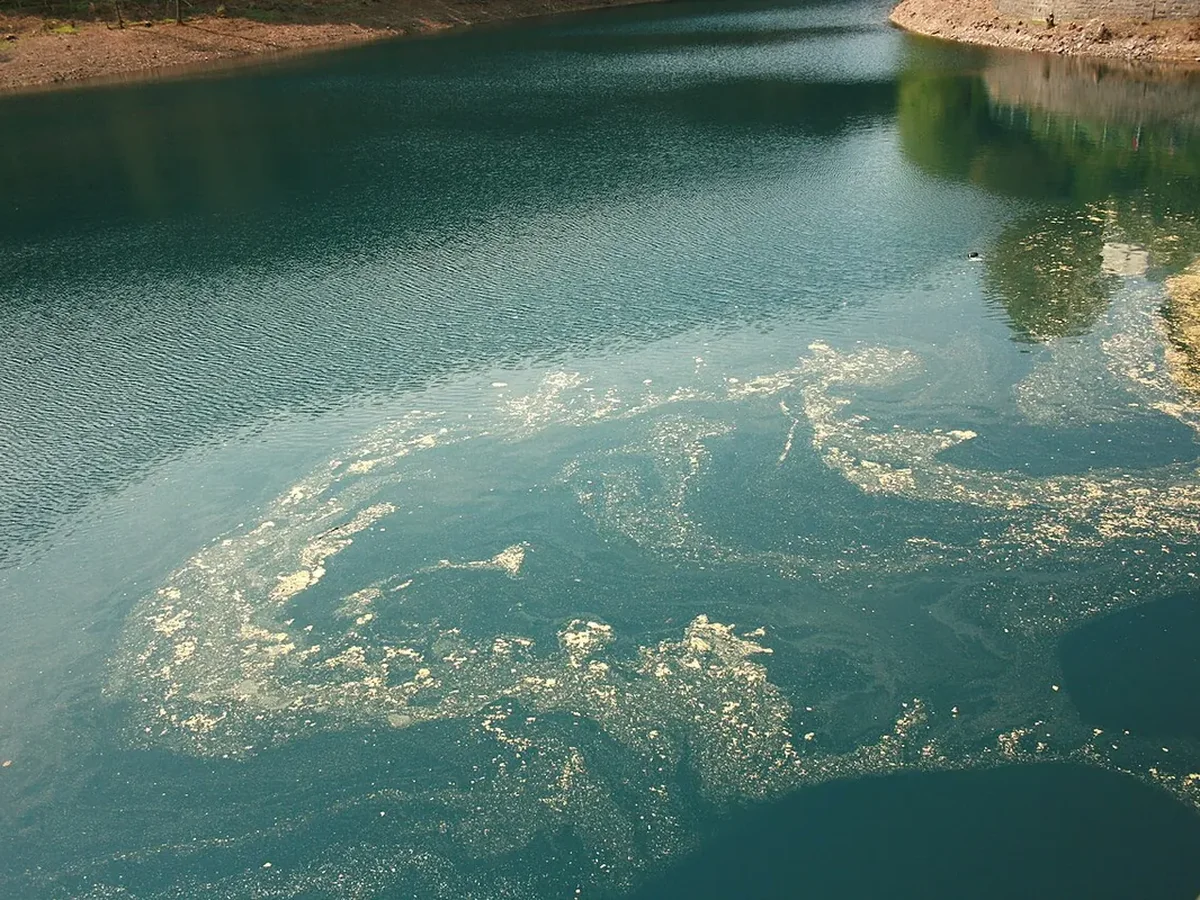
Photo: Frank Vincentz, Wikimedia Commons, CC BY-SA 3.0
Quick Answer
To get pollen out of pool water, skim the surface often with a fine mesh net, put skimmer socks (fine mesh filter liners) in the skimmer baskets, run the pump longer during heavy pollen weeks, and add a pool clarifier so the filter can catch fine dust. Brush walls and steps, vacuum settled pollen (to waste if there is a lot), and clean the filter when pressure rises 8 to 10 psi above clean. Keep free chlorine at 2 to 4 ppm, since pollen can feed algae. Pollen floats and wipes off easily; if yellow patches cling to shady walls and come back after brushing, it is likely mustard algae. A cover blocks most new pollen.
Every spring, many pool owners wake up to a yellow-green film on the water, a dusty ring at the waterline and skimmer baskets coated in what looks like mustard powder. It is pollen. Trees like pine, oak, birch, maple and many grasses release huge amounts of it, and a pool is a big, flat, wet trap. Pollen in pool water is not dangerous for most swimmers, but it looks dirty, clogs filters, makes the water cloudy and can feed algae. It can also bother swimmers with allergies.
This guide explains how to get pollen out of pool water quickly and how to keep it out for the rest of the season. It also shows how to tell pollen in swimming pool water from mustard algae, which looks similar but needs a different treatment.
Why Pollen in Pool Water Is Hard to Remove
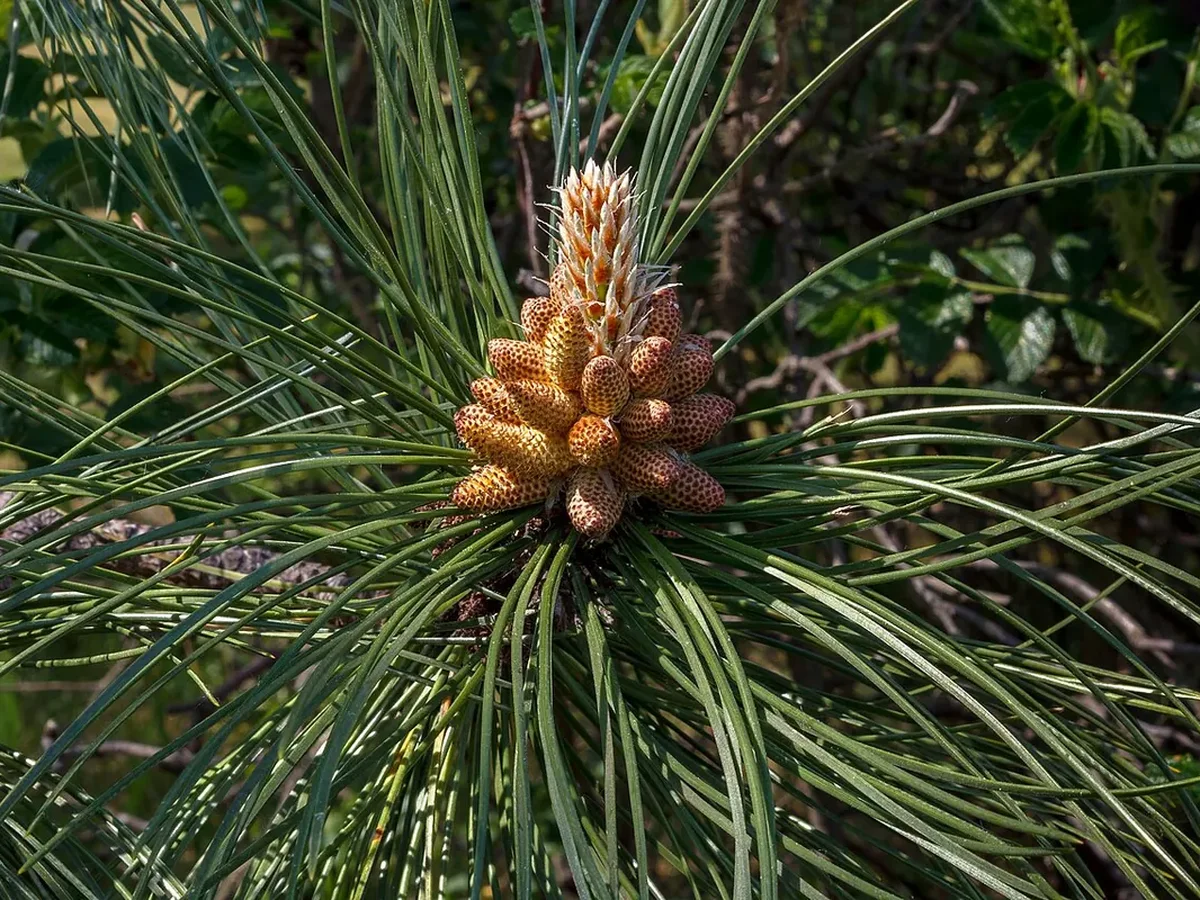
Photo: W.carter, Wikimedia Commons, CC BY-SA 4.0
Pollen grains are tiny. Most are between about 10 and 100 microns, and some tree pollens are around 20 to 30 microns. That is right at the edge of what a sand filter can catch, which is roughly 20 to 40 microns. Cartridge filters do better at 10 to 20 microns, and DE filters catch particles down to 3 to 5 microns. So in a pool with a sand filter, a lot of pollen passes straight through and goes back into the pool. Pine pollen, like the cone above produces, even has small air sacs that help it float, so it stays on the surface and gathers along the edges.
Pollen also does not respond to chlorine the way algae does. Chlorine can break down some of the organic material, but it cannot make the grains disappear. They must be skimmed, filtered or vacuumed out. That is why learning how to get pollen out of pool water is mostly about removal and filtration, not chemicals.
How to Get Pollen Out of Pool Water in 8 Steps
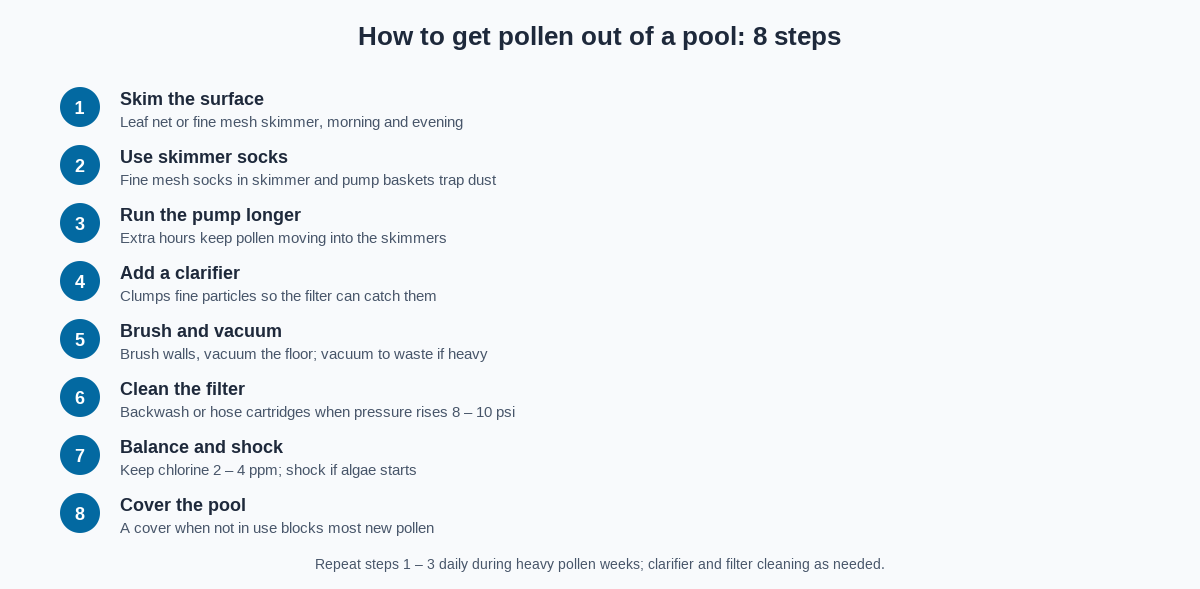
Chart: Asphapro.com
Step 1: Skim the surface often. Use a leaf net with fine mesh, or a dedicated fine mesh skimmer net, and skim the whole surface in the morning, when pollen has gathered overnight, and again in the evening. Work slowly so the pollen does not slip through. Push pollen toward the skimmer opening, where the flow will pull it in. On windy days, skim from the side the wind blows toward, where pollen piles up. Skimming is the single most important part of how to get pollen out of pool water.
Step 2: Use skimmer socks. Skimmer socks are fine mesh liners, like a stocking, that stretch over the skimmer basket and the pump strainer basket. They catch fine pollen that would otherwise go straight through the basket to the filter. Replace or rinse them daily during heavy pollen weeks, since they clog fast. Some owners use an old pair of nylon stockings for the same purpose. Socks greatly reduce how much pollen reaches the filter.
Step 3: Run the pump longer. During pollen season, run the pump 10 to 12 hours a day or even longer so the skimmers keep pulling the surface clean. If you have a variable speed pump, a long run at moderate speed works well. Aim return jets slightly upward and in a circular pattern so the surface flows toward the skimmers. For guidance on run time, see how long to run pool pump.
Step 4: Add a pool clarifier. A clarifier is a polymer that clumps tiny particles together so the filter can catch them. It is especially helpful with sand filters. Add the dose on the label and run the pump; the water usually clears over one to two days. For heavy pollen that has settled, a flocculant (floc) can drop everything to the floor overnight with the pump off, after which you vacuum it out to waste. Floc works faster but needs more effort and wastes water. A clarifier is the gentler first choice when learning how to get pollen out of pool water.
Step 5: Brush and vacuum. Brush the walls, steps and waterline daily during pollen season to lift pollen into the water where the filter can catch it. Pollen that settles to the floor should be vacuumed. If there is a lot of it, or if the filter keeps passing it back into the pool, set the multiport valve to "waste" and vacuum it straight out of the pool, then top up the water. For more on cleaning, see how to clean pool water and surfaces.
Step 6: Clean the filter. Pollen clogs filters quickly. Watch the pressure gauge, and backwash a sand or DE filter or hose off a cartridge when pressure rises 8 to 10 psi above the clean reading. During heavy pollen weeks, this may be every few days. A deep clean of cartridges with filter cleaner at the end of the season removes oily residue. See how to clean swimming pool filter for steps.
Step 7: Keep chlorine up and shock if needed. Pollen is organic material. It uses up chlorine and can feed algae, and it carries phosphates and nitrogen. Test more often and keep free chlorine at 2 to 4 ppm with pH between 7.4 and 7.6. If the water starts to turn green or cloudy, shock the pool. A phosphate remover can help if tests show high phosphate levels; see how to remove phosphates from pool water.
Step 8: Cover the pool. A cover blocks most new pollen from landing in the water when the pool is not in use. A solar cover is cheap and also warms the water in spring. Rinse pollen off the cover before removing it so it does not slide into the pool. An automatic cover is the easiest long-term option. See our pool cover cost guide.
Pollen in Pool or Mustard Algae?
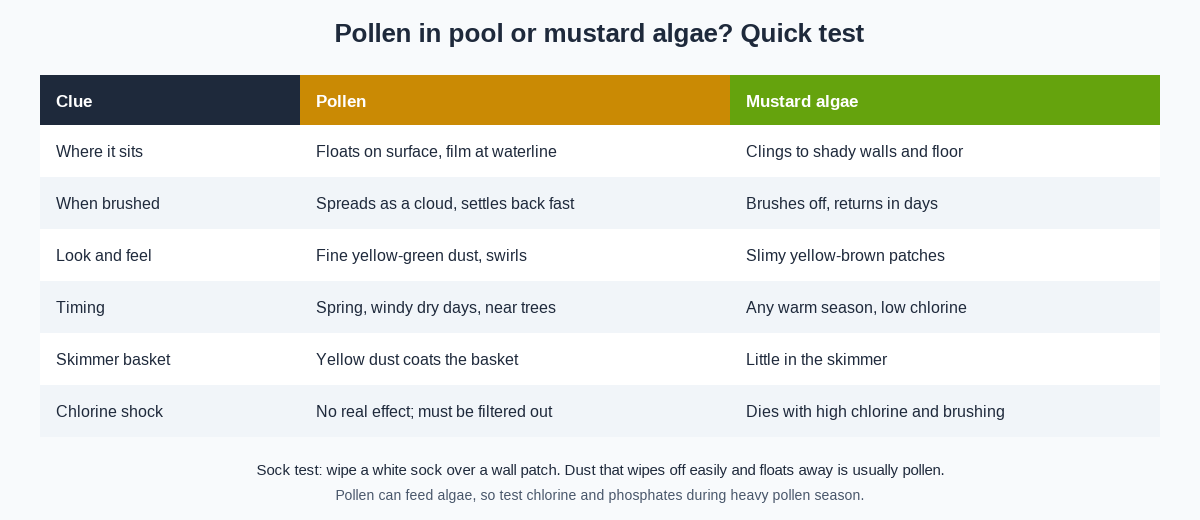
Chart: Asphapro.com
Pollen in pool water and mustard algae are both yellow, and many owners confuse them. Getting it right matters, because pollen needs filtration while mustard algae needs a strong chlorine treatment. Pollen usually floats on the surface or forms a dusty film at the waterline and on steps. When brushed, it spreads as a cloud and settles again. Mustard algae clings to shady walls and the floor in slimy patches, brushes off easily but comes back within days. Pollen also coats the skimmer basket, while algae usually does not.
A simple test: wipe a white sock or cloth over a yellow patch. If the dust wipes off easily, floats away and the patch does not return within a day or two once the water is filtered, it is pollen. If it comes back in the same shady spots, treat it as algae. See how to get rid of mustard algae in pool water for that treatment.
How to Get Pollen Out of Pool Water With Each Filter Type
Sand filter. Sand filters catch the least pollen. Use a clarifier regularly during pollen season, consider adding a filter aid such as a small amount of DE or a cellulose product made for sand filters, and backwash when pressure rises. Skimmer socks are especially important. Some owners switch to a glass media, which can filter slightly finer than sand. Glass media also backwashes more cleanly, which helps when pollen clogs the bed every few days in spring.
Cartridge filter. Cartridges catch most pollen but clog quickly. Keep a spare set so you can swap and let one dry while you clean the other. Hose off cartridges from top to bottom, and soak in cleaner if pollen leaves an oily film.
DE filter. DE filters catch even very fine pollen. Backwash and recharge with fresh DE when pressure rises. During the heaviest weeks, you may need to do this more often than usual.
If your filter struggles every spring, it may be too small for your pool; use our pool filter size calculator to check.
How to Get Pollen Out of Pool Water Without a Filter Upgrade
You do not need to replace your equipment to handle pollen in swimming pool water. A few small tools make a big difference: a fine mesh leaf net, skimmer socks, a skimmer basket with a weir door that works properly, and an automatic surface skimmer or solar-powered skimmer robot that patrols the surface all day. A tennis ball or an absorbent sponge in the skimmer basket picks up oily residue that pollen leaves behind. These steps are cheap and help with leaves and bugs as well.
Pollen in Swimming Pool Water and Allergies
Pollen in swimming pool water can trigger sneezing, itchy eyes and congestion in people with allergies. Swimming in water with heavy pollen is not usually harmful beyond that, but it is unpleasant. During peak pollen days, swim in the early morning or evening when pollen counts are often lower, shower after swimming and keep the water as clean as possible. People with severe allergies or asthma should follow their doctor's advice. Local pollen forecasts help you plan swims and extra cleaning.
How to Get Pollen Out of Pool Walls and the Waterline
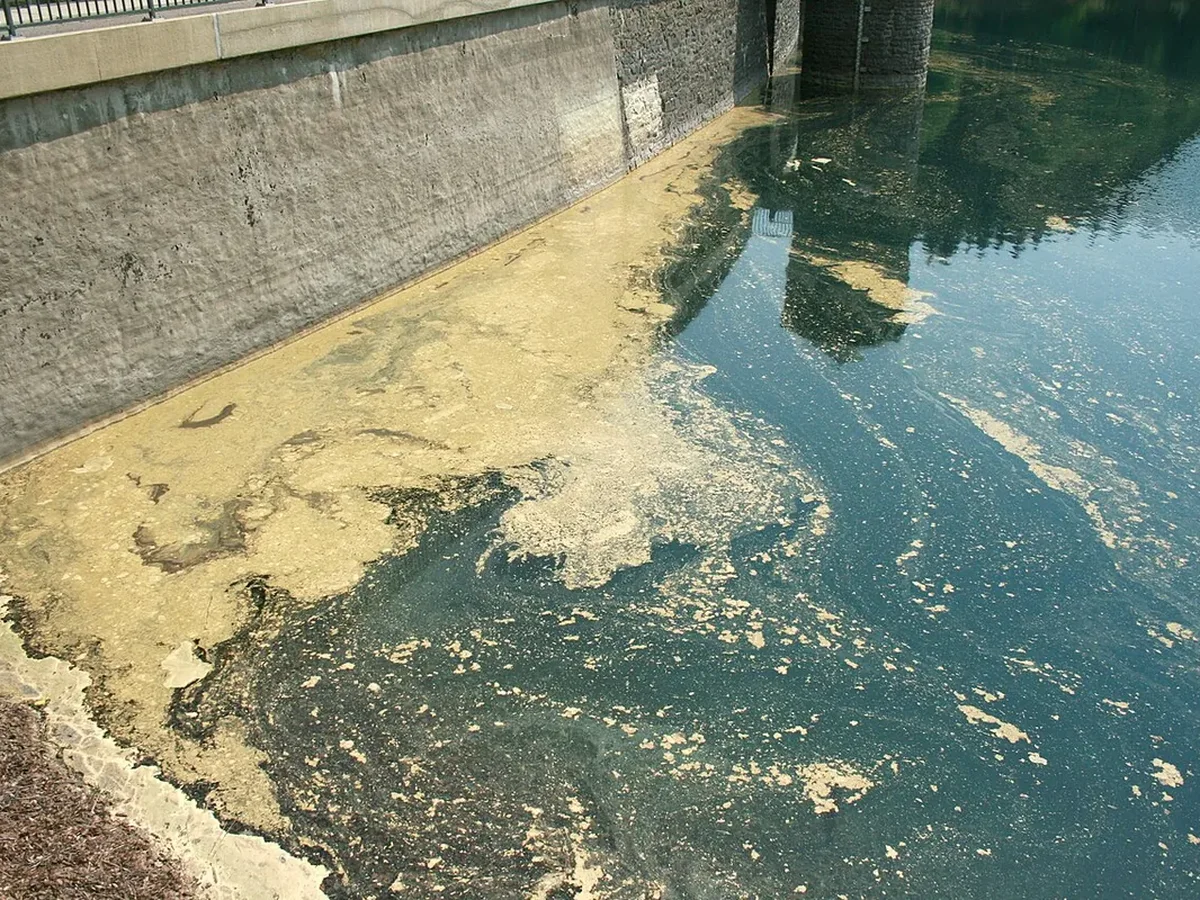
Photo: Frank Vincentz, Wikimedia Commons, CC BY-SA 3.0
Wind pushes floating pollen into corners and along walls, where it forms a thick film like the one in the photo. In a pool, this ends up as a yellow ring on the tile line. Skim these corners first, and brush the waterline daily. If a ring sticks to the tile, use a tile and vinyl cleaner or a soft scrub pad made for pool surfaces. For stubborn rings, see how to clean pool tile. Aim the return jets so they push water toward the skimmers and away from corners, so pollen does not collect where flow is weak.
How to Get Pollen Out of Pool Water Before It Lands: Prevention
Prevention matters as much as cleaning. Use a cover whenever the pool is not in use during spring. Trim back trees and shrubs that hang over the pool, especially pines, oaks and birch. When planting near the pool, choose low-pollen plants and avoid wind-pollinated trees close to the water. Hose down the deck and patio furniture so pollen does not blow or wash into the pool. Keep skimmer socks on all season. Fences and hedges can help block windblown pollen, though they also produce some of their own.
When Is Pollen in Pool Water Worst?
Pollen season depends on where you live. In much of the US, tree pollen peaks from late winter to late spring, with pine and oak pollen often heaviest in March, April and May in the South and April to June farther north. Grass pollen peaks in late spring and early summer, and weed pollen like ragweed peaks in late summer and fall. Heavy tree pollen usually lasts two to four weeks. Knowing your local season tells you when to expect pollen in pool water and when to step up skimming and filter cleaning.
How to Get Pollen Out of Pool Water: A Daily Routine
During the two to four weeks of heavy pollen, a short daily routine keeps the pool swimmable with the least effort. In the morning, before the sun warms the water and before swimmers stir things up, skim the whole surface and empty the skimmer baskets. Rinse or replace the skimmer socks. Check the filter pressure gauge and note the reading. Brush the waterline and steps, working toward the main drain. In the evening, skim again and put the cover on if you use one. Every two or three days, test free chlorine and pH, add clarifier if the water looks hazy and clean the filter if the pressure has climbed 8 to 10 psi. This routine takes about 15 to 20 minutes a day and is the simplest answer to how to get pollen out of pool water and keep it out during the worst weeks.
Pollen in Pool Water vs Other Yellow Problems
Mustard algae is not the only thing that can be confused with pollen in pool water. Fine sand or dirt blown in by wind settles on the floor and looks tan or brown, but it is heavier than pollen and does not float. Iron or other metals can turn water yellow, green or brown after adding shock, especially with well water; that color is in the water itself, not floating dust, and needs a metal sequestrant. Sulfur-like yellow films from some sunscreens and body oils form a greasy ring at the waterline. Yellow staining on plaster from leaves or metals does not wipe off at all. Pollen in pool water is the only one that floats as fine dust, swirls when you move the water and coats the skimmer basket. If you are not sure, take a water sample to a pool store and ask them to look at it.
Tools That Help Get Pollen Out of Pool Water
A few inexpensive tools make pollen season easier. A fine mesh leaf skimmer catches more pollen than a standard net; some are sold as "fine mesh" or "silt" skimmers. Skimmer socks come in packs and cost a few dollars each. A skimmer basket with a weir door keeps pollen in the skimmer when the pump cycles off. An automatic surface skimmer or solar-powered surface robot moves around the pool collecting floating debris all day and costs a few hundred dollars. A robotic pool cleaner with a fine filter bag or cartridge picks up pollen that settles on the floor without sending it through your main filter. Clarifier and enzyme products help with fine particles and oily films. Together, these tools make getting pollen out of pool water far less work.
Pollen in Swimming Pool Water: Above Ground Pools
Above ground pools usually have small filters and a single skimmer, so pollen in swimming pool water can overwhelm them quickly. Use a skimmer sock on the skimmer basket, keep the pool covered when not in use, and run the pump longer during pollen season. Many above ground pools use sand or small cartridge filters, so a clarifier helps a lot. If pollen settles, vacuum it to waste if your filter has that setting, or use a robotic or battery-powered vacuum with its own fine bag. See how to vacuum above ground pool floors for steps.
Pollen in Pool Water With a Salt System
Saltwater pools face pollen the same way as chlorine pools: pollen still has to be filtered out. Pollen uses up chlorine, so the salt cell may need a higher output setting during heavy weeks, and you should test free chlorine more often. Pollen does not usually affect the salt cell directly, but keep an eye on the cell for buildup and clean it as needed. For details, see how to clean salt water pool cell plates.
What It Costs to Get Pollen Out of Pool Water
For most owners, the cost of dealing with pollen is small. Skimmer socks cost about $10 to $20 for a season's supply. A bottle of clarifier costs $15 to $30 and lasts several weeks. A fine mesh skimmer net costs $15 to $40. Extra pump run time adds a few dollars to tens of dollars a month to the electricity bill, depending on the pump; a variable speed pump keeps this low. Extra chlorine during pollen season might add $10 to $30. A solar cover costs $50 to $300, while an automatic surface skimmer costs $200 to $600. If you hire a pool service, some charge extra for heavy pollen cleanups or more frequent visits during spring.
Should You Drain the Pool to Remove Pollen?
Almost never. Draining a pool is risky; inground pools can pop out of the ground if groundwater is high, and vinyl liners can shrink or wrinkle. Pollen can always be removed by skimming, filtering, clarifier, floc and vacuuming to waste. The only reason to drain partially would be if the water has very high levels of dissolved solids or other chemistry problems that a partial drain and refill would fix, which is not caused by pollen itself. So when you ask how to get pollen out of pool water, draining is not the answer.
How to Get Pollen Out of Pool Water: Worked Examples
Pool next to a pine woodland in Georgia. Every April the surface turns yellow. The owner puts skimmer socks in both skimmers, runs the variable speed pump 14 hours a day at medium speed, skims twice a day and adds clarifier every three days. The sand filter is backwashed twice a week. After three weeks of heavy pollen, the water stays clear and the chlorine level stays steady.
Cartridge filter pool in Ohio. The owner notices yellow dust on the steps and wonders if it is mustard algae. A sock wipe shows the dust lifts off easily and the skimmer basket is coated in pollen. They brush daily, rotate a spare cartridge set and cover the pool at night. The yellow film is gone within a week.
Heavy pollen settled on the floor. After a windy weekend, a thick layer of pollen covers the floor. The owner adds a flocculant in the evening with the pump off, then vacuums the settled cloud to waste in the morning and refills the pool. This is the fastest way to get pollen out of pool water when there is a lot of it.
How to Get Pollen Out of Pool Water: Common Mistakes
Shocking repeatedly to remove pollen wastes chemicals; pollen needs to be filtered or skimmed out. Forgetting to clean the filter leads to low flow and poor skimming. Vacuuming heavy pollen through a sand filter just sends it back into the pool. Leaving the pool uncovered on peak days means starting over every morning. Confusing pollen with mustard algae can mean treating the wrong problem. Avoid these and you will know how to get pollen out of pool water quickly every spring.
How to Get Pollen Out of Pool Water: Key Points
- Skim often and put skimmer socks in skimmer and pump baskets.
- Run the pump longer and add a clarifier, especially with sand filters.
- Brush, vacuum and clean the filter when pressure rises.
- Keep chlorine at 2 to 4 ppm, since pollen can feed algae.
- Pollen wipes off and floats; mustard algae clings and returns.
- Cover the pool to keep most pollen out.
Frequently Asked Questions
Is pollen in pool water harmful?
It is not usually harmful, but it can make water cloudy, feed algae and bother swimmers with allergies.
Does shock remove pollen from a pool?
No. Shock can help prevent algae that feeds on pollen, but the grains must be skimmed, filtered or vacuumed out.
Will a sand filter remove pollen?
Only partly. Many pollen grains are near the size limit of sand filters. Use a clarifier and skimmer socks to help, and vacuum heavy pollen to waste rather than through the filter.
How do I get pollen out of pool water without a pool service?
Most owners can handle it alone. Skim twice a day, keep skimmer socks in every basket, run the pump longer, add clarifier and clean the filter when the pressure rises. Those simple steps are all you need to know about how to get pollen out of pool water at home.
Can pollen in pool water stain the surface?
Pollen rarely stains on its own, but a pollen ring left at the waterline for weeks can mix with oils and leave a yellow film on tile. Brush it off early.
How long does pollen season last?
Heavy tree pollen often lasts two to four weeks in spring, though grass and weed pollen continue into summer and fall.
How do I know if it is pollen or mustard algae?
Pollen floats and wipes off easily. Mustard algae clings to shady walls and comes back after brushing.
What is the fastest way to get pollen out of pool water?
For heavy pollen, use a flocculant overnight and vacuum to waste. For light pollen, skim, use socks and add a clarifier.
Sources
- CDC: Healthy swimming
- AAAAI: Outdoor allergens
- CDC: Allergens and pollen
- US Department of Energy: Swimming pool covers