
How to Clean a Green Pool: A Step-by-Step Green to Clean Guide
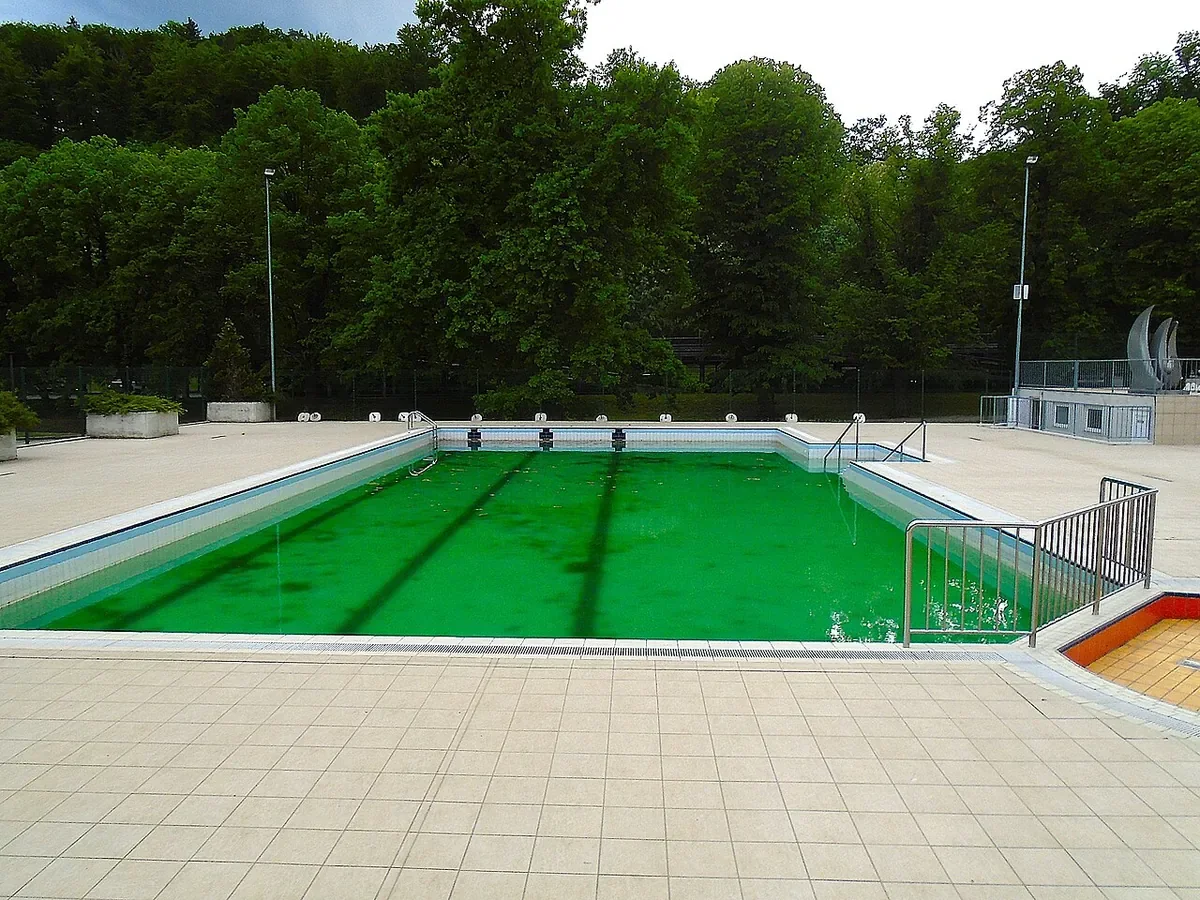
Photo: Silverije, Wikimedia Commons, CC0
Quick Answer
How to clean a green pool: (1) remove leaves and debris with a leaf rake; (2) test the water and bring pH to about 7.2 to 7.4 and alkalinity into range so chlorine works well; (3) shock heavily, often 2 to 4 times a normal dose depending on how green the pool is, adding it at dusk; (4) brush every wall, step and the floor; (5) run the filter 24 hours a day and clean or backwash it whenever pressure rises; (6) keep chlorine high and repeat shock and brushing daily until the water turns blue, then cloudy-clear; (7) vacuum dead algae, preferably to waste. Most green pools clear in 2 to 7 days. A pool that stays green after shock usually has too little chlorine for its stabilizer level, poor filtration, or high phosphates. A professional green-to-clean service usually costs about $200 to $800 or more.
A green pool is an algae bloom. Algae spores enter every pool with wind, rain and swimmers. When chlorine drops too low, or circulation and filtration fall behind, algae multiply fast, especially in warm, sunny weather. A pool can go from slightly hazy to green in a day or two. The good news is that almost every green pool can be cleared without draining, using chlorine, brushing and filtration.
This guide explains how to clean a green pool step by step, why pools turn green, how much shock a green pool needs, what to do if the pool is still green after shock, how long it takes, when it is safe to swim, and how to keep the pool from turning green again. For the weekly routine once it is clear, see how to clean a pool.
Why Is My Pool Green?
- Low chlorine. The most common cause. Heat, sun, rain, heavy use and missed doses drop chlorine below the level needed to stop algae.
- High pH. Above about 7.8, chlorine becomes much less effective, even if the test shows some chlorine.
- Too much stabilizer (cyanuric acid). High CYA protects chlorine from the sun but also slows it down, so a pool can turn green with "normal" chlorine readings.
- Poor circulation and filtration. A pump that runs too few hours, a dirty filter or a broken part lets algae grow in dead spots.
- Phosphates and nitrates from fertilizer, leaves and rain feed algae.
- Storms and debris. Heavy rain dilutes chemicals and washes in nutrients.
- Metals. Copper in the water can tint water green-blue without algae; this needs a different fix.
If your pool keeps turning green, the cause is usually one of the first three. Test for chlorine, pH and cyanuric acid before treating.
Is It Safe to Swim in a Green Pool?
No. Green water means chlorine is too low to control germs as well as algae, and cloudy water makes it hard to see swimmers on the bottom, which is a drowning risk. The CDC advises that pool water should be clear enough to see the main drain. Keep everyone out until the water is clear, chlorine is in the normal range, and pH is balanced.
What You Need
- Test kit or test strips for chlorine, pH, alkalinity and cyanuric acid.
- Pool shock: liquid chlorine (sodium hypochlorite) or granular calcium hypochlorite; liquid chlorine adds no calcium or stabilizer.
- pH reducer (muriatic acid or dry acid) and alkalinity increaser (baking soda) as needed.
- A stiff pool brush and a leaf rake.
- Vacuum head and hose, or a robotic cleaner.
- Optional: algaecide, clarifier or flocculant, phosphate remover.
- Gloves and eye protection.
How to Clean a Green Pool Step by Step
Step 1: Remove debris
Use a leaf rake to pull out leaves, twigs and debris. Decaying debris uses up chlorine and feeds algae, so clearing it first makes every dose of shock work harder. Empty the skimmer and pump baskets.
Step 2: Get the filter running
Clean or backwash the filter so it starts fresh, check that the pump primes and runs, and set it to run 24 hours a day until the pool is clear. If the filter is broken or the pump does not run, fix that first; chemicals alone will not clear a green pool.
Step 3: Test and balance the water
Lower pH to about 7.2 to 7.4, where chlorine works best, and keep alkalinity around 80 to 120 ppm. Check cyanuric acid; if it is very high (often above 80 to 100 ppm), chlorine will be weak, and a partial drain may be needed. See how to lower pH in a pool and how to reduce cyanuric acid in a pool.
Step 4: Shock the pool
Shock at dusk so the sun does not burn off chlorine. The green-pool shock dose is much larger than weekly shock. As a rough guide, many pool professionals use about twice the normal shock for light green, three times for dark green and four times or more for a swamp-green pool. Pre-dissolve granular shock in a bucket of pool water for vinyl pools, and pour shock in front of a return with the pump running.
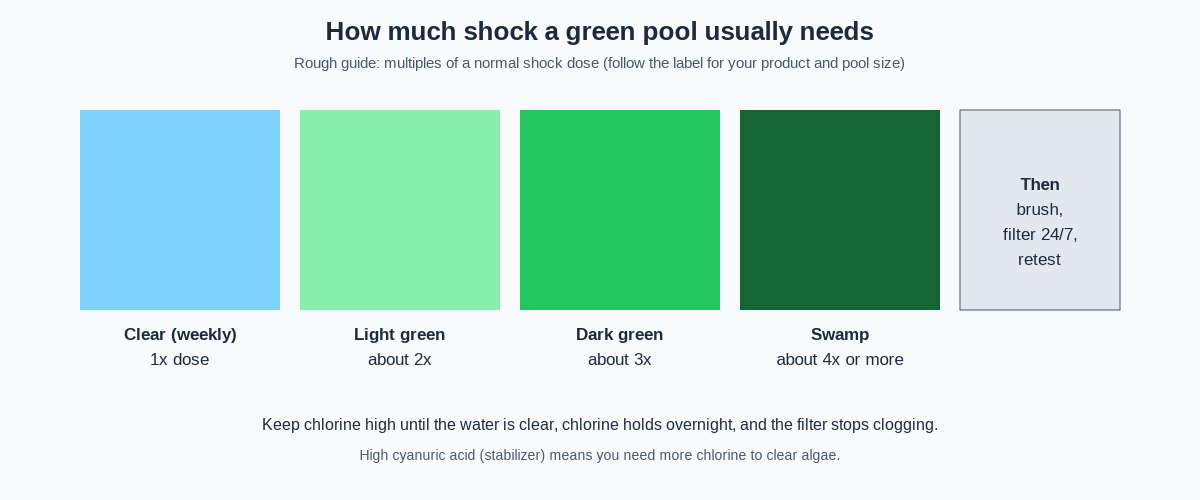
Chart: Asphapro.com
A more precise method many pool owners use is to raise free chlorine to a target level based on the pool's cyanuric acid and hold it there until the algae is gone, testing several times a day. Whatever method you use, the key is keeping chlorine high enough, long enough. See how much chlorine to add to a pool and when to shock a pool.
Step 5: Brush everything
Brush the walls, floor, steps, corners and behind ladders right after shocking, and at least once a day after. Brushing breaks up algae colonies and exposes them to chlorine. Pay special attention to shady areas and spots with poor circulation.
Step 6: Filter around the clock
Keep the pump running 24 hours a day. As algae die, they turn gray or white and clog the filter. Backwash sand and DE filters or rinse cartridges whenever pressure rises 8 to 10 psi above clean. A clogged filter is the most common reason a green pool stays cloudy for days.
Step 7: Test and re-shock
Test chlorine the next morning. If it has dropped a lot overnight, the algae is still using it up; add more shock and keep brushing. Repeat daily until the water is clear and chlorine holds overnight with little loss.
Step 8: Vacuum the dead algae
When the water turns blue-gray and debris settles on the floor, vacuum it. With sand or DE filters, vacuum to WASTE so dead algae leaves the pool instead of clogging the filter. With a cartridge filter, rinse the cartridge often. See how to vacuum a pool.
Step 9: Clear the cloudiness
After the algae dies, the water often goes through a cloudy blue stage. Keep filtering and cleaning the filter. A clarifier helps the filter catch fine particles; a flocculant clumps them so they sink and can be vacuumed to waste. See how to clear a cloudy pool.
Step 10: Rebalance and maintain
When the water is clear and chlorine holds, rebalance pH, alkalinity and calcium, and return to normal chlorine levels and pump hours.
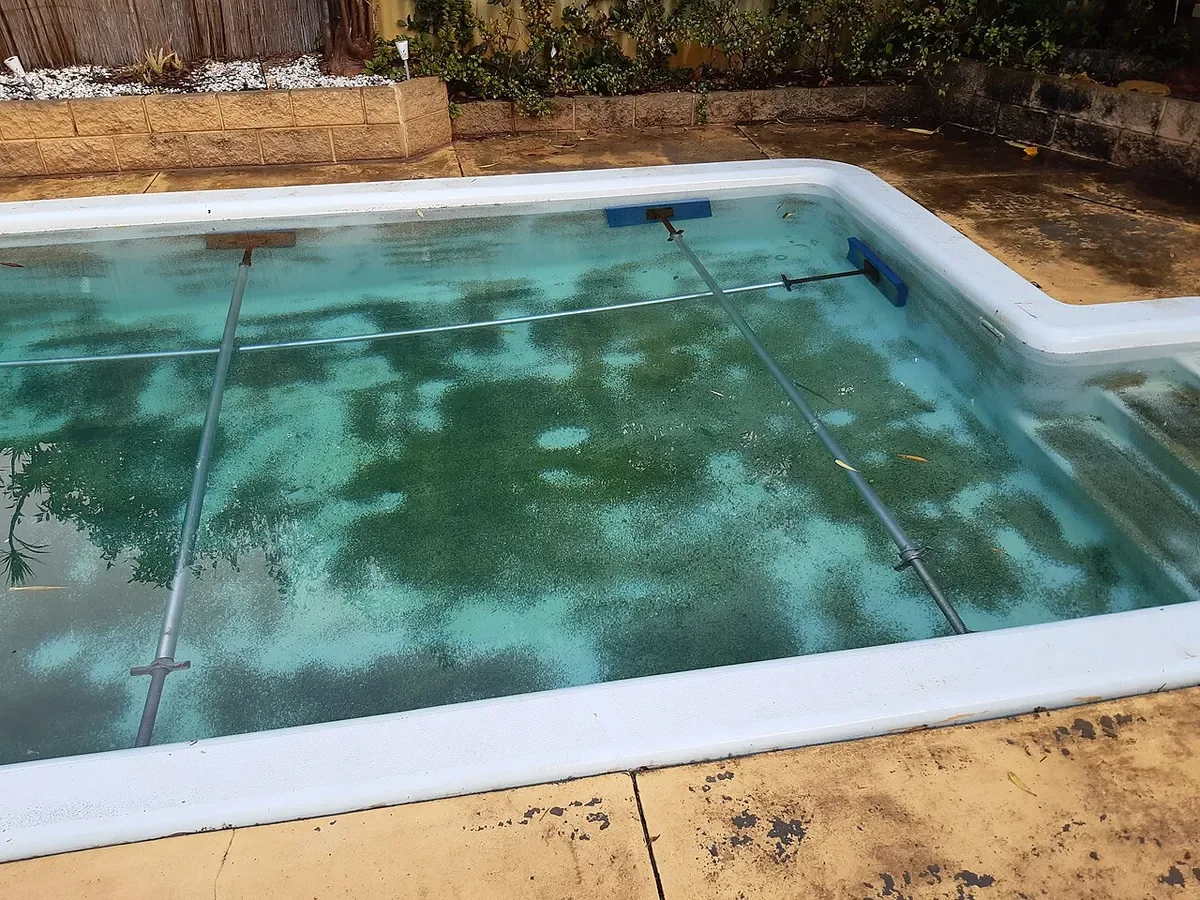
Photo: Calistemon, Wikimedia Commons, CC BY-SA 4.0
How Long Does It Take to Clear a Green Pool?
| How green | Typical time to clear |
|---|---|
| Slight green tint, walls slick | 1 – 2 days |
| Clearly green, can see the floor | 2 – 4 days |
| Dark green, cannot see the floor | 4 – 7 days |
| Swamp (neglected for months) | 1 – 2 weeks |
Can you clear a green pool overnight? A lightly green pool sometimes clears in one night with a strong shock, good filtration and brushing, but most green pools take several days. Flocculants can drop debris overnight, but they do not kill algae; you still need chlorine.
Pool Still Green After Shock?
- Not enough chlorine. The most common reason. Add more and keep levels up longer.
- High cyanuric acid. Chlorine is held back by stabilizer; you need much more chlorine, or a partial drain.
- High pH. Lower it to about 7.2 to 7.4 so chlorine works.
- Dirty or undersized filter. Clean it often; consider a clarifier.
- Pump not running long enough. Run it 24 hours a day until clear.
- Phosphates. Very high phosphates feed algae; a phosphate remover can help after the algae is killed.
- Metals. If the water is green but clear and walls are not slimy, test for copper; a metal sequestrant is the fix.
My Pool Is Green: What Do I Do First?
If you have just discovered your pool is green, start with three quick checks before buying chemicals:
- Is the pump running and the filter clean? If not, fix that first; green pool water will not clear without circulation.
- What are the chlorine, pH and stabilizer levels? A pool store can test them free or for a small fee if you do not have a kit.
- Is it algae or metal? Algae makes walls slimy and water cloudy green. Clear green water with smooth walls, especially right after shocking, may be copper or iron.
Once you know the cause, follow the steps above. Most owners asking "my pool is green, what do I do?" need a strong shock, brushing and 24-hour filtering.
What Shock Is Best for a Green Pool?
- Liquid chlorine (sodium hypochlorite): fast-acting, adds no calcium or stabilizer, easy to dose in large amounts. A common choice for green pools.
- Calcium hypochlorite (cal-hypo) shock: strong and widely available, but adds calcium and must be pre-dissolved for vinyl pools.
- Dichlor shock: adds cyanuric acid with every dose, which can make algae harder to kill if used repeatedly.
- Non-chlorine shock (potassium monopersulfate): oxidizes contaminants but does not kill algae well; not the right pool shock for a green pool.
For most green swimming pools, liquid chlorine or cal-hypo is the best choice. How much shock for a green pool depends on volume, how green it is and your stabilizer level; read the product label and see the chart above.
Green Pool Water: Algae, Metals or Pollen?
Algae is by far the most common cause of green pool water. The water is cloudy, walls feel slimy, and chlorine disappears quickly.
Metals such as copper (from old heaters, ionizers or some algaecides) can turn water clear green and stain surfaces, especially after shocking raises oxidation. The fix is a metal sequestrant and finding the source, not more chlorine.
Pollen can form a yellow-green film on the surface in spring. It skims off and does not cling to walls like algae. Skimming, filtering and a little extra chlorine handle it.
How to Clear a Green Pool Overnight
Clearing a green pool overnight is possible only when the pool is lightly green and everything is working well. To try it: balance pH, add a heavy shock at dusk, brush thoroughly, run the filter all night, and check in the morning. If the water has turned blue and cloudy, keep filtering and cleaning the filter. A darker green pool will not clear overnight; it needs several days of high chlorine. A flocculant can drop debris overnight so it can be vacuumed to waste, but it should be used after the algae has been killed.
Green Algae in a Pool After Rain or Heat Waves
Heavy rain dilutes chlorine and washes in nutrients and dirt, while heat waves increase chlorine demand and algae growth. Both can turn a clean pool green within a day or two. After storms or several very hot days, test the water and shock if chlorine is low. Brushing and running the pump longer during heat waves helps prevent green algae in a pool from getting started.
Green Pool at Opening
Pools often open green in spring, especially with mesh covers that let in sunlight and debris. Remove the cover carefully to keep debris out, fill to the normal level, start the equipment, balance pH and shock heavily. Expect several days of shocking, brushing and filter cleaning. Closing the pool with proper chemicals and a solid or well-fitted cover reduces how green it is at opening; see how to winterize a pool.
What It Costs to Fix a Green Pool Yourself
For a typical 15,000 to 20,000 gallon pool, clearing a green pool yourself often costs about $50 to $250 in chemicals: several gallons of liquid chlorine or bags of shock, pH adjuster, perhaps clarifier and a phosphate remover. Add the cost of water if you vacuum to waste, and of a new cartridge if the old one clogs badly. That is usually far cheaper than a professional green-to-clean service, but it takes your time every day for several days.
Swimming Pool Repairs That Cause Green Water
Sometimes a pool turns green because something is broken. A failed pump motor, a cracked filter part, a clogged impeller, a leak that pulls air into the system, or a broken salt cell can all lead to green water. If a pool turns green repeatedly despite good chemistry, check the equipment; these swimming pool repairs are often the real fix. See how to prime a pool pump and pool leak repair cost.
A Day-by-Day Green Pool Plan
| Day | What to do |
|---|---|
| Day 1 | Remove debris, clean the filter, balance pH, shock heavily at dusk, brush everything, run the pump 24 hours. |
| Day 2 | Test chlorine in the morning; add more shock if it dropped. Brush again. Clean the filter if pressure rose. |
| Day 3 | Water should be blue-green to blue and cloudy. Keep chlorine high, brush, clean the filter. |
| Day 4 | Vacuum settled dead algae to waste. Add clarifier if still cloudy. |
| Days 5 – 7 | Keep filtering until clear. When chlorine holds overnight, rebalance and return to normal care. |
Darker green pools follow the same plan but may take longer at each stage, and very neglected pools may need two or three full rounds of heavy shock before the water turns blue. The key signs of progress are the color shifting from green to blue-gray, chlorine lasting longer overnight, and the filter clogging less.
How to Remove Green Algae From Pool Surfaces
Even after the water clears, green algae can cling to walls, steps, lights and corners. To remove green algae from pool surfaces, brush daily with a stiff brush, spot treat stubborn areas by sprinkling granular chlorine (on plaster only) or placing a chlorine tablet in a sock against the spot, and check hidden areas such as behind ladders, in skimmer throats and around return fittings. Clean or replace the filter media if algae keeps returning, because algae spores can survive in a dirty filter.
Common Mistakes When Fixing a Green Pool
- Adding too little shock and stopping too soon.
- Shocking in bright midday sun instead of at dusk.
- Not lowering high pH before shocking.
- Skipping brushing.
- Running the pump only a few hours a day.
- Ignoring a dirty or broken filter.
- Relying on algaecide or flocculant instead of chlorine.
- Using stabilized chlorine tablets repeatedly, which raises cyanuric acid.
Green Pools by Type of Pool
Above ground pools. Use liquid chlorine or pre-dissolved shock to avoid bleaching the liner. Smaller filters clog faster, so clean them often.
Vinyl inground pools. Avoid pouring granular shock directly on the liner; it can bleach or weaken vinyl.
Plaster and pebble pools. Brush hard with a stainless brush to reach algae in the rough surface.
Saltwater pools. The salt cell cannot make chlorine fast enough to clear a green pool. Add liquid chlorine to shock, then let the cell maintain levels afterward. See how to maintain a saltwater pool.
Safety When Shocking a Green Pool
Fixing a green pool means handling large amounts of chlorine and acid, so safety matters. Wear gloves and eye protection. Add chemicals to water, never water to chemicals, and never mix different chemicals in the same bucket, because some combinations release dangerous gases or can even ignite. Store chlorine and acid apart, in a cool, ventilated place out of reach of children and pets. Add shock in front of a return with the pump running so it spreads quickly, and keep swimmers out until chlorine returns to the normal range. Rinse any splashes off skin right away and follow every label. If a large amount of chemical is spilled, read the label for cleanup guidance and keep people and pets away from the area.
Keep a record of how much shock you added and when. It helps you avoid overdosing, shows how fast chlorine is being used up, and makes it easier to judge when the algae is finally under control.
Green to Clean Pool Service
If you do not have the time or the pool is badly neglected, a pool company can do a green-to-clean service: heavy shock, brushing, filter cleaning, vacuuming and follow-up visits. Costs often run about $200 to $800 or more depending on how green the pool is and how many visits it takes. Some companies drain and acid wash very neglected plaster pools instead, which costs more. See cost to maintain a pool.
Should You Drain a Green Pool?
Usually not. Draining wastes water and can damage the pool, and refilling brings in fresh water that still needs balancing. Draining makes sense only when cyanuric acid or dissolved solids are extremely high, when the pool is full of mud or sewage after a flood, or when a plaster pool needs an acid wash. See how to drain a pool.
How to Keep a Pool From Turning Green
- Keep free chlorine in range every day, and test at least two or three times a week.
- Keep pH between 7.2 and 7.8.
- Keep cyanuric acid at a moderate level; do not let it build up from tablets.
- Run the pump long enough to turn the water over daily.
- Clean the filter when pressure rises.
- Brush weekly, especially corners and steps.
- Shock after storms, heat waves and parties.
- Use a cover and keep debris out.
For more on algae, see how to get rid of algae in a pool.
How to Clean a Green Pool: Key Points
- A green pool is almost always algae caused by low chlorine, high pH, high stabilizer or poor filtration.
- Balance pH, shock heavily at dusk, brush everything and filter 24 hours a day.
- Keep chlorine high until the water is clear and chlorine holds overnight.
- Vacuum dead algae to waste and clean the filter often.
- Most green pools clear in 2 to 7 days without draining.
Frequently Asked Questions
How do you fix a green pool fast?
Balance pH, shock heavily at dusk, brush everything, run the filter 24 hours a day, clean the filter often, and repeat shock until the water clears.
How much shock does a green pool need?
Often 2 to 4 times a normal dose depending on how green it is, or enough chlorine to reach a high target level for your cyanuric acid, held until the algae is gone.
Why is my pool green after I shocked it?
Usually not enough chlorine for the algae load or stabilizer level, high pH, or a filter that needs cleaning.
Can I swim in a green pool?
No. Wait until the water is clear, you can see the main drain, and chlorine and pH are back in the normal range.
Does algaecide clear a green pool?
Algaecide helps prevent algae and can support treatment, but chlorine, brushing and filtration do the main work. Use it after the pool is clear as a preventive dose, following the label.
How do I fix a green swimming pool without draining it?
Use the shock, brush and filter method: balance pH, shock to a high chlorine level, brush daily, run the filter 24 hours and keep chlorine high until the water is clear. Draining is rarely needed.
Is my pool green after shock because of metals?
If the water turns clear green right after shocking and walls are not slimy, metals such as copper may be the cause. Use a metal sequestrant and test for copper and iron.
How much does it cost to fix a green pool?
Doing it yourself usually costs about $50 to $250 in chemicals; a professional green-to-clean service often costs $200 to $800 or more.
What does green pool water mean?
Usually an algae bloom from low or ineffective chlorine. It means the water is not properly sanitized and should not be used until it is cleared. Less often, green water comes from metals or heavy pollen, which need different treatments.
Why does my pool keep turning green?
Common causes are chlorine dropping too low, high pH, high stabilizer, short pump run times, a dirty filter or high phosphates.
Sources
- CDC: Healthy Swimming
- CDC: Chlorine, pH and water clarity guidance
- Pool & Hot Tub Alliance: water chemistry resources
- HomeGuide: Pool cleaning service prices