
Vinyl Inground Pool Cost: Full Price Guide for Vinyl Liner Pools
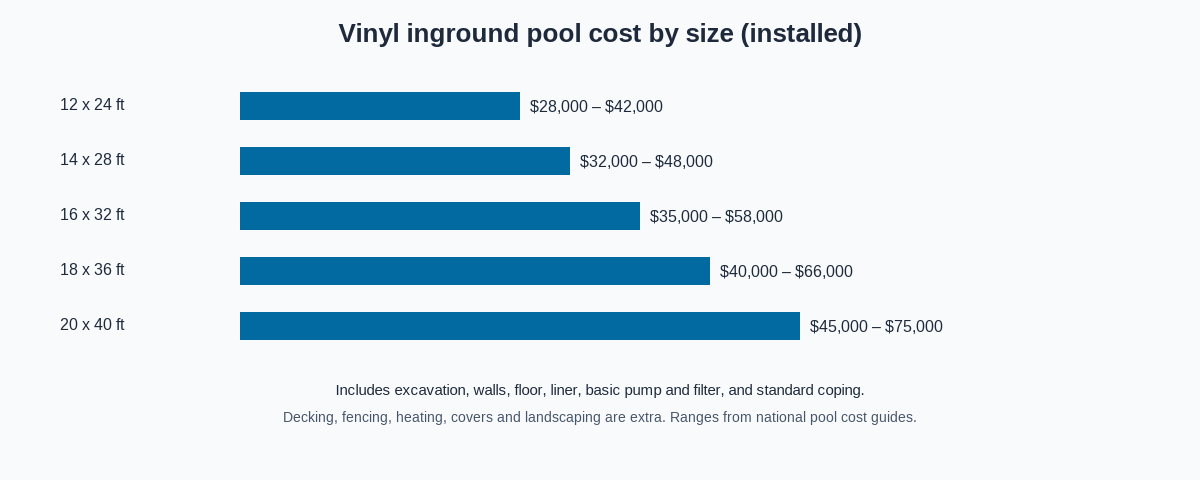
Chart: Asphapro.com
Quick Answer
The typical vinyl inground pool cost is about $35,000 to $65,000 installed for a complete project with basic equipment, coping and a concrete deck. By size, a 12 x 24 foot vinyl pool runs about $28,000 to $42,000, a 16 x 32 about $35,000 to $58,000, and a 20 x 40 about $45,000 to $75,000. Heating, covers, fencing, lighting and landscaping add more. A DIY vinyl pool kit costs $8,000 to $18,000 plus excavation, concrete and equipment. Plan on a new liner every 6 to 12 years at $4,000 to $8,000, and yearly upkeep of about $1,000 to $3,000. Vinyl is usually the lowest-cost inground pool to build.
A vinyl inground pool, also called a vinyl liner pool, is the most affordable way to get a full-size inground pool. It is built on site from wall panels, a shaped floor and a custom vinyl liner, so it can be almost any size or shape. Vinyl inground swimming pools are popular across North America, especially in the Northeast and Midwest, where they handle freezing winters well when properly closed.
This guide breaks down vinyl inground pool cost by size, explains what is included, shows where the money goes, and covers long-term costs such as liner replacement. For a comparison with other types, see our guide on fiberglass vs vinyl pool choices.
What Is Included in Vinyl Inground Pool Cost?
Most quotes for an inground vinyl pool include the pool kit (wall panels, bracing, the vinyl liner, steps and fittings), excavation, installation labor, a basic pump and filter, plumbing, a skimmer and returns, and standard coping. Many also include a small concrete apron around the pool. Items often priced separately include a larger deck, a fence, a heater, a cover, lights, automation, a salt system, landscaping, electrical runs from the house, permits and soil or rock surprises. When comparing quotes, line them up item by item so you know what each includes.
Vinyl Inground Pool Cost Breakdown
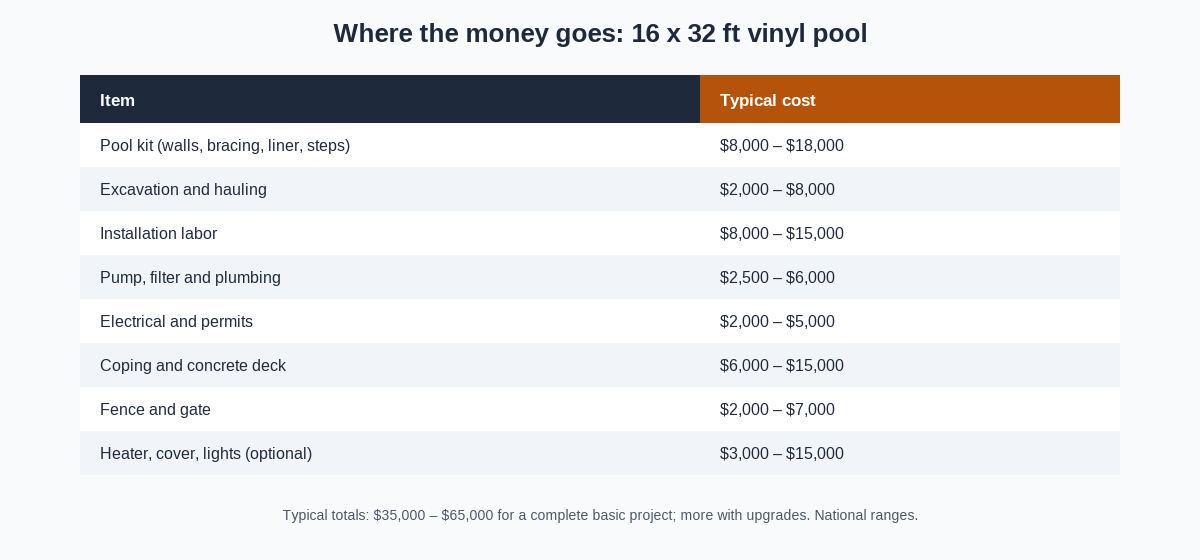
Chart: Asphapro.com
For a typical 16 x 32 foot pool, the pool kit with walls, liner and steps costs about $8,000 to $18,000, depending on wall material and features. Excavation and hauling add $2,000 to $8,000. Installation labor runs $8,000 to $15,000. The pump, filter and plumbing add $2,500 to $6,000, and electrical work and permits $2,000 to $5,000. Coping and a concrete deck can cost $6,000 to $15,000, and a code-compliant fence $2,000 to $7,000. Optional heaters, covers and lights add $3,000 to $15,000 or more. Together, a complete, basic vinyl pool project often lands around $35,000 to $65,000.
Vinyl Inground Pool Cost by Size
Size is a major driver of vinyl inground pool cost, but price does not rise in a straight line, since many costs, such as equipment, permits and electrical, are similar for small and large pools. A 12 x 24 foot pool costs about $28,000 to $42,000; 14 x 28 about $32,000 to $48,000; 16 x 32 about $35,000 to $58,000; 18 x 36 about $40,000 to $66,000; and 20 x 40 about $45,000 to $75,000. Deep diving ends, freeform shapes and built-in features add to each range.
Photo: Infrogmation, Wikimedia Commons, CC BY-SA 4.0
Vinyl Inground Pool Cost: Steel vs Polymer Walls
Vinyl inground pools use wall panels to hold back the soil. Galvanized steel walls are the traditional choice. They are strong and usually the lowest cost, but over many years they can rust if water gets behind the liner or the soil stays wet. Polymer (composite or thermoplastic) walls cost more, often $1,000 to $4,000 extra for an average pool, but they cannot rust and resist corrosion from salt and soil. Many builders now recommend polymer walls, especially for salt water pools and wet or coastal sites. A few builders pour concrete walls for vinyl pools, which is the strongest option but adds cost and time. Wall choice is one of the main differences between budget and premium vinyl inground swimming pools.
Inground Vinyl Pool Liner Thickness and Pattern
The liner is the part you see and touch, so its quality matters. Standard liners are 20 mil thick; upgraded liners are 27 to 30 mil. Thicker liners resist punctures and wear better, but cost more, often $500 to $1,500 extra for an average pool, and they are harder to install in cool weather. Liner patterns range from plain blue to tile-look borders, stone prints and full-floor designs. Patterned and premium liners cost a little more than basic ones. Ask about the liner warranty, which is usually prorated and covers seam defects rather than fading or damage.
Vinyl Inground Pool Shapes, Depths and Steps
Rectangles are the simplest and least expensive shape for inground vinyl pool builds. L-shapes, Roman ends, kidney and freeform shapes need more wall panels, custom liners and more labor, adding about 10% to 25%. Depth also matters: a simple sport pool with a 3.5 to 5 foot floor is cheaper than a pool with an 8-foot deep end, which needs more digging, a larger liner and often a hopper floor. Steps come in two styles: white thermoplastic step units that bolt to the walls, and steps covered by the liner. Thermoplastic steps are durable and easy to see; liner-covered steps blend in and can be any shape. Benches, sun shelves and swim-outs add to the cost but make the pool more useful.
Photo: Infrogmation, Wikimedia Commons, CC BY-SA 4.0
Equipment Choices for a Vinyl Inground Pool
Basic vinyl pool packages include a single-speed or two-speed pump and a sand or cartridge filter. Upgrading to a variable-speed pump costs about $800 to $1,500 more but can save hundreds of dollars a year in electricity, and many states now require variable-speed pumps for new pools. A larger cartridge filter reduces cleaning. A heater adds $2,500 to $6,000 for gas or heat pump models. A salt system adds $1,500 to $2,500. LED lights add $500 to $1,500 each. Automation, which lets you control equipment from a phone, adds $1,500 to $4,000. These choices can move a vinyl inground pool cost by $5,000 to $15,000.
DIY Vinyl Inground Pool Kits
Some homeowners buy a vinyl inground pool kit and install it themselves, or act as their own general contractor. Kits include wall panels, bracing, the liner, coping track, steps and sometimes the pump, filter and plumbing. They cost about $8,000 to $18,000 for a typical size. On top of the kit, you need excavation, a concrete collar around the base of the walls, floor material, electrical work by a licensed electrician, the deck, the fence and permits. A DIY build can save $10,000 to $20,000, but it is a big job that takes skill, help and time, and mistakes in leveling or floor shaping can cause wrinkles and leaks. Many owners hire a pro for excavation and liner installation even if they do the rest.
Long-Term Cost of a Vinyl Inground Pool
The upfront price is only part of the story. The biggest long-term cost of a vinyl pool is liner replacement, every 6 to 12 years, at about $4,000 to $8,000 each time, including labor and water. Over 20 years, you may replace the liner twice. Pumps last 8 to 12 years and cost $800 to $2,000 to replace; filters last 10 to 15 years. Yearly upkeep, including chemicals, electricity, water and opening and closing, is about $1,000 to $3,000 for most vinyl pools. Over 20 years, a vinyl pool's total cost of ownership is often similar to a fiberglass pool's, even though it starts cheaper. See our guides to pool liner replacement cost and the cost to maintain a pool.
Vinyl vs Fiberglass vs Concrete Pool Costs
Among inground pool types, vinyl swimming pools in ground are usually the cheapest to build. Fiberglass pools cost about $45,000 to $85,000 installed and need less upkeep. Concrete pools, built of gunite or shotcrete, cost about $55,000 to $120,000 or more, take the longest to build, and need resurfacing every 10 to 15 years. Each type has strengths: vinyl for size and shape at a lower price, fiberglass for speed and low maintenance, and concrete for full custom design and durability. For concrete details, see our guide to the concrete pool.
What Affects Vinyl Inground Pool Cost the Most
Location changes prices a lot: labor and permit costs are higher in big cities and coastal areas. Site conditions matter too, since rock, clay, groundwater, slopes and tight access add excavation and installation costs; see our guide to pool excavation cost. Pool size, shape and depth set the size of the kit and liner. Wall type, liner thickness and equipment quality add or subtract thousands. Finally, the deck and fence can cost as much as a third of the project, so their size and material choices matter.
Ways to Save on a Vinyl Inground Pool
Choose a simple rectangle in a standard size, which uses stock wall panels and liners. Keep the depth modest unless you need a diving end. Build the deck in broom-finish concrete rather than pavers or stone, and add upgrades later. Pick a quality variable-speed pump to save on electricity over time. Get at least three quotes, and ask builders about off-season discounts, since fall and winter bookings can be cheaper. Consider doing some work yourself, such as landscaping or painting the fence, while leaving the technical work to pros.
Vinyl Inground Pool Cost: Worked Example
A family in Ohio plans a 16 x 32 foot rectangular vinyl pool with polymer walls, a 4 to 6 foot depth, a 27-mil patterned liner, a variable-speed pump, a cartridge filter and a heat pump. The builder quotes $42,000 for the pool, equipment and standard coping. A 600-square-foot concrete deck adds $9,000, a 4-foot aluminum fence $5,000, and permits and electrical $3,500. An automatic safety cover would add $14,000, so they choose a solid safety cover for $2,800 instead. The total is about $62,300. They budget $1,800 a year for upkeep and $6,000 for a liner in about 10 years.
How Long It Takes to Build a Vinyl Inground Pool
Once permits are approved, most vinyl inground pools take about two to four weeks to build. Excavation takes one or two days. Setting and bracing the walls, installing plumbing and pouring the concrete collar around the base of the walls take several more days. The floor is shaped and smoothed, then the liner is measured, ordered and installed, which can mean a wait of one to two weeks for a custom liner. Filling the pool takes a day or two. The deck, fence and landscaping follow. Weather, inspections and site problems can add time. Compared with concrete pools, which often take two to three months, vinyl pools inground are much faster to complete.
Regional Price Differences
Vinyl inground pool cost varies by region. In the Northeast and Midwest, where vinyl pools are the most common type, there are many experienced builders and prices are often competitive, though short building seasons can push prices up in spring. In the South and West, concrete and fiberglass pools are more common, and fewer builders specialize in vinyl, which can affect pricing either way. Urban areas with high labor costs and strict permit rules usually cost more than rural areas. Ask local builders how many vinyl pools they install each year; experience matters more than a low price.
Warranties on Vinyl Inground Swimming Pools
Wall panels for vinyl inground swimming pools often come with long warranties, sometimes 25 years or lifetime for the original owner, especially for polymer walls. Liners usually carry prorated warranties covering seams and manufacturing defects, often 20 to 30 years on paper, but coverage drops sharply after the first few years and does not cover punctures, fading or chemical damage. Equipment has its own warranties, usually 1 to 3 years for pumps and heaters. Builders may warranty their workmanship for one to several years. Get all warranties in writing and keep them with your pool records.
Financing a Vinyl Pool
Because vinyl is the lowest-cost inground option, it is often easier to finance. Many buyers use pool loans, home equity loans or HELOCs. For a $50,000 project at 9% over 10 years, the monthly payment is about $633. Budget for the liner replacement in your long-term plan, since it is a big expense that usually comes after the loan is paid off. For options and a payment calculator, see our guide on how to finance a pool.
Semi-Inground Vinyl Pools
Semi-inground pools sit partly below ground, usually with 2 to 4 feet of wall buried and the rest above ground, surrounded by a deck. They use vinyl liners and strong wall systems, and they cost much less than a full vinyl inground pool, often $12,000 to $35,000 installed with a deck. They suit sloped yards and tight budgets. See our guide to the cost of semi-inground pool options.
Caring for a Vinyl Inground Pool
Good care makes the liner last longer and keeps long-term costs down. Keep water chemistry balanced, with pH around 7.4 to 7.6 and steady chlorine, since low pH and very high chlorine fade and weaken vinyl. Do not let the water level drop much below the skimmer, which can pull the liner away from the wall. Use soft brushes and liner-safe cleaners. Keep sharp toys, pets' claws and pool tools away from the liner. Close the pool properly in winter with the water at the right level and a tight cover. Fix small leaks quickly with a patch kit before they cause bigger problems.
Questions to Ask Vinyl Pool Builders
Ask each builder what wall material they use and why, what liner thickness and warranty are included, how they build and finish the floor, and what pump, filter and options are in the base price. Ask how they handle rock, water and hauling, who pulls permits, and what the timeline is. Ask how much a replacement liner will cost later and whether they offer liner replacement service. Ask to see finished pools that are several years old, so you can judge how their liners and floors hold up over time, and ask past customers whether the final price matched the quote.
Hidden Costs in a Vinyl Inground Pool Project
Several costs often surprise owners after they sign. Rock or groundwater during excavation can add thousands. Long electrical runs from the house to the equipment pad, or a panel upgrade, can add $1,000 to $5,000. Many towns require a survey, engineered drawings or a drainage plan. Hauling dirt away, repairing lawns and driveways after heavy trucks, and moving sprinklers are often extra. Required barriers, such as a fence and alarms on doors leading to the pool, add more. Water to fill the pool may cost $100 to $500, or more if trucked. Finally, the first season's chemicals, a cover, cleaning tools and a robot cleaner can add $1,000 to $3,000. Asking about each item up front keeps your vinyl inground pool cost close to the budget.
Vinyl Inground Pool Cost Over 20 Years
Here is a simple 20-year view for a 16 x 32 foot vinyl inground pool. The initial project costs about $55,000 including a deck and fence. Two liner replacements at about $6,000 each add $12,000. One pump replacement adds $1,500 and one filter $1,200. Yearly upkeep of about $1,800 adds $36,000 over 20 years. The total is roughly $106,000, or about $5,300 a year. A fiberglass pool might start $15,000 higher but skip liner replacements and use a little less in chemicals, so the 20-year totals are often close. The right choice depends on your budget now, the size and shape you want, and your plans for the home.
Is a Vinyl Inground Pool Worth It?
For many families, yes. A vinyl inground pool offers the most pool for the money, a soft surface that children and adults like, and almost unlimited choice of size and shape. It handles cold climates well and can be refreshed every decade or so with a new liner and a new look. The trade-offs are the ongoing liner costs and the care needed to avoid punctures and wrinkles. If you want a large pool on a moderate budget, and you are comfortable planning for liner replacements, a vinyl pool is a strong choice. If you want the lowest maintenance and a standard shape fits your yard, compare it with fiberglass before you decide, and price both for the same size and features.
Adding Features Later
One way to manage vinyl inground pool cost is to build the core pool now and add features later. Plan for future upgrades during construction by running extra conduit and plumbing for a heater, lights or a spa, and by leaving space on the equipment pad. Adding these later then costs far less than if new trenches, deck cuts or new wiring runs are needed after the deck is finished. Common later upgrades include a heat pump, an automatic cover, LED lights, a salt system, and a larger deck or patio. Ask your builder to note these plans on the drawings so the pool is ready for them.
Vinyl Inground Pool Cost vs Above Ground Pools
Some owners compare a vinyl inground pool with a large above ground pool. Above ground pools also use vinyl liners and cost far less, about $1,500 to $15,000 installed including a deck. But they last 10 to 20 years, have limited sizes and depths, usually add no home value, and look less finished. A vinyl inground pool costs much more but offers more size and shape options, deeper water, a built-in look and a longer life. For families who will use a pool for many years, the inground vinyl pool often gives more value for the extra cost. For deck ideas on above ground pools, see our above ground swimming pool deck ideas.
Getting an Accurate Quote
To get an accurate vinyl inground pool cost, invite builders to see your yard. Share a rough sketch of where you want the pool, the size and shape you like, and the features you want. Builders will check access, slope, soil and utilities, and point out problems. Ask for an itemized quote that lists the kit, excavation, equipment, deck, fence and allowances for rock or water. Compare quotes on equal terms, and do not choose only on price; experience, warranties and reviews matter just as much.
Vinyl Inground Pool Cost: Key Points
- Most complete vinyl pool projects cost $35,000 to $65,000.
- A 16 x 32 ft vinyl pool runs about $35,000 to $58,000 installed.
- Liners need replacing every 6 to 12 years at $4,000 to $8,000.
- Vinyl is usually the lowest-cost inground pool to build.
Frequently Asked Questions
Is a vinyl inground pool cheaper than fiberglass?
Yes, usually by $10,000 to $20,000 up front. Liner replacements narrow the gap over time, so compare 20-year costs as well as the starting price.
How long does a vinyl inground pool last?
The walls and structure can last 30 years or more with good care. The liner lasts 6 to 12 years, depending on sun, water chemistry and how the pool is used and closed each winter.
What is the cheapest inground vinyl pool?
A small rectangle, such as 12 x 24 feet, with steel walls, a standard liner, basic equipment and a small concrete apron. Expect about $28,000 to $42,000 for this inground vinyl pool, before fencing and extras.
Are vinyl pools inground good in cold climates?
Yes. Vinyl pools are very common in cold regions and handle freezing well when closed properly with the water at the correct level and a good cover. Many builders in the Northeast and Midwest install mostly vinyl pools.
Can I put a salt system in a vinyl inground pool?
Yes. Polymer walls are best for salt water. With steel walls, follow the maker's guidance on salt levels and protection, and keep the liner sealed so salt water does not reach the panels.
Sources
- HomeGuide: Inground pool cost
- HomeGuide: Vinyl pool liner replacement cost
- Pool and Hot Tub Alliance
- ICC: International Swimming Pool and Spa Code