
How Long Does an Above Ground Pool Last? Lifespan by Type and Part
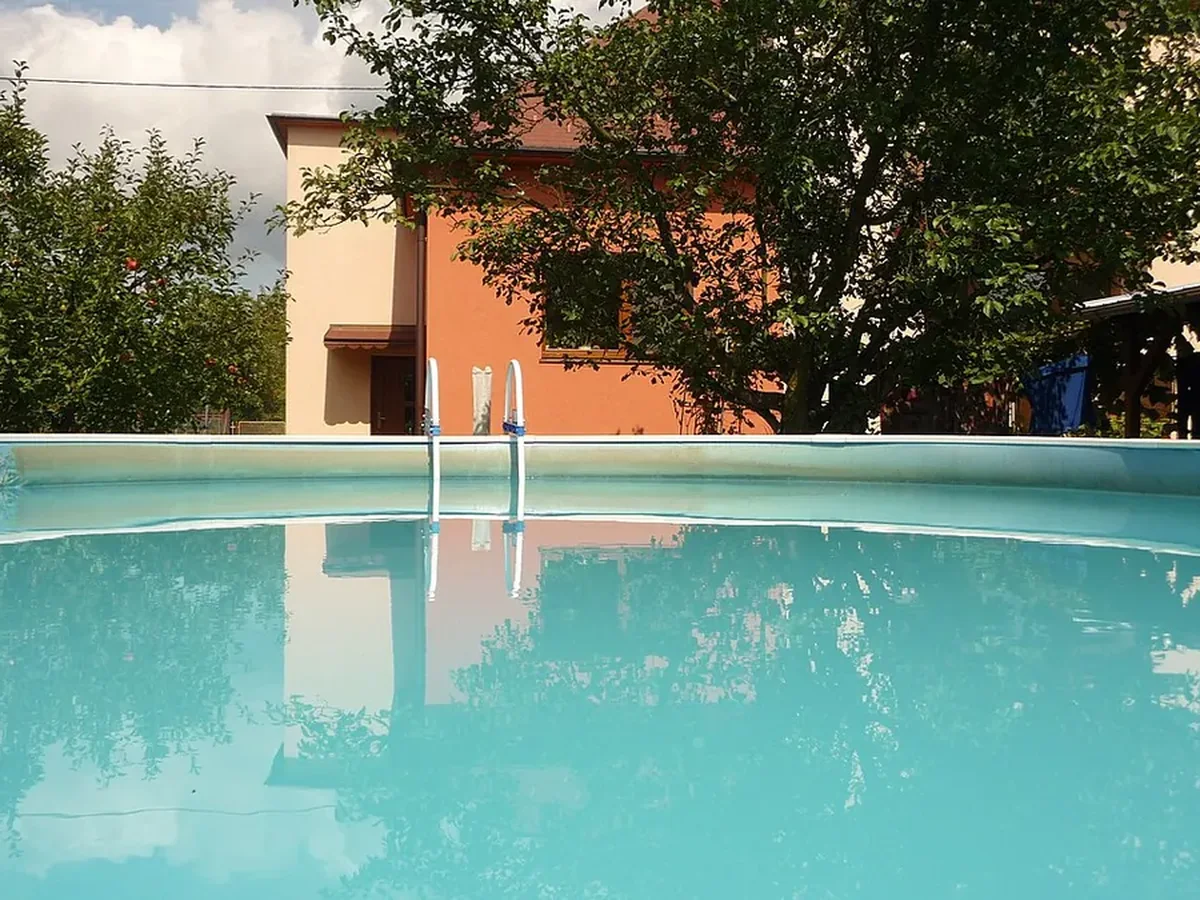
Photo: Sevela.p, Wikimedia Commons, CC BY-SA 3.0
Quick Answer
A hard-sided above ground pool usually lasts 10 to 20 years for a steel wall pool and 15 to 25 years or more for aluminum or resin pools, with good care. Soft-sided metal frame pools last 2 to 5 years, and inflatable pools 1 to 3 seasons. Parts wear out sooner: the vinyl liner lasts 6 to 10 years, the pump 8 to 12 years, a cartridge 1 to 3 years and filter sand 3 to 5 years. Rust at the bottom of the wall, a bulging wall, a rotted base or a collapsing frame mean it is time to replace the pool. Balanced water, a level base, proper winterizing and regular cleaning add years.
An above ground pool is one of the most affordable ways to have a pool at home, but buyers often ask the same question before they spend the money: how long does an above ground pool last? The answer depends mostly on what the pool is made of, how well it was installed and how well it is cared for. A cheap pop-up pool may be done after a summer or two, while a quality resin or aluminum pool on a good base can still be in use twenty years later, after a couple of liner changes.
This guide explains how long an above ground pool lasts by type and by part, what shortens and extends its life, the signs it is wearing out, and when to repair or replace. For the cost of a new pool, see above ground pool installation cost, and for a comparison with inground pools, see in-ground vs above-ground pool.
How Long Does an Above Ground Pool Last by Type?
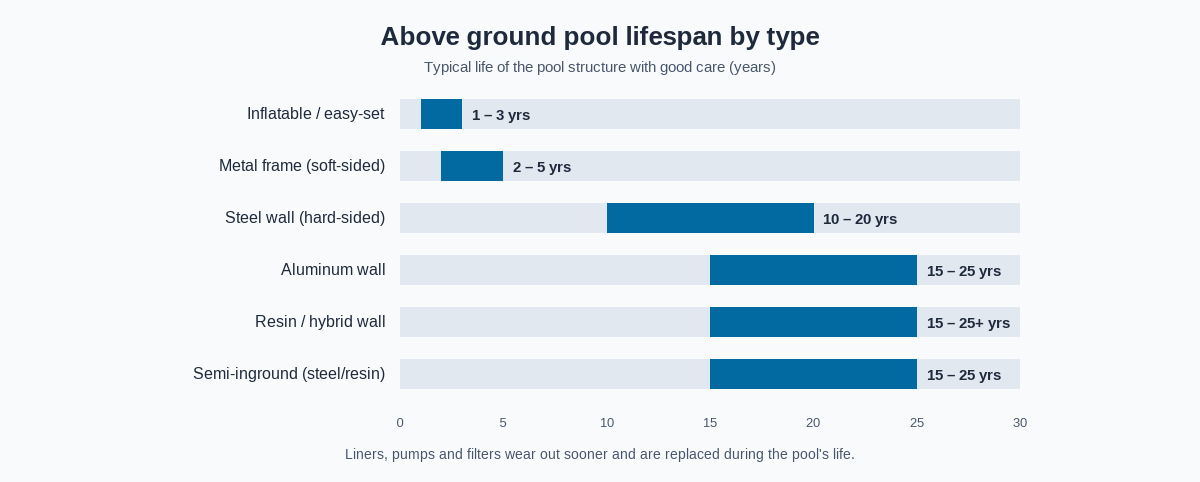
Chart: Asphapro.com
Inflatable and easy-set pools: 1 to 3 seasons. These pools have an inflatable top ring and soft PVC walls. They are cheap and easy to set up, but the vinyl punctures, seams split and UV light makes the material brittle. With careful storage in winter, some last three seasons; many last one or two.
Metal frame (soft-sided) pools: 2 to 5 years. A steel tube frame holds a heavy PVC or laminated liner. Better models with thicker liners and powder-coated frames can last five years or more if they are taken down and stored dry each winter. Leaving them up all year shortens their life, especially in freezing climates.
Steel wall pools: 10 to 20 years. The most common hard-sided above ground pool has a galvanized and coated steel wall, steel or resin top rails and uprights, and a separate vinyl liner. Steel's weak point is rust, especially at the bottom track and wall seams. Good coatings and a dry base help a steel wall pool last 15 years or more.
Aluminum wall pools: 15 to 25 years. Aluminum does not rust like steel, though it can corrode in some conditions. Aluminum pools cost more but usually outlast steel pools.
Resin and hybrid pools: 15 to 25 years or more. Resin top rails, uprights and bottom tracks do not rust or corrode and stay cool in the sun. Hybrid pools combine a steel wall with resin parts, while some premium models use resin walls too. These are often the longest-lasting above ground pools.
Semi-inground pools: 15 to 25 years. Pools rated for partial burial have heavier walls and stronger bracing. Their life depends on the wall material and on proper backfill and drainage, since soil against the wall holds moisture.
How Long Does an Above Ground Pool Last, Part by Part?
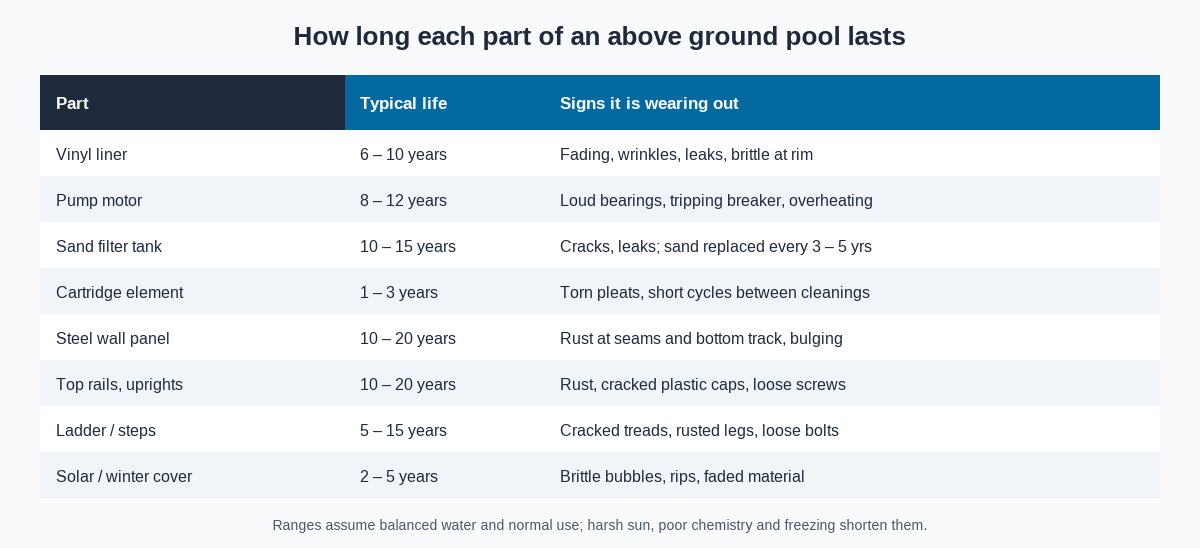
Chart: Asphapro.com
The pool structure is only one part of the answer. Several parts wear out and are replaced during the life of the pool, often more than once.
Vinyl liner: 6 to 10 years. The liner is usually the first major part to fail. Sun, chemicals and freezing make vinyl brittle and faded over time, and small leaks appear. Thicker liners (25 mil and up) and liners with UV and chemical inhibitors last longer. See how long do pool liners last for details and how to install above ground pool liner for replacement steps.
Pump: 8 to 12 years. Above ground pool pumps are often smaller and cheaper than inground pumps, and some budget pumps fail sooner. Shelter from sun and rain and correct winter storage extend pump life. See how long do pool pumps last.
Filter: 10 to 15 years for the tank. Sand filter tanks often last a decade or more, but the sand should be replaced every 3 to 5 years. Cartridge elements last 1 to 3 years. See how long do pool filters last.
Walls and frame: 10 to 25 years. The structure usually outlasts two or three liners. Rust and corrosion are the main enemies.
Ladder, steps and covers: 2 to 15 years. Resin steps last longer than cheap ladders. Solar covers last 2 to 5 years, winter covers 3 to 5.
How Long Does an Above Ground Pool Last? What Shortens Its Life
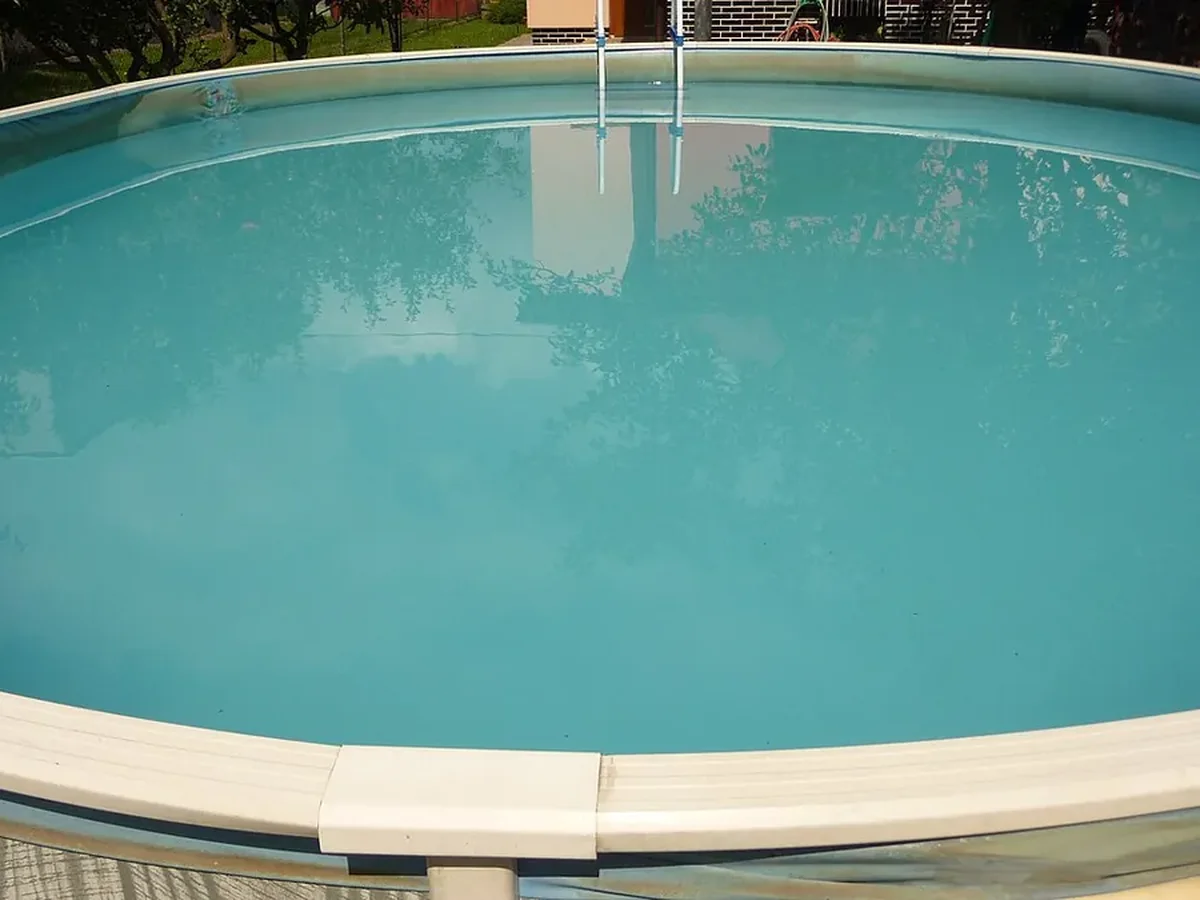
Photo: Sevela.p, Wikimedia Commons, CC BY-SA 3.0
Poor water chemistry. Low pH and low alkalinity make water corrosive. It attacks metal parts, wrinkles and weakens vinyl and can eat through the steel wall where water seeps behind the liner. High chlorine bleaches and weakens vinyl. Keep pH around 7.4 to 7.6, total alkalinity 80 to 120 ppm and free chlorine 1 to 3 ppm.
Uneven or poorly prepared base. A pool on uneven ground puts extra stress on one side of the wall and frame, which can lead to buckling or collapse. A soft spot lets the liner stretch into a hole. See how to level an above ground pool.
Moisture at the bottom of the wall. Wet soil, puddles or grass clippings against the bottom track trap moisture and cause rust. Good drainage and a gravel or paver border help.
Leaks behind the liner. A small leak can soak the base and rust the wall from inside for months before anyone notices.
Sun and heat. UV light fades and weakens vinyl, plastic parts and covers. Pools in hot, sunny climates often need liners sooner.
Freezing. Ice can damage the liner, skimmer and fittings if the pool is not winterized properly. Water must be lowered and lines blown out where required, and an air pillow helps protect the walls.
Rough use. Sitting or standing on top rails, leaning on the wall and jumping or diving all strain the pool. Above ground pools are not built for diving.
How to Make an Above Ground Pool Last Longer
If you want to know how long does an above ground pool last at its best, the answer is mostly in your hands. These habits add years:
Start with a good base. Level the site properly, remove sod, use compacted sand or a foam pad, and place pavers under uprights. A level, firm base is the foundation of a long-lasting pool.
Keep water balanced. Test at least weekly and adjust pH, alkalinity, calcium and chlorine. Never pour undissolved chlorine granules or tablets directly onto the liner floor.
Protect the wall. Keep the area around the wall dry and clear of grass, mulch and soil. Touch up scratches on the wall and rails with rust-inhibiting paint.
Winterize correctly. Lower the water to the level recommended by the maker, clean and balance the water, protect the skimmer and return, use an air pillow under a winter cover in freezing climates, and store the pump and filter indoors if possible.
Clean regularly. Skim, brush and vacuum to keep the liner free of debris and stains. See how to vacuum above ground pool floors.
Use a cover. A solar cover in the season and a winter cover in the off-season protect the liner from sun and debris.
Fix leaks quickly. Patch small holes as soon as you find them, before water soaks the base.
How Long Does an Above Ground Pool Last Before Replacement? Signs to Watch
Some problems can be repaired; others mean the pool is near the end of its life. Signs the pool needs replacing include:
- Rust holes or heavy rust in the wall, especially near the bottom track.
- A bulging, bowed or buckled wall.
- Rusted-through or broken bottom tracks and uprights.
- A base that has washed out or sunk badly on one side.
- Repeated leaks in an old liner with a damaged wall behind it.
- A frame pool with bent or rusted legs and a split liner.
A faded or leaking liner alone does not mean the pool must be replaced. Liner replacement is common and much cheaper than a new pool, as long as the wall and frame are sound.
How Long Does an Above Ground Pool Last After Repairs? Repair or Replace
If the wall and frame are in good shape, replacing the liner, pump or filter keeps the pool going for many more years. A new liner typically costs $300 to $800 for the material, plus $500 to $1,500 for professional installation. A new pump costs $200 to $800, and a new filter $200 to $800. See pool liner replacement cost for more.
If the wall is badly rusted or the frame is failing, replacement is usually better. A new steel above ground pool kit costs about $1,500 to $5,000, and installed costs typically run $3,000 to $9,000 or more depending on size, type and site work. Spending $1,500 on a new liner for a pool with a rotting wall is a waste, since the wall will fail soon after.
How Long Does an Above Ground Pool Last at Each Price Level?
Price is a rough guide to quality. Budget steel pool kits sold at big box stores often have thinner walls, lighter coatings and plastic top rail parts that crack in the sun. They can still last 10 years or more with careful setup and care, but they are more likely to show rust early. Mid-range steel and hybrid pools have heavier walls, better galvanizing and thicker coatings, and they usually reach 15 years. Premium resin and aluminum pools cost the most and often come with the longest warranties; many owners get 20 to 25 years from them. When you compare kits, look at wall thickness, the type of coating, whether the bottom track is resin or steel and how long the wall warranty runs. Those details tell you more about how long does an above ground pool last than the brand name or photos on the box.
What Above Ground Pool Warranties Tell You
Warranties are another clue. Wall warranties on steel above ground pools often run 20 to 30 years, and some premium resin pools offer even longer coverage, but these are almost always prorated. That means the maker pays a shrinking share of the cost as the years pass, and you usually pay for labor, a new liner and shipping. Many wall warranties also exclude damage from poor water chemistry, salt systems not approved by the maker, improper installation or a wet base. Read the fine print before you buy. A long wall warranty is a good sign of the maker's confidence, but it does not mean the pool will last that long without care. Liner warranties are often shorter and heavily prorated, and they rarely cover fading.
How Long Does an Above Ground Pool Last With a Salt System?
Salt chlorine generators are popular for their soft feel and steady chlorine. Salt water is more corrosive to steel than fresh water, though, so salt can shorten the life of a steel wall pool if water reaches the wall through a liner leak or splashes onto exposed metal. Many pool makers now sell salt-friendly models with resin parts and special coatings, and some warranties are void if you use salt on a pool that is not approved for it. If you want a salt system, choose a resin or hybrid pool rated for salt, keep the salt level at the generator's recommended range, rinse splashed areas and fix leaks fast. Done right, a salt system does not have to shorten how long an above ground pool lasts.
Installation Quality and Pool Life
Two identical pools can have very different lives because of how they were installed. A careful installer removes sod, levels the ground to within about an inch across the whole footprint, compacts the soil, sets the bottom track on solid pavers, builds a sand or foam cove at the base of the wall to support the liner and backfills or edges the outside so water drains away. A rushed install on unlevel ground, with uprights on soft soil, can cause wall stress, liner stretching and early collapse. If you are installing a pool yourself, follow the maker's instructions closely; see how to put up an above ground pool. Good installation is one of the most important factors in how long does an above ground pool last.
Buying a Used Above Ground Pool
Used above ground pools are often listed online for a fraction of the new price. They can be a good deal, but you need to inspect carefully. Ask how old the pool is and how it was cared for. Look at the bottom of the wall and the bottom track for rust, check the top rails and uprights for cracks and corrosion, and look for dents or creases in the wall that could weaken it. Assume you will need a new liner, since old liners rarely survive being taken down and moved. Steel walls that have been rolled up and stored outside often rust on the inside of the roll. A used pool that is already 10 years old may only have a few years left. When thinking about how long does an above ground pool last after a move, subtract its age and allow for the stress of taking it down and putting it up again.
Yearly Checklist to Extend Pool Life
Spring opening: check the wall, rails and uprights for rust and loose screws; inspect the liner for leaks and wrinkles; clean and start the pump and filter; balance the water before swimming.
Every week in season: test and balance water, skim and vacuum, empty skimmer and pump baskets, check the filter pressure and look around the base for wet spots.
Mid-season: clean the filter, check the ground around the pool for settling, touch up scratches on the wall or rails and check that the ladder or steps are secure.
Fall closing: clean and balance the water, lower the level as directed, blow out or plug lines as required, add winter chemicals, install the air pillow and winter cover, and store the pump and filter indoors where possible.
Following this checklist every year is the simplest way to make your answer to how long does an above ground pool last closer to 20 years than 10.
How Long Does an Above Ground Pool Last if You Move It?
Hard-sided above ground pools can be taken down and moved, but every move shortens their life. The liner almost never survives; plan on a new one. Steel walls can kink or crease when they are unrolled and rolled again, and the coating can scratch, opening the door to rust. Screws and bolts that have rusted in place may snap. A pool that is moved carefully, with the wall kept clean and dry, rolled loosely and stored off the ground, can still give many more years. One that sits rolled up in a damp shed for a winter may come out rusted through. If you plan to move, budget for a new liner, new hardware and fresh sand or foam padding for the base.
How Long Does an Above Ground Pool Last in Storage?
Frame and inflatable pools spend part of each year in storage, and how they are stored matters as much as how they are used. Clean the liner, let it dry completely, dust it with talc or cornstarch to stop it sticking, fold it loosely and store it in a plastic bin indoors, away from rodents and extreme cold. Store frame parts dry. A frame pool stored this way can last several seasons longer than one packed away damp, where mildew and brittle folds quickly ruin the liner.
Steel vs Resin: Which Lasts Longer?
For most buyers, the choice comes down to steel or resin parts. Steel is strong and cheaper, but it can rust where coatings are scratched or where water sits. Resin does not rust, stays cooler to the touch and resists salt, but it costs more and can become brittle after many years of strong sun. Hybrid pools with a steel wall and resin rails, uprights and bottom track give most of the benefit at a middle price, because the bottom track and top rails are where steel pools usually rust first. If you want the longest life for the money, a hybrid or full resin pool is usually the best choice.
How Long Does an Above Ground Pool Last Compared With an Inground Pool?
Inground pools generally last longer. Concrete pools can last 50 years or more with resurfacing every 10 to 15 years. Fiberglass pools last 25 years or more. Inground vinyl pools have walls that last decades with liners replaced every 6 to 10 years. An above ground pool usually lasts 10 to 25 years, but it costs far less to buy. For many families, two above ground pools over 30 years still cost less than one inground pool.
How Long Does an Above Ground Pool Last in Different Climates?
In hot, sunny climates, UV light and heat age vinyl faster, so liners often need replacing at the lower end of their range. Walls generally last well if the base stays dry. In cold climates with freezing winters, the main risks are ice damage and moisture during snow melt. Pools in coastal areas face salt air, which can speed up rust on steel parts. Resin and aluminum pools do especially well near the coast. Matching the pool type to your climate helps answer how long does an above ground pool last for you.
How Long Does an Above Ground Pool Last: Worked Examples
Steel wall pool in Ohio. A 24-foot round steel pool installed on a well-leveled sand base with pavers under the uprights. The owner balances water weekly and winterizes each fall. The liner is replaced at year 8 and again at year 16. At year 19, rust holes appear at the bottom of the wall, and the pool is replaced. Total life: 19 years.
Resin hybrid pool in Florida. A 15 by 30 foot oval pool with resin rails and a steel wall in a sunny yard. The liner fades and is replaced at year 6. The structure is still sound at year 20. Expected life: 25 years or more.
Metal frame pool in Michigan. A 12-foot frame pool left up through winter. Ice splits the liner and bends a leg in the second winter. Life: 2 seasons. A similar pool taken down and stored dry each fall lasts five seasons.
How Long Does an Above Ground Pool Last: Key Points
- Steel wall pools: 10 to 20 years; aluminum and resin: 15 to 25 years or more.
- Frame pools last 2 to 5 years; inflatable pools 1 to 3 seasons.
- Liners last 6 to 10 years, pumps 8 to 12 years.
- Balanced water, a level base and good winterizing add years.
- Wall rust and a failing frame usually mean replacement.
Frequently Asked Questions
How long does an above ground pool last on average?
A hard-sided above ground pool lasts about 10 to 20 years on average, with resin and aluminum models often reaching 25 years with good care.
Can you leave an above ground pool up all year?
Hard-sided pools are designed to stay up all year and should be winterized. Soft-sided frame and inflatable pools should be taken down and stored in cold climates.
How often do you replace an above ground pool liner?
Usually every 6 to 10 years, depending on sun, chemistry and thickness.
Is it worth replacing a liner on an old pool?
Yes, if the wall and frame are solid. If the wall is rusted through or bulging, replace the whole pool.
What makes an above ground pool last longest?
Resin or aluminum parts, a level and dry base, balanced water and proper winterizing.
Do above ground pools rust?
Steel parts can rust, especially at the bottom track and wall seams. Resin and aluminum parts resist rust.
How long does an above ground pool last in a cold climate?
About as long as anywhere else if it is winterized correctly, with the water lowered, lines protected and an air pillow under a good winter cover. Skipping those steps is what shortens pool life in the north.
Sources
- CPSC: Pool and spa safety
- CDC: Healthy swimming
- HomeGuide: Above ground pool cost
- US Department of Energy: Swimming pool covers