
Concrete Screed Guide: How to Screed Concrete by Hand, Power Screed or Laser Screed
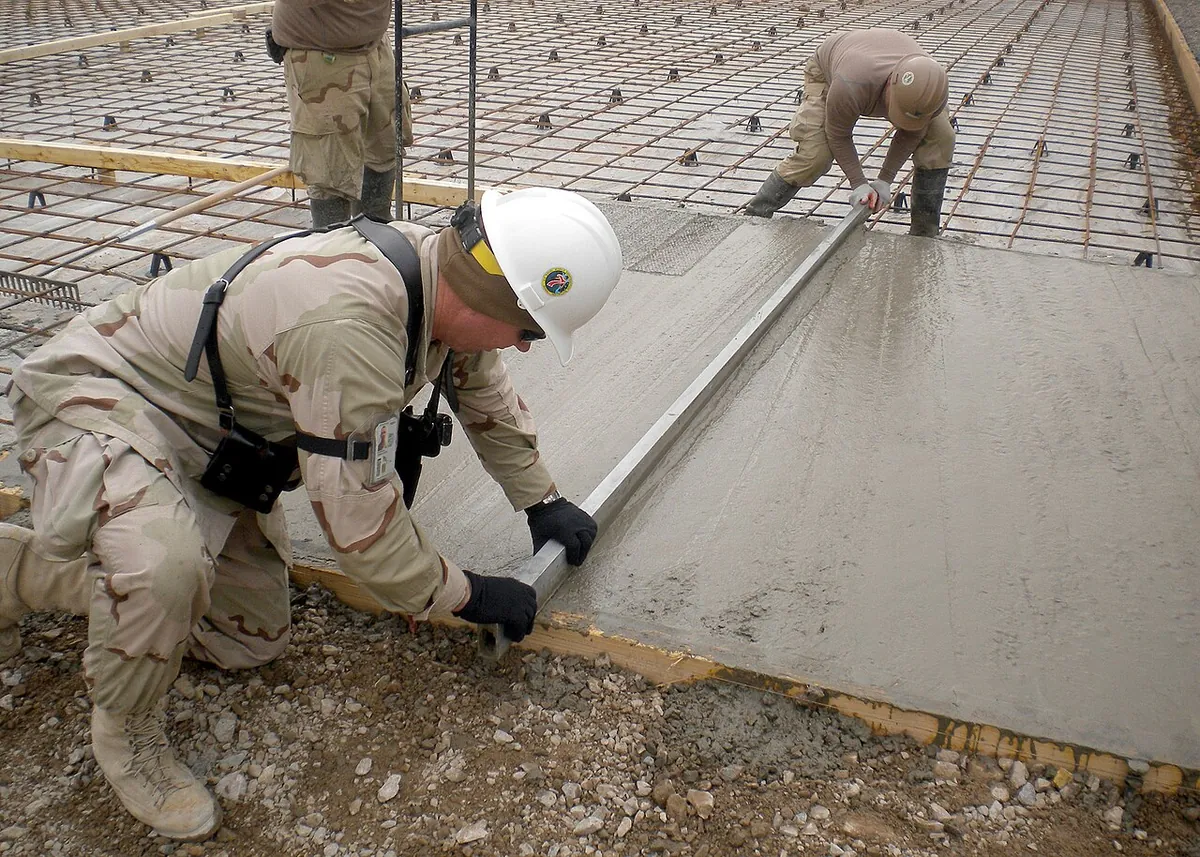
Photo: U.S. Navy, Ensign Daniel Cloutier, Wikimedia Commons, public domain
Quick Answer
A concrete screed is a straight board, aluminum straightedge or machine used to strike fresh concrete off level with the forms or grade guides right after it is placed. To screed concrete by hand, rest the straightedge on both forms, push a little extra concrete ahead of it, and pull it toward you with a side-to-side sawing motion, filling low spots and repeating. A concrete power screed adds a vibrating engine to the blade so one or two people can strike off driveways and slabs faster and flatter. A laser screed is a large machine guided by a laser for warehouse and commercial floors that need very tight flatness. In the UK and elsewhere, "screed" also means a sand-cement floor topping placed over a concrete slab, which is different from concrete itself.
Screeding is the first step after the concrete leaves the chute, and the concrete screed decides how flat the finished slab will be. Every later finishing tool, from the bull float to the trowel, works on the surface the concrete screed leaves behind. A float can smooth small ridges, but it cannot fix a slab that was struck off high in one corner and low in another. That is why good crews spend as much care on setting forms and screed guides as on finishing.
This guide explains what a concrete screed does, the types of concrete screeds from a simple 2x4 to power and laser screeds, how to screed concrete step by step, how to choose a screed by slab size, common mistakes, rental and purchase costs, and the difference between concrete and screed when the word is used for floor toppings.
What Does a Concrete Screed Do?
To screed concrete, also called striking off, means cutting the fresh concrete down to the right height and fills it up where it is low. The screed rides on the edge forms, on screed rails, or on wet screed strips set to the finished height, so the top of the slab ends up exactly where it should be, with the right slope for drainage. It also does a first, rough consolidation of the surface and leaves it ready for the bull float. A slab where crews screed concrete well is flat, at the right thickness everywhere, and drains the way it was designed to. See concrete flatwork for where screeding fits in the full process.
Types of Concrete Screeds
Wood 2x4 or 2x6: the simplest concrete screed. A straight, dry board slightly longer than the slab is wide works for small pads and walks. Check it is straight by sighting along it; a bowed board leaves a bowed slab.
Aluminum straightedge: the standard hand screed for most crews. Hollow aluminum rectangles or channels, from about 6 to 20 feet long, are light, stay straight, and are easy to clean. Some have handles that make them easier to pull.
Magnesium screeds and highway straightedges: used after screeding to check and cut down high spots on floors.
Vibrating or power screed: a concrete power screed has an aluminum blade with a small gas, battery or electric motor that vibrates it. The vibration helps the concrete flow and consolidate, so the blade strikes off faster with less effort and leaves a smoother surface. Single-operator power screeds with handles, often called wet screeds or vibratory screeds, are popular for driveways, patios and garage slabs. Larger truss screeds span wide bridge decks and pavements.
Roller screed: a spinning tube that rides on the forms and strikes off as it rolls, used for sloped and curved work.
Laser screed: a self-propelled machine with a long boom and a vibrating screed head, controlled by a laser receiver that reads a rotating laser beam. It strikes off large areas to a precise elevation in a single pass. Laser screed concrete floors are standard in warehouses, distribution centers and big-box stores.
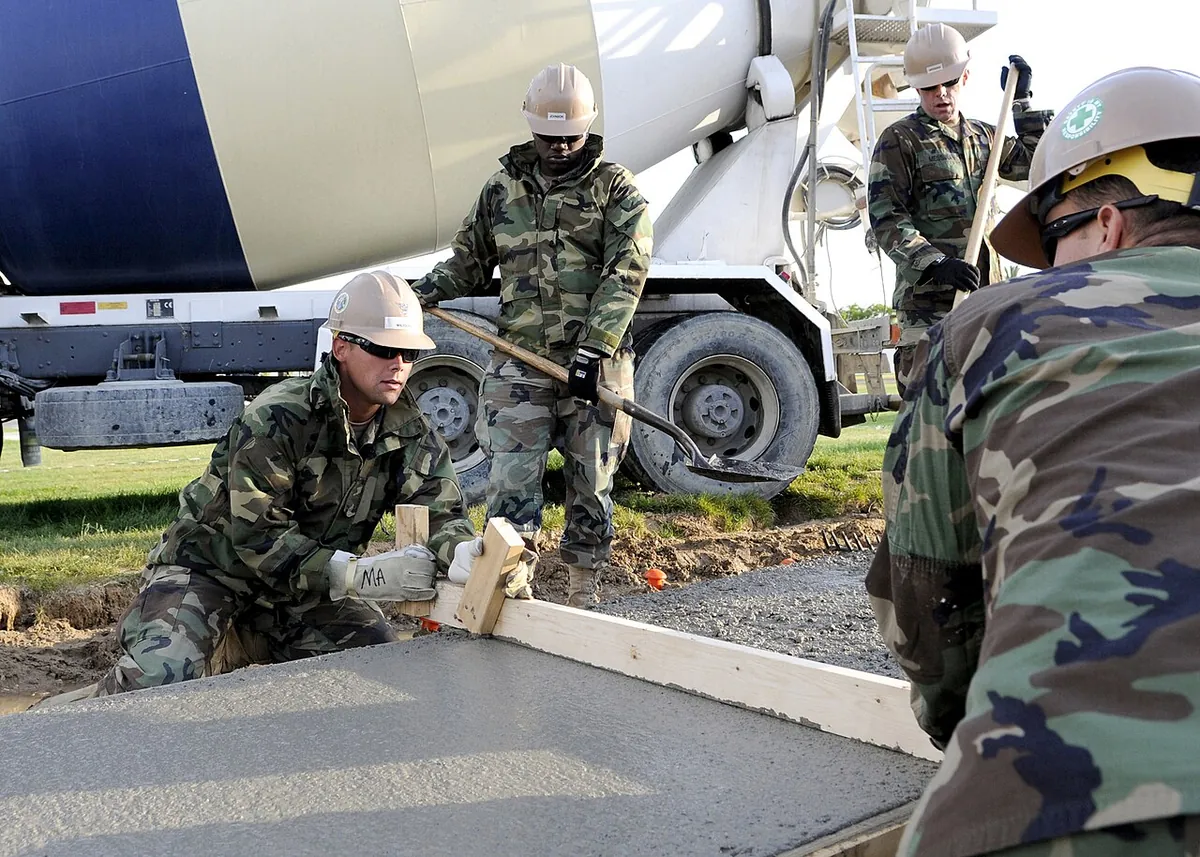
Photo: U.S. Navy, Chief Mass Communication Specialist Yan Kennon, Wikimedia Commons, public domain
How to Screed Concrete by Hand
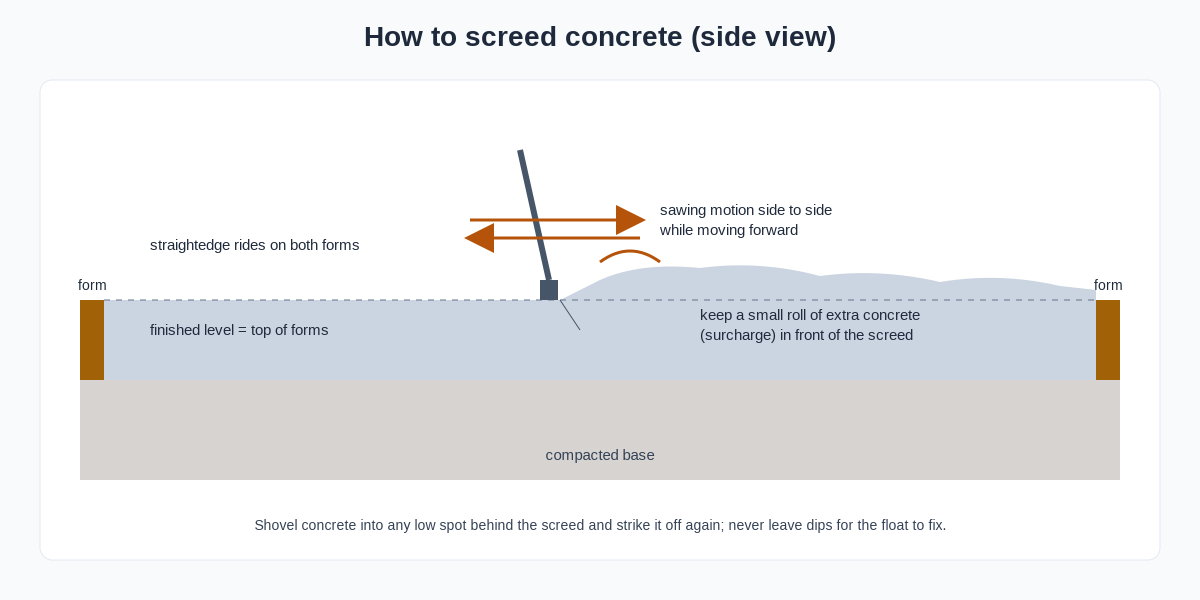
1. Set forms and guides accurately. The screed can only be as good as what it rides on. Check the forms with a level and string line for height and slope before the pour. For slabs too wide for one screed, set intermediate screed rails or wet screed strips.
2. Place concrete slightly high. Spread the concrete with rakes and come alongs so it is a little above the forms, about 1/2 to 1 inch, across the section you will screed.
3. Rest the screed on the forms. One person at each end, or one person on short screeds, holds the straightedge on top of the forms, tilted slightly so the leading edge is up.
4. Saw and pull. Move the concrete screed side to side in a sawing motion while pulling it slowly forward. The sawing cuts the concrete down cleanly; the forward motion carries extra concrete ahead.
5. Keep a surcharge. Keep a small roll of extra concrete in front of the concrete screed. If the roll runs out, the concrete screed will leave low spots.
6. Fill low spots and repeat. A helper shovels concrete into any holes or low spots behind the concrete screed, and the concrete screed is pulled over that area again.
7. Remove the extra. At the end of the forms, pull the surplus concrete off with a shovel and use it elsewhere.
8. Bull float right away. Follow the concrete screed with a bull float immediately. See bull float concrete.
Using a Concrete Power Screed
A concrete power screed makes it faster, flatter and easier to screed concrete, especially on slabs wider than about 10 feet. The operator walks backward, holding the handles, and guides the vibrating blade across the forms or guides while the vibration settles the concrete. Most power screeds come with interchangeable blades from about 6 to 16 feet or more. Battery and electric models are quieter; gas models are common for outdoor work.
Tips for using a power screed for concrete: start the vibration before the blade touches the concrete, keep a surcharge ahead as with a hand screed, and move at a steady pace without stopping in one place, which can leave a dip. Do not over-vibrate stiff concrete or the surface will bleed excessively. On air-entrained concrete, keep vibration moderate. A power screed does not replace good forms; it still rides on the forms or guides, so they must be set accurately.
Laser Screed Concrete Floors
On large commercial and industrial floors, a laser screed is the standard tool. A rotating laser transmitter sets a reference plane, and receivers on the screed head adjust its height automatically many times per second, so the operator can strike off a wide strip of concrete in one pass without forms or screed rails in the middle of the floor. Laser screeds can place thousands of square feet per hour and achieve the high flatness and levelness numbers (F-numbers) that warehouse forklifts and racking need. They are expensive machines, usually owned by specialist floor contractors. For a homeowner, the relevant point is that laser screed concrete is the reason big-box store floors are so flat; for a driveway or patio, a hand or power concrete screed is all you need.
Choosing a Concrete Screed by Slab Size
Small pads and walks up to about 4 feet wide: a straight 2x4 is fine.
Patios and slabs up to about 10 to 12 feet: an aluminum hand screed one to two feet longer than the slab width, handled by two people.
Driveways and garage slabs: a concrete power screed with a 12 to 16 foot blade, or a hand screed working between intermediate guides.
Large commercial floors: laser screeds or truss screeds.
Why Flatness Matters
For a patio or driveway, the main goals of screeding are an even surface, the right thickness, and a slope that drains water away. A dip of half an inch over ten feet will hold a puddle after rain, and puddles on concrete speed up freeze-thaw damage and staining. For interior floors, flatness matters even more. Tile, vinyl plank and wood flooring all need a flat base, and a wavy slab means expensive grinding or leveling compound later. In warehouses, forklifts lifting loads many feet high need floors flat enough that the mast does not sway. That is why the industry measures floor flatness and levelness with F-numbers under ASTM E1155, and why specifications for those floors often call for a laser screed. The concrete screed you choose and how carefully you use it set the flatness of the finished slab more than any later step.
Screed Rails, Wet Screeds and Grade Guides
When a slab is too wide for one concrete screed to span between forms, the crew needs guides in the middle. There are three common ways to set them. Screed rails are steel pipes or rails set on adjustable stands or chairs to the exact finished height; the concrete screed rides on them, and they are pulled out after each section is struck off, with the gaps filled and smoothed. Wet screeds are narrow strips of concrete placed first and struck off to grade using stakes or a laser as a guide; the rest of the concrete is then placed and screeded between them. Grade stakes or pins driven to the finished height let finishers check and adjust the surface while screeding by hand.
Each concrete screed guide method has its place. Screed rails give the most accurate result for a hand or power screed on wide slabs. Wet screeds are fast and common on house slabs and basements, where a skilled crew can set them by eye and with a level. On commercial floors, a laser screed makes most of these guides unnecessary. Whatever you use, check the guides with a level or a laser before the truck arrives, because once concrete is placed there is no time to fix them.
Choosing a Powered Concrete Screed
A powered concrete screed is the most useful upgrade for anyone pouring driveways, garage floors and patios regularly. Models differ in power source, blade length, weight and vibration. Gas power screeds for concrete use small four-stroke engines and are the most common outdoors; they are powerful but noisy and produce exhaust, so they are not ideal indoors. Battery-powered models have become popular because they are quiet, light and free of fumes, and a spare battery usually covers a large pour. Electric corded models suit indoor work near power.
Concrete screed blade length should match the width of the slab or the spacing of your guides. Many power screed concrete kits come with a motor unit and interchangeable aluminum blades from about 6 to 16 feet, sometimes longer, so one machine covers walks and wide slabs. Lighter units are easier to carry and set on the forms, while heavier blades stay straighter on long spans. Look for adjustable vibration, comfortable handles that can be set to your height, and a blade profile that strikes off cleanly without dragging. If you are not sure, rent first: many rental stores carry power screeds by the day, and trying one on a real pour is the best way to choose.
When using power screed concrete equipment, remember that the vibration consolidates only the top few inches. It does not replace an internal vibrator for walls, footings or thick slabs with dense rebar; that job needs a concrete vibrator.
Concrete Laser Screed: When It Is Worth It
A concrete laser screed is not a tool most people will ever operate, but it is worth understanding if you are building a warehouse, shop or commercial floor. The machine stands outside the area being placed, extends a telescoping boom over the concrete, and pulls a vibrating screed head back toward itself. Laser receivers on the head compare its height with the reference plane from a laser transmitter and adjust hydraulic cylinders automatically. The result is a slab struck off to within a few millimeters of the design elevation over very large areas, with much less labor than hand screeding.
Laser concrete screed work is usually priced as part of the floor contractor's square-foot rate rather than as a separate rental. It becomes cost-effective on floors of several thousand square feet or more, and essential where specifications call for high F-numbers. Smaller ride-on and walk-behind laser screeds exist for mid-size jobs such as parking decks and retail floors. For residential driveways, patios and basements, a well-set form and a hand or power screed give all the flatness needed.
Screeding Slopes, Curves and Steps
On sloped driveways and ramps, screed concrete from the low end up, so the surcharge of concrete stays in front of the concrete screed instead of sliding away. Use a slightly stiffer mix and keep each section short. On curved walks, a straightedge long enough to span the forms still works if you move it as a radius around the curve; flexible forms must be set very carefully for height, because the concrete screed will follow every bump. Roller screeds handle curves and slopes well. Steps and landings are usually struck off with a short board or a margin trowel using the riser forms as guides. See how to pour concrete steps.
Screeding in Hot and Cold Weather
Hot, dry and windy weather makes the window to screed concrete and bull floating short. Concrete can start to stiffen at the surface before the whole section is placed, and a screed dragged over stiffening concrete tears it. Place and screed in small sections, keep enough crew on the concrete screed and float, and wet the base before placing so it does not draw water from the concrete. In cold weather, the concrete stays workable longer, which makes screeding easier, but bleed water may rise more and take longer to evaporate. Screed and float promptly, then wait patiently for the next steps. See pouring concrete in cold weather.
Installing a Floor Screed Over Concrete
Where floor screeds are common, the order of work is structural slab first, screed later. The concrete slab is cast and cured, any services or underfloor heating pipes are laid, insulation and a separating membrane may be added, and then the screed is placed. A bonded screed is laid directly on a prepared, primed slab and can be fairly thin. An unbonded screed is laid on a membrane and must be thicker. A floating screed is laid over insulation and is thicker again. Traditional sand-cement screed is mixed fairly dry, placed in bays, compacted and leveled with a straightedge between screed rails or levelled bands, then finished with a trowel. Liquid screeds are pumped and leveled with a dappling bar.
Screeds take time to dry before flooring can go down; a common rule of thumb for sand-cement screeds is about one day per millimeter of thickness for the first 40 millimeters in good conditions, longer for thicker layers. Moisture tests are used before laying wood or vinyl. When people compare concrete and screed for a floor, the answer is that both are usually needed: concrete for strength and screed for a level, smooth surface on top.
Cleaning and Storing Concrete Screeds
Rinse concrete screeds as soon as the section is finished, before paste hardens on the blade. Scrape and brush aluminum straightedges clean, and wipe down the motor housing and handles of power screeds without spraying water into the engine or battery compartment. Store screeds flat on a rack or hung at several points so they do not bow. A bent screed is useless, so protect long blades in transport. Check straightness before every pour by laying the concrete screed on a flat floor or sighting along it.
A Concrete Screed Checklist for Pour Day
Before the truck arrives, run through a short list. Are the forms set to the right height and slope, checked with a string line, and staked firmly so the concrete screed will not push them out of line? Is the screed straight, long enough to span the forms or guides with a foot to spare, and clean? If you are using a power screed, is it fueled or charged, with the right blade fitted and a spare battery ready? Are screed rails or wet screed guides set and checked? Is there a shovel crew to keep a surcharge in front of the screed and to fill low spots behind it? And is someone ready with the bull float to follow right behind? With those in place, you can screed concrete calmly and accurately, and every later finishing step will be easier.
After the pour, look across the finished slab at a low angle in the evening light. Any waves or dips you see will usually trace back to forms that moved, a screed that was bent, or sections where the surcharge ran out. Note them for next time; good screeding is learned one slab at a time, and each concrete screed pass teaches you how the concrete moves.
For a first project, keep it simple: a straight aluminum concrete screed, two people, and forms set carefully. Screed concrete in short sections, keep the surcharge going, and let the bull float follow. Once that feels easy, a power screed for concrete driveways and garage slabs is the natural next step, and it will make every concrete screed pass faster and flatter.
Whatever concrete screed you use, the rule is the same: true forms, a steady surcharge, and a bull float right behind. Get those three right and you will screed concrete that is flat, drains well and is easy to finish.
Common Screeding Mistakes
Forms not set right. The concrete screed copies whatever it rides on. Check form heights and slope with a string line before the pour.
Running out of surcharge. Without extra concrete ahead of the concrete screed, low spots remain.
Leaving low spots for the float. A bull float cannot fill dips. Fill them and screed again.
Using a bent board. Sight along wood concrete screeds before the pour.
Adding water. Stiff concrete is hard to screed with any concrete screed, but adding water at the site weakens the slab. Order the right slump; see concrete slump.
Waiting too long. Concrete that has started to stiffen will tear under a concrete screed rather than strike off cleanly. Screed and float each section as soon as it is placed.
Concrete and Screed: What Is the Difference?
The word screed has a second meaning, used widely in the UK, Europe, Australia and the Middle East. There, a screed is a thin layer of sand and cement mortar, usually 1:3 to 1:5 cement to sand, placed over a structural concrete slab to create a smooth, level surface for floor coverings, or over underfloor heating pipes. Concrete contains coarse aggregate (gravel or crushed stone) and is structural; floor screed contains only fine sand and is a finishing layer, typically 50 to 75 millimeters thick for bonded or floating screeds. Liquid or self-leveling screeds based on calcium sulfate (anhydrite) or cement are also common. So when people talk about concrete and screed, they usually mean the structural slab and the leveling topping on top of it. In North America, the closest equivalents are self-leveling underlayments and toppings; see self-leveling concrete.
Costs: Buying and Renting Concrete Screeds
Aluminum hand concrete screeds cost roughly $40 to $150 depending on length. Concrete power screeds cost from a few hundred dollars for basic models to well over a thousand for professional units with multiple blades; many rental stores rent them by the day. Laser screeds cost hundreds of thousands of dollars and are run only by specialist contractors. For most homeowners, buying an aluminum screed or using a straight 2x4 and renting a power screed for a driveway is the practical approach. See concrete tools for the full list of placing and finishing tools.
Frequently Asked Questions
What is a concrete screed?
A straightedge or machine used to strike fresh concrete off level with the forms or guides right after it is placed.
What can I use to screed concrete?
A straight 2x4 for small pads, an aluminum screed for most slabs, and a power screed for driveways and wide slabs.
Is a power screed worth it?
For slabs wider than about 10 feet or larger than a few hundred square feet, yes: it is faster, easier and gives a flatter surface.
What is the difference between concrete and screed?
Concrete contains coarse aggregate and is structural; a floor screed is a thin sand-cement layer placed over concrete to level it.
Sources
- American Concrete Institute: ACI 302.1R floor and slab construction, and ACI 117 tolerances
- Portland Cement Association: placing and finishing concrete
- The Concrete Centre (UK): screeds and floor toppings
- National Ready Mixed Concrete Association: finishing concrete flatwork
Related Guides
- Bull float concrete — when and how to use a concrete bull float
- Concrete vibrator — consolidating walls, footings and columns
- How to pour a concrete patio — DIY steps, calculator and cost
- Concrete stakes — wood and steel form stakes
- How to smooth concrete — troweling and smoothing hardened concrete
- Concrete machines — mixers, placer booms, screeds, trowels, sprayers, saws and scrubbers