
Concrete Machines: Every Machine for Concrete Work, From Mixer to Scrubber
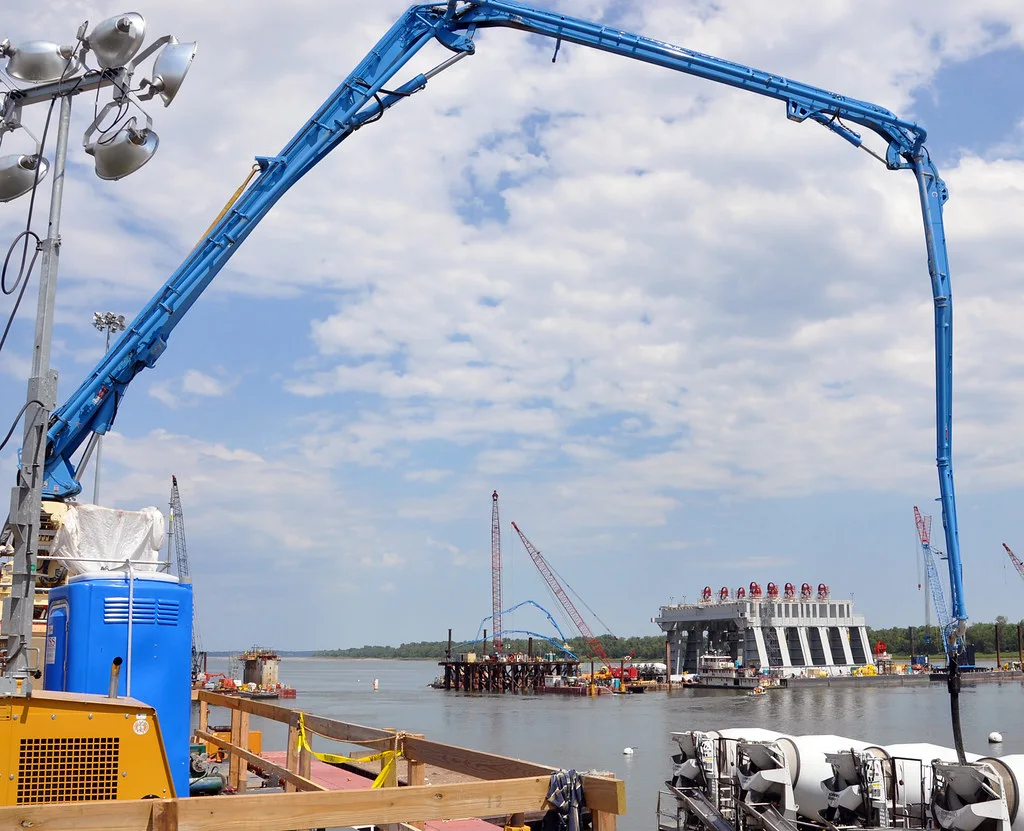
Photo: LouisvilleUSACE, Flickr, CC BY 2.0
Quick Answer
Concrete machines are the equipment used to mix, move, place, consolidate, finish, spray, cut and clean concrete. The main machines for concrete work are mixers (drum mixers, mixer trucks, volumetric mixers), pumps and concrete placer booms that deliver concrete where it is needed, vibrators and screeds that consolidate and level it, power trowels that finish slabs, shotcrete rigs and the concrete sprayer used for sealers and curing compounds, saws and grinders for cutting and surface prep, and the concrete scrubber, a floor-cleaning machine for warehouses, garages and shops. Homeowners usually rent small concrete machines such as mixers, buggies, screeds and trowels for $50 to $200 per day; large machines such as boom pumps, laser screeds and slipform pavers come with trained operators.
Modern concrete work would be impossible without machines. A single crew can place and finish thousands of square feet of slab in a day because a pump delivers the concrete, a laser screed levels it, and ride-on trowels finish it. The photo above shows one of the most important concrete machines on large projects, a placing boom, swinging concrete from a line of ready-mix trucks to a structure far out of their reach. This guide walks through every major type of concrete machine in the order the work happens, explains what each does, and covers rental costs and how to choose the right machine for concrete jobs of every size.
Concrete Machines by Stage of Work
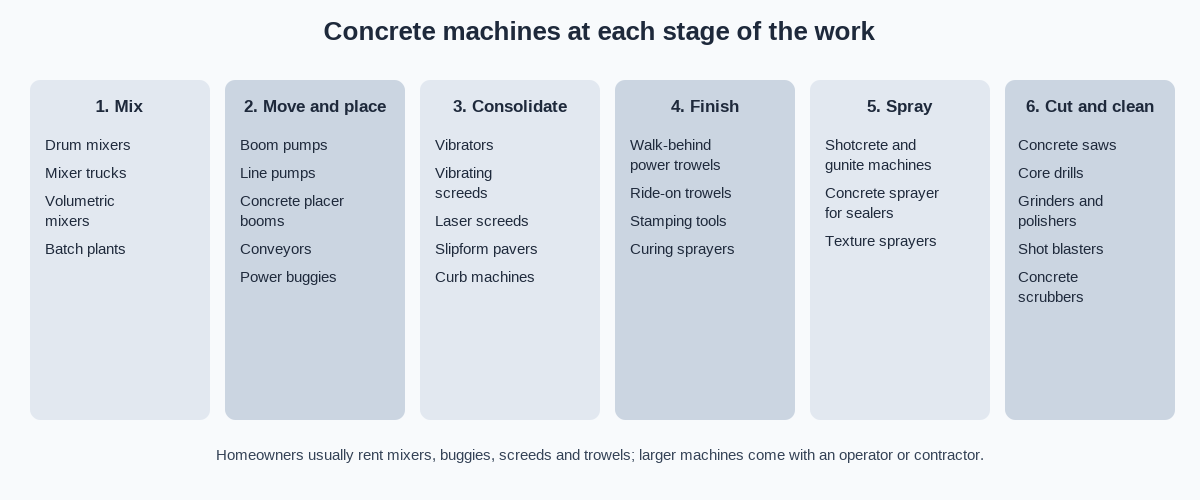
The chart above groups concrete machines by the stage of work they serve. Each section below covers one stage.
1. Concrete Mixing Machines
Portable drum mixers. The most familiar concrete machine for homeowners: a rotating drum, driven by an electric motor or small gas engine, that mixes bagged concrete or site-batched cement, sand and gravel with water. Sizes range from about 1.25 to 12 cubic feet. A 6 to 9 cubic foot mixer handles two or three 80 pound bags per batch. See concrete cement mixers and concrete mixer rental cost.
Mortar and paddle mixers. Horizontal paddle machines and drill-driven paddles for mortar, grout, self-leveling underlayment and small batches.
Ready-mix trucks. Transit mixers carry 8 to 11 cubic yards of concrete from a batch plant, keeping it mixed with a rotating drum on the way to the job.
Volumetric mixers. Trucks that carry cement, sand, stone and water in separate bins and mix fresh concrete on site, in exactly the amount needed. They are ideal for small or uncertain quantities, multiple mixes in one trip, and remote sites.
Batch plants. Stationary or portable plants that weigh and mix large volumes of concrete for ready-mix suppliers, precast plants and big projects such as dams and highways.
Self-loading mixers. Off-road machines with a loader bucket and rotating drum that load, weigh, mix and deliver concrete on remote or rural sites.
2. Machines That Move and Place Concrete
Boom pumps. Truck-mounted pumps with folding booms from about 28 to over 60 meters that place concrete over buildings and across sites. A boom pump is one of the most productive machines for concrete placement. See concrete pump truck cost.
Line pumps. Smaller trailer pumps that push concrete through hoses for backyard slabs, footings, walls and places a truck cannot reach.
Concrete placer booms. A concrete placer, or separate placing boom, is a boom mounted on a pedestal, tower, building core or tracked base, fed by a stationary pump through a pipeline. On high-rise buildings, a concrete placer climbs with the structure, placing concrete on each new floor. The machine in the photo at the top of this guide is this type of concrete placer.
Conveyor trucks and belt placers. Telescoping conveyor belts that throw concrete, gravel or sand over long distances, useful for low-slump concrete and aggregate placement.
Power buggies. Walk-behind or ride-on motorized wheelbarrows that carry about 10 to 21 cubic feet of concrete across a site, saving hours of manual wheelbarrow work.
Cranes and buckets. Concrete buckets lifted by crane place concrete for columns, walls and remote spots.
Hand placers. The term concrete placer also refers to a hand tool: a flat-bladed rake, sometimes called a come-along or concrete placer rake, used to pull and spread concrete without separating the stone.
3. Consolidation and Leveling Machines
Internal vibrators. Pencil-shaped heads on flexible shafts that vibrate concrete in forms to remove air voids. Every pour of walls, footings and columns needs one. See concrete vibrator.
Vibrating and roller screeds. Power screeds strike off and vibrate the surface of a slab, faster and flatter than a hand straightedge. See concrete screed.
Laser screeds. Ride-on or boom-mounted concrete machines that use laser receivers to strike off large slabs automatically to precise grades, a standard on warehouse and commercial floors.
Slipform pavers. Large tracked machines that extrude and finish highway, airport and road pavements continuously without fixed forms.
Curb and gutter machines. Smaller slipform machines that extrude curbs, gutters, barrier walls and sidewalks. See concrete curbing.
Bridge deck finishers. Rail-mounted machines that strike off and finish concrete bridge decks.
4. Concrete Finishing Machines
Walk-behind power trowels. Machines with rotating blades, 24 to 48 inches across, that float and trowel slabs after the bleed water is gone. A power trowel is the essential finishing machine for concrete garage floors, basements and shops.
Ride-on power trowels. Larger machines with two or three rotors that a finisher drives over the slab, finishing large floors quickly and very flat.
Edgers, groovers and stamps. Mostly hand tools, but power stamping and texture rollers are used on large decorative projects. See concrete trowel.
5. Concrete Spraying Machines
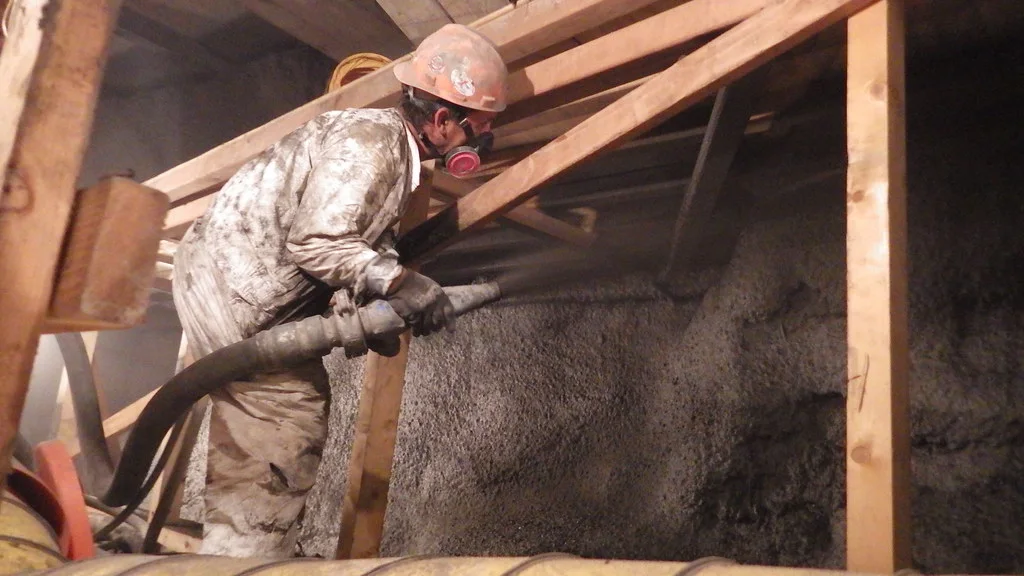
Photo: MTA C&D - East Side Access, Flickr, CC BY 2.0
Shotcrete and gunite machines. Concrete spraying machines pump or blow concrete through a hose and spray it at high velocity onto a surface, as in the tunnel shown above. Wet-mix shotcrete pumps premixed concrete and adds air at the nozzle; dry-mix gunite blows dry material and adds water at the nozzle. They are used for pools, tunnels, slopes, retaining walls and repairs. See shotcrete vs gunite.
Concrete sprayer for sealers and curing compound. To most homeowners and contractors, a concrete sprayer is a pump-up or battery sprayer used to apply curing compound, sealer, release agent, stain or cleaner to concrete. Choose a concrete sprayer with seals that resist solvents if you will spray solvent-based sealers, and a fan tip for even coverage. See concrete curing compound and concrete sealer.
Texture and plaster sprayers. Hopper guns and pumps that spray cement-based coatings, stucco, overlays and knockdown textures.
6. Cutting, Grinding and Cleaning Machines
Concrete saws. Handheld cut-off saws, walk-behind saws, wall saws and concrete chainsaws cut joints and openings. See concrete cutter.
Core drills. Drill round holes for pipes and anchors. See concrete core drilling.
Grinders and polishers. Remove coatings, flatten floors and polish concrete. See concrete polisher.
Shot blasters and scarifiers. Roughen or remove the surface of concrete for coatings and overlays.
Concrete scrubbers. A concrete scrubber, also called an auto scrubber or floor scrubber, is a walk-behind or ride-on machine that sprays cleaning solution, scrubs with rotating brushes or pads, and vacuums the dirty water in one pass. Warehouses, factories, parking garages, stores and polished concrete floors are cleaned daily with a concrete scrubber. See how to clean concrete floors.
Concrete Placer Booms in Detail
A concrete placer boom separates the placing arm from the pump. A stationary trailer or truck pump at ground level pushes concrete through a steel pipeline up the building, and the concrete placer at the top swings its articulated boom to reach any point on the deck. This arrangement makes sense when a building is too tall or too large for a truck-mounted boom, when the pour site is far from where trucks can park, or when the same floor-by-floor pour repeats for months.
Types of concrete placer. Pedestal placers bolt to a floor and are moved by crane from level to level. Climbing placers ride up inside an elevator shaft or a tower as the building rises. Tower-mounted placers stand on their own mast beside the building. Tracked and crawler placers move around large flat sites such as tunnels and industrial floors. Small spider-type concrete placer booms fit inside buildings for slab pours where trucks cannot enter.
Reach and capacity. A typical concrete placer boom reaches about 28 to 40 meters horizontally, and the pump behind it can push concrete hundreds of meters vertically through the pipeline. Output depends on the pump, often 30 to 100 or more cubic yards per hour.
Advantages. A concrete placer frees the crane for other lifts, keeps ready-mix trucks off congested streets, and delivers concrete exactly where finishers need it.
Choosing a Concrete Sprayer for Sealers and Curing
For homeowners and contractors applying sealer or curing compound, the right concrete sprayer makes the difference between an even, professional coat and streaks, puddles and wasted product. Points to consider when choosing a concrete sprayer:
Seal material. Solvent-based acrylic sealers and many curing compounds attack the rubber seals in cheap garden sprayers within minutes. Choose a concrete sprayer with Viton or EPDM seals rated for the product, as the sealer label recommends.
Tank size. One to two gallon sprayers suit small patios and touch-ups; 3 to 4 gallon pump-up sprayers suit driveways and garage floors. Backpack and battery concrete sprayers reduce pumping fatigue on large areas.
Nozzle. A flat fan tip gives an even band of product; cone tips leave rings. Many concrete sprayer kits include several tips.
Pressure. Low to moderate pressure keeps the mist down and reduces overspray onto siding, cars and plants.
Technique. Spray in overlapping passes, back-roll if the sealer maker recommends it, and avoid puddles. Clean the concrete sprayer immediately with the right solvent or water.
Airless sprayers. Contractors applying sealers, coatings and curing compounds over large areas use airless sprayers with a pump, which produce a fine, consistent spray and cover thousands of square feet per hour.
Concrete Scrubber Guide
A concrete scrubber is one of the most widely used concrete machines in commercial buildings, even though it never pours a yard of concrete. Choosing the right concrete scrubber depends on floor area, layout and soil type:
Walk-behind scrubbers. Cleaning paths of about 17 to 34 inches, battery or corded. Suited to shops, garages, retail stores and smaller warehouses, up to roughly 30,000 square feet.
Ride-on scrubbers. Cleaning paths of about 28 to 60 inches, for large warehouses, distribution centers, parking garages and factories. A ride-on concrete scrubber can clean tens of thousands of square feet per hour.
Micro scrubbers. Compact concrete scrubber units for restrooms, kitchens and tight spaces.
Brushes and pads. Disc brushes or pads for smooth floors and polished concrete; cylindrical brushes for textured, uneven or debris-covered floors, since they sweep small debris too. Use non-abrasive pads on polished floors to protect the shine.
Sweeper-scrubbers. Combination machines that sweep debris and scrub in one pass, useful in dusty industrial plants.
Cleaning solutions. Use neutral pH cleaners on sealed and polished concrete; degreasers for oily shop floors. Harsh acids damage concrete.
New concrete scrubbers range from a few thousand dollars for small walk-behinds to $20,000 to $60,000 or more for large ride-on units, and rentals are available by the day or week. Homeowners with an oily garage floor can rent a small concrete scrubber or use a pressure washer with a surface cleaner instead.
Concrete Block, Precast and Paver Machines
Not all concrete machines work on construction sites. Block machines in factories vibrate and compress stiff, zero-slump concrete in steel molds to produce concrete masonry units, pavers, curbs and retaining wall blocks by the thousands every hour. Small manual and semi-automatic block machines are used in many developing countries to make blocks on site. Precast plants use concrete machines such as extruders for hollow-core planks, pipe machines for culverts and manholes, and spinning machines for poles. See precast concrete and concrete blocks.
3D Concrete Printing Machines
One of the newest concrete machines is the 3D concrete printer, a gantry or robotic arm that extrudes a special printable mortar layer by layer, following a digital model. 3D printed concrete homes, walls and small structures have been built in many countries. The machines can print wall shapes without formwork and reduce labor, though reinforcement, building codes, roofs and finishing still require conventional methods. This is still an emerging technology, but it shows how machines for concrete continue to change the trade.
Renting Concrete Machines: Typical Prices
Approximate U.S. daily rental prices for common concrete machines:
Portable drum mixer: about $50 to $110 per day.
Power buggy: about $150 to $300 per day.
Vibrator: about $50 to $100 per day.
Power screed: about $75 to $150 per day.
Walk-behind power trowel: about $80 to $150 per day.
Ride-on power trowel: about $250 to $450 per day.
Concrete saw: about $70 to $200 per day plus blade wear.
Floor grinder: about $150 to $300 per day plus tooling.
Walk-behind concrete scrubber: about $100 to $200 per day.
Line pump with operator: often $150 to $250 per hour with minimums; boom pumps more.
Prices vary by region and season, and most rental stores charge less for weekly rentals. Always ask for a quick demonstration of any concrete machine you have not used before.
Choosing Concrete Machines by Project Size
Small repairs and fence posts: no concrete machine needed beyond a wheelbarrow and a hoe; a drill paddle mixer helps.
Patio or shed pad of 1 to 3 cubic yards: rented drum mixer or a small ready-mix or volumetric delivery, plus a bull float and hand tools.
Driveway or garage floor of 5 to 15 cubic yards: ready-mix truck, a line pump or power buggy if the truck cannot reach, a power screed and a walk-behind power trowel for garage floors.
Large slabs and commercial work: boom pumps or concrete placer booms, laser screeds, ride-on trowels and early-entry saws.
Roads and curbs: slipform pavers and curb machines.
Concrete Machine Safety
Every concrete machine carries hazards. Pump and concrete placer booms can contact power lines, so keep them well clear, as OSHA requires minimum clearances; hoses can whip violently when blockages clear; outriggers must sit on solid ground and pads. Mixers have rotating drums and pinch points. Power trowels can kick and spin if a blade catches. Saws and grinders create silica dust and must be used with water or dust collection. Concrete sprayer equipment for sealers releases solvent vapors, so ventilate and avoid ignition sources. Read the operator manual, use guards, wear protective equipment, and never let an untrained person run a concrete machine.
Maintaining Concrete Machines
Concrete hardens on everything it touches, so cleaning is the most important maintenance for any concrete machine. Wash out mixers, pumps, hoses, buggies, screeds and trowel blades immediately after use, before concrete sets. Flush pump lines with water and a cleanout ball. Grease bearings and check belts, engine oil and air filters, which clog quickly in dusty conditions. Replace worn trowel blades, screed edges and pump wear parts on schedule. A well-maintained concrete machine lasts years; one left with hardened concrete inside can be ruined in a day.
Buying vs Renting a Concrete Machine
Whether to buy or rent a concrete machine depends on how often you will use it. A homeowner pouring a patio once should rent every concrete machine needed. A landscaper who sets fence posts and pads every week may save money buying a drum mixer, vibrator and small power trowel. A concrete contractor usually owns the machines used on almost every job, such as mixers, screeds, trowels, saws, vibrators and buggies, and rents or subcontracts specialized ones like boom pumps, laser screeds and ride-on trowels until the workload justifies buying.
A simple rule: if you would rent a concrete machine more than about 15 to 25 days a year, buying usually pays off, as long as you have storage, transport and time for maintenance. Used concrete machines are common, but inspect them carefully for hardened concrete inside drums and pumps, worn bearings and cracked frames.
Electric and Battery Concrete Machines
Battery power is changing small concrete machines. Battery vibrators, screeds, cut-off saws, drum mixers and even walk-behind power trowels are now available. They are quieter, produce no exhaust, and can be used indoors, in basements and in enclosed spaces where gas engines are a carbon monoxide hazard. Corded electric concrete machines such as grinders, core drills and floor scrubbers have long been standard indoors. Large concrete machines like pumps, ready-mix trucks and slipform pavers still rely on diesel engines, though electric and hybrid versions are being introduced in some markets to cut emissions and noise on urban job sites.
What Concrete Machines Does a DIYer Really Need?
For most home projects, the list of machines for concrete work is short:
A mixer, or ready-mix delivery. For less than about 1 cubic yard, a rented drum mixer is practical. Above that, ready-mix is cheaper and far less work.
A way to move concrete. Wheelbarrows for short distances; a power buggy or line pump when the truck cannot get close.
A vibrator for walls and footings. Not usually needed for thin slabs, but important for formed walls, steps and columns.
A power trowel for smooth interior floors. Garage and basement slabs look better and wear better with a machine finish.
A saw for control joints. A cut-off saw the next day, unless you tool joints by hand.
A concrete sprayer for curing and sealing. A good pump-up concrete sprayer is one of the cheapest and most useful concrete machines a homeowner can own.
Everything else, from pump trucks to laser screeds, is best left to contractors who own the concrete machine and know how to run it safely.
How Concrete Machines Changed the Trade
A century ago, concrete was mixed by hand or in small steam-driven mixers, carried in wheelbarrows and buckets, and finished entirely with hand tools. Every major concrete machine since then has cut labor and raised quality. Ready-mix trucks, introduced in the early twentieth century, took mixing off the job site. Pumps and placer booms replaced wheelbarrow runs and crane buckets. Power trowels, invented in the mid-twentieth century, made smooth industrial floors practical. Laser screeds, starting in the late twentieth century, made very flat floors over huge areas routine. Today, a small crew with the right concrete machines can place and finish in one day what once took dozens of workers a week. Labor shortages in the trade continue to push manufacturers toward lighter, battery-powered and more automated machines for concrete, from robotic layout and rebar-tying machines to 3D printers.
Frequently Asked Questions
What is the most important concrete machine on a job site?
For most slabs, the pump or ready-mix truck that delivers concrete, followed by the screed and power trowel that level and finish it. On walls and footings, the vibrator is the key concrete machine.
Can I rent a concrete scrubber?
Yes. Many equipment rental stores and janitorial suppliers rent walk-behind concrete scrubbers by the day or week for garages, shops and warehouses.
What machines for concrete do I need for a garage floor?
Usually a ready-mix truck, a line pump or power buggy if access is tight, a power screed or straightedge, a bull float, a walk-behind power trowel, a saw for joints and a concrete sprayer for curing compound.
What machine is used to mix concrete?
A concrete mixer: a portable drum mixer for small jobs, a ready-mix or volumetric truck for larger ones. Mortar, grout and self-leveling products are usually mixed with a paddle mixer or a heavy drill fitted with a mixing paddle.
What is a concrete placer?
A placing boom fed by a pump that delivers concrete where it is needed, or a rake-like hand tool used to spread concrete. On high-rise jobs, the concrete placer boom climbs with the building floor by floor.
What is a concrete scrubber?
A floor-cleaning machine that scrubs and vacuums concrete floors in one pass. Walk-behind and ride-on concrete scrubber models clean warehouses, garages, parking decks and polished floors, using brushes for rough surfaces and soft pads for polished concrete so the shine is not dulled.
What is a concrete sprayer used for?
Applying curing compound, sealer, release agent or stain to concrete, or, for shotcrete rigs, spraying concrete itself.
Sources
- American Concrete Pumping Association: pump and placing boom safety
- American Shotcrete Association
- American Concrete Institute: ACI 304 guide to measuring, mixing, transporting and placing concrete
- OSHA: concrete and masonry construction safety