
How to Smooth Concrete: Fresh Floating and Troweling, and Smoothing Hardened Concrete
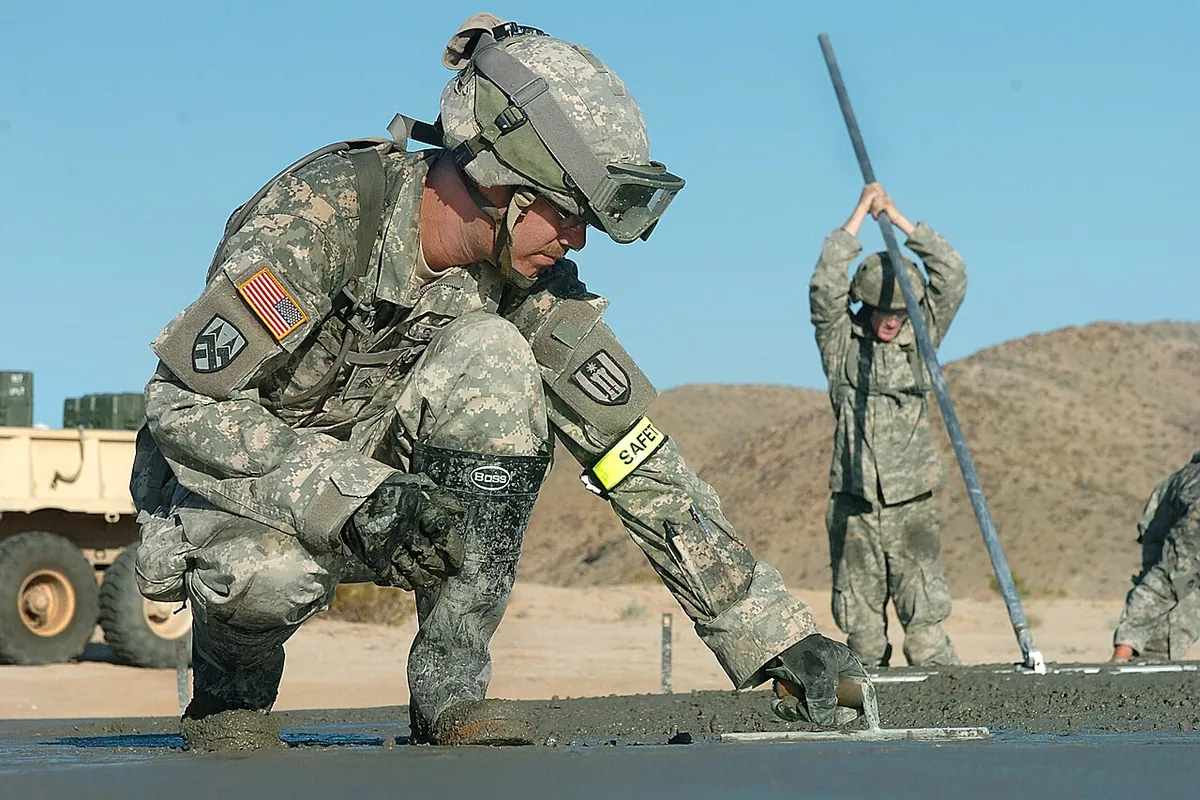
Photo: Sgt. Brent Powell, US Army (public domain), Wikimedia Commons
Quick Answer
Here is how to smooth concrete while it is fresh: screed it level, bull float it to push down stones and bring up paste, wait until the bleed water has disappeared, float it with a magnesium or power float, then steel trowel it in one to three passes, tilting the blade a little more each time as the concrete stiffens. Large slabs use a power trowel. To smooth concrete that has already hardened, grind high spots and ridges with a diamond cup wheel or rubbing stone, apply a skim coat of concrete resurfacer for rough or pitted surfaces, or pour self-leveling underlayment on uneven floors. Keep outdoor surfaces lightly textured so they are not slippery.
Smooth concrete looks clean and modern, is easy to sweep and mop, and makes a good base for paint, epoxy, tile and flooring. Getting it smooth takes the right tools and, above all, the right timing. Most of the work of concrete smoothing happens in the hours after the concrete is placed, when it changes from a soupy mix to a firm surface that can still be shaped. Miss the window and the surface stays rough; work it too early and it becomes weak and dusty. The soldier in the photo above is using a hand trowel to smooth the edge of a fresh slab while a teammate works the surface with a long-handled float.
This guide explains how to smooth concrete at every stage: the tools, the timing, step-by-step floating and troweling by hand and machine, how to smooth concrete that has already hardened, smoothing walls and steps, keeping smooth concrete safe to walk on, common mistakes and costs.
Smooth Concrete: Fresh vs Hardened
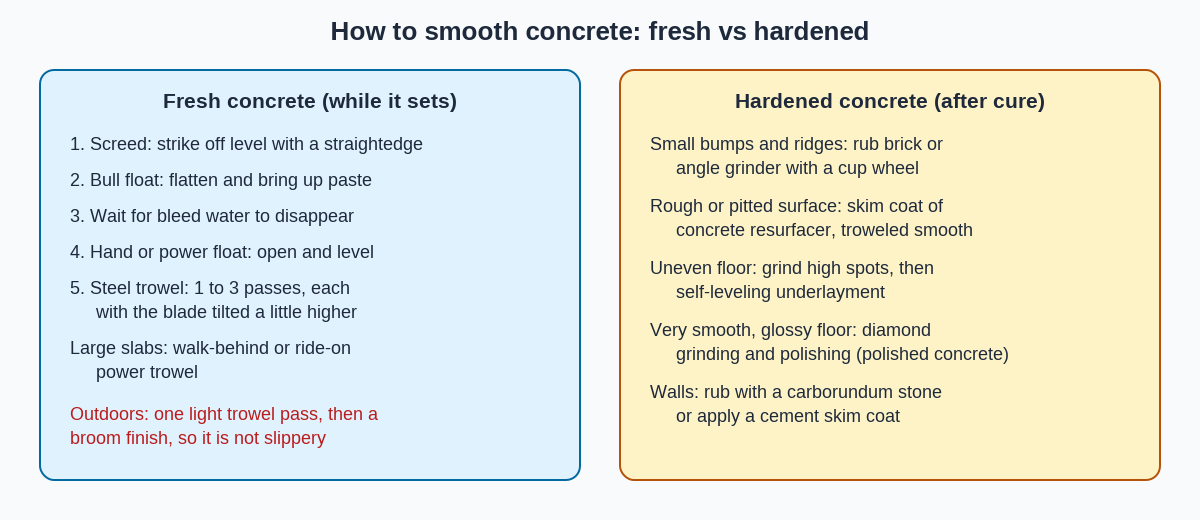
There are two very different situations, as the chart shows. When concrete is fresh, smoothing is part of finishing: you shape the surface with floats and trowels while it is still plastic. When concrete has hardened, you cannot trowel it anymore; instead you remove material by grinding, or add a thin new layer that can be smoothed. Knowing which situation you are in tells you which tools to use. See types of concrete finishes and concrete finishing tools.
Tools for Smoothing Fresh Concrete
Screed. A straight 2x4, aluminum straightedge or vibrating screed used to strike off the concrete level with the forms. See concrete screed.
Bull float or darby. A wide float on a long handle (bull float) or a long hand float (darby) that flattens the surface after screeding, pushes down coarse aggregate and brings cement paste to the top. See concrete bull float.
Hand floats. Magnesium, aluminum or wood floats used to open the surface, level small bumps and prepare it for troweling. Magnesium floats are the most common for air-entrained concrete.
Steel trowels. Flat steel blades, often 12 to 20 inches long, that compact and polish the surface to a smooth, dense finish. Fresno trowels are steel trowels on long handles for reaching across slabs. See concrete trowel.
Power trowel. A gas or electric machine with rotating blades, either walk-behind or ride-on, used to float and trowel large slabs.
Edger and groover. Hand tools that round slab edges and cut control joints, giving a clean, finished look.
Kneeboards. Boards that spread your weight so you can kneel on the slab while hand troweling without sinking in.
Timing: When to Smooth Concrete
Timing is the key to smooth concrete, and the main thing to learn about how to smooth concrete well. Right after placing, concrete is too wet to trowel. As the cement starts to set, water rises to the surface, called bleed water. Working the surface while bleed water is present mixes extra water into the top layer, weakening it and causing dusting, scaling and crazing later. Wait until the sheen is gone. A simple test: press your thumb into the surface. When it leaves an impression about 1/4 inch deep and no water rises, it is ready to float. When the thumb leaves only a slight impression, it is ready for the first trowel pass. Each later trowel pass comes as the concrete stiffens further. In warm, dry, windy weather this can happen in under an hour; in cool, humid weather it can take several hours. On large slabs, different areas set at different times, so finishers work where the concrete is ready. See pouring concrete in cold weather and concrete slump.
How to Smooth Concrete by Hand
1. Screed. Immediately after placing, move a straightedge across the forms in a sawing motion to strike off excess concrete and fill low spots.
2. Bull float. Push the bull float away from you with its leading edge slightly raised, then pull it back flat. Overlap passes. This flattens ridges and embeds coarse aggregate. Do not overwork it; two passes are usually enough.
3. Wait. Let bleed water rise and evaporate. Do not sprinkle cement or water on the surface. Use this time to run an edger along the forms and cut control joints with a groover.
4. Float. When the surface can support a kneeboard with only a slight impression, float it with a magnesium hand float in sweeping arcs, keeping the float flat. Floating fills small holes, levels minor bumps and brings up a little paste for troweling, the first real step toward smooth concrete.
5. First trowel pass. Hold the steel trowel almost flat, with the leading edge just slightly raised, and sweep it in overlapping arcs. Press lightly. This pass smooths float marks.
6. Later trowel passes. As the concrete hardens, make a second and sometimes third pass, each with the trowel tilted a little more and pressed a little harder. The surface becomes denser and smoother, and eventually develops the sheen of smooth concrete. You will hear a ringing sound as the trowel glides over a hard surface.
7. Cure. As soon as the surface can be touched without marking, start curing with wet burlap, plastic sheeting or a curing compound, so the smooth concrete does not dry too fast and crack. See concrete curing compound.
How to Smooth Concrete With a Power Trowel
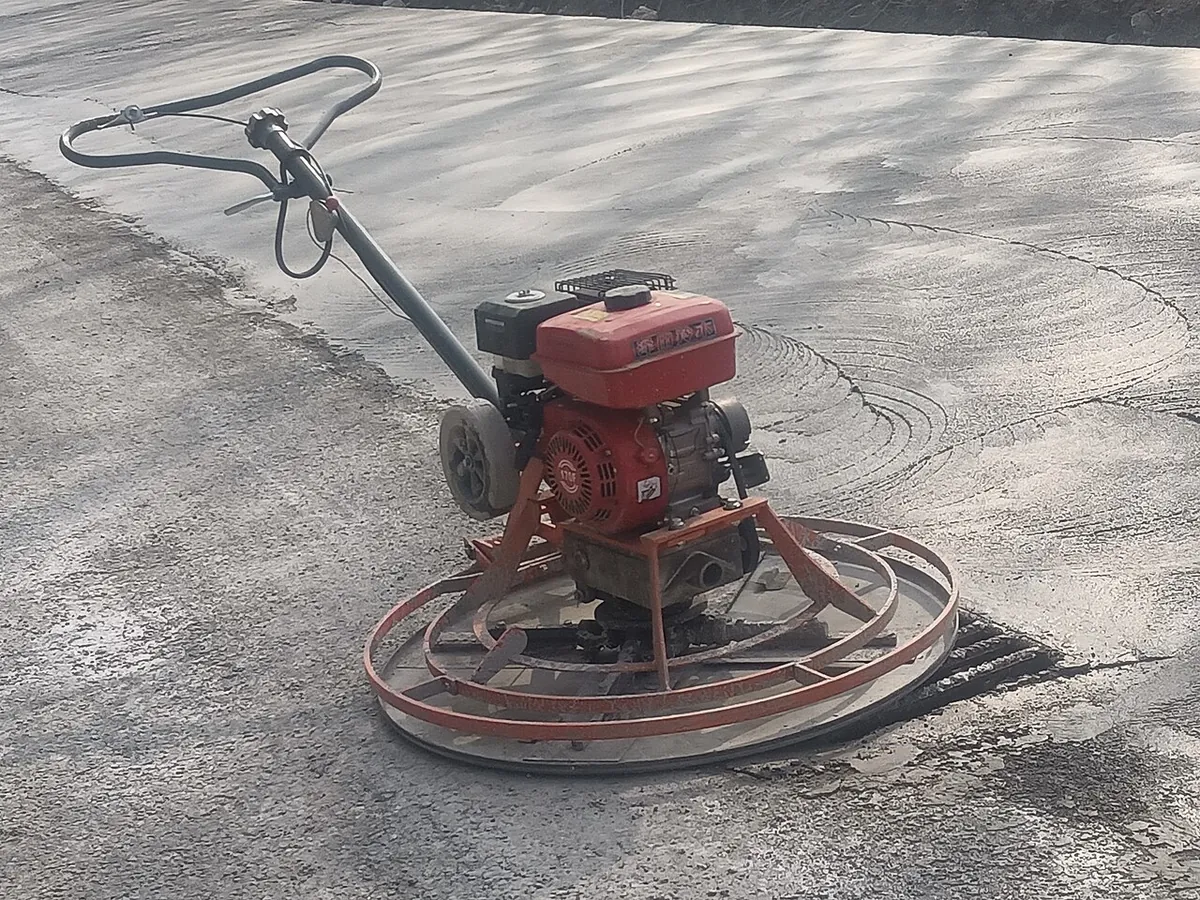
Photo: Fumikas Sagisavas, Wikimedia Commons, CC BY 4.0
For garage floors, basements, shops and other large slabs where you need smooth concrete fast, a power trowel like the walk-behind machine above saves time and gives a flatter, smoother finish. Power trowels have three or four blades on a rotating spider, with a large round guard ring. First, fit float pans or float blades and run the machine over the slab when it can support the machine without leaving deep marks; this floats the surface. Then switch to finishing blades and make several trowel passes, increasing the blade pitch each time as the concrete hardens. Keep the machine moving, overlap passes, and finish edges and corners by hand. Walk-behind trowels typically have 36 to 46 inch diameters; ride-on trowels with two rotors are used on large commercial floors. Power trowels rent for about $75 to $150 per day. Running one takes practice; a beginner should practice on an area that will be covered later. See concrete floors in homes.
How to Smooth Concrete That Has Already Hardened
If the concrete has already set and the surface is rough, uneven, pitted or has trowel marks, you can still get smooth concrete with the right concrete smoothing method.
Rubbing and light grinding. Small ridges, form lines and bumps can be removed with a rubbing brick (carborundum stone) dipped in water, or with an angle grinder fitted with a diamond cup wheel. Work in small circles, keep the grinder moving, and use a dust shroud and vacuum. See concrete grinding.
Floor grinding. For whole floors with rough or uneven surfaces, a walk-behind floor grinder with diamond tooling flattens and smooths the surface, starting with coarse grits and moving to finer ones. Continuing to very fine grits produces polished concrete. See polished concrete cost.
Skim coat or resurfacer. A polymer-modified concrete resurfacer can be spread thin, about 1/8 inch, over a clean, damp surface with a squeegee or steel trowel and finished smooth. It covers pitting, scaling, pop-outs and rough finishes. See how to resurface concrete.
Self-leveling underlayment. For indoor floors that are uneven as well as rough, a self-leveling underlayment poured over a primed slab flows out to a flat, smooth surface ready for flooring. See self-leveling concrete.
Patching. Holes and spalls are filled with a patching compound and troweled smooth. See concrete patching compound.
Smoothing Concrete Walls, Steps and Countertops
Getting smooth concrete on walls is a little different. Poured concrete walls often have form lines, honeycombing and fins where form panels met. Fins can be knocked off with a hammer and ground smooth, and the surface can be rubbed with a carborundum stone and a cement slurry, a traditional technique called sack rubbing, or skim coated with a wall resurfacer. Steps are smoothed like slabs while fresh, but treads should get a light broom texture for safety. For countertops and other precast items, smoothness comes from casting against smooth molds and from grinding and polishing after demolding. See honeycombing in concrete, how to fix concrete steps and concrete countertops.
How to Smooth Concrete for Common Projects
Garage floors. A garage floor is the classic place for smooth concrete. Screed and bull float the slab, wait for the bleed water to go, then float and steel trowel it two or three times, by hand on a single-car garage or with a power trowel on larger floors. A hard-troweled garage floor is easy to sweep and hose, resists oil stains better than a rough surface, and is ready for an epoxy coating after it is ground or etched. Leave the apron outside the door with a broom finish for traction. See concrete garage floor repair and epoxy for concrete.
Basement and interior floors. Interior slabs that will be left exposed, stained or polished benefit from careful concrete smoothing while fresh, because every trowel mark and low spot will show. Floors that will be covered with tile or flooring need to be flat rather than glassy; a smooth floated or lightly troweled finish gives thinset and adhesives a good bond. If an existing basement floor is rough, grinding or a self-leveling underlayment gives smooth concrete for new flooring. See concrete floors in homes and how to lay tile on concrete.
Patios and driveways. For outdoor slabs, the goal is a smooth, flat surface with a fine texture for grip. Bull float and float the slab until it is smooth, edge and joint it, make at most one light trowel pass, and finish with a broom. This gives smooth concrete underfoot without the danger of a polished surface. See how to pour a concrete patio and concrete driveway cost.
Countertops and furniture. Cast-in-place countertops are troweled repeatedly, then ground and polished; precast pieces get their smooth face from the mold and are finished with diamond pads. See concrete sink and concrete coffee table.
Before painting or coating. Paint and coatings need a clean, sound surface with a slight profile, not a glassy one. If you are smoothing concrete before painting, grind off bumps and fill holes, but leave enough texture for the paint to bite, or etch the surface. See concrete paint and concrete primer.
How to Smooth Concrete in Hot and Cold Weather
Weather changes how to smooth concrete more than anything else. In hot, dry or windy weather, the surface can dry and crust before the concrete below has set, making it hard to finish and prone to plastic shrinkage cracks. To smooth concrete in heat, pour early in the morning, dampen the base and forms before placing, use a set-retarding admixture if needed, spray an evaporation retarder on the surface between finishing passes, have extra finishers on hand, and start curing as soon as finishing is done. In cold weather, the opposite happens: the concrete sets slowly, bleed water lingers, and finishers may wait hours before they can trowel. Use heated concrete or accelerators, protect the slab with blankets, and never trowel while bleed water is present just to speed things up. Smooth concrete placed in cold weather must be kept from freezing until it has gained strength. See pouring concrete in cold weather, concrete blankets and calcium chloride in concrete.
Concrete Smoothing Tips From Experienced Finishers
Experienced finishers have a few habits that make concrete smoothing easier. They order concrete with the right slump for the job, rather than adding water at the truck, which makes the surface weak and slow to finish. They keep their tools clean, because dried concrete on a trowel leaves streaks. They work in a consistent pattern, overlapping each pass by about half, so no area is missed. They tilt the trowel only slightly on the first pass and more on later passes, letting the tool glide rather than dig. They keep the edges and joints crisp by running the edger and groover again after troweling. They watch the whole slab, not just the spot in front of them, so they can catch areas that are setting faster. And they never sprinkle dry cement on wet spots, a practice called dusting, which creates a weak layer that peels later. Following these habits, even a first-timer can learn how to smooth concrete on a small slab and get a surface that looks professional.
Concrete Smoothing for Repairs and Patches
Repairs need smooth concrete too, so the patch blends in with the surrounding surface. When patching a spall or a hole, overfill it slightly, then strike it off flush with a straightedge or trowel, and finish it with the same tool used on the original surface: a steel trowel on smooth floors, a float and broom on driveways and sidewalks. Feather the edges carefully only with products designed for featheredging, since ordinary mortars break at thin edges. For larger worn areas, a resurfacer spread over the whole slab gives a uniform finish rather than a patchwork of smooth and rough spots. Concrete smoothing on repairs should be done at the same stage as on new concrete: after bleed water has gone, and before the patch material becomes too stiff to work. See concrete spalling and concrete restoration.
Grinding vs Resurfacing: Which Is Best for Smooth Concrete?
When an existing slab is rough, both grinding and resurfacing can give smooth concrete, and the choice depends on the problem. Grinding removes material, so it is best for high spots, ridges, old coatings, trowel marks and lippage between slabs, and for preparing a surface for polishing or coatings. It does not fill low spots, pits or holes, and grinding too deep exposes aggregate. Resurfacing adds a new layer, so it covers pitting, scaling, pop-outs, stains and rough broom finishes, and can renew the color of the slab. It does not fix structural cracks or settled slabs, and it needs a sound, clean surface to bond to. Many projects use both: grind first to remove high spots and open the surface, then resurface to fill and smooth. For indoor floors that are out of level, self-leveling underlayment is the best way to get both flat and smooth concrete. See concrete grinding and how to resurface concrete.
Quick Checklist: How to Smooth Concrete
If you only remember one section on how to smooth concrete, make it this checklist. For fresh concrete: order the right mix and do not add water at the truck; screed the concrete level as soon as it is placed; bull float it once or twice; wait for the bleed water to disappear completely; float the surface with a magnesium float or power float; steel trowel it one to three times as it stiffens, raising the blade angle each pass; edge and joint it; and cure it right away. That is how to smooth concrete on a new slab. For hardened concrete: clean it, grind high spots and ridges, fill holes and cracks, then either grind further for a polished look, skim coat it with a resurfacer for smooth concrete outdoors, or pour self-leveling underlayment for smooth concrete floors indoors. That is how to smooth concrete that has already set.
Concrete smoothing is a skill that improves with practice. On a first project, start small, such as a shed pad or a short walkway, have a helper, and keep a spare trowel and float on hand. Watch how the surface changes as it sets, and test it often. With a little experience you will learn to read the concrete and know exactly when to float, when to trowel and when to stop, which is the real secret of smooth concrete.
Smooth Concrete vs Textured Concrete
Smooth concrete and textured concrete each have their place. Smooth concrete is easy to clean, looks sleek and modern, reflects light, and is the right base for polishing, staining, sealing, coatings and many floor coverings. It is the standard finish for garage floors, basements, warehouses, interior slabs and countertops. Textured concrete, such as broom, swirl, salt, exposed aggregate and stamped finishes, gives grip outdoors and hides wear and stains. Many projects combine both: smooth concrete indoors and textured outside, or a smooth troweled border around a broom-finished center. When deciding how to smooth concrete on your project, start by deciding how smooth it should be for its use, then pick the tools and finishing steps to match. See brushed concrete and decorative concrete.
DIY or Hire a Pro for Smooth Concrete?
Small jobs such as a shed pad, a short walkway or a patch are good DIY practice for learning how to smooth concrete. Large garage floors, basements and any slab that will be left exposed or polished are harder, because the finishing window is short and smooth concrete shows every mistake. Professional finishers bring power trowels, extra hands and experience reading the surface. If you hire out the pour, ask the contractor what level of concrete smoothing is included, such as a steel-troweled or hard-troweled finish, and agree on how smooth concrete should look before the truck arrives.
Smooth Concrete and Slip Safety
A hard-troweled, glossy smooth concrete surface is very slippery when wet. That is fine for garage floors, basements and interior floors that stay dry, but dangerous for driveways, sidewalks, patios, steps, ramps and pool decks. Outdoors, smooth the concrete with a float and at most one light trowel pass, then give it a broom finish. Indoors, smooth concrete floors can be made safer with anti-slip additives in sealers or coatings. Hard troweling also seals the surface so tightly that it can trap air in air-entrained exterior concrete, leading to surface delamination, which is another reason to keep exterior slabs lightly finished. See brushed concrete.
Common Mistakes When Smoothing Concrete
Troweling too early. The most common mistake in concrete smoothing. Working bleed water into the surface makes it weak, dusty and prone to scaling.
Adding water to the surface. Sprinkling water to make troweling easier weakens the surface. Use an evaporation retarder if the surface dries too fast.
Troweling too late. If the concrete is too hard, the trowel only scratches it. Have enough people and tools to finish while the window is open.
Overworking. In concrete smoothing, more is not better. Too many passes, too early, bring too much fine material and water to the top.
Hard troweling exterior air-entrained concrete. Can cause blistering and delamination, plus a slippery surface.
Skipping curing. Smooth surfaces dry and crack quickly if not cured. See why does concrete crack.
Cost of Smoothing Concrete
For DIY concrete smoothing, hand floats and trowels cost about $15 to $60 each, a bull float with handle about $80 to $250, and a power trowel rental $75 to $150 per day. Contractors typically include a smooth troweled finish in the price of a slab, sometimes charging slightly more for a hard steel-troweled interior finish than for a broom finish because of the extra labor. Smoothing hardened concrete costs more, because smooth concrete has to be created by removing or adding material: grinding typically runs $1 to $3 per square foot, resurfacing $3 to $7 per square foot, self-leveling underlayment $2 to $6 per square foot, and polished concrete $3 to $12 per square foot. See concrete cost per square foot and concrete overlay cost.
Frequently Asked Questions
When should you start troweling concrete?
When the bleed water has disappeared and a thumb pressed into the surface leaves only a slight impression.
How do you make concrete smooth like glass?
Indoors, trowel it several times with a steel or power trowel as it hardens, or grind and polish it after it cures.
Can you smooth concrete after it dries?
Yes, by grinding, rubbing, applying a resurfacer skim coat, or pouring self-leveling underlayment indoors.
Should outdoor concrete be smooth?
No. Float it smooth, then give it a broom finish so it is not slippery when wet.
Why is my troweled concrete dusty?
Usually from troweling while bleed water was present, adding water, or poor curing, all of which weaken the surface.
Sources
- American Concrete Institute: ACI 302.1R floor and slab construction
- Portland Cement Association: finishing concrete slabs
- National Ready Mixed Concrete Association: Concrete in Practice, finishing
- OSHA: silica dust when grinding concrete
Related Guides
- Concrete densifier — silicate hardeners for floors