
How to Add Stabilizer to Pool Water: A Complete CYA Guide
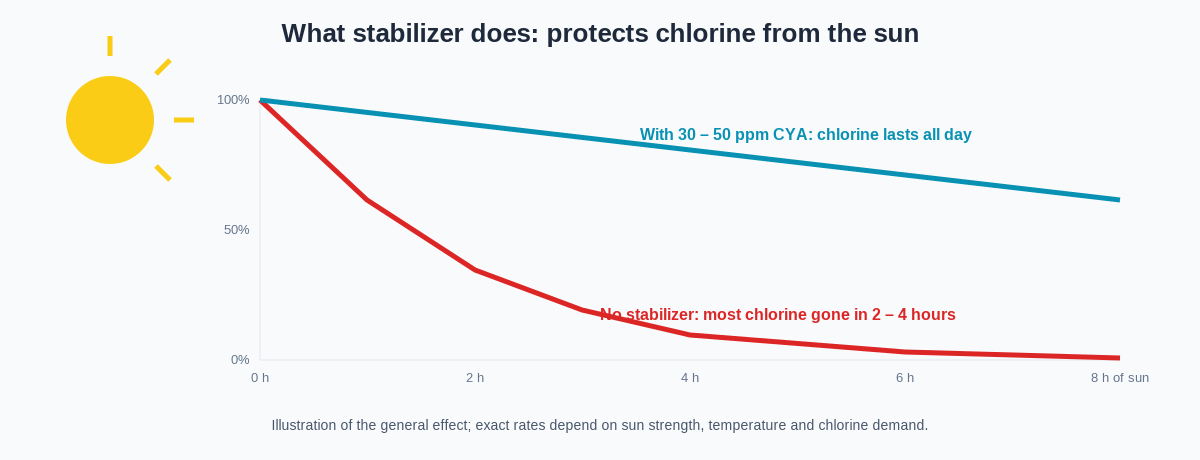
Chart: Asphapro.com
Quick Answer
How to add stabilizer to pool water: test cyanuric acid (CYA) first. Most outdoor chlorine pools do best at 30 to 50 ppm, and salt pools at 60 to 80 ppm. About 13 oz of granular cyanuric acid raises 10,000 gallons by 10 ppm. To add it, put the granules in a sock or mesh bag in the skimmer basket with the pump running, or dissolve them slowly in a bucket of warm water and pour it in front of a return. Liquid stabilizer dissolves faster but costs more. Do not backwash for 3 to 7 days, then retest. Stabilizer does not break down or evaporate, so add it carefully: the only practical way to lower CYA that is too high is to drain part of the water and refill.
If you keep adding chlorine to an outdoor pool but the level keeps dropping to zero by afternoon, the problem may not be chlorine at all. Sunlight destroys unprotected chlorine within a few hours. Pool stabilizer, also called conditioner or cyanuric acid (CYA), forms a loose bond with chlorine that shields it from ultraviolet light, so it lasts through sunny days. Adding the right amount of stabilizer can cut chlorine use dramatically.
But stabilizer has a catch: it slowly builds up, and too much makes chlorine weak. This guide explains what pool stabilizer does, the right CYA levels for chlorine and salt pools, granular versus liquid stabilizer, how to add stabilizer to pool water step by step, a pool stabilizer calculator, how to test CYA, and how to fix stabilizer that is too high or too low. For chlorine doses that match your CYA, see how much chlorine to add to pool.
What Is Pool Stabilizer?
What is stabilizer for a pool, and what is the stabilizer in a pool made of? Pool stabilizer is cyanuric acid, a white, mildly acidic compound sold as granules, tablets (as part of trichlor and dichlor) or liquid. What is CYA in a pool doing exactly? When it dissolves, it binds loosely to free chlorine. The bound chlorine is protected from the sun's UV rays but is released as needed to kill germs and algae. In effect, stabilizer acts like sunscreen for chlorine.
Without stabilizer, an outdoor pool can lose most of its free chlorine in 2 to 4 hours of strong sun. With stabilizer in range, the same chlorine can last all day. That is why stabilizer is sometimes called a chlorine stabilizer for pool use, or pool conditioner.
What Does Pool Stabilizer Do (and Not Do)?
- Protects chlorine from sunlight, greatly reducing how much chlorine you use outdoors.
- Keeps chlorine levels steadier through the day.
- Reduces chlorine strength: the bound chlorine is weaker, so with more CYA you need a higher free chlorine level to get the same germ-killing power.
- Does not sanitize on its own and does not kill algae.
- Does not break down or evaporate; it leaves only with water loss from splash-out, backwashing, leaks or draining.
Ideal Pool Stabilizer Levels
The right swimming pool stabilizer level depends on how you chlorinate. Pool water stabilizer targets differ for chlorine and salt pools.
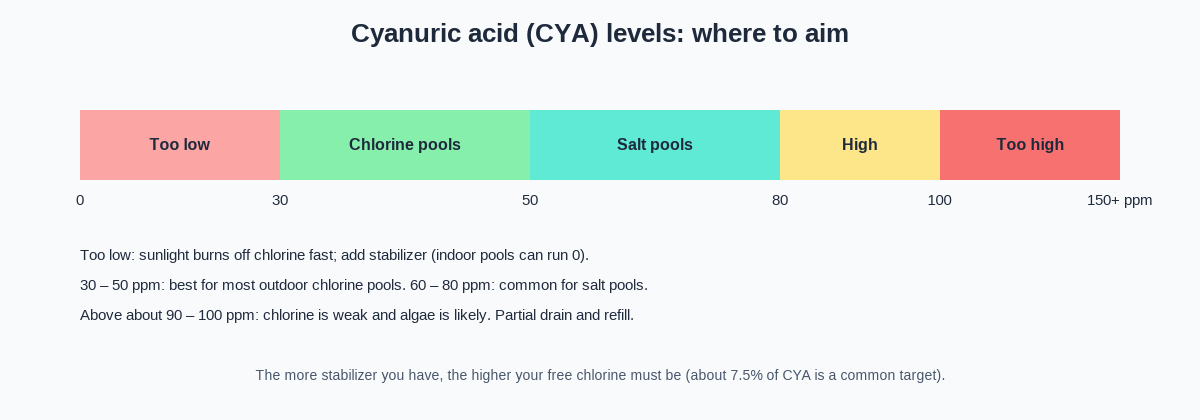
Chart: Asphapro.com
| Pool type | Target CYA | Matching free chlorine (about 7.5% of CYA) |
|---|---|---|
| Indoor pool | 0 – 20 ppm | 1 – 3 ppm |
| Outdoor chlorine pool | 30 – 50 ppm | 3 – 5 ppm |
| Outdoor salt pool | 60 – 80 ppm | 5 – 7 ppm |
| Too high (any pool) | Above 90 – 100 ppm | Chlorine becomes very weak |
Many public health codes set a maximum CYA for commercial pools (often 90 or 100 ppm). Residential pools are not regulated the same way, but staying in the ranges above keeps chlorine effective and algae away.
Pool Stabilizer Calculator
Use this pool stabilizer calculator to estimate how much granular cyanuric acid to add to reach your target.
The math: raising 10,000 gallons by 1 ppm takes about 0.083 lb (1.3 oz) of pure cyanuric acid. Granular stabilizer is close to 100% cyanuric acid. For liquid stabilizer, follow the product label, since concentrations vary. Add a bit less than the result, wait a week, and top up if needed, since you cannot easily remove extra.
How to Add Stabilizer to Pool: Step by Step
Here is how to raise pool stabilizer safely. These steps also answer how to increase stabilizer in pool water, how to raise cya in pool water and how to adjust cyanuric acid in pool water in small steps.
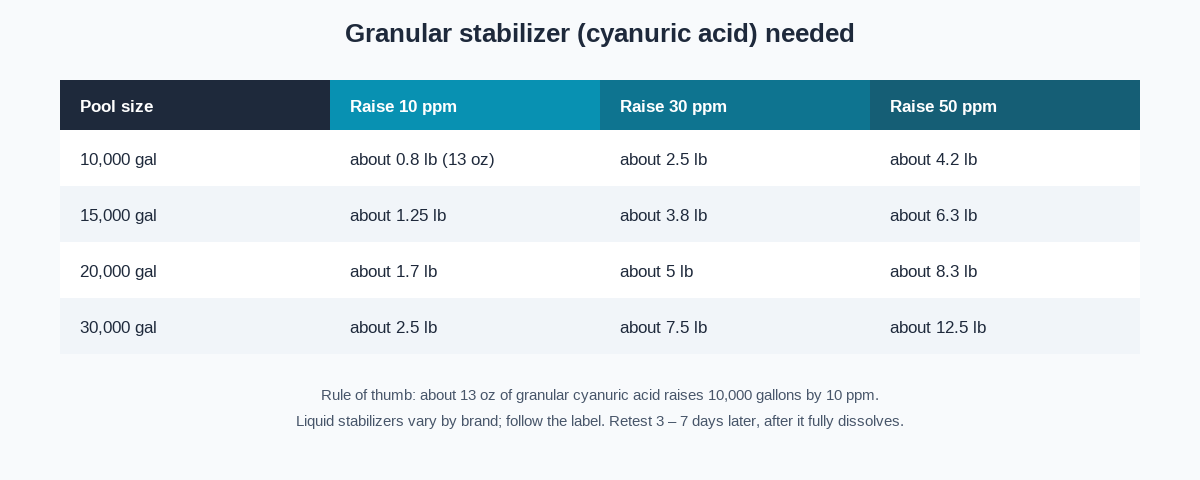
Chart: Asphapro.com
Method 1: Sock in the skimmer (granular)
- Test CYA and calculate the dose.
- Pour the granules into a clean sock, nylon stocking or mesh bag, and tie it closed.
- Place the sock in the skimmer basket with the pump running.
- Squeeze the sock every few hours to help it dissolve. Granular cyanuric acid dissolves slowly, often taking 1 to 3 days.
- Do not backwash or clean the filter for 3 to 7 days, so undissolved stabilizer trapped in the filter is not lost.
- Retest CYA after a week.
Method 2: Dissolve in a bucket
- Fill a 5-gallon bucket with warm water.
- Slowly add the granules while stirring (add chemical to water).
- Pour the slurry slowly in front of a return jet with the pump running.
- Brush any granules that settle on the floor until they dissolve.
Avoid broadcasting granules directly over a vinyl liner, where they can sit on the floor and bleach or weaken the vinyl.
Method 3: Liquid stabilizer
Liquid stabilizer is cyanuric acid in suspension. It is easy to pour and dissolves quickly, so CYA rises faster and you can test sooner. It costs more per ppm than granular stabilizer. Shake well, pour in front of a return with the pump running, and follow the label for the dose.
Pool Stabilizer Low: Signs and Fixes
A pool stabilizer low reading is common in new pools, after a partial drain, after heavy rain overflow, and in pools that use only liquid chlorine or a salt cell without ever adding CYA. Signs that your CYA pool level is too low:
- Free chlorine drops to near zero by mid-afternoon on sunny days.
- You add chlorine every day but still struggle to hold a level.
- Algae appears even though you chlorinate often.
- Your salt cell runs at high output but chlorine stays low.
- A test shows CYA below about 20 ppm.
The fix is simple: add stabilizer to bring CYA into the target range, then keep it there. In many pools, raising CYA from 0 to 40 ppm cuts daily chlorine use by more than half.
How to Raise Cyanuric Acid Level in Pool Water: Choosing a Product
There are three common ways to raise cyanuric acid level in pool water:
- Granular cyanuric acid: the most common and lowest-cost stabilizer. Nearly pure CYA. Dissolves slowly; best added in a skimmer sock or pre-dissolved.
- Liquid stabilizer for pool use: liquid pool stabilizer is a suspension that dissolves fast and shows up on tests sooner. It costs more per ppm. Good for small adjustments and for owners who want quick results.
- Stabilized chlorine (trichlor or dichlor): these chlorine products contain CYA. Every pound of trichlor adds stabilizer as it dissolves. Useful for small, gradual increases, but easy to overdo over a season.
Pool stabilizer and conditioner are the same product under different names. Whichever label you see, check that the active ingredient is cyanuric acid.
Hidden Stabilizer: Trichlor and Dichlor
Many owners never add pool stabilizer directly, yet end up with very high CYA. The reason is stabilized chlorine:
- Trichlor tablets: for each 10 ppm of chlorine added, they add about 6 ppm of CYA.
- Dichlor granules: for each 10 ppm of chlorine added, they add about 9 ppm of CYA.
Over a hot summer, an outdoor pool using only tablets can gain 50 ppm or more of stabilizer. That is why many experienced owners use tablets only part of the season and switch to liquid chlorine or a salt cell once CYA reaches the target. Test CYA every month or two if you use stabilized chlorine.
Pool Stabilizer Too High: How to Lower CYA
Cyanuric acid does not break down in sunlight or evaporate. Once it is in the water, it stays until water leaves the pool. When CYA climbs above about 90 to 100 ppm, chlorine becomes so weak that algae and cloudy water are hard to prevent, even with normal chlorine readings. Options:
- Partial drain and refill: the most reliable method. To lower CYA by a certain percentage, replace about that percentage of the water. For example, to go from 120 ppm to 60 ppm, drain and refill about half the pool. Take care with vinyl liners and high water tables; drain in stages if needed. See how to drain a pool.
- Backwash and splash-out: normal water loss lowers CYA slowly; refill with fresh water.
- Reverse osmosis service: mobile units in some areas filter pool water to remove CYA and dissolved solids, saving water.
- CYA reducer products: enzyme-based products claim to break down CYA. Results vary, and they work best in warm water with good conditions.
- Raise chlorine to match: as a short-term fix, keep free chlorine at about 7.5% of your CYA level.
After lowering CYA, switch to unstabilized chlorine (liquid or cal-hypo) or a salt cell to stop it from climbing again.
How to Test Pool CYA
Testing pool CYA is usually done with a turbidity test: you mix pool water with a reagent that turns cloudy in proportion to the CYA, then look through it at a black dot in a tube. The CYA level is read where the dot disappears. Test strips also measure CYA, but they are less accurate. Tips:
- Test in good daylight with your back to the sun.
- Water warmer than about 70 °F gives the most accurate readings.
- Readings under 30 ppm are hard to read on some kits; dilute the sample with tap water for very high readings.
- Test CYA monthly, or every two weeks if you use trichlor tablets.
Stabilizer in Salt Water Pools
Salt pools need stabilizer too, usually more of it, at 60 to 80 ppm. The salt cell makes chlorine steadily, and higher CYA protects that chlorine and lets the cell run at a lower output, which extends cell life. Many salt system manuals give a recommended CYA range; follow it. Because salt cells add no CYA, the level only drops with water loss, so retest after big refills or rain overflows.
How to Increase Cyanuric Acid in Swimming Pool Water Without Overshooting
Because CYA is hard to remove, the safest way to increase cyanuric acid in pool water is in steps. Add about two-thirds of the calculated dose, wait 5 to 7 days for granular stabilizer to dissolve fully, retest, and then add the rest if needed. Liquid stabilizer shows up faster, often within 24 to 48 hours. Keep the filter from being backwashed during this time, since granules caught in a sand filter can be lost to waste.
Common Stabilizer Mistakes
- Adding too much at once and having no easy way to remove it.
- Testing too soon after adding granular stabilizer, before it dissolves, and then adding more.
- Backwashing right after adding, washing undissolved granules out of the filter.
- Using trichlor all season without testing CYA.
- Keeping the same chlorine target while CYA rises; free chlorine must go up with CYA.
- Adding stabilizer to an indoor pool, where it is rarely needed.
- Leaving granules on a vinyl floor, which can damage the liner.
Stabilizer and Chlorine: Why the Two Numbers Go Together
The most important thing to know about a chlorine stabilizer pool setup is that CYA and free chlorine must be matched. When cyanuric acid binds to chlorine, only a small share of the chlorine stays in its strong, active form. The higher the CYA, the smaller that share. So a pool with 80 ppm CYA and 3 ppm free chlorine has far less active chlorine than a pool with 30 ppm CYA and 3 ppm free chlorine, even though the test reads the same.
A simple rule many pool owners use is to keep free chlorine at about 7.5% of the CYA level, and never let it fall below about 5% of CYA. At 40 ppm CYA, that means about 3 ppm minimum and 4 to 5 ppm as a daily target. At 80 ppm CYA, it means about 6 ppm. To shock, raise free chlorine to about 40% of CYA. This is why pool chlorine stabilizer levels should stay moderate: the higher you go, the more chlorine you must add to stay safe and clear.
Managing Stabilizer Through the Season
- At opening: test CYA first. Winter rain and overflow may have diluted it, or it may be high from last year's tablets.
- Early summer: bring CYA to your target with granular or liquid stabilizer before the sun gets strong.
- Mid-summer: test monthly. If you use tablets, switch to liquid chlorine when CYA reaches the top of your range.
- After big storms or refills: retest, since dilution lowers CYA.
- At closing: note the level so you know where you start next year.
Stabilizer for Above Ground Pools
Above ground pools follow the same targets: 30 to 50 ppm for chlorine pools and 60 to 80 ppm for salt systems. Because their volume is smaller, doses are smaller and easier to overshoot, so add stabilizer in steps. Many above ground pools use trichlor tablets in a floater, which adds stabilizer steadily, so testing CYA every few weeks matters. Avoid letting granular stabilizer sit on the vinyl floor; use the skimmer sock or bucket method.
Pool Stabilizer Cost
Granular stabilizer usually costs about $5 to $10 per pound, and liquid stabilizer about $15 to $30 per gallon (which treats fewer ppm per dollar). Raising a 15,000 gallon pool from 0 to 40 ppm takes about 5 lb of granular stabilizer, roughly $25 to $50. Because CYA stays in the water, most pools only need stabilizer at opening and after large water changes. Swimming pool stabilizer distributors and pool stores sell it in 4 lb, 7 lb and larger tubs; buy only what you need, since excess is easy to add and hard to remove.
Storage and Safety
- Store stabilizer in a cool, dry place in its original container, away from chlorine and acids.
- Wear gloves and avoid breathing the dust when pouring granules.
- Keep it away from children and pets.
- Never mix stabilizer with chlorine products in the same bucket.
- Rinse skin or eyes with water if dust or liquid gets on them.
Is Stabilizer Always Needed?
For outdoor pools in sunny climates, yes: without it, chlorine costs and daily dosing go up sharply. For indoor pools, it is usually unnecessary. Some owners of outdoor pools prefer low CYA (20 to 30 ppm) with careful, frequent chlorine dosing, because chlorine is stronger at low CYA. Others with salt cells run higher CYA to protect the cell. Either approach works if free chlorine is matched to CYA and tested often.
Worked Examples: How Much Stabilizer to Add
Example 1: New 15,000 gallon chlorine pool, CYA 0
Target 40 ppm. The pool needs about 15,000 x 8.34 x 40 / 1,000,000 = 5 lb of granular stabilizer. Add about 3.5 lb in a skimmer sock, wait a week, retest, and add the remaining 1.5 lb if needed.
Example 2: 20,000 gallon salt pool after a partial refill, CYA 40
Target 70 ppm, an increase of 30. The pool needs about 5 lb of granular stabilizer. Since the salt cell adds no CYA, this level should hold for months, dropping only with water loss.
Example 3: 24 ft round above ground pool (about 13,000 gallons), CYA 20
Target 40, an increase of 20. The pool needs about 2.2 lb (35 oz). Add about 24 oz first. If the pool uses trichlor tablets, add less, since the tablets will add more CYA over the coming weeks.
Liquid Stabilizer Pool Tips
Liquid stabilizer pool products are popular because they show up on tests within a day or two and do not leave granules on the floor. Shake the bottle well, since cyanuric acid can settle. Check the label for how many ppm each bottle adds per 10,000 gallons, because concentrations differ by brand. Liquid stabilizer usually costs two to four times more per ppm than granular, so it makes the most sense for small corrections, small pools and owners who want quick, simple dosing.
When to Call a Pool Professional
If your CYA test results seem odd, if chlorine will not hold even with matched CYA, or if CYA is very high and you are unsure how to drain safely, a pool professional can test with lab-grade equipment and plan a partial drain or water replacement. This is especially important for vinyl pools, where draining too much can damage the liner, and for pools in areas with high groundwater.
Stabilizer by Pool Surface
Stabilizer itself does not harm plaster, fiberglass or vinyl at normal levels, but how you add it matters. On plaster, undissolved granules can sit in one spot and cause small etched areas, so brush them until they dissolve. On vinyl, granules left on the floor can weaken and bleach the liner, so use the skimmer sock or pre-dissolve in a bucket. Fiberglass handles stabilizer well, but keep pH in range while granules dissolve, since cyanuric acid is mildly acidic and can lower pH slightly.
Stabilizer When Opening a Pool
Spring opening is the best time to set CYA for the year. Test after the water has been circulating for a day. If CYA is low, add stabilizer before the sun gets strong; if it is high from last season's tablets, plan a partial drain before you fill the pool with fresh chemicals. Getting CYA right at opening makes chlorine easier to manage all summer.
Can I put stabilizer directly in the skimmer?
Use a sock or mesh bag in the skimmer basket. Pouring loose granules straight into the skimmer can clog the pump basket and filter.
How often do I need to add stabilizer?
Usually only at opening and after large refills, since CYA does not break down. Test monthly to confirm.
How to Add Stabilizer to Pool: Key Points
- Keep CYA at 30 to 50 ppm for chlorine pools and 60 to 80 ppm for salt pools.
- About 13 oz of granular stabilizer raises 10,000 gallons by 10 ppm.
- Add it in a sock in the skimmer or dissolved in a bucket; do not backwash for 3 to 7 days.
- Too much CYA weakens chlorine; lower it by partial draining.
Frequently Asked Questions
What is swimming pool stabilizer?
Pool stabilizer is cyanuric acid, which protects chlorine from sunlight so it lasts longer in outdoor pools.
How much stabilizer do I add to my pool?
About 13 oz of granular stabilizer per 10,000 gallons for each 10 ppm increase. Use the calculator for your pool.
What does stabilizer do for a pool?
It protects chlorine from sunlight so it lasts longer, which lowers chlorine use and keeps levels steadier.
How do you raise cyanuric acid in a pool quickly?
Use liquid stabilizer, which dissolves fast. Granular stabilizer can take several days to show its full effect.
Can I add stabilizer and chlorine at the same time?
Yes, they can go in the same day, but add them separately, not mixed together in one bucket.
How long after adding stabilizer can I swim?
Usually right away or after it has mixed, since cyanuric acid at normal levels does not irritate swimmers. Follow the label.
What happens if pool stabilizer is too low?
Sunlight burns off chlorine within hours, so you use much more chlorine and the pool is at risk of algae by late afternoon.
Can too much stabilizer hurt swimmers?
Not directly at pool levels, but it weakens chlorine, which can let germs and algae grow.
Does shock add stabilizer?
Dichlor shock does; cal-hypo and liquid chlorine do not. Check the label of any shock product for "stabilized" or "dichlor" before using it often, especially in summer.
Is pool stabilizer the same as conditioner?
Yes. Pool conditioner stabilizer products are both cyanuric acid.
Do indoor pools need stabilizer?
Usually not, since there is little sunlight to destroy chlorine. Some indoor pools with large windows use a small amount.
Why is my CYA high but chlorine keeps dropping?
High CYA weakens chlorine, so algae or organic waste can use it up. Raise free chlorine to about 7.5% of CYA and consider a partial drain.
Sources
- CDC: Pool chemistry and testing
- CDC: Model Aquatic Health Code
- Trouble Free Pool: Pool water chemistry
- Swim University: Pool stabilizer