
How to Increase Free Chlorine in Pool Water: Causes, Doses and Calculator
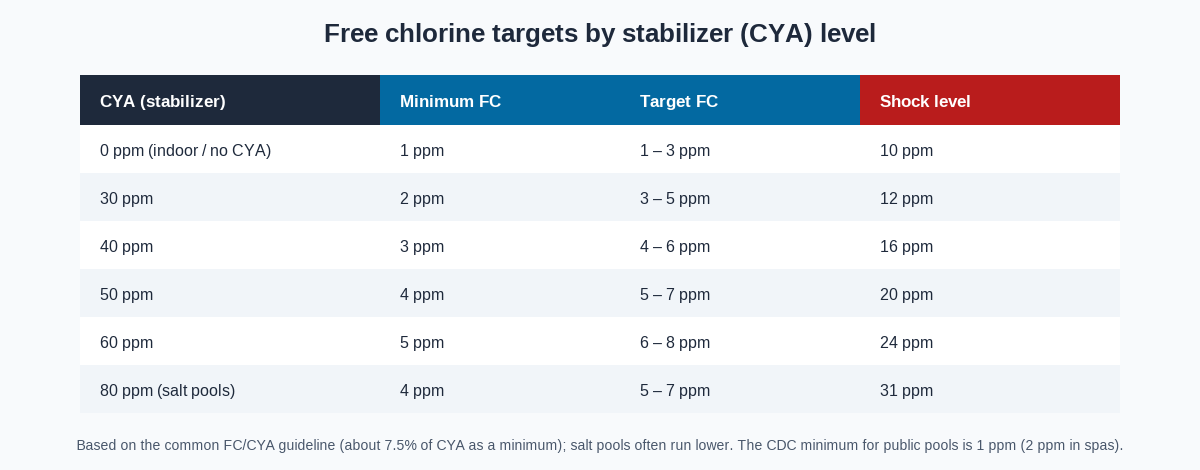
Chart: Asphapro.com
Quick Answer
To increase free chlorine in pool water, test free chlorine (FC) and cyanuric acid (CYA), then add a fast chlorine source such as liquid chlorine or unscented bleach in the evening with the pump running. About 10 fl oz of 12.5% liquid chlorine per 10,000 gallons raises FC by 1 ppm; cal-hypo needs about 2 oz and dichlor about 2.4 oz. Aim for a free chlorine level of about 7.5% of your CYA as a minimum, which is around 3 to 5 ppm for most outdoor pools. If free chlorine is low in pool water day after day, find the cause: low stabilizer, algae, heavy use, high phosphates, a worn salt cell or too little pump time.
Free chlorine is the part of the chlorine in your pool that is ready to kill germs and algae. When it drops too low, pools turn cloudy and green, and swimmers are less protected from bacteria. Low free chlorine in pool water is one of the most common problems owners face, especially in hot weather, after heavy use and after storms. The good news is that it is easy to fix once you know how much chlorine to add and why it is dropping.
This guide explains what is free chlorine in a pool, the right level to aim for, how to raise free chlorine in pool water with different products, and how to keep it steady. For general dosing, see our guide on how much chlorine to add to pool water.
What Is Free Chlorine in a Pool?
What is free chlorine in a pool, exactly? When you add chlorine to water, it forms hypochlorous acid and hypochlorite ions. Together these are called free chlorine (FC), or free available chlorine. This is the active sanitizer: it kills bacteria, viruses and algae and breaks down sweat, oils and other contaminants. As free chlorine reacts with ammonia and nitrogen compounds from swimmers, it forms chloramines, called combined chlorine (CC). Combined chlorine is a weak sanitizer and causes the "chlorine smell," red eyes and irritation. Free chlorine plus combined chlorine equals total chlorine (TC).
So when people ask what is free chlorine in a swimming pool, the short answer is: the chlorine that is still available to do its job. A good test kit measures free and total chlorine separately, so you can see both.
What Should Free Chlorine Be in a Pool?
The right free chlorine in pool water depends on your cyanuric acid (CYA), also called stabilizer. CYA protects chlorine from sunlight but also holds some of it in reserve, making it slower to act. The more CYA you have, the more free chlorine you need. A widely used guideline is to keep free chlorine at least 7.5% of your CYA level, with a target a little above that. For example, with CYA at 40 ppm, keep FC at least 3 ppm and aim for 4 to 6 ppm. With CYA at 60 ppm, keep FC at least 5 ppm.
Indoor pools with no CYA can run at 1 to 3 ppm. The CDC sets a minimum of 1 ppm free chlorine for public pools (2 ppm for hot tubs) and 3 ppm for pools that use CYA. Many test kit makers suggest 1 to 3 ppm as a general range, but in outdoor pools with stabilizer, that is often too low to prevent algae. Matching free chlorine to CYA, as in the chart above, is the most reliable approach.
Why Is Free Chlorine Low in Pool Water?
If free chlorine low in pool tests keeps showing up, look for these causes:
Sunlight. UV light destroys unstabilized chlorine within hours. Without CYA, an outdoor pool can lose most of its chlorine in a single sunny afternoon.
Low stabilizer. If CYA is under 30 ppm in an outdoor pool, chlorine burns off quickly. Add stabilizer to bring it to 30 to 50 ppm.
Heavy use. Swimmers bring in sweat, sunscreen and other contaminants that use up chlorine fast.
Algae or organic matter. Algae, leaves, pollen and dirt consume chlorine. If chlorine disappears overnight, you may have hidden algae.
Warm water. Chlorine is used up faster in warm water.
Rain. Heavy rain dilutes chlorine and brings in debris.
Salt cell problems. In salt pools, low salt, a scaled cell, too little pump time or a worn cell can all reduce output. See how to clean salt water pool cell plates.
Not enough chlorine added. Tablets that have run out in the floater or a feeder set too low are common causes.
How to Increase Free Chlorine in Pool: Step by Step
Step 1: Test. Test free chlorine, combined chlorine, pH and CYA. A drop-based FAS-DPD test kit gives the most accurate free chlorine results, especially at higher levels.
Step 2: Set your target. Use the chart to choose a target free chlorine for your CYA level.
Step 3: Choose a chlorine source. For a quick increase, use liquid chlorine (sodium hypochlorite) or unscented bleach. These add no CYA or calcium. Cal-hypo adds calcium, and dichlor adds CYA, which matters over time.
Step 4: Calculate the dose. Use the calculator below.
Step 5: Add chlorine in the evening. With the pump running, pour liquid chlorine slowly in front of a return jet. Pre-dissolve granular chlorine in a bucket of pool water unless the label says otherwise. Never mix different chlorine products.
Step 6: Circulate and retest. Run the pump for at least an hour, then retest. Test again the next morning to see how much chlorine was lost overnight.
Free Chlorine Dose Calculator
Enter your pool volume, current and target free chlorine and the product you are using to see how much to add.
How to Raise Free Chlorine in Pool Water With Different Products
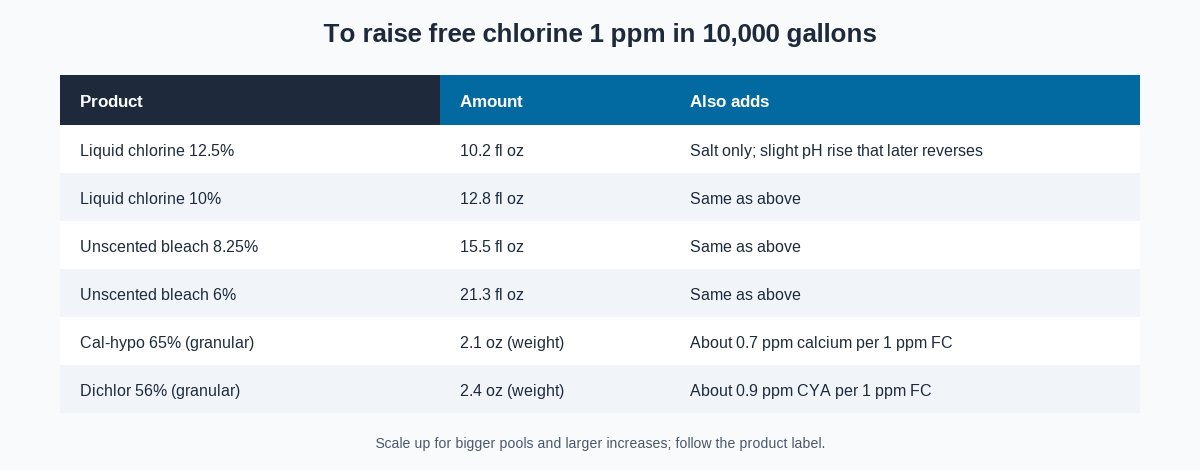
Chart: Asphapro.com
Liquid chlorine (sodium hypochlorite). The best choice for most daily dosing and for raising free chlorine quickly. It adds no CYA or calcium, only a little salt. Buy fresh, since it loses strength over time, especially in heat.
Unscented household bleach. The same chemical at a lower strength, usually 6 to 8.25%. Use plain, unscented bleach without additives or splash-less formulas.
Cal-hypo (calcium hypochlorite). A strong granular shock that adds calcium. Good in pools with low calcium hardness, but can raise hardness too high over time.
Dichlor. A stabilized granular chlorine that dissolves quickly and adds CYA. Useful in new pools that need stabilizer, but regular use pushes CYA too high.
Trichlor tablets. Slow-dissolving tablets for floaters or feeders. They add CYA and lower pH. They keep chlorine steady but are too slow to raise free chlorine quickly.
Salt chlorine generators. In salt pools, raise free chlorine by turning up the output percentage, running the pump longer, or using the boost mode. For a fast increase, add liquid chlorine.
Low Free Chlorine in Pool Water That Will Not Hold
Photo: Farven, Wikimedia Commons, CC BY-SA 3.0
If you add chlorine and the free chlorine level falls quickly again, something is using it up. Do an overnight chlorine loss test: test free chlorine at dusk after the sun goes down, then again at dawn before the sun comes up. If you lose more than 1 ppm overnight, there is likely algae or organic matter in the pool. In that case, shock the pool by raising free chlorine to the shock level for your CYA and holding it there, brushing and testing several times a day, until the water is clear, combined chlorine is 0.5 ppm or less, and the overnight loss is 1 ppm or less. See how to get rid of algae in pool water.
Free Chlorine vs Total Chlorine
If your total chlorine is much higher than your free chlorine, the difference is combined chlorine. Combined chlorine above 0.5 ppm means chloramines are building up. The fix is to raise free chlorine to shock level and hold it until combined chlorine drops. Adding more chlorine may seem odd when you smell chlorine, but the smell comes from chloramines, not free chlorine, and only more free chlorine breaks them down.
Chlorine Free Pool Shock
Chlorine free pool shock is potassium monopersulfate (MPS), sometimes called non-chlorine shock or oxidizer. It oxidizes sweat, oils and other contaminants and can help break down chloramines, freeing up chlorine to do its sanitizing work. It lets swimmers return to the pool in about 15 minutes. But chlorine free pool shock does not raise free chlorine and does not kill algae or bacteria on its own. Use it as a weekly oxidizer in busy pools if you like, but when free chlorine is low, add chlorine. Note that MPS can show up as free chlorine on some DPD tests, giving a falsely high reading.
Chlorine Free Pool and Chlorine Free Swimming Pool Options
Some owners want a chlorine free pool. Options include biguanide (PHMB) systems, natural swimming pools that use plants and biological filters, and pools that rely mostly on ozone, UV or mineral systems. In practice, most chlorine free swimming pool options still need some sanitizer: ozone and UV treat water only as it passes through the equipment, and mineral systems are usually paired with low chlorine levels. Biguanide works without chlorine but is more expensive, cannot be mixed with chlorine and can be harder to manage. Natural pools need a large planted area and careful design. Salt pools are not chlorine free; they make their own chlorine. See salt pool versus chlorine.
How to Keep Free Chlorine Steady
Keeping free chlorine steady is easier than chasing it up and down. Keep CYA at 30 to 50 ppm (60 to 80 ppm for salt pools). Add chlorine every day or two at the same time, or use a floater, feeder or salt system to add it steadily. Test free chlorine at least three times a week in summer. Run the pump long enough to circulate all the water at least once a day. Keep the pool clean, skim debris and brush weekly. Use a cover when the pool is not in use to reduce sunlight loss and debris. Raise the dose after heavy use, rain or hot spells. And keep pH at 7.2 to 7.6, since chlorine works better at lower pH.
What Is Free Chlorine in Pool Test Results Telling You?
When you look at a test result and wonder what is free chlorine in pool water telling you, compare it with three other numbers. First, compare free chlorine with your CYA, using the chart near the top of this page; if free chlorine is below the minimum for your CYA, algae can grow even though some chlorine is present. Second, compare free chlorine with total chlorine; a gap of more than 0.5 ppm means combined chlorine is building up. Third, compare this test with your last test; a fast drop since yesterday points to algae, heavy use or a lot of sunlight on unstabilized water.
Test strips give a rough idea, but they often read low at higher chlorine levels and can be hard to judge by color. Liquid DPD tests are better, and FAS-DPD titration kits, where you count drops until the color changes, are the most accurate. They measure free chlorine in 0.2 or 0.5 ppm steps up to high shock levels, which is useful when you are trying to hold a shock level. Many digital photometers also read free chlorine well. Whatever kit you use, keep reagents fresh and out of heat, since old reagents give false results.
How pH Affects Free Chlorine
Free chlorine exists in two forms: hypochlorous acid, which is a strong sanitizer, and hypochlorite ion, which is much weaker. The balance between them depends on pH. At pH 7.2, a larger share of free chlorine is in the strong form; at pH 8.0, far less is. That is why chlorine seems to work poorly when pH is high, and why pool experts suggest lowering pH to about 7.2 to 7.4 before a big shock. In pools with CYA, the effect of pH is smaller, because CYA holds much of the chlorine in reserve, but keeping pH in range still helps. Test pH every time you test chlorine.
How to Raise Free Chlorine in Pool Water in a Salt Pool
Salt pools make chlorine continuously while the pump runs. To raise free chlorine in pool water with a salt system, first check the salt level; if it is low, the cell cannot make enough chlorine. Next, increase the output percentage on the control box in steps of 10% and retest after a day. You can also run the pump longer each day, since the cell only works when water flows through it. Many systems have a "boost" or "super chlorinate" mode that runs the cell at full output for 24 hours. For a fast increase, add liquid chlorine directly to the pool; it works the same in a salt pool as in any other. If free chlorine stays low with the output at 100% and correct salt levels, inspect and clean the cell, and check whether it is near the end of its life.
Free Chlorine in Pool Water After Rain or a Party
Heavy rain and big pool parties are two of the most common reasons free chlorine in pool water drops suddenly. Rain dilutes chlorine and brings in dirt, pollen and organic matter, which use up chlorine. A busy pool party adds sweat, sunscreen, lotions and other contaminants. In both cases, test free chlorine as soon as you can afterward and add enough chlorine to bring it back to your target. For very heavy use, raise it a little above target. Run the pump longer than usual for a day or two, clean the skimmer and pump baskets, and brush the walls. If combined chlorine is high afterward, shock to break down chloramines.
How Much Does It Cost to Raise Free Chlorine?
Liquid chlorine costs about $4 to $8 a gallon at pool and home stores, and unscented bleach about $3 to $6 a gallon at lower strength. To raise free chlorine by 4 ppm in a 15,000-gallon pool, you need about 61 fl oz of 12.5% liquid chlorine, roughly half a gallon, costing $2 to $4. Daily maintenance in summer, replacing 2 to 4 ppm a day, costs most owners $40 to $120 a month in liquid chlorine, depending on pool size, sunlight and use. Cal-hypo and dichlor cost more per ppm but are easier to store. Salt systems have higher upfront costs but lower daily chlorine costs. See convert pool to salt cost.
Storing Liquid Chlorine
Liquid chlorine loses strength over time, faster in heat and sunlight. A jug that started at 12.5% can drop to 10% or lower within a few weeks in a hot garage. Buy only what you will use in a few weeks, store it in a cool, shaded place, and keep the cap tight. Never store chlorine near acids, ammonia or other pool chemicals, and keep it away from children and pets. If your chlorine seems weaker than expected, test the pool after adding a known amount; you may need to adjust the dose in the calculator for weaker product.
Worked Examples
Example 1: routine top-up. A 20,000-gallon outdoor pool with CYA at 40 ppm tests at 2 ppm free chlorine in the evening. The target is 5 ppm, a 3 ppm increase. With 12.5% liquid chlorine: 10.2 × 2 × 3 = about 61 fl oz, just under half a gallon.
Example 2: low free chlorine every morning. A 15,000-gallon pool loses 3 ppm overnight. The owner suspects algae, raises free chlorine to 16 ppm (the shock level for 40 ppm CYA) with about 1.5 gallons of 12.5% liquid chlorine, brushes and retests several times a day. After three days, the overnight loss is under 1 ppm and the water sparkles.
Example 3: salt pool after a party. A salt pool drops from 5 to 2 ppm after a party. The owner adds a quart of 12.5% liquid chlorine to a 12,000-gallon pool, raising free chlorine by about 2.6 ppm, and turns the cell up 10% for a day.
Common Mistakes
The most common mistake when trying to increase free chlorine in pool water is relying on trichlor tablets or dichlor every day, which raises CYA until chlorine barely works. Another is adding chlorine in bright midday sun, where much of it burns off before it does any good. Some owners use scented or splash-less bleach, which contains additives that cause foam or residue. Mixing different chlorine products, especially cal-hypo and trichlor, can cause fire or explosion. Testing with old reagents or strips gives wrong readings. And many owners stop shocking as soon as the water looks clear, before the overnight loss test shows the algae is truly gone.
Free Chlorine Low in Pool Water After Opening
Free chlorine low in pool water is almost guaranteed when you first open the pool in spring. Over winter, chlorine runs out, leaves and pollen collect, and algae may start growing. Rain and snowmelt dilute the CYA too. At opening, test CYA first and add stabilizer if needed, then raise free chlorine to the shock level for your CYA and hold it there until the water is clear and the overnight loss test passes. This can take a few days for a clean pool and a week or more for a green one. Once the pool holds chlorine overnight, drop back to your normal target. See how to open a pool after winter.
Free Chlorine in Hot Tubs
Hot tubs need more care with free chlorine because the water is hot and the volume is small, so a few bathers use up chlorine quickly. Most hot tub guidelines call for 3 to 5 ppm free chlorine, with a CDC minimum of 2 ppm for public spas. Test before each use and add a small dose of dichlor or liquid chlorine after soaking. Because hot tubs are drained every few months, CYA buildup from dichlor is less of a problem than in pools. If you use bromine instead, the same idea applies: keep the sanitizer level up and test often.
How to Increase Free Chlorine in Pool Water Without Raising CYA
If your CYA is already high, choose a chlorine source that adds no stabilizer. Liquid chlorine and unscented bleach are the best options, since they add only a little salt. Cal-hypo also adds no CYA, but it adds calcium, so watch hardness if you use it often. Avoid trichlor tablets and dichlor until CYA comes down, since every pound adds more stabilizer. If CYA is very high, above about 80 to 100 ppm, the only real fix is to partly drain and refill with fresh water. See how to reduce cyanuric acid in pool water.
How to Increase Free Chlorine in a Pool: Key Points
- Free chlorine is the active sanitizer; match it to your CYA level.
- About 10 fl oz of 12.5% liquid chlorine raises FC 1 ppm in 10,000 gallons.
- Add chlorine in the evening with the pump running, then retest.
- If free chlorine keeps dropping, check CYA, algae, use and equipment.
Frequently Asked Questions
What raises free chlorine the fastest?
Liquid chlorine or unscented bleach, added with the pump running in front of a return jet. Cal-hypo also works fast once dissolved.
Why is my free chlorine 0 after shocking?
Usually algae, heavy organic load or very low CYA. Do an overnight loss test and shock until it holds.
Can I swim with low free chlorine?
It is not recommended. Below 1 ppm, germs are not controlled well. Raise it first, wait for it to circulate, and retest before anyone swims.
Does non-chlorine shock raise free chlorine?
No. Chlorine free pool shock oxidizes contaminants but adds no chlorine, so it will not raise your free chlorine reading in a meaningful way.
How long does it take for free chlorine to rise?
Liquid chlorine raises it within 30 to 60 minutes of circulation. Granular products take a little longer to dissolve and spread, so retest after an hour or two.
Does high CYA cause low free chlorine?
High CYA does not lower the reading, but it makes chlorine less active, so you need more free chlorine.
Sources
- CDC: Pool chemistry and testing
- CDC: Model Aquatic Health Code
- Trouble Free Pool: Pool water chemistry
- CDC: Pool chemical safety