
How to Clean Salt Water Pool Cell Plates Safely, Step by Step
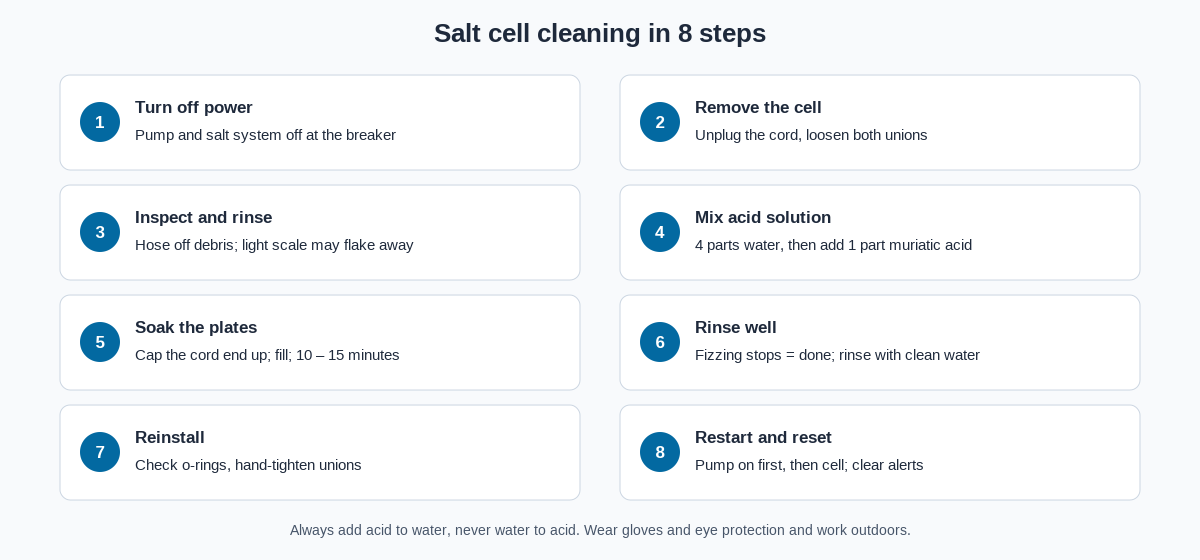
Diagram: Asphapro.com
Quick Answer
To clean a salt water pool cell, turn off the pump and salt system at the breaker, unplug the cell cord and unscrew the cell from the plumbing. Rinse it with a hose and look between the plates. If you see white, crusty scale, mix a weak acid solution of 4 parts water to 1 part muriatic acid (always add acid to water), stand the cell upright on a cleaning stand or capped end, and fill it until the plates are covered. Let it soak for 10 to 15 minutes until the fizzing stops, then pour the solution out, rinse well and reinstall. Clean only when needed, usually every 3 to 6 months, since every acid wash wears the plate coating.
A salt chlorine generator makes chlorine by passing a low-voltage current through coated titanium plates inside the cell. As it works, the water right at the plate surface becomes very alkaline, and calcium in the water turns into hard white scale that sticks to the plates. A little scale is normal. A lot of it blocks water flow, cuts chlorine output and makes the cell work harder, shortening its life. Knowing how to clean salt water pool cell plates the right way keeps your pool chlorinated and protects a part that costs $500 to $1,100 to replace.
This guide covers how to clean pool salt cell plates safely, how often to inspect and clean, the acid soak method, gentler options, mistakes to avoid and how to keep scale from coming back. For the bigger picture of salt pool care, see how to maintain a saltwater pool.
Why Cleaning Salt Water Pool Cell Plates Is Needed
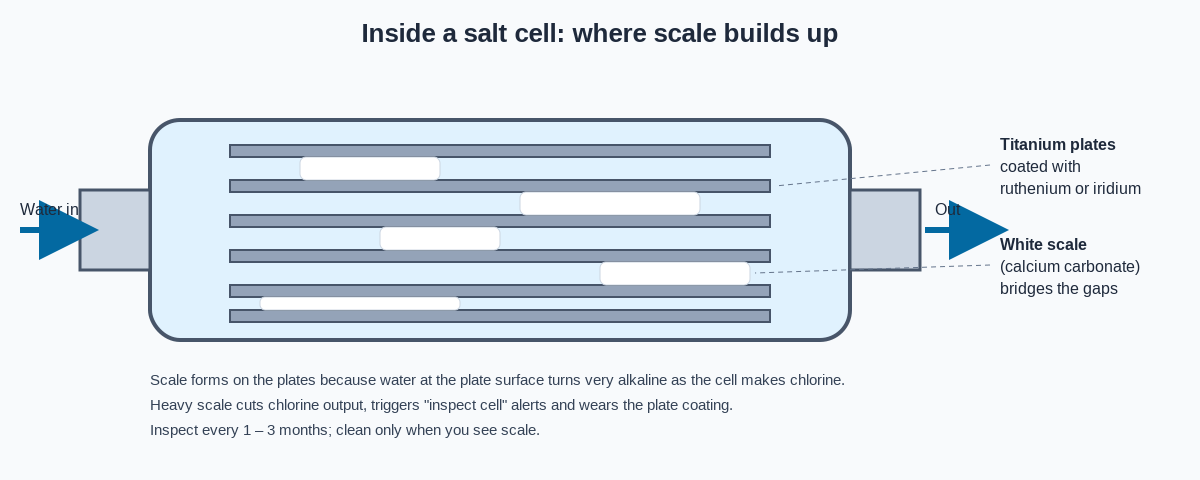
Diagram: Asphapro.com
Inside the clear or gray housing of a salt cell are several thin titanium plates, coated with a precious metal oxide such as ruthenium or iridium. Current flows between the plates and splits salt and water to make chlorine. At the same time, hydrogen gas and hydroxide form at one set of plates, raising the pH right at the plate surface far above the pH of the pool. Calcium carbonate is much less soluble at high pH, so it comes out of the water and sticks to the plates as scale. Pools with high calcium hardness, high pH, high alkalinity or warm water scale faster.
Scale shows up as a white, chalky or crusty layer on the plates, often thickest at the edges and between plates. In bad cases it fills the gaps entirely. Many salt systems use reverse polarity, which switches the direction of the current every few hours so scale flakes off on its own. This reduces how often you need to clean, but it does not always remove all scale, especially in hard water.
Signs It Is Time for Cleaning Pool Salt Cell Plates
Look for these signs that it is time for cleaning pool salt cell plates:
- An "inspect cell," "check cell" or "clean cell" light or message on the control box.
- Free chlorine dropping even though the output setting has not changed.
- A low salt reading on the control box while a separate salt test shows normal levels.
- Visible white scale between the plates when you look through the housing or ends.
- Reduced flow or higher filter pressure in some setups.
Any of these is a reason to remove and inspect the cell. If the plates look clean, do not acid wash them; simply reinstall the cell and check other causes such as low salt, low stabilizer or a flow problem.
How Often Should You Do Pool Salt Cell Cleaning?
For most owners, the answer to how to clean pool salt cell plates on schedule is simple. Most salt cell makers recommend inspecting the cell every one to three months and cleaning only when scale is visible. In many pools with balanced water and reverse polarity cells, that means cleaning once or twice a season, about every three to six months. In hard water areas or pools with high pH, it may be every month or two. In pools with soft water and good balance, some cells go a full year without needing acid. Clean only when needed, since each acid soak removes a tiny amount of the plate coating, and the coating is what makes chlorine.
Tools for Cleaning Salt Cell Swimming Pool Parts
Before cleaning salt cell swimming pool equipment, gather what you need:
- Rubber gloves and safety glasses or goggles.
- Muriatic acid (31.45% hydrochloric acid) or a ready-made salt cell cleaner.
- A clean plastic bucket, at least 5 gallons.
- A cell cleaning stand or cap that fits your cell (many makers sell one), or a bucket deep enough to stand the cell in.
- A garden hose with a spray nozzle.
- A plastic or wooden stick for removing loose debris (never metal).
- Silicone lubricant for o-rings.
Work outdoors in a well-ventilated area, away from plants, pets and children. Keep a hose running nearby to rinse spills. Read the acid label before you begin.
How to Clean Salt Water Pool Cell: Step by Step
Step 1: Turn Off the Power
Turn off the pump and the salt chlorinator at the control panel, then switch off the breaker for both. Never remove a salt cell with the power on. Close any valves before and after the cell if your system has them, so water does not drain from the pipes.
Step 2: Remove the Cell
Unplug the cell cord from the control box or the cell itself. Loosen the unions on each end of the cell by hand, turning counterclockwise, and lift the cell out. A little water will drain out. Note which way the cell faces, since some cells have a flow direction arrow.
Step 3: Inspect and Rinse
Look through each end of the cell at the plates. Rinse it with a strong stream from a garden hose to wash out debris and any loose scale. Light scale often flakes off with rinsing alone. If you can remove a few small bits with a plastic or wooden stick, do it gently, without scraping the plates. If the plates now look clean, skip the acid and reinstall the cell.
Step 4: Mix the Acid Solution
If scale remains, mix a cleaning solution. Most makers recommend 4 parts water to 1 part muriatic acid, and some suggest an even weaker 10 to 1 or 15 to 1 mix for light scale. Put the water in the bucket first, then slowly add the acid. Always add acid to water, never water to acid, which can cause the acid to spatter violently. Stir gently with a plastic stick. You can also use a ready-made salt cell cleaner, which is often a milder acid and easier to handle.
Step 5: Soak the Plates
Stand the cell upright with the cord end down, using a cleaning stand or cap, so the electrical connection stays dry. Slowly pour the acid solution into the top of the cell until the plates are covered but the solution does not reach the electrical end. You will see foaming and bubbles as the acid dissolves the scale. Let the cell soak for 10 to 15 minutes, or until the fizzing stops. For heavy scale, you may need to pour out the solution and repeat once. Do not leave the cell in acid longer than needed, and never soak it overnight.
Step 6: Rinse Thoroughly
Pour the used solution back into the bucket. Rinse the cell inside and out with clean water from the hose. Look at the plates again; they should be clean and gray or dark, with no white deposits. If some scale remains, repeat the soak for a few minutes.
Step 7: Reinstall the Cell
Check the o-rings on each union. Replace any that are cracked or flat, and lightly coat them with silicone lubricant. Put the cell back in the same direction, hand-tighten the unions, and plug the cord back in.
Step 8: Restart and Reset
Turn the breaker back on, start the pump and let water flow for a minute, then turn on the salt system. Bleed air from the filter if needed. Check for leaks at the unions. Many control boxes need you to reset the "inspect cell" alert; see your manual. Test chlorine over the next day or two to confirm output has returned to normal.
Disposing of Used Acid Solution
The used solution is weak acid with dissolved calcium. Many owners pour it slowly into the deep end of the pool with the pump running, where it lowers pH and alkalinity slightly; retest and adjust afterward. Others save it in a sealed, labeled plastic container to reuse for the next cleaning, since it can be used more than once until it stops fizzing. Do not pour it onto plants, lawns or into storm drains. Follow local rules for chemical disposal.
How to Clean Salt Pool Cell Plates With Vinegar
If you want to know how to clean salt pool cell plates without strong acid, vinegar works for light scale. White vinegar is a weak acid that dissolves calcium more slowly than muriatic acid but is safer to handle. Fill the cell with undiluted vinegar and soak it for several hours, or overnight for stubborn scale, then rinse. Some owners prefer vinegar for routine cleaning because it is gentler on the plate coating. For heavy scale, vinegar may take too long or not work fully, and a diluted muriatic acid soak is more effective.
Commercial Products for Cleaning Salt Water Pool Cell Plates
Ready-to-use salt cell cleaners are sold at pool stores. Many are mild acids or acid blends designed to be safer than muriatic acid while still dissolving scale. They often include instructions and work well with a cleaning stand. They cost more per use than homemade acid solutions but are convenient and reduce the risk of mixing errors. Follow the label for soak times.
What Not to Do When You Clean Salt Cell Pool Plates
Never scrape or scratch the plates with metal tools, screwdrivers or wire brushes; this damages the coating and ruins the cell. Never use a pressure washer on the plates. Do not soak the cell in strong, undiluted muriatic acid. Do not leave the cell in acid for hours. Do not submerge the electrical cord end. Do not acid clean a cell that is already clean. And do not mix acid with chlorine or other chemicals, which can release toxic gas.
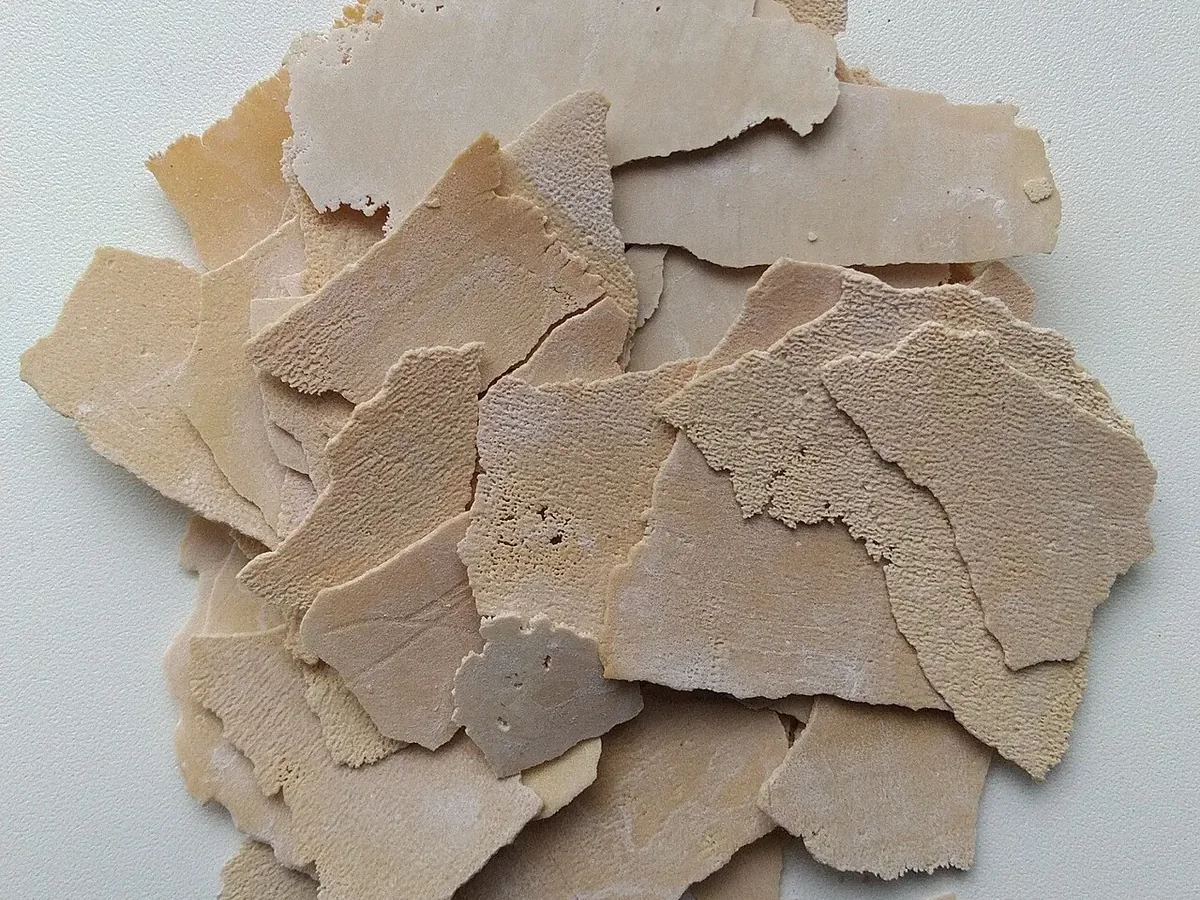
Photo: Alexander Davronov, Wikimedia Commons, CC BY-SA 4.0
How to Clean the Salt Cell for a Saltwater Pool Less Often
The best way to reduce how often you need to clean the salt cell for a saltwater pool is to keep water balanced. Keep pH between 7.2 and 7.6; salt pools tend to drift high, so check it twice a week and add acid as needed. Keep calcium hardness on the lower side of the range for your pool surface, usually 200 to 300 ppm for plaster and 150 to 250 ppm for vinyl and fiberglass. Keep total alkalinity around 60 to 90 ppm, which slows pH rise. Keep the saturation index slightly negative or near zero. Use the reverse polarity feature if your system has one. Run the cell at the lowest output that holds your chlorine target, and run the pump long enough to spread the work. Some owners add a scale inhibitor or a borate product, which can reduce scale formation. See how to lower hardness in pool water.
Photo: Dmitry G, Wikimedia Commons, CC BY-SA 3.0
How to Clean Swimming Pool Salt Chlorinator Cells by Type
The basic method on how to clean swimming pool salt chlorinator cells is the same for nearly every brand, but the details differ. Inline cells with unions, the most common type on inground pools, unscrew from the plumbing at both ends and stand upright in a cleaning stand or cap for the acid soak. Cells with a removable plate stack, found on some systems, let you slide the plate pack out of the housing and soak only the plates in a container. Above ground pool salt systems often use small cells on the return hose; they unclip or unscrew and can be soaked in a small bucket of solution. Cells with built-in cleaning ports let you pump acid through the cell without removing it, using a cleaning kit sold by the maker.
Always read your manual before you start, since some makers recommend weaker acid mixes, specific soak times, or their own cleaning solution, and using a different method can affect the warranty. If you have lost the manual, most makers post them online. Knowing how to clean swimming pool salt chlorinator cells of your exact type keeps the job quick and safe.
How to Clean Salt Cell on Pool Systems With Reverse Polarity
Many modern salt systems use reverse polarity, sometimes called self-cleaning. Every few hours the control box switches which plates are positive and which are negative. Scale that formed on one set of plates while it was the cathode tends to loosen and flake off when the polarity flips. This greatly reduces how often you need to learn how to clean salt cell on pool equipment by hand, but it does not end the job. In hard water or with high pH, scale can still build up faster than reverse polarity removes it. Inspect these cells every two to three months, and acid clean only when you see scale.
Some control boxes let you set how often polarity reverses. Shorter intervals shed scale more often but can wear the plate coating slightly faster. Most owners should leave the default setting unless the maker suggests changing it for hard water. If you see flakes of scale in the pool or in the pump basket, reverse polarity is doing its job; just keep the filter clean.
Cleaning Salt Cell Swimming Pool Plates in Hard Water Areas
In areas with hard tap water, such as much of the American Southwest, cleaning salt cell swimming pool plates is a more frequent chore. Every top-up adds more calcium, so hardness creeps up over the season, and scale forms faster. Owners in these areas often inspect the cell monthly and clean every one to two months in summer. To cut the workload, keep pH at the low end of the range, around 7.2 to 7.4, and alkalinity around 60 to 80 ppm. Consider a scale inhibitor product made for salt pools, and if hardness climbs above about 400 ppm, partly drain and refill or use reverse osmosis water treatment to lower it. A cover reduces evaporation, so you top up less often and add less calcium.
Cleaning Salt Water Pool Cell Plates Through the Seasons
Scale forms fastest when the water is warm, so the busiest time for cleaning salt water pool cell plates is mid to late summer. Inspect the cell when you open the pool in spring, once or twice in summer, and again before you close for winter. Cleaning the cell before closing means it is ready to work as soon as you open next year. In winter, most salt cells stop making chlorine below about 50 to 60 °F, so in warm climates where the pool stays open, they do little work and need little cleaning. Store a removed cell indoors in winter if your system allows, after rinsing and drying it.
Troubleshooting After Cleaning
If chlorine output is still low after you clean salt cell pool plates, check the basics. Test the salt level with a separate test strip or meter; many control boxes read low if the cell is worn. Check stabilizer (cyanuric acid); without it, sunlight burns off chlorine quickly no matter how much the cell makes. Make sure the pump runs long enough each day and the flow switch is working. Check that the cell cord is fully plugged in and the connection is clean and dry. If the cell still reports problems or chlorine stays low with the output at 100%, the cell may be near the end of its life. Many pool stores can test a salt cell's output for free.
How to Clean Pool Salt Cell Plates: Time and Cost
Learning how to clean pool salt cell plates yourself saves money. A gallon of muriatic acid costs $10 to $15 and makes enough solution for several cleanings. A cleaning stand costs $15 to $40 and lasts for years. Commercial cell cleaners cost $15 to $30 per bottle. The whole job takes about 30 to 45 minutes, including removing and reinstalling the cell. Pool service companies typically charge $50 to $150 to clean a salt cell, or include it in a regular service plan. Doing it yourself, carefully and only when needed, is one of the easiest ways to protect a part that costs hundreds of dollars to replace.
Safety When Cleaning Salt Water Pool Cell Plates
Muriatic acid is a strong, corrosive acid, so safety comes first when cleaning salt water pool cell plates. Wear chemical-resistant gloves, safety goggles and long sleeves. Work outdoors in fresh air and stand upwind of the bucket, since acid gives off sharp fumes that irritate the nose, throat and lungs. Never mix acid in a closed shed or garage. Keep a hose running nearby, and if acid splashes on skin or eyes, rinse with plenty of clean water for at least 15 minutes and seek medical help if irritation continues. Store acid in its original sealed container, upright, away from chlorine products and out of reach of children and pets. Do not store diluted acid in drink bottles or unlabeled containers. These simple steps make the job safe even for first-timers.
A Simple Inspection Routine
A short routine makes salt cell care easy. Every month or two, during your normal pool check, turn off the system, remove the cell and look through it with a flashlight. If the plates are clean, put the cell back. If you see thin white deposits, rinse with a hose and check again. Only when scale remains after rinsing should you do the acid soak. Write the date and what you found in a pool log. Over a season, the log shows how fast your cell scales, so you can plan cleanings and spot water balance problems early.
When to Replace a Salt Cell
Even with good care, salt cells wear out. Most last 3 to 7 years, or about 10,000 hours of run time. Signs that a cell is near the end of its life include chlorine output that stays low even after cleaning and with correct salt levels, a cell that needs to run at 100% to hold chlorine, plates that look worn or shiny bare titanium showing through, and control boxes that report low cell life. Replacement cells cost $500 to $1,100 for most inground systems. See convert pool to salt cost for cell and system prices.
How to Clean Salt Water Pool Cell: Key Points
- Inspect the cell every 1 to 3 months; clean only when you see scale.
- Use 4 parts water to 1 part muriatic acid, adding acid to water.
- Soak 10 to 15 minutes until fizzing stops, then rinse well.
- Keep pH, calcium and alkalinity balanced to prevent scale.
Frequently Asked Questions
How long should I soak my salt cell in acid?
About 10 to 15 minutes, or until the fizzing stops. Do not leave it longer than needed, since extra time in acid wears the plate coating.
Can I clean my salt cell without removing it?
Some systems allow in-line cleaning with a special kit that pumps acid through the cell, but removing the cell lets you inspect the plates properly and check the o-rings at the same time.
What ratio of acid to water for cleaning a salt cell?
Most makers recommend 4 parts water to 1 part muriatic acid. Milder mixes, such as 10 to 1, work well for light scale.
Can I use vinegar to clean a salt cell?
Yes, for light scale. Fill the cell with undiluted white vinegar, soak for several hours or overnight, then rinse well. For heavy scale, a diluted muriatic acid soak works faster.
How often should I clean my salt cell?
Usually every 3 to 6 months, but only when scale is visible. Inspect the cell every 1 to 3 months, and clean more often in hard water areas or during hot summer weather when scale forms fastest.
Why does my salt cell keep scaling?
High pH, high calcium or high alkalinity are the usual causes. Balance the water to slow scale, and keep pH between 7.2 and 7.6 with regular acid additions.
Sources
- CDC: Pool chemistry and testing
- Trouble Free Pool: Pool water chemistry
- CDC: Pool chemical safety
- PubChem: Hydrochloric acid