
How to Get Rid of Mustard Algae in Pool Water: Step-by-Step Guide
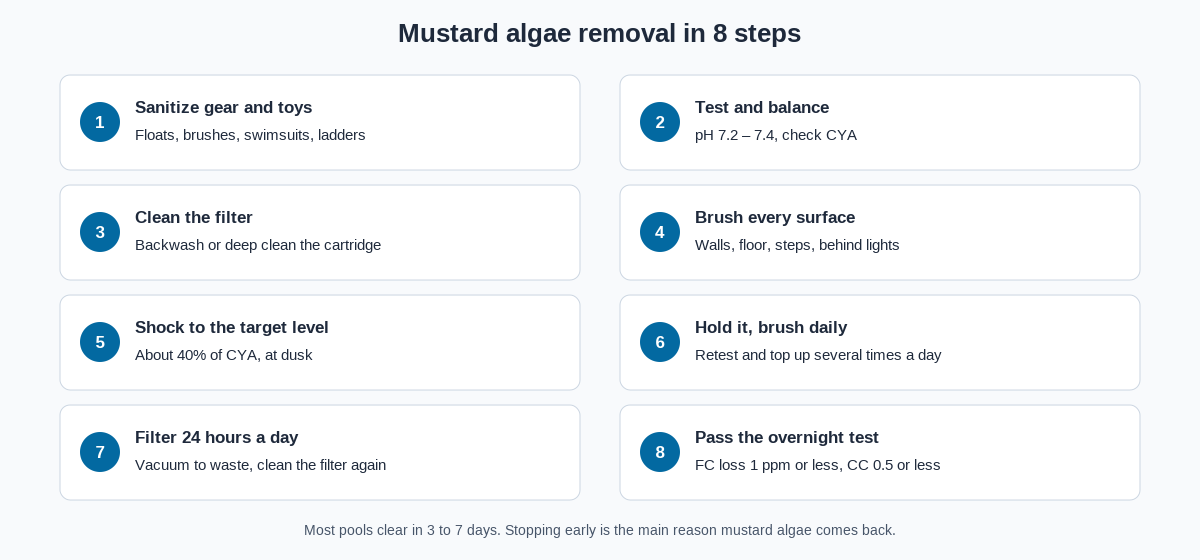
Diagram: Asphapro.com
Quick Answer
To get rid of mustard algae in pool water, first wash everything that has been in the pool, such as toys, floats, brushes and swimsuits, in a chlorine solution, since mustard algae hides on them. Lower pH to 7.2 to 7.4, clean the filter and brush every surface. Then raise free chlorine to the shock level for your stabilizer, about 40% of your cyanuric acid (CYA) level (for example, 16 ppm at 40 ppm CYA), and hold it there, brushing daily and adding chlorine several times a day, until the water is clear, combined chlorine is 0.5 ppm or less and the pool loses no more than 1 ppm of chlorine overnight. Run the filter around the clock and vacuum dead algae to waste. Most pools clear in 3 to 7 days.
Mustard algae is one of the most frustrating pool problems. It looks like yellow or yellow-brown dust on the walls and floor, usually in shady spots, and it brushes away easily, only to come back a few days later. It resists normal chlorine levels better than green algae, and it can survive outside the pool on toys, equipment and swimwear, so it keeps reinfecting the water. The good news is that mustard algae in pool water can be beaten with the right approach and a bit of patience.
This guide explains how to get rid of mustard algae in pool water step by step, how to identify it, why it returns and how to prevent it. For other types, see how to get rid of algae in pool water and how to get rid of black algae in pool surfaces.
What Is Mustard Algae?
Mustard algae, sometimes called yellow algae, is a chlorine-resistant form of green algae that looks yellow, tan or brown. It grows as a thin, powdery or slimy layer, often on the shady side of the pool, on steps, behind ladders and in corners with poor circulation. Unlike green algae, it rarely turns the whole pool green; instead it forms patches that can look like sand or pollen. Mustard algae pool problems are most common in warm, sunny climates and in pools where chlorine runs low or stabilizer runs high. Pools with poor circulation, shady sides under trees or walls, and lots of toys and floats that stay in the water are also more prone to it.
How to Identify Mustard Algae in Swimming Pool Water
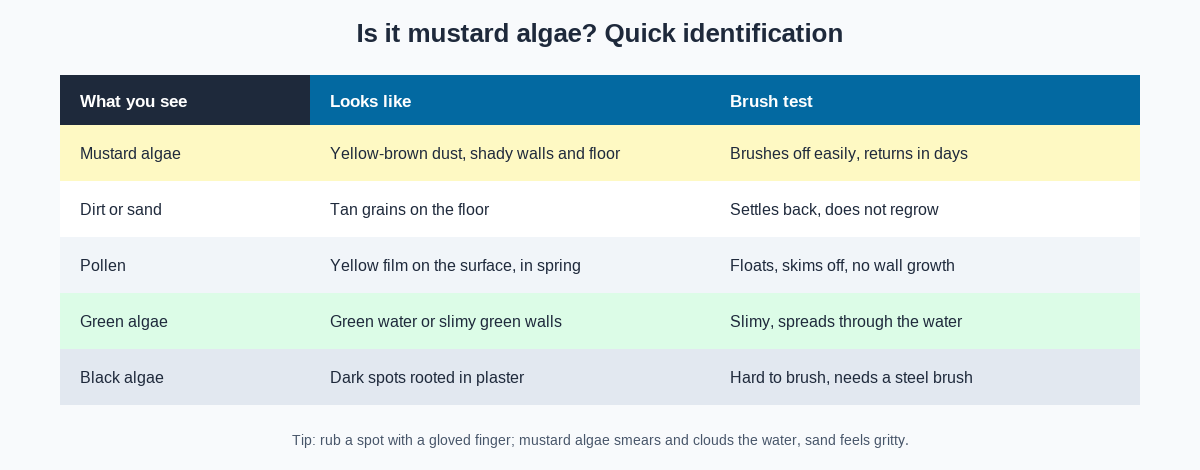
Chart: Asphapro.com
Mustard algae in swimming pool water is easy to confuse with dirt, sand or pollen. Brush a patch. If it clouds the water and then settles back in the same place within a day or two, and comes back even after vacuuming, it is likely mustard algae. Sand feels gritty and does not regrow. Pollen floats on the surface in spring and gathers at the skimmer. Green algae is slimy and green and usually spreads through the water. Black algae forms hard, dark spots rooted into plaster. If you are not sure, a pool store can look at a sample or a clear photo.
Why Mustard Algae in Pool Water Keeps Coming Back
Mustard algae survives normal chlorine levels and can live for a while outside the pool. It clings to pool toys, floats, brushes, poles, ladders, the skimmer basket, the filter, and even swimsuits and towels that have been in the water. If you treat the pool but put contaminated items back in, the algae returns. Low chlorine, high stabilizer that weakens chlorine, poor circulation in shady corners, and stopping treatment as soon as the water looks clear all help it come back.
How to Get Rid of Mustard Algae in Pool: Step by Step
Step 1: Clean Everything That Touches the Water
Gather pool toys, floats, noodles, goggles, brushes, leaf nets, the vacuum head and hose, and any removable ladders and step pads. Wash them in a bucket or tub of water with a strong dose of chlorine, or spray them with a diluted bleach solution, and let them sit before rinsing. Wash swimsuits and towels in the washing machine. Keep cleaned items out of the pool until the treatment is finished, and store them somewhere dry and sunny rather than in a damp pool shed.
Step 2: Test and Balance the Water
Test free chlorine, pH, alkalinity and cyanuric acid. Bring pH to 7.2 to 7.4, where chlorine works best. If CYA is very high, above about 80 ppm, the shock level you need will be very high; partly draining and refilling to lower CYA can make treatment easier. See how to reduce cyanuric acid in pool water.
Step 3: Clean the Filter
Backwash a sand or DE filter, or deep clean a cartridge, so it can catch the dead algae. Algae trapped in a dirty filter can reseed the pool, so plan to clean it again during and after treatment.
Step 4: Brush Every Surface
Brush the walls, floor, steps, benches, corners and behind lights and ladders, pushing the algae into the water so chlorine can reach it. Pay extra attention to shady areas, the waterline, the seams around steps and the floor right under the skimmer, where algae often collects.
Step 5: Shock to the Right Level
Add liquid chlorine, ideally at dusk, to raise free chlorine to the shock level for your CYA, about 40% of CYA. That is roughly 12 ppm at 30 ppm CYA, 16 ppm at 40 ppm, 20 ppm at 50 ppm and 24 ppm at 60 ppm. Many pool store "mustard algae" treatments are double or triple doses of shock; matching the dose to CYA is more reliable. See how to increase free chlorine in pool water.
Step 6: Hold the Shock Level and Keep Brushing
Test free chlorine several times a day and add chlorine to keep it at the shock level. Brush daily. The pool will use a lot of chlorine at first as it kills algae; that is normal and shows the treatment is working. Keep a log of each test and dose so you can see the chlorine demand falling day by day.
Step 7: Filter and Vacuum
Run the pump 24 hours a day. Clean the filter whenever pressure rises. Vacuum dead algae to waste if your filter allows, so it does not go back through the filter. Top up the water afterward and retest, since fresh water lowers chlorine slightly.
Step 8: Confirm It Is Gone
Keep going until three things are true: the water is clear, combined chlorine is 0.5 ppm or less, and free chlorine drops no more than 1 ppm overnight (test at dusk and again at dawn). Only then let chlorine drop back to normal, without adding more until it falls into your usual range. Stopping too early is the most common reason mustard algae returns.
Photo: Bigroger27509, Wikimedia Commons, public domain
Do Mustard Algae Pool Treatments Work?
Pool stores sell special mustard algae treatments, often based on sodium bromide or copper, and algaecides. Sodium bromide products work with chlorine to make bromine, which can help kill mustard algae, but they leave bromide in the water permanently, which raises chlorine demand and can make it harder to use stabilizer to protect chlorine in sunlight. Copper algaecides can stain plaster and turn blond hair green. Polyquat algaecides are safer and can help as a backup. In most cases, maintaining a proper shock level is enough without special products.
How to Prevent Mustard Algae in Swimming Pool Water
Keep free chlorine at least 7.5% of your CYA every day, and never let it drop to zero. Keep CYA in range, 30 to 50 ppm for chlorine pools. Brush shady areas weekly. Run the pump enough for good circulation, and aim returns to move water through corners. Clean and sanitize toys and gear regularly, and do not bring in toys or swimsuits from other pools or lakes without washing them. Keep the filter clean. Test overnight chlorine loss now and then; a steady loss points to hidden algae.
Photo: FASTILY, Wikimedia Commons, CC BY-SA 4.0
How to Remove Mustard Algae From Pool Equipment
A big part of learning how to remove mustard algae from pool water for good is cleaning the equipment it hides in. Start with the filter. For a cartridge filter, remove the cartridge, hose it off, then soak it overnight in a bucket of water with a strong dose of chlorine or a filter cleaner, and rinse before reinstalling. Many owners keep a spare cartridge so they can swap one in while the other soaks. For a sand filter, backwash thoroughly, then add a filter cleaner or a dose of chlorine into the skimmer with the pump off, let it sit for several hours as the label directs, and backwash again. For a DE filter, backwash, then disassemble and clean the grids if possible, and recharge with fresh DE.
Next, empty and scrub the skimmer and pump baskets, and spray chlorine solution into the skimmer throat. Clean the automatic cleaner, its hoses and brushes, and the vacuum head and pole. Wipe the underside of the ladder treads and the backs of handrail anchors. If you have a solar cover, spray it with a chlorine solution on both sides and let it dry in the sun before putting it back. These steps make sure you remove mustard algae from pool equipment, not just from the water you can see.
How to Remove Mustard Algae From Swimming Pool Surfaces by Pool Type
Plaster and pebble pools. Use a stiff nylon brush, or a stainless steel brush on stubborn patches of plaster only. Brush hard in shady corners and along the waterline. Pebble finishes can trap algae between the stones, so brush in several directions.
Vinyl liner pools. Use a soft or medium nylon brush only; steel brushes will damage the liner. Avoid pouring undissolved granular shock onto the vinyl, which can bleach it. Liquid chlorine is the safest choice. Check under step pads and along seams.
Fiberglass pools. Use a soft brush. Fiberglass resists algae better than plaster, so mustard algae usually brushes off easily, but it can still hide in steps and behind lights.
Whatever the surface, the method on how to remove mustard algae from swimming pool walls and floors is the same: brush to break up the colony, then hold a high chlorine level long enough to kill what is left.
Mustard Algae in a Salt Pool
Salt pools are not immune to mustard algae in pool water. Salt cells make chlorine steadily but rarely fast enough to reach and hold the shock level needed. To treat mustard algae in a salt pool, add liquid chlorine to reach the shock level for your CYA, and use the cell only to help hold it. Salt pools usually run higher CYA, often 60 to 80 ppm, so the shock level is higher too, about 24 to 32 ppm. Lower pH to about 7.2 before shocking, since salt pools tend to run high. Do not add sodium bromide products to a salt pool; the bromide will stay and turn the system into a bromine pool. See how to maintain a saltwater pool.
Mustard Algae in Above Ground Pools
Above ground pools get mustard algae just like inground pools, often along the shady side of the wall and in the seam where the wall meets the floor. Smaller water volume makes it easier to reach the shock level, but vinyl liners need gentle brushing and liquid chlorine instead of granular shock. Check behind the ladder or steps and in the skimmer box. Clean the filter well; small cartridge filters can clog quickly with dead algae, so rinse them daily during treatment.
How Much Chlorine Do You Need?
The amount of chlorine needed to get rid of mustard algae in pool water depends on pool size, current chlorine and CYA. About 10 fl oz of 12.5% liquid chlorine raises free chlorine by 1 ppm in 10,000 gallons. For a 20,000-gallon pool at 2 ppm with CYA at 40 ppm, reaching the shock level of 16 ppm needs 14 ppm × 2 × 10.2 fl oz, about 286 fl oz, or roughly 2.2 gallons. Expect to add more over the next few days as the algae uses up chlorine; heavy infestations can consume several gallons a day at first. For a calculator, see how much chlorine to add to pool water.
Cost to Treat Mustard Algae in Pool Water
Treating mustard algae in swimming pool water usually costs $50 to $250 in chemicals for a typical residential pool, mostly liquid chlorine at about $4 to $8 a gallon. A filter cleaner adds $15 to $30, and a new cartridge $40 to $150 if the old one is worn. Pool stores' mustard algae products cost $20 to $60 a treatment but are often not needed. If you hire a pool service, expect $150 to $500 for a full algae treatment over several visits. The cheapest approach is to treat early, as soon as you see yellow patches, before the algae spreads.
Mustard Algae vs Pollen in Spring
In spring, many owners mistake pollen for mustard algae pool problems. Pollen is usually bright yellow or yellow-green, floats on the surface, collects in corners and at the skimmer, and leaves a film on the waterline. It does not grow on walls or return after brushing if chlorine is normal. Mustard algae sits on surfaces, often below the water, and keeps coming back in the same shady spots. If you are not sure, skim the surface; if the yellow comes off easily and does not return on the walls, it is probably pollen. Running the pump longer, using a skimmer sock and a clarifier help with pollen.
Common Mistakes: How to Get Rid of Mustard Algae in Pool Water the Right Way
The most common mistake when trying to get rid of mustard algae in pool water is stopping as soon as the water looks clear. Mustard algae can survive in small numbers on surfaces and in equipment and return within days. Other mistakes include not cleaning toys, gear and swimsuits; shocking with a fixed amount instead of matching the dose to CYA; letting chlorine fall overnight between doses; shocking in the midday sun, where much of the chlorine burns off; not cleaning the filter; and relying on algaecide alone. Following all the steps for several days in a row is the reliable way to remove mustard algae from pool surfaces and water.
Worked Example
A 15,000-gallon plaster pool with CYA at 50 ppm shows yellow patches on the shady wall and steps. The owner washes all toys and the brush in bleach water, lowers pH to 7.3, deep cleans the cartridge filter and brushes the whole pool. At dusk, they raise free chlorine from 3 to 20 ppm with about 2.0 gallons of 12.5% liquid chlorine. Over the next four days, they test morning, noon and evening, adding chlorine to hold 20 ppm, brushing twice a day and cleaning the filter twice. On day five, the water is clear, combined chlorine is 0.2 ppm, and the overnight loss is 0.5 ppm. They let chlorine fall back to 5 to 7 ppm and keep brushing the shady wall weekly.
Mustard Algae in Pool Water After Opening
Many owners first notice mustard algae in pool water right after spring opening. Spores and small colonies can survive the winter in the filter, in shady corners and on equipment stored in a damp shed. When the water warms and chlorine is still being balanced, the algae gets a head start. Prevent this by cleaning and sanitizing all equipment before closing, storing toys dry, and shocking well at opening. If you do see yellow patches after opening, follow the full mustard algae pool treatment at once, rather than waiting to see if normal chlorine handles it. See how to open a pool after winter.
Mustard Algae Pool Myths
"Mustard algae is just dirt." If it comes back in the same spot after brushing and vacuuming, it is not dirt.
"One big shock will kill it." A single shock usually knocks it back but does not finish it. You must hold the shock level until the overnight test passes.
"You need a special mustard algae product." Proper chlorine levels, brushing and cleaning gear work in most pools. Special products are optional.
"Draining the pool is the only fix." Draining is rarely needed, except to lower very high stabilizer that makes the shock level impractical.
"Salt pools cannot get mustard algae." They can, and they need liquid chlorine to reach the shock level.
How to Remove Mustard Algae From Swimming Pool Toys and Gear
Toys and gear are the most overlooked part of how to remove mustard algae from swimming pool environments. Mustard algae can survive on dry surfaces and in damp corners for some time, then reinfect the pool when the item goes back in. Fill a large tub or trash can with water and add about a cup of liquid chlorine per 5 gallons, then soak floats, noodles, goggles, dive toys, brushes and nets for at least 30 minutes, scrubbing textured surfaces. Rinse and let them dry in the sun. Spray larger items such as inflatable islands, ladders and step pads with a diluted bleach solution. Wash swimsuits, rash guards and towels in a hot wash. Ask guests not to bring in toys or suits from other pools, lakes or the beach without washing them first.
Keeping Mustard Algae Away for Good
Once you get rid of mustard algae in pool water, a few habits keep it from coming back. Test free chlorine at least three times a week and keep it above the minimum for your CYA. Brush the shady wall and steps every week, since mustard algae prefers low light. Aim return jets to sweep corners and steps. Run the pump long enough each day for at least one turnover. Clean the filter on schedule and sanitize toys monthly in summer. Keep stabilizer in range, and partly drain if it climbs too high. Doing an overnight chlorine loss test once a month catches any new growth before you can see it. With these habits, mustard algae in swimming pool water becomes a rare problem instead of a seasonal battle.
When to Call a Pool Professional
Most owners can treat mustard algae themselves, but some situations call for help. If stabilizer is very high and the shock level would be impractical, a pool pro can advise on partial draining or other options. If the algae keeps returning after a full, correct treatment, there may be a hidden source such as a dead spot in circulation, a cracked skimmer, a failing filter or algae behind a light niche. A professional can also test for phosphates, metals and other factors, and check that equipment is sized and working properly. If you are short on time, a pool service can carry out the multi-day shock process for you, testing and adding chlorine several times a day until the pool passes the overnight test.
How to Get Rid of Mustard Algae in Pool: Key Points
- Clean toys, gear and swimsuits so they do not reinfect the pool.
- Lower pH, clean the filter and brush every surface.
- Shock to about 40% of CYA and hold it until the overnight test passes.
- Prevent it with steady chlorine, good circulation and weekly brushing.
Frequently Asked Questions
Is mustard algae harmful to swimmers?
It is not known to be directly harmful, but it can shelter bacteria such as E. coli and makes the water less sanitary. Do not swim until it is fully treated and chlorine is back in the normal range.
How long does it take to get rid of mustard algae?
Usually 3 to 7 days of holding the shock level, brushing daily and filtering around the clock. Large infestations or pools with high stabilizer can take longer.
Can I swim with mustard algae in my pool?
No. Wait until the algae is gone, the overnight chlorine test passes and free chlorine has dropped back to a normal swimming level.
Does mustard algae come back?
Yes, if toys, gear and swimsuits are not cleaned or if treatment stops as soon as the water looks clear. Holding the shock level until the overnight test passes prevents most returns.
What kills mustard algae fast?
A sustained shock level based on CYA, about 40% of the stabilizer level, plus daily brushing and a clean filter.
Can mustard algae live on swimsuits?
Yes. Mustard algae can cling to swimsuits and towels, so wash them in a hot wash after they have been in an affected pool.
Sources
- Trouble Free Pool: Pool water chemistry
- CDC: Pool chemistry and testing
- CDC: Pool chemical safety
- Pool and Hot Tub Alliance