
How to Lower Hardness in Pool Water: Step-by-Step Guide
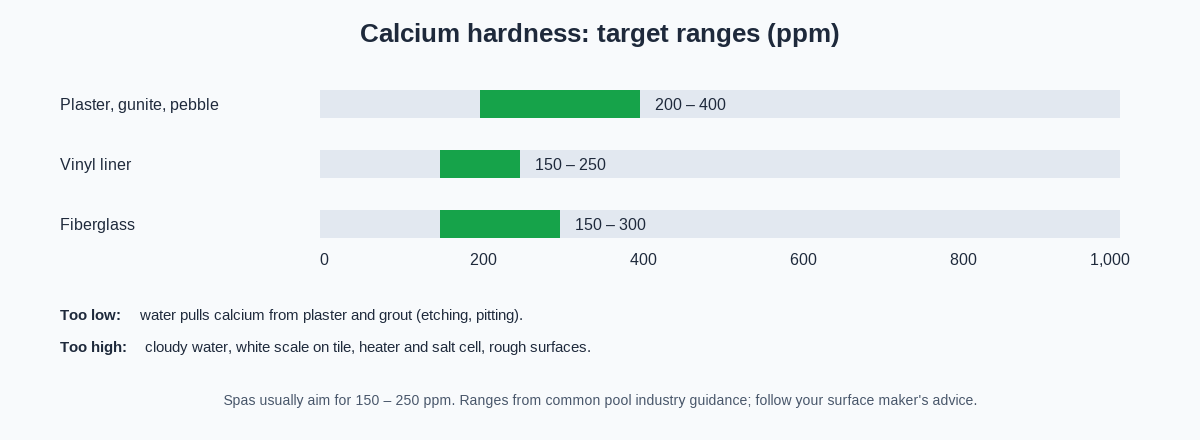
Chart: Asphapro.com
Quick Answer
The only reliable way to lower hardness in pool water is to replace some of the water with softer water. Test your pool and your fill water, then use this formula: % to replace = (current − target) ÷ (current − fill) × 100. For example, to lower calcium hardness from 600 to 300 ppm with 100 ppm fill water, drain and refill about 60% of the pool. If your tap water is also hard, use reverse osmosis (RO) treatment, which removes calcium from the pool water on site, or truck in soft water. Sequestrants and flocculants do not lower hardness but can hold calcium in solution and slow scale while you plan a fix. Keep calcium hardness at 200 to 400 ppm for plaster pools and about 150 to 250 ppm for vinyl and fiberglass.
Calcium hardness is the amount of dissolved calcium in your pool water. A little calcium is good, especially in plaster pools, because water with too little calcium pulls it out of the plaster and grout. But calcium only goes up over time. Every time water evaporates, the calcium stays behind, and every top-up with hard tap water adds more. Calcium-based chlorine products, such as cal-hypo shock, add more again.
When calcium hardness climbs too high, the water turns cloudy, white scale forms on tile and equipment, heaters and salt cells lose efficiency, and surfaces feel rough. This guide explains how to lower hardness in pool water, how much water to replace, when reverse osmosis is the better choice, and how to stop calcium from building up again.
What Is Calcium Hardness in a Pool?
Calcium hardness in pool water is measured in parts per million (ppm) of calcium carbonate. It is part of the water's overall balance, together with pH, total alkalinity and temperature. Pool professionals combine these numbers in the Langelier Saturation Index (LSI), which predicts whether water will tend to form scale (positive LSI) or dissolve surfaces (negative LSI).
You may also see total hardness in pool test results. Total hardness includes calcium and magnesium. In most pools, calcium makes up the largest share, and pool chemistry targets are based on calcium hardness. If your test kit reports total hardness, the calcium part is usually somewhat lower. A good drop kit tests calcium hardness directly, which is more useful for balancing.
What Should Calcium Hardness Be in a Pool?
- Plaster, gunite, concrete and pebble pools: 200 to 400 ppm. These pools need calcium to protect the surface.
- Vinyl liner pools: about 150 to 250 ppm. Vinyl does not need calcium, but low levels can be hard on metal parts.
- Fiberglass pools: about 150 to 300 ppm, kept on the lower side to avoid scale on the gel coat.
- Spas and hot tubs: about 150 to 250 ppm, since hot water scales more easily.
Over about 400 to 500 ppm in a plaster pool, or over about 300 ppm in vinyl or fiberglass, it is time to think about how to lower calcium hardness in pool water, especially if you see scale or cloudiness.
Signs of High Calcium Hardness
- Cloudy water that does not clear with good chlorine and filtration.
- White, crusty scale at the waterline and on tile.
- Rough surfaces and white spots on plaster or fiberglass.
- Scale in the heater and salt cell, reducing efficiency.
- Higher filter pressure and shorter filter cycles.
- White flakes on returns and fittings.
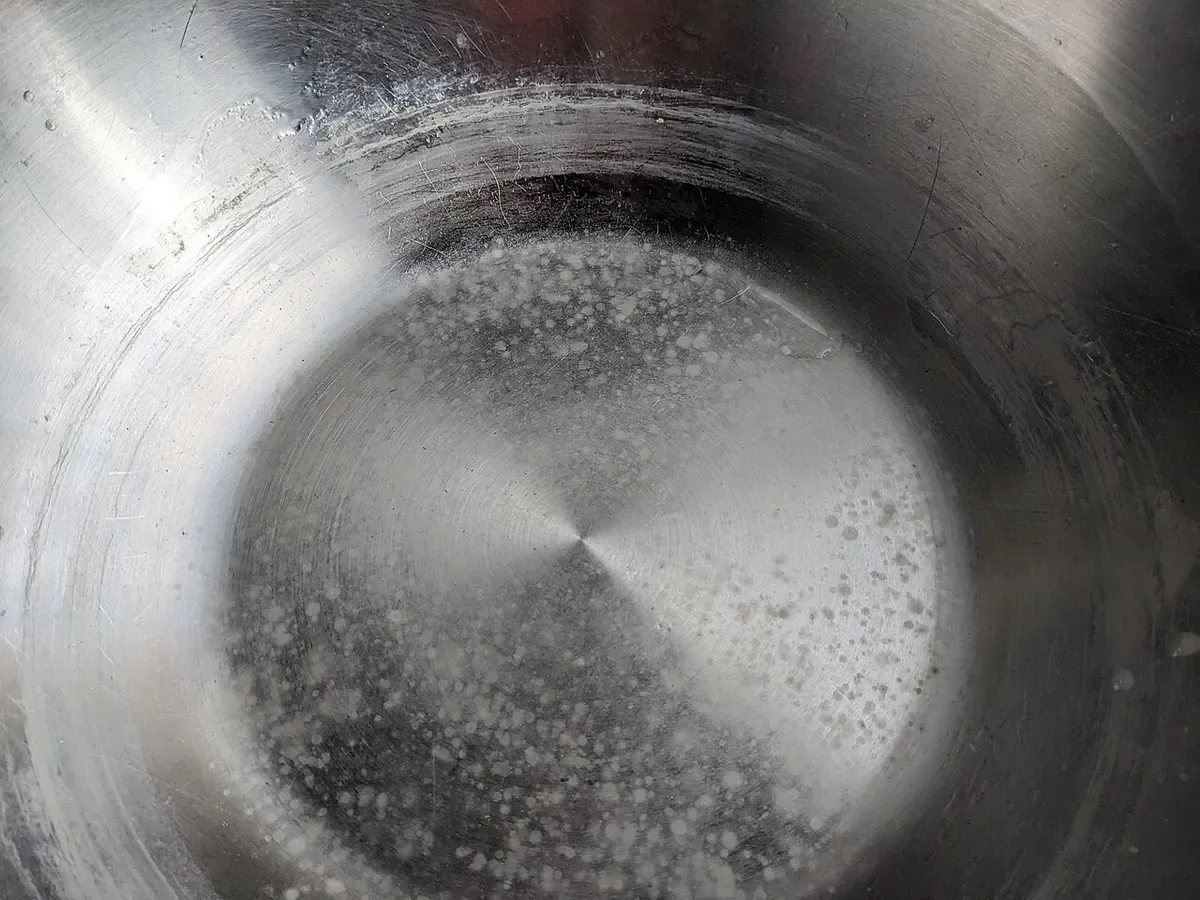
Photo: Nicbou, Wikimedia Commons, CC0
What Causes High Hardness in a Pool?
- Hard fill water: tap or well water with high calcium.
- Evaporation: water leaves, calcium stays.
- Calcium hypochlorite shock and tablets add calcium with every dose.
- Calcium chloride added to raise hardness, sometimes overdosed.
- New plaster releases calcium into the water during curing.
- Little or no draining for many years, so calcium keeps building.
How to Lower Hardness in Pool: Drain and Refill
Partial draining and refilling is the standard way to lower calcium hardness in pool water. You remove some of the hard water and replace it with softer water, which dilutes the calcium. It works every time, as long as your fill water is softer than your target.
Step 1: Test the pool and the fill water
Test calcium hardness in the pool with a drop kit, and test your tap or well water too. If the fill water is close to or above your target, draining will not help much; see the reverse osmosis section below.
Step 2: Work out how much to replace
Use the formula: % to replace = (current − target) ÷ (current − fill) × 100. Or use the calculator below. The chart shows common examples.
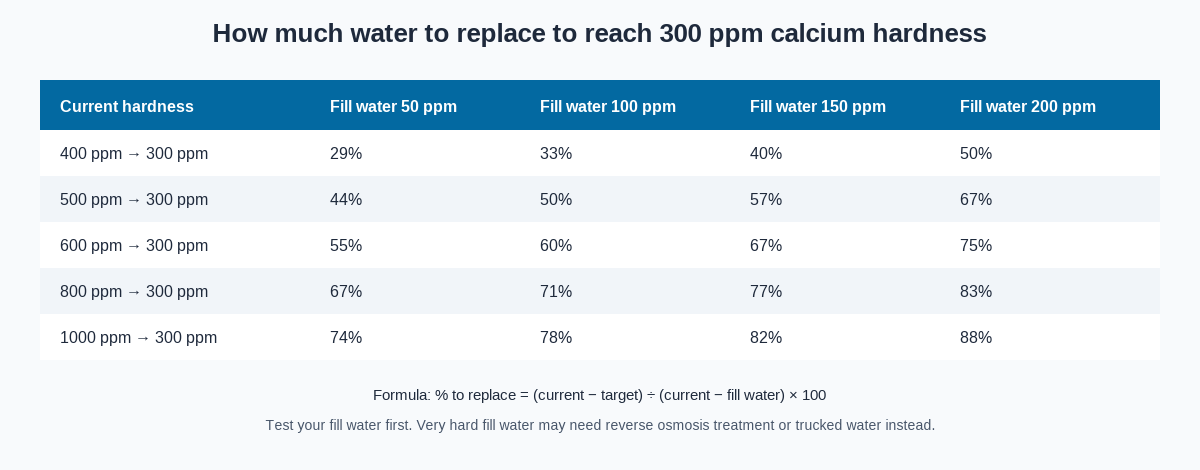
Chart: Asphapro.com
Step 3: Drain part of the water safely
Use a submersible pump or the filter's Waste setting to remove water. Do not drain more than you need, and never fully drain a vinyl liner pool, which can shrink and tear, or a concrete pool in an area with a high water table, which can lift out of the ground. Many pools can be safely lowered by a third to a half at a time. Follow local rules about where pool water may be discharged; many towns ask you to let chlorine drop first and drain to the sanitary sewer or onto your own landscape.
Step 4: Refill and rebalance
Refill with fresh water, run the pump for a full cycle, and retest everything: calcium, pH, alkalinity, stabilizer, salt and chlorine. Fresh water dilutes all of these, so you will usually need to add stabilizer and, in salt pools, salt.
Pool Hardness Calculator: How Much Water to Replace
Enter your pool volume, current calcium hardness, target and fill water hardness. The calculator shows the percentage and gallons to drain and refill to reduce calcium hardness in pool water.
How to Reduce Calcium Hardness in Pool Water With Reverse Osmosis
If your tap water is hard, draining and refilling with the same water will not lower pool hardness much. Reverse osmosis is the answer for many pools in hard water areas such as the American Southwest. A mobile RO service brings a trailer-mounted filtration unit, connects hoses to the pool and runs the water through membranes that remove calcium, dissolved solids, stabilizer and other minerals. The clean water goes back to the pool, and a smaller stream of concentrated waste water is discharged.
RO treatment usually takes 8 to 24 hours and costs about $300 to $800 for an average pool, depending on the volume and how much hardness must be removed. It saves most of the water compared with draining and can lower hardness by 70% to 90% in one visit. It also reduces stabilizer and total dissolved solids, so the water is close to fresh again.
Can Chemicals Lower Hardness in Pool Water?
Sequestrants (scale and stain treatments) bind calcium and metals so they stay dissolved instead of forming scale. They do not lower the hardness reading, but they can keep water clear and slow new scale while hardness is high. They need to be added regularly because chlorine breaks them down.
Flocculants and clarifiers can clear cloudy water caused by calcium particles, but they do not remove dissolved calcium.
"Hardness reducer" products are sold for pools, but most work as sequestrants or by forming particles that you then filter or vacuum out, with limited effect. For a real drop in calcium, dilution or RO is the reliable choice.
Lowering pH and alkalinity slightly can also reduce the tendency to scale, which helps while hardness is high, but it does not lower calcium. Keep pH at 7.2 to 7.4 and alkalinity at the lower end of its range until you can dilute.
Photo: Siegfried Schüller, Wikimedia Commons, CC BY-SA 4.0
Why Calcium Hardness Pool Levels Matter
Calcium hardness pool readings get less attention than chlorine and pH, but they decide how long your pool surfaces and equipment last. Water always tries to reach a balance with the surfaces it touches. If the water has too little calcium, it takes calcium from plaster, grout and concrete, leaving the surface rough, pitted and stained. If it has too much, the calcium comes out of the water as scale, coating tile, plaster, heaters, salt cells and filter media.
Both problems cost money. Etched plaster may need resurfacing years earlier than expected, and a heater coated with scale loses efficiency and can overheat and fail. A salt cell covered in scale stops making chlorine. Keeping calcium hardness for pool water in the right range is one of the cheapest ways to protect thousands of dollars of finish and equipment.
How Do I Lower the Hardness in My Pool if My Tap Water Is Hard?
Many owners ask: how do I lower the hardness in my pool when my tap water is already at 300 or 400 ppm? In this case, the usual drain-and-refill method does not work well, because the new water is nearly as hard as the old. There are three practical options.
The first is reverse osmosis, explained above, which removes calcium from the pool water itself and does not depend on your tap water. The second is buying soft water by the truckload. Pool water delivery services can bring 6,000 to 8,000 gallons of low-hardness water at a time, often for $200 to $500 a load depending on distance. The third is running your fill water through a whole-house water softener or a portable softener on a hose. Softeners swap calcium for sodium, so the fill water has low hardness but slightly more salt, which is usually fine for pools. A portable hose softener costs $150 to $400 and can treat thousands of gallons before it needs recharging.
Rainwater is another free source of soft water. In rainy months, letting the pool take on rain and then draining back down slowly lowers hardness over time. It will not fix a big problem, but it helps keep pool hardness steady in some climates.
How to Decrease Calcium Hardness in Pool Water in Stages
If your hardness is very high, it is often safer to decrease calcium hardness in pool water in stages rather than in one big drain. Removing more than half the water at once can be risky. In vinyl pools, the liner can shrink, pull out of its track or wrinkle when the water level drops far. In concrete and fiberglass pools, high groundwater can push an empty or nearly empty shell upward. Many pool pros suggest replacing about a third of the water at a time, retesting, and repeating a week later if needed.
For example, to bring a 20,000-gallon pool from 800 ppm down to 350 ppm with 150 ppm fill water, you would need to replace about 69% of the water. Instead of draining 13,800 gallons at once, drain and refill about 6,700 gallons twice, a week apart. The first round brings hardness to about 600 ppm and the second to about 400 ppm; a third, smaller round finishes the job. Doing it this way keeps the pool safe and lets you rebalance the chemistry between rounds.
How to Lower Calcium Hardness in a Pool With a Vinyl Liner
Vinyl pools do not need much calcium, but high hardness still causes cloudy water and scale on the waterline, steps and equipment. When you lower calcium hardness in a pool with a vinyl liner, keep at least a foot of water in the pool at all times, and refill the same day you drain. Never drain a vinyl pool completely unless you are replacing the liner. If the liner is older and stiff, lower the water only a little at a time, because old vinyl can tear or crack when it shifts. For full draining guidance, see our guide on how to drain a pool.
Calcium Hardness in Swimming Pool Plaster: Special Care
Plaster pools are where calcium hardness in swimming pool water matters most. New plaster releases a lot of calcium during its first month, which raises hardness and pH quickly. Pool builders often use a start-up process that brushes the new surface daily and keeps the water balanced to protect the finish. Older plaster pools in hard water areas tend to build up hardness year after year until scale appears. If you plan to replaster, it is a good time to drain and refill with softer water anyway, since the pool is being emptied.
Never let hardness drop too low in a plaster pool, though. Below about 150 to 200 ppm, the water starts to dissolve the finish. If you overshoot while diluting, add calcium chloride to bring the level back up.
Total Hardness Pool Readings vs Calcium Hardness
Some test strips and home kits give a total hardness pool reading instead of calcium hardness. Total hardness includes magnesium as well as calcium. In most fill water, calcium makes up about 60% to 80% of the total, but this varies by region. If your strip shows total hardness of 500 ppm, your calcium hardness might be 300 to 400 ppm. For balancing a pool, calcium hardness is the number that matters, so use a drop kit that tests calcium directly when you need to decide whether to dilute. The method for how to lower total hardness in pool water is the same: dilute with softer water or use reverse osmosis.
How to Lower Calcium Hardness in Swimming Pool Water Before Winter
Fall is a good time to deal with high hardness. Evaporation is lower, many owners lower the water level for winter anyway, and fresh water is cooler and less likely to form scale as it warms. In areas where pools close for winter, lower the water to the winter level, then refill with fresh water in spring to dilute calcium. In warm climates where pools run all year, schedule draining or RO in the cooler months, when the pool is used less and water is less likely to turn green while chlorine is low after refilling.
Reduce Pool Hardness Over Time With Good Habits
Once hardness is in range, a few habits help reduce pool hardness creep. Switch from calcium hypochlorite shock to liquid chlorine or non-chlorine shock. Use a solar cover to cut evaporation by as much as 90% when the pool is not in use, which means fewer top-ups with hard water. Backwash only when needed; backwashing removes water but also wastes it. In very hard water areas, plan to replace 10% to 20% of the water each year, or book RO treatment every two to four years. A regular sequestrant dose keeps calcium dissolved between treatments.
How to Lower Pool Calcium Hardness: A Worked Example
Here is how to lower pool calcium hardness in a typical case. A 15,000-gallon plaster pool in Arizona tests at 650 ppm calcium hardness, with scale on the tile and cloudy water. The tap water tests at 250 ppm. The owner wants to reach 350 ppm. Using the formula, (650 − 350) ÷ (650 − 250) × 100 = 75%. That means draining and refilling 11,250 gallons, close to a full drain, and the water would still be fairly hard.
Instead, the owner books a mobile RO service, which brings the pool down to about 150 ppm in one day. They then add calcium chloride to raise it to 250 ppm and rebalance pH, alkalinity and stabilizer. The RO visit costs $500, about the same as the water and chemicals for a large drain, and the result is better because the water is softer and lower in total dissolved solids.
Lowering Hardness in Salt Pools and Spas
Salt pools are more sensitive to high calcium than regular chlorine pools. The salt cell raises pH at the plates, which makes calcium drop out as scale right inside the cell. A cell coated in scale makes less chlorine and wears out faster. If you have a salt system, keep calcium toward the low end of the range for your surface, and check the cell every few months. When you drain to lower hardness, remember that you also lower salt, so test and add salt after refilling. Our guide on how to maintain a saltwater pool covers cell cleaning.
Spas and hot tubs hold far less water and run much hotter, so calcium scales out quickly. Most spa owners simply drain and refill every three to four months, which resets hardness along with dissolved solids. If your fill water is hard, use a hose-end softener or pre-filter when filling, and add a sequestrant with each refill.
Cost to Lower Pool Hardness
The cost to lower pool hardness depends on the method. Partial draining and refilling costs only the water and chemicals, usually $50 to $300 for a residential pool depending on local water rates, plus stabilizer, salt and balancing chemicals afterward. Trucked soft water costs about $200 to $500 per load of 6,000 to 8,000 gallons. Mobile reverse osmosis treatment costs about $300 to $800 per pool. Sequestrants cost $20 to $50 per bottle and need regular doses. For most owners, dilution is cheapest when tap water is soft, and RO is the better value when tap water is hard. Knowing how to lower pool hardness with the right method for your water saves money over the life of the pool.
Common Mistakes When Lowering Hardness
The most common mistake is draining too much at once, which can damage vinyl liners and lift concrete or fiberglass shells. Another is draining without testing the fill water first, only to find the new water is nearly as hard as the old. Some owners add hardness reducer products and expect a big drop, then are disappointed. Others forget to rebalance after refilling, leaving the pool with low stabilizer and chlorine that burns off quickly. Finally, discharging pool water into storm drains is against the rules in many towns; check local guidance first.
Testing Calcium Hardness Accurately
Good decisions start with a good test. Drop-based calcium hardness tests use a sample of pool water, a buffer that raises pH, an indicator that turns the water pink or red, and a titrant added drop by drop until the color changes to blue. Each drop equals 10 or 25 ppm, depending on the kit and sample size. Use the larger sample for more exact results. Test strips are handy for quick checks but can be off by 100 ppm or more at high levels, which matters when you are deciding how much water to replace. Test your fill water the same way, letting the tap run for a minute first so you sample fresh water from the main, not water that has sat in your pipes. Write down both numbers before you drain, and test again after refilling and circulating for a day.
How to Keep Calcium Hardness in Range
- Use liquid chlorine instead of cal-hypo if your hardness is high.
- Keep pH and alkalinity balanced so calcium stays dissolved.
- Use a pool cover to reduce evaporation and top-ups.
- Replace some water each year in hard water areas, or schedule RO every few years.
- Add a sequestrant regularly if your fill water is very hard.
- Test calcium monthly and keep a record.
How to Lower Hardness in Pool: Key Points
- Target calcium hardness: 200 to 400 ppm for plaster, 150 to 250 for vinyl and fiberglass.
- Partial draining and refilling is the main way to lower hardness.
- Use the formula (current − target) ÷ (current − fill) × 100 to size the drain.
- Reverse osmosis treatment works when fill water is hard.
- Sequestrants slow scale but do not lower hardness.
Frequently Asked Questions
Can I swim with high calcium hardness?
Yes, high calcium is not a health risk. The problems are cloudy water, scale and damage to equipment. Very hard water can feel slightly rough and leave white spots on skin and swimwear as it dries, but it is safe to swim in.
Does baking soda lower calcium hardness?
No. Baking soda raises alkalinity and can make scale more likely when calcium is high.
How often should I test calcium hardness in my pool?
Once a month during the swim season, and after refilling. In hard water areas, test every two weeks in hot weather.
How long does it take to lower calcium hardness in a pool?
Partial draining and refilling takes one to two days. RO treatment usually takes 8 to 24 hours. Staged draining over several weeks is safest for very high readings.
Will rain lower my pool's calcium hardness?
A little. Rainwater has almost no calcium, so heavy rain followed by draining back to normal level dilutes hardness slightly.
Sources
- CDC: Pool chemistry and testing
- Trouble Free Pool: Pool water chemistry
- Swim University: How to lower calcium hardness
- Pool and Hot Tub Alliance