
How to Get Rid of Black Algae in Pool: Step-by-Step Guide
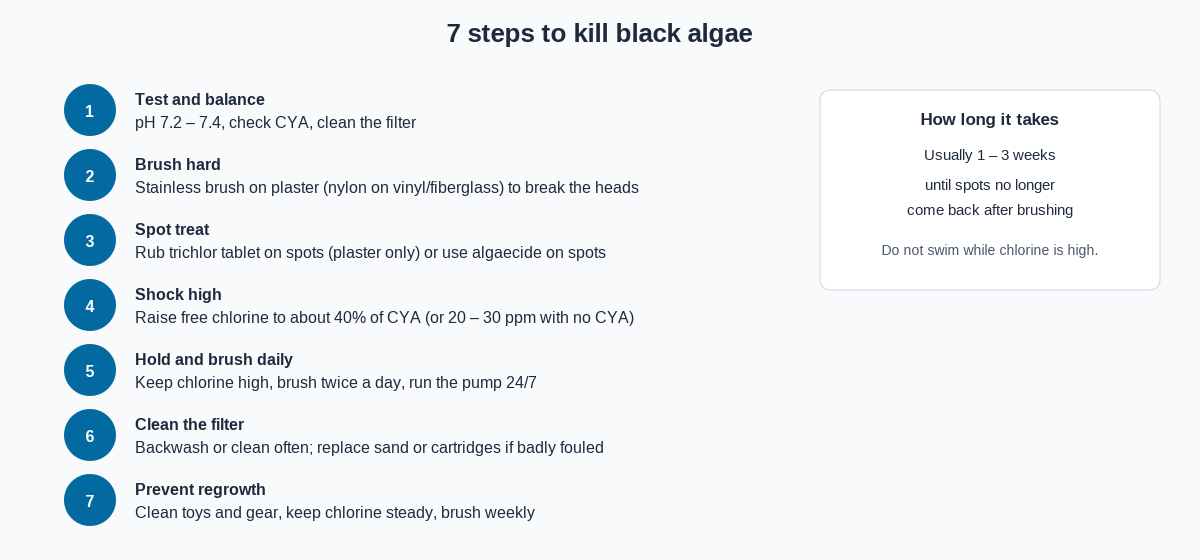
Diagram: Asphapro.com
Quick Answer
To get rid of black algae in pool water, you need to break its protective layer and then keep chlorine high long enough to kill the roots. First balance the water (pH 7.2 to 7.4) and clean the filter. Brush every spot hard with a stainless steel brush on plaster (nylon on vinyl or fiberglass). On plaster, rub a chlorine tablet directly on each spot. Then shock the pool and hold free chlorine at about 40% of your stabilizer level (around 16 ppm at 40 ppm CYA), brushing the spots twice a day and running the pump around the clock. Most black algae dies in 1 to 3 weeks. Clean toys, brushes and swimsuits to stop it from coming back, and keep chlorine steady afterward.
Black algae is the toughest algae to beat in a swimming pool. It shows up as small, raised black or dark blue-green dots, often in grout lines, corners, steps and shady spots. Unlike green algae, which floats and clouds the water, black algae grips the surface with roots and hides under a protective outer layer that shields it from chlorine. If you only shock the pool, the surface layer may die while the roots survive, and the spots come right back.
This guide explains how to get rid of black algae in pool water, step by step, and how to keep it from returning. For green and mustard algae, see our guide on how to get rid of algae in pool water.
What Is Black Algae in Pool Water?
Despite its name, black algae in pool water is not a true algae but a type of cyanobacteria, a microscopic organism that can make its own food from sunlight. It forms small colonies with layers: a slimy protective coating on top, and roots that grow into the tiny pores of plaster, pebble finishes and grout. That structure is what makes black pool algae so hard to kill. It thrives where circulation is poor and chlorine is low, and it is most common in plaster, gunite and pebble pools, though it can appear on vinyl and fiberglass too.
Black algae often enters a pool on swimsuits, toys and equipment that have been in natural water such as oceans, lakes or rivers. Spores can also blow in with dust and rain. Once it finds a rough spot with low chlorine, it settles in and spreads slowly.
Black Algae Pool Spots or Stains?
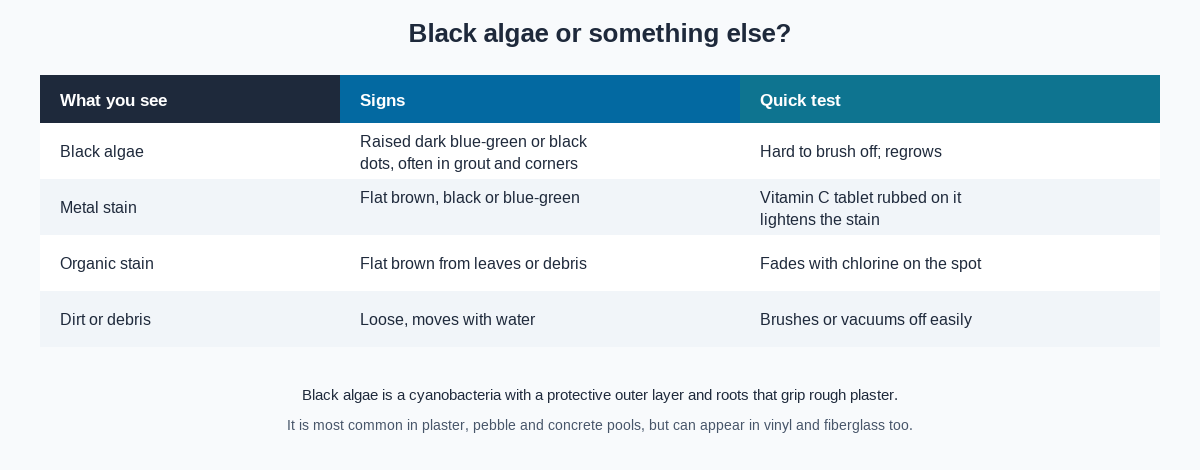
Chart: Asphapro.com
Before treating, make sure the spots are black algae. Black algae spots are slightly raised, feel slick or rough, and are hard to brush off; if you do scrape them, they often leave a darker spot and come back within days. Metal stains are flat and smooth; rubbing a vitamin C tablet on a brown or dark stain lightens it if it is iron or copper. Organic stains from leaves are flat and fade when you hold chlorine against them. Dirt and debris move when you brush or vacuum.
How to Remove Black Algae From Pool Surfaces: Step by Step
Step 1: Test and balance the water. Test free chlorine, pH, alkalinity and cyanuric acid (stabilizer). Lower pH to about 7.2 to 7.4, since chlorine works much better at lower pH. Your stabilizer level decides how much chlorine you will need, so get an accurate CYA reading. If CYA is very high, over about 80 to 100 ppm, consider lowering it first, because the chlorine needed to kill algae will be very high. See our guide on how to reduce cyanuric acid in pool water.
Step 2: Clean or backwash the filter. Start with a clean filter so it can catch dead algae. Backwash a sand or DE filter, or clean a cartridge.
Step 3: Brush every spot hard. This is the most important step. On plaster, pebble and concrete pools, use a stainless steel algae brush to scrub each black spot until the dark top layer is broken and the spot looks lighter or greenish. On vinyl, fiberglass and painted pools, use a stiff nylon brush, since steel will damage the surface. Brush the whole pool, including steps, benches, corners, behind ladders and around lights, because small colonies hide in these places.
Step 4: Spot treat. On plaster pools only, hold a trichlor chlorine tablet in a gloved hand or tablet holder and rub it directly on each spot after brushing. The concentrated chlorine reaches the roots. Do not use tablets on vinyl or fiberglass, which they can bleach or damage. On those surfaces, apply a spot-treatment algaecide made for black algae instead.
Step 5: Shock the pool high. Raise free chlorine to a level based on your stabilizer: about 40% of the CYA level is a common target, so 16 ppm at 40 ppm CYA or 24 ppm at 60 ppm CYA. Use liquid chlorine or cal-hypo rather than dichlor, which would add more stabilizer. Shock at dusk so the sun does not burn off chlorine.
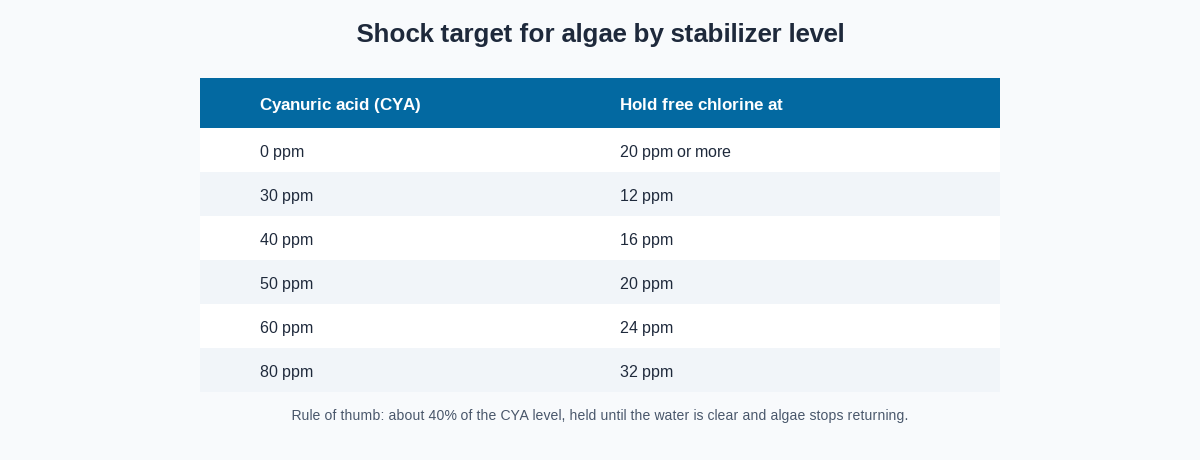
Chart: Asphapro.com
Step 6: Hold chlorine high and keep brushing. This is where many owners give up too soon. Test chlorine at least twice a day and add more to keep it at the target. Brush the spots, and the whole pool, at least twice a day. Run the pump 24 hours a day. As the algae dies, spots fade and turn gray or white. Keep going until the spots stop returning and the water stays clear overnight with little chlorine loss.
Step 7: Clean the filter again. Dead algae clogs the filter. Backwash or clean it as pressure rises. If the filter was badly fouled, consider replacing cartridges or sand after treatment, since spores can survive in the media. See our guide on how to clean swimming pool filter media.
Step 8: Clean everything that touched the water. Wash pool toys, floats, ladders, brushes, vacuum heads and hoses in a strong chlorine solution, and wash swimsuits. Black algae can survive on these items and reinfect the pool.
How Long Does It Take to Get Rid of Black Algae in Pool Water?
Killing black algae in pool water usually takes one to three weeks of steady effort. Light cases may clear in a few days; heavy, long-established colonies can take a month. The key sign you are done is that spots no longer reappear after brushing, and the pool holds chlorine overnight with little loss. Stopping early, while roots are still alive, is the main reason black algae comes back.
Photo: Dave Spicer, Wikimedia Commons, CC BY-SA 2.0
Black Algae in Swimming Pool Vinyl and Fiberglass
Black algae in swimming pool vinyl liners and fiberglass shells is less common, because smooth surfaces give roots little to grip, but it does happen, especially in seams, steps and around fittings. On these surfaces, never use stainless steel brushes or rub chlorine tablets, which can tear vinyl, scratch gel coat and bleach both. Use a stiff nylon brush, a black algae spot treatment rated for your surface, and the same high-chlorine shock process. On vinyl, black algae roots can stain the liner permanently even after the algae is dead; treat it early.
Using Algaecide for Black Pool Algae
Algaecides can help kill black algae but rarely work alone. Products made for black algae often contain copper, silver or strong quaternary compounds. Copper-based algaecides can stain plaster and turn hair green if overused, so follow labels closely and check copper levels. Use algaecide as a supplement after brushing and shocking, not as a replacement. Some owners use a granular spot-treatment product sprinkled on spots in the deep end with the pump off for a few hours. Always follow the label and never mix algaecides with other chemicals.
Why Black Algae in Pool Water Comes Back
Black algae comes back for a few reasons: the treatment stopped before roots died, chlorine dropped too low after treatment, stabilizer was too high for the chlorine level, the filter still held spores, toys and gear were not cleaned, or circulation in some spots is poor. Pools with rough, worn plaster give roots more places to hide, which makes reinfection more likely. If black algae keeps returning in old plaster, resurfacing may be the long-term fix; see our guide on pool resurfacing cost.
How to Prevent Black Algae in Pool Water
Prevention is far easier than treatment. Keep free chlorine steady at about 7.5% of your CYA level or more, and never let it drop to zero. Brush the walls, steps and corners every week, especially shady and low-circulation areas. Keep pH at 7.4 to 7.6. Run the pump long enough to turn over the water every day, and aim returns to stir corners and steps. Shock weekly in hot weather and after heavy use. Rinse swimsuits, toys and gear used in lakes, rivers or the ocean before they go in your pool. Keep stabilizer in range so chlorine stays effective. Clean the filter regularly.
How Do You Get Rid of Black Algae in Pool Corners and Steps?
How do you get rid of black algae in pool corners, steps and other hard-to-reach places? These areas have the poorest circulation and are often skipped when brushing, so black algae in pool corners and step edges is very common. Use a small hand brush or a corner brush to reach tight spots, and brush toward the main drain. Point a return toward the steps during treatment to improve flow. On plaster steps, rub a chlorine tablet into the corners after brushing. Check behind ladders, under light rings and around skimmer throats, where colonies often hide unseen.
How to Eliminate Black Algae in Pool Grout and Tile
Black algae loves grout lines because grout is porous and rough. To eliminate black algae in pool grout, scrub the lines with a stiff narrow brush or a grout brush, then apply a chlorine paste or spot treatment rated for your tile. On waterline tile, lower the water a few inches so you can work on dry grout. After the algae is gone, consider regrouting damaged areas and sealing grout to make it smoother and less inviting. See our guide on how to clean pool tile for safe tile cleaning methods.
A Black Algae Pool Treatment Schedule
A written schedule keeps a black algae pool treatment on track. Day 1: test, balance pH, clean the filter, brush everything hard, spot treat, and shock to the target level at dusk. Days 2 to 7: test chlorine morning and evening and top up to the target, brush the spots and walls twice a day, and clean the filter as pressure rises. Week 2: continue holding chlorine and brushing; spots should be fading and turning gray. Week 3: if spots no longer return and the pool holds chlorine overnight, let chlorine drop back to normal, clean or replace filter media, clean all gear, and return to regular care. If spots keep returning, continue until they stop.
How to Get Rid of Black Algae in Your Pool on a Budget
Getting rid of black algae in your pool does not require expensive specialty products. The core tools are a stainless or nylon brush ($20 to $40), liquid chlorine (often the cheapest way to hold high levels), and a reliable test kit. Trichlor tablets for spot treating cost little. Specialty black algae algaecides can help but are optional. The biggest cost is chlorine over two to three weeks, which depends on pool size and stabilizer level. Lowering pH and keeping the cover off at night is not needed; shock at dusk and keep the pump running to make each gallon of chlorine count.
Black Algae in Pool Water and Health
Black algae in pool water is not usually dangerous to touch, but it shows that chlorine has been too low for too long, which means bacteria and other germs may also be present. It also creates slippery spots on steps and floors. Keep swimmers out of the pool during treatment, since chlorine levels will be well above swimming range. After treatment, wait until chlorine drops back to about 1 to 4 ppm before swimming; see our guide on how long after shocking pool can you swim.
Tools You Need
Gather these before starting: a stainless steel algae brush for plaster or a stiff nylon brush for vinyl and fiberglass, a wide wall brush on a pole, a small hand brush for corners and grout, a reliable FAS-DPD test kit that reads high chlorine accurately, liquid chlorine or cal-hypo in enough quantity for several days, trichlor tablets for spot treating plaster, a tablet holder or gloves, muriatic acid to lower pH, and filter cleaner. A pool vacuum helps remove dead algae from the floor. Having everything ready before you start makes it easier to keep chlorine high without gaps, which is the key to success.
Black Algae vs Green and Mustard Algae
Green algae floats in the water, turns it cloudy or green, and dies quickly with a normal shock and filtering. Mustard (yellow) algae clings to shady walls in a powdery layer, brushes off easily but returns fast, and needs a strong shock and cleaning of gear. Black algae is the most stubborn: it roots into the surface, hides under a protective layer, and needs hard brushing plus days of high chlorine. Knowing which type you have tells you how hard and how long to fight. If you see green water with a few dark spots, treat the black algae in pool surfaces with the full process, since a normal shock will clear the green but leave the black.
Black Algae in Salt Water Pools
Salt pools can get black algae too, often when the cell output is too low, the cell is scaled, or stabilizer is high. A salt cell cannot raise chlorine fast enough to treat algae on its own. Use liquid chlorine to reach and hold the shock level, run the cell at its normal setting, and brush as usual. After treatment, check the cell, clean it if scaled, and increase output so chlorine stays steady. Keep stabilizer at 60 to 80 ppm, not higher. See our guide on how to maintain a saltwater pool.
Worked Examples
Example 1: early spots. A 15,000-gallon plaster pool shows a dozen black dots on the steps in June. CYA is 40 ppm. The owner brushes hard with a steel brush, rubs a tablet on each spot, and shocks to 16 ppm, holding it for six days while brushing twice daily. The spots fade and do not return. Total cost: about $60 in liquid chlorine.
Example 2: established colonies. A 20,000-gallon pebble pool has black algae across the floor and steps after a summer of low chlorine. CYA is 90 ppm, so the shock target would be 36 ppm. The owner first drains and refills about half the water to bring CYA to 45 ppm, then shocks to 18 ppm and holds it for three weeks with daily brushing. The algae is gone, and the owner replaces the filter cartridges.
Example 3: vinyl pool. A vinyl pool shows black spots in the corner seams. The owner uses a nylon brush and a black algae spot treatment rated for vinyl, then shocks to 40% of CYA for ten days. Two faint stains remain where roots had been, but the algae does not return.
Cost to Treat Black Algae
For most residential pools, the cost to remove black algae from pool surfaces yourself is about $50 to $250, mostly for chlorine over one to three weeks, plus a brush, test supplies and possibly algaecide. If CYA must be lowered by draining, add water costs. If filter media is fouled, new cartridges cost $100 to $300 and sand $50 to $150 plus labor. A pool service may charge $150 to $500 for a black algae treatment, plus follow-up visits. If black algae keeps returning because of rough, failing plaster, resurfacing may eventually be needed.
When to Call a Pool Professional
Call a pro if black algae covers most of the pool, keeps returning after a full treatment, or if you cannot keep chlorine high because of high stabilizer or equipment problems. A pro can test thoroughly, lower stabilizer, inspect the filter and circulation, and recommend whether the surface needs repair. For severe cases in old plaster pools, some pros drain and acid wash the pool, which removes a thin layer of plaster along with the algae roots, then refill and balance the water.
After the Black Algae Is Gone
Once the spots stop coming back, let chlorine fall to your normal level, test and balance pH, alkalinity and calcium, and check the filter pressure. Deep-clean or replace filter media if it held a lot of algae. Brush the pool thoroughly one more time and vacuum. Wash and dry all brushes and toys. Over the next month, brush the former trouble spots extra carefully every week and keep a close eye on chlorine, especially during hot weather and heavy use, when black algae in pool water is most likely to return. A stable routine from here on keeps black algae from getting a foothold again.
Common Mistakes
The biggest mistakes when fighting black algae are stopping the treatment too soon, not brushing hard enough, letting chlorine drop overnight, using dichlor shock that raises stabilizer, using steel brushes on vinyl or fiberglass, forgetting to clean the filter and gear, and ignoring high stabilizer that makes chlorine too weak. Avoiding these mistakes turns a frustrating fight into a straightforward, predictable one.
Why Brushing Matters So Much
Brushing is what separates a successful black algae treatment from a failed one. The protective outer layer on each colony blocks chlorine from reaching the living cells and roots below. A steel brush on plaster tears that layer open and scrapes away some of the roots, letting chlorine in. Brushing also lifts dead cells so the filter can remove them, and it stirs water in corners where circulation is poor. Many owners who say chlorine "does not work" on black algae have not brushed hard or often enough. Twice-daily brushing during treatment is not optional; it is the core of the process. With good brushing, the high chlorine level needed is reached faster and the treatment ends sooner. Owners who stick with daily brushing usually find that black algae in pool corners and steps fades within days, while untouched spots elsewhere keep growing, which shows exactly where brushing made the difference.
Black Algae Pool Checklist
Use this short checklist for any black algae pool problem: test and balance, clean the filter, brush every spot hard, spot treat plaster with a tablet, shock to about 40% of CYA, hold that level with twice-daily tests and brushing, run the pump nonstop, clean the filter again, wash all gear, and keep chlorine steady once the black algae in pool surfaces is gone.
How to Get Rid of Black Algae in Pool: Key Points
- Brush hard to break the protective layer before and during treatment.
- Hold free chlorine at about 40% of the CYA level until spots stop returning.
- Brush twice a day and run the pump around the clock.
- Clean the filter, toys and gear to prevent reinfection.
Frequently Asked Questions
Can you swim in a pool with black algae?
It is best not to swim during treatment, since chlorine is held very high. Black algae itself is not usually harmful, but it can harbor bacteria and make steps slippery, so keep swimmers out until the pool is clear and chlorine is back in range.
What kills black algae in a pool?
High chlorine held for days, combined with hard brushing that breaks its protective layer. Algaecides made for black algae can help as a supplement, but they do not replace brushing and chlorine.
Does shock alone kill black algae in pool water?
Rarely. Shock kills the surface, but the roots survive unless you brush hard and hold chlorine high for days, often one to three weeks.
Can a pool store treat black algae for me?
Many pool services will brush and shock the pool, but you still need to brush daily and keep chlorine high between visits for the black algae pool treatment to work.
Will black algae stain my pool?
It can, especially on vinyl liners and soft plaster. Treat it early to limit staining, and use stain treatments after the algae is gone if marks remain.
How do I know black algae is gone?
When spots no longer come back after brushing and the pool holds chlorine overnight with little loss, the black algae in pool surfaces is dead. Keep brushing weekly for a month to be sure.
Sources
- CDC: Pool chemistry and testing
- Trouble Free Pool: Pool water chemistry
- Swim University: Black algae in pools
- Pool and Hot Tub Alliance