
When to Shock a Pool: What Pool Shock Does, How Much to Add and When to Swim
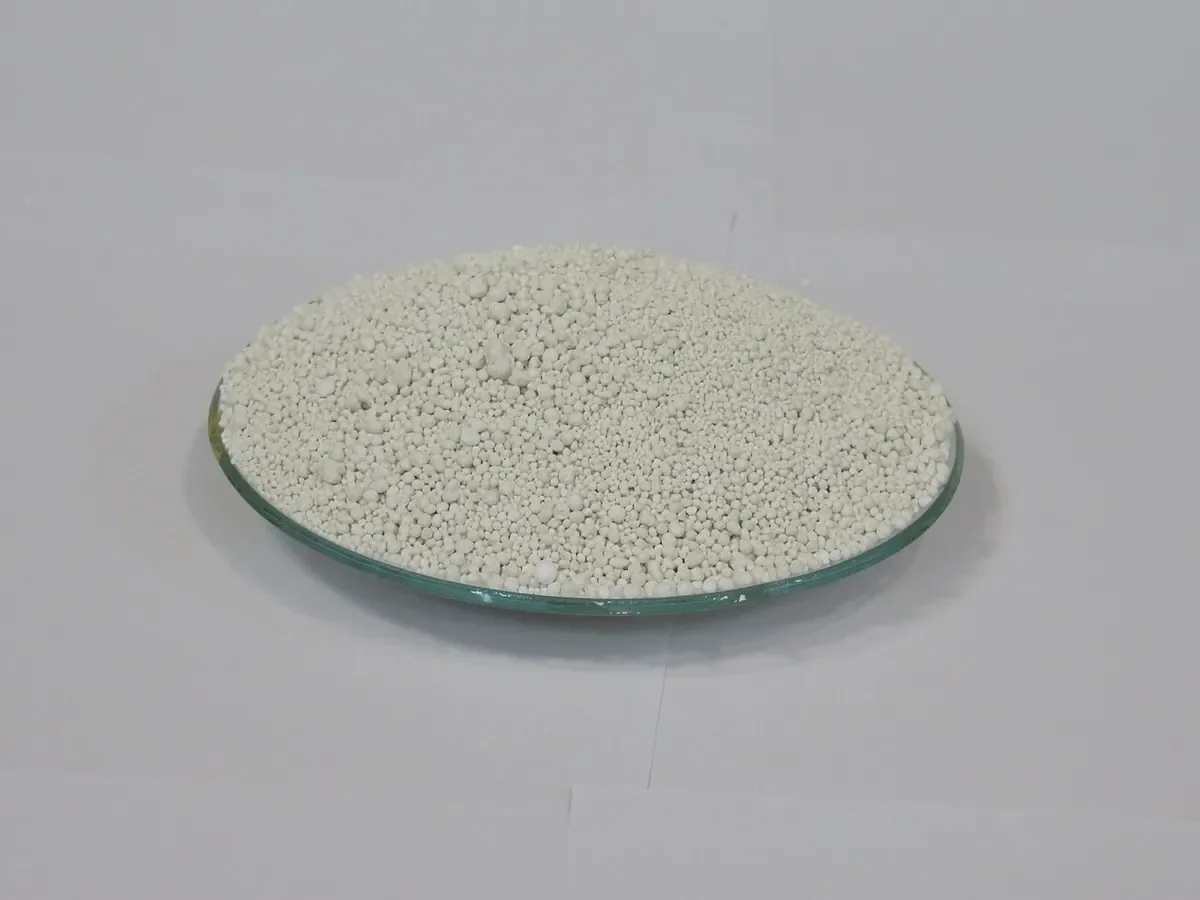
Photo: CCPCIRAN, Wikimedia Commons, CC BY-SA 4.0
Quick Answer
When to shock a pool: about once a week in the swim season, plus after heavy use such as parties, after storms and heavy rain, during heat waves, when the water looks cloudy or dull, when there is a strong chlorine smell (chloramines), at the first sign of algae, and when you open or close the pool. Shock at dusk or in the evening so sunlight does not burn off the chlorine, with the pump running. A common routine dose is about 1 pound of calcium hypochlorite shock or about 1 gallon of liquid chlorine per 10,000 gallons; algae needs much more. Wait to swim until free chlorine drops back to the normal range, usually overnight, or about 15 minutes after non-chlorine shock.
Pool shock is one of the most important tools in pool care, and one of the most misunderstood. "Shocking a pool" simply means adding a large dose of oxidizer, usually chlorine, to quickly break down contaminants, kill bacteria and algae, and restore clear, fresh-smelling water. Done at the right time, it prevents most water problems before they start.
This guide explains what pool shock is and what it does, when to shock a pool, the best time of day, the types of pool shock, how much to add, how to shock step by step, how long to wait before swimming, and whether pool shock goes bad. For the regular cleaning routine, see how to clean a pool.
What Is Pool Shock?
Pool shock is a concentrated chemical, most often a form of chlorine, added in a large dose to raise the sanitizer and oxidizer level quickly. Swimming pool shock comes as granules, powders or liquid. The word "shock" describes how it is used, a big dose at once, rather than a single chemical.
What Does Shocking a Pool Do?
- Breaks down chloramines. When chlorine combines with sweat, urine and body oils, it forms chloramines, which cause the "chlorine smell" and red eyes. Shock burns them off.
- Kills bacteria and algae that normal chlorine levels are not keeping up with.
- Oxidizes organic contaminants such as sunscreen, cosmetics and leaves.
- Restores free chlorine after heavy demand.
- Clears dull or cloudy water caused by contaminants.
So what does it mean to shock a pool? It means raising the oxidizer level high enough, briefly, to clean the water chemically, then letting it return to normal.
When to Shock a Pool
| Situation | Why shock |
|---|---|
| Weekly in the swim season | Routine oxidation and chloramine control |
| After pool parties or heavy use | Lots of sweat, oils and sunscreen |
| After heavy rain or storms | Dilution and contaminants washed in |
| During heat waves | Heat and sun use up chlorine fast |
| Cloudy or dull water | Contaminants overwhelming normal chlorine |
| Strong chlorine smell or red eyes | High combined chlorine (chloramines) |
| First sign of algae | Stop a bloom before it spreads |
| Opening and closing the pool | Start and end the season with clean water |
| After a fecal accident | Kill germs; follow CDC guidance |
Best Time of Day to Shock a Pool
Shock the pool at dusk or in the evening. Sunlight's UV rays break down unstabilized chlorine quickly, so shocking in midday sun wastes much of the dose. Shocking at night gives the chlorine hours to work. Run the pump during and after shocking so the chemical spreads evenly, and test the water the next morning.
Types of Pool Shock
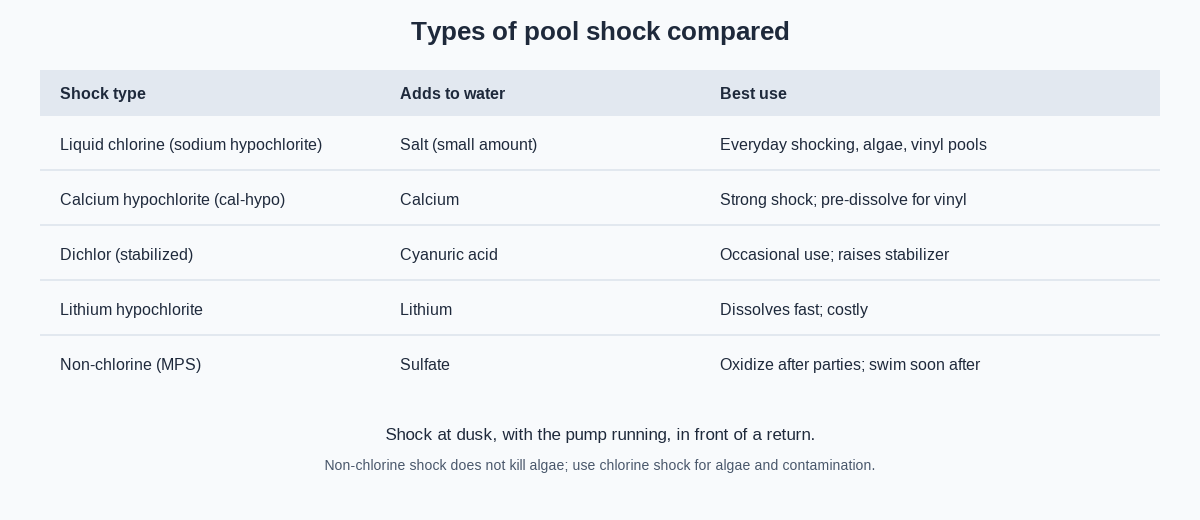
Chart: Asphapro.com
- Liquid chlorine (sodium hypochlorite): fast-acting, adds no calcium or stabilizer, easy to dose. Loses strength in storage, especially in heat.
- Calcium hypochlorite (cal-hypo): the most common granular shock, usually about 65% to 73% available chlorine. Adds calcium; pre-dissolve for vinyl pools.
- Dichlor: stabilized chlorine shock that dissolves fast but adds cyanuric acid with each use, which can build up.
- Lithium hypochlorite: dissolves quickly with little residue; more expensive and less common.
- Non-chlorine shock (potassium monopersulfate, MPS): oxidizes contaminants without raising chlorine, so you can swim soon after. It does not kill algae or sanitize like chlorine.
How Much Shock to Add: A Simple Pool Shock Calculator Method
A pool shock calculator works out the dose from your pool volume, the product's strength and how much you want to raise chlorine. You can estimate it by hand:
- Liquid chlorine (10%): about 1 gallon raises free chlorine about 10 ppm in a 10,000 gallon pool.
- Liquid chlorine (12.5%): about 1 gallon raises free chlorine about 12 ppm in 10,000 gallons.
- Cal-hypo (65%): about 1 pound raises free chlorine about 7 to 8 ppm in 10,000 gallons.
| Pool volume | Routine shock: cal-hypo 65% | Routine shock: liquid chlorine 10% |
|---|---|---|
| 10,000 gallons | about 1 lb | about 1 gallon |
| 15,000 gallons | about 1.5 lb | about 1.5 gallons |
| 20,000 gallons | about 2 lb | about 2 gallons |
| 30,000 gallons | about 3 lb | about 3 gallons |
These are routine weekly doses. Algae needs much more, often two to four times as much, held until the water clears; see how to clean a green pool. Always read the label, because product strengths vary. If you do not know your pool volume, see how many gallons is my pool.
How to Shock a Pool Step by Step
- Test the water for free chlorine, pH and alkalinity.
- Adjust pH to about 7.2 to 7.6 so the shock works efficiently.
- Calculate the dose for your pool size and goal.
- Wear gloves and eye protection.
- Pre-dissolve granular shock in a bucket of pool water if the label calls for it (always add shock to water, never water to shock).
- Add the shock at dusk with the pump running, pouring slowly in front of a return jet and around the pool.
- Brush the walls and floor to spread it and loosen any algae.
- Run the pump for at least 8 hours, or overnight.
- Test the next morning and wait until chlorine returns to the normal range before swimming.
For more on dosing chlorine, see how much chlorine to add to a pool.
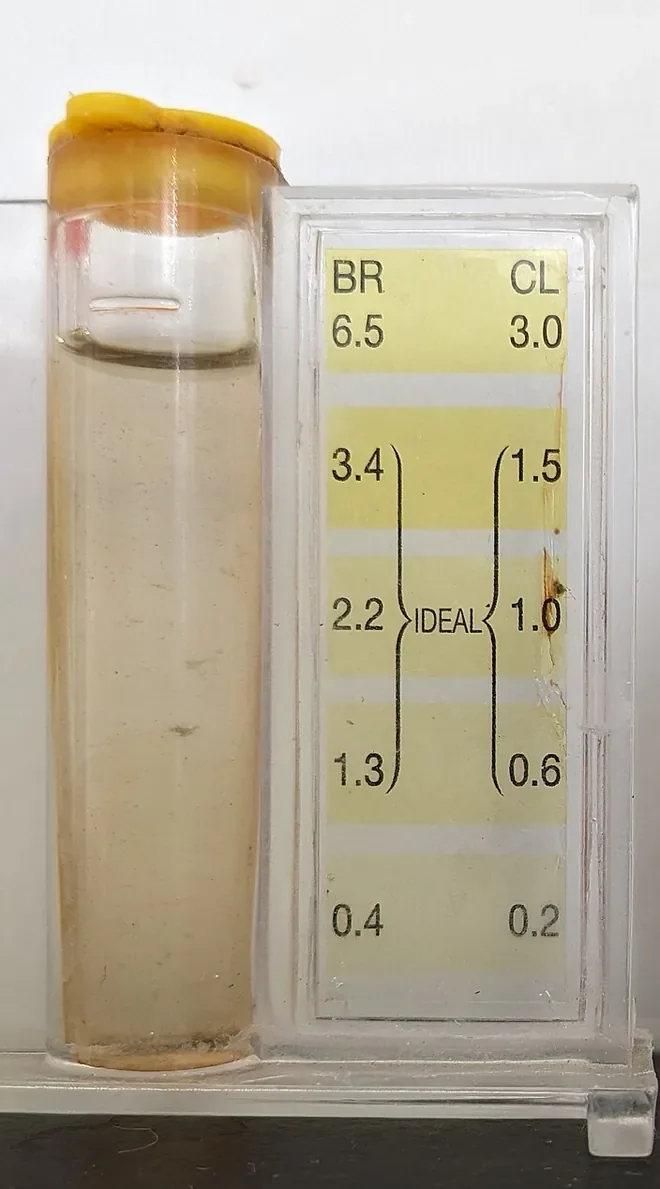
Photo: Registreernu, Wikimedia Commons, CC0 (cropped)
Signs Your Pool Needs to Be Shocked
- A strong "chlorine" or chemical smell around the pool.
- Swimmers complain of red, itchy eyes or skin.
- Water looks dull, hazy or cloudy.
- Walls or steps feel slippery.
- Free chlorine is low, or combined chlorine (total minus free) is above about 0.2 to 0.5 ppm.
- Green, yellow or black spots appear.
- The pool had heavy use, a storm, or a hot, sunny stretch.
If you see any of these, shocking the pool that evening is usually the right move.
Breakpoint Chlorination Explained Simply
Pool test kits measure free chlorine (active and available) and total chlorine. The difference is combined chlorine, mostly chloramines. To destroy chloramines, you need to add enough chlorine to pass a point called breakpoint, roughly ten times the combined chlorine level. If combined chlorine is 0.5 ppm, raising free chlorine by about 5 ppm usually clears it. Adding too little shock can leave chloramines in place and even make the smell worse for a while. This is why swimming pool shock doses are much larger than daily chlorine additions.
Shock and Stabilizer (Cyanuric Acid)
Outdoor pools use cyanuric acid (stabilizer) to protect chlorine from the sun. But stabilizer also slows chlorine's action. The higher the stabilizer, the higher the free chlorine needed to shock effectively. A pool with 30 ppm stabilizer needs much less chlorine to shock than a pool with 80 ppm. If you use stabilized tablets or dichlor shock, stabilizer builds up over the season, and shocking becomes less effective. Test cyanuric acid monthly and use unstabilized shock such as liquid chlorine or cal-hypo to avoid adding more. See how to add stabilizer to a pool and how to reduce cyanuric acid in a pool.
Shock and pH
Chlorine works best when pH is about 7.2 to 7.6. At pH 8.0, a much smaller share of chlorine is in its active form, so the same dose does less. Lower high pH before shocking. Note that liquid chlorine and cal-hypo raise pH slightly, while dichlor is closer to neutral. After shocking, test and adjust pH again. See how to lower pH in a pool.
Shocking a Pool at Opening and Closing
Opening: after removing the cover and starting the equipment, balance the water and shock the pool to kill bacteria and algae that grew over winter. A heavier dose is common if the water is cloudy or green.
Closing: shock a few days before closing, let chlorine drop toward normal, then add closing chemicals and the cover. Shocking at closing helps the pool open cleaner next spring. See how to winterize a pool.
How to Shock a Pool to Clear Cloudy Water
Cloudy water can come from contaminants, early algae or poor filtration. Shock the pool at dusk, brush, run the filter overnight and clean it if pressure rises. If the water stays cloudy but chlorine holds, the problem is likely filtration or water balance rather than a need for more shock; a clarifier can help. See how to clear a cloudy pool.
Shocking a Hot Tub or Spa
Spas need shocking more often than pools because hot water and many bathers in a small volume use chlorine quickly. Many spa owners shock after each use or weekly with a spa-sized dose of chlorine or non-chlorine shock. Use products labeled for spas and follow the label; spa volumes are small, so it is easy to overdose. See hot tub cost.
Pool Shock and Water Testing
Testing is what tells you whether shocking worked. A good test kit measures free chlorine and total chlorine, so you can calculate combined chlorine, plus pH, alkalinity and cyanuric acid. Test before shocking to choose the dose, the next morning to confirm chlorine has returned to the normal range, and again after a day or two if you were treating algae. Test strips are convenient for quick checks, but drop-based kits are more accurate at high chlorine levels, which matters during and after a heavy shock. If free chlorine falls sharply overnight after shocking, the pool still has a contaminant or algae problem and needs another dose.
How Long After Shocking a Pool Can You Swim?
After chlorine shock, wait until free chlorine falls back to the normal swimming range. For many pools that means waiting overnight, or about 8 to 24 hours, depending on the dose, sun and stabilizer level. After non-chlorine shock, swimming is often allowed after about 15 minutes; check the label. Test before letting anyone swim. See how long after shocking a pool can you swim.
Shocking Different Types of Pools
Vinyl pools: use liquid chlorine or pre-dissolve granular shock; undissolved granules can bleach the liner.
Plaster pools: broadcast shock around the pool with the pump running; avoid letting granules sit in one spot.
Fiberglass pools: pre-dissolve granular shock to avoid surface spots.
Saltwater pools: use the cell's boost mode for small needs, but for real shocking add liquid chlorine. See how to maintain a saltwater pool.
Above ground pools: smaller volumes need smaller doses; pre-dissolve granules.
Does Pool Shock Go Bad?
Yes, pool shock can go bad. Liquid chlorine loses strength over weeks to months, faster in heat and sunlight; buy it fresh and use it within the season. Granular cal-hypo is more stable and can last a year or more if kept sealed, cool and dry, but it slowly loses strength and can clump if it absorbs moisture. Non-chlorine shock also degrades with moisture. Store shock in its original container, off the floor, away from other chemicals, especially acids and organic materials, in a cool, dry, ventilated place.
Chlorine Shock vs Non-Chlorine Shock: Which to Use When
Both types have a place in pool care. Use chlorine shock when you need to sanitize as well as oxidize: algae, cloudy water, after fecal accidents, at opening, after storms, and when free chlorine is low. Use non-chlorine shock when free chlorine is already in range but the water needs oxidizing, for example after a party or heavy use when you want to swim again soon. Non-chlorine shock does not raise free chlorine, so it does not replace chlorine for sanitizing, and it can make some test kits read combined chlorine incorrectly for a while. Many owners alternate: chlorine shock weekly, with non-chlorine shock after busy weekends.
Shocking After a Fecal Accident
If a swimmer has a fecal accident, get everyone out, remove the material, and follow CDC guidance. For formed stool, CDC guidance for treated pools involves raising free chlorine to a set level and holding it for a set time before reopening; for diarrhea, the required chlorine level and contact time are much higher because of chlorine-tolerant germs. Home pool owners can follow the same steps. Check the CDC's current fecal incident guidance for exact levels and times, and keep swimmers out until the process is complete and chlorine returns to normal.
Can You Shock a Pool During the Day?
You can, but it is less efficient. Sunlight breaks down chlorine that is not protected by stabilizer, so part of a daytime dose is lost. If you must shock during the day, for example to fix a sudden problem, use a larger dose or shock again in the evening, and make sure the pump is running. For routine shocking, evening is always better.
How to Store Pool Shock Safely
- Keep shock in its original, closed container with the label.
- Store it off the floor in a cool, dry, ventilated area, out of direct sun.
- Keep it away from acids, fertilizers, fuels, paints and organic materials such as oils and paper.
- Store chlorine products and acid in separate places.
- Never store opened bags where moisture can get in.
- Keep all pool chemicals locked away from children and pets.
Pool Shock Safety
- Never mix different shock products or other chemicals together.
- Add shock to water, not water to shock.
- Keep shock away from heat, flames, fuel, fertilizer and acids.
- Wear gloves and eye protection.
- Keep children and pets away while shocking and until chlorine returns to normal.
- Follow every label direction.
Pool Shock Calculator: Worked Examples
Example 1: routine weekly shock. A 16 x 32 ft pool with an average depth of 5 ft holds about 19,200 gallons. Free chlorine is 2 ppm, combined chlorine 0.4 ppm. To pass breakpoint, raise free chlorine by about 4 to 5 ppm. With 10% liquid chlorine (about 10 ppm per gallon per 10,000 gallons), that is roughly 19,200 ÷ 10,000 × 0.45 ≈ 0.9 gallon, so about 1 gallon.
Example 2: after a pool party. The same pool had 20 swimmers on a hot day and smells strongly of chlorine. A larger dose, raising free chlorine by about 8 to 10 ppm, is reasonable: about 1.5 to 2 gallons of 10% liquid chlorine, or about 2 to 2.5 pounds of 65% cal-hypo.
Example 3: an 18 ft round above ground pool. About 7,000 gallons. A routine shock raising chlorine about 5 ppm needs roughly a third to half a gallon of 10% liquid chlorine, or about half a pound of cal-hypo, pre-dissolved.
A swimming pool shock calculator app or chart does the same math. The key inputs are always pool volume, product strength and how much you want to raise free chlorine.
What Is in Pool Shock?
Most pool shock contains a chlorine compound: sodium hypochlorite in liquid chlorine, calcium hypochlorite in cal-hypo, sodium dichloroisocyanurate in dichlor, or lithium hypochlorite. Granular products may include small amounts of other compounds. Non-chlorine shock contains potassium peroxymonosulfate (MPS). The label lists the active ingredient and its percentage of available chlorine, which tells you how strong it is.
Common Pool Shock Mistakes
- Shocking in bright sun, which wastes chlorine.
- Adding too little, leaving chloramines and algae behind.
- Pouring granular shock directly onto vinyl, causing bleached spots.
- Mixing shock with other chemicals or adding it into a skimmer with a tablet feeder, which can cause dangerous reactions.
- Relying on dichlor shock every week, which raises stabilizer.
- Ignoring pH before shocking.
- Swimming too soon after a chlorine shock.
- Storing old shock in a hot, damp place.
Cost of Shocking a Pool
For an average residential pool, weekly shock costs roughly $5 to $15 per treatment with liquid chlorine or cal-hypo, more for non-chlorine and lithium shock. Over a swim season, shock commonly costs $50 to $200, more for large pools, hot climates or algae treatment. Buying in bulk at the start of the season saves money, but buy liquid chlorine fresh because it weakens over time. See cost to maintain a pool.
A Simple Weekly Shock Routine
For most pools, this routine keeps water clear with little effort:
- Pick a day, such as Sunday evening after weekend swimming.
- Test free chlorine, combined chlorine and pH that afternoon.
- Adjust pH if needed and let it circulate for an hour.
- Add the routine shock dose at dusk with the pump running.
- Brush the walls and steps.
- Test Monday morning; swim once chlorine is back in the normal range.
Add an extra shock after big parties, storms or very hot weeks. If you find you need to shock more than twice a week to keep the water clear, look for an underlying problem such as high stabilizer, poor circulation, a dirty filter or a pump that runs too few hours. Keeping a short log of test results and shock doses makes it easy to see patterns over the season and fine-tune the routine for your pool and climate.
When to Shock a Pool: Key Points
- Shock the pool weekly in season and after heavy use, storms, heat waves and at the first sign of algae.
- Shock at dusk with the pump running, after adjusting pH.
- Use enough shock to pass breakpoint; algae needs much more.
- Prefer unstabilized shock to avoid stabilizer buildup.
- Wait to swim until chlorine returns to the normal range.
Frequently Asked Questions
How often should you shock a pool?
About once a week in the swim season, plus after heavy use, storms, heat waves, or when water looks dull. Pools with heavy use or hot climates may need to shock the pool twice a week.
Should I shock my pool at night or during the day?
At night or dusk, so sunlight does not break down the chlorine before it works. The pool shock then has many hours to oxidize contaminants before morning.
What does pool shock do?
It oxidizes contaminants, breaks down chloramines, kills bacteria and algae, and restores free chlorine.
What is shocking a pool?
Shocking a pool means adding a large dose of pool shock, usually chlorine, to quickly oxidize contaminants, kill bacteria and algae, and break down chloramines.
What does shock do to a pool?
Shock raises the oxidizer level so contaminants are destroyed, chloramines are broken down, and free chlorine is restored. The water clears and the chlorine smell fades.
How do you shock a pool for the first time?
Test and balance pH, calculate the dose for your pool volume, pre-dissolve granular shock if needed, add it at dusk in front of a return with the pump running, brush, and test the next morning.
What is swimming pool shock made of?
Most swimming pool shock is calcium hypochlorite, sodium hypochlorite (liquid), dichlor or lithium hypochlorite. Non-chlorine shock is potassium monopersulfate.
Should I shock the pool after it rains?
Yes, after heavy rain. Rain dilutes chlorine and washes in contaminants, so shocking the pool that evening helps prevent cloudy water and algae.
Can I add shock and algaecide at the same time?
It is better to shock first and add algaecide after chlorine has dropped back toward normal, often the next day, because very high chlorine can reduce the effect of some algaecides.
What is a shocked pool supposed to look like?
Right after shocking, water may look briefly cloudy as contaminants are oxidized and dead algae is suspended. With good filtration, a shocked pool should be clear and sparkling within a day.
Can pool shock go bad?
Yes. Liquid chlorine weakens within weeks to months, especially in heat, and granular shock slowly loses strength and can clump if it gets damp. Buy fresh and store it cool and dry.
Can you shock a pool too much?
Over-shocking wastes chemicals, can bleach vinyl and delays swimming, but chlorine levels return to normal over time. Test before swimming and avoid repeated heavy doses with stabilized products.
How long does pool shock last in storage?
Liquid chlorine weakens within weeks to months; granular shock can last a year or more if kept cool and dry in a sealed container.
Sources
- CDC: Healthy Swimming
- CDC: Chlorine and fecal incident response guidance
- OSHA: Chemical hazards and storage
- Pool & Hot Tub Alliance: pool chemical safety