
How to Remove Phosphates From Pool Water: A Step-by-Step Guide
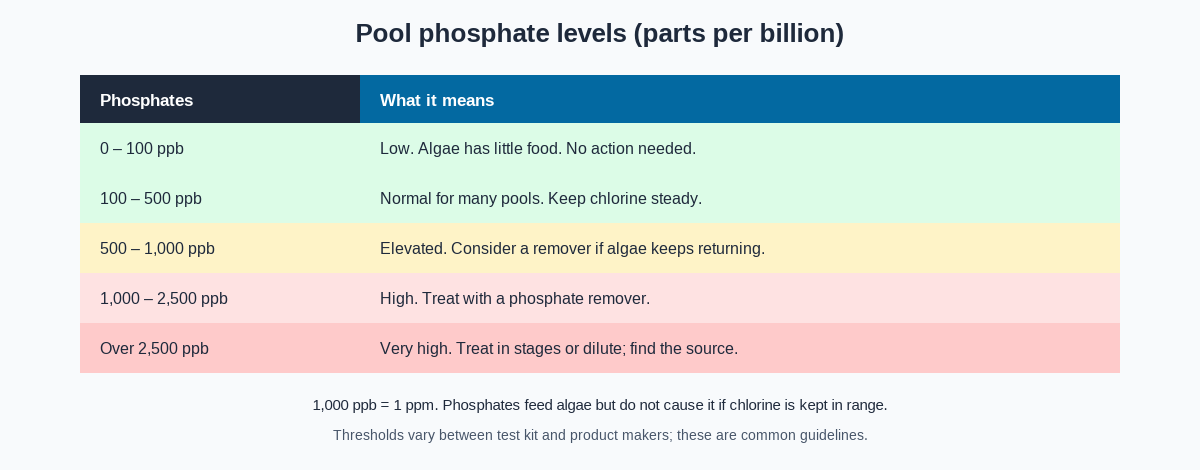
Chart: Asphapro.com
Quick Answer
To remove phosphates from pool water, first test the level in parts per billion (ppb). If it is over about 1,000 ppb, or algae keeps returning, balance the water, clean the filter, and add a phosphate remover (usually lanthanum-based) with the pump running, following the label dose for your pool size and phosphate level. The water may turn cloudy as phosphates bind into particles; run the filter 24 to 48 hours, then clean or backwash the filter and vacuum any settled material. Retest and repeat if needed. Then find the source, such as leaves, fertilizer or tap water, and keep chlorine at the right level, since good chlorine kills algae even when some phosphates are present.
Phosphates are nutrients that feed algae. They are everywhere: in leaves, soil, fertilizer, rain, tap water and even swimmers. Every outdoor pool has some. In small amounts they are harmless, but when phosphates in pool water build up, algae has a ready food supply, and pools that do not keep chlorine steady can struggle with green water and slimy walls.
This guide explains how to remove phosphates from pool water, when it is worth doing, and how to keep levels low. For treating algae itself, see our guides on how to get rid of algae in pool water and how to get rid of black algae in pool surfaces.
What Are Phosphates in a Pool?
What are phosphates in a pool, exactly? Phosphates are compounds of phosphorus and oxygen. Phosphorus is a key nutrient for all living things, including algae. In pool water, phosphates usually come from organic matter breaking down and from fertilizers and other outside sources. They dissolve in the water and cannot be seen, so the only way to know the level is to test for them.
Phosphates do not make water unsafe for swimmers, and they do not cause algae on their own. Algae needs sunlight, warmth and a lack of sanitizer as well as nutrients. But when chlorine drops, even briefly, high phosphates let algae grow faster and come back more quickly after treatment.
Where Do Phosphates in Pool Water Come From?
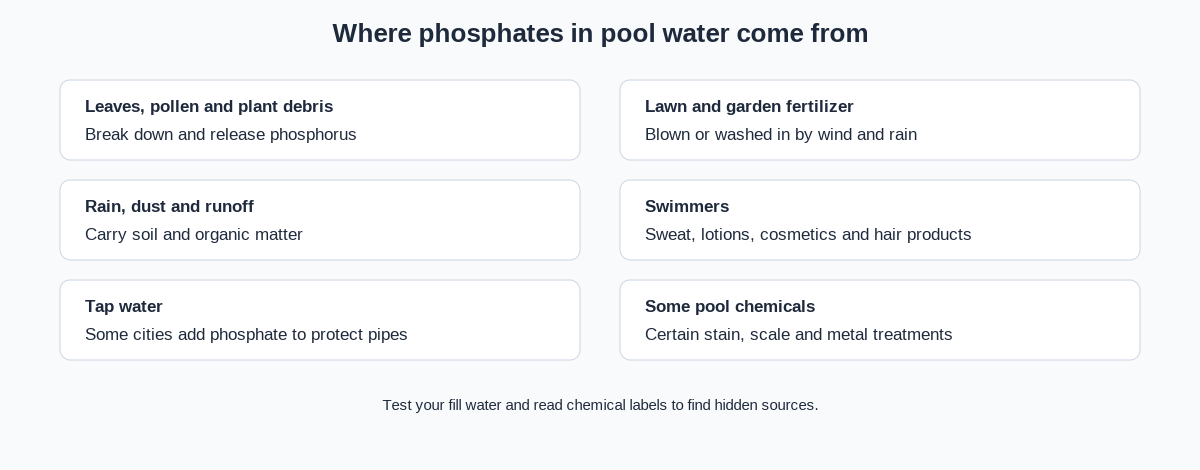
Chart: Asphapro.com
The most common sources of phosphates in pool water are leaves, pollen, grass clippings and other plant debris that fall into the water and break down. Lawn and garden fertilizer is another big source, carried in by wind, sprinkler overspray and rain runoff. Rain itself carries dust and organic matter. Swimmers add phosphates through sweat, lotions, cosmetics and hair products. Some city water systems add phosphates to tap water to protect pipes from corrosion, so every top-up adds more. Finally, some pool chemicals, especially certain stain and scale treatments and metal sequestrants, contain phosphonates or phosphates.

Photo: beaucon, Wikimedia Commons, CC BY-SA 2.0
How to Test for Phosphates in Pool Water
Phosphate test kits and strips measure phosphates in parts per billion (ppb). Drop kits and color comparators give more accurate readings than strips, and digital photometers give the most precise results. Many pool stores test phosphates for free. Test when you open the pool, after heavy rain or leaf fall, and whenever algae keeps coming back. Also test your tap water, which tells you whether top-ups add phosphates.
What Phosphate Level Is Too High?
Opinions vary, but common guidelines are: under 100 ppb is low; 100 to 500 ppb is normal for many outdoor pools; 500 to 1,000 ppb is elevated; over 1,000 ppb is high and worth treating if algae is a problem; and over 2,500 ppb is very high. Many phosphate remover labels recommend treating above 500 or 1,000 ppb. If your pool stays clear with steady chlorine at a moderate phosphate level, there may be no need to treat at all.
How to Remove Phosphates From Pool: Step by Step
Step 1: Test and balance. Test phosphates, chlorine, pH and alkalinity. Bring pH to 7.4 to 7.6. If there is algae, treat it first with shock and brushing, since dead algae releases phosphates and will raise your reading again.
Step 2: Clean the filter. Backwash a sand or DE filter or clean the cartridge, so it can catch the particles the remover will create.
Step 3: Measure the dose. Read the phosphate remover label. Doses depend on pool volume and phosphate level. Large initial doses are used for high levels, then smaller maintenance doses.
Step 4: Add the remover. With the pump running, pour the remover slowly into the skimmer or in front of a return, as the label directs. Most phosphate removers use lanthanum, which binds phosphate into an insoluble particle.
Step 5: Run the filter. Run the pump continuously for 24 to 48 hours. The water may turn cloudy or milky as the particles form; this is normal and clears as the filter catches them.
Step 6: Clean the filter again and vacuum. Backwash or clean the filter when pressure rises, and vacuum any fine material that settles on the floor, ideally to waste.
Step 7: Retest. Test phosphates again after the water clears. If the level is still high, repeat the treatment. Very high levels may need several treatments over a week or two.
Do You Really Need to Remove Pool Phosphates?
Pool experts disagree on how much pool phosphates matter. One view is that phosphates are always present in outdoor pools and that keeping free chlorine at the right level for your stabilizer is enough to prevent algae, no matter the phosphate level. From this view, phosphate removers are an optional extra. The other view, common among pool stores and product makers, is that lowering phosphates makes algae much harder to grow and gives a safety margin when chlorine dips, for example during hot weather, heavy use or a missed dose.
Both views agree on one thing: chlorine comes first. Removing phosphates does not replace a sanitizer. A practical approach is to keep chlorine steady and use a phosphate remover when levels are high, especially if algae keeps returning despite good chlorine, when opening a pool after winter, or after a big influx of leaves or fertilizer.
How to Lower Phosphates in Pool Water Without Chemicals
You can lower phosphates in pool water without removers by cutting off sources and diluting. Skim leaves daily and empty the skimmer basket often, before debris breaks down. Use a leaf net or cover in fall. Keep lawn fertilizer away from the pool, sweep the deck after fertilizing, and direct sprinklers away from the water. Trim trees and shrubs that drop leaves into the pool. Rinse off before swimming to reduce sunscreen and lotions. Partially draining and refilling the pool lowers phosphates in proportion, as long as your tap water is low in phosphates. A clean filter and regular vacuuming also remove organic matter before it adds more phosphates.
Photo: PhilipSPB, Wikimedia Commons, CC BY 4.0
How to Get Rid of Phosphates in Pool Water From Tap Water
If your tap water contains phosphates, every top-up adds more. Check your water utility's annual water quality report, which often lists orthophosphate if it is used for corrosion control, or test a glass of tap water. If tap water is high, use a pre-filter on the fill hose, add a small maintenance dose of phosphate remover after each top-up, or rely on rainwater to top up where practical. Keeping a cover on the pool cuts evaporation, which means fewer top-ups and less phosphate added. Trying to get rid of phosphates in pool water while topping up with phosphate-rich tap water is an uphill battle, so tackling the source makes everything easier.
Phosphate in My Pool After Opening
Many owners find high phosphate in my pool readings at spring opening. Over winter, leaves, pollen and debris collect under the cover or in the water and slowly break down, releasing phosphates. Water left uncovered or with a loose cover can reach several thousand ppb. At opening, remove debris, shock and clean the pool until clear, then test phosphates. If they are high, treat with a phosphate remover before the warm weather starts, so algae does not get a head start. Closing the pool with a clean, well-fitted cover and clear water reduces this problem next year.
How to Reduce Phosphates in Pool Water That Keeps Turning Green
If your pool keeps turning green even though you add chlorine, check three things before blaming phosphates. First, test stabilizer (cyanuric acid); if it is high, chlorine works too slowly and algae can grow. Second, check that you keep chlorine at the right level every day, not just after shocking. Third, make sure the filter is clean and running long enough. If those are all in order and algae still returns, high phosphates may be giving it an edge. Reduce phosphates in pool water with a remover after the algae is fully gone, then keep chlorine steady. See our guide on how to reduce cyanuric acid in pool water.
Removing Phosphates From Pool Water With a Sand, Cartridge or DE Filter
Removing phosphates from pool water works with any filter type, but each needs care. Sand filters catch the larger particles but let some fine material through, so you may need to vacuum the floor. Cartridge filters catch fine particles well but can clog quickly; clean them often during treatment. DE filters trap the finest particles and work very well, but may need backwashing and fresh DE more often. Some phosphate removers are designed to be filter-friendly, while others form heavier particles that settle for vacuuming. Read the label for advice on your filter type.
Phosphate Removers: What to Know
Most phosphate removers use lanthanum chloride or lanthanum carbonate. Lanthanum reacts with phosphate to form lanthanum phosphate, a solid that does not dissolve, so it can be filtered out. Products come in liquid and granular forms, with strong "initial" doses for high levels and weekly "maintenance" doses for ongoing control. Overdosing can cause persistent cloudiness and filter clogging, so follow the dose for your measured phosphate level. Avoid adding phosphate removers at the same time as clarifiers, flocculants or other chemicals unless the label allows it. Store them away from children and other pool chemicals.
Swimming Pool Phosphates and Salt Pools
Salt pools are not immune to swimming pool phosphates. In fact, phosphates can contribute to scale and may affect salt cell performance when combined with high calcium. Many salt cell makers suggest keeping phosphates low. Use the same testing and treatment approach, and clean the cell as needed. See our guide on how to maintain a saltwater pool.
Worked Examples
Example 1: spring opening. A 20,000-gallon pool opens green with 3,000 ppb phosphates. The owner shocks, brushes and filters until the water is clear, which takes four days, then retests at 2,500 ppb. A full initial dose of phosphate remover is added with the pump running. The water turns cloudy for a day and clears after two filter cleanings. A retest shows 400 ppb, and weekly maintenance doses keep it there through summer.
Example 2: fertilizer runoff. After a lawn is fertilized and heavy rain washes some into the pool, phosphates jump to 1,500 ppb and the walls feel slippery within days. The owner brushes, shocks and adds a phosphate remover, then puts a small curb and a drainage swale between the lawn and the deck to stop future runoff.
Example 3: tap water source. A pool in a city that adds orthophosphate to tap water tests at 800 ppb every summer. The owner adds a small maintenance dose of remover after each large top-up and uses a cover to reduce evaporation. Levels stay under 300 ppb.
Cost to Remove Phosphates From Swimming Pool Water
The cost to remove phosphates from swimming pool water is usually modest. A bottle of phosphate remover that treats a typical pool once costs about $20 to $60, and very high levels may need two or three bottles. Weekly maintenance products cost $10 to $30 a month in the swim season. Test kits or strips cost $10 to $40, and many pool stores test for free. Extra filter cleaning or cartridge replacement may add to the cost if the filter clogs. Preventing phosphates, by skimming, covering and controlling fertilizer, costs little and saves money on removers.
Phosphates in Hot Tubs and Natural Pools
Hot tubs can build up phosphates from body oils, lotions and some spa chemicals, but because spas are drained every few months, phosphates rarely become a lasting problem. Natural swimming pools, which use plants instead of chlorine, are very sensitive to phosphate in pool water, since phosphates feed algae with nothing to stop it. Natural pool designers aim for extremely low phosphate levels, use special filters that bind phosphorus, and avoid fertilizer near the pool entirely.
How to Keep Pool Phosphates Low
Keeping pool phosphates low is mostly about stopping them at the source. Skim daily and empty baskets often. Use a cover when the pool is not in use, especially in fall. Keep fertilizer, mulch and soil away from the pool edge and slope the deck away from the water. Rinse off before swimming. Avoid pool products that contain phosphates unless needed, and read labels on stain and scale treatments. Test phosphates monthly in the swim season and after storms or heavy leaf fall. Above all, keep chlorine in the right range every day, so even if some phosphates are present, algae cannot take hold.
Common Mistakes
The most common mistake is using a phosphate remover to treat an existing algae bloom; remove the algae with chlorine first, then treat phosphates. Another is adding too much remover, which causes long-lasting cloudiness. Some owners forget to clean the filter after treatment, so the particles get pushed back into the pool. Others treat phosphates repeatedly without finding the source. And many forget that low chlorine, not phosphates, is the main cause of algae.
What Is Phosphate in a Swimming Pool Test Reading?
What is phosphate in a swimming pool test reading telling you? The number, in ppb, shows how much dissolved phosphate is available to algae. It does not measure algae itself, chlorine or any other chemical. A rising reading over time means a steady source, such as leaves, fertilizer or tap water. A sudden jump after a storm or a lot of leaf fall points to an event. Tracking readings in a simple log helps you see patterns over the season and decide when to treat.
Phosphates and Other Water Chemistry
Phosphates interact with other parts of pool chemistry. In water with high calcium hardness and high pH, phosphates can combine with calcium to form calcium phosphate scale, a white, hard deposit on surfaces and in heaters and salt cells. Keeping pH and calcium in range reduces this risk. Some metal sequestrants and scale inhibitors are phosphonate-based, which can raise phosphate test readings over time as they break down. If you use these products regularly, expect higher phosphate readings and weigh the benefits against the algae risk. Balanced water also helps chlorine work at its best, which is the main defense against algae whatever the phosphate level.
Seasonal Phosphate Plan
A simple seasonal plan keeps phosphates under control without much effort. In spring, clean up winter debris, open with a shock, test phosphates and treat if high. In early summer, test monthly and use a maintenance dose if your tap water or yard adds phosphates. In midsummer, watch chlorine closely during heat waves and heavy use, since this is when algae grows fastest. In fall, skim daily during leaf drop, use a leaf net or cover, and treat phosphates before closing if they are high. At closing, leave the water clean and clear under a tight cover, so less debris breaks down over winter.
Professional Help
If algae keeps returning despite good chlorine and phosphate treatment, a pool professional can test thoroughly, check stabilizer, inspect circulation and filtration, and find hidden phosphate sources. Weekly pool services often include phosphate testing and maintenance doses for a small extra charge. For persistent problems in old or rough surfaces, resurfacing may help by removing the rough spots and cracks where algae and debris collect and hide.
Removing Phosphates From Pool Water Safely
Removing phosphates from pool water is generally safe when you follow the product label. Wear gloves and eye protection when handling concentrated removers, since they can irritate skin and eyes. Pour slowly, with the pump running, so the product mixes evenly. Keep swimmers out while the water is cloudy, both because cloudy water hides swimmers in trouble and because the label may set a wait time. Do not mix phosphate removers with other chemicals in a bucket, and allow several hours between adding a remover and adding other treatments such as shock or clarifier. Store products in a cool, dry place out of the reach of children.
Phosphate Removers and Pool Equipment
Phosphate removers are safe for most pool equipment, but the particles they create can load the filter quickly. Watch filter pressure closely during treatment, and clean or backwash as soon as pressure rises 8 to 10 psi above normal. Cartridge filters may need a soak in filter cleaner afterward to remove fine residue. With DE filters, add fresh DE after each backwash. If you use a robotic cleaner, run it after the water clears to pick up settled material from the floor. Clean equipment works better and lasts longer, and it keeps the filter ready for the next treatment if phosphates climb again later in the season.
Final Checklist
Before you start, test phosphates and chlorine, clear any algae and clean the filter. During treatment, dose by the label, run the pump nonstop and watch filter pressure. Afterward, clean the filter, vacuum, retest and fix the source. With these steps, removing phosphates from pool water becomes a simple, occasional task rather than a constant fight.
Landscaping Choices That Keep Phosphates Out
Your yard design has a big effect on phosphates. Choose plants near the pool that drop few leaves, flowers or seeds, and keep large deciduous trees well back from the water. Use gravel, stone or low-phosphate mulch instead of bark and compost right beside the deck. Build a small curb or slope the deck away from the pool so rain does not wash soil and fertilizer into the water. When fertilizing lawns and beds, choose phosphorus-free fertilizer where possible, apply it when no rain is expected, and sweep any granules off the deck right away. These small choices mean fewer nutrients reach the water, so you treat less often and algae has less to feed on all season long.
When to Retest
Retest phosphates a day or two after each treatment, once the water is clear and the filter is clean. After that, test monthly in the swim season, and again after storms, heavy leaf fall, large top-ups or any return of algae. Regular testing shows whether your prevention steps are working.
How to Remove Phosphates From Pool: Key Points
- Test phosphates in ppb; treat if over about 1,000 ppb or if algae keeps returning.
- Balance water and clean the filter before adding a phosphate remover.
- Run the filter 24 to 48 hours and clean it afterward.
- Keep chlorine steady and remove phosphate sources to prevent buildup.
Frequently Asked Questions
Do phosphates cause algae?
Phosphates feed algae but do not cause it alone. Algae grows when chlorine is too low; phosphates help it grow faster and return sooner after treatment.
Why is my pool cloudy after phosphate remover?
The remover binds phosphates into tiny particles. Run the filter until the water clears, usually within 24 to 48 hours, then clean the filter.
How do I get rid of phosphates in my pool quickly?
Use a phosphate remover at the dose for your level, run the filter for 24 to 48 hours, and clean the filter. For very high levels, partial draining with low-phosphate water also helps, especially when stabilizer or other chemicals are high too.
How to get rid of phosphates in swimming pool water naturally?
Remove sources: skim leaves, use a cover, keep fertilizer away, and dilute with low-phosphate water if needed. Keep chlorine steady so algae cannot use the phosphates that remain.
Is phosphate in pool water harmful to swimmers?
No. Phosphates are not harmful to swimmers at pool levels. The concern is that they feed algae, which can make water cloudy, surfaces slippery and chlorine harder to maintain.
Can I remove phosphates from swimming pool water with my filter alone?
No. Dissolved phosphates pass through filters. A remover must first turn them into particles the filter can catch, which is why filtering and cleaning after treatment matter so much.
Sources
- CDC: Pool chemistry and testing
- EPA: Nutrient pollution sources
- Trouble Free Pool: Pool water chemistry
- Pool and Hot Tub Alliance