
Shipping Container Pool Cost: Prefab, Installed and DIY Prices
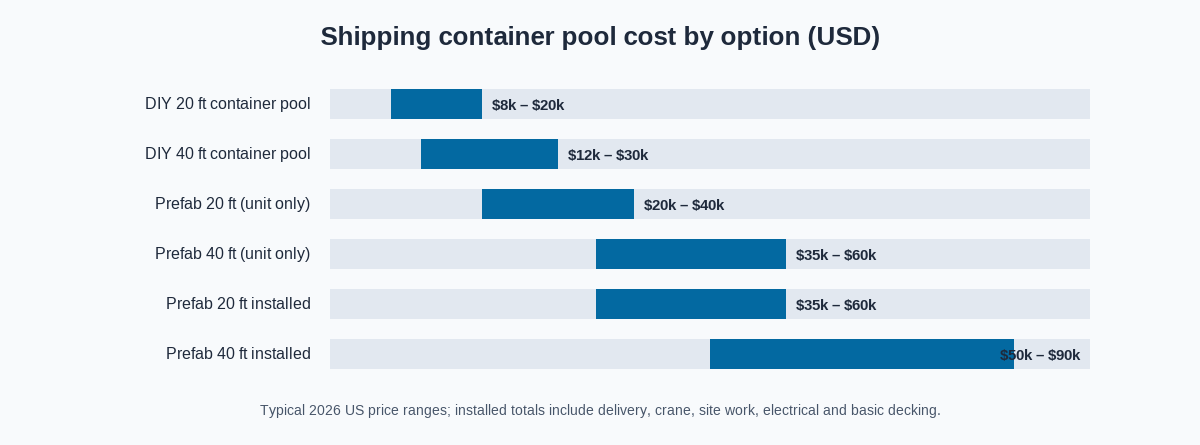
Chart: Asphapro.com
Quick Answer
The typical shipping container pool cost is $35,000 to $60,000 installed for a prefab 20-foot unit and $50,000 to $90,000 installed for a 40-foot unit. The pool unit alone costs about $20,000 to $40,000 (20 ft) or $35,000 to $60,000 (40 ft), with delivery and crane, site prep, electrical, permits, decking and fencing added on top. In-ground installs add excavation. A DIY shipping container pool can cost $8,000 to $30,000 in materials, but cutting, reinforcing, waterproofing and plumbing a steel box is hard work, and many DIY builds fail from rust and leaks.
A shipping container swimming pool is a steel shipping container that has been cut, reinforced, lined and fitted with pool equipment so it can hold water. Most are 8 feet wide and either 20 or 40 feet long, with a depth of about 4 to 5 feet. They can sit above ground, be partly sunk into a slope, or be fully set in the ground like a regular inground pool. Container pools are made in a factory, shipped as one piece and set in place with a crane, so installation is fast.
This guide breaks down shipping container pool cost for prefab and DIY builds, what drives the price up or down, running costs, and how the cost of a shipping container pool compares with fiberglass, vinyl and concrete pools. If you are looking at small pools in general, also see our guides on plunge pool cost and small inground pool cost.
Shipping Container Pool Cost at a Glance
Here are the typical price ranges for a shipping container pool in 2026 in the US. Prices vary by maker, region and options.
- Prefab 20-foot container pool, unit only: $20,000 to $40,000.
- Prefab 40-foot container pool, unit only: $35,000 to $60,000.
- Prefab 20-foot, installed: $35,000 to $60,000.
- Prefab 40-foot, installed: $50,000 to $90,000.
- DIY shipping container pool, 20 ft: $8,000 to $20,000.
- DIY shipping container pool, 40 ft: $12,000 to $30,000.
The unit price usually includes the container shell, a liner or fiberglass finish, a filter and pump, basic lighting and sometimes a heater or cover. The installed shipping container pool cost adds delivery, crane, a level base or excavation, electrical work, permits and the finishing touches around the pool, such as decking and fencing.
Shipping Container Swimming Pool Cost Breakdown
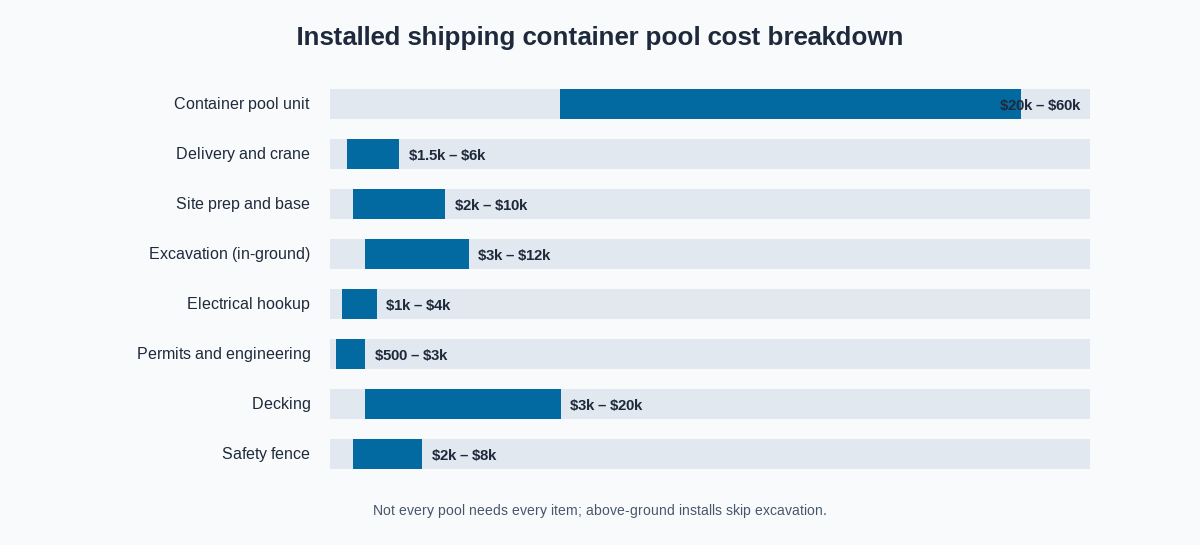
Chart: Asphapro.com
The Container Pool Unit: $20,000 to $60,000
The pool itself is the biggest part of shipping container pool cost. Makers start with a new or "one-trip" steel container, cut out the roof, add steel reinforcement to stop the walls bowing under water pressure, and finish the inside with a vinyl liner, a sprayed coating or a fiberglass shell. Many add a built-in bench or step, a window panel in the side, a divider wall to make a separate hot tub area, and an equipment room at one end. A basic 20-foot shipping container swimming pool with a liner and simple equipment sits at the low end; a 40-foot pool with a fiberglass finish, heat pump, automatic cover, LED lighting and a glass window sits at the top end.
Delivery and Crane: $1,500 to $6,000
A finished container pool weighs about 4 to 8 tons empty, so it arrives on a flatbed truck and is lifted into place with a crane. Delivery cost depends on distance from the factory. Crane hire depends on how far the crane must reach over a house or fence; a tight backyard that needs a large crane costs more. If the truck cannot reach the street in front of your home, or the street is narrow, there may be extra fees for permits or traffic control.
Site Prep and Base: $2,000 to $10,000
Every shipping container swimming pool needs a level, solid base. An above-ground pool can sit on a compacted gravel pad, concrete piers or a concrete slab. A full slab costs more but gives the best support. If your yard slopes, grading or a retaining wall adds to the shipping container pool cost. See our guide on concrete pads for slab prices.
Excavation: $3,000 to $12,000
Sinking a container pool partly or fully into the ground means digging a hole, hauling soil away and backfilling around the pool. Rocky soil, a high water table or poor access raise the price. In-ground container pools also need a drainage plan and often a concrete or gravel base under the pool. For more detail, see our guide on pool excavation cost.
Electrical Hookup: $1,000 to $4,000
A licensed electrician must run power to the pump, heater and lights, with GFCI protection and proper bonding of all metal parts. Because a shipping container swimming pool is made of steel, bonding is very important; it must be done to code to keep swimmers safe. Long runs from the house panel or a needed panel upgrade cost more.
Permits and Engineering: $500 to $3,000
Most towns treat a container pool like any other pool, so you need a building permit, an electrical permit and a safety barrier inspection. Some places also require engineered drawings for the base or for an in-ground install. Check with your local building office before you order, since some zoning rules limit pool size or placement.
Decking and Fencing: $5,000 to $28,000
Most owners add a deck around or beside the pool, especially for above-ground installs where the top sits about 5 feet off the ground. A small wood or composite deck costs $3,000 to $8,000; a large multi-level deck can cost $20,000 or more. A pool safety fence or barrier is required by most codes and costs $2,000 to $8,000. See our guides on pool fence cost and concrete pool deck options.
20-Foot vs 40-Foot Shipping Container Swimming Pool
The two standard sizes make a big difference to shipping container pool cost and how you use the pool.
A 20-foot shipping container swimming pool holds about 4,500 to 5,500 gallons. It is large enough to cool off, soak and play, but too short for real laps. It fits in most backyards, costs less to deliver and crane, and is cheaper to heat. Many owners use part of it as a hot tub with a divider.
A 40-foot shipping container swimming pool holds about 9,000 to 11,000 gallons. It is long enough for short lap swimming and has room for a hot tub section plus a swimming area. It needs more space, a bigger crane and a bigger base, so the installed cost of a shipping container pool at this size is often $15,000 to $30,000 more than the 20-foot version.
Some makers also build "high cube" containers that are 9.5 feet tall instead of 8.5 feet, giving a slightly deeper pool, and custom widths made by joining two containers side by side. These custom builds add to the cost shipping container pool buyers should expect.
DIY Shipping Container Pool Cost
A DIY shipping container pool looks cheap on paper. A used 20-foot container costs about $2,000 to $4,000 and a 40-foot about $3,000 to $6,000. Add steel for reinforcement, welding, a liner or coating, a pump and filter, plumbing, a heater and electrical work, and a DIY shipping container pool usually ends up at $8,000 to $30,000 in materials, plus delivery, crane and base costs.
What a DIY Container Pool Involves
Building a DIY shipping container pool means:
- Buying a sound container, ideally "one-trip" or new, with no rust holes or dents.
- Cutting off the roof with a plasma cutter or grinder.
- Welding steel beams or a frame around the top edge and along the walls, since a container is designed to carry weight on its corners, not to hold water pressure on its walls.
- Cutting holes for the skimmer, returns and drains, and fitting them watertight.
- Removing the wood floor, cleaning and treating the steel, then coating it with a marine epoxy or fitting a vinyl liner.
- Plumbing a pump, filter and heater, and wiring them with GFCI protection and bonding by a licensed electrician.
- Building a level base, setting the container on it with a crane, and adding steps, a deck and a fence.
Risks of a DIY Shipping Container Pool
The main risk is structural failure. An unreinforced container will bulge and can split when filled, since 5,000 gallons of water weighs over 20 tons. Rust is the next big problem: chlorinated water attacks bare steel, and any gap in the coating or liner leads to corrosion that can eat through the wall in a few years. Poor welding can leak. Electrical faults in a steel pool can be dangerous. Insurance companies may not cover a homemade pool, and inspectors may not pass it. For most people, a DIY shipping container pool only makes sense with real welding and fabrication skills and an engineer to check the design.
Container Pool vs Other Pool Types
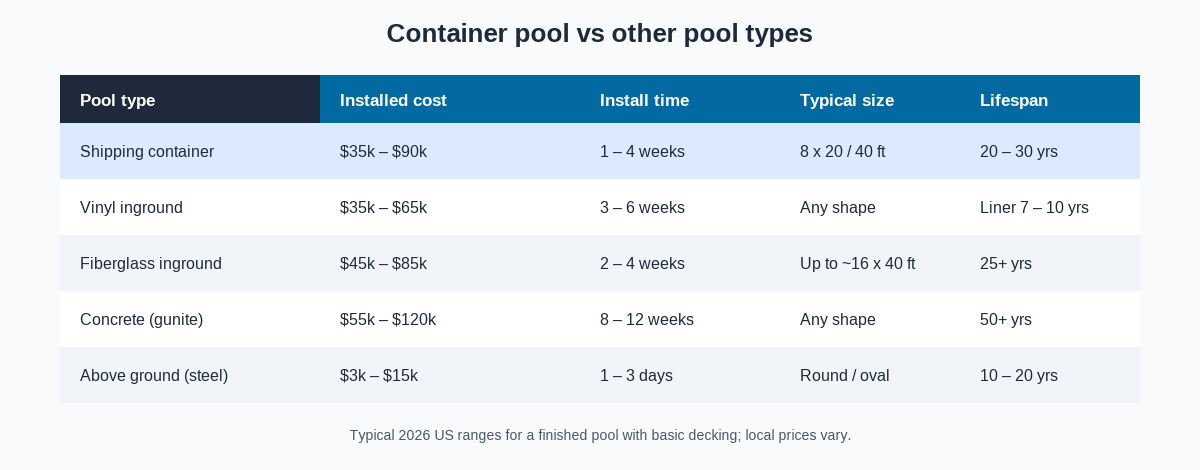
Chart: Asphapro.com
Is a shipping container swimming pool cheaper than a regular pool? Not usually. The installed shipping container pool cost is close to that of a vinyl or small fiberglass inground pool, and below that of a concrete pool. The main benefits are speed, the ability to install above ground or on a slope, and the option to move the pool if you move house. The downsides are a fixed size and shape, a narrow 8-foot width, and the risk of rust if the steel is not well protected.
Vinyl inground pools cost about $35,000 to $65,000 installed and can be built in almost any size and shape, but the liner needs replacing every 7 to 10 years. See vinyl inground pool cost.
Fiberglass inground pools cost about $45,000 to $85,000 installed. Like container pools, they arrive as one piece and are set with a crane, but they are wider and come in many shapes. See fiberglass vs vinyl pool.
Concrete pools cost $55,000 to $120,000 or more and take months to build, but last the longest and can be any shape. See our guide to the concrete pool.
Above ground steel pools cost far less, at $3,000 to $15,000 installed, but look more temporary and last 10 to 20 years. See above ground pool installation cost.
Photo: 1250metersdeep, Wikimedia Commons, CC0
What Affects Shipping Container Pool Cost?
Size. A 40-foot pool costs more than a 20-foot one for the unit, delivery, crane, base and water.
Finish. A vinyl liner is cheapest. A sprayed polyurea or epoxy coating costs more. A fiberglass shell inside the container costs the most but lasts longest and resists rust best.
Installation type. Above-ground installs are cheapest. Partly sunk or fully in-ground installs add excavation, backfill, drainage and often a concrete surround.
Features. Heat pumps ($3,000 to $6,000), automatic covers ($3,000 to $8,000), glass windows ($2,000 to $6,000), jets, LED lighting, a hot tub section and a salt system all add to the shipping container pool cost.
Access. Long delivery distances, large cranes and tight yards raise the price.
Location. Labor, permits and crane costs vary a lot by region.
Running Costs of a Shipping Container Swimming Pool
Because a shipping container swimming pool holds less water than most pools, it is cheaper to run. A 20-foot pool uses about one third of the chemicals of a typical 15,000-gallon inground pool. Expect about $30 to $60 a month for chemicals in the swim season, $20 to $60 a month for electricity to run a variable-speed pump, and more if you heat the pool. A heat pump on a 20-foot pool may cost $50 to $150 a month to run in spring and fall, depending on your climate and power price. A cover cuts heat loss and evaporation a lot.
Above-ground container pools lose heat through the steel walls, so insulation in the walls and a good cover are worth paying for in cool climates. For more, see our guide on how much does it cost to heat a pool.
Maintenance and Lifespan
A well-built container pool from a good maker can last 20 to 30 years. The biggest threat is rust. Keep the outside paint in good condition, touch up scratches quickly, and keep water chemistry balanced so pH and alkalinity do not drift low and corrode metal parts. Vinyl liners need replacing every 7 to 10 years at a cost of about $1,500 to $4,000. Coatings may need touching up every 5 to 10 years. Pumps and filters need the same care as in any pool. In freezing climates, the pool must be winterized like any other; see how to winterize a pool.
Pros and Cons of a Shipping Container Swimming Pool
Pros:
- Fast install, often in one to four weeks from delivery to swimming.
- Can sit above ground, on a slope or in the ground.
- Can be moved to a new home with a crane.
- Small water volume means lower running costs.
- Modern industrial look that works well with decks and patios.
Cons:
- Installed shipping container pool cost is similar to a regular inground pool.
- Only 8 feet wide, with a fixed length and depth.
- Rust risk if the steel is not well protected.
- Steel conducts heat, so above-ground units cool quickly without insulation.
- Fewer makers and installers than fiberglass or vinyl, and resale value is less certain.
Worked Examples
Example 1: above-ground 20-foot pool. A homeowner buys a 20-foot prefab container pool with a vinyl liner, sand filter and heat pump for $32,000. Delivery and crane cost $3,000, a gravel and concrete pier base $3,500, electrical $2,000, permits $800, a composite deck along one side $7,000 and a fence $3,000. Total shipping container pool cost: about $51,300.
Example 2: in-ground 40-foot pool. A family orders a 40-foot container pool with a fiberglass finish, automatic cover and LED lights for $55,000. Excavation and backfill cost $9,000, a concrete base $5,000, delivery and a large crane $5,500, electrical $3,000, permits and engineering $2,000, a concrete deck $14,000 and a fence $4,000. Total: about $97,500.
Example 3: DIY shipping container pool. A welder buys a one-trip 20-foot container for $3,500, steel for reinforcement for $2,000, marine epoxy coating for $1,500, a pump, filter and fittings for $1,800, and a used heater for $800. Crane and delivery cost $1,500, a gravel base $1,000 and an electrician $1,500. Total: about $13,600, plus many weekends of work.
How to Save on Shipping Container Pool Cost
Choose a 20-foot pool if you do not need laps. Pick a vinyl liner instead of fiberglass. Install above ground on a gravel and pier base instead of digging. Place the pool close to the street so a smaller crane can reach. Build the deck yourself or in stages. Skip extras such as windows and lights at first. Get quotes from several makers, and ask what is included in the unit price, since some include equipment and delivery and others do not. Check local rules before ordering to avoid costly changes later.
Is a Shipping Container Swimming Pool Worth It?
A shipping container swimming pool is worth it if you want a small, modern pool installed quickly, have a sloped or tight yard where digging a large hole is hard, or may move house and want to take the pool with you. It is not the cheapest way to get a pool; a regular above ground pool costs far less, and a vinyl inground pool costs about the same with more design freedom. Weigh the shipping container pool cost against your goals, the space you have and how long you plan to stay in your home.
Shipping Container Swimming Pool Design Ideas
Because the shape is fixed, most design choices for a shipping container swimming pool are about how it sits in the yard and what surrounds it. A popular layout sets the pool half in the ground with a deck built level with the top edge, so it looks like an inground pool from one side and shows the steel wall on the other. On sloped lots, the container can be dug into the hill on the high side and left exposed on the low side, sometimes with a glass window panel facing the garden. Some owners clad the outside walls in wood, composite boards or stone veneer to soften the industrial look, while others keep the ribbed steel and paint it a bold color.
A divider wall can turn one end of the container into a heated spa, with the rest kept cooler for swimming. A built-in bench along one side gives a place to sit, and wide steps at one end make getting in and out easier. Adding a pergola or shade sail over part of the pool helps in hot climates. Every one of these choices adds to the shipping container pool cost, so decide early which features matter most and price them as part of the first quote rather than as add-ons later.
Questions to Ask a Container Pool Maker
Prices for a shipping container swimming pool vary a lot between makers, and the cheapest quote is not always the best value. Before you order, ask each maker the same questions so you can compare like with like. Is the container new, one-trip or used? How is the steel reinforced, and has an engineer signed off on the design? What finish is used inside, and what warranty covers it against leaks and rust? Which pump, filter and heater are included, and what size are they? Is delivery included, and how far? Who arranges the crane? Does the price include an equipment room, a cover, lights and steps?
Also ask for photos of finished installs and contact details for past customers, and check how long the company has been in business. A clear written quote that lists everything included is the best way to understand the true shipping container pool cost and avoid surprise charges on delivery day.
Insurance, Taxes and Home Value
Tell your home insurer before installing any pool. Most insurers cover a permanent container pool like other pools but may ask for a fence, a locked gate or a safety cover, and some raise liability limits. A DIY shipping container pool may be harder to insure, so ask before you build. A permanent, in-ground container pool may raise your property tax assessment in some areas, while an above-ground unit that can be moved may be treated differently; ask your local assessor. As for home value, a well-finished container pool can appeal to buyers who like modern design, but it is a niche feature, so do not count on getting the full shipping container pool cost back when you sell. For more on this, see how much value does a pool add to a home.
Timeline From Order to First Swim
Most makers quote 6 to 16 weeks to build a container pool after you order, depending on their backlog and the options you choose. While the pool is being built, you can get permits, prepare the base, run power and plan the deck. Delivery and crane placement take one day. Plumbing and electrical connections take one or two days, and filling and balancing the water takes another few days. If the site work is ready when the pool arrives, you can be swimming within a week or two of delivery, which is one of the main reasons people accept a shipping container pool cost that is similar to other options.
Shipping Container Pool Cost: Key Points
- Prefab container pools cost $20,000 to $60,000 for the unit and $35,000 to $90,000 installed.
- Delivery, crane, base, electrical, permits, decking and fencing add $10,000 to $50,000.
- A DIY shipping container pool costs $8,000 to $30,000 in materials but carries real risks.
- Small water volume keeps running costs low; rust protection is the key to long life.
Frequently Asked Questions
How much does a shipping container pool cost?
About $35,000 to $60,000 installed for a 20-foot pool and $50,000 to $90,000 for a 40-foot pool, depending on finish, features and site work.
Is a shipping container pool cheaper than a fiberglass pool?
Often a little cheaper, but not by much. Container pools are smaller, so compare price per square foot and features, not just totals.
How long does a shipping container pool last?
A well-built prefab container pool can last 20 to 30 years with good rust protection and balanced water.
Can you put a shipping container pool in the ground?
Yes. Many are partly or fully in-ground, which adds excavation, drainage and backfill to the cost.
Do shipping container pools rust?
They can if the coating or liner fails. Good makers use marine coatings, liners or fiberglass shells and treated steel to prevent it.
Do you need a permit for a shipping container pool?
In most places, yes. You usually need building and electrical permits and an approved safety barrier.
Sources
- CPSC: Pool and spa safety
- Pool and Hot Tub Alliance
- ICC: International Swimming Pool and Spa Code
- OSHA: Cranes and derricks