
Can Concrete Burn? Fire Resistance, Heat Damage and Spalling
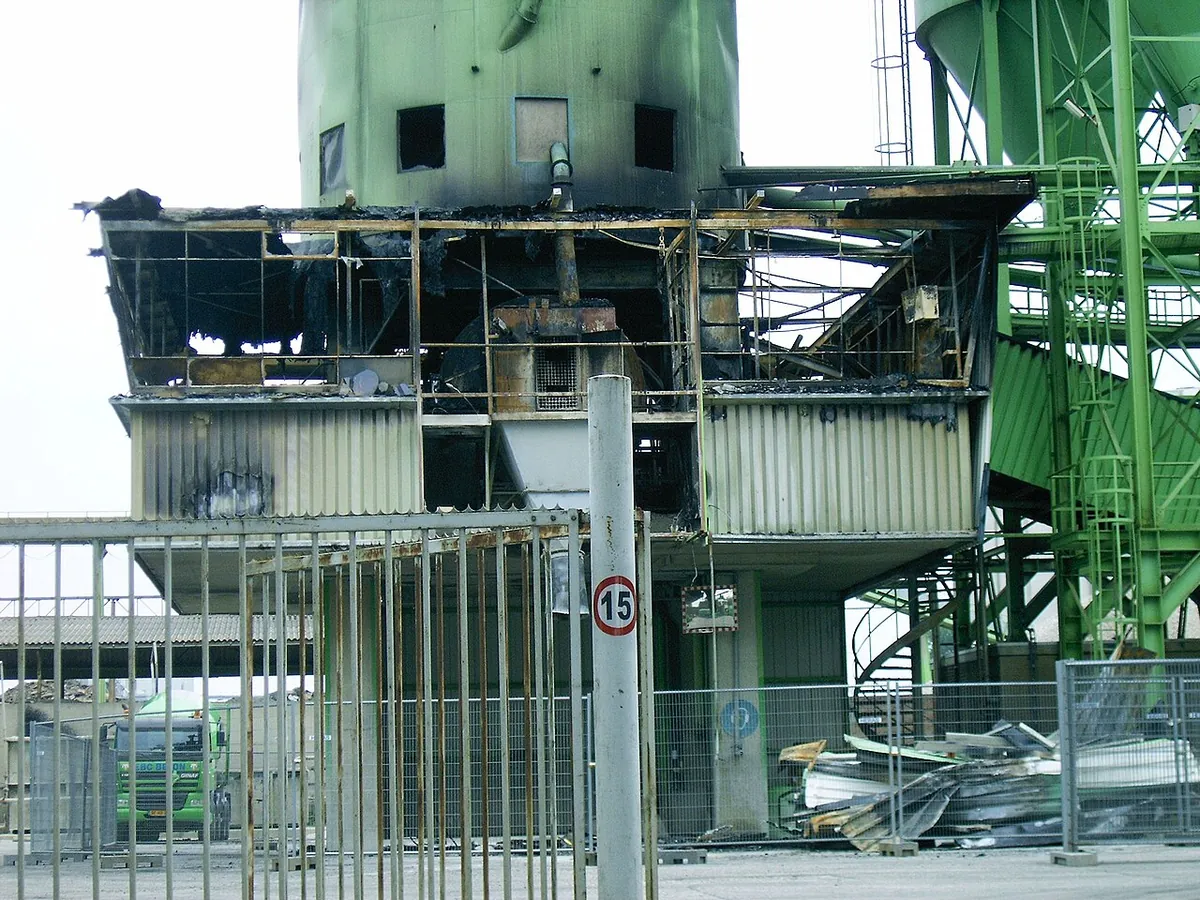
Photo: P.J.L Laurens, Wikimedia Commons, CC BY 2.5.
Quick Answer
No, concrete cannot burn. It is a noncombustible material made of cement, water, sand and stone, so it does not catch fire, does not feed a fire, and does not give off toxic smoke from burning. That is why it is widely used for fire walls, stairwells and fire-rated construction. But fire and high heat can damage concrete. As it heats, concrete loses strength, starting at roughly 300°C (about 570°F), and the surface can spall, breaking off as trapped moisture turns to steam. Steel reinforcement inside also weakens when it gets hot. After a serious fire, concrete should be inspected by a qualified professional before reuse.
When people see a building burn, they often notice that the concrete parts are still standing when wood framing, furniture and roofing are gone. Concrete's resistance to fire is one of its great strengths. But "does not burn" is not the same as "not damaged." Heat changes concrete in ways that can affect its strength and safety.
This guide answers whether concrete can burn, explains what happens to concrete in a fire, why it spalls, how fire resistance is rated, what to know about concrete fire pits, and how fire-damaged concrete is assessed and repaired.
Why Concrete Does Not Burn
Does concrete burn? No. It is made of minerals that have already been through heat in a cement kiln or formed in rock, so there is nothing left in it to catch fire.
Burning is a chemical reaction where a fuel combines with oxygen and releases heat. Wood, plastics, paper and fabrics are made of carbon-based compounds that burn readily. Concrete is made of portland cement, water, sand and gravel or crushed stone. The cement has already been through a kiln at about 2,700°F during manufacturing, and the hardened cement paste and aggregates are mineral materials that do not combust. See what concrete is made of.
Because of this, concrete:
- Does not ignite or spread flames.
- Does not add fuel to a fire.
- Does not drip burning material.
- Conducts heat slowly, so it protects the far side of a wall or floor for a long time.
- Is classified as noncombustible in building codes.
Concrete surfaces can still have combustible things on or in them, such as paint, sealers, coatings, adhesives, foam insulation, flooring and stored items, which can burn and blacken the concrete.
What Happens to Concrete in a Fire
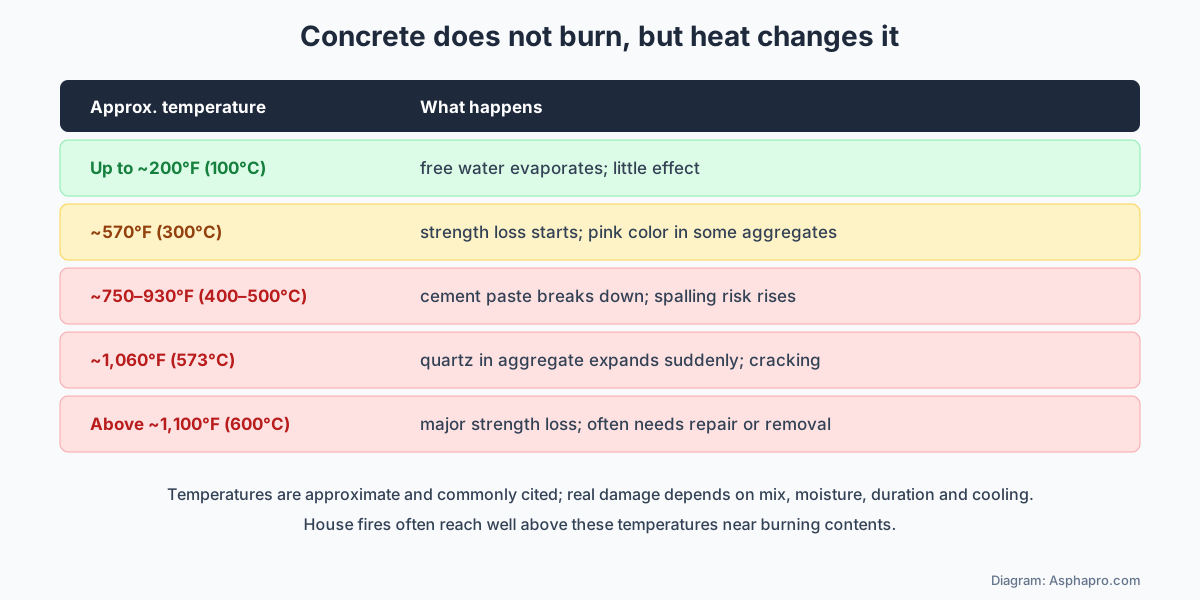
Concrete changes in stages as it heats. The temperatures below are commonly cited approximations; real behavior depends on the mix, aggregate type, moisture and how long the fire lasts.
- Up to about 100°C (212°F): free water in the pores evaporates. Little effect on strength.
- Around 300°C (about 570°F): strength loss begins. Concrete with certain aggregates turns pink or reddish as iron compounds oxidize, a useful clue for inspectors.
- Around 400 to 500°C (about 750 to 930°F): calcium hydroxide in the cement paste decomposes, and the paste weakens further.
- Around 573°C (about 1,060°F): quartz, common in sand and many aggregates, undergoes a sudden expansion, causing internal cracking.
- Above about 600°C (1,100°F): concrete loses a large share of its strength, and surface layers are often badly damaged.
Because concrete conducts heat slowly, the damage is usually greatest near the exposed surface and decreases with depth. A slab or wall may be badly damaged on the fire side but sound a couple of inches in.
Why Concrete Spalls in Fires
Spalling is when pieces of the concrete surface break off, sometimes violently. In fires, the main causes are:
- Steam pressure: moisture inside the concrete turns to steam faster than it can escape, building pressure that blows off surface layers. This is called explosive spalling.
- Thermal stress: the hot surface expands while the cooler interior does not, causing cracking and flaking.
- Aggregate changes: some aggregates expand or break down with heat.
- Steel expansion: reinforcing steel expands more than concrete as it heats, which can push off the cover.
Dense, high-strength concrete with low permeability is actually more prone to explosive spalling, because steam cannot escape easily. Engineers sometimes add polypropylene fibers to such mixes; the fibers melt in a fire and leave channels for steam to escape. Spalling matters because it removes the concrete cover that protects reinforcing steel from heat. See scaling vs spalling for spalling from other causes.
Fire Resistance Ratings
Building codes rate walls, floors and other assemblies by how long they resist a standard fire test, such as 1, 2, 3 or 4 hours. Concrete and masonry assemblies earn high ratings because they are noncombustible and slow heat transfer. Thickness, aggregate type and the concrete cover over reinforcement all affect the rating. That is why concrete is used for fire walls between townhouses, stair and elevator shafts, parking garages and many commercial buildings. Insulated concrete form walls also typically achieve high fire ratings; see insulated concrete forms cost.
Concrete Fire Pits and Outdoor Kitchens
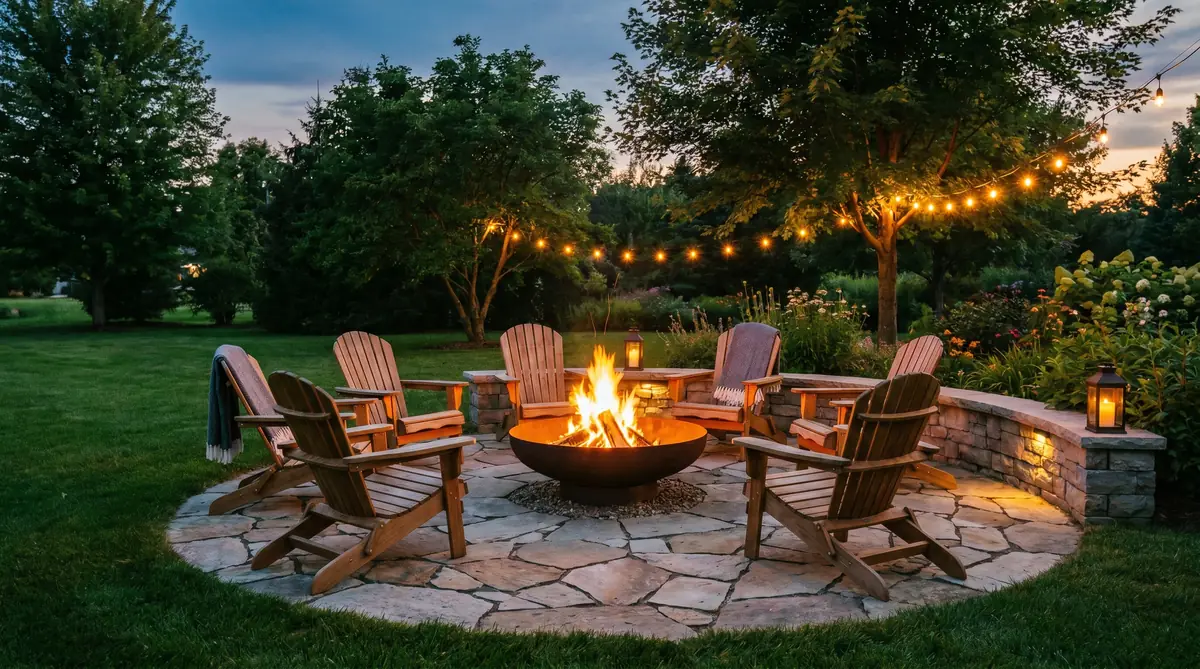
Concrete is a popular material for fire pit surrounds, patios and outdoor kitchens because it does not burn. But ordinary concrete is not designed to be in direct contact with flames for hours at a time, again and again. Repeated heating and cooling, especially when the concrete is damp from rain, can cause cracking, spalling and, in the worst cases, pieces popping off violently.
- Line the firebox: use fire brick set in refractory mortar, a steel fire ring, or a refractory (heat-resistant) castable inside the fire pit. Keep regular concrete and pavers outside the direct flame zone.
- Keep it dry: add drainage in the bottom of the pit and cover it when not in use so it does not soak up rain.
- Avoid river rocks and wet stones in the fire: they can trap water and burst when heated.
- Leave a gap: allow space for expansion between the hot fire ring and surrounding concrete.
- Choose the patio carefully: concrete or pavers around the pit are fine; ensure stray embers cannot reach wood decks or furniture.
- Check local rules: many areas limit open fires and specify distances from buildings.
For layouts and materials, see paving for a fire pit.
Concrete Countertops, Grills and Heat
Concrete countertops can handle warm pans for a moment, but direct, prolonged heat from hot pots, grills or pizza ovens can crack the surface, burn the sealer and leave marks. Use trivets indoors. For outdoor kitchens, keep the grill's hot surfaces away from concrete edges, follow the grill maker's clearance and insulation instructions, and use insulated jackets where required. For pizza ovens, use refractory materials and the oven maker's base design. See concrete countertops.
Assessing Fire-Damaged Concrete
After a fire, concrete may look sound but have weakened layers. Assessment usually includes:
- Visual inspection: soot, cracking, spalling, exposed or bent reinforcement, sagging slabs or beams, and color changes. A pink or reddish tint in exposed aggregate can indicate the concrete reached roughly 300°C or more.
- Sounding: tapping with a hammer or dragging a chain finds hollow, delaminated areas.
- Rebound hammer and other nondestructive tests: compare surface hardness with undamaged areas.
- Core samples: drilled cores tested in a lab show strength and the depth of damage.
- Reinforcement check: steel that got very hot may have lost strength or sagged.
- Engineering review: for structural elements, a structural engineer decides on repair or replacement.
For homes, insurers and adjusters often bring in engineers to document fire damage to foundations, slabs and walls.
Repairing Fire-Damaged Concrete
- Soot and smoke staining: clean with detergents or specialized soot cleaners; light surface staining is cosmetic. See how to clean concrete.
- Shallow surface damage: remove weak, cracked surface layers by grinding or hydrodemolition down to sound concrete, then apply a repair mortar or overlay.
- Spalls exposing reinforcement: remove damaged concrete around the steel, clean or replace steel as needed, and rebuild the cover with repair mortar or shotcrete.
- Severely damaged members: beams, slabs or columns with deep damage or overheated reinforcement may need strengthening or replacement under an engineer's design.
- Garage slabs and driveways: after car fires, surfaces may be scaled or spalled; grinding and resurfacing, or partial replacement, are common fixes. See concrete repair cost.
Concrete vs Other Materials in Fire
- Wood: burns, but large timbers char on the outside, which slows further burning; light framing burns quickly.
- Steel: does not burn but loses strength at high temperatures and can buckle; structural steel usually needs fireproofing.
- Brick and stone masonry: noncombustible, generally good fire resistance; mortar joints may need repointing after severe fires.
- Concrete: noncombustible, slow to heat through, and protects reinforcement with its cover; it can spall and lose strength in severe or long fires.
- Plastics and foams: burn and produce toxic smoke; foam insulation must be protected by approved coverings in buildings.
How Concrete Protects Buildings in a Fire
Concrete's fire performance is about more than not burning. It works as a barrier in several ways. First, a concrete wall or floor keeps flames and hot gases from passing through, which is why fire codes rely on concrete and masonry to divide buildings into compartments. Second, concrete heats up slowly. Its mass and low thermal conductivity mean that even when one side faces a fire, the other side stays cool for a long time, protecting people, contents and escape routes. Third, the concrete cover around reinforcing steel insulates the steel, keeping it below the temperature where it loses much of its strength. Thicker cover and thicker members give longer fire ratings.
These properties are why stairwells, elevator shafts, parking garages, fire walls between attached homes and many apartment buildings are built with concrete or masonry. They give firefighters time and keep fires from spreading between units.
Design Details That Improve Fire Performance
- Adequate cover over reinforcement: codes and fire-resistance tables list minimum cover for each rating.
- Sufficient thickness: thicker walls and slabs earn longer ratings.
- Aggregate choice: some lightweight and carbonate aggregates perform better in fire than siliceous aggregates.
- Polypropylene fibers: help relieve steam pressure in dense, high-strength concrete and reduce explosive spalling.
- Sealed penetrations: pipes and cables passing through concrete fire walls need approved firestopping, or fire and smoke can pass through the gaps.
- Protected joints: joints between precast panels and slabs are sealed with fire-rated materials.
Common Myths About Concrete and Fire
- "Concrete is fireproof." It is noncombustible and highly fire resistant, but not immune; severe fires damage it.
- "If it is still standing, it is fine." Fire can weaken concrete and steel without visible collapse. Get an inspection.
- "Any concrete works for a fire pit." Direct, repeated flame contact cracks ordinary concrete. Use fire brick or a steel ring inside.
- "Concrete gives off toxic smoke when it burns." Concrete does not burn. Smoke comes from coatings, contents and other materials.
- "Stronger concrete is always better in fire." Very dense, high-strength concrete can be more prone to explosive spalling unless designed for it.
A Short History of Concrete and Fire Safety
After major urban fires in the 1800s and early 1900s destroyed large parts of cities built mostly of wood, builders and code writers turned to noncombustible materials. Reinforced concrete gained a reputation for fire resistance when concrete buildings survived disasters such as the 1906 San Francisco earthquake and fire better than many others. Modern building codes grew from those lessons, with fire-resistance ratings based on standard furnace tests. Today, concrete is one of the main tools for passive fire protection, the built-in features that slow fire spread without needing any action from people or equipment.
Can Concrete Explode?
"Exploding" concrete usually means explosive spalling. Wet concrete heated quickly, such as a slab or stone that has absorbed water and is placed in a hot fire, can pop and throw fragments. This is a real hazard with concrete fire pits, patio blocks and river rocks heated in campfires. It is not an explosion of the concrete itself but a burst of steam pressure.
Concrete Burns on Skin and Feet
There is another meaning of concrete burns that has nothing to do with fire. Wet concrete is strongly alkaline, and long contact with skin can cause chemical burns. Concrete burns on feet and knees are common when someone stands or kneels in wet concrete without boots or pads, and they often do not hurt until hours later. Wash wet concrete off skin right away with clean water, wear waterproof boots and gloves, and get medical care for any burn that blisters or keeps hurting. On hot summer days, sun-baked concrete can also get hot enough to burn bare feet and pets' paws.
Does Concrete Melt?
In ordinary building fires, concrete does not melt. It weakens, cracks and spalls long before anything like melting could occur. Melting the minerals in concrete takes temperatures well above typical fire conditions, closer to those found in industrial furnaces, volcanic lava or specialized processes. Lava flows can surround and damage concrete structures, mostly by heat and force, and in extreme cases surface layers can fuse, but this is far beyond what a house fire does.
Car Fires and Garage Floors
A burning car in a garage or on a driveway can produce intense, localized heat on the concrete below, along with burning fuel, oil and tires. The concrete will not burn, but the surface under the car may scale, spall or crack, and stains from burned rubber and oil can be stubborn. After the scene is safe and insurance has documented the damage, the slab is usually cleaned, inspected by sounding for hollow spots, and then repaired by grinding and resurfacing or replacing the damaged section. In multi-story parking garages, engineers check the structure because post-tensioned and reinforced slabs can be affected by heat. See how to remove oil stains from concrete.
Wildfires and Concrete Homes
In wildfire-prone areas, concrete and masonry walls, concrete roof tiles and noncombustible patios and walkways help reduce a home's risk, because they do not catch embers or burn. Fire safety guidance for these areas usually focuses on noncombustible materials close to the house, clearing vegetation, and closing gaps where embers can enter. Concrete foundations and walls often survive wildfires even when the rest of the house is lost, though they still need inspection before rebuilding on them.
Fire Safety Tips for Homeowners
- Keep grills, fire pits and heaters at the distances their makers and local codes require from walls, decks and overhangs, even if the nearby wall is concrete.
- Remember that coatings, sealers and items on concrete can burn.
- Store fuels and flammable liquids properly; a concrete floor will not contain a fuel fire.
- After any fire, have a professional inspect structural concrete before reuse.
- Do not throw water on very hot concrete surfaces in fire pits; sudden cooling can crack them.
Quick Reference
- Can concrete burn? No; it is noncombustible.
- Can concrete catch fire? No, but things on it can.
- Does fire damage concrete? Yes; strength loss starts around 300°C, with spalling and cracking at higher temperatures.
- Can concrete explode? Wet concrete heated quickly can spall violently from steam pressure.
- Concrete fire pit: line with fire brick or a steel ring; keep it dry.
- Fire-damaged concrete: inspect, sound, test, then repair or replace.
So, can concrete burn? No, and that is one of the best reasons to build with it. But concrete is not immune to fire. Understanding how heat affects it helps you design safer fire pits and outdoor kitchens and know when to call an expert after a fire.
What Happens to Concrete After the Fire Is Out
The effects of a fire on concrete continue after the flames are gone. As heated concrete cools, the outer layers contract at a different rate from the cooler interior, which can open new cracks. Water from firefighting hoses hitting very hot concrete can cause sudden cooling, adding more cracking and surface damage. In the days and weeks afterward, concrete that was heated enough to break down some of its cement paste can slowly take on moisture again, and certain products of heating can expand as they rehydrate, sometimes causing further cracking or crumbling of the damaged surface. That is one reason engineers often wait and re-inspect rather than judging everything on the first day.
Smoke and soot leave acidic residues that stain concrete and can etch some finishes. Cleaning soon after the fire, once the area is safe, limits staining. Odor from smoke can linger in porous concrete; cleaning with appropriate detergents, followed by a sealer, often helps.
Questions to Ask After a Fire
- How long did the fire burn, and how hot did it get near the concrete?
- Is there visible spalling, exposed reinforcement, sagging or wide cracks?
- Do any concrete surfaces sound hollow when tapped?
- Has the concrete changed color, especially pink or reddish tints in exposed stone?
- Was the concrete structural, such as a foundation, suspended slab, beam or column?
- Has a structural engineer reviewed the damage and documented it for insurance?
For a garage slab or patio, you may only need a contractor to grind and resurface damaged areas. For a foundation or a structural floor, an engineer's assessment is the right first step before any rebuilding.
Building a Safer Backyard With Concrete
Concrete is a smart choice for areas where fire is part of the plan. A concrete or paver patio around a fire pit, grill or outdoor kitchen will not ignite from a stray ember the way a wood deck or dry mulch can. Concrete pads under smokers and grills protect the ground and make cleanup easier. Fire-resistant hardscape near the house is also part of many wildfire safety plans. The key is to keep direct, prolonged flame contact on materials designed for it, like fire brick and steel, and to use concrete for what it does best: a durable, noncombustible surface and barrier around the fire.
Concrete, Insulation and Fire
Many modern concrete walls and slabs are combined with foam insulation, such as insulated concrete forms, foam board under slabs, or foam on basement walls. The concrete itself will not burn, but foam plastics can, and they give off thick, toxic smoke. Building codes generally require foam insulation inside homes to be covered by an approved thermal barrier, such as gypsum board, so it is protected from fire. If you finish a basement with foam board against the concrete walls, follow the code and the product's instructions for covering it. The concrete wall stays strong; it is the materials attached to it that need protection.
Paint, Sealers and Coatings in a Fire
Coatings on concrete, such as paint, epoxy floor systems, sealers and adhesives, are thin, but they can burn, blister and add smoke in a fire. After a fire, they usually need to be removed by grinding or stripping before new coatings go down, because heat breaks their bond to the concrete. If you are choosing a garage floor coating, some products are rated for flame spread; ask the supplier. See concrete coating cost and how to remove paint from concrete.
In short, can concrete burn? No. But the full picture includes the materials around it, how hot and how long the fire was, and how the concrete was designed. That is why concrete is a cornerstone of fire-safe construction, and why a professional inspection after any serious fire is always worth it.
Concrete Stairs and Escape Routes
One of the most important jobs concrete does in a fire is protecting the way out. Concrete stairs and stair enclosures in apartment and office buildings are designed to stay usable while a fire burns elsewhere, giving people a protected path to the exit and giving firefighters a safe route in. The same idea applies at home on a smaller scale: concrete basement walls and a concrete floor between a garage and living space slow the spread of fire from the garage, where cars, fuel and stored items create higher fire risk. Building codes also require fire-rated separation, such as fire-rated drywall and self-closing doors, between attached garages and homes, because the materials on top of and around the concrete still matter.
Frequently Asked Questions
Can concrete burn?
No. Concrete is noncombustible. It does not ignite or fuel a fire.
Can concrete catch fire?
No, though paint, sealers, coatings and items on concrete can burn and scorch it.
At what temperature does concrete lose strength?
Strength loss commonly begins around 300°C (about 570°F) and becomes severe above about 600°C (1,100°F).
Why does concrete spall in a fire?
Moisture turns to steam and builds pressure, and uneven heating causes stress, breaking off surface layers.
Can I use regular concrete for a fire pit?
Not for the firebox. Use fire brick or refractory materials inside; regular concrete can crack or spall.
Is fire-damaged concrete safe?
It must be assessed. Light surface damage can often be repaired; severe damage may require removal.
Does concrete melt in a house fire?
No. It weakens and spalls, but typical house fires are far below the temperatures needed to melt concrete.
Why did my fire pit concrete crack?
Direct heat and moisture inside the concrete cause thermal stress and steam pressure. Line fire pits with fire brick or a steel ring.
Is concrete a good fire barrier?
Yes. It is noncombustible, heats slowly, and is used for fire walls, stairwells and fire-rated floors.
Can fire-damaged concrete be repaired?
Often. Damaged surface layers are removed and replaced; severely damaged structural members may need strengthening or replacement.
Sources
- Portland Cement Association, concrete and fire resistance. cement.org
- American Concrete Institute, guidance on fire resistance and assessment of fire-damaged concrete. concrete.org
- Temperature thresholds are commonly cited approximations from concrete engineering literature.
- Image credits: fire photo by P.J.L Laurens, Wikimedia Commons (CC BY 2.5); other images and chart by Asphapro.com.
Structural fire damage must be assessed by a qualified engineer. Checked November 2026.