
Concrete Cylinder Testing and the Concrete Cylinder Calculator
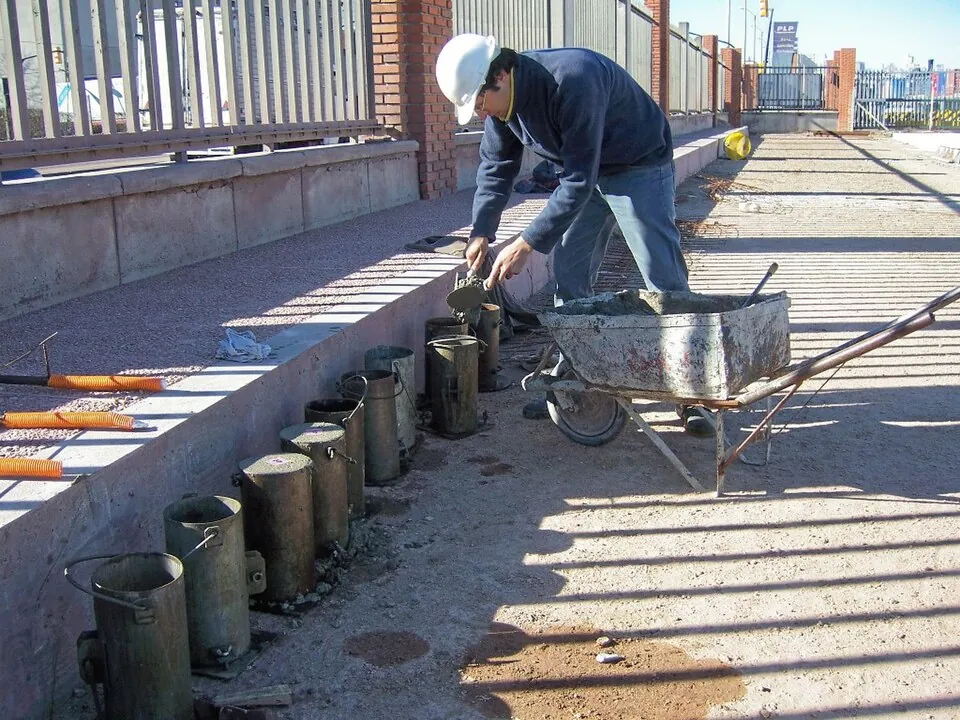
Photo: Tano4595, Wikimedia Commons, CC BY-SA 2.5
Quick Answer
A concrete cylinder test is how the strength of delivered concrete is checked. A field technician fills plastic or steel molds, usually 4 × 8 inches or 6 × 12 inches, with fresh concrete from the truck following ASTM C31, cures them, and a lab crushes them in a press at 7 and 28 days (ASTM C39). Under ACI 318, the concrete passes if the average of any three consecutive tests meets the specified strength and no single test falls more than 500 psi below it (for specified strengths up to 5,000 psi). The same visit usually includes a slump test and a concrete air test. For volume, a concrete cylinder calculator uses V = 3.14 × r² × h; a 12-inch column 10 feet tall holds about 7.85 cubic feet.
Concrete is ordered by strength, but you cannot see strength when the truck arrives. Slump, air content and temperature can be measured on the spot; strength takes days or weeks to develop. Concrete testing with cylinders bridges that gap: small samples cast from the same load are cured under controlled conditions and crushed later, giving a measured strength for that concrete. On commercial and public projects, concrete cylinder testing is required by code and contract. On home projects it is optional, but understanding it helps you read reports, deal with problems and decide when testing is worth paying for.
This guide explains how concrete test cylinders are made, cured and broken, what the results mean, the acceptance rules, the other tests run at the truck including the concrete air test, what happens when results are low, costs, and how to use a concrete cylinder calculator for columns, piers and tubes.
What Is a Concrete Cylinder Test?
A concrete cylinder test, the most common concrete test for strength, measures compressive strength, the load per square inch that a concrete specimen can carry before it fails. Specimens are cylinders because they are easy to cast and test uniformly, and the standard height is twice the diameter. In North America, 6 × 12-inch cylinders were the traditional size; today 4 × 8-inch concrete cylinders are more common because they are lighter, use less concrete and fit in smaller presses, and standards allow them when the coarse aggregate is not too large. Many other countries test 150-millimeter cubes instead of cylinders; cube results read somewhat higher than cylinder results for the same concrete.
How Concrete Test Cylinders Are Made
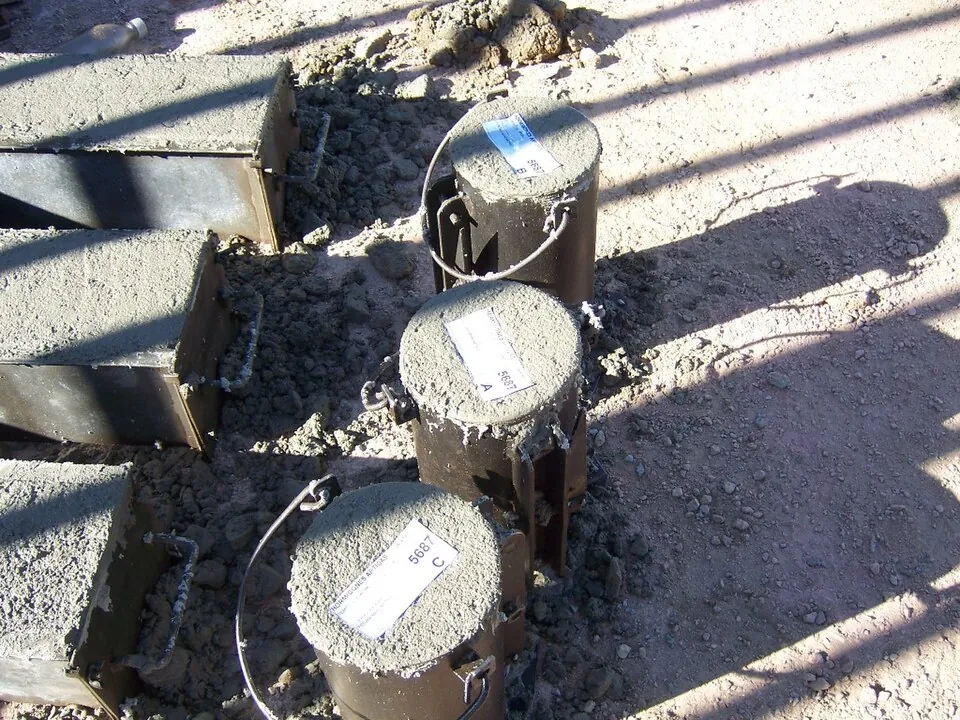
Photo: Tano4595, Wikimedia Commons, CC BY-SA 2.5
Making concrete test cylinders in the field for concrete cylinder testing follows ASTM C31:
- Sample the concrete under ASTM C172 from the middle of the truck's discharge, combine it, and start molding within 15 minutes.
- Set the molds on a level, firm surface out of traffic, where they can stay undisturbed.
- Fill in layers: two equal layers for 4 × 8-inch molds and three for 6 × 12-inch molds when consolidating by rodding.
- Rod each layer 25 times with a rounded-tip rod (3/8 inch for 4-inch molds, 5/8 inch for 6-inch molds), then tap the outside of the mold 10 to 15 times with a mallet to close rod holes and release air. Mixes with low slump may be consolidated with a vibrator instead.
- Strike off the top smooth and level with the rim.
- Cover and label each cylinder with the project, date, load ticket and location in the structure.
- Initial curing: keep the cylinders between 60 and 80°F (16 to 27°C) and protected from moisture loss for up to 48 hours, often in an insulated curing box on site.
- Transport them carefully to the lab, where they are removed from molds and moist-cured at about 73°F until testing.
Most failed or low concrete testing results trace back not to the concrete but to poorly handled cylinders: left in the sun, frozen, bumped in a truck bed, or not cured. That is why the initial curing step matters so much.
How Cylinders Are Tested
At the lab, each concrete test cylinder is capped with unbonded neoprene pads in steel retainers or with sulfur mortar, or its ends are ground flat, so the load is applied evenly. The cylinder is placed in a compression machine and loaded at a controlled rate until it fails, under ASTM C39. The maximum load divided by the cross-sectional area gives the compressive strength. A 4-inch cylinder that fails at 50,000 pounds has a strength of about 3,980 psi; a 6-inch cylinder failing at 113,000 pounds is about 4,000 psi. Technicians also record the fracture pattern, which helps diagnose problems such as poor capping or bad consolidation.
Typical sets are one or two concrete cylinders broken at 7 days to show early strength gain and two or three at 28 days for acceptance, with a spare held for later testing if needed. For mixes with fly ash or slag, the specification may call for 56-day tests. The 28-day strength test result is the average of the cylinders broken at that age.
Acceptance Rules for Concrete Testing
Under ACI 318, the concrete in a project is considered satisfactory if both of these are true:
- Every average of three consecutive strength tests equals or exceeds the specified strength, f'c.
- No individual strength test falls below f'c by more than 500 psi when f'c is 5,000 psi or less, or by more than 10 percent of f'c when f'c is higher.
Tests are taken at a minimum frequency: at least once a day for each class of concrete, and at least once for every 150 cubic yards or every 5,000 square feet of slab or wall placed. These rules accept that individual results vary while protecting against concrete that is consistently weak. The mix is usually designed to average well above f'c so it passes these rules comfortably.
Other Tests at the Truck: Concrete Air Test, Slump and Temperature
When the technician casts cylinders, they run several fresh-concrete tests on the same sample:
- Concrete air test: the pressure method (ASTM C231) measures entrained air in normal-weight concrete, usually 4 to 8 percent for exterior work; the volumetric method (ASTM C173) is used for lightweight concrete. See concrete admixtures.
- Slump: ASTM C143, a measure of consistency. See concrete slump.
- Temperature: ASTM C1064, to confirm the concrete is within hot- or cold-weather limits.
- Unit weight: ASTM C138, to check yield and air.
These results are recorded on the same report as the cylinders, so each concrete test can be traced to a specific truck and location.
When Cylinder Results Are Low
Low concrete cylinder results do not automatically mean the structure is weak. The usual steps are to check the testing first: were the cylinders made, cured and transported properly, and was the lab procedure correct? Next, the engineer may compare results with other tests from the same pour and consider whether the low strength matters for the element involved. If doubt remains, cores are drilled from the actual structure and tested under ASTM C42. ACI 318 considers the concrete in that area adequate if the average of three cores is at least 85 percent of f'c and no single core is below 75 percent. Nondestructive tests, such as rebound hammers or ultrasonic pulse velocity, can help map where to core. Only if cores confirm low strength does the discussion move to strengthening or replacement.
Field-Cured Cylinders and Maturity
Besides standard-cured concrete test cylinders for acceptance, contractors sometimes cast field-cured cylinders that stay next to the structure and experience the same temperatures. These show the actual in-place strength for decisions such as when to remove forms or shores, or when to stress post-tensioning tendons. The maturity method uses temperature sensors embedded in the concrete and a calibration curve to estimate in-place strength in real time. See post tension concrete slab and how long concrete takes to cure.
Concrete Cylinder Calculator: Volume of Round Shapes
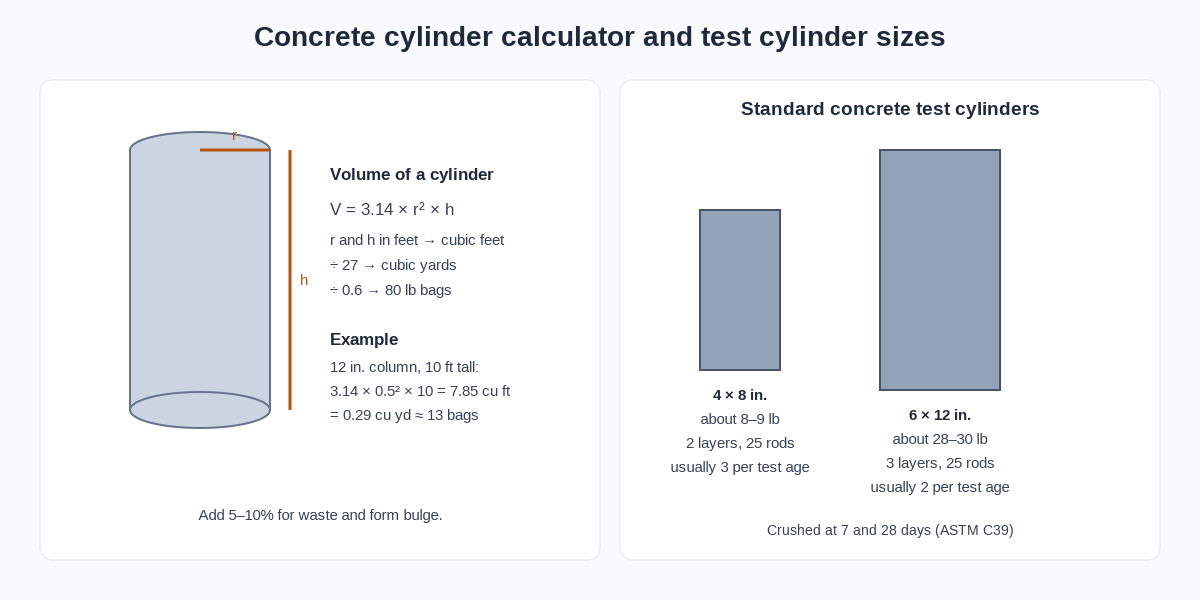
The other meaning of "concrete cylinder" is any round concrete shape you need to fill: a column, a pier, a sonotube, a round footing or a post hole. A concrete cylinder calculator uses one formula: volume = 3.14 × radius² × height. Measure the diameter, divide by 2 for the radius, and convert inches to feet by dividing by 12.
| Diameter | Cubic feet per foot of height | 80 lb bags per foot |
|---|---|---|
| 8 in. | 0.35 | 0.6 |
| 10 in. | 0.55 | 0.9 |
| 12 in. | 0.79 | 1.3 |
| 16 in. | 1.40 | 2.3 |
| 18 in. | 1.77 | 2.9 |
| 24 in. | 3.14 | 5.2 |
Example: ten 12-inch piers 4 feet deep need 10 × 0.79 × 4 = 31.6 cubic feet, or about 1.17 cubic yards, roughly 53 bags of 80-pound mix. Add 5 to 10 percent. A cylinder concrete calculator for many piers is just this multiplication repeated. See concrete piers and how to calculate yards of concrete.
Why Concrete Testing Matters
Concrete testing exists because concrete is a manufactured product made in a hurry: batched, mixed, hauled and placed within about 90 minutes, from natural materials that vary every day. Ready-mix plants control their materials carefully, but water added on site, a delayed truck, a hot afternoon or a batching error can change the result. Concrete testing gives everyone involved, the owner, the engineer, the contractor and the supplier, an objective record of what was delivered and how strong it became. It catches problems while they can still be fixed, settles disputes with data rather than opinion, and over time helps plants tune their mixes. For structures that people live and work in, testing is part of how codes protect public safety.
Concrete Testing on Home Projects
Most homeowners never see a concrete cylinder, because codes rarely require testing for one- and two-family houses. That does not mean it is never worth it. Consider hiring a testing lab for large slabs, basement walls, structural slabs over living space, foundations on difficult soil, or any job where you are paying extra for a specific strength. A single visit for the first truck, with slump, a concrete air test and a set of cylinders, gives you a baseline at modest cost. If a problem appears later, such as scaling, cracking or a soft surface, you will have records that show what was delivered. Ask your contractor whether they object; reputable contractors and suppliers generally welcome testing because it protects them as well. Make sure the lab knows where each truck was placed, so results can be matched to locations. Keep the delivery tickets and the test reports together with the house records; they are useful when selling the house or planning future work on that slab or wall.
Cylinders vs Cubes
Much of Europe, the United Kingdom, India and other regions test 150-millimeter cubes rather than concrete cylinders. A cube is easier to cast and does not need capping, but because of its shape and the restraint from the press platens, it reads higher than a cylinder made from the same concrete, often by about 20 to 25 percent. That is why European concrete classes list two numbers, such as C25/30, meaning 25 megapascals on cylinders and 30 on cubes. When comparing strengths from different countries, check whether the value refers to a concrete cylinder or a cube before drawing conclusions.
Reading a Concrete Test Report
A typical concrete testing report lists the project, date, supplier, truck ticket number, mix design, and placement location for each set. Fresh-concrete results follow: slump, air content, concrete temperature, air temperature and unit weight. Then come the cylinder results: the age at test, the dimensions, the maximum load, the calculated strength and the fracture type for each cylinder, with the average for the set. Look first at the 28-day average compared with the specified strength, then at whether any single cylinder is much lower than its partners, which may point to a handling problem with that cylinder rather than the concrete. Also check the fresh-concrete results for anything outside the specification; for example, low air content in exterior concrete is a durability concern even if strength is fine.
Common Cylinder Handling Mistakes
A concrete test cylinder is only as reliable as the way it was handled. Common problems include casting cylinders on sloping or soft ground so they end up out of square, leaving them uncovered in sun and wind so they dry out, letting them freeze on a cold night, storing them in a hot truck cab, moving them too soon and cracking them, dropping or bouncing them in transport, and leaving them on site for days instead of getting them to the lab within 48 hours. Each of these can lower the measured strength by hundreds of psi, sometimes leading to expensive coring and disputes over concrete that was actually fine. A good testing firm uses insulated curing boxes and a strict pickup schedule to avoid these issues, and logs the box temperature.
Using a Concrete Calculator: Cylinder Shapes in Practice
When using a concrete calculator, cylinder shapes come up more often than people expect: round columns on a porch, sonotube piers for a deck, round footings under posts, round stepping stones, planters and bollards. For a full cylinder, the formula is simple, but real projects add twists. A pier with a wider bell or square footing at the bottom needs the footing volume added separately. A hollow cylinder, such as a concrete ring around a pipe, needs the inner cylinder subtracted from the outer one. A half-round step or curved planter is half a cylinder. And a cylinder concrete calculator should always include extra for the bulge of cardboard tubes and the rough bottom of a dug hole, typically 5 to 10 percent. For mixed shapes, calculate each part separately and add them up. If the total is more than about a cubic yard, compare the cost of bags with a small ready-mix load. See how many bags of concrete in a yard.
Other Ways to Test Concrete
Concrete cylinders are the standard, but other concrete test methods help in specific situations. Rebound hammers measure surface hardness and give a quick, rough comparison of strength across a structure. Ultrasonic pulse velocity tests send sound through concrete to find cracks, voids and weak zones. Ground-penetrating radar locates rebar, tendons and voids before drilling. Pull-out and penetration tests estimate in-place strength. Moisture tests check slabs before flooring; see concrete moisture barrier. None of these replaces cylinders for acceptance, but they help engineers investigate existing concrete without drilling dozens of cores.
How Many Concrete Cylinders Are Needed?
The number of concrete cylinders depends on the project specification, but a common pattern for each concrete test is one 4 × 8-inch cylinder broken at 7 days, three at 28 days, and one held in reserve, or two 6 × 12-inch cylinders at 28 days plus one at 7 days. ACI 318 requires at least one strength test per day of placement for each class of concrete, and at least one for every 150 cubic yards or every 5,000 square feet of slab or wall surface, with a minimum of five tests for a project unless fewer than five truckloads are used. Specifications for critical elements, such as post-tensioned slabs or high-strength columns, may call for more frequent concrete cylinder testing, plus extra field-cured cylinders to decide when to strip forms or stress tendons. For a home slab where testing is optional, one set of concrete test cylinders from the first truck, plus a second set if the pour runs long, is a sensible minimum.
Concrete Testing Labs and Certification
Concrete testing should be done by trained, certified technicians and accredited labs. In the U.S., the American Concrete Institute certifies Concrete Field Testing Technicians, Grade I, who are qualified to perform slump, air, temperature and unit weight tests and to make concrete cylinders, and Concrete Strength Testing Technicians, who run compression tests in the lab. Labs are often accredited under programs that audit their equipment and procedures, and compression machines must be calibrated regularly. When hiring a lab for a home project, ask whether its field technicians hold ACI certification and whether the lab is accredited; it costs no more and makes the results far more reliable if they are ever questioned.
How Long Do Concrete Test Results Take?
Fresh concrete test results, slump, air and temperature, are known on the spot within minutes. Cylinder results take as long as the specified test ages: the 7-day break comes about a week after the pour and gives an early indication, typically 60 to 75 percent of the 28-day strength for ordinary mixes. The 28-day results arrive about four weeks after the pour. Labs usually email results within a day of each concrete cylinder break, and many now post them to an online portal the whole project team can see. If a 7-day concrete cylinder result is unusually low, the engineer may ask for an extra break at 14 days or plan for coring early, rather than waiting the full 28 days to act.
What a Concrete Cylinder Can and Cannot Tell You
A concrete cylinder tells you the potential strength of the concrete as delivered, cured under ideal laboratory conditions. It does not directly tell you the strength of the concrete in the slab or wall, which depends on how it was placed, consolidated and cured on site. A perfectly good mix can end up weaker in place if it was overwatered at the chute, poorly vibrated, or allowed to dry out or freeze in its first days. That is why concrete testing programs pair standard-cured cylinders, which judge the supplier's product, with field-cured cylinders, cores or maturity sensors when the in-place strength matters. It is also why good placement and curing practices matter as much as the mix. A concrete test cylinder that passes is necessary, but it does not guarantee a good structure on its own.
Cylinders also say little about durability. A mix can reach its strength and still scale in freezing weather if it lacks air entrainment, or crack if it shrinks too much. That is why the concrete air test, slump and temperature are recorded alongside strength, and why some projects add tests for permeability or shrinkage.
A Short History of Concrete Testing
Engineers have crushed concrete samples since the 19th century, but standardized concrete testing came with the growth of reinforced concrete in the early 1900s. Duff Abrams, working at the Lewis Institute in Chicago around 1918, tested thousands of specimens and showed that strength depends mainly on the water-cement ratio, a finding that still underpins mix design. ASTM standards for making and testing cylinders followed in the 1920s and have been refined ever since, from the move to unbonded caps to the adoption of smaller 4 × 8-inch cylinders. Today, digital compression machines, electronic reports and maturity sensors make the process faster, but the basic idea is unchanged: cast a small concrete cylinder from the load, cure it carefully, and crush it to see what the concrete can do.
How Much Does Concrete Testing Cost?
- Field technician visit with slump, air, temperature and a set of cylinders: often about $150 to $400, depending on travel and minimum charges.
- Compression test per cylinder: often about $20 to $60.
- Cores: several hundred dollars and up, including drilling and patching.
- Engineering review of low results: billed hourly.
For a home foundation or a large slab, a single testing visit is a modest cost compared with the concrete itself and can settle questions later. See concrete price per yard.
Frequently Asked Questions
What is a concrete test cylinder?
A cylinder of fresh concrete, usually 4 × 8 or 6 × 12 inches, cast from a truck load, cured and crushed in a lab to measure compressive strength.
When are concrete cylinders tested?
Typically at 7 days for early strength and 28 days for acceptance, with extra cylinders held for later tests.
What is a concrete air test?
A field test, usually with a pressure meter, that measures the percentage of entrained air in fresh concrete to confirm freeze-thaw protection.
How do I use a concrete cylinder calculator?
Multiply 3.14 × radius² × height in feet for cubic feet, divide by 27 for cubic yards, or by 0.6 for 80-pound bags, and add 5 to 10 percent.
What if concrete cylinder testing fails?
Check the testing procedure first, then compare with other results; if doubt remains, cores are drilled from the structure and tested.
Sources
- ASTM C31: Making and Curing Concrete Test Specimens in the Field
- ASTM C39: Compressive Strength of Cylindrical Concrete Specimens
- American Concrete Institute: ACI 318 strength acceptance criteria
- National Ready Mixed Concrete Association: Concrete in Practice, testing
Related Guides
- Concrete slump test — what slump means and how to test it
- Concrete vibrator — consolidating walls, footings and columns
- Concrete core drilling — coring holes, bits, scanning and cost
- Concrete batching plant — how ready-mix is made
- Density of concrete — unit weight and modulus of elasticity
- World of Concrete — the industry's annual trade show in Las Vegas
- Commercial concrete — specs, tilt-up, parking decks, testing, costs and contractors