
Concrete Core Drill Guide: Concrete Coring, Core Bits, Scanning and Cost
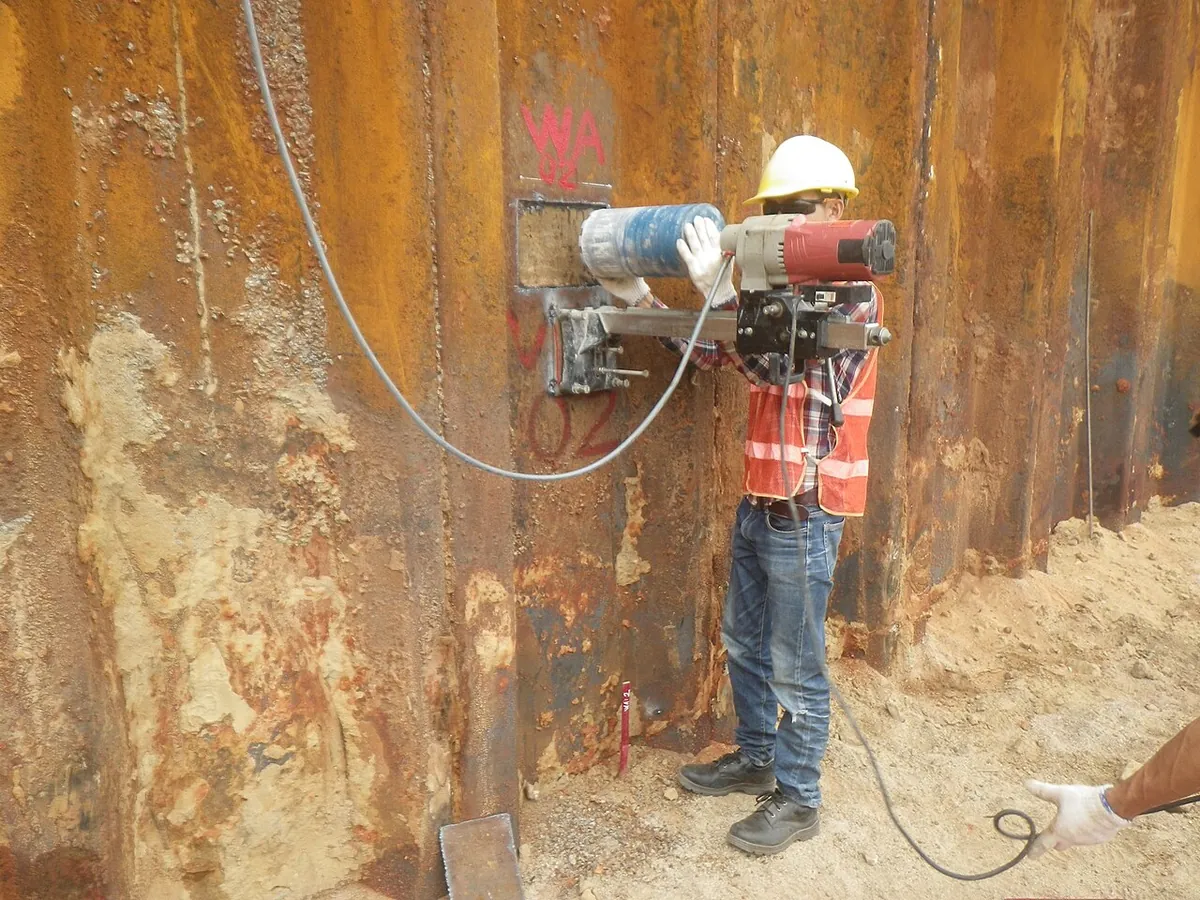
Photo: USAID Vietnam / CDM Smith, Wikimedia Commons, public domain
Quick Answer
A concrete core drill uses a hollow, diamond-tipped tube, the core bit, to cut a perfectly round hole and remove a solid cylinder, or core, of concrete. Concrete core drilling is used for holes for plumbing, electrical, HVAC and dryer vents through walls and slabs, for anchor and dowel holes too large for a hammer drill, and to take core samples for strength testing. Most coring is done wet, with water cooling the bit and controlling dust, using a drill mounted on a stand bolted or vacuum-fixed to the concrete. Bits run from about 1 inch to 12 inches and larger. Before coring, concrete scanning with ground penetrating radar finds rebar, post-tension cables, conduit and pipes. Professional coring typically costs from roughly $100 to several hundred dollars per hole.
When you need a clean, round hole through a foundation wall for a new drain line, a slab for a floor drain, or a block wall for a dryer vent, a hammer drill and chisel make a ragged, slow mess. Concrete core drilling cuts the hole precisely, with minimal vibration and no cracking of the surrounding concrete, and leaves a neat opening ready for a pipe sleeve or seal. The same technique is used by engineers to take cores out of existing structures and test what the concrete is really like.
This guide explains how a concrete core drill works, the types of drills and core bits, wet versus dry coring, how to core drill concrete step by step, why concrete scanning before coring matters, core samples and testing, and what concrete coring costs to hire or do yourself.
How a Concrete Core Drill Works
A concrete core drill is a powerful, relatively slow-turning motor with a heavy-duty spindle that drives a core bit. The bit is a thin-walled steel tube with diamond segments brazed or laser-welded around its cutting rim. As the bit turns, the diamonds grind a narrow ring, called the kerf, into the concrete, and the center stays intact as a solid cylinder. Water fed through the spindle and into the bit cools the diamonds and flushes the slurry out. When the bit reaches the far side, or the required depth, the core is removed, leaving a smooth-walled round hole.
Because a concrete core drill only removes the thin ring of material, concrete coring needs far less power than drilling a solid hole of the same size, and it cuts through rebar as easily as concrete. Unlike hammer drilling, there is no impact, so there is little risk of cracking the slab, spalling the back face, or disturbing nearby finishes. See how to drill into concrete for when a hammer drill is the better tool.
Types of Concrete Core Drills
Handheld concrete core drills are used for smaller holes, typically up to about 2 to 4 inches, in block, brick and lighter concrete work. They are often used dry with a vacuum attachment, or wet with a water feed. They are fast to set up but harder to keep straight and are limited in power.
Rig-mounted concrete core drills, like the one pictured above, mount the motor on a column and carriage attached to a base plate. The base is fixed to the concrete with an anchor bolt or a vacuum pad, and the operator feeds the bit with a handle or wheel. Rigs keep the hole perfectly straight, handle large diameters and deep holes, and reduce operator fatigue and injury from bit binding. Most professional concrete core drills are rig-mounted units of about 2 to 4 horsepower, with multiple speeds for different bit sizes. Large hydraulic and high-frequency electric units are used for very large or very deep cores.
Concrete Core Bits
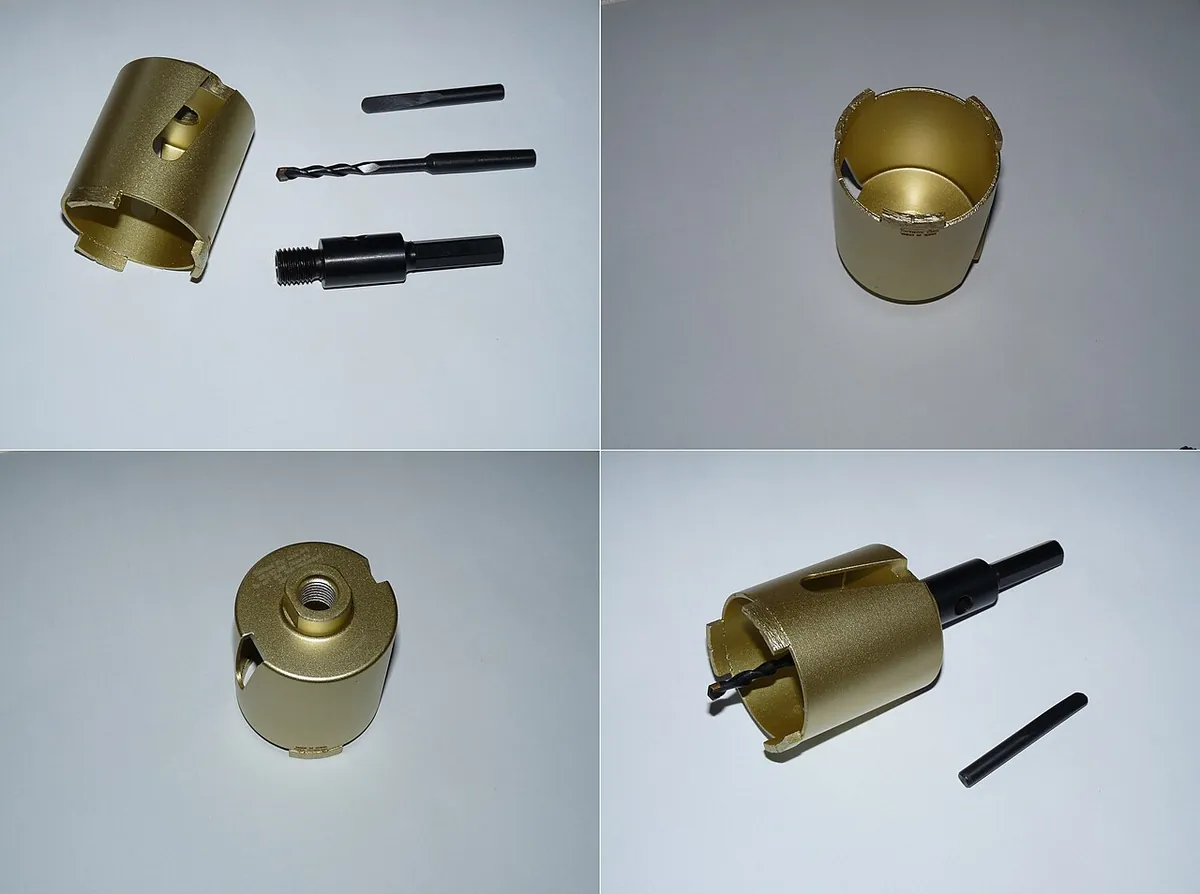
Photo: Dmitry G, Wikimedia Commons, CC BY-SA 3.0
A concrete core bit has three parts: the diamond segments or crown, the steel barrel, and the connection end that threads or locks onto the drill. Bits are sized by outside diameter, from about 1/2 inch to over 24 inches, and by usable barrel length, commonly 14 to 17 inches for standard bits. Common sizes for building services are 1 1/2 to 6 inches for pipes and cables, 4 to 6 inches for dryer vents and exhausts, and larger for ducts and drains.
Concrete core bits come as wet bits and dry bits. Wet core bits are used with water and are the standard for reinforced concrete; they cut faster, last longer and control dust. Dry core bits, often vacuum-brazed or with special segments, are used in brick, block and softer masonry with dust extraction, mostly in smaller sizes. Segment bond and diamond quality are matched to the material: soft-bond segments for hard concrete with hard aggregate, harder bonds for abrasive, soft materials like block. Choosing the right concrete core drill bit for the material makes a big difference in speed and bit life.
Connection types vary: 1 1/4-7 UNC threads are common in North America for larger concrete core drill bits, and 5/8-11 threads for smaller ones; other regions use different standards. Adapters let one drill take several bit types. Some bits have a pilot drill and center bit to start the hole without a rig, like the small dry bit in the photo above. Core bits for concrete are an investment; a quality 4 inch wet bit can core many holes in normal concrete before needing re-tipping.
Wet vs Dry Concrete Coring
Wet concrete core drilling is the standard method for reinforced concrete and for any hole of significant size or depth. Water keeps the diamonds cool, carries the cuttings out of the kerf, extends bit life, and eliminates dust. The trade-off is slurry: a gray, alkaline mix of water and fine concrete that must be contained. Operators use water rings, wet vacuums and sheeting to collect it, especially indoors or when coring overhead.
Dry concrete coring avoids water damage concerns in finished interiors and is common for small holes through block and brick, using dry bits with a vacuum attached to the drill or bit. It produces silica dust that must be captured with a HEPA dust extractor, and it is slower and harder on bits in dense concrete. For most reinforced concrete jobs, wet coring is better.
Concrete Scanning Before Coring
Before anyone cores a hole in an existing slab or wall, they should know what is inside it. Concrete scanning locates rebar, post-tension tendons, electrical conduit, plumbing, radiant heating tubes and voids, so the core can be placed to avoid them. Cutting a live electrical conduit can be deadly; cutting a post-tension tendon in an elevated slab can be dangerous and very expensive to repair; and cutting main structural bars can weaken a beam or slab.
The most common method is ground penetrating radar, or GPR, which sends radio waves into the concrete and records reflections from embedded objects. A trained technician moves a GPR cart or handheld unit over the area and marks the findings directly on the surface. GPR can usually see objects to a depth of about a foot or more in typical slabs, depending on the concrete and the equipment. Electromagnetic cover meters find steel near the surface, and X-ray imaging, which requires clearing the area of people, gives a detailed picture through slabs where both sides are accessible. Many concrete coring companies offer scanning as part of the job; for coring in commercial buildings, scanning is often required by the building owner or general contractor.
In a single-family house slab on grade with no post-tensioning, scanning is less often done, but it is still wise near plumbing runs and in-floor heating. For post-tensioned slabs, which are common in some regions for houses on expansive soils, never core without professional scanning. See post-tensioned concrete slab.
How to Core Drill Concrete, Step by Step
Here is the typical concrete core drilling process to core drill concrete with a rig-mounted wet drill.
First, scan and mark. Locate rebar, conduit and pipes, and mark the hole center and outline. Confirm the hole location with whoever designed the services.
Second, set the rig. Drill a hole for the anchor bolt at the right distance from the core center, set an anchor, and bolt the base plate down; or use a vacuum base on smooth, sound concrete. Level and plumb the column so the hole will be straight.
Third, prepare water and slurry control. Connect a water supply or pressurized tank, and set up a water collection ring, wet vacuum or sheeting. Protect finishes, electrical outlets and the area below if coring through a floor.
Fourth, start the cut. Mount the core bit, start the water, and lower the bit to the surface at low feed pressure to establish a clean kerf. Once the bit has cut a groove, increase to normal feed pressure. Let the bit cut at its own rate; forcing it glazes the diamonds and can stall the motor.
Fifth, cut through. Keep water flowing and feed pressure steady. When the bit hits rebar, the sound changes and progress slows; ease off slightly and let the diamonds cut through the steel. When coring through a floor, arrange support for the core underneath so it does not fall onto anything or anyone below.
Sixth, remove the core. Retract the bit, remove the core, and clean up the slurry. If the core stays inside the bit, tap the barrel gently with a rubber mallet, never with a steel hammer, which dents the barrel.
Seventh, finish the hole. Install the pipe, sleeve or cable, and seal the gap with appropriate firestop, waterproof or hydraulic cement, depending on the location.
Concrete Core Samples and Testing
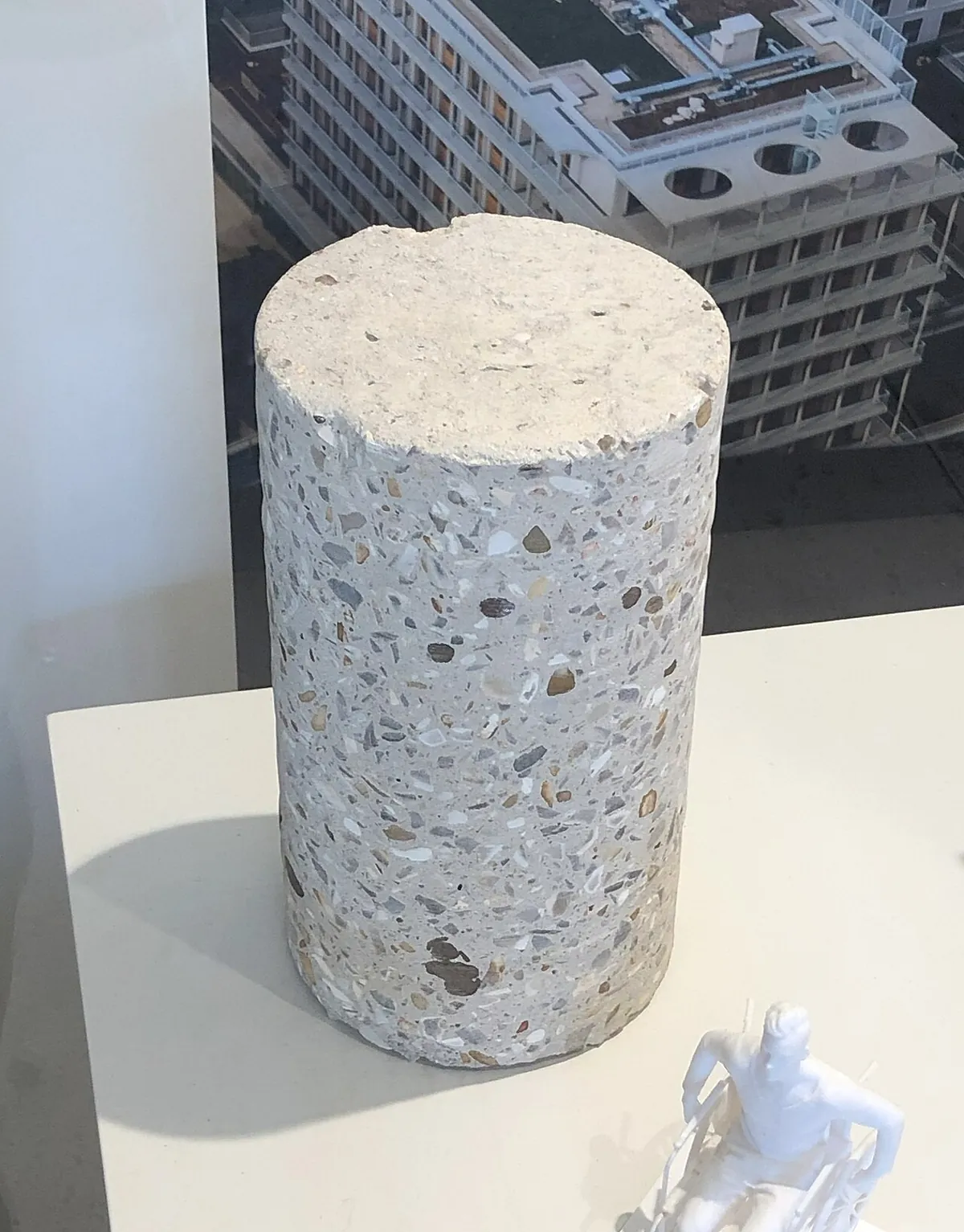
Photo: Lorevdoreb, Wikimedia Commons, CC0
Coring concrete is also the standard way to find out how strong concrete really is in an existing structure. When cylinder tests during construction come back low, when a building is being renovated or assessed, or when a dispute arises about quality, an engineer may order cores to be drilled and tested. ASTM C42 covers obtaining and testing drilled cores. Cores are typically about 3.75 to 4 inches in diameter, at least three times the maximum aggregate size, with a length about twice the diameter where possible. They are conditioned, trimmed, capped and crushed in a testing machine much like cast cylinders. ACI 318 gives acceptance criteria for core strength results. Cores also reveal how thick a slab is, how well it was consolidated, how deep cracks run, and whether reinforcement is where the drawings say. See concrete cylinder test.
Matching Core Drill Bits to the Material
Not every bit suits every job. Buyers often see listings for wet core drill bits. Concrete with hard aggregate such as granite or river gravel needs bits with a softer bond, so worn diamonds release and fresh ones are exposed; otherwise the segments polish and stop cutting. Softer, more abrasive materials such as concrete block, brick and green concrete wear segments quickly, so they need harder bonds. Heavily reinforced concrete calls for segments designed to cut steel without chipping. If you choose the wrong core bit, concrete coring slows to a crawl or the bit wears out after a few holes.
For asphalt and pavement coring, which highway agencies use to check thickness and density, special bits with bonds suited to the softer, abrasive material are used. For tile and stone, thin-wall bits with continuous rims give cleaner edges. If you hire a coring contractor, they will carry several bit types; if you rent, tell the rental store what you are coring so they give you the right one.
Coring Through Floors for Plumbing
One of the most common uses of concrete coring in homes and businesses is running plumbing through floors: drains for new bathrooms, toilet flanges, floor drains, sump pits and laundry lines. Coring floor slabs needs extra care. The core will drop out the bottom when the bit breaks through, so someone must support or catch it if there is a room below. Water from wet coring runs down through the hole, so protect ceilings and contents below. In slabs on grade, the bit will break into the base or vapor barrier below the slab; for larger openings such as a new shower drain trench, saw cutting and breaking out a section may be better than coring. See how to cut concrete and vapor barrier under concrete.
Coring Foundation Walls for Vents and Pipes
Dryer vents, range hood ducts, bathroom fans, HVAC lines, water service and sewer lines often need holes through concrete or block foundation walls. A rig-mounted concrete core drill gives a clean round hole sized for the pipe plus a sleeve and sealant. Below grade, the hole must be sealed against water with a link-seal type mechanical seal, hydraulic cement or a waterproof sealant system, because a leaking penetration is a common source of basement water. Above grade, exterior holes need flashing or a sealed vent cap. Plan core locations to avoid footings, beams and the corners of walls, and check the height above grade outside so a vent does not exit into soil. See is concrete waterproof.
Large Openings and Stitch Drilling
When an opening is larger than a single core, such as a doorway through a basement wall or a large duct opening, contractors often use stitch drilling: a row of overlapping or closely spaced cores around the outline, followed by breaking out the center. Wall sawing and wire sawing are used for bigger openings. Large openings in foundation walls and structural slabs almost always require an engineer's design, because they remove load-carrying concrete and reinforcement and may need new beams or headers.
Firestopping Cored Holes
In multi-story buildings, floors and some walls are fire-rated assemblies. Every hole cored through them for pipes, cables or ducts must be firestopped with a listed firestop system that restores the rating, using approved sealants, collars or wraps installed exactly as the listing describes. Inspectors check firestopping carefully. In single-family homes, firestopping is required in some locations, such as penetrations between a garage and the house; check local codes.
Caring for Concrete Core Bits
Diamond concrete core bits are expensive, and a little care makes them last much longer. Always run with enough water; a dry-running wet bit overheats in seconds and can lose segments. Do not force the feed; let the diamonds cut. If a bit starts cutting slowly and the segments look shiny, it has glazed: open it up by drilling a few inches into an abrasive block or a cinder block, which wears the bond and exposes fresh diamonds. Keep barrels straight and free of dents, which cause binding. When the segments wear down, many bits can be re-tipped with new segments for less than the cost of a new bit. Store core bits for concrete standing on their connection end or hanging, never resting on the segments.
Troubleshooting Concrete Coring Problems
If the concrete core bit is cutting slowly, the segments may be glazed, the bond may be too hard for the concrete, water flow may be too high or too low, or the drill speed may be wrong for the bit diameter; larger bits need lower speeds. If the concrete core drill bit binds, the barrel may be bent, the rig may have shifted, or the core may have broken inside and jammed; stop, check the anchor and alignment, and clear the core. If the core will not come out of the bit, let the bit dry and tap it gently with a rubber mallet. If the hole is out of round or wanders, the rig was not secure or level. Most coring problems come down to setup, water and feed pressure.
Should You Core Drill Concrete Yourself?
For one small hole through a block wall, a rented handheld core drill or a hammer drill and a hole saw for masonry can work for a careful DIYer. For holes through reinforced concrete, holes larger than about 3 inches, coring overhead, or anything in a post-tensioned or elevated slab, hiring a coring contractor is usually safer and often cheaper once rental, bit wear, time and cleanup are counted. A professional brings scanning, the right concrete core drills and bits, water control and the experience to handle rebar and stuck cores.
Concrete Core Drilling vs Other Methods
Concrete core drilling is not the only way to make a hole, so it helps to know when it is the best choice. A hammer drill or rotary hammer is faster and cheaper for holes up to about an inch, as long as some spalling at the back face is acceptable. A masonry hole saw in a rotary hammer can cut rough holes of a few inches in block and brick. Saw cutting and breaking out is better for rectangular openings and trenches. Concrete core drilling wins whenever you need a round hole larger than about an inch, a clean edge for a seal, a straight hole through a thick wall or slab, a hole through rebar, or minimal vibration near sensitive finishes and equipment. For core samples, a concrete core drill is the only practical option.
In practice, many jobs use several methods: a rotary hammer for anchor holes, a concrete core drill for the pipe penetration, and a saw for the trench. Planning which tool does which hole saves time on site.
Before booking a coring contractor, have the hole locations, sizes and depths ready, know whether the slab is on grade or elevated, and ask whether scanning, water control, patching and firestopping are included in the price. Clear access for the rig and a nearby power and water supply also keep concrete core drilling quick and the bill lower. A clear plan also lets the contractor bring the right concrete core bits, so the job is done in one visit without return trips, delays or extra charges on your final bill.
Concrete Core Drilling Cost
Professional concrete core drilling is usually priced per hole, based on diameter and depth, with a minimum charge for a visit. As a rough guide, small holes of a few inches through a typical 4 to 6 inch slab or 8 inch wall might cost roughly $100 to $250 each, with larger diameters, thicker concrete, overhead work and heavy rebar costing more. Many contractors have a minimum charge of a few hundred dollars per trip. Concrete scanning, when needed, is often priced per visit or per area, commonly a few hundred dollars for a small job. Prices vary a lot by region, so get quotes that include setup, water control and cleanup.
Renting is an option for DIYers with one or two holes. Rental stores rent rig-mounted concrete core drills by the day, and bits are usually rented with a charge for diamond wear, or sold. Including the bit, a day's rental can cost a significant fraction of what a pro charges for a single hole, so for one or two holes, hiring often makes more sense. For many holes, renting can save money if you are comfortable with the setup and the water control.
Safety With Concrete Core Drills
Concrete core drills are powerful, and the main hazard is the bit binding and twisting the drill. On handheld drills this can injure wrists and arms; on rigs it can tear the base loose if it is not anchored properly. Always use the side handle on handhelds and secure rigs firmly. Use ground-fault protected power and keep electrical connections away from water. Wear eye, ear and foot protection, and support cores when drilling through floors and walls so they do not fall. Control dust from dry coring with a HEPA extractor. And never core without knowing what is inside the concrete; that is what concrete scanning is for.
Frequently Asked Questions
What is concrete core drilling used for?
Clean round holes for pipes, cables, vents and drains through walls and slabs, large anchor holes, and core samples for strength testing.
Can a core drill cut through rebar?
Yes. Diamond core bits cut steel and concrete, but cutting structural bars should be checked with an engineer, and scanning helps avoid them.
Do I need concrete scanning before coring?
It is strongly recommended in commercial buildings and essential in post-tensioned slabs. In simple house slabs, it is wise near plumbing and heating lines.
How much does it cost to core a hole in concrete?
Roughly $100 to several hundred dollars per hole depending on size, depth and access, often with a minimum trip charge.
Sources
- ASTM C42: standard test method for obtaining and testing drilled cores of concrete
- American Concrete Institute: ACI 214.4R obtaining and interpreting core strength results; ACI 228.2R nondestructive test methods
- Concrete Sawing and Drilling Association: core drilling standards and safety
- OSHA: silica standard Table 1, core drilling controls
Related Guides
- How to drill into concrete — hammer drills, bits and step-by-step
- How to remove concrete anchors — wedge, sleeve, screw and epoxy anchors
- Concrete cutting blade — diamond and sawzall blades
- Concrete nailer — powder, gas and battery tools
- Concrete fence — panel, poured and block fences
- Concrete chisel — hand and SDS chisels
- Metal decking for concrete — composite steel deck floors
- Concrete slurry — bonding slurry, flowable fill and cutting slurry
- Concrete slab leak repair — signs, detection and repair options under slabs
- Concrete cutter — cut-off saws, Stihl models, concrete chainsaws, depths and rental