
Concrete Plant Guide: How a Concrete Batching Plant Makes Ready-Mix
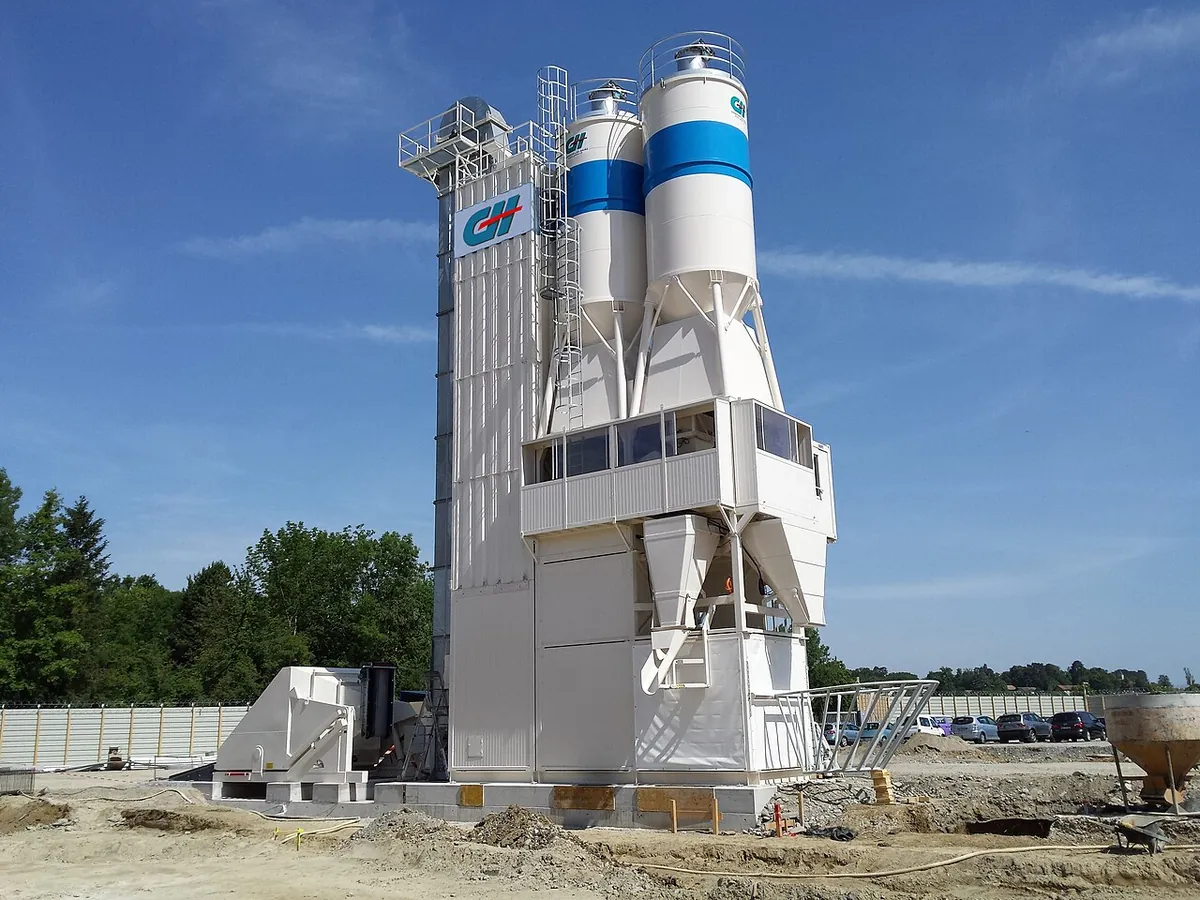
Photo: GH SA, Wikimedia Commons, CC BY-SA 4.0
Quick Answer
A concrete plant, or concrete batching plant, is the facility where the ingredients of concrete, cement, sand, gravel or crushed stone, water and admixtures, are weighed or measured and combined to make ready-mix concrete. In a dry batch or transit-mix plant, the measured materials drop into a truck mixer, which mixes the concrete on the way to the job. In a wet batch or central-mix plant, a stationary mixer mixes the concrete first and then loads it into trucks. Plants are stationary or portable, and output ranges from about 30 to over 300 cubic yards per hour. In the United States, a ready mix concrete plant batches to ASTM C94 tolerances, and many are certified by the National Ready Mixed Concrete Association.
Almost all the concrete used in driveways, foundations, sidewalks, buildings and roads starts at a concrete plant. When you order concrete for a patio, a dispatcher at a nearby plant enters your mix and quantity into a computer, the plant weighs out the materials in a few minutes, a truck is loaded, and the concrete arrives at your site mixed and ready to place. Understanding how a plant works helps explain why concrete is ordered by the cubic yard, why delivery time matters, why mixes differ, and how quality is controlled.
This guide explains what a concrete batching plant does, its main parts, the difference between dry-batch and central-mix plants, stationary and portable concrete plants, capacity, quality rules and tolerances, environmental controls, and practical tips for ordering from a ready mix concrete plant.
What a Concrete Plant Does
Concrete is a recipe. Each mix design sets the amount of cement, supplementary materials such as fly ash or slag, fine aggregate (sand), coarse aggregate (gravel or crushed stone), water and chemical admixtures per cubic yard. A concrete plant's job is to measure each of those ingredients accurately, combine them in the right order, mix them thoroughly, and load the result into trucks, batch after batch, all day. The word batching refers to measuring out one batch, a truckload or part of one, at a time.
Modern concrete plants are highly automated. An operator, called a batchman, selects the mix and quantity on a computer, and the control system opens gates, runs conveyors, weighs materials on load cells, adds water through a meter, dispenses admixtures, and records every weight on a batch ticket that travels with the truck. Moisture probes in the sand bins measure how wet the sand is, and the system adjusts the water accordingly, because wet sand carries water into the mix. See what concrete is made of and concrete mix ratio.
Main Parts of a Concrete Batching Plant
In a concrete batching plant, aggregate storage holds sand and several sizes of stone in stockpiles, bins or bunkers. Front-end loaders feed the stockpiles into overhead bins or ground-level feed hoppers. Conveyor belts carry aggregates up to the batching area.
At the concrete plant, cement and supplementary materials are stored in tall steel silos, like those in the photos on this page, filled pneumatically from bulk tanker trucks. Screw conveyors or air slides move the powder from the silos into a cement weigh hopper. Dust collectors on top of silos and at loading points capture cement dust.
Concrete plant weigh hoppers weigh each material. Aggregates are usually weighed cumulatively in one hopper or on a weigh belt, cement and fly ash in a separate cement hopper. Water is measured by a meter or weighed in a water hopper, and admixtures are dispensed by calibrated meters in small amounts.
In a central-mix plant, a stationary mixer, often a tilting drum, twin-shaft or pan mixer, mixes the batch before it goes to the truck. In a dry-batch plant, the truck's drum is the mixer.
The concrete plant control room houses the batching computer and the operator, usually with a view of the loading point. Many plants also have a small lab for testing aggregates and concrete.
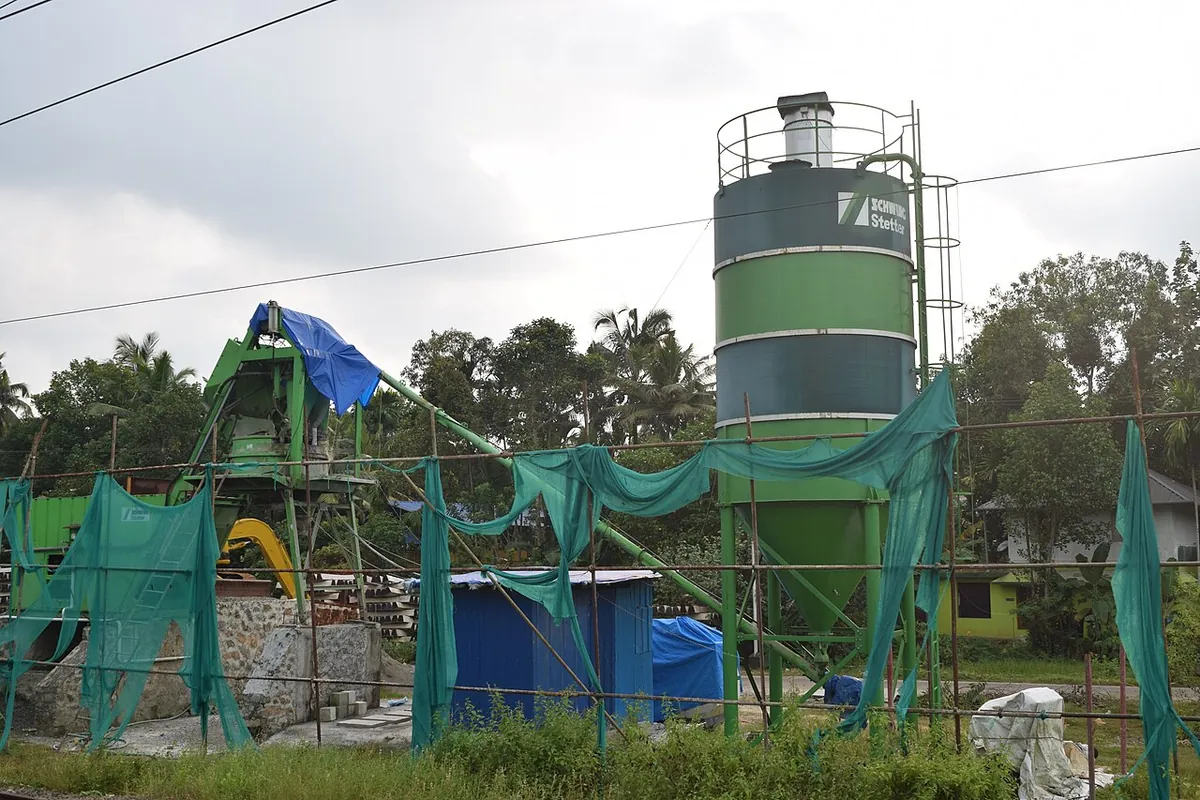
Photo: KannanVM, Wikimedia Commons, CC BY-SA 4.0
Dry Batch vs Central Mix Plants
Most concrete plants in North America are dry-batch, also called transit-mix, plants. The weighed aggregates, cement and water are dropped through a charging chute directly into a truck mixer, whose rotating drum mixes the concrete, usually with a set number of revolutions at mixing speed before and during the trip. Dry-batch plants cost less to build and maintain, and they suit the spread-out delivery patterns of residential and light commercial work.
Central-mix, or wet-batch, concrete plants mix the concrete in a stationary mixer at the plant and then discharge it into truck mixers, agitator trucks or dump trucks. Because mixing happens under controlled conditions, central-mix concrete is more uniform from batch to batch, and loading is faster, since the truck receives finished concrete. Central mix is common in Europe and for high-volume work such as paving, airports, dams and large projects with strict specifications. Some plants can work either way. Shrink-mixing, a hybrid, partly mixes the concrete in the central mixer and finishes mixing in the truck.
Stationary and Portable Concrete Plants
Stationary concrete plants are permanent facilities on a fixed site, usually near a city or along a highway with good truck access, with large aggregate stockpiles, multiple silos and room for a fleet of trucks. A typical region has several stationary concrete plants run by one or more ready-mix companies, each serving jobs within a delivery radius of roughly 20 to 30 miles, or about 30 to 60 minutes of driving.
Portable and mobile concrete batching plants are built on trailers or skids so they can be moved and set up at a large job site, such as a highway, airport, wind farm or dam, where the volume of concrete justifies an on-site plant. They save trucking time and guarantee supply for continuous pours. The photo below shows a portable concrete mixing plant set up for a highway project. Some suppliers also use small mobile batching plants or volumetric mixer trucks, which carry the dry ingredients separately and mix concrete on demand at the site.
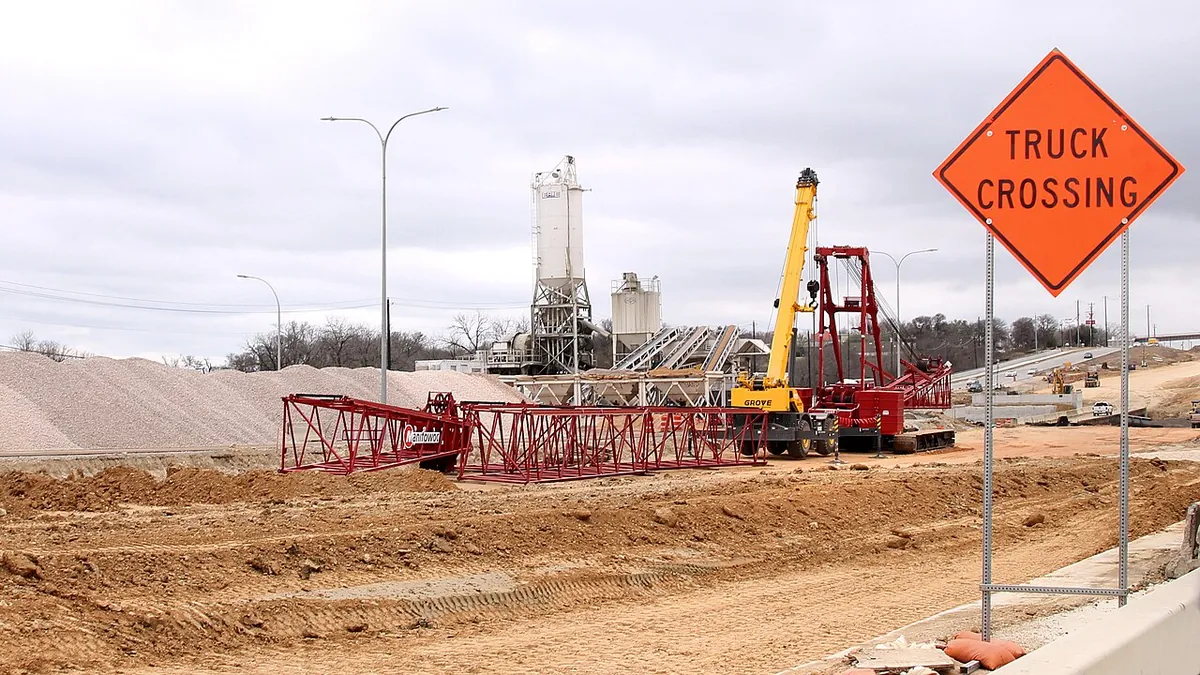
Photo: Larry D. Moore, Wikimedia Commons, CC BY 4.0
Concrete Plant Capacity
Concrete plants are rated by how many cubic yards or cubic meters they can produce per hour. Small plants produce around 30 to 60 cubic yards per hour; typical ready-mix plants in towns and cities produce roughly 100 to 200 cubic yards per hour; large central-mix plants for paving and major projects can exceed 300 cubic yards per hour. In practice, output is often limited less by the plant than by the number of trucks and how quickly jobs can receive concrete. A standard truck mixer carries about 8 to 10 cubic yards, so a plant producing 150 yards per hour loads a truck every few minutes. See how many yards of concrete are in a truck.
Quality Control and Batching Tolerances
In the United States, ready-mixed concrete is usually specified under ASTM C94, Standard Specification for Ready-Mixed Concrete. Among other things, it sets batching tolerances: cement and other cementitious materials generally within about 1 percent of the required weight, aggregates within about 2 percent, water within about 1 percent, and admixtures within about 3 percent, with some differences for small batches. It also covers mixing, delivery and the batch ticket information that must accompany each load. ASTM C94 traditionally calls for concrete to be discharged within 90 minutes or before the drum has turned 300 revolutions after water is added, unless the buyer allows otherwise.
The National Ready Mixed Concrete Association runs a plant certification program that checks equipment, scales and meters, storage, batching controls and delivery trucks against a detailed checklist. Many public agencies and project specifications require concrete from NRMCA-certified plants or state DOT-approved plants. Plants also calibrate their scales regularly and test aggregates for grading and moisture. On the job site, slump, air content, temperature and cylinder tests check the concrete as delivered. See concrete slump and concrete cylinder test.
Environmental Controls at Concrete Plants
Concrete batching plants need permits and controls for dust, water and noise. Cement and fly ash dust is controlled with baghouse filters on silos and at loading points, enclosed conveyors, and water sprays on aggregate stockpiles and haul roads. Many states require an air permit for concrete batching plants. Water used to wash out trucks and the plant is collected in settling ponds or reclaimers that separate sand and stone for reuse and recycle the water into new batches where specifications allow. Returned concrete, leftover concrete brought back by trucks, is either used to make blocks and barriers, reclaimed, or crushed later. Noise from loaders, trucks and conveyors is controlled by operating hours, enclosures and site layout. Neighbors often raise concerns about dust and truck traffic when a new concrete plant is proposed, so siting and controls are part of the permitting process. See concrete washout and crushed concrete.
How a Batch Is Made, Step by Step
When an order comes in, the dispatcher schedules a truck and sends the ticket to the batch operator. The operator selects the mix design in the batching software and enters the quantity, for example 9 cubic yards of a 4,000 psi air-entrained driveway mix. The software calculates the weights of each material for that quantity, adjusting the water for the moisture measured in the sand and stone.
Next, the aggregates are weighed. Gates under the aggregate bins open in turn, and sand and each size of stone are weighed into the aggregate hopper or onto a weigh belt until each target weight is reached. At the same time, cement and any fly ash or slag are drawn from the silos by screw conveyors into the cement weigh hopper. Water is metered or weighed, and the admixture dispensers measure the air-entraining agent, water reducer or other admixtures the mix requires.
Then the batch is charged. In a dry-batch plant, the truck pulls under the loading point with its drum turning, and the materials are released into the drum in a set sequence: often some water first, then aggregates and cement together with more water, and admixtures at specified points, so the materials blend evenly and do not form cement balls. In a central-mix plant, the same materials go into the stationary mixer, which mixes them for a set time before discharging into the truck.
Finally, the batch ticket is printed with the mix, quantity, actual weights, water added, admixtures, time batched and truck number. The driver may add a small amount of water at the plant to reach the target slump, within the limits of the mix design, and then the truck heads to the job, mixing or agitating on the way. The whole batching process for a truckload takes only a few minutes at a busy plant.
Ordering From a Ready Mix Concrete Plant
For homeowners and small contractors, the most practical side of concrete plants is ordering. Call the dispatcher at a nearby ready mix concrete plant a few days ahead, and have this information ready: the delivery address and site access, the quantity in cubic yards (add about 5 to 10 percent for waste and uneven base), the use (driveway, footing, patio, wall), the strength in psi, whether you need air entrainment, the slump, any admixtures such as accelerator or fibers, the delivery date and time, and whether the concrete will be placed from the chute or pumped. See how to calculate yards of concrete.
Ask about prices and fees: the price per cubic yard, short-load fees for small orders (often below about 4 to 6 yards), Saturday or after-hours charges, fuel or environmental surcharges, and waiting time charges if unloading takes longer than the allowed time per yard. Ask the plant to describe its standard mixes for your use; most concrete ready mix plants have house mixes for common residential work. See concrete price per yard.
On the day, confirm the order in the morning, have the site ready before the truck arrives, and be ready to sign the ticket and check the mix and quantity listed on it. Note the batch time on the ticket; long delays between batching and placing affect workability and strength.
Finding Concrete Ready Mix Plants Near You
Most areas have several ready mix concrete plants run by national companies, regional producers and small family-owned businesses. Search for ready-mix concrete suppliers near your address, check which plants are closest to your site, and ask local concrete contractors who they use. A concrete ready mix plant that is close to you means shorter haul times, fresher concrete, and often lower delivery charges. Small producers may be more willing to deliver short loads, while large producers may have more mix options and trucks. For a big project, ask whether the supplier's plant is NRMCA certified and whether it can supply the full volume on your schedule.
Concrete Plants in Hot and Cold Weather
Concrete plants adjust production for the weather. In hot weather, concrete sets faster and loses slump during delivery, so concrete batch plants may use chilled water or ice in place of part of the mix water, sprinkle and shade aggregate piles to cool them, add retarders, and schedule pours early in the morning. In cold weather, plants heat the mix water and sometimes the aggregates, add accelerators on request, and make sure aggregates are free of ice and frozen lumps. Some concrete plants close or reduce hours in the coldest months in northern regions. If you are pouring in extreme weather, discuss these options with the plant when you order. See pouring concrete in cold weather and calcium chloride in concrete.
Who Owns Concrete Batch Plants and What They Cost
Concrete batch plants are owned by ready-mix producers, some of which are part of large cement and aggregate companies, while many are independent regional businesses. Large contractors and precast manufacturers also run their own plants, and highway and dam projects often bring in portable plants run by the contractor or a specialist supplier.
The cost of a concrete batching plant varies widely with size and type. Small mobile plants may cost in the low hundreds of thousands of dollars, while large stationary central-mix plants with multiple silos, aggregate handling and environmental systems can cost several million. On top of the plant come land, permits, loaders, a fleet of truck mixers, testing equipment and staff. That investment, plus the short distance fresh concrete can travel, is why each town is served by a few local concrete plants rather than many small ones.
Ready-Mix Plants vs Precast and Volumetric Plants
Not every concrete plant makes ready-mix. Precast concrete plants batch concrete to cast products such as steps, septic tanks, pipes, beams, wall panels and blocks inside a factory, usually with their own central mixers feeding molds directly. Block and paver plants use very stiff, dry mixes compacted in machines. See precast concrete and concrete blocks.
Volumetric mixer trucks are a mobile alternative to a fixed batch plant concrete delivery. They carry sand, stone, cement and water in separate compartments and mix concrete on site by volume, producing exactly the amount needed. They suit small and scattered jobs, remote sites, and repairs where a ready-mix truck would carry too much or travel too far. The trade-off is that volumetric batching is measured by volume calibration rather than weight, so quality depends on careful calibration, and it is covered by a different standard, ASTM C685.
Concrete Plants and Neighbors
Concrete batching plants are industrial sites, and living near one can mean truck traffic, noise from loaders and conveyors, and dust if controls are poor. Modern plants reduce these impacts with enclosed conveyors, baghouses, paved and watered yards, sound barriers, wheel washes for trucks, and limits on operating hours. When a new concrete plant is proposed, local planning and air quality agencies review its permits and controls, and neighbors can comment. If you have concerns about an existing plant, the state or local air quality agency is usually the place to start.
Inside a Concrete Plant on a Busy Morning
A ready mix concrete plant is busiest early in the morning, when contractors want concrete for slabs and footings before the heat of the day. Trucks line up at the loading point, each receiving its load in a few minutes while the batch operator works through the dispatch schedule. Loaders keep the aggregate bins full, cement tankers arrive to refill the silos, and the dispatcher juggles calls from job sites asking for the next truck sooner or later. Quality control technicians may test the first loads of a large pour for slump, air and temperature before they leave the yard. By midafternoon the rush slows, trucks return to wash out, and the concrete plant prepares for the next day's orders.
This rhythm is why ordering early matters. Concrete plants schedule trucks in time slots, and the first slots of the day fill quickly in the building season. If your pour is small, ask for a time when the plant is less busy; you may get faster service and less waiting.
Concrete Batching Plants and Mix Options
Because concrete batching plants can weigh any combination of materials, they offer a wide range of mixes beyond plain gray concrete. Common options include different strengths, from about 2,500 to 5,000 psi for residential work and much higher for commercial; air-entrained mixes for freeze-thaw exposure; pump mixes with smaller aggregate; fiber-reinforced mixes; colored concrete with integral pigment; high early strength mixes with accelerators; flowable fill for trenches; and mixes with fly ash or slag to lower cement content and carbon. Ask the concrete plant what standard mixes it has for your use before specifying something unusual, because house mixes are tested and usually cheaper. See concrete admixtures, fiber reinforced concrete and how to color concrete.
Lowering Carbon at Concrete Plants
Cement is the largest source of carbon emissions in concrete, so concrete plants increasingly offer lower-carbon mixes. Options include replacing part of the cement with fly ash, slag or calcined clay, using portland-limestone cement, optimizing mixes to use only the cement needed for the required strength, injecting captured carbon dioxide into fresh concrete, and reusing wash water and returned concrete. Some concrete batch plants publish environmental product declarations for their mixes so builders can compare carbon footprints. If lower-carbon concrete matters to your project, ask the plant what it offers.
Visiting a Concrete Plant
Many contractors never see the inside of the concrete plant that supplies them, but a visit is worth it if you order concrete regularly. You will see how materials are stored, how loads are batched, and how the plant handles quality, and you will meet the dispatchers and batch operators who decide when your trucks arrive. Most concrete plants welcome customer visits by appointment. Wear sturdy boots, a high-visibility vest and a hard hat, stay in marked walkways, and keep clear of loaders and trucks, which have large blind spots. Seeing a concrete batching plant at work makes it easier to understand batch tickets, delivery times and why good communication with the plant leads to better concrete on site. Ask the plant manager to walk you through a batch from the order screen to the truck, and ask how the concrete plant tests its aggregates and calibrates its scales; the answers tell you a lot about the quality you can expect. A good concrete plant is proud to show how it works and quick to explain its mixes and delivery rules to new and returning customers alike.
Frequently Asked Questions
What is a concrete batching plant?
A facility that weighs and combines cement, aggregates, water and admixtures to make ready-mix concrete, either loading them into truck mixers or mixing them in a stationary mixer first.
What is the difference between dry batch and wet batch?
Dry batch plants load measured materials into a truck that does the mixing; wet batch, or central-mix, plants mix the concrete at the plant and then load it.
How far can a ready mix concrete plant deliver?
Typically within about 30 to 60 minutes of driving, because concrete should be placed within about 90 minutes of batching under ASTM C94 unless otherwise allowed.
How many cubic yards does a concrete plant produce?
Roughly 30 to 60 cubic yards per hour for small plants, 100 to 200 for typical ready-mix plants, and 300 or more for large central-mix plants.
Sources
- ASTM C94: standard specification for ready-mixed concrete
- National Ready Mixed Concrete Association: plant certification and ready-mix industry data
- U.S. EPA: AP-42 emission factors, concrete batching
- Portland Cement Association: ready-mixed concrete production
Related Guides
- Concrete pump truck cost — boom and line pump prices
- Concrete barriers — jersey barriers, bollards and interlocking blocks
- Concrete culvert — concrete pipe and box culverts
- Concrete pool — construction, gunite and costs
- Concrete burial vault — vaults, grave liners and cost
- Roller compacted concrete — RCC pavements and dams
- World of Concrete — the industry's annual trade show in Las Vegas