
Concrete Moisture Barrier: Vapour Barrier Under Slabs, Floor Barriers and Moisture Testing
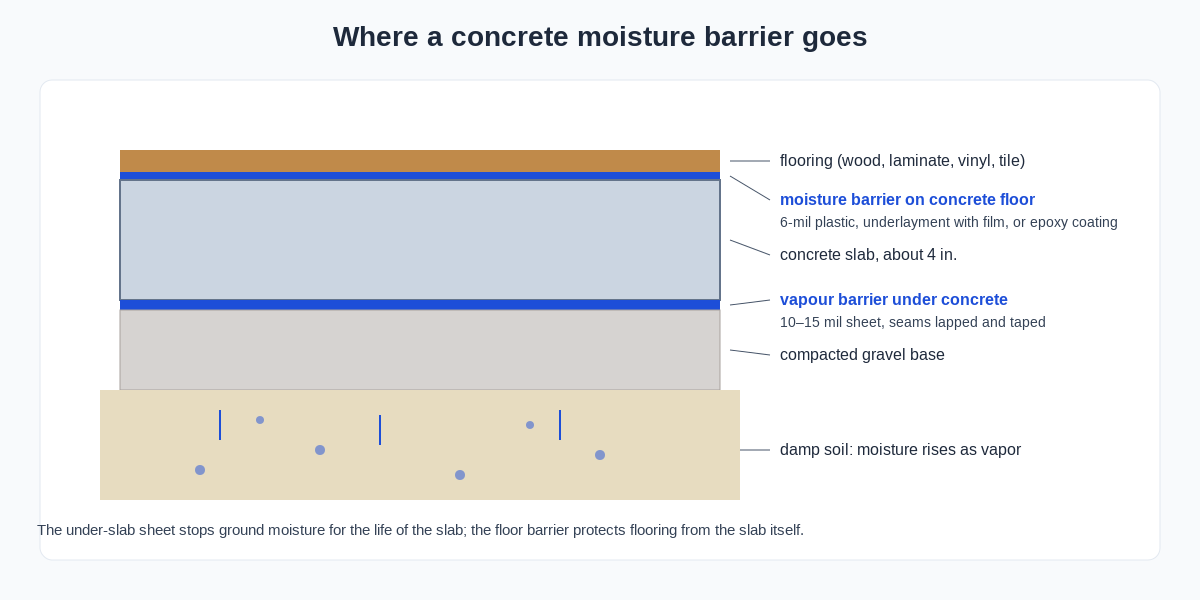
Quick Answer
A concrete moisture barrier is a layer that stops water vapor from moving through concrete. There are two kinds. A vapour barrier under concrete is a plastic sheet laid on the gravel before a slab is poured; the residential code requires at least 6-mil polyethylene under slabs of living spaces, and many builders now use 10- to 15-mil sheets that meet ASTM E1745, with seams lapped at least 6 inches and taped. A moisture barrier for concrete floor work goes on top of an existing slab under flooring, as 6-mil plastic, an underlayment with a built-in film, or an epoxy moisture coating. Before installing flooring, test the slab with a concrete moisture meter, an RH probe test or a calcium chloride test.
Concrete looks dry, but it is not waterproof. Ground moisture moves up through a slab as vapor every day, and a new slab holds a large amount of its own mixing water for months. Most of the time you never notice. Put a rug, laminate, hardwood, vinyl plank or glued flooring on that slab, though, and the moisture gets trapped underneath, leading to mold, musty smells, cupped boards, lifting tiles and failed adhesives. A concrete moisture barrier keeps that from happening.
This guide explains how moisture moves through concrete, when a slab needs a vapour barrier under it, what thickness and type to use, how to install it, which moisture barrier on concrete floor surfaces suits each kind of flooring, how to test moisture with a concrete moisture meter and other methods, and what it all costs.
How Moisture Moves Through Concrete
Concrete is full of tiny connected pores, which is why a concrete moisture barrier matters. Water can move through it in three ways:
- As liquid water under pressure, when groundwater rises against the slab or water pools at foundation walls.
- By capillary action, wicking up from damp soil through the pores, like a paper towel drawing up water.
- As water vapor, moving from the damp ground below toward the drier, warmer air above.
A concrete moisture barrier mainly stops vapor and capillary moisture. It is not a substitute for drainage, waterproofing or a sump pump where liquid water is the problem. In a basement that floods or has water coming through cracks, fix the water first; see mold on concrete for moisture causes and fixes.
Vapour Barrier Under Concrete Slabs
The best time to stop ground moisture is before the slab is poured, with a vapour barrier under concrete. A vapour barrier for concrete floor slabs is a continuous plastic sheet laid over the compacted base, under the concrete. Once the slab is poured, the sheet is there for the life of the building.
When a slab needs one
The International Residential Code requires a vapor retarder of at least 6-mil polyethylene, or another approved material, with joints lapped at least 6 inches, between the concrete floor slab and the base for slabs under living spaces. The code exempts slabs that do not need one, including:
- Garages, utility buildings and other unheated accessory structures.
- Unheated storage rooms under about 70 square feet and carports.
- Driveways, walks, patios and other flatwork not likely to be enclosed and heated later.
- Where approved based on local site conditions.
In practice, many builders put a vapour barrier under concrete in garages and workshops too, especially if they might be finished later, and it is wise under any shed or outbuilding used to store things that rust or mildew. See concrete pad for shed.
6-mil vs 10-mil vs 15-mil
| Material | Typical use | Notes |
|---|---|---|
| 6-mil polyethylene | Code minimum under residential slabs | Cheap, but tears easily during rebar and concrete placement |
| 10-mil polyethylene or polyolefin | Better residential and light commercial slabs | Tougher; many meet ASTM E1745 Class C or better |
| 15-mil Class A vapour barrier | Slabs with moisture-sensitive flooring, commercial work | Very low permeance, high puncture resistance; ASTM E1745 Class A |
ASTM E1745 is the standard for plastic water vapor retarders in contact with soil under concrete slabs. It sets three classes, A, B and C, based on tensile strength and puncture resistance, and requires a low water vapor permeance for all of them. Thin, generic 6-mil plastic often does not meet E1745 at all. The American Concrete Institute's guidance for slabs with moisture-sensitive flooring generally recommends a vapor retarder of at least 10 mils, and many flooring makers ask for one in their warranties.
You will hear both "vapor barrier" and "vapor retarder". Technically, a barrier lets almost no vapor through, while a retarder slows it. Under-slab sheets that meet E1745 are low enough in permeance that most people simply call them vapour barrier concrete sheets.
Where the sheet goes
For slabs that will get flooring, adhesives or coatings, the ACI guidance favors placing the vapour barrier directly under the concrete, on top of the compacted base. That keeps the most moisture out. Some designers place a layer of granular fill on top of the sheet to help the slab cure evenly and reduce curling, but that fill can trap water from rain or curing and feed moisture back into the slab. Follow the plans; for most homes, directly under the slab is standard.
How to Install a Vapour Barrier Under Concrete
- Prepare the base. Compact the gravel and remove sharp stones that could puncture the vapour barrier concrete sheet.
- Roll out the sheet with the long edges running the way the concrete will be placed, so the crew pushes concrete along the laps rather than against them.
- Lap the seams at least 6 inches and tape them with the tape the maker recommends.
- Turn the edges up the inside of footings or foundation walls to the top of the slab, or seal them to the walls.
- Seal penetrations. Wrap pipes, drains and conduits with boots or tape so there are no open holes.
- Protect it. Lay boards for wheelbarrows, set rebar chairs with wide bases or plates, and repair any tears with patches lapped 6 inches beyond the damage and taped.
- Pour and cure the slab normally. See how long concrete takes to cure.
Rebar and wire mesh sit on chairs above the sheet; see concrete rebar and concrete wire mesh.
Moisture Barrier for Concrete Floor Surfaces
Many slabs, especially in older houses and basements, have no vapour barrier under concrete, or one that was torn during construction. Before laying flooring on those slabs, or on any slab that tests high for moisture, add a moisture barrier on concrete floor surfaces that suits the flooring:
| Flooring | Common moisture barrier for concrete floor use |
|---|---|
| Floating laminate or engineered wood | 6-mil polyethylene sheet lapped 8 in. and taped, or underlayment with a built-in vapor film |
| Floating vinyl plank | Per maker; some require a 6-mil sheet, some have an attached pad |
| Glue-down wood or vinyl | Moisture-tolerant adhesive rated for the slab's tested moisture, or an epoxy moisture mitigation coating |
| Tile | Usually none needed on a sound slab; uncoupling or vapor-control membranes where moisture is high |
| Carpet | Moisture-resistant pad, or a subfloor system in damp basements |
| Finished basement subfloor | Dimpled plastic membrane panels or subfloor panels with a built-in air gap |
Always follow the flooring maker's instructions, which usually state the moisture limit, the test method and the required barrier. Using the wrong concrete moisture barrier, or none at all, can void the flooring warranty.
Epoxy moisture mitigation systems
For glue-down floors and commercial work over damp slabs, contractors grind the concrete and roll on a 100 percent solids epoxy moisture barrier for concrete, designed to block high vapor emissions. These systems are rated to specific moisture levels, often up to very high relative humidity, and cost much more than plastic sheet, but they let flooring go down on slabs that would otherwise fail.
Sealers and paints are not the same
Penetrating concrete sealers and ordinary floor paints reduce dusting and water absorption from the surface, but most are not designed as a concrete moisture barrier under flooring. Paint can blister and peel when vapor pushes up from below. See how to seal concrete and concrete paint for those products.
Testing: Concrete Moisture Meter and Other Methods
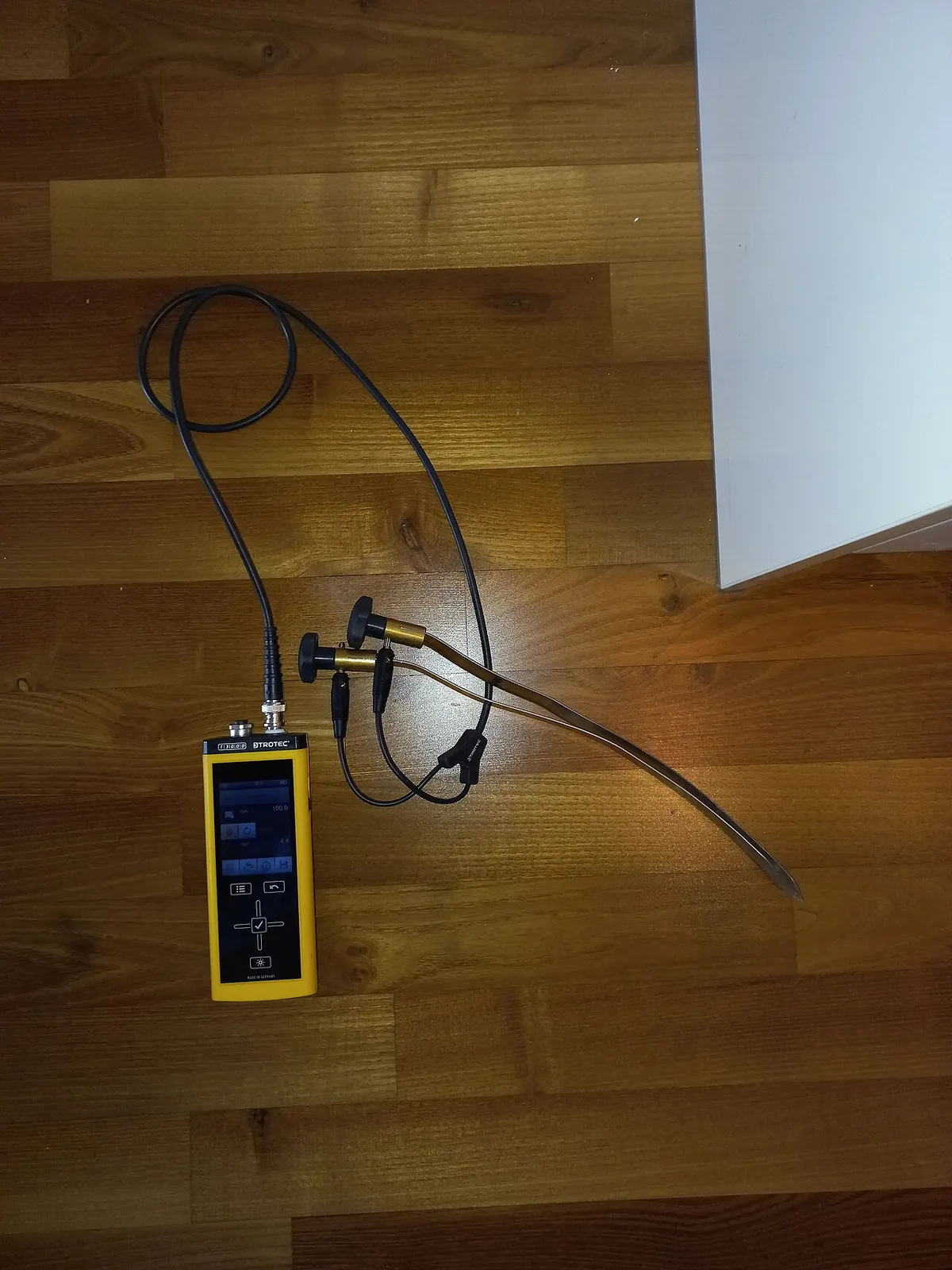
Photo: Asurnipal, Wikimedia Commons, CC BY-SA 4.0
Before flooring goes down over any concrete moisture barrier, you need to know how much moisture the slab holds or gives off. The main methods:
- Plastic sheet test (ASTM D4263). Tape an 18 × 18 inch square of clear plastic tightly to the slab and leave it at least 16 hours. Condensation under the plastic or a darkened slab means moisture is coming through. It is a simple yes-or-no check, not a number flooring makers accept.
- Concrete moisture meter (ASTM F2659). A handheld concrete moisture meter, usually a pinless type that reads the top inch or so of the slab, gives a quick relative reading. It is excellent for finding wet areas and comparing spots, but most flooring makers do not accept meter readings alone for warranty purposes.
- In-situ relative humidity test (ASTM F2170). Holes are drilled to 40 percent of the slab depth (20 percent if the slab dries from both sides), sensors are placed, and the RH is read after the hole equilibrates, typically 24 hours. Many flooring makers set limits around 75 to 85 percent RH, depending on the product.
- Calcium chloride test (ASTM F1869). A dish of calcium chloride is sealed under a dome on the cleaned slab for 60 to 72 hours, then weighed. Results are in pounds of moisture per 1,000 square feet per 24 hours; common limits are 3 to 5 pounds for many floors.
Choosing a moisture meter for concrete
A good moisture meter for concrete for homeowners is a pinless meter with a concrete mode, costing roughly $50 to $400. Contractors use professional pinless meters and RH probe kits that cost several hundred to over a thousand dollars. Pin meters made for wood do not read concrete accurately. Whichever you use, take many readings across the slab, near walls and in the middle, and on different days, and compare them to the flooring maker's limits and required test method.
How Long a New Slab Takes to Dry
A new 4-inch slab can take months to dry enough for moisture-sensitive flooring, even with a concrete floor vapour barrier under it. An old rule of thumb is about one month per inch of thickness under good drying conditions, but slabs poured with high water content, in cool or humid weather, or over a vapour barrier that keeps them from drying downward often take longer. Running the HVAC system, using dehumidifiers and keeping the building closed in helps. Never assume a slab is ready by its age; test it, and test again if the weather or the building conditions change.
Does Concrete Need to Breathe?
You will hear that concrete "needs to breathe" and that a concrete moisture barrier traps water in the slab. There is some truth in it, but it is mostly about the top surface. A slab with a vapour barrier under it can only dry upward, so a new slab poured over a barrier takes longer to dry, which is why testing before flooring matters. Once that construction moisture is gone, though, the barrier keeps new ground moisture from coming in, and the slab stays drier for good. The real risk is putting a non-breathable coating or flooring on top of a slab that is still wet, or that has no barrier below and keeps drawing moisture from the ground. In both cases the moisture collects under the finish. Test, choose the right barrier on the surface, or give the slab time to dry.
Basements and Older Slabs Without a Barrier
Many basements built before the 1980s and 1990s have no vapour barrier under the concrete. Signs of moisture include a white, powdery residue (efflorescence), dark damp patches, musty smells and rusty nail heads in floor tack strips. Steps that help:
- Fix outside drainage: gutters, downspout extensions and grading.
- Run a dehumidifier to keep basement relative humidity below about 50 to 60 percent.
- Seal cracks; see how to fix cracks in concrete.
- Use a moisture barrier on concrete floor surfaces under any new flooring, or a dimpled subfloor system.
- Choose moisture-tolerant flooring such as tile, sealed concrete or luxury vinyl plank rated for basements.
For the white residue, see efflorescence on concrete.
Crawlspaces: Vapour Barrier Over Soil
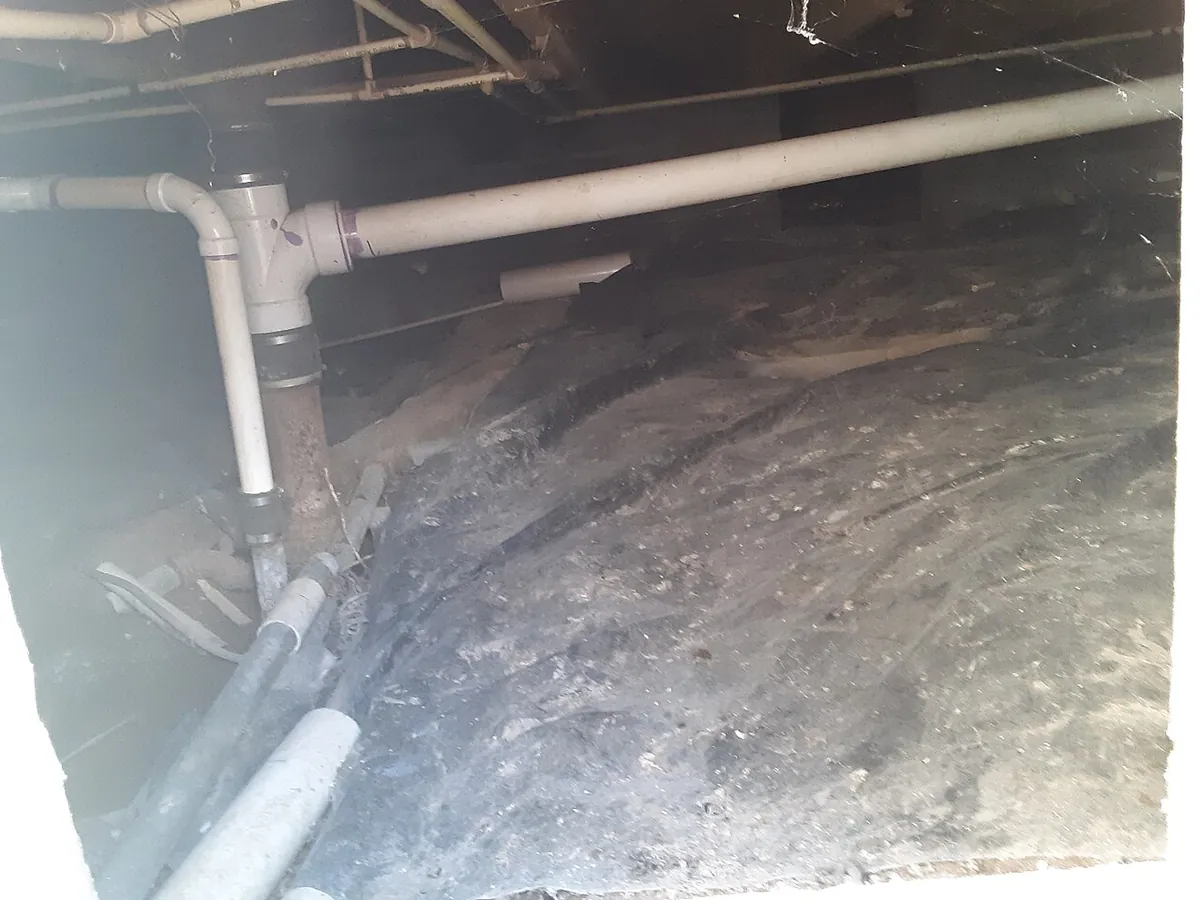
Photo: TradeCrawlspaces, Wikimedia Commons, CC BY-SA 4.0
Houses on crawlspaces face the same ground moisture, without a slab, so the moisture barrier goes on the soil instead of under concrete. Codes require a vapor retarder ground cover in many crawlspaces, and sealed crawlspaces use heavier sheets, often 10 to 20 mil, lapped, taped and run up the walls. Some builders pour a thin "rat slab" of concrete over the sheet to protect it. See concrete piers for pier and beam houses.
Concrete Floor Vapour Barrier in Garages, Workshops and Additions
Garages are exempt from the under-slab rule, so many garage slabs have no barrier. That is fine for parking cars, but if you later turn the garage into a bedroom, office or gym, the slab becomes a floor for living space, and moisture can ruin carpet, laminate or wood. Plan a concrete floor vapour barrier for the conversion: test the slab, then use a raised subfloor system, a sheet barrier under floating floors, or an epoxy moisture coating. If you are pouring a new garage or workshop slab you might finish someday, put a 10-mil or heavier vapour barrier under the concrete now; it costs little and keeps your options open.
For additions, match or exceed the barrier under the house's existing slab, and lap or seal the new sheet to the existing foundation where they meet. A new slab poured against an old one without a barrier at the joint can wick moisture into the new flooring along that edge.
Insulation and Radiant Heat Under Slabs
Heated slabs and slabs in cold climates often have rigid foam insulation under them, usually extruded or expanded polystyrene boards about 1 to 4 inches thick. The order of layers matters:
- Compacted gravel base at the bottom.
- Rigid foam insulation on the gravel, joints tight.
- Vapour barrier over the foam, directly under the concrete, lapped and taped.
- Radiant tubing tied to mesh or clipped to the foam, then the concrete slab.
Some foam boards come with a facing that acts as a vapor retarder, and some designers place the sheet under the foam to protect it; follow the radiant system maker and the plans. Either way, the slab should not sit directly on damp soil with no concrete moisture barrier, or the heat will drive moisture up into the floor finish.
Hardwood and Moisture-Sensitive Floors on Concrete
Solid hardwood is the flooring most sensitive to slab moisture. It is usually installed over a plywood subfloor that floats or is fastened over a moisture barrier for concrete floor use, or glued with a moisture-cure urethane adhesive that doubles as a membrane. Engineered wood is more stable and is often floated over a 6-mil sheet and foam pad, or glued down with a rated adhesive. Many wood flooring makers set limits such as 75 to 85 percent RH by ASTM F2170, or 3 pounds by calcium chloride test, and require you to keep the test records. Acclimate the flooring in the room with the HVAC running before installation.
Sealed, Stained and Polished Concrete Floors
If the concrete itself is the finished floor, moisture is less of a problem, because there is nothing to trap it. Polished concrete breathes, and penetrating sealers let vapor pass. Film-forming coatings like epoxy, urethane and some acrylic sealers can blister or turn white on a slab with high moisture and no barrier below. Test first, and choose a breathable sealer or a moisture-tolerant coating system on damp slabs. See concrete staining and types of concrete finishes.
Common Vapour Barrier Concrete Mistakes
- Using thin, cheap plastic that tears during the pour, leaving holes under the slab.
- Unlapped or untaped seams that let vapor through every few feet.
- Open penetrations around plumbing and conduits.
- Wheelbarrows and boots puncturing the sheet; lay planks and inspect before the pour.
- Sharp gravel poking through under rebar chairs.
- Laying flooring too soon on a new slab without testing.
- Relying on a moisture meter alone when the flooring warranty requires RH or calcium chloride tests.
- Treating a vapour barrier as waterproofing where liquid water or a high water table is the real problem.
Concrete Moisture Barrier Checklist by Project
- New house slab: 10- to 15-mil vapour barrier under concrete meeting ASTM E1745, lapped and taped, sealed at penetrations and edges.
- New garage you may finish later: at least a 10-mil sheet under the slab, even though code does not require it.
- Basement floor in an older house: test with a concrete moisture meter and a plastic sheet test; use a moisture barrier on concrete floor areas under any new flooring, or a dimpled subfloor.
- Laminate or floating floor on any slab: 6-mil sheet or underlayment with an attached film, as the flooring maker requires.
- Glue-down flooring: RH or calcium chloride tests, then a rated adhesive or epoxy moisture barrier for concrete if readings are high.
- Exposed or polished concrete: breathable sealer, no film barrier on top.
- Crawlspace: heavy sheet over the soil, lapped and run up the walls.
Match the concrete moisture barrier to the job: the sheet under a slab protects for decades, while a barrier on top of the floor protects only the flooring above it, so plan the under-slab barrier whenever you have the chance.
Moisture Barrier for Concrete in Commercial Buildings
Offices, schools, hospitals and stores face the same problems at a larger scale, and flooring failures from slab moisture are among the most common construction claims in the industry. Commercial specifications usually call for a Class A vapour barrier under concrete slabs on ground, RH testing at a set number of locations per thousand square feet, and epoxy mitigation if tests fail. Low water-cement ratio concrete, which dries faster, is often specified for slabs that must receive flooring on a tight schedule.
Concrete Moisture Barrier Cost
- 6-mil polyethylene: about $0.05 to $0.15 per square foot.
- 10-mil vapor retarder: about $0.10 to $0.30 per square foot.
- 15-mil Class A under-slab barrier: about $0.30 to $0.60 per square foot, plus tape and boots.
- Flooring underlayment with vapor film: about $0.25 to $1.00 per square foot.
- Epoxy moisture mitigation: about $3 to $7 per square foot installed, including grinding.
- Moisture testing by a pro: often $200 to $600 for a set of RH or calcium chloride tests on a home.
Even a premium vapour barrier under concrete adds only a few hundred dollars to a typical home slab, far less than replacing failed flooring. For slab prices, see concrete slab cost.
Frequently Asked Questions
Do I need a vapour barrier under concrete?
Under slabs for living spaces, yes; the residential code requires at least 6-mil polyethylene. Garages, driveways, patios and unheated outbuildings are exempt, but a barrier still helps if the space may be finished later.
How thick should a vapour barrier under a concrete slab be?
At least 6 mil by code, and 10 to 15 mil for better durability and for slabs that will get moisture-sensitive flooring.
Do I need a moisture barrier on a concrete floor before laminate?
Usually yes. Most laminate and engineered wood makers require a 6-mil plastic sheet or an underlayment with a built-in vapor film over concrete.
How do I test concrete for moisture?
Use a plastic sheet test for a quick check, a concrete moisture meter to find wet areas, and an RH probe test or calcium chloride test when the flooring maker requires numbers.
Is a concrete sealer a moisture barrier?
Not usually. Most sealers reduce surface absorption but do not stop vapor from below enough to protect flooring. Use a rated moisture barrier or epoxy system.
What is the best moisture meter for concrete?
For homeowners, a pinless concrete moisture meter with a concrete scale is the most practical for finding wet areas. For flooring warranties, use RH probes (ASTM F2170) or calcium chloride tests as the maker requires.
Can I put plastic under a concrete floor that is already poured?
Not under it, but you can put a moisture barrier on the concrete floor surface under new flooring, or use an epoxy moisture coating.
Sources
- International Code Council: 2021 IRC Section R506, concrete floors on ground and vapor retarders
- ASTM E1745: Plastic Water Vapor Retarders Used in Contact with Soil or Granular Fill under Concrete Slabs
- ASTM F2170: Relative Humidity in Concrete Floor Slabs Using in situ Probes
- American Concrete Institute: ACI 302.2R guide for concrete slabs that receive moisture-sensitive flooring
Related Guides
- Concrete pad for shed — shed slab size, thickness, cost and pouring
- Is concrete waterproof? — porosity, waterproof concrete and sealants
- Concrete floors in homes — pros, cons, finishes and costs indoors
- Concrete splash blocks — downspout splash blocks and drainage
- Concrete storm shelters — storm cellars and tornado shelters
- Concrete nailer — powder, gas and battery tools
- How to lay tile on concrete — floors, patios and grouting
- Heated concrete floor — hydronic and electric floor heating
- Concrete pads — sheds, AC units, hot tubs, carports
- Chicken coop concrete floor — slabs, bedding and predators
- Concrete floor coverings — flooring options over slabs
- Gravel base for concrete — best base material, thickness, compaction and quantities