
Cold Joint Concrete: What a Cold Joint Is, Why It Happens and How to Fix It
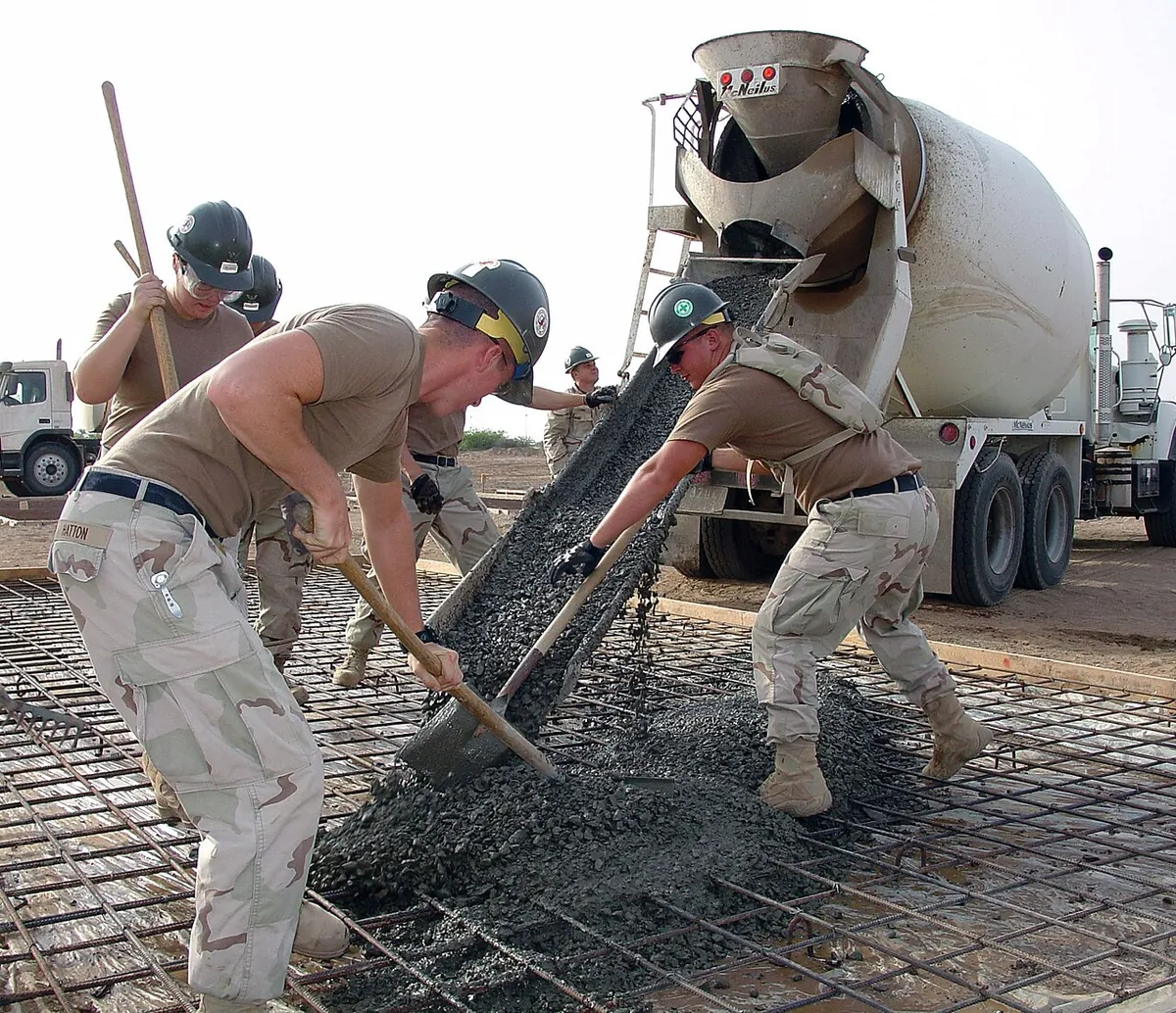
Photo: U.S. Navy, Wikimedia Commons, public domain.
Quick Answer
A cold joint in concrete is an unplanned seam that forms when fresh concrete is placed against concrete that has already started to set, so the two pours do not fully blend together. It usually happens because of a delay during the pour: a late truck, a pump breakdown, too few workers, or hot weather that makes the first concrete stiffen faster. A concrete cold joint can show as a visible line, may be weaker than the surrounding concrete, and can leak water or crack along the seam. It is different from a construction joint, which is planned, prepared and often reinforced. Cold joints are prevented by good scheduling and by vibrating new concrete into the previous layer while it is still soft. Repairs range from sealing a cosmetic line to injection for leaking or structural cold joints.
Concrete has a limited working time. Once a load is placed, it begins to stiffen and set, slowly at first and faster in warm weather. If the next load arrives in time, the crew can vibrate it into the first one and the two become one solid mass. If the next load is late, the first concrete may have stiffened too much to mix with the new concrete. The result is a cold joint: a boundary inside the concrete where the two pours touch but do not truly bond.
This guide explains what is a cold joint in concrete, why concrete cold joints form, how they differ from planned joints, when a cold joint is a real problem, how contractors prevent them, and how to repair them in slabs, walls and foundations.
What Is a Cold Joint in Concrete?
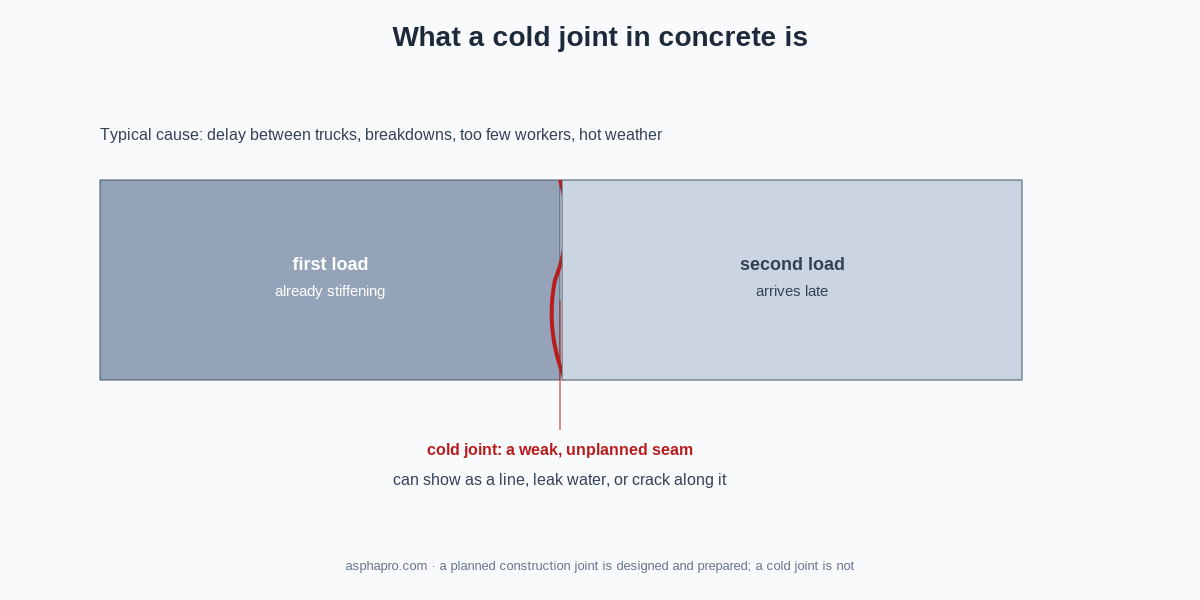
The concrete industry defines a cold joint, in general terms, as a joint or discontinuity caused by a delay in placing concrete long enough that the new concrete cannot unite with the concrete already in place. In plain terms, the first batch has gone past the point where vibration can make it soft and plastic again, so the second batch sits against it instead of blending in.
Concrete cold joints can form:
- Vertically, across a slab or wall, where one truckload ended and the next one started much later.
- Horizontally, in walls and columns poured in layers, where an upper layer was placed on a lower layer that had already set.
- Around corners and openings, where concrete flowing from two directions meets after a delay.
The American Concrete Institute's guide to the visible effects of consolidation, ACI 309.2R, lists cold joints among the most serious defects caused by poor placing and consolidation, alongside honeycombing. See our guide to honeycombing concrete for that defect.
Cold Joint vs Construction Joint vs Control Joint
Concrete has several kinds of joints, and only one of them is a mistake:
| Joint | Planned? | Purpose | How it is made |
|---|---|---|---|
| Cold joint | No | None; it is a defect from a delay | Happens when fresh concrete meets set concrete |
| Construction joint | Yes | Stopping point between planned pours | Formed edge, often with dowels, keyway, waterstop; surface prepared before the next pour |
| Control (contraction) joint | Yes | Make shrinkage cracks happen in a straight line | Sawn or tooled groove in a slab |
| Expansion / isolation joint | Yes | Let slabs move against walls, columns and other slabs | Compressible filler and sealant |
The key difference between a cold joint and a construction joint is preparation. A construction joint is placed where the designer allows it, formed straight, and treated so the next pour bonds: the old surface is cleaned and roughened, reinforcement continues through it, and in walls that must stay dry a waterstop is built in. A cold joint has none of that, and it can end up in the wrong place, at an angle, and with poor bond.
What Causes Concrete Cold Joints?
- Truck delays. Traffic, plant problems or poor scheduling leave a gap between loads long enough for the first load to stiffen.
- Equipment breakdowns. A pump or conveyor that stops mid-pour can stall placement for an hour or more.
- Too few workers. A crew that cannot place, vibrate and finish fast enough falls behind the setting concrete.
- Hot weather. High temperatures speed up setting, shrinking the time available before the next layer must go in.
- Layers that are too thick or too slow. In tall walls, placing a deep layer and then waiting too long before the next one lets the lower layer set.
- Poor vibration between layers. If the vibrator does not reach into the layer below, a weak line can form even with short delays.
- Weather stoppages. Sudden rain or wind can halt a pour.
Are Cold Joints a Problem?
It depends on where the cold joint is and how bad the bond is.
Cosmetic
On a driveway, patio or sidewalk, a cold joint may only show as a line or slight color change, sometimes with a small step in the surface where the finishers had to work the new concrete up to the old edge. If the slab is well supported and the seam is tight, it often behaves much like a control joint and may never be a problem beyond appearance.
Water leaks
In basement walls, foundation walls, tanks, pools and retaining walls, a cold joint can be a path for water. Many basement leaks show up as a horizontal line partway up the wall, where one layer of the pour sat too long before the next one was placed. The leak may appear only during heavy rain or snowmelt, when the soil outside is saturated and water pressure against the wall is highest.
Cracking
A concrete cold joint is a weak plane, so shrinkage and temperature cracks often follow it, sometimes within the first few weeks after the pour as the slab dries and shrinks. In slabs, a cold joint in the wrong place can crack and open up instead of a planned control joint.
Structural
In beams, columns, slabs and walls that carry load, a poorly bonded cold joint can reduce strength and shear capacity, especially if it is in a place where the designer did not expect a joint. Structural cold joints should be evaluated by the project engineer.
How to Prevent Cold Joints
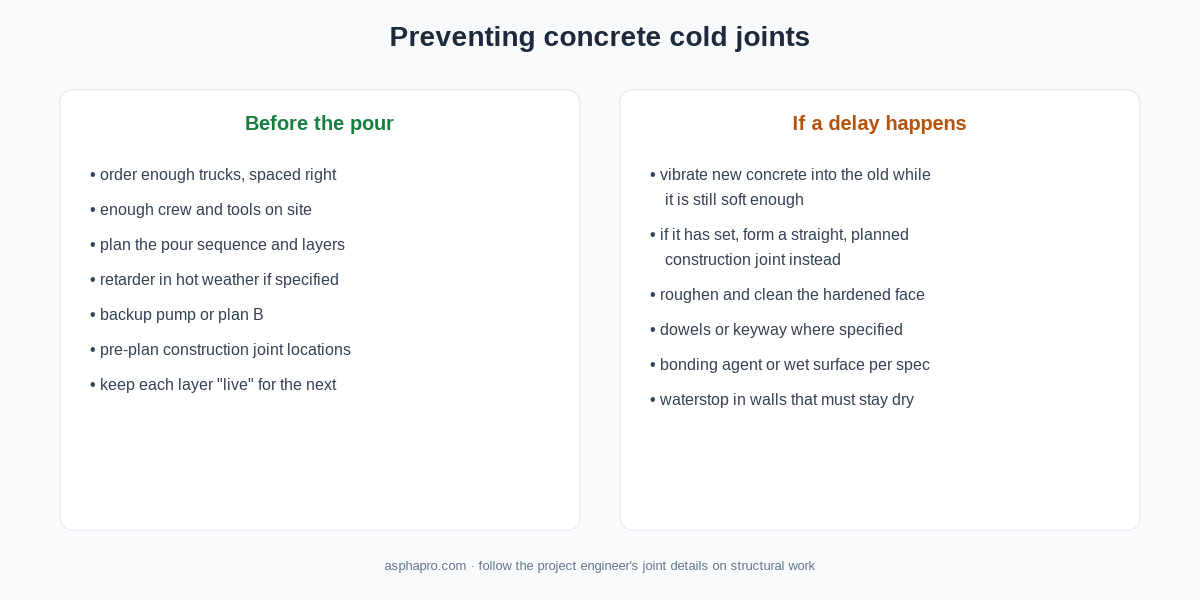
Plan the pour
- Order enough concrete and space the trucks so there is no long wait between loads, based on how fast the crew can place and finish.
- Have enough people and tools, including spare vibrators.
- Plan the sequence for walls and large slabs so each new layer is placed while the previous one is still workable.
- Plan construction joints ahead of time with the engineer, so if the pour must stop, it stops at a designed location.
- Have a backup for the pump or a second supplier for large pours.
On pour day
- Keep layers "live". Place each layer so the next one goes on before the earlier one sets, and vibrate through the new layer into the top of the old one so they mix.
- Use the vibrator test. A common field rule is that if a running vibrator still sinks into the previous layer under its own weight and makes it plastic again, the layers can still be joined. If it does not, a cold joint is likely.
- Use set retarders in hot weather when the mix design allows, to extend working time.
- Protect from sun and wind on hot days to slow surface stiffening.
If a delay happens anyway
If the concrete in place has stiffened too much to join, the best option is usually to stop at a straight, planned construction joint rather than to keep adding concrete to a sloping, stiffened face. Form a clean edge, and before the next pour, prepare the joint: remove weak surface material (laitance), roughen and clean the surface, wet it or apply the bonding agent the engineer specifies, and continue with good vibration.
How to Repair a Cold Joint in Concrete
Cosmetic cold joints in slabs
If a cold joint in a driveway or patio is tight and not moving, you can leave it or treat it like a control joint: clean it and seal it with a flexible joint sealant so water does not get under the slab. If it has opened into a crack, seal it the same way you would any crack. See how to repair concrete cracks.
Leaking cold joints in walls
Leaking concrete cold joints in basement and foundation walls are commonly repaired by injection. Polyurethane injection is popular for leaks because it reacts with water and stays flexible. Exterior waterproofing over the joint, where you can dig down, gives a more complete fix. On new walls, the best defense is a waterstop and good joint preparation during construction.
Structural cold joints
When a cold joint is in a structural member, the engineer may call for epoxy injection to bond the two sides together, drilled-in dowels, or other reinforcement. Epoxy injection is used for dry, stable cold joints where restoring bond matters. Our guide to epoxy concrete repair explains how injection works.
Cold joints with honeycomb
Cold joints often come with poorly consolidated, honeycombed concrete next to them. Those areas need to be chipped out to sound concrete and patched, then the joint sealed or injected. See concrete patching compound.
What Cold Joint Repair Costs
- Sealing a cold joint in a slab: a few dollars per foot DIY; professional crack and joint sealing typically about $0.50 to $3 per linear foot with minimum charges.
- Polyurethane or epoxy injection: commonly about $400 to $1,500 per joint or crack for a typical residential wall, according to published cost guides.
- Exterior waterproofing: much more, priced per project because of excavation.
- Structural repairs: priced after an engineering evaluation.
See our concrete repair cost guide for more detail.
Cold Joints in Common Projects
Driveways and patios
Residential slabs are usually poured in one continuous operation, but a late second truck can leave a cold joint across the slab. Large patios and long driveways that need two or three trucks are the most at risk, especially on hot summer mornings. Ask the contractor to stop at a joint line if the second truck will be very late, and seal the joint afterward.
Basement and foundation walls
Walls are often poured in lifts around the perimeter. Delays can leave horizontal cold joints that later leak. Good scheduling, waterstops at planned joints and exterior waterproofing protect against this.
Footings
Footings poured in sections sometimes have cold joints where one section ended, for example when a long footing is poured from bagged concrete over a weekend. Most are not a problem if the reinforcement continues through them, but the engineer or inspector should know about any unplanned joints.
Pools and tanks
For water-holding structures such as pools, cisterns and tanks, cold joints are a major leak risk, because the water pressure is constant. Specifications usually require planned joints with waterstops and careful placement.
Cold Joint Concrete in DIY Bagged Pours
Homeowners who mix bagged concrete one batch at a time run a high risk of cold joint concrete. Mixing 40 or 50 bags by hand or with a small mixer takes hours, and on a warm day the first batches in the form can start to set long before the last ones go in. The result is a slab or footing made of several pours stuck together, with weak seams between them.
To avoid it on DIY projects:
- Get help. Have one or two people mixing while others place and finish.
- Use a mixer rather than mixing by hand for anything over a few bags.
- Work in the cool part of the day, and keep bags and water out of the sun.
- Place each batch against the last while it is still soft, and rod or vibrate them together.
- Plan a stopping point at a form board or joint line if you cannot finish in one session.
- Order ready-mix for anything over about a yard; see how many bags of concrete are in a yard for the math.
How to Spot a Cold Joint After the Forms Come Off
Cold joints are easiest to find right after stripping forms or once a slab has cured:
- A line or seam across a wall or slab that does not match any planned joint, often at an angle or wavy.
- A color or texture change above and below the line, because the two pours finished differently.
- Honeycomb or voids along the line, where the new concrete did not fill against the old.
- Dampness or efflorescence along the line on a basement wall, where water is moving through. See efflorescence in concrete.
- A crack that follows the line months later.
Photograph and measure any suspected concrete cold joints and tell the contractor or engineer, especially on foundations and structural elements.
Cold Joints in Hot and Cold Weather
Weather changes how quickly cold joint concrete can form. In hot weather, concrete sets faster, so the window for placing the next layer is shorter; crews use retarders, cooler mix water and quicker truck spacing to keep up. In cold weather, concrete sets more slowly, which gives more time between layers, but delays in cold weather bring their own problems: the surface may need protection from freezing, and the concrete may stay soft for a long time. Our guides to pouring concrete in cold weather and pouring concrete in the rain explain other weather risks on pour day.
How Engineers Plan Joints So Cold Joints Do Not Happen
On engineered projects, the drawings show where construction joints are allowed. Those joints are detailed so that, when a pour must stop, the next pour bonds well:
- Reinforcement continues through the joint, so the joint carries load.
- A keyway or roughened surface helps transfer shear across the joint.
- Dowels may tie slabs together across joints.
- Waterstops, strips of PVC, rubber or swelling material, are cast into walls and tanks to block water at the joint.
- Joint preparation before the next pour removes laitance and loose material and leaves a clean, rough surface.
When a pour has to stop unexpectedly, the crew's goal is to turn what would be a cold joint into one of these planned construction joints, by forming a clean bulkhead at an allowed location.
Testing a Suspected Cold Joint
For important elements, engineers may test a suspected concrete cold joint by taking cores across it to see whether the two pours bonded, or by using non-destructive methods such as ultrasonic testing. A core that breaks cleanly along the joint shows poor bond; one that breaks through the concrete on either side shows the joint is sound. The results guide whether the joint needs injection, dowels or other repairs.
Questions to Ask Your Contractor About Cold Joints
- How many trucks are scheduled, and how far apart?
- How many people will be placing and finishing?
- What happens if a truck is late or the pump breaks down?
- Where will you stop if the pour has to be interrupted?
- For walls: will there be waterstops at planned joints?
- Will you use a retarder in hot weather?
Good answers show the contractor has planned for delays, which is the best protection against a cold joint in concrete on your project.
Cold Joint Concrete vs Cracks: How to Tell Them Apart
A cold joint and a crack can look alike once the concrete has cured, but they start differently. A crack forms after the concrete has hardened, from shrinkage, settlement or load, and usually runs as a thin, jagged line. A cold joint forms during the pour, at the boundary between two placements, and often shows a change in color, texture or finish on each side, sometimes with a slight ridge or step where one pour ended. On walls, cold joints are often roughly horizontal and follow the level where a layer stopped. Of course, a cold joint can also crack open later, so the two often end up together. Either way, the treatment depends on whether the line is leaking, moving or affecting a structural member.
A Worked Example: Late Truck on a Driveway Pour
A crew is pouring a 20 × 40 foot driveway that needs about 13 yards of concrete, delivered in two trucks. The first truck arrives at 7:30 a.m. on a warm day, and the crew places and screeds it across the garage end. The second truck is stuck in traffic and arrives at 9:15.
- The risk: by the time the second load arrives, the edge of the first pour has been sitting for well over an hour in warm weather and may have stiffened. Placing the new concrete against it without preparation would create cold joint concrete in the middle of the driveway, likely at an angle.
- The better choice: when it became clear the truck would be late, the crew sets a straight form board at the nearest planned control joint location, finishes the first section to that line, and treats it as a construction joint, with dowels if the plan calls for them.
- When the second truck arrives: the crew removes the board, places the new concrete against the clean, straight edge, consolidates it well, and finishes it to match.
- Afterward: the joint is sealed with a flexible sealant like the other control joints.
The result is a joint that looks planned and behaves like a control joint, instead of a crooked cold joint that may crack and hold water.
Cold Joint Concrete Checklist
- Truck schedule confirmed with the plant the day before the pour.
- Enough crew and working vibrators on site.
- Planned stopping points marked in case of delays.
- Retarder or hot-weather plan if temperatures will be high.
- Form boards and stakes ready to create a construction joint if needed.
- Waterstops in place at planned wall joints.
- After the pour, any unplanned seams photographed and reported.
- Leaking or structural concrete cold joints repaired by injection or as the engineer specifies.
Do Cold Joints Need to Be Sealed?
On outdoor slabs, yes, in most cases. A cold joint acts like an open joint or crack: water and dirt get in, and in freeze-thaw climates the edges can spall. Cleaning it and sealing it with a flexible sealant, as you would a control joint, protects the slab. On interior slabs that will be covered with flooring, a cold joint may need a crack isolation membrane under tile. On walls, sealing from the inside alone often does not stop a leak for long, because water pressure from outside pushes through; injection or exterior waterproofing works better.
Common Myths About Cold Joints
- "Any joint between two pours is a cold joint." No. A planned, prepared construction joint is not a cold joint, even if the second pour is days later.
- "Adding water to the first load keeps it workable." Adding water weakens the concrete and does not prevent a cold joint; retarders and good scheduling do.
- "A bonding agent fixes any cold joint." Bonding agents help at prepared construction joints, but they cannot rescue a poorly placed seam inside a structural member.
- "Cold joints always leak." Many tight cold joints in slabs never cause problems. In walls they are a common leak path, but not every one leaks.
- "You can always see a cold joint." Some are hidden inside the concrete or under a finish, and only show up later as a crack or damp line.
Understanding these points helps homeowners talk with contractors about cold joint concrete without assuming the worst, or the best, about every seam.
Frequently Asked Questions
What is a cold joint in concrete?
It is an unplanned seam formed when fresh concrete is placed against concrete that has already begun to set, so the two do not fully bond together.
Is a concrete cold joint a problem?
On slabs it is often cosmetic. In walls it can leak water, and in structural members it can reduce strength. It depends on location and bond quality.
How long before a cold joint forms?
There is no single time; it depends on temperature, the mix and admixtures. In hot weather it can happen much faster. If a running vibrator no longer sinks into the earlier concrete and makes it plastic again, a cold joint is likely.
How do you fix concrete cold joints that leak?
Usually with polyurethane injection from the inside, or exterior waterproofing over the joint. Structural cold joints may get epoxy injection or other repairs specified by an engineer.
What is the difference between a cold joint and a construction joint?
A construction joint is planned, formed and prepared so the next pour bonds, often with dowels and a waterstop. A cold joint is an unplanned result of a delay.
Sources
- American Concrete Institute: ACI 309.2R-15, Identification and Control of Visible Effects of Consolidation on Formed Concrete Surfaces (preview)
- American Concrete Institute: ACI 306R-16, Guide to Cold Weather Concreting (preview)
- U.S. General Services Administration: Types of Cracks in Concrete and Typical Causes
- HomeGuide: Cracked Slab Foundation Repair Cost
Related Guides
- Honeycombing concrete — causes, how serious it is and repair
- Efflorescence in concrete — what the white powder is and how to remove it
- Precast concrete walls vs cast in place — wall panels, tilt-up and costs
- Is concrete waterproof? — porosity, waterproof concrete and sealants
- Sugar in concrete — how sugar delays or stops setting
- Concrete vibrator — consolidating walls, footings and columns
- Concrete retaining walls — poured, precast and bag walls
- Concrete slurry — bonding slurry, flowable fill and cutting slurry
- Concrete keyways — footing keyways and keyed joints
- Concrete wall crack repair — injection, sealants and when cracks are structural