
Concrete Worker: What the Job Involves, Pay, Training and Career Path
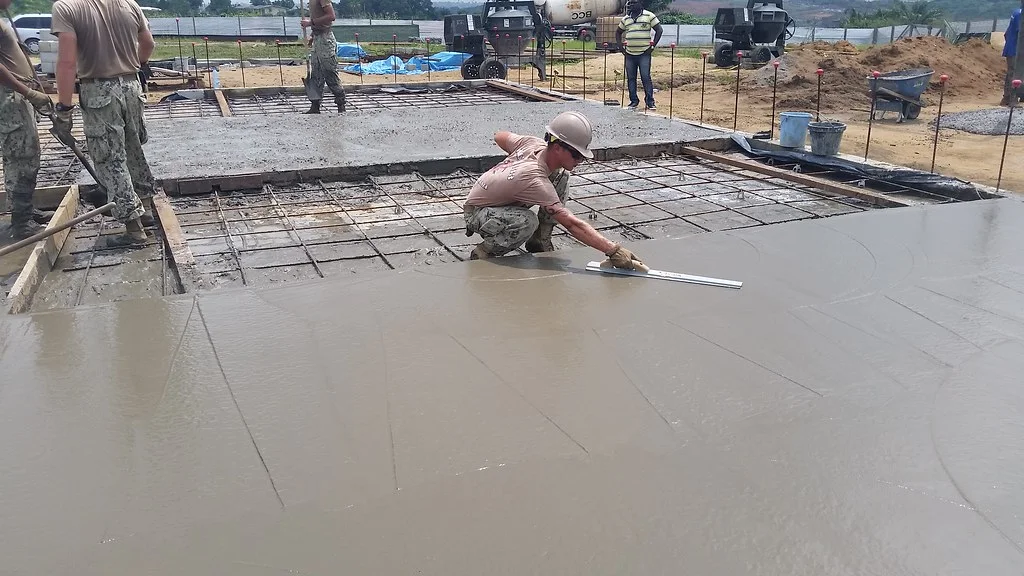
Photo: CNE CNA C6F (U.S. Navy), Flickr, Public Domain Mark
Quick Answer
A concrete worker places, spreads, levels, finishes and cures concrete for slabs, driveways, sidewalks, foundations, walls and structures. Skilled concrete workers are called cement masons and concrete finishers; others work as concrete laborers, form setters, pump operators or rebar workers. According to the U.S. Bureau of Labor Statistics, cement masons and concrete finishers earned a median of $54,660 a year in May 2024, and about 206,700 people held these jobs. No degree is required: most concrete workers learn on the job or through a 2 to 3 year paid apprenticeship. The work is physically demanding and outdoors, with hazards such as cement burns, silica dust, heavy lifting and heat, but it offers steady demand, overtime and a clear path to foreman or running your own concrete business.
Every sidewalk, driveway, basement floor, parking garage and bridge deck was placed and finished by a concrete worker. It is one of the oldest building trades and one of the most essential. The photo above shows a concrete worker in action: kneeling on a board over a freshly placed slab to float the surface smooth while the rest of the crew places concrete over the reinforcement behind them. Timing, teamwork and skill decide whether that slab ends up flat, strong and good looking.
This guide explains what a concrete worker does day to day, the different concrete jobs, how much concrete workers earn, the skills and tools involved, how to get training, the main safety hazards, and how a concrete worker's career can grow.
What Does a Concrete Worker Do?
A concrete worker's duties change with every stage of a pour. On a typical slab or flatwork job, a concrete worker will:
Prepare the site. Grade and compact the base, set forms and stakes to the right elevation, place vapor barriers, and install reinforcement such as rebar, wire mesh or dowels. See rebar in concrete.
Place the concrete. Direct the ready-mix truck chute or pump hose, and spread the concrete with shovels and come-alongs so it fills the forms evenly.
Consolidate it. Use a vibrator to remove air pockets, especially in walls, footings and around reinforcement. See concrete vibrator.
Screed and float. Strike off the surface with a straightedge or power screed, then smooth it with a bull float to bring up paste and level ridges. See concrete bull float.
Finish. Once bleed water is gone, edge the slab, cut or tool joints, and trowel or broom the surface to the required finish, by hand or with a power trowel.
Cure and protect. Apply curing compound, wet coverings or plastic, protect the concrete from rain, heat or frost, and cut control joints at the right time.
Strip and clean. Remove forms, clean tools and equipment, and prepare for the next pour.
On structural work, a concrete worker also builds and braces wall and column forms, places concrete at heights, and patches and rubs finished walls after the forms come off.
Types of Concrete Worker Jobs
Cement mason and concrete finisher. The skilled trade. Cement masons specialize in finishing: floating, troweling, edging, jointing, decorative finishes and repairs. They read plans, judge the setting time and decide when the slab is ready for each step.
Concrete laborer. An entry-level concrete worker who shovels and rakes concrete, carries materials, runs vibrators and helps the finishers. Many concrete workers start here.
Form setter or form carpenter. Builds, sets and strips the forms that shape footings, walls, columns, stairs and curbs. See concrete formwork.
Rebar worker (ironworker). Cuts, bends, places and ties reinforcing steel.
Concrete pump operator. Runs a boom or line pump to deliver concrete to the point of placement. See concrete pump truck cost.
Ready-mix driver. Drives the mixer truck from the batch plant to the job.
Decorative concrete worker. Specializes in stamped, stained, polished and exposed-aggregate concrete. See stamped concrete patterns.
Concrete cutting and coring operator. Saws and drills existing concrete for openings and repairs.
Concrete testing technician. Samples and tests fresh concrete on site, usually for an independent laboratory.
How Much Does a Concrete Worker Make?
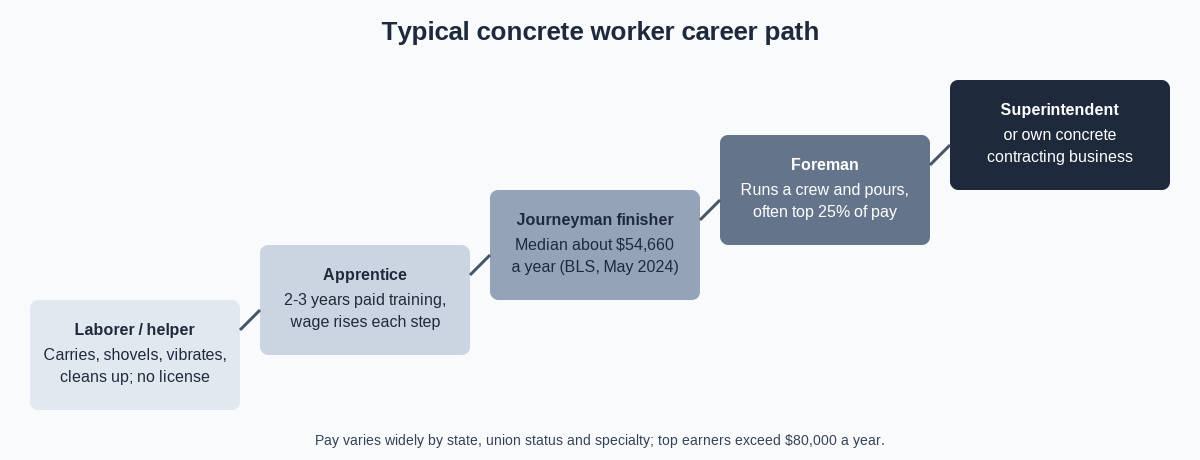
According to the U.S. Bureau of Labor Statistics, the median annual wage for cement masons and concrete finishers was $54,660 in May 2024, meaning half earned more and half earned less. In May 2023 the median was $50,720 a year, or about $24.38 an hour, and the top 10 percent earned more than about $83,580. Pay depends heavily on:
Location. Concrete workers in large metro areas and high-cost states, such as parts of the Northeast, West Coast, Hawaii and Alaska, earn well above the national median.
Union membership. Union cement masons, represented by the Operative Plasterers' and Cement Masons' International Association, and union concrete laborers, represented by the Laborers' International Union of North America, often earn higher hourly rates plus health and pension benefits.
Type of work. Commercial, highway and public projects, especially those paying prevailing wages, typically pay more than residential flatwork. See commercial concrete.
Skill and role. Experienced finishers, decorative specialists and foremen earn more than laborers and apprentices.
Overtime. Concrete pours often start before dawn and cannot stop once they begin, so concrete workers frequently earn overtime, especially in busy summer months.
Entry-level concrete laborers generally start below the finisher median, and apprentices usually start at around 40 to 60 percent of the journeyman rate, rising at each step of the program.
Job Outlook for Concrete Workers
The BLS projects employment of cement masons and concrete finishers to grow about 2 percent from 2024 to 2034, from about 206,700 to 210,400 jobs. That is slower than average growth, but many openings still arise every year as concrete workers retire or leave the trade, and the industry widely reports a shortage of skilled finishers. Infrastructure spending on roads, bridges and water systems, data centers, warehouses and housing all keep concrete workers in demand. Work is seasonal in cold climates, where winter brings fewer pours, but it is busy for most of the year in warm regions.
Skills a Concrete Worker Needs
Physical stamina and strength. Concrete work means long hours on your feet and knees, lifting 50 to 80 pound bags, carrying forms and rebar, and working in heat and cold.
Timing and judgment. Knowing when concrete is ready to float, trowel, edge and cut is the core skill of a concrete finisher. It changes with temperature, wind, sun and mix.
Hand and tool skills. Using floats, trowels, edgers, groovers and power equipment smoothly to produce a flat, even finish.
Math and layout. Measuring, calculating volumes and slopes, setting grades, and reading plans.
Teamwork. A pour is a team effort with strict timing, so concrete workers must communicate and work together under pressure.
Attention to detail. Small mistakes in forms, grades or finish become permanent once concrete hardens.
Tools Concrete Workers Use
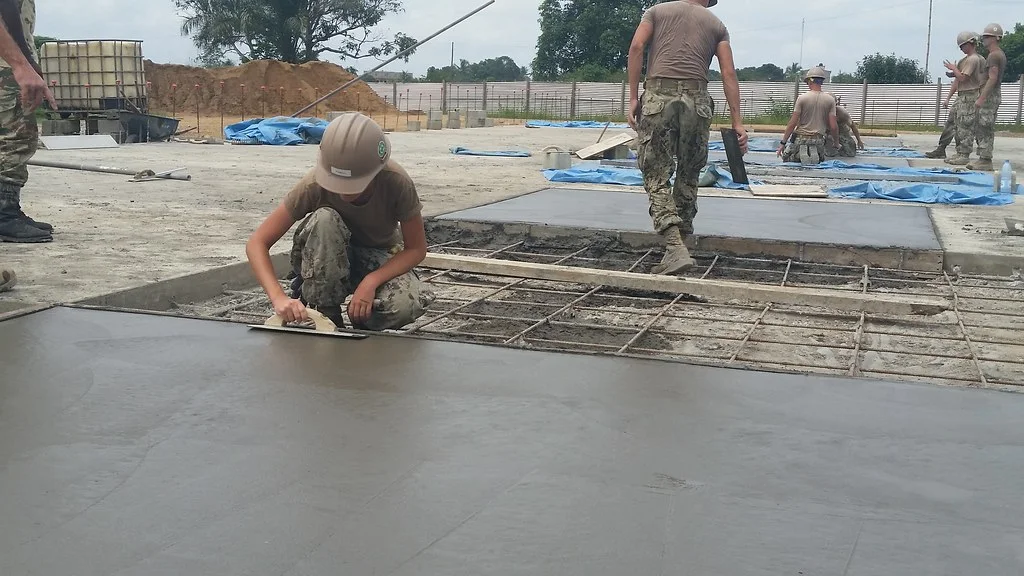
Photo: CNE CNA C6F (U.S. Navy), Flickr, Public Domain Mark
The photo above shows a concrete worker hand troweling the edge of a freshly placed slab, with the reinforcement for the next section in the foreground. Common tools of the trade include:
Hand tools: square-point shovels, concrete rakes and come-alongs, magnesium and wood hand floats, steel finishing trowels, edgers, groovers, knee boards, brooms and stamps. See concrete finishing tools and concrete trowel.
Screeds and floats: straightedges, vibrating screeds, laser screeds on large jobs, bull floats and fresno trowels.
Power equipment: walk-behind and ride-on power trowels, internal vibrators, concrete saws, mixers, plate compactors, and concrete buggies.
Layout tools: levels, transits and laser levels, string lines, tape measures and chalk lines.
Protective gear: waterproof gloves, rubber boots, knee pads, eye protection, hard hats, hearing protection and respirators.
Training, Apprenticeships and Certifications
Most concrete workers need no formal education credential, although a high school diploma or equivalent helps and is required by many apprenticeship programs. There are three main ways to become a concrete worker:
On-the-job training. Start as a laborer with a concrete contractor and learn from experienced finishers. This is the most common path in residential concrete.
Apprenticeship. Union and non-union contractor associations run cement mason apprenticeships, usually 2 to 3 years, combining paid work with classroom training in blueprint reading, math, safety, concrete materials and finishing techniques. Apprentices earn while they learn, with raises as they progress.
Trade school. Some community colleges and technical schools offer construction or concrete programs that teach basics and safety before entering the field.
Certifications that help a concrete worker stand out include the American Concrete Institute's Concrete Flatwork Finisher and Technician certifications, ACI Concrete Field Testing Technician Grade I, OSHA 10-hour or 30-hour construction safety cards, and certifications for decorative concrete products, pump operation and forklift or equipment use.
Concrete Worker Safety Hazards
Concrete work carries real health risks. The main hazards for every concrete worker are:
Cement burns. Wet concrete is strongly alkaline, with a pH around 12 to 13. Prolonged skin contact causes chemical burns that may not hurt until the damage is done, especially when concrete gets inside boots or gloves or soaks through knees. Wear waterproof gloves, boots, long pants and knee pads, and wash skin promptly. See can concrete burn.
Silica dust. Cutting, grinding, drilling and breaking concrete releases respirable crystalline silica, which causes silicosis and lung cancer. OSHA's silica standard requires water, vacuums and respirators for many tasks. See concrete dust.
Musculoskeletal injuries. Lifting, kneeling and bending damage backs, knees and shoulders over time.
Heat and cold stress. Concrete workers often work in full sun on hot slabs or in winter conditions.
Struck-by and caught-in. Pump booms, mixer trucks, forms and equipment cause serious injuries; formwork collapses and trench work are also dangerous.
Falls. Elevated decks, walls and stairs require fall protection.
Noise and vibration. Saws, vibrators and power trowels cause hearing loss and hand-arm vibration problems.
Concrete Worker Career Path
As the diagram earlier shows, a concrete worker can move up quickly with skill and reliability. A typical path starts as a laborer or helper, then apprentice, then journeyman cement mason or finisher. Strong finishers become crew leaders and foremen who run pours, schedule crews and deal with general contractors and inspectors. From there, concrete workers can become superintendents or estimators for larger contractors, specialize in high-paying niches such as decorative or polished concrete, or start their own concrete contracting business. Many small concrete companies were founded by former finishers. Running your own business requires licensing in many states, insurance, equipment, bidding skills and the ability to manage cash flow.
A Day in the Life of a Concrete Worker
A concrete worker's day often starts before sunrise, especially in summer, because concrete sets faster in the afternoon heat. A typical pour day for a residential concrete worker might look like this:
5:30 a.m. The crew meets at the shop, loads tools, and drives to the job. The foreman checks the forms, grades and reinforcement one last time.
7:00 a.m. The first ready-mix truck arrives. Concrete workers guide the chute, shovel and rake the concrete into place, and run the vibrator along the forms.
8:00 a.m. Screeding and bull floating follow right behind the placement. One concrete worker checks grades while others keep the concrete moving.
9:00 to 11:00 a.m. As the bleed water disappears, finishers edge, joint and trowel the slab, or broom it for an exterior finish. Experienced concrete workers watch the surface constantly to judge each step.
Noon. The slab is finished and curing compound goes on. Concrete workers wash tools, strip forms from yesterday's pour, and set forms for tomorrow.
Afternoon. Saw cutting control joints, prepping the next site, compacting base, or tying rebar. The day ends when tomorrow's pour is ready, which on busy weeks can mean 10 to 12 hour days.
On days without a pour, a concrete worker spends time forming, excavating, setting reinforcement, demolishing old concrete and preparing sites. Rain days may be days off, which is why many concrete workers value overtime when the weather is good.
Residential vs Commercial Concrete Workers
Residential concrete workers pour driveways, patios, sidewalks, garage floors, foundations and basement slabs. Crews are small, often 3 to 8 people, and each concrete worker does many tasks: forming, placing, finishing and cleanup. The work offers variety and fast results, and a concrete worker can learn every part of the trade quickly.
Commercial concrete workers work on warehouses, stores, schools, hospitals, parking garages and highways. Crews are larger and more specialized, with dedicated form setters, placing crews, finishers and pump operators. Commercial concrete workers use laser screeds and ride-on trowels, follow strict specifications, and are more often union members or paid prevailing wages. The pay is generally higher, but the work may be more repetitive.
Many concrete workers start in residential work to learn the basics and later move to commercial or highway contractors for higher pay and benefits.
How to Become a Concrete Worker: Step by Step
1. Get basic qualifications. Most employers want concrete workers who are at least 18, physically fit, reliable and able to get to job sites early. A driver's license helps, since crews travel between sites, and a high school diploma or GED is needed for most apprenticeships.
2. Take a safety course. An OSHA 10-hour construction card shows employers you understand basic jobsite safety, and it is required on many projects.
3. Buy basic gear. Rubber boots, waterproof gloves, knee pads, safety glasses and a hard hat. Many contractors supply tools, but a concrete worker who owns a good hand float and trowel stands out.
4. Apply for laborer or apprentice jobs. Contact local concrete contractors, ready-mix suppliers who know contractors, union halls for cement masons and laborers, and contractor association apprenticeship programs. Spring is the best time to apply, when contractors staff up for the season.
5. Learn every task. Volunteer to set forms, run the vibrator, bull float and help finishers. The concrete worker who learns finishing fastest moves up fastest.
6. Earn certifications. ACI flatwork finisher certification, OSHA 30 and equipment training increase your pay and job options.
7. Build a reputation. Showing up on time every pour day matters more in concrete than in most trades, because a missing concrete worker can ruin a pour.
What Employers Look for in a Concrete Worker
Concrete contractors consistently say the most valuable qualities in a concrete worker are reliability, work ethic and willingness to learn. Specific skills that raise a concrete worker's value include finishing ability with hand and power trowels, reading plans and setting grades, decorative skills such as stamping and staining, operating equipment like skid steers, laser screeds and pumps, a commercial driver's license for hauling equipment, and bilingual communication on mixed crews. Concrete workers with a clean safety record and experience on both residential and commercial jobs are especially in demand.
Pros and Cons of Being a Concrete Worker
Pros:
No degree or student debt. You earn money from the first day as a concrete worker or apprentice.
Steady demand. Everything is built on concrete, and skilled concrete workers are hard to find.
Visible results. Many concrete workers take pride in pointing out driveways, buildings and bridges they built.
Overtime and advancement. Long seasons and a clear path to foreman or business owner.
Teamwork. Crews work closely together, and many concrete workers enjoy the camaraderie.
Cons:
Physically hard. The work wears on backs, knees and hands over a career.
Weather. Concrete workers deal with heat, cold, rain delays and seasonal layoffs in cold regions.
Early hours and pressure. Concrete waits for no one; once the trucks arrive, the crew must finish.
Health hazards. Cement burns, silica and noise require constant precautions.
Protecting Your Body as a Concrete Worker
Long careers in concrete depend on protecting your body early. Experienced concrete workers recommend high-quality knee pads and kneeling boards, lifting with your legs and sharing heavy loads, using wheelbarrows, buggies and carts instead of carrying, stretching before work, staying hydrated and taking shade breaks in summer, wearing hearing protection around saws and trowels, and replacing worn gloves before cement reaches your skin. Many contractors now use lighter bagged materials, mechanical screeds and ride-on trowels partly to reduce strain on each concrete worker. A concrete worker who stays healthy can work in the trade for decades, often moving into supervision, estimating or inspection later in life.
Concrete Worker Specialties That Pay More
Once a concrete worker masters basic placing and finishing, specializing is the fastest way to raise income:
Decorative concrete. Stamping, staining, overlays and exposed aggregate command premium prices, and a concrete worker who can produce clean, natural-looking stamped work is valuable to any residential contractor.
Polished concrete. Grinding and polishing floors for retail, offices and homes uses specialized machines and know-how. See polished concrete cost.
Superflat and industrial floors. Finishers who can hit tight flatness numbers on warehouse floors are in short supply.
Pump operation. Certified boom pump operators are among the best-paid concrete workers on many sites.
Concrete repair and restoration. Repairing parking garages, bridges and historic structures requires knowledge of repair materials and methods.
Testing and inspection. A concrete worker with field experience can earn ACI certifications and move into testing or inspection, which is less physically demanding.
Estimating and project management. Concrete workers who understand both the field and the numbers often become estimators and project managers.
Hiring Concrete Workers
For contractors, finding and keeping good concrete workers is one of the biggest challenges in the business. Successful companies recruit through trade schools, apprenticeship programs, referrals and local job boards; pay competitively with overtime and bonuses for quality work; offer training so laborers can become finishers; provide good tools and safety equipment; and plan work to give concrete workers steady hours. Homeowners hiring a crew should ask how experienced the finishers are, since the skill of the individual concrete worker holding the trowel decides how the finished surface looks.
Concrete Worker vs Mason vs Construction Laborer
These job titles overlap, which confuses many people looking for work. A concrete worker is any worker whose main job is concrete: placing, finishing, forming or cutting it. A cement mason or concrete finisher is the skilled concrete worker who finishes surfaces. A brick, block or stone mason lays individual masonry units with mortar, a separate trade with its own apprenticeship, although some masons also pour footings and small slabs. A construction laborer does general site work across many trades, including helping on concrete pours. In practice, a concrete worker on a small residential crew may do the work of all of these, while a concrete worker on a large commercial job usually sticks to one role. When searching for jobs, look under all of these titles, since contractors use them differently from region to region.
Frequently Asked Questions
How long does it take to become a skilled concrete worker?
Most concrete workers learn basic placing in a few months, but becoming a confident finisher usually takes 2 to 4 years, the length of a typical apprenticeship plus field experience.
Do concrete workers work in winter?
In warm regions, yes, most of the year. In cold climates many concrete workers have slower winters, though commercial jobs continue with heated enclosures and blankets.
What should a new concrete worker buy first?
Rubber boots, waterproof gloves, knee pads and safety glasses. These protect against cement burns, the most common injury for a new concrete worker.
Can a concrete worker start their own business?
Yes. Many concrete contractors started as concrete workers. You will usually need a contractor license, insurance, equipment and bidding skills.
What is a concrete worker called?
Skilled concrete workers are called cement masons or concrete finishers. Others are concrete laborers, form setters or rebar workers.
How much do concrete workers make an hour?
The BLS median for cement masons and concrete finishers was $54,660 a year in May 2024, roughly $26 an hour. Union and commercial concrete workers often earn more.
Is concrete work hard?
Yes. It is physically demanding, involves heavy lifting, long hours and outdoor conditions, and requires precise timing. Most concrete workers say the first season is the hardest, and that good gear, teamwork and smart lifting habits make the work much easier to sustain over the years.
Do you need a license to be a concrete worker?
Individual concrete workers usually do not, but concrete contractors need a license in many states. Some cities also require a separate license or permit for work on public sidewalks and curbs, and pump operators may need certification from the equipment maker or a national program before they can run a boom on site.
Sources
- U.S. Bureau of Labor Statistics: Occupational Outlook Handbook, masonry workers (cement masons and concrete finishers)
- U.S. Bureau of Labor Statistics: Occupational Employment and Wages, cement masons and concrete finishers
- OSHA: silica in construction
- NIOSH: construction worker health and safety
- American Concrete Institute: certification programs
Related Guides
- Concrete canoe — how a concrete boat floats and the ASCE competition
- Concrete slide — hillside and playground slides, plus concrete sliders (knee boards)