
Concrete Dust: How Dangerous It Is, How to Control It, and How to Fix Dusting Slabs
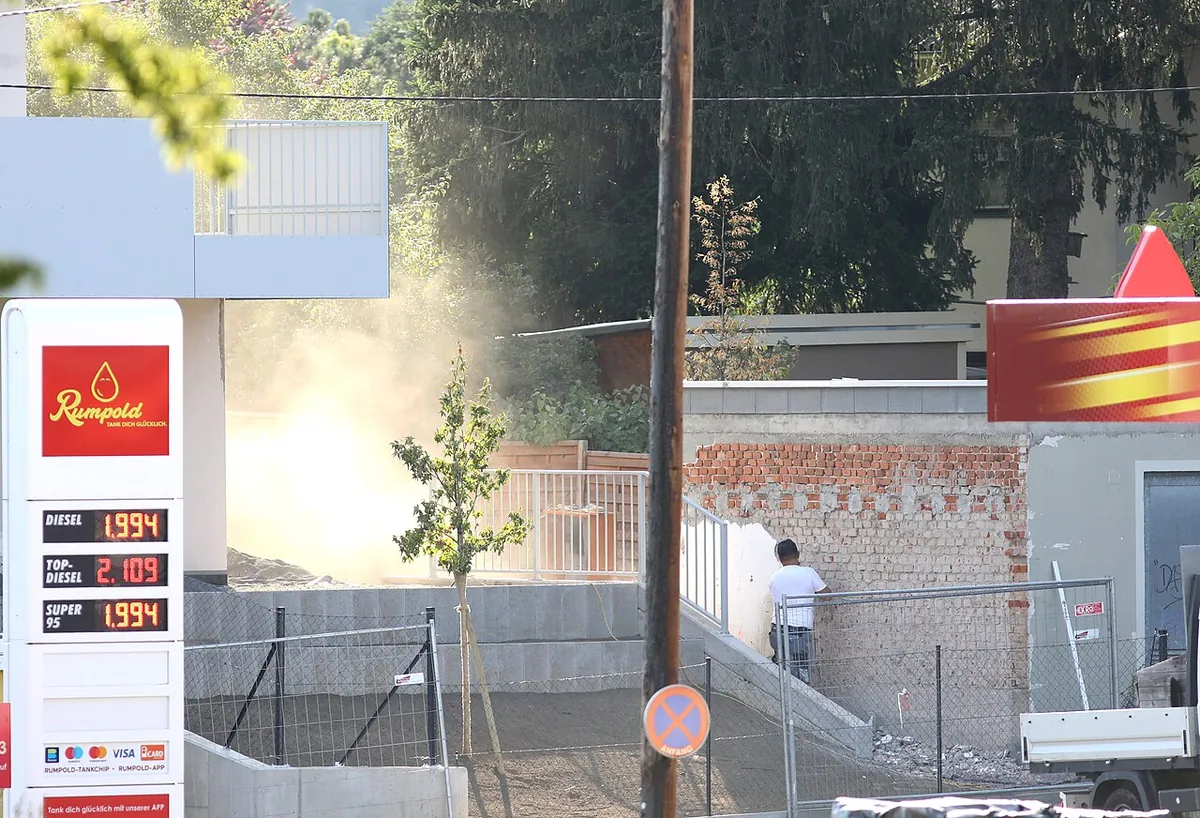
Photo: Christian Pirkl, Wikimedia Commons, CC BY-SA 4.0
Quick Answer
Concrete dust from cutting, grinding, drilling, sanding or breaking concrete contains respirable crystalline silica, particles small enough to reach deep into the lungs. Breathing it over time can cause silicosis, lung cancer, COPD and kidney disease. How much exposure to concrete dust is dangerous? OSHA's limit is 50 micrograms of respirable silica per cubic meter of air averaged over 8 hours, an amount of dust you cannot see; dry cutting concrete can exceed it within minutes. Short, occasional exposures carry low risk but should still be controlled. Use wet cutting, tools with vacuum dust collection, and a properly fitted N95 or better respirator. Separately, concrete dusting is a slab defect in which the surface wears into a fine powder, usually from too much water or poor finishing and curing.
Most people think of dust as a nuisance. Concrete dust is different. The fine gray powder that comes off a saw blade or a grinder looks harmless, but the smallest particles in it are invisible and can stay in the air for hours. Workers who breathed it for years without protection developed lung diseases that cannot be cured, which is why concrete dust has its own federal standard in the United States.
This guide explains what concrete dust is, why the silica in it is harmful, how much exposure to concrete dust is dangerous, how to control dust on the job and at home, how to clean it up safely, and the separate problem of concrete dusting, when a slab surface keeps turning to powder.
What Is Concrete Dust?
Concrete is made of cement, sand, gravel or crushed stone, and water. Sand and many types of stone are largely made of quartz, the most common form of crystalline silica. When hardened concrete is cut, ground, drilled, chipped, crushed or sanded, it breaks into particles of all sizes. The larger ones fall quickly and form the visible gray powder. The smallest, under about 10 microns and especially those under 4 microns, called respirable dust, stay in the air and can be breathed deep into the lungs.
Concrete dust also contains cement particles, which are alkaline and irritate skin, eyes and airways. Dust from fresh cement powder, when you open and pour bags, is mostly cement and some fine sand, and it also contains small amounts of crystalline silica. See what concrete is made of.
Why Concrete Dust Is Harmful
Respirable crystalline silica is the main hazard. Once it reaches the small air sacs in the lungs, the body cannot clear it easily, and the particles cause inflammation and scarring. Health agencies link silica exposure to:
- Silicosis: a progressive, incurable scarring of the lungs. Chronic silicosis usually appears after 10 or more years of exposure; accelerated silicosis can develop in 5 to 10 years at high exposure; acute silicosis can develop within weeks to a few years of very heavy exposure.
- Lung cancer: crystalline silica is classified as a known human carcinogen by the International Agency for Research on Cancer.
- Chronic obstructive pulmonary disease (COPD): including chronic bronchitis and emphysema.
- Kidney disease and a higher risk of tuberculosis in people with silicosis.
OSHA estimates that more than 2 million construction workers are exposed to respirable crystalline silica, much of it from concrete dust and masonry. Cement dust adds irritation: it can cause coughing, nose and throat irritation, eye damage and skin burns when wet.
How Much Exposure to Concrete Dust Is Dangerous?
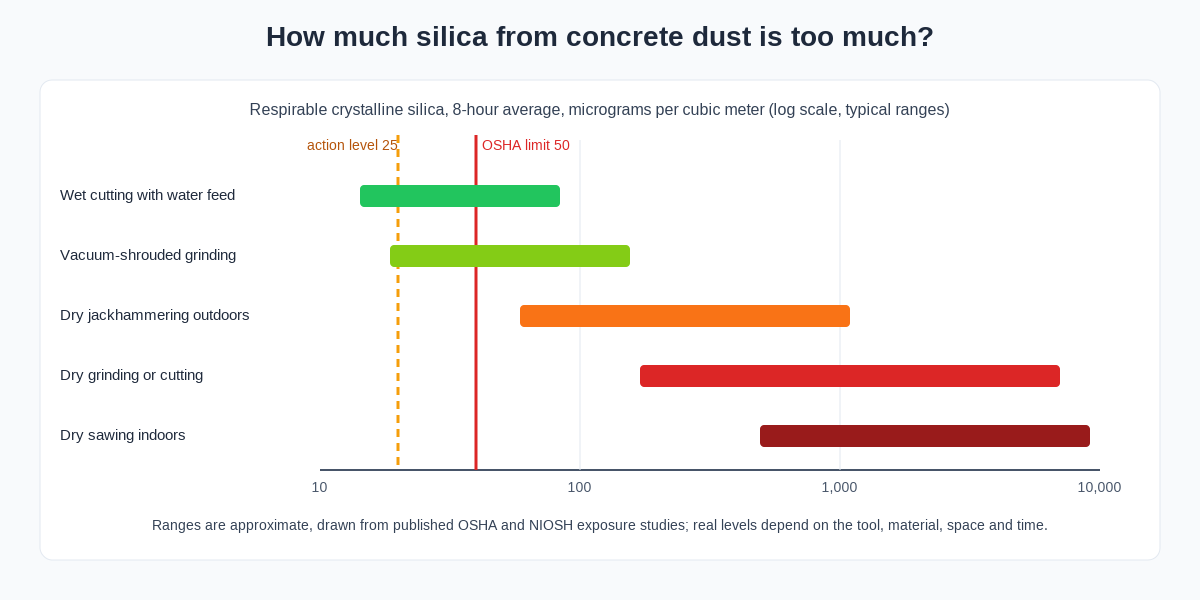
Regulators measure silica exposure as the average concentration of respirable crystalline silica in the air a worker breathes over an 8-hour shift. Under the OSHA construction standard for silica, 29 CFR 1926.1153:
- Permissible exposure limit (PEL): 50 micrograms per cubic meter of air (µg/m³), 8-hour time-weighted average.
- Action level: 25 µg/m³, above which employers must monitor exposure and take further steps.
- NIOSH recommended limit: 50 µg/m³ for up to a 10-hour day.
To put that in perspective, 50 micrograms is a tiny fraction of the weight of a grain of salt spread through a cubic meter of air. You cannot see dust at that level. Studies by OSHA and NIOSH have measured dry cutting, grinding and jackhammering of concrete at levels many times higher than the limit, sometimes hundreds of times higher in enclosed spaces. That is why how much exposure to concrete dust is dangerous is answered less by a number you can feel and more by the task: if you are cutting or grinding concrete dry and you can see a dust cloud, you are almost certainly far above the safe level.
Measuring Concrete Dust Exposure
Because respirable concrete dust is invisible at harmful levels, the only way to know a worker's exposure is to measure it. Industrial hygienists clip a small pump and a cyclone sampler to the worker's collar, in the breathing zone, and run it for the whole shift. The filter is sent to a lab that measures the crystalline silica on it, giving an 8-hour average. Employers who do not follow OSHA Table 1 must assess exposure this way, and repeat it when tasks or controls change. Real-time dust monitors give instant readings of total concrete dust in the air and are useful for checking whether a control is working, though they do not measure silica directly.
Limits in Other Countries
Other countries set similar or stricter limits for respirable crystalline silica from concrete dust and other sources. Many European countries and Australia use an 8-hour limit of 50 or 100 µg/m³, with Australia lowering its national limit to 50 µg/m³ in 2020 and banning engineered stone in 2024. The United Kingdom's workplace exposure limit is 100 µg/m³, and its Health and Safety Executive recommends keeping exposure as low as reasonably practicable. Whatever the local number, the same rule applies: control concrete dust at the source with water or extraction, then add respiratory protection.
What About Occasional DIY Exposure?
Silicosis and the other diseases are linked mainly to repeated exposure over months and years, so cutting a few pavers or drilling some anchor holes one weekend is far less risky than working a concrete saw every day. But there is no reason to take even a short exposure lightly. A few minutes of dry cutting indoors can put more concrete dust in the air than a worker is allowed to breathe in a whole day, and the dust settles into the house and gets stirred up again later. The same controls that protect workers, water, vacuums and a respirator, are cheap and easy for DIY jobs too. The practical answer to how much exposure to concrete dust is dangerous for a homeowner is: any visible cloud is too much, so control it at the source.
How to Control Concrete Dust
OSHA's silica standard includes a list, called Table 1, of common construction tasks with the controls that must be used for each. Employers who follow Table 1 do not have to measure exposure for those tasks. The same controls are a good guide for anyone working with concrete.
1. Wet Methods
Water is the simplest way to control concrete dust. A steady flow of water at the blade or bit turns the dust into slurry before it can get into the air. Most walk-behind saws, handheld cut-off saws and core drills have water feed attachments, and Table 1 lists wet cutting as the main control for saws. Studies have found that wet cutting can cut respirable dust by roughly 90 percent or more compared with dry cutting. Use enough water to keep the cut wet, and manage the slurry so it does not dry on surfaces and become dust again or run into storm drains.
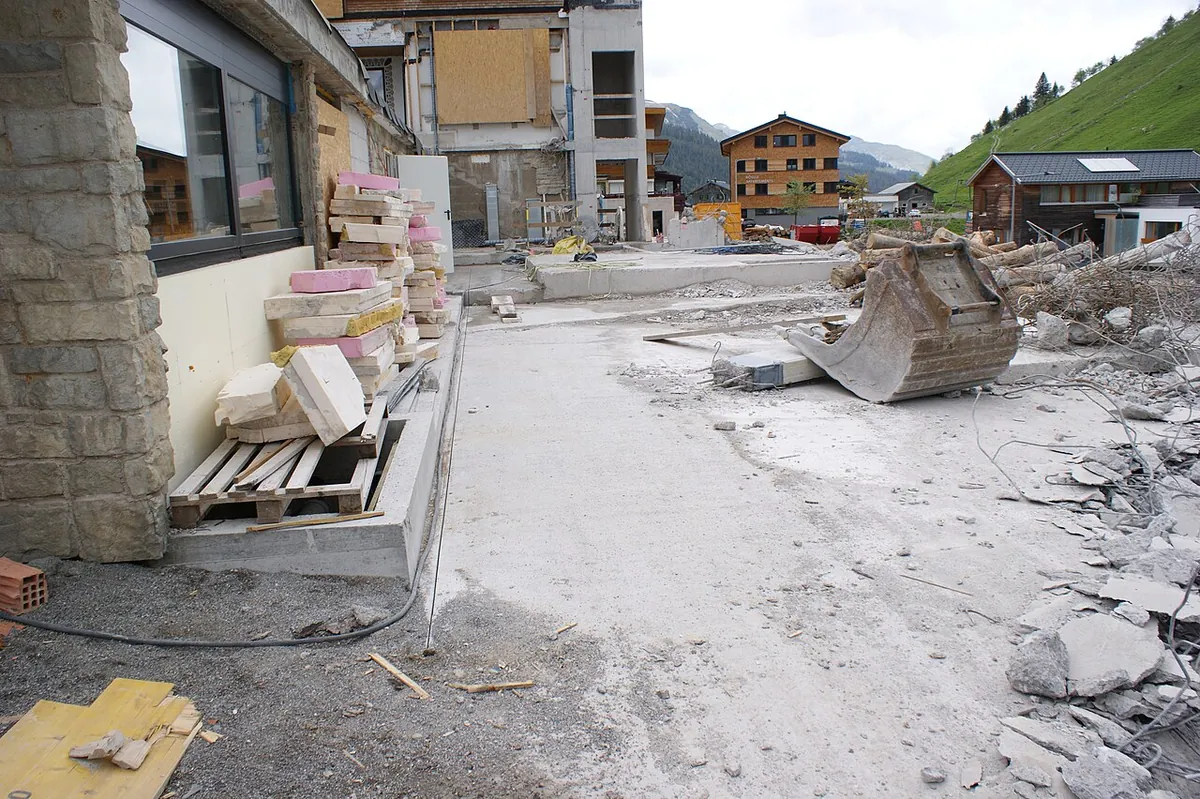
Photo: Asurnipal, Wikimedia Commons, CC BY-SA 4.0
2. Vacuum Dust Collection
Where water is not practical, such as indoors near electrical equipment, use tools with a shroud connected to a dust extractor. Table 1 calls for a commercially available shroud and a vacuum dust collection system with enough airflow for the tool and a high-efficiency filter, often described as 99 percent efficient or HEPA, with a cyclonic pre-separator or filter-cleaning mechanism for grinders. Ordinary shop vacuums without HEPA filters blow fine concrete dust straight back out into the room. Grinders, rotary hammers, tuckpointing tools and drills all have shrouds or dust-collecting attachments available.
3. Respirators
Respirators are the last line of defense, used with water or vacuums, not instead of them. For many Table 1 tasks done outdoors with controls, no respirator is needed for short durations; for longer tasks or work indoors, a respirator with an assigned protection factor of 10, such as a properly fitted N95 filtering facepiece or a half-mask with P100 filters, is required. Dust masks that are not NIOSH approved, and loose surgical masks, do not protect against respirable concrete dust. Facial hair under the seal makes any tight-fitting respirator ineffective. Employers whose workers must wear respirators for 30 or more days a year must provide medical exams under the silica standard.
4. Work Practices
Keep other people away from the cutting area, and work with the wind at your back outdoors. Avoid cutting indoors when you can cut outside. Choose methods that make less dust, such as splitting pavers with a splitter instead of sawing, or planning layouts that reduce cuts. Limit the time spent on the dustiest tasks. Clean up as you go so dust does not build up. See how to cut concrete and concrete saw.
Cleaning Up Concrete Dust
How you clean up matters as much as how you cut. Dry sweeping and blowing concrete dust with compressed air put fine silica back into the air; OSHA's standard prohibits both where they contribute to exposure, unless wet methods or HEPA vacuuming are not feasible. Instead:
- Use a HEPA-filtered vacuum for floors, tools and surfaces.
- Wet down dust before sweeping, or use a sweeping compound that holds dust down.
- Mop or wipe hard surfaces with damp cloths, rinsing often.
- Let slurry dry and scrape it up, or vacuum it wet, rather than letting it dry into dust on floors and walks.
- Change clothes before going home, and wash work clothes separately, so concrete dust does not come into the house or the car.
- Seal off rooms with plastic sheeting during indoor work, and run an air scrubber if available.
For dust that has settled throughout a house after renovation, vacuum with a HEPA vacuum from top to bottom, wipe surfaces with damp cloths, replace HVAC filters, and repeat after a few days as fine dust keeps settling.
Concrete Dust on Skin and in Eyes
Cement in concrete dust is alkaline. On sweaty skin it can cause irritation and dermatitis, and wet cement or concrete can cause chemical burns. Wear gloves, long sleeves and safety glasses or goggles. If concrete dust gets into your eyes, flush them with clean water for at least 15 minutes and seek medical care if irritation continues. Wash skin with plain water and a pH-neutral soap. See can concrete burn for burns from wet concrete.
Symptoms and When to See a Doctor
Early silicosis may cause no symptoms. As it progresses, it causes a persistent cough, shortness of breath, fatigue, chest pain and weight loss. Because symptoms can appear years after exposure, anyone who has worked regularly with concrete, masonry, stone or sand should tell their doctor about it. Chest X-rays and lung function tests are used to check for silicosis, and the OSHA standard requires periodic medical exams for workers who wear respirators 30 or more days a year. Stopping smoking reduces the added lung cancer and COPD risk.
Who Is Most at Risk From Concrete Dust?
The people with the highest exposure to concrete dust are those who cut, grind, drill or break concrete for a living: concrete cutters and sawing crews, demolition workers, floor grinders and polishers, masons and tuckpointers, drywall and tile installers who cut cement board, road and highway workers, and anyone running a jackhammer or a crusher. Workers nearby, such as laborers, electricians and plumbers on the same site, breathe the same concrete dust without doing the cutting themselves. Studies of silicosis cases in construction have repeatedly traced them to these trades, especially where dry methods were used indoors or in trenches and stairwells with little air movement.
Homeowners and DIYers are at lower risk only because their exposure is shorter. A weekend spent grinding a garage floor with no dust control can still produce heavy concrete dust exposure, and the dust left behind in the house exposes family members too.
Common Home Jobs That Make Concrete Dust
Many everyday projects create concrete dust. Knowing which ones are dusty helps you plan controls before you start.
Drilling anchor holes: a hammer drill throws concrete dust out of every hole. Use a drill with a dust shroud and vacuum, or hold a vacuum nozzle at the hole. See concrete drill bit and concrete screws.
Cutting pavers, blocks and slabs: a dry cut-off saw makes a huge cloud. Rent a wet saw or a saw with water feed, or use a block splitter. See how to cut concrete.
Grinding or polishing a floor: floor grinders must be connected to a dust extractor with a HEPA filter. See polished concrete cost.
Removing tile and thinset: chipping tile off a concrete floor releases concrete dust and mortar dust. Mist the area and use a HEPA vacuum.
Breaking up a slab or steps: jackhammers and sledgehammers create dust outdoors; wet the surface and stand upwind. See how to remove concrete.
Mixing bagged concrete: opening and pouring bags releases cement and fine sand dust. Pour slowly, close to the mixer, and wear a mask. See how to mix concrete.
Concrete Dust and Neighbors
Concrete dust does not stay on the job site. Clouds from dry cutting and demolition drift onto neighboring yards, cars, windows and outdoor air intakes, and fine particles add to local air pollution. Many cities have dust control rules for construction and demolition, requiring water spraying, covered loads and limits on dry cutting. On a demolition site, crews use water hoses or misting cannons to wet the concrete as it is broken and loaded. At home, the courtesy rules are simple: cut wet, cut away from the property line, and clean up concrete dust from shared surfaces at the end of the day.
Concrete Dust vs Cement Dust and Other Dusts
People sometimes use concrete dust and cement dust interchangeably, but they come from different stages. Cement dust is the fine gray powder from dry portland cement, released when bags are opened, mixed or spilled. It is strongly alkaline, so it irritates eyes, skin and airways, and it contains small amounts of crystalline silica. Concrete dust comes from cutting or breaking hardened concrete. It contains much more crystalline silica, from the sand and stone, so it is the bigger long-term lung hazard.
Dust from drywall, wood and other building materials has its own hazards, but drywall and most wood dust contain little or no crystalline silica. Cement board, brick, stone, tile, mortar, grout and engineered stone countertops all produce silica dust similar to concrete dust; engineered stone, which can be over 90 percent silica, has caused severe silicosis among countertop fabricators.
Disposing of Concrete Dust and Slurry
Collected concrete dust from a HEPA vacuum can usually go out with regular construction debris or household trash in a sealed bag, so it does not puff out when the bin is emptied. Wet slurry from cutting should be contained and allowed to settle and dry, then the solids scraped up and bagged; it is alkaline and should not be rinsed into storm drains, gutters or gardens. See concrete washout for how high-pH water is handled on job sites.
Is Concrete Dust Good for the Garden?
Some gardeners ask whether concrete dust can be used like garden lime to raise soil pH. Concrete dust is alkaline and contains calcium, so it does raise pH, but it is not a good substitute for agricultural lime. Its effect is uneven, it may contain traces of metals from cement, and spreading it creates the very silica dust you want to avoid breathing. Use proper garden lime, applied according to a soil test.
Concrete Dusting vs Other Surface Problems
Concrete dusting is easy to confuse with other surface problems. Efflorescence is a white, powdery salt deposit that appears on the surface as water evaporates; it brushes off and comes back with moisture, but the concrete underneath is sound. See efflorescence on concrete. Scaling and flaking are thin layers of the surface peeling off, usually outdoors after freeze-thaw cycles and salt. See concrete pitting and flaking. Concrete dusting, by contrast, is a soft surface that keeps producing powder wherever it is rubbed, without peeling or salts.
A Quick Concrete Dust Checklist
Before any job that cuts, grinds, drills or breaks concrete, run through a short checklist. Can the work be done outdoors, or the material split instead of sawed? Is there a water feed for the saw or a shroud and HEPA dust extractor for the grinder or drill? Does everyone in the area have a fitted N95 or better respirator, safety glasses and gloves? Are other people, children and pets kept away, and are doors and vents to the rest of the house sealed? Is there a plan to clean up concrete dust with a HEPA vacuum or wet methods instead of a broom or air hose? If the answer to each is yes, the concrete dust exposure from the job will be a small fraction of what it would be with dry, uncontrolled work.
Concrete Dusting: When a Slab Turns to Powder
Concrete dusting means something different: a defect in which the surface of a concrete floor or slab is weak and keeps wearing off as a fine powder under foot traffic or sweeping. You can test for it by rubbing the surface with your hand or dragging a key or nail across it; a dusting surface leaves powder and scratches easily. Concrete dusting is common in garages, basements and warehouse floors.
Causes of Concrete Dusting
- Too much water in the mix, or water added at the site, which leaves a weak, high water-cement ratio paste at the top.
- Finishing while bleed water is on the surface, which mixes extra water into the top layer.
- Sprinkling water or dry cement on the surface during finishing.
- Poor curing, which lets the surface dry out before it gains strength.
- Carbonation from unvented heaters used in cold weather, whose carbon dioxide reacts with fresh concrete and creates a soft surface.
- Freezing of the surface before it has set.
- Dirty or poorly graded aggregates with clay or silt.
How to Fix Concrete Dusting
Light concrete dusting can often be fixed with a chemical densifier or hardener, such as a sodium, potassium or lithium silicate product. These soak into the surface and react with the calcium hydroxide in the concrete to form a harder layer. Clean the floor thoroughly, apply the densifier as directed, and remove the residue. For more severe concrete dusting, the weak surface layer is ground off, then the floor is densified, sealed or coated with epoxy or polyaspartic. Very poor surfaces may need a bonded overlay or topping. See how to resurface concrete, concrete coating cost and concrete sealer.
Preventing Concrete Dusting
Prevention comes down to the basics of good flatwork: use a mix with the right water-cement ratio and do not add water at the site, wait for bleed water to evaporate before finishing, never sprinkle water or cement on the surface, cure the slab properly, protect it from freezing, and vent heaters to the outside during cold-weather work. See concrete flatwork and concrete curing compound.
Frequently Asked Questions
Is concrete dust harmful?
Yes. Concrete dust contains respirable crystalline silica, which can cause silicosis, lung cancer, COPD and kidney disease with repeated exposure. Cement in the dust also irritates skin and eyes.
How much exposure to concrete dust is dangerous?
OSHA's limit is 50 micrograms of respirable silica per cubic meter averaged over 8 hours, an invisible amount. Dry cutting or grinding can exceed it in minutes, so always use water, vacuums and a respirator.
Does an N95 protect against concrete dust?
A properly fitted NIOSH-approved N95 gives an assigned protection factor of 10, which is enough for many tasks when combined with water or vacuum controls.
What causes concrete dusting on a floor?
Usually too much water at the surface from the mix or finishing, poor curing, freezing, or carbonation from unvented heaters.
Sources
- OSHA: Silica, crystalline, and the construction standard 29 CFR 1926.1153
- CDC NIOSH: Silica and worker health
- OSHA: Small Entity Compliance Guide for the respirable crystalline silica standard for construction
- National Ready Mixed Concrete Association: CIP 1, Dusting concrete surfaces
Related Guides
- Concrete washout — handling rinse water from trucks and tools
- Concrete flatwork — what flatwork is and how it is built
- Concrete trowel — trowel finishes and technique
- Concrete grinding — floor grinders, discs, scarifiers and how-to
- How to drill into concrete — hammer drills, bits and step-by-step
- Concrete core drilling — coring holes, bits, scanning and cost
- How to wash cement floor — best way to clean concrete floors
- Concrete cutting blade — diamond and sawzall blades
- Concrete chisel — hand and SDS chisels
- Concrete densifier — silicate hardeners for floors
- Concrete slurry — bonding slurry, flowable fill and cutting slurry
- Concrete polisher — planetary grinders, hand polishers, pads and rental prices
- Concrete board — backer board for shower walls and tile floors, installation and waterproofing
- Concrete cutter — cut-off saws, Stihl models, concrete chainsaws, depths and rental
- Concrete worker — job duties, pay, training, safety and career path