
How to Lower Chlorine in Pool Water: Safe, Fast Methods
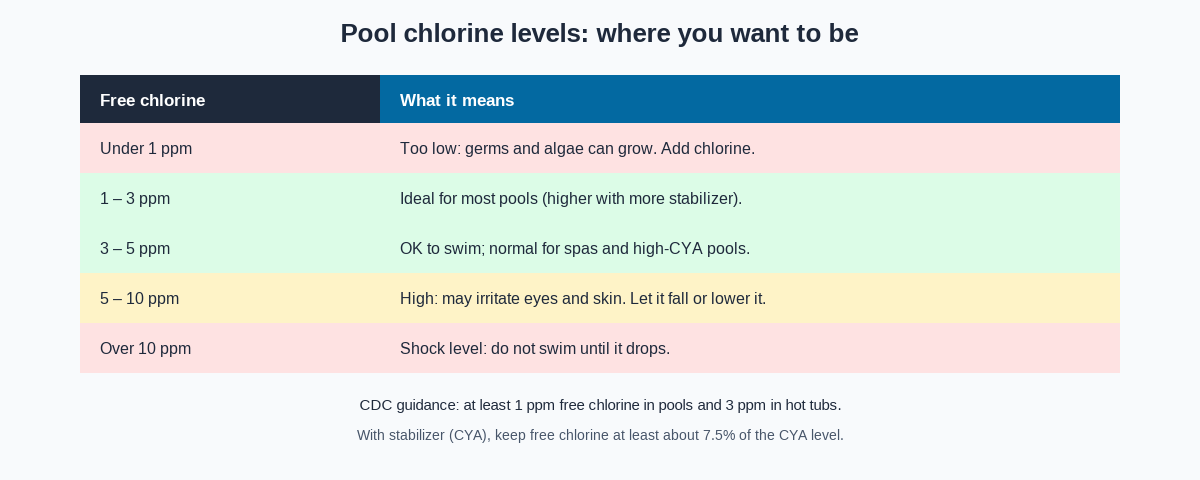
Chart: Asphapro.com
Quick Answer
To lower chlorine in pool water, first stop adding chlorine: remove tablets from the feeder or floater, and turn down or off a salt cell. Then take the cover off and let sunlight break chlorine down; most high readings fall back into the 1 to 4 ppm range within a day or two. To lower it faster, drain and refill part of the water, or add a chlorine neutralizer (sodium thiosulfate), roughly 1.5 ounces per 10,000 gallons for each 1 ppm you want to remove, added in small steps with retests. Pool-grade hydrogen peroxide also works. Do not swim while free chlorine is above about 5 ppm, and recheck pH after lowering chlorine.
Chlorine keeps pool water safe, but too much is a problem. High chlorine irritates eyes and skin, fades swimsuits and hair, can damage vinyl liners and equipment over time, and makes the pool unpleasant to swim in. It often happens after a heavy shock, a stuck tablet feeder, a salt cell set too high, or simply a mistake in measuring.
This guide explains how to lower chlorine in pool water safely, how fast each method works, and how to keep chlorine levels steady once they are back in range. For the opposite problem, see our guide on how much chlorine to add to pool water.
Pool Chlorine Levels: What Is Too High?
Most pools are best with free chlorine between about 1 and 3 ppm, and up to 4 or 5 ppm is still comfortable for many swimmers, especially in pools with stabilizer. The CDC recommends at least 1 ppm free chlorine in pools and 3 ppm in hot tubs. Above about 5 ppm, many people feel eye and skin irritation, and above 10 ppm, which is shock level, you should not swim. If your test shows chlorine level in pool water above 5 ppm and no one needs to swim right away, the simplest fix is to stop adding chlorine and wait.
Pools with stabilizer (cyanuric acid) need more free chlorine to work, roughly 7.5% of the CYA level. A pool with 60 ppm CYA might run 4 to 5 ppm chlorine normally. So "too high" depends partly on your stabilizer.
Why Chlorine Levels Get Too High
- Over-shocking or adding shock without measuring.
- Tablet feeders or floaters left open too far, especially in cool weather when chlorine is used up more slowly.
- Salt cells set too high for the season or the pump run time.
- Pool covered for days, so sunlight is not breaking chlorine down.
- Little swimming, so chlorine is not being used up.
- Test errors, such as old reagents or strips that read high.
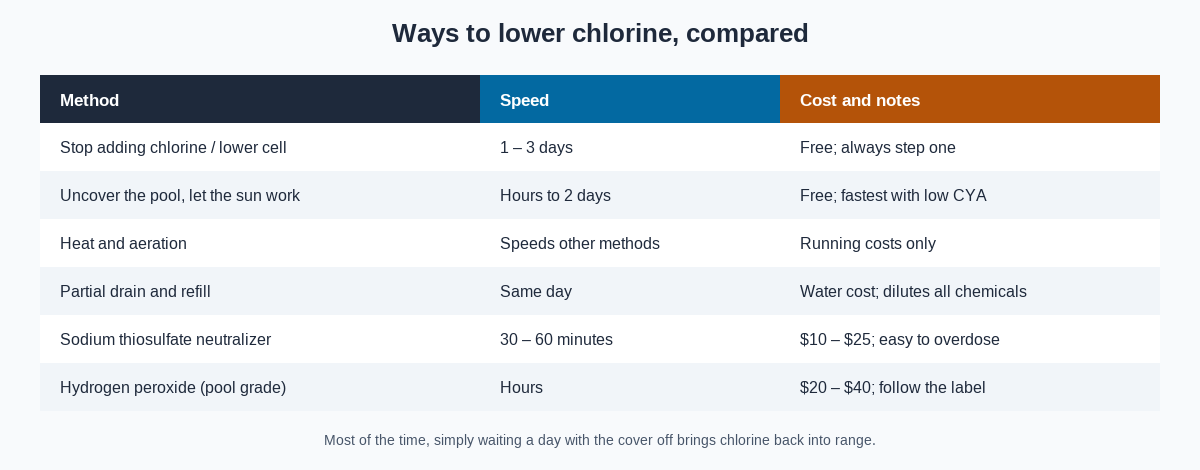
Chart: Asphapro.com
How to Lower Chlorine in Pool: 6 Methods
1. Stop adding chlorine. Take tablets out of the feeder or floater, turn the salt cell output to 0% or a low setting, and hold off on shock. This is always the first step.
2. Use sunlight. Uncovered, sunlit water loses chlorine fast, especially in pools with low stabilizer. A few hours of strong sun can drop chlorine by several ppm. Leave the cover off until levels are back in range.
3. Heat and aerate. Warm water and aeration from fountains, spillways or jets help chlorine dissipate faster. Running a heater for a few hours also speeds things up.
4. Swim (when safe) and wait. Once chlorine is in a comfortable range, normal use consumes chlorine. If it is only slightly high, swimming helps bring it down.
5. Drain and refill part of the water. Replacing a portion of the water with fresh water lowers chlorine right away in proportion. Replacing 25% lowers chlorine by about 25%. This also lowers stabilizer, salt and other chemicals, so retest and rebalance afterward.
6. Add a chlorine neutralizer. Sodium thiosulfate reacts with chlorine and removes it within 30 to 60 minutes. Use it when you need to lower chlorine fast. See the calculator below.
How to Lower Chlorine in Pool Quickly With a Neutralizer
When you need to know how to lower chlorine in pool water quickly, for example before a party or after a big overdose, a chlorine neutralizer is the fastest option. Most pool neutralizers are sodium thiosulfate, sold as granules or liquid. It reacts directly with chlorine and removes it within about 30 to 60 minutes of circulation.
As a rough guide, about 1.5 ounces of sodium thiosulfate per 10,000 gallons lowers free chlorine by about 1 ppm, but product strength varies, so always follow the label. The biggest risk is overdosing: extra thiosulfate stays in the water and destroys chlorine you add later, so the pool may struggle to hold chlorine for days. To avoid this, add about half the calculated dose, circulate for 30 to 60 minutes, retest, and then add more only if needed.
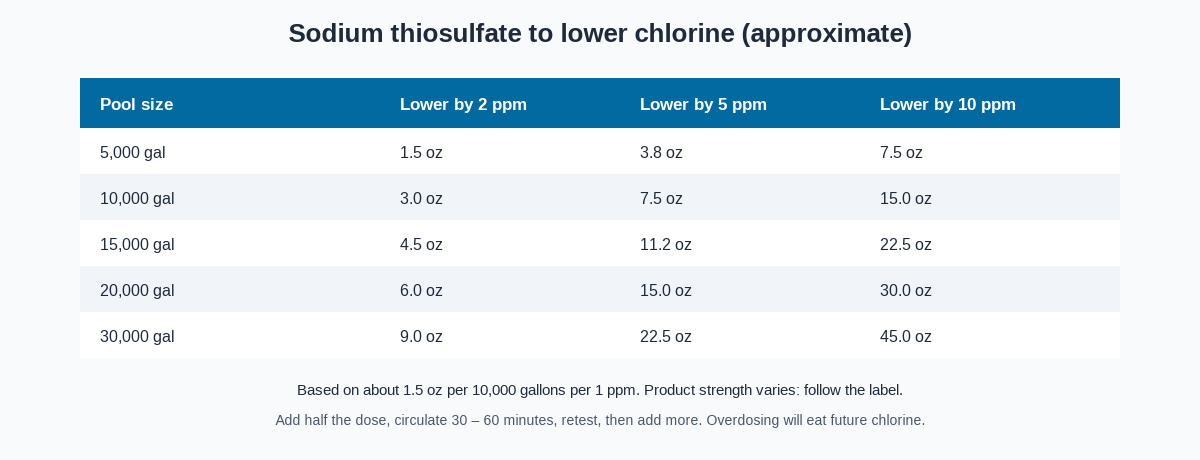
Chart: Asphapro.com
Chlorine Neutralizer Calculator
Enter your pool volume, current free chlorine and target level to estimate how much sodium thiosulfate to add. The calculator uses about 1.5 ounces per 10,000 gallons per 1 ppm and suggests a first dose of half the total.
How to Reduce Chlorine in Pool Water Naturally
Many owners prefer to reduce chlorine in pool water without adding another chemical. The natural approach combines time, sun and air. Stop adding chlorine, take the cover off, run the pump on a normal schedule, and let sunlight break down the excess. Ultraviolet light destroys unstabilized chlorine quickly; even stabilized chlorine fades over a day or two of strong sun. Running water features, pointing returns at the surface and running the heater help too. Check chlorine levels in pool water every few hours so you know when it is back in range. For most mild overdoses, this is all you need.
How to Lower Free Chlorine in Pool With a Salt System
In a salt pool, high chlorine usually means the cell output is set too high for the season, the pump runs too long, or the pool is covered. To lower free chlorine in pool water with a salt system, turn the cell output down to 0% or a low setting, or switch it off, and leave the pump running so water circulates. Uncover the pool and let the sun lower chlorine. When levels are back to your target, set the cell to a lower output than before, and adjust in steps of 10% based on daily tests. Cooler weather and fewer swimmers mean the cell needs less output. See our guide on how to maintain a saltwater pool.
How to Reduce Pool Chlorine From Tablets
Tablet feeders and floaters keep releasing chlorine whether the pool needs it or not. In cool weather or after a rain-free week with little swimming, they can push chlorine levels in pool water too high. To reduce pool chlorine from tablets, remove the tablets, close the feeder or turn the dial down, and let levels fall. When you restart, use fewer tablets or a lower setting. Remember that trichlor tablets also add stabilizer, which builds up over time and makes chlorine less effective. See our guide on how to reduce cyanuric acid in pool water.
Photo: PattayaPatrol, Wikimedia Commons, CC BY-SA 4.0
How to Lower Chlorine Level in Pool by Dilution
Draining and refilling part of the water is a reliable way to lower chlorine level in pool water the same day. The drop is proportional: replace 20% of the water and chlorine falls by about 20%. To lower chlorine from 10 to 5 ppm, replace about half. Because this also lowers stabilizer, salt, calcium and alkalinity, test everything after refilling and rebalance. Dilution makes the most sense when other chemicals are also high, such as stabilizer from long tablet use. For small overdoses, waiting or a neutralizer wastes less water.
Using Hydrogen Peroxide to Lower Chlorine
Pool-grade hydrogen peroxide, usually 27% to 35% strength, reacts with chlorine and lowers it within a few hours. It breaks down into water and oxygen, so it leaves no residue to fight future chlorine, which is an advantage over thiosulfate. However, it is a strong oxidizer that must be handled carefully with gloves and eye protection, and dosing depends on the product. Do not use household 3% peroxide in a pool; it is far too weak to be practical. Follow the label exactly.
What Should the Chlorine Level Be in a Pool?
What should the chlorine level be in a pool? For most residential pools, free chlorine should be about 1 to 3 ppm, with the CDC setting at least 1 ppm as the minimum for pools. Pools with stabilizer often run higher, about 7.5% of the CYA level, so 3 to 5 ppm is common. Hot tubs and spas should have at least 3 ppm. Combined chlorine, the chloramines that cause odor and irritation, should be close to zero. Total chlorine is free plus combined chlorine. Keeping swimming pool chlorine levels steady in this range keeps the water safe and comfortable.
Is Your Chlorine Really Too High? Test Carefully
Before lowering chlorine, make sure the reading is right. Very high chlorine can bleach the pink color in DPD test drops and tablets, giving a falsely low or even zero reading, so a pool at 20 ppm may look like 0. Test strips may top out at 10 ppm. A FAS-DPD drop kit gives accurate free chlorine readings at high levels. Also check whether you are reading free or total chlorine. If the pool smells strongly of chlorine and swimmers get red eyes, the problem is often combined chlorine (chloramines), which means the pool needs more free chlorine, not less. In that case, shock the pool rather than lowering chlorine. See our guide on when to shock a pool.
Effects of High Chlorine
A pool chlorine level that is too high for too long can cause several problems. Swimmers may get red, stinging eyes, dry or itchy skin, and in sensitive people, coughing or breathing irritation. Swimsuits fade and hair can turn dry or brittle. Vinyl liners can fade and weaken, and the pattern can bleach. Very high chlorine combined with low pH can corrode metal parts such as ladders, heaters and pump seals. High chlorine also wastes money, since you paid for chlorine the pool did not need. Bringing chlorine level pool readings back into range protects swimmers and equipment.
Check pH After Lowering Chlorine
Lowering chlorine can shift pH. Sodium thiosulfate can lower pH slightly, while dilution with fresh tap water may raise or lower it depending on your water supply. Liquid chlorine and cal-hypo raise pH when added, so a pool that was over-chlorinated may also have high pH. After lowering chlorine, test pH and total alkalinity and adjust to keep pH between 7.2 and 7.8. Balanced pH makes chlorine work better at lower levels, which helps keep you from overdosing again. See our guides on how to lower pH in pool and how to raise pH in pool water.
Lowering Chlorine in a Hot Tub
Hot tubs hold far less water, so chlorine changes quickly. To lower chlorine in a spa, leave the cover off with the jets and air running; heat and aeration drive chlorine off within hours. You can also drain a few inches and refill with fresh water. Neutralizer works too, but use a tiny dose, since a 400-gallon spa needs only a small fraction of a pool dose. Many hot tub owners simply drain and refill if levels are very high, since a full refill is quick and cheap.
Worked Examples
Example 1: overdose after shock. A 15,000-gallon pool reads 12 ppm the morning after a shock. No one needs to swim until evening. The owner removes the cover, stops the salt cell, and lets the sun work. By evening, chlorine is 5 ppm, and by the next morning, 3 ppm.
Example 2: party in two hours. A 20,000-gallon pool reads 9 ppm and guests arrive soon. The target is 3 ppm, a 6 ppm drop. The calculator suggests about 18 ounces of sodium thiosulfate. The owner adds 9 ounces in front of a return, waits 45 minutes, and retests at 5 ppm. A further 5 ounces brings it to 3.5 ppm.
Example 3: tablet feeder left open. A 12,000-gallon pool with a feeder set too high reads 8 ppm in cool spring weather. The owner removes the tablets, uncovers the pool and waits two days. Chlorine drops to 3 ppm, and the owner resets the feeder to a lower setting with fewer tablets.
Common Mistakes When Lowering Chlorine
The most common mistake is overdosing neutralizer, which leaves thiosulfate in the water to destroy future chlorine, so the pool will not hold chlorine for days. Another is trusting a single test strip reading without confirming with a drop kit. Some owners lower chlorine when the real problem is chloramines, making the water worse. Others drain far more water than needed, wasting water and throwing off other chemicals. And some forget to fix the cause, such as a stuck feeder or high salt cell setting, so chlorine climbs again.
How to Keep Chlorine Levels Steady
Steady chlorine is easier than fixing highs and lows. Test chlorine and pH several times a week in the swim season. Add chlorine in measured doses based on tests, not by habit. Adjust feeders and salt cells with the seasons: less in spring and fall, more in summer heat. Keep stabilizer in range so chlorine lasts without building up. Use a pool cover at night to save chlorine, and remove it during the day if chlorine runs high. Keep a log of readings and doses to learn your pool's patterns through the season.
Lowering Chlorine in Pool Water: A Step-by-Step Plan
Here is a simple plan for lowering chlorine in pool water that works for most situations. First, confirm the reading with a reliable drop kit. Second, stop all chlorine sources: tablets, feeders, salt cell and shock. Third, uncover the pool, run the pump, and let sunlight and air work. Fourth, retest every few hours. If chlorine is still above about 5 ppm when you need to swim, either add a measured dose of neutralizer or drain and refill part of the water. Fifth, once chlorine is back in range, check pH and alkalinity. Finally, find and fix the cause so it does not happen again. This plan answers how to lower chlorine in a pool without wasting water or chemicals.
How Can You Lower Chlorine Level in Pool Water Safely?
How can you lower chlorine level in pool water safely? Choose the gentlest method that meets your timeline. Waiting and sunlight are the safest, since nothing is added. Dilution is safe too, though it uses water and changes other levels. Neutralizers are safe when measured carefully, stored away from other chemicals, and added to water with the pump running. Never mix neutralizer and chlorine products together in the same bucket, and never add chemicals directly into the skimmer in large amounts. Keep people out of the water while you lower chlorine and until levels are back in range.
How to Reduce Chlorine Level in Pool Water Before Closing
Before closing a pool for winter, many owners shock it a few days ahead. If chlorine is very high when it is time to add winter chemicals or put on the cover, high levels can bleach liners and covers over months. To reduce chlorine level in pool water before closing, shock earlier so it has time to fall, leave the cover off for a day or two, and test before adding winterizing chemicals. Aim for normal levels, around 1 to 3 ppm, when you close. See our guide on how to winterize a pool.
How Do You Lower the Chlorine Level in a Pool Overnight?
How do you lower the chlorine level in a pool overnight? Without sunlight, chlorine drops slowly at night, especially in a covered pool. If you need it lower by morning, remove the cover, run the pump and any water features to aerate the water, and run the heater if you have one. If it is still high in the morning, the sun will finish the job within hours. For a faster overnight drop, add half a calculated dose of neutralizer in the evening and retest in the morning. Partial draining also works overnight if you start in the evening and refill before morning.
How Do You Lower Chlorine Levels in a Pool With a Cover?
Covers keep chlorine in by blocking sunlight, which is great for saving chemicals but slows the drop when levels are too high. If you want to know how do you lower chlorine levels in a pool with a cover, the answer is simple: take the cover off during the day. Solar covers and automatic covers both trap chlorine in the water, so leave them open until levels return to your target, then use the cover again at night.
Chlorine Types and How Long They Linger
Different chlorine products affect how long high levels last. Liquid chlorine and cal-hypo are unstabilized, so in strong sun they break down fast; a high reading from these often falls within a day once the cover is off. Trichlor tablets and dichlor granules add stabilizer along with chlorine, which protects chlorine from sunlight, so high levels from these products can last longer. Salt cells produce unstabilized chlorine, but most salt pools run with higher stabilizer, so chlorine also lingers. Knowing which product caused the high reading helps you predict how quickly it will fall and whether you need a neutralizer.
Storing and Handling Neutralizer
Sodium thiosulfate is fairly safe to handle, but treat it like any pool chemical. Store it in a sealed container in a cool, dry place away from chlorine, acids and oxidizers. Measure doses with a clean, dry scoop or a kitchen scale. Dissolve granules in a bucket of pool water before adding them, and pour slowly in front of a return with the pump running. Wear gloves and eye protection. Keep it out of reach of children and pets, and label the container clearly so it is never mistaken for another white powder.
How to Lower Chlorine in Pool: Key Points
- Stop adding chlorine and let sunlight work first.
- Target about 1 to 4 ppm; do not swim above about 5 ppm.
- Partial draining lowers chlorine right away.
- Sodium thiosulfate lowers chlorine fastest; add it in small steps.
Frequently Asked Questions
How long does it take for chlorine to go down in a pool?
Often 1 to 2 days with the cover off and no chlorine added, faster in strong sun and low stabilizer, and slower in cloudy weather or indoor pools.
Is it safe to swim with high chlorine?
Up to about 4 to 5 ppm is usually fine. Above that, wait or lower it before swimming, especially for children and people with sensitive skin or asthma.
How do you lower chlorine in a pool fast?
Use a sodium thiosulfate neutralizer, added in small steps with retests, or drain and refill part of the water. Both work within an hour or two.
How to reduce chlorine in swimming pool water without chemicals?
Stop adding chlorine, remove the cover, and let sunlight, heat and aeration lower it over a day or two. Running fountains and pointing returns upward speeds it up.
How do I lower chlorine level in pool water with a salt cell?
Turn the cell output down or off, keep the pump running, uncover the pool, and retest daily until it is in range. Then restart the cell at a lower setting.
How to reduce free chlorine in pool water before swimming?
Add a measured dose of neutralizer, circulate for 30 to 60 minutes and retest, or simply wait with the cover off.
What should chlorine level be in pool water for kids?
The same as for adults: about 1 to 3 ppm, or a little higher with stabilizer. Keep pH at 7.4 to 7.6 for comfort, and test before children swim.
How to lower pool free chlorine after a shock?
Usually just wait overnight with the pump running and the cover off. Use neutralizer only if you need to swim sooner, and add it in small, measured steps.
How to reduce free chlorine in swimming pool water for sensitive skin?
Keep free chlorine at the low end of the safe range, about 1 to 2 ppm in unstabilized pools, keep pH at 7.4 to 7.6, and shock regularly to remove chloramines, which cause most irritation.
Sources
- CDC: Pool chemistry and testing
- CDC: Model Aquatic Health Code
- Trouble Free Pool: Pool water chemistry
- Pool and Hot Tub Alliance