
How to Make Asphalt: From Crude Oil and Quarry Stone to Hot Mix on the Road

Quick Answer
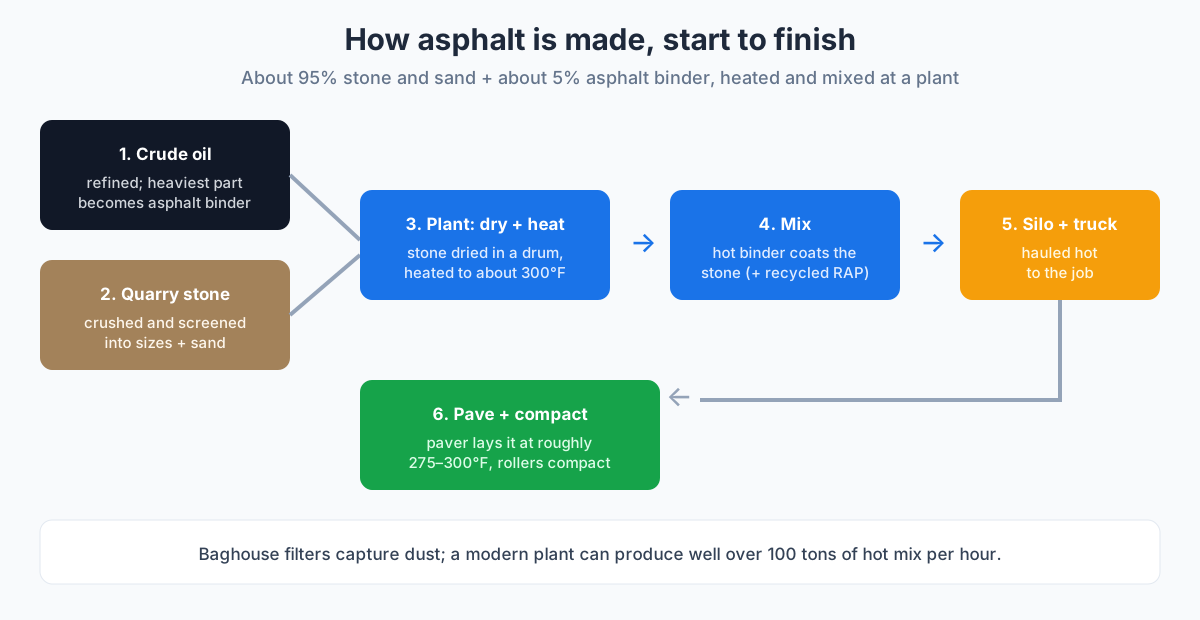
Here is how to make asphalt pavement: crushed stone and sand (about 95% of the mix by weight) are dried and heated in a rotating drum at an asphalt plant to around 300°F, then coated with about 5% hot asphalt binder. The binder is the heavy residue left after crude oil is refined. Many plants also add recycled asphalt. The finished hot mix is stored in a silo, loaded into trucks, hauled to the job while still hot, spread by a paver and compacted by rollers. You cannot make real hot mix at home; homeowners use bagged cold patch for small repairs.
Asphalt is everywhere: on roads, parking lots, driveways and airport runways. Yet most people have never seen how it is made. It does not come out of the ground ready to use, and it is not simply poured like concrete. Making asphalt is a two-part process. First, the binder is produced at an oil refinery and the stone is produced at a quarry. Then the two come together at an asphalt plant, where they are heated, proportioned and mixed into hot mix asphalt.
This guide walks through how to make asphalt from start to finish: what asphalt is made of, how the binder is refined, how aggregate is prepared, how a plant dries, heats and mixes the materials, how recycled asphalt is added, how the mix is tested, how it is delivered and laid, how warm mix and cold mix differ, and whether you can make asphalt yourself at home.
What Is Asphalt Made Of?
Asphalt pavement, also called asphalt concrete, hot mix asphalt or blacktop, has two main ingredients:
| Ingredient | Share by weight | Role |
|---|---|---|
| Aggregate (crushed stone, gravel, sand) | About 95% | Carries the load; gives strength and texture |
| Asphalt binder (bitumen) | About 5% | Glues the aggregate together and waterproofs the pavement |
| Additives (in some mixes) | Small amounts | Polymers, anti-strip agents, warm mix additives, fibers |
| Recycled asphalt pavement (RAP) | Varies | Replaces part of the new stone and binder |
By volume the mix also contains a small amount of air voids after compaction, which engineers control carefully. For more detail on the terminology and standards, see our asphaltic concrete guide and types of asphalt.
Step 1: Making the Asphalt Binder
The first part of how asphalt is made happens at an oil refinery. Almost all asphalt binder comes from crude oil. At a refinery, crude oil is heated and separated by boiling point in a distillation column. The lightest products, such as gases and gasoline, rise to the top; kerosene, diesel and heating oils come off in the middle; and the heaviest material stays at the bottom. That heavy residue, after further processing such as vacuum distillation, becomes asphalt binder.
Refiners and terminals then adjust the binder to meet performance grades, the PG grades that state highway agencies specify for each climate. Some binder is modified with polymers or rubber for heavy-duty pavements. The binder is shipped hot in insulated tanker trucks, rail cars or barges to asphalt plants, where it is stored in heated tanks so it stays liquid. A small amount of asphalt also comes from natural deposits, such as the Pitch Lake in Trinidad, but refined asphalt supplies nearly all paving today.
Step 2: Producing the Aggregate
The second part of making asphalt happens at a quarry. Aggregate makes up most of the asphalt, so its quality matters. Stone is blasted or dug from a quarry or gravel pit, then crushed and screened into a range of sizes, from coarse stone down to fine sand. Crushed, angular stone is preferred because it locks together better than rounded gravel. Each size is stockpiled separately at the plant. Engineers choose a blend of sizes, called the gradation, so the stones fill each other's gaps in a way that suits the mix: dense-graded for most paving, stone matrix for heavy traffic, or open-graded for drainage.

Step 3: Designing the Mix
Before a plant makes asphalt for a job, the mix is designed in a lab. Technicians combine different proportions of aggregate sizes and binder, compact test samples and measure properties such as air voids, density and stability. In the U.S., most highway mixes are designed with the Superpave method; older methods such as the Marshall method are still used for some work. The result is a job mix formula that tells the plant exactly how much of each stockpile and how much binder to use. For residential driveways, plants usually supply a standard surface mix that already has an approved design.
Step 4: Heating and Mixing at the Asphalt Plant
The asphalt plant is where the real making of asphalt happens, and it is the heart of asphalt production. There are two main types, drum plants and batch plants, but the basic steps are the same:
- 1
Cold feed
Aggregate from each stockpile is loaded into cold feed bins. Conveyors meter each size in the right proportion.
- 2
Drying and heating
The aggregate enters a large rotating drum with a burner that dries out moisture and heats the stone to roughly 275 to 325°F.
- 3
Dust collection
Exhaust gases pass through a baghouse that filters out fine dust; some of that fine material is returned to the mix.
- 4
Adding binder
Hot liquid asphalt binder is pumped from heated tanks and sprayed onto the hot aggregate in measured amounts.
- 5
Mixing
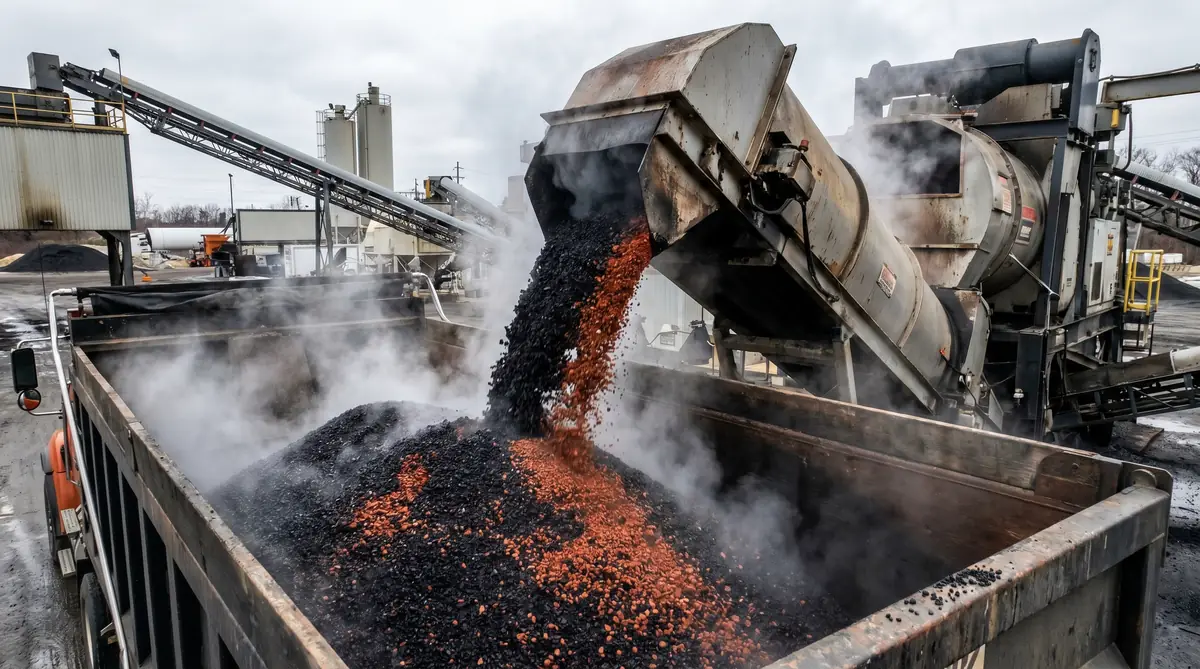
The materials are mixed until every stone is coated. Recycled asphalt, if used, is added at this stage.
- 6
Storage and loading
Finished hot mix goes up a conveyor into insulated storage silos, then drops into trucks that are weighed on a scale.
In a drum plant, drying and mixing happen continuously in the drum, which suits steady, high production. In a batch plant, heated aggregate is screened into hot bins and mixed in separate batches in a pugmill, which makes it easy to switch between mix types. Our asphalt mixing plant guide compares the two and covers plant capacity and cost.
Step 5: Adding Recycled Asphalt
Most asphalt plants now use recycled asphalt pavement (RAP), the material milled or removed from old roads and lots. RAP is crushed and screened into sizes, then added to the mix, where its old binder is reactivated by the heat and its stone is reused. This lowers the amount of new binder and aggregate needed, which saves money and resources. The amount of RAP allowed depends on the specification and the mix. Some plants also use recycled asphalt shingles. See our recycled asphalt pavement guide for more.
Step 6: Quality Control
Throughout asphalt production, plants test the mix to make sure it matches the design. Technicians take samples to check binder content, gradation, temperature and density. On public projects, highway agencies take their own samples too. Trucks are weighed so the customer pays for the correct tonnage, and delivery tickets record the mix type, temperature and weight.
Step 7: Delivery and Paving
Hot mix asphalt is delivered in dump trucks, often with tarps to keep the heat in. Because it must be placed while hot, plants are usually within an hour or so of the job. At the site, the truck dumps the mix into a paver, which spreads it to an even thickness and partially compacts it. Rollers follow closely, compacting the asphalt to the target density before it cools. That compaction is what turns loose hot mix into strong, durable pavement. Our how long asphalt takes to dry guide covers what happens after it is laid.
How Warm Mix and Cold Mix Are Made
Warm mix asphalt
Warm mix asphalt is made the same way as hot mix, but at roughly 30 to 100°F lower temperatures. Additives, chemical packages or water-foaming systems at the plant make the binder workable at the lower temperature. The result is less fuel use, fewer fumes and a longer window to pave.
Cold mix asphalt
Cold mix is made with an asphalt emulsion (binder dispersed in water) or a solvent-thinned binder instead of hot binder. Because it does not need heat to stay workable, it can be stockpiled for months and sold in bags. It is used mainly for patching. See cold asphalt patch.
Asphalt emulsions
Emulsions themselves are made by milling hot binder into tiny droplets in water with an emulsifying agent in a colloid mill. They are used for tack coat, chip seal and many sealers.
How Asphalt Is Made for Roads vs Driveways
The basic way asphalt is made is the same for a highway and a driveway, but the details differ. For a state highway, the plant follows a job mix formula designed in the lab for that project, uses a binder grade chosen for traffic and climate, and is checked by agency inspectors throughout production. The mix may include polymer-modified binder, a set percentage of recycled asphalt and a specific aggregate gradation. Paving often happens at night or in long shifts, with the plant running continuously.
For a home driveway, the contractor usually buys a standard surface mix that the plant already makes every day for small commercial and residential work. Making asphalt for driveways is therefore mostly about timing: the plant mixes the order, the contractor picks it up, and the crew lays it within the hour while it is hot. The quality you get depends as much on how the base is built and how well the asphalt is compacted as on how the asphalt was produced.
How Asphalt Is Made for Shingles and Roofing
Asphalt shingles use the same raw material, refined asphalt, in a very different way. At a shingle factory, a fiberglass mat is saturated and coated with hot asphalt that has been oxidized (air-blown) to make it stiffer and more weather-resistant, then filled with mineral filler. Colored ceramic-coated granules are pressed into the hot surface to protect the asphalt from sunlight, and the sheet is cooled, cut into shingles and packaged. So asphalt for roofs and asphalt for roads both start at the refinery, but the way asphalt is produced for each product is different. See our asphalt vs architectural shingles guide for roof types.
How Asphalt Making Changes With the Seasons
In colder parts of the country, asphalt production is seasonal. Many plants shut down or cut back in winter because hot mix cannot be laid on frozen ground and cools too quickly to compact. During that time, plants maintain equipment, and crews switch to cold patch repairs. Making asphalt ramps up again in spring and runs at full capacity through summer and fall. In warm southern states, plants can make asphalt most of the year. Warm mix technology has helped stretch the season in cooler regions, because the mix can be placed at lower temperatures.
What It Costs to Make Asphalt
The price you pay per ton of hot mix reflects the cost of making asphalt at the plant. The main parts are:
- Binder. The most expensive ingredient per ton, and the one that follows oil prices.
- Aggregate. Cheaper per ton but the largest share of the weight; hauling distance from the quarry matters.
- Fuel. Natural gas, oil or other fuel to dry and heat the stone.
- Plant operation. Labor, maintenance, permits and quality control.
- Recycled content. RAP lowers the amount of new binder and stone, which helps hold down cost.
Together these produce typical hot mix prices of roughly $80 to $160 per ton. Delivery, placement and compaction are added by the paving contractor. See asphalt price per ton and asphalt cost per yard for current ranges.
A Short History of Making Asphalt
People used natural asphalt for thousands of years, as mortar and waterproofing in ancient Mesopotamia and for sealing boats. Modern asphalt paving began in the 1800s, when natural rock asphalt and lake asphalt were used to pave streets in Europe and the United States. Early paving plants heated sand and stone over fires and mixed them with natural asphalt by hand or with simple mixers. As the oil industry grew in the early 1900s, refined asphalt from crude oil became cheaper and more consistent, and purpose-built asphalt plants with rotating dryers and mechanical mixers took over. Over the last decades, how asphalt is made has kept improving with computer-controlled plants, Superpave mix design, warm mix and high recycled content.
Asphalt Production Terms
| Term | Meaning |
|---|---|
| Binder / bitumen / asphalt cement | The liquid asphalt that glues the stone |
| Aggregate | Crushed stone, gravel and sand in the mix |
| Gradation | The blend of aggregate sizes |
| Job mix formula | The recipe a plant follows for a specific mix |
| Drum plant / batch plant | The two main types of plant used in asphalt production |
| Baghouse | Filter that captures dust from the dryer exhaust |
| RAP | Recycled asphalt pavement added to new mix |
| Silo | Insulated storage for finished hot mix |
Common Questions About Making Asphalt
- Is asphalt made the same way everywhere? The principle is the same worldwide, but mixes, binder grades and specifications vary by country, state and climate.
- Is asphalt made from tar? No. Modern asphalt binder is made from crude oil. Coal tar is a different material; see asphalt vs tar.
- Does making asphalt use a lot of recycled material? Yes, increasingly. Old pavement is one of the most commonly recycled construction materials.
- Why is asphalt made hot? Heat makes the binder fluid enough to coat the stone and lets the mix be compacted before it hardens.
How to Make Asphalt: Step-by-Step Summary
If you want the whole process of how to make asphalt in one place, here it is:
- Refine the binder. Crude oil is distilled; the heaviest residue is processed into asphalt binder and graded for climate.
- Produce the aggregate. Stone is quarried, crushed and screened into sizes; sand is washed and stockpiled.
- Design the mix. A lab sets the recipe: how much of each aggregate size and how much binder.
- Feed and heat. At the plant, aggregate is metered from cold bins into a drum and heated to about 300°F.
- Coat with binder. Hot binder is added and mixed until every stone is coated; recycled asphalt is added if used.
- Store and load. The hot mix goes into silos, then into weighed trucks.
- Deliver and pave. Trucks haul it to the job, a paver spreads it and rollers compact it.
That is how asphalt is made for nearly every road, parking lot and driveway. The way asphalt is produced varies in the details, such as drum or batch plant, warm or hot mix, and the amount of recycled content, but these seven steps describe asphalt production almost everywhere.
What Is Asphalt Made Of, Layer by Layer?
Once it is on the ground, the same question, what is asphalt made of, has a second answer: a pavement is built in layers, and each layer can be a different mix. At the bottom is compacted soil, then a crushed stone base. On roads and busy lots, a coarse asphalt base or binder course comes next, made with larger stone. On top is the surface course, made with smaller stone for a smooth, tight finish. A driveway may have just one asphalt layer over the stone base. Each asphalt layer is made the same way at the plant, but with a different aggregate blend, so knowing how asphalt is made also explains why a contractor might order two different mixes for one job.
Why Asphalt Is Made Hot and Placed Fast
Timing runs through everything about how asphalt is made and used. The binder is only fluid enough to coat the stone when hot, and the mix can only be compacted to full density while it stays hot. That is why asphalt is produced close to where it will be laid, hauled in covered trucks, and rolled right behind the paver. If hot mix cools too much before compaction, it ends up with too many air voids and wears out faster. When you watch a paving crew working quickly, they are racing the temperature of the asphalt that was made at the plant less than an hour before.
Signs the Asphalt Was Made and Laid Well
You cannot watch the plant, but you can see the results of good asphalt production and placement on your driveway or lot:
- The surface is evenly black with no brown, dry-looking patches (a sign of too little binder).
- There are no shiny, sticky spots (a sign of too much binder).
- The stone is evenly spread, without coarse streaks or segregated patches.
- The surface is firm and tight after the first few weeks, not loose or raveling.
- The edges are compacted and straight.
If you notice problems in the first weeks, call the contractor; most issues with how asphalt is made or laid show up early.
How Asphalt Is Made More Sustainable
The industry has changed how asphalt is made to reduce its environmental impact. Three changes matter most. First, recycled asphalt: most plants now add reclaimed pavement, so making asphalt uses less new binder and quarried stone. Second, warm mix: producing asphalt at lower temperatures cuts fuel use and fumes. Third, cleaner plants: modern burners and baghouses lower emissions and capture dust. Research into bio-based binder modifiers, such as plant oils, is also under way; see our epoxidized soybean oil asphalt article for one example. Together, these mean the way asphalt is made today is quite different from even a few decades ago.
Making Asphalt for Small Jobs: What Contractors Do
Small paving contractors do not make asphalt themselves; they buy it. For a driveway, the contractor orders the tons of hot mix the job needs, picks it up from the plant early in the day, and paves while it is still hot. On very small jobs, some contractors use a hot box, an insulated trailer with a heater, to keep a few tons of asphalt hot for patching throughout the day. Others use infrared heaters to reheat existing asphalt for repairs. So when homeowners ask how to make asphalt for a small project, the practical answer is that the asphalt is made at the plant and the contractor's job is to keep it hot and place it well.
Can You Make Asphalt at Home?
Not in any practical sense. Making real hot mix asphalt requires heating stone and binder to around 300°F in exact proportions, keeping it hot during placement, and compacting it with heavy rollers. Attempting to heat asphalt binder at home is a serious fire and burn hazard. What homeowners can do:
- Buy bagged cold patch for potholes and small repairs. See how to fix a pothole.
- Use asphalt millings for a low-cost driveway surface; see asphalt millings.
- Hire a paving contractor who buys hot mix from a plant for a new or resurfaced driveway.
How Much Asphalt a Plant Makes
Asphalt plants vary in size, from small and portable to large permanent facilities. Many produce well over 100 tons of hot mix per hour, and the largest produce several hundred tons per hour. That output is why paving crews can lay a whole street in a day. For context, a 600 square foot residential driveway at 2.5 inches thick needs only about 9 tons, a few minutes of plant output. Use the asphalt tonnage calculator to see how many tons your project needs, and asphalt price per ton for material prices.
Environmental Side of Making Asphalt
Making asphalt uses energy to dry and heat the aggregate, and produces emissions from the burner, so plants use baghouses to capture dust and operate under air quality permits. Several trends have reduced the footprint: warm mix lowers fuel use, recycled asphalt reduces the need for new binder and stone, and asphalt itself is one of the most recycled construction materials. Old pavement is routinely milled and reused rather than landfilled.
Frequently Asked Questions
How is asphalt made?
Stone and sand are dried and heated at a plant, mixed with about 5 percent hot asphalt binder from refined crude oil, then trucked hot to the job, spread and compacted.
What is asphalt made of?
About 95 percent aggregate and about 5 percent binder by weight, often with recycled asphalt and small amounts of additives.
Can you make asphalt at home?
No. Use bagged cold patch for small repairs and hire a contractor with plant-made hot mix for paving.
What temperature is asphalt made at?
About 275 to 325°F for hot mix; warm mix is made roughly 30 to 100°F cooler.
Where does asphalt binder come from?
From crude oil refining. It is the heavy residue left after lighter fuels are removed.
Sources
- National Asphalt Pavement Association — how asphalt pavement is produced and recycled. asphaltpavement.org
- Federal Highway Administration — asphalt pavement technology, warm mix and RAP. fhwa.dot.gov
- Images and diagram: Asphapro.com.
Temperatures and proportions are typical values; mix designs vary by specification.