
Hydraulic Concrete and Hydraulic Cement: What They Are and How They Are Used
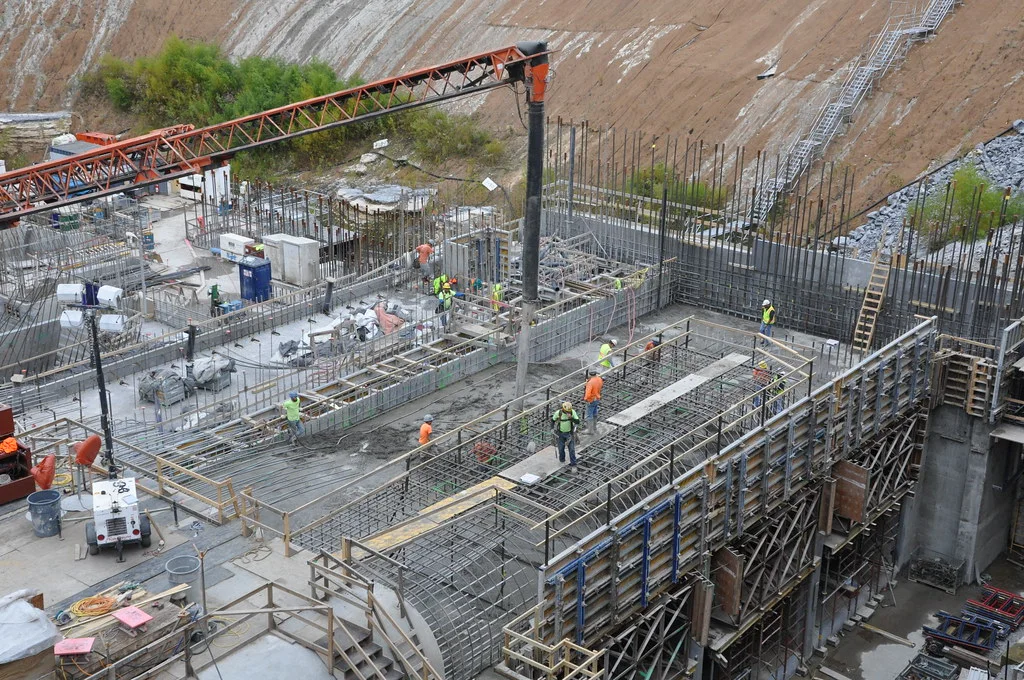
Photo: NashvilleCorps (U.S. Army Corps of Engineers), Flickr, CC BY-SA 2.0
Quick Answer
Hydraulic concrete has two common meanings. In the technical sense, all ordinary concrete is hydraulic, because it is made with hydraulic cement, cement that hardens by reacting chemically with water and can set even underwater; Portland cement is the main example. In construction, hydraulic concrete also means concrete built to hold or move water: dams, spillways, canals, locks, pipes, tanks and treatment plants, designed for low permeability, crack control and resistance to erosion. To homeowners, hydraulic cement usually means a fast-setting, slightly expanding patching cement that sets in about 3 to 5 minutes and is pressed into cracks and holes to stop active water leaks in basement walls, foundations, pipes and pools. It is a quick fix for leaks, not a structural crack repair or a full waterproofing system.
Water is concrete's partner and its enemy. Concrete needs water to harden, yet many of the largest concrete structures ever built exist to hold water back or carry it somewhere: dams, canals, navigation locks, sewers and reservoirs. The photo above shows hydraulic concrete construction on a large scale: a new lock chamber on a river, with heavily reinforced walls and floor being formed and poured to hold back tons of moving water. At the other end of the scale, a small bucket of hydraulic cement can stop a trickle of water coming through a basement wall in minutes.
This guide explains what hydraulic means for cement and concrete, how hydraulic cement products plug leaks and how to use them, their limits, and how hydraulic concrete structures such as dams and tanks are designed and built. For basics on cement types, see cement vs concrete.
What Does Hydraulic Mean for Cement and Concrete?
A hydraulic cement is any cement that sets and hardens by chemical reaction with water and keeps its strength and stability underwater. ASTM C219 defines it that way. Portland cement, blended cements and most modern cements are hydraulic. That is why concrete hardens through hydration rather than drying, and why it can be placed underwater for bridge piers and sea walls.
The opposite is a non-hydraulic binder, such as traditional lime putty or gypsum plaster, which hardens by drying or by absorbing carbon dioxide from the air and softens or dissolves when kept wet. Non-hydraulic binders work for interior plaster and mortar in dry conditions but cannot make hydraulic concrete for water structures.
In everyday use, then, hydraulic concrete can mean any concrete made with hydraulic cement, which is nearly all concrete, or more specifically concrete designed for water-retaining and water-conveying structures. And hydraulic cement on a hardware store shelf means a special fast-setting product for leaks. The context tells you which one is meant. See wet concrete for how hydration works.
A Short History of Hydraulic Cement
Roman concrete. The Romans mixed lime with volcanic ash from around Pozzuoli, near Naples, creating a hydraulic binder that hardened underwater. Roman harbor structures built with this hydraulic concrete still survive after two thousand years in seawater, and the word pozzolan, for reactive ash, comes from that town.
Smeaton and hydraulic lime. In the 1750s, English engineer John Smeaton experimented with limes for the Eddystone Lighthouse and found that limestone containing clay produced a hydraulic lime that set underwater, a key step toward modern cement.
Portland cement. Joseph Aspdin patented Portland cement in 1824, and later improvements in burning temperature produced the strong hydraulic cement used today.
Modern hydraulic cements. Today's hydraulic cements include Portland cements (ASTM C150), blended cements with slag, fly ash, limestone or pozzolans (ASTM C595), and performance-based hydraulic cements (ASTM C1157) classified by properties such as general use, high early strength, moderate or high sulfate resistance, and moderate or low heat of hydration.
Hydraulic Cement for Stopping Leaks
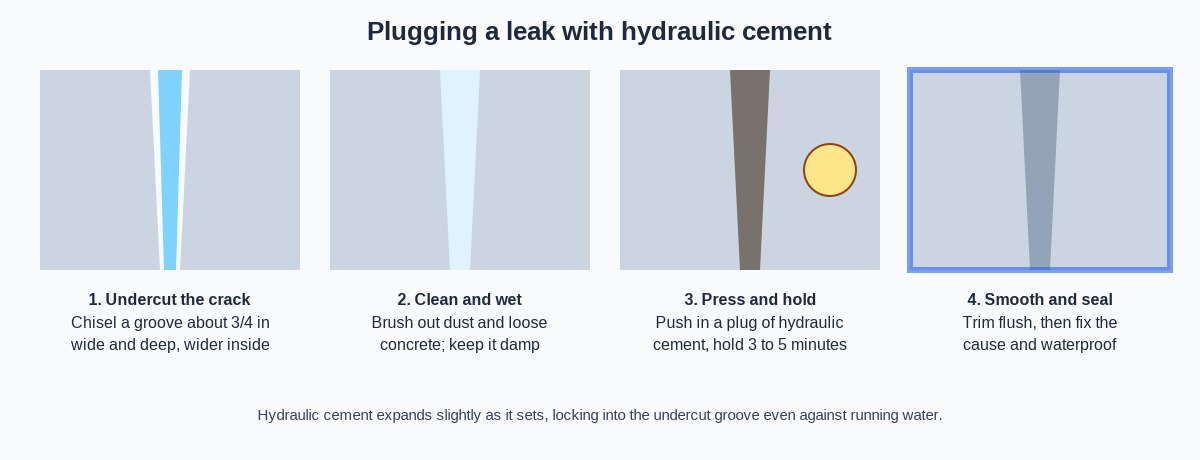
Fast-setting hydraulic cement, sometimes called water-plug or leak-stop cement, is a blend of hydraulic cements and additives designed to set within a few minutes and expand slightly as it hardens. Because it sets so quickly and expands, it can be packed into a hole or crack that is actively leaking water and hold against the flow. Typical properties:
Set time: about 3 to 5 minutes, with only 1 to 3 minutes of working time.
Expansion: slight expansion locks the plug into the opening.
Works wet: it can be applied to wet surfaces and even under running water.
Strength: hardens to a concrete-like strength, often several thousand psi.
Common uses: plugging leaks in basement walls and floors, sealing around pipes that pass through foundations, anchoring railings and bolts quickly, patching leaks in concrete cisterns, ponds, pools and manholes, and sealing the joint between a basement wall and floor where water seeps in.
How to Use Hydraulic Cement to Plug a Leak
The diagram above shows the process. In more detail:
1. Prepare the opening. Using a cold chisel and hammer, enlarge the crack or hole to at least about 3/4 inch wide and deep, and undercut it so it is wider inside than at the surface, a dovetail shape that locks the plug in. Remove all loose and crumbling concrete.
2. Clean. Brush or blow out dust and debris. The surface should be clean and damp, not dry.
3. Mix small batches. Mix only as much hydraulic cement as you can place in about 2 to 3 minutes, with cool water, to a putty-like consistency. Wear waterproof gloves.
4. Shape and press. Roll the mix into a plug or cone, wait until it begins to warm and stiffen slightly, then push it firmly into the opening, starting at the top of a crack and working down, or at the point of the strongest leak last.
5. Hold it. Hold steady pressure with your hand or a trowel for 3 to 5 minutes until it sets.
6. Finish. Trim it flush with a trowel and keep it damp for about 15 minutes.
7. Waterproof. After the hydraulic cement cures, apply a cementitious waterproof coating or sealer over the area if needed.
For larger leaks with strong flow, plumbers and contractors relieve the pressure first by inserting a small tube into the leak to channel the water away, plugging around it, and then plugging the tube last.
Limits of Hydraulic Cement
Not a structural repair. Hydraulic cement fills and seals; it does not restore strength to a cracked foundation. Cracks that are wide, growing, offset or horizontal suggest structural movement and need professional evaluation. See concrete wall crack repair.
Rigid. It does not flex. Cracks that open and close with seasons will usually reopen around a rigid plug. Flexible polyurethane injection is often better for moving cracks. See epoxy concrete crack repair.
Does not fix the cause. Water leaking through a basement wall is driven by water pressure in the soil. Gutters, grading, drainage and exterior waterproofing address the source; a plug only treats the symptom. See is concrete waterproof.
Thin coats fail. Hydraulic cement should be packed into openings, not spread thinly over surfaces, where it can crack and debond.
Short working time. Mixing too much at once wastes material, since it hardens in the bucket.
Hydraulic Concrete Structures: Dams, Canals and Tanks
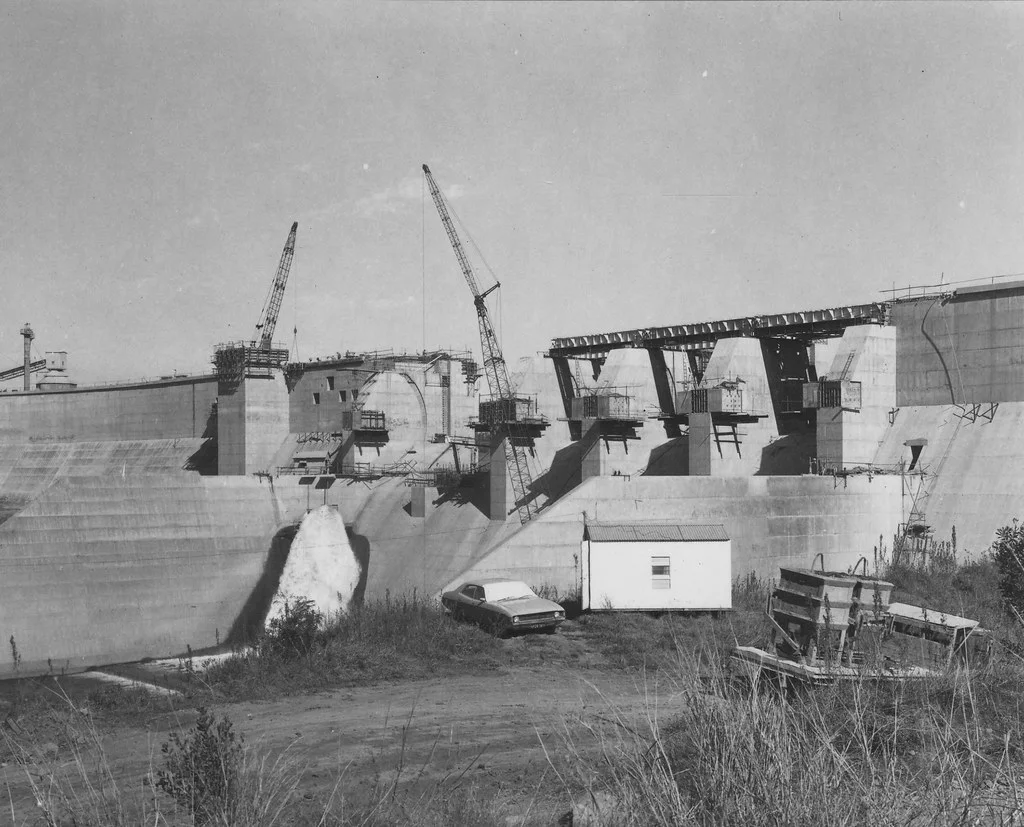
Photo: Queensland State Archives, Flickr, Public Domain Mark
The photo above, from the construction of a dam in 1974, shows hydraulic concrete in its most dramatic form: spillway piers and a massive concrete wall built to hold back a reservoir. Hydraulic concrete structures include:
Dams. Gravity dams rely on the sheer weight of concrete to resist water pressure; arch dams curve into the canyon walls. Hoover Dam contains about 3.25 million cubic yards of concrete, and Grand Coulee Dam about 12 million. Many newer dams use roller-compacted concrete. See roller-compacted concrete.
Spillways and stilling basins. Channels that carry flood water over or around a dam at high speed, requiring concrete that resists abrasion and cavitation.
Navigation locks. Massive walls and floors that hold water at different levels as boats pass, as in the photo at the top of this page.
Canals and channels. Concrete-lined irrigation and flood control channels that reduce seepage and erosion.
Pipes, culverts and box culverts. Precast concrete pipe and culverts that carry stormwater and sewage. See precast concrete.
Water and wastewater tanks. Reservoirs, clarifiers, digesters and treatment basins designed to hold liquids without leaking.
Marine structures. Sea walls, piers and breakwaters exposed to waves and seawater.
Design Requirements for Hydraulic Concrete
Hydraulic concrete structures must hold or carry water for decades without leaking, cracking excessively or wearing away. Standards such as ACI 350 for environmental engineering structures and the U.S. Army Corps of Engineers' civil works manuals set stricter requirements than ordinary building concrete:
Low permeability. Hydraulic concrete uses a low water-cementitious materials ratio, often 0.40 to 0.45 or lower, so water cannot travel easily through the concrete.
Crack control. More reinforcement, closer bar spacing and lower allowable steel stresses keep cracks narrow so they do not leak. Many water tanks are designed so cracks stay fine enough to self-seal.
Durability. Hydraulic concrete exposed to freezing needs air entrainment; concrete exposed to sulfates in soil or wastewater needs sulfate-resistant cement; marine and wastewater structures need protection against chloride and chemical attack.
Cover. Thicker concrete cover over reinforcement, often 2 inches or more, protects steel from corrosion in wet environments.
Joints and waterstops. Carefully detailed construction and movement joints with waterstops prevent leaks at the weakest points.
Curing. Extended moist curing produces dense, watertight concrete.
Mass Hydraulic Concrete and Heat Control
Dams and other massive hydraulic concrete structures face a special problem: the heat released by cement hydration. In a thick placement, the interior can heat up by 50°F or more while the surface cools, and the difference causes thermal cracking. Engineers control heat in mass hydraulic concrete by using low-heat cements and large amounts of fly ash or slag, lowering cement content, using large aggregate, cooling the concrete with chilled water or ice, placing it in lifts of limited height, and, in some dams, circulating cold water through embedded pipes. Hoover Dam was built in interlocking columns with embedded cooling pipes; without them, engineers estimated the concrete would have taken over a century to cool. ACI 207 covers mass concrete design and construction.
Erosion, Abrasion and Cavitation
Fast-moving water attacks hydraulic concrete in ways ordinary concrete never sees:
Abrasion-erosion. Sand, gravel and debris carried in water grind away concrete in spillways, stilling basins, channels and outlet works. Hard aggregate, high-strength concrete, silica fume and steel fibers improve resistance.
Cavitation. When water flows very fast over an irregular surface, vapor bubbles form and collapse violently, pitting and destroying concrete. Smooth, carefully finished surfaces, aeration slots that add air to the flow, and high-strength hydraulic concrete reduce cavitation damage.
Freeze-thaw and wet-dry cycles. Concrete at the waterline of dams, locks and canals is constantly saturated and freezes in winter, requiring well air-entrained concrete.
Joints and Waterstops in Hydraulic Concrete
Every joint in a water-retaining structure is a potential leak. Hydraulic concrete designers place joints carefully and seal them with waterstops: strips of PVC, rubber, or metal cast into the concrete across the joint, which water cannot pass. Hydrophilic waterstops swell when wet to seal tight. Construction joints are cleaned and roughened before the next pour. Expansion and contraction joints in canals and tanks are filled with flexible sealants. Poorly placed or displaced waterstops are one of the most common causes of leaks in hydraulic concrete structures, which is why inspectors check them closely before each pour.
Leakage Testing of Water Tanks
Concrete tanks for drinking water and wastewater are usually tested for watertightness before they go into service. Under ACI 350.1, the tank is filled with water and the level is monitored over several days, accounting for evaporation and rainfall. The allowable loss is very small, typically a fraction of a percent of the volume per day, and no visible flow or damp spots on the outside are permitted for many tank types. If a tank fails, leaks are found and repaired, often with injection grouts or, for small active leaks, hydraulic cement, and the test is repeated.
Repairing Hydraulic Concrete Structures
Aging hydraulic concrete in dams, locks, canals and pipes needs regular inspection and repair. Common repair methods include crack injection with epoxy or polyurethane, removal and replacement of deteriorated concrete, shotcrete overlays on canal linings and walls, underwater concrete placement by tremie or pump for submerged repairs, and specialized abrasion-resistant overlays on spillways. For small active leaks in tanks, manholes and tunnels, fast-setting hydraulic cement remains a simple, effective first step. See shotcrete vs gunite.
Hydraulic Concrete at Home: Ponds, Cisterns and Pools
Homeowners build small hydraulic concrete structures too: garden ponds, rainwater cisterns, fountains, septic tanks, retaining walls with water behind them, and swimming pools. The same principles apply on a smaller scale. Use a dense mix with a low water-cement ratio, place and consolidate it well, reinforce it to control cracks, cure it moist for at least a week, and seal or coat it with a cementitious waterproofing or pond-safe coating. For small leaks in an existing concrete pond, cistern or pool, drain it below the leak, chisel out the crack, and pack it with hydraulic cement, then coat the area. See concrete fountain.
Hydraulic Cement vs Other Patching Products
Hydraulic cement vs mortar or concrete patch. Standard patching mortars set in hours and shrink slightly; they cannot stop running water. Hydraulic cement sets in minutes and expands, so it seals active leaks.
Hydraulic cement vs epoxy. Epoxy injection bonds cracks structurally but needs a dry or nearly dry crack and cannot stop flowing water by itself.
Hydraulic cement vs polyurethane foam. Polyurethane injection reacts with water, foams and stays flexible, making it the preferred professional method for leaking cracks that move. Hydraulic cement is cheaper and simpler for holes, tie holes and pipe penetrations.
Hydraulic cement vs waterproof coatings. Cementitious and elastomeric coatings cover a whole wall surface to reduce dampness; they are often applied after leaks are plugged with hydraulic cement.
Hydraulic Cement Cost
Fast-setting hydraulic cement is inexpensive: small containers of about 10 pounds typically cost about $10 to $25, and larger 50 pound pails or bags about $40 to $90, depending on brand and store. A 10 pound container plugs many small holes or a few feet of crack. Professional leak repair in a basement with injection typically costs a few hundred dollars per crack, while full basement waterproofing costs thousands. For pricing on structural hydraulic concrete, such as tanks and channels, costs depend on design, formwork and reinforcement and run well above ordinary flatwork. See concrete cost guide.
Placing Hydraulic Concrete Underwater
Because hydraulic cement hardens by reaction with water, hydraulic concrete can be placed directly underwater for bridge piers, cofferdam seals, pier repairs and marine foundations. The challenge is keeping water from washing the cement out of the fresh mix. Contractors use a tremie, a steel pipe whose lower end stays buried in the fresh hydraulic concrete so new concrete pushes the mass outward and upward without falling through water. Pumped placement with the hose end buried works the same way. Antiwashout admixtures make underwater hydraulic concrete cohesive and sticky so it resists washout even when it flows through water briefly. Divers often guide and inspect underwater hydraulic concrete placements, and the top layer, exposed to water, is usually removed or tolerated as lower quality.
Hydraulic Concrete in Sewers and Wastewater Plants
Wastewater structures are one of the toughest environments for hydraulic concrete. In sewers and treatment plants, bacteria convert hydrogen sulfide gas into sulfuric acid on the crown of pipes and the walls of manholes and tanks above the water line, slowly dissolving the cement paste. Hydraulic concrete for these structures uses dense, low-permeability mixes, sulfate-resistant cements, calcium aluminate cement liners, sacrificial concrete thickness, plastic or epoxy liners, and ventilation to reduce gas. Rehabilitation of old concrete sewers often involves spray-applied cementitious or epoxy liners. Small infiltration leaks through manhole walls are commonly plugged with hydraulic cement before the walls are relined.
Basement Leaks: When Hydraulic Cement Is Enough
Hydraulic cement works well for:
Form tie holes in poured foundation walls that let water through.
Pipe penetrations where water enters around a pipe through the wall.
Small, stable cracks that leak during heavy rain but do not move.
The cove joint where wall meets floor, as part of a broader fix.
Holes in block walls and mortar joints.
It is not enough when water comes through many places, when cracks are widening or horizontal, when the whole wall is damp, or when the floor floods from below. Those situations call for drainage improvements, interior drain tile and a sump pump, exterior waterproofing, or structural repair. A good rule is to use hydraulic cement as a first aid for leaks in hydraulic concrete and masonry walls, then deal with the water source outside.
Storing and Handling Hydraulic Cement
Because it reacts so quickly with water, hydraulic cement is sensitive to humidity. Keep containers tightly sealed in a dry place, off concrete floors, and use partly opened containers within a few months; lumpy powder has already started to react and will not set properly. Mix with cool, clean water, since warm water shortens the already brief working time, and in hot weather work in very small batches. In cold weather, hydraulic cement sets more slowly, so warm the material and the surface slightly if possible, and protect the patch from freezing for the first day. Always wear gloves and eye protection, because hydraulic cement, like all hydraulic concrete products, is caustic when wet.
Testing Hydraulic Concrete Quality
Large hydraulic concrete projects are tested far more than ordinary construction. Besides strength cylinders, engineers may test permeability, chloride penetration resistance, abrasion resistance, freeze-thaw durability and the temperature rise of mass placements. Embedded temperature sensors track heat in dams and thick walls, and cores drilled from finished hydraulic concrete confirm density and bond between lifts. On dam projects, test sections are often built before the main work to confirm the mix and placement methods. See concrete cylinder test.
Famous Hydraulic Concrete Structures
Some of the most famous engineering works in the world are hydraulic concrete structures. Hoover Dam on the Colorado River, completed in 1936, was the largest concrete structure of its time and pioneered cooling methods still used for mass concrete. Grand Coulee Dam in Washington remains one of the largest concrete structures in North America. The Panama Canal locks, opened in 1914, were among the first great uses of reinforced hydraulic concrete for navigation, and the newer locks opened in 2016 used millions of cubic yards more. Three Gorges Dam in China holds the record for the largest volume of concrete in a single dam. Each of these projects pushed the science of hydraulic concrete forward, from heat control and mix design to placement methods and quality testing that ordinary construction later adopted.
Frequently Asked Questions
Can hydraulic cement be used underwater?
Yes. Fast-setting hydraulic cement can be packed into leaks under running water, and hydraulic concrete for structures can be placed underwater with a tremie pipe.
Is Portland cement a hydraulic cement?
Yes. Portland cement is the most common hydraulic cement; it hardens by reacting with water and remains stable underwater. That is why almost all concrete is hydraulic concrete.
How thick can hydraulic cement be applied?
It should be packed into openings at least about 3/4 inch deep. It is not meant for thin surface coats over large areas.
What makes hydraulic concrete watertight?
A low water-cement ratio, good consolidation, crack-controlling reinforcement, waterstops at joints, and proper curing make hydraulic concrete dense and watertight.
Does hydraulic cement stop basement leaks permanently?
It can permanently seal a small, stable hole or crack, but if water pressure outside remains, leaks often appear elsewhere. Fix drainage and grading too.
What is hydraulic concrete?
Concrete made with hydraulic cement, which hardens by reacting with water, or, more specifically, concrete designed for water structures such as dams, canals and tanks.
What is hydraulic cement used for?
Around the house, fast-setting hydraulic cement is used to stop active leaks in concrete and masonry and to anchor bolts and posts quickly.
How long does hydraulic cement take to set?
Usually about 3 to 5 minutes, with full strength developing over the following days.
Is hydraulic cement waterproof?
It is dense and blocks water where it is packed in, but it is not a waterproofing system for whole walls.
Sources
- ASTM C1157: performance specification for hydraulic cement
- American Concrete Institute: ACI 350 environmental engineering concrete structures and ACI 207 mass concrete
- U.S. Army Corps of Engineers: EM 1110-2-2000, standard practice for concrete for civil works structures
- U.S. Bureau of Reclamation: Hoover Dam facts
- Portland Cement Association: history and types of cement
Related Guides
- Concrete canoe — how a concrete boat floats and the ASCE competition