
Spray Concrete: Shotcrete vs Gunite, How It Works and Where It Is Used
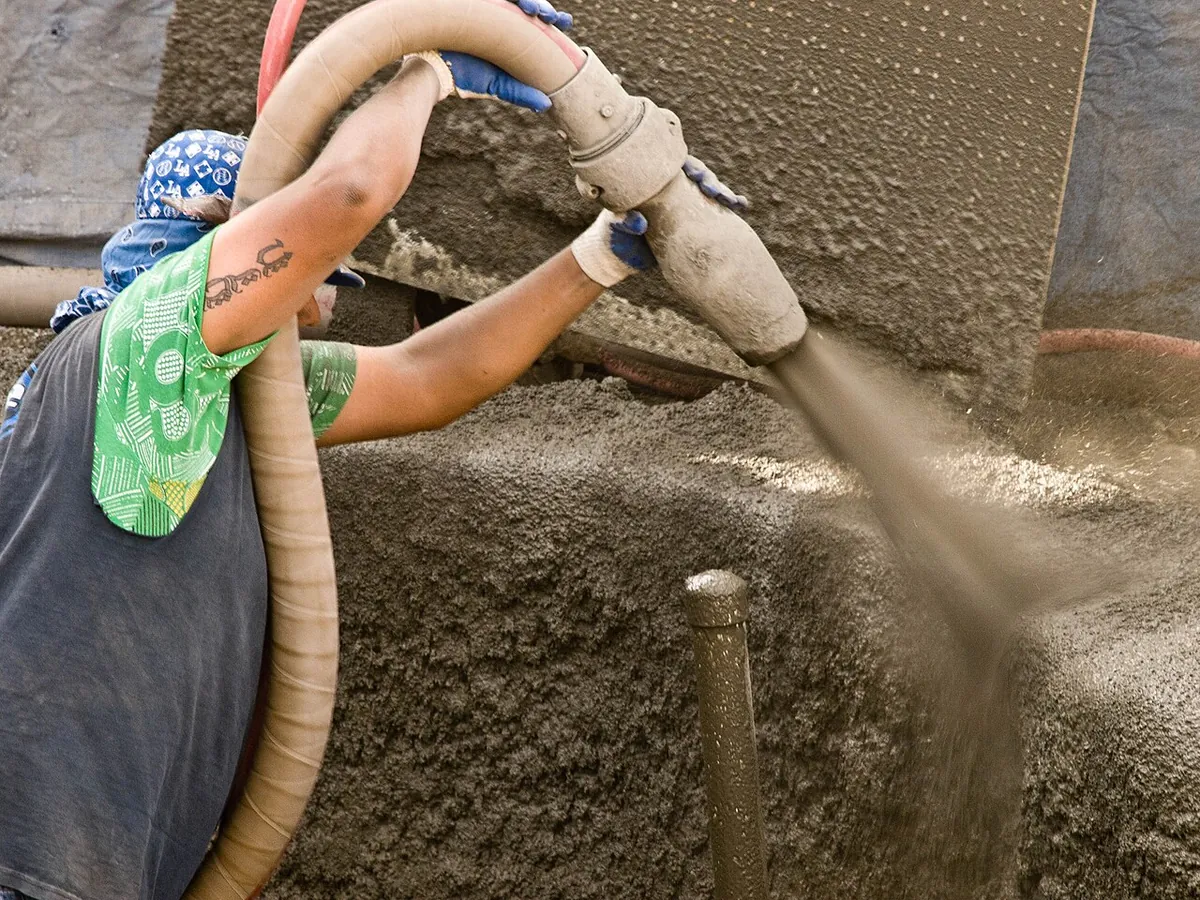
Photo: Dorian Wallender, Wikimedia Commons, CC BY-SA 2.0
Quick Answer
Spray concrete, called shotcrete, is concrete or mortar shot through a hose and nozzle at high speed onto a surface, where it compacts itself on impact. There are two processes. Wet-mix shotcrete pumps ready-mixed concrete to the nozzle, where compressed air sprays it. Dry-mix shotcrete, known as gunite, blows dry cement and sand through the hose and adds water at the nozzle. Both are real concrete, so gunite vs concrete is really sprayed concrete vs poured concrete. Sprayed concrete is used for swimming pools, tunnels, slopes, retaining and soil-nail walls, repairs of bridges and dams, and curved shapes, because it needs a form on only one side. Typical strengths are about 4,000 to 7,000 psi.
Most concrete is poured into forms that hold it on both sides until it hardens. Spray concrete works differently: it is shot onto a backing, such as earth, rock, a rebar cage with one-sided forms, or old concrete, and sticks there, building up layer by layer. That lets crews shape freeform swimming pools, line tunnels as they are dug, stabilize cut slopes, and rebuild damaged structures without building expensive formwork. For homeowners, spray concrete is most familiar from in-ground pools, where the terms gunite and shotcrete come up in every quote.
This guide explains how spray concrete works, shotcrete vs gunite, wet vs dry process, how sprayed concrete compares with poured concrete, where it is used, pools in particular, quality and strength, spray on concrete coatings for patios and pool decks, and costs.
What Is Spray Concrete?
Spray concrete, or shotcrete, is defined by the American Concrete Institute as concrete or mortar conveyed through a hose and pneumatically projected at high velocity onto a surface. The force of impact compacts the material, so no vibration is needed, and the mix is designed to stick to vertical and even overhead surfaces without sagging. Spray concrete is placed in layers by a nozzleman who directs the stream, controls the thickness and, in dry-mix work, adjusts the water. Finishers then cut and trowel the surface as needed.
The ingredients are the same as ordinary concrete: cement, sand, often small coarse aggregate up to about 3/8 or 1/2 inch, water and admixtures, sometimes with steel or synthetic fibers and accelerators. Mixes generally use smaller aggregate and more cement than ordinary concrete so they pump and spray well.
Shotcrete vs Gunite: Wet Mix vs Dry Mix
Wet-mix shotcrete
In the wet process, concrete is batched and mixed with water at a plant or on site, then pumped through the hose like pumped concrete. At the nozzle, compressed air is injected to accelerate the stream onto the surface. Because the water is measured at batching, the water-cement ratio is controlled precisely, and production rates are high, often several cubic yards per hour. Wet-mix is common for pools, large walls, tunnels and slope work. Rebound, the material that bounces off and is wasted, is relatively low, often around 5 to 10 percent.
Dry-mix shotcrete (gunite)
In the dry process, cement and damp sand (and sometimes small aggregate) are mixed dry and fed into a gun that blows them through the hose with compressed air. Water is added through a ring at the nozzle, and the nozzleman controls the amount by feel and eye. The term gunite started as a trademark for this process in the early 1900s and is still widely used, especially in the pool industry. Dry-mix is good for smaller jobs, repairs, overhead work and remote sites, because the equipment is smaller and the material can be stopped and started easily without wasting concrete. Rebound is higher, often 15 to 30 percent on walls and more overhead, and the quality depends heavily on the nozzleman's skill.
| Feature | Wet-mix shotcrete | Dry-mix gunite |
|---|---|---|
| Water added | At the plant or mixer | At the nozzle |
| Water-cement control | Precise | Depends on the nozzleman |
| Output | High | Lower |
| Rebound | Low | Higher |
| Stop and start | Wasteful once mixed | Easy |
| Dust | Low | Higher |
| Typical uses | Pools, walls, tunnels, slopes | Pools, repairs, overhead, small jobs |
Both spray concrete processes can produce excellent, strong concrete when done by qualified crews. In the pool industry, debates between gunite and shotcrete are mostly about crew skill and logistics, not about one material being fundamentally better.
Gunite vs Concrete: Sprayed vs Poured
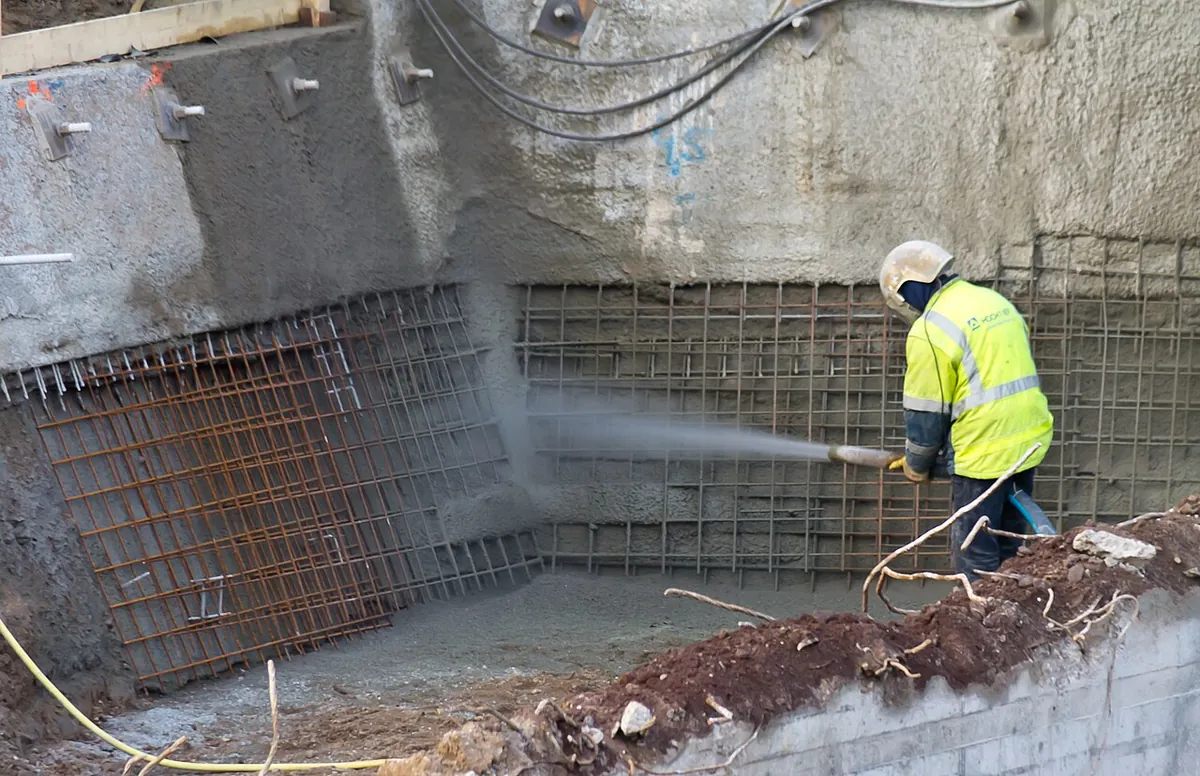
Photo: Raimond Spekking, Wikimedia Commons, CC BY-SA 4.0
People ask about gunite vs concrete as if they were different materials, but gunite is concrete, placed by spraying. The real comparison is sprayed concrete vs cast-in-place concrete poured into forms:
- Formwork: sprayed concrete needs a backing on one side only, or none against rock and soil; poured concrete needs forms on both sides for walls.
- Shapes: spray concrete handles curves, freeform pools, domes and irregular surfaces easily; poured concrete is best for straight, repeated shapes.
- Consolidation: sprayed concrete compacts on impact; poured concrete is vibrated.
- Quality control: poured concrete quality depends on the mix and placement; sprayed concrete also depends heavily on the nozzleman's technique, angle and distance.
- Cost: sprayed concrete costs more per cubic yard placed but can save far more in forms and time on the right job.
- Strength: well-placed shotcrete matches or exceeds typical poured concrete, often 4,000 to 7,000 psi.
Where Sprayed Concrete Is Used
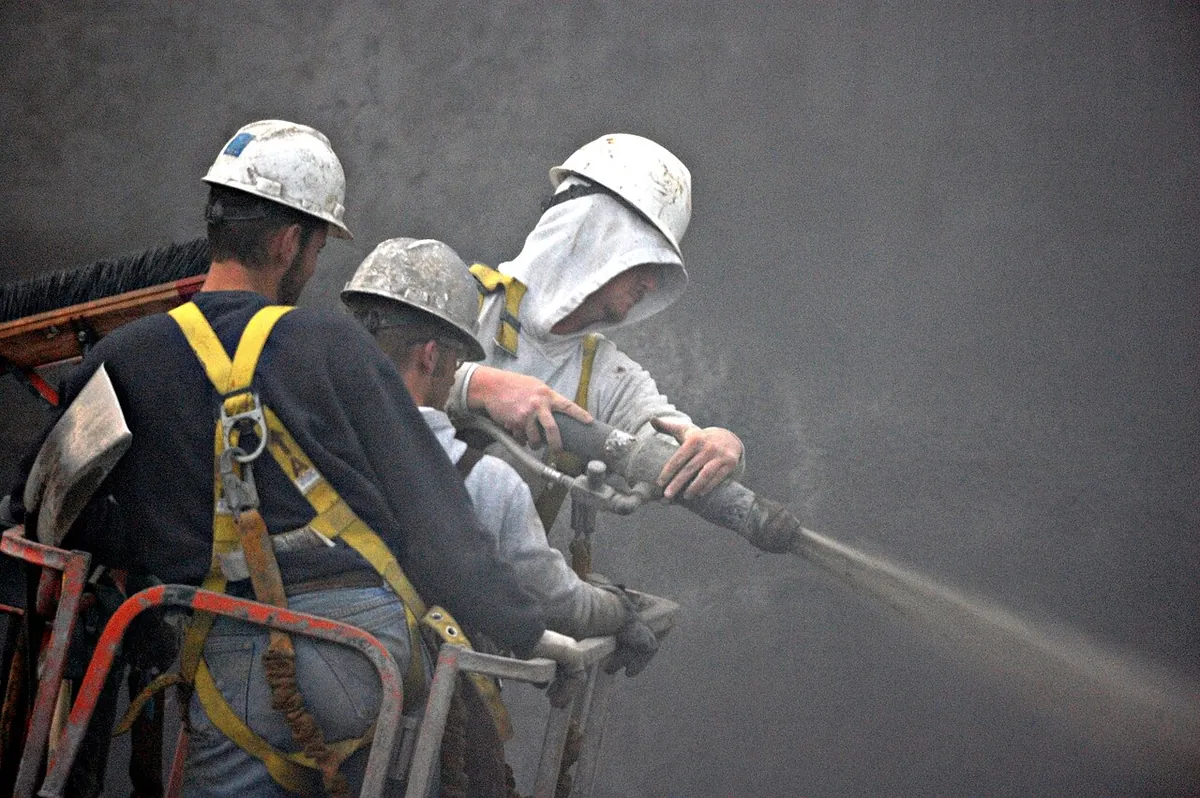
Photo: dw_ross, Wikimedia Commons, CC BY 2.0
- Swimming pools and spas: the most common residential use, shaping the shell over a rebar cage.
- Tunnels and mines: lining freshly excavated rock and ground, often with steel fibers and rock bolts.
- Slope stabilization and soil-nail walls: shotcrete facing over soil nails or anchors holds back excavations and road cuts.
- Retaining and basement walls: sprayed against shoring or one-sided forms.
- Repair and rehabilitation: rebuilding spalled bridges, dams, piers, sewers and parking structures. See concrete spalling.
- Canals and channels: lining irrigation and drainage channels.
- Artificial rock and themed structures: zoo exhibits, water features and climbing walls.
- Domes and thin shells: sprayed onto inflated forms or mesh.
Spray Concrete for Swimming Pools
Most in-ground concrete pools are built with spray concrete, either wet or dry sprayed concrete. After excavation, plumbing and a rebar grid shaped to the pool, a crew sprays gunite or shotcrete onto the steel, typically 6 to 12 inches thick, building walls, floor, steps and benches in one continuous shell. Finishers trim and shape the surface by hand. The shell then needs curing: crews or homeowners usually spray it with water a couple of times a day for about a week or more, because a dry shell can crack. After curing, tile, coping and an interior finish such as plaster, aggregate or quartz are applied. Pool builders should use certified nozzlemen and follow ACI and American Shotcrete Association guidance; ask your builder who will be on the nozzle and how they will cure the shell. For decks around pools, see concrete pool deck repair.
Quality, Strength and Rebound
Good sprayed concrete, like any concrete spray work, comes down to the mix, the equipment and, above all, the nozzleman. The nozzle should be held about 2 to 6 feet from the surface and roughly perpendicular to it, so material compacts and does not trap rebound or create voids behind rebar. Rebound, sand and stone that bounce off, must be cleaned out and never shot back into the work, because it lacks cement and creates weak pockets. Test panels are often shot before work starts, and cores are taken to check strength and look for voids. The American Concrete Institute offers certification for shotcrete nozzlemen, and specifications often require it. Well-placed shotcrete is dense and durable, with compressive strengths commonly 4,000 to 7,000 psi and low permeability.
A Short History of Spray Concrete
Spray concrete began with a museum taxidermist. In 1907, Carl Akeley, working on animal displays for the Field Museum in Chicago, invented a "cement gun" to blow mortar onto wire frames, and soon used it to repair the museum's crumbling facade. The process, marketed as gunite, spread quickly to building, mining and repair work, and sprayed concrete was used on tunnels, dams and ships in the early 20th century. Wet-mix shotcrete arrived after World War II with better concrete pumps. In the 1960s, the New Austrian Tunneling Method made sprayed concrete the primary support for many tunnels, and steel fibers, accelerators and robotic nozzles followed. Today spray concrete is used on everything from backyard pools to the world's longest tunnels.
Spray Concrete in Tunnels and Mines
Tunnels are where spray concrete does some of its most demanding work, and sprayed concrete is often the first lining placed. As a tunnel advances, a layer of sprayed concrete, often with steel or macro-synthetic fibers and a set accelerator, is applied to the freshly exposed rock or soil within hours, sometimes minutes, of excavation. It seals the surface, prevents loose rock from falling, and works with rock bolts and steel ribs to support the ground. Robotic spraying arms place the concrete at high output while keeping workers away from unsupported ground. Later, a final lining of sprayed or cast concrete is added. Mines use similar methods for shafts and drifts. The high early strength needed in tunnels is one reason accelerators and fiber-reinforced sprayed concrete were developed. See fiber concrete.
Spray Concrete for Slopes and Soil Nail Walls
Road cuts, building excavations and unstable hillsides are often held in place with soil nail walls: steel bars drilled and grouted into the slope, with a facing of spray concrete over welded wire mesh tying them together. The concrete spray is applied in lifts from the top down as excavation proceeds, so the wall is built as the hole is dug. Shotcrete facings are also used over rock bolts, on dam faces and spillways, and on canals and drainage channels. Sprayed concrete can be sculpted and colored to look like natural rock, a common finish on highways and in parks. For home retaining walls, see concrete block wall cost.
Curing Sprayed Concrete
Sprayed concrete is usually applied in relatively thin layers with a lot of surface area, so it dries out quickly and needs good curing. Pool shells are typically kept wet with a hose or sprinkler several times a day for at least 7 days; some builders recommend longer in hot, dry climates. Walls and slopes may be cured with curing compounds, wet burlap or fog sprays. Inadequate curing leads to shrinkage cracks, weak surfaces and poor bond between layers. In cold weather, sprayed concrete must be protected from freezing like any concrete. See concrete curing compound.
How Much Does Spray Concrete Cost?
Spray concrete is usually priced per cubic yard placed or per square foot of finished surface, including equipment, crew and material. Rough U.S. ranges: structural shotcrete commonly runs from several hundred to over a thousand dollars per cubic yard placed, depending on access, thickness, reinforcement and job size, far more per yard than poured concrete, but often less overall once formwork savings are counted. A complete in-ground gunite or shotcrete pool usually costs tens of thousands of dollars, with the shell being only one part of the total along with excavation, plumbing, tile, coping, finish, decking and equipment. Thin spray on concrete coatings for patios and pool decks typically cost a few dollars to about $10 per square foot. Get detailed quotes that state thickness, strength and curing, and compare apples to apples, since a cheap price often hides a thinner shell or shorter curing.
Choosing a Spray Concrete Contractor
Because the quality of spray concrete depends so much on the crew, and every concrete spray job is only as good as the nozzleman, choosing the contractor matters. Ask whether the nozzlemen are ACI-certified and how many similar projects they have done. Ask whether they use wet-mix or dry-mix and why, how they handle rebound, what thickness and strength they will deliver, and how they will cure the work. For pools, ask to see shells they have shot recently and talk to past customers about cracking or leaks years later. For structural work, the engineer may require test panels and cores. A reputable sprayed concrete contractor will welcome these questions.
Safety and Dust
Spray concrete operations create dust, especially dry-mix gunite, and the dust contains cement and silica. Nozzlemen and helpers wear respirators, eye protection and protective clothing, and the area around the spraying should be kept clear of people and anything that should not be coated. Overspray travels, so neighbors' cars, windows and fences may need covering. Hoses carry high pressure, and blockages can whip a hose dangerously, so only trained crews should operate the equipment. Homeowners watching a pool shell being shot should stay well back from the nozzle, the hose line and the pump, and keep children and pets indoors until the crew has finished and cleaned up.
Spray Concrete Mix Design
A spray concrete mix has to do three things at once: flow through a hose, stick to a vertical or overhead surface without sliding off, and harden into dense, durable concrete. That calls for a different balance than a slab mix. Spray concrete usually has a higher cement content, often 650 to 850 pounds per cubic yard, more fine aggregate, and a smaller maximum stone size, typically 3/8 inch, sometimes 1/2 inch. Silica fume is often added to make the mix stickier, reduce rebound and improve strength and durability. Air entrainment is used in freeze-thaw exposures, although some of the air is lost on impact, so higher initial air contents are batched. Water reducers keep the water-cement ratio low while maintaining pumpability, and accelerators make each layer set quickly so the next layer can follow. Fibers add toughness and control cracking. For dry-mix gunite, the sand and cement are proportioned dry, often around 1 part cement to 3 to 4 parts sand, and the nozzleman adds water to reach the right consistency at the nozzle. See concrete mixing ratio.
How a Spray Concrete Job Comes Together
A typical sprayed concrete wall or pool follows a clear sequence. First, the surface or framework is prepared: excavation trimmed, drainage installed, rebar or mesh tied and held off the backing with spacers, and depth guides or shooting wires set to show the finished thickness. The area is wetted if it is absorbent. The crew then starts spraying at the bottom, filling corners and the space behind reinforcement first, and builds up in layers, letting each layer stiffen before adding the next on vertical surfaces. Rebound is cleared continuously. When the full thickness is reached, finishers cut the surface to the guides with a rod or trowel and apply the final finish, from a rough natural gun finish to a smooth troweled one. Curing begins immediately. On larger jobs, inspectors watch the spraying, check thickness, and take cores from test panels or the work to confirm strength and the absence of voids behind the steel.
Spray Concrete vs Poured Concrete for Home Projects
For most home projects, poured concrete is the right choice, and spray concrete only comes into play for a few specific jobs. Driveways, patios, footings and slabs are flat or simple shapes where forms are cheap and ready-mix trucks are efficient, so there is no reason to pay for sprayed concrete. Pools are the big exception: their curved walls and floors would need complex forms if poured, while spray concrete shapes them directly over the rebar. Spray concrete also makes sense for retaining walls cut into a slope, where only one side can be formed, for rebuilding a crumbling basement wall from the inside, and for artificial rock features in a garden. If a contractor suggests spray concrete for a basic slab or wall, ask why; if they suggest a poured pool shell, ask how they plan to form the curves. Matching the method to the shape keeps costs down and quality up.
Repairing Old Concrete With Spray Concrete
Spray concrete is one of the main tools for rehabilitating old structures. When bridge piers, parking garage beams, seawalls or sewer tunnels have spalled from rusting steel, crews remove the damaged concrete, clean or replace the rebar, and apply new sprayed concrete to rebuild the original shape, often in a fraction of the time formwork would take. Because sprayed concrete bonds well to a properly prepared surface and can be applied overhead, it suits the undersides of decks and the insides of tunnels and pipes. The same approach can rebuild a deteriorated block or stone basement wall from the inside with a reinforced spray concrete lining, though that should be designed by an engineer.
Common Problems With Sprayed Concrete
Most problems with sprayed concrete come from placement rather than materials. Shadowing, voids behind rebar where the stream could not reach, happens when bars are too close together, the nozzle angle is wrong, or rebound collects behind the steel. Sloughing, where fresh material slides or sags off a wall, comes from layers that are too thick or a mix that is too wet. Laminations, weak planes between layers, form when a layer dries or gets dusty before the next is applied, or when rebound is trapped. Shrinkage cracks appear when curing is poor. Hollow-sounding areas found by tapping usually mean voids or delamination. Each of these is prevented by a skilled nozzleman, a well-designed mix, clean surfaces between layers, and prompt curing, and each can be found by inspection, sounding and cores. On a pool, the most visible signs of poor work years later are cracks and leaks, which is why choosing an experienced crew matters more than the choice between wet and dry spray.
Gunite Pool vs Other Pool Types
Homeowners comparing pools often weigh a gunite or shotcrete pool against vinyl-liner and fiberglass pools. Sprayed concrete pools can be any shape and size, last for decades and can be refinished many times, but they cost more up front, take longer to build, and need periodic resurfacing of the interior finish. Vinyl-liner pools cost less to build but need new liners every decade or so. Fiberglass shells install quickly with smooth surfaces but come in fixed shapes and sizes limited by highway shipping. For a custom shape, a beach entry, built-in spas or large size, spray concrete is usually the way to go. Ask any pool builder for references, look at pools they built five or ten years ago, and get the shell thickness, rebar spacing and curing plan in writing before signing.
Spray Concrete and the Environment
Spray concrete can reduce the environmental footprint of some projects because it eliminates most formwork, which often means less lumber, plywood and steel forms, fewer truck trips and less waste. Sprayed concrete linings in tunnels can be thinner than cast linings, using less material. On the other hand, spray concrete mixes are rich in cement, and rebound is wasted material, so good practice focuses on low-rebound mixes, wet-mix processes where possible, and recycling rebound as fill rather than sending it to landfill. Using fly ash, slag or silica fume in sprayed concrete mixes lowers cement content while improving durability.
Concrete Spray-On Coatings and Textures
Homeowners also see "spray on concrete" used for a different kind of product: thin cement-based coatings and textures sprayed onto existing patios, walks and pool decks. A concrete spray-on resurfacer or knockdown texture is applied with a hopper gun or texture sprayer over clean, prepared concrete, then lightly troweled to a pattern, colored and sealed. These coatings are typically 1/16 to 1/8 inch thick and give a cool, slip-resistant surface around pools and a fresh look on worn slabs. They are not structural and depend on a sound base. See concrete pool deck resurfacing and how to resurface concrete.
Frequently Asked Questions
What is spray concrete?
Concrete or mortar shot through a hose at high speed onto a surface, where it compacts itself. It is called shotcrete; the dry-mix process is also called gunite.
What is the difference between shotcrete and gunite?
Shotcrete usually means wet-mix, where concrete is mixed before pumping. Gunite is dry-mix, where water is added at the nozzle. Both produce strong concrete when done well.
Is gunite stronger than concrete?
Gunite is concrete. Well-placed gunite and shotcrete commonly reach 4,000 to 7,000 psi, similar to or higher than typical poured concrete.
Can you spray concrete yourself?
Structural shotcrete needs specialized pumps or guns and trained nozzlemen. DIYers can rent hopper guns to spray thin mortar and texture coatings.
Sources
- American Shotcrete Association: shotcrete basics and nozzleman certification
- American Concrete Institute: ACI 506R guide to shotcrete
- Portland Cement Association: shotcrete
- Federal Highway Administration: shotcrete in tunnels and repairs
Related Guides
- Is concrete waterproof? — porosity, waterproof concrete and sealants
- Concrete pump truck cost — boom and line pump prices
- Concrete pool — construction, gunite and costs
- Concrete pool coping — poured and precast coping, joints and repair
- Pool deck concrete — installation, finishes and cost
- Concrete house construction — ICF, block, poured and prefab homes
- Concrete cloth — rolled concrete for ditches and slopes
- Concrete machines — mixers, placer booms, screeds, trowels, sprayers, saws and scrubbers
- Hydraulic concrete — hydraulic cement for leaks and concrete for dams, canals and tanks
- Concrete slide — hillside and playground slides, plus concrete sliders (knee boards)