
Is Concrete Waterproof? How to Make Waterproof Concrete and Choose a Sealant
Photo: Eric Jones, Wikimedia Commons, CC BY-SA 2.0
Quick Answer
Is concrete waterproof? No. Ordinary concrete is water-resistant but porous: it is full of tiny capillary pores and almost always has cracks and joints, so water can slowly soak in, pass through under pressure, and carry salts and moisture vapor. Is concrete porous? Yes, typically with a pore volume of roughly 10 to 20 percent. Waterproof concrete is achieved with a system: a dense, low water-cement ratio mix, often with a crystalline or pore-blocking admixture, waterstops at joints, membranes or coatings on the wet side, and good drainage. For existing surfaces, a waterproof sealant for concrete, such as a silane or siloxane water repellent, crystalline coating, or elastomeric membrane, reduces water entry; plain sealers repel rain but do not stop water under pressure.
Concrete holds back rivers in dams, carries water in pipes and tanks, and lines swimming pools, so it is easy to assume it is waterproof. But damp basements, efflorescence stains, and moisture coming up through slabs tell a different story. The truth is that concrete can be made watertight, but ordinary concrete by itself is not. Understanding why helps you choose the right protection for a basement, a garage floor, a planter, a fountain or a patio.
This guide answers is concrete porous, is concrete waterproof, how water moves through it, the difference between water-resistant and waterproof, how waterproof concrete is built for basements, tanks and pools, the types of waterproof concrete sealant and when each works, and what to do about a leaking slab or wall.
Is Concrete Porous?
Is concrete porous? Yes. When concrete is mixed, more water is added than the cement needs to react, so the mix can flow. As the concrete hardens and dries, that extra water leaves behind a network of microscopic capillary pores. Air bubbles, both entrapped and intentionally entrained, add more voids, and the boundaries between paste and stones can be more porous still. Typical concrete has a total pore volume somewhere around 10 to 20 percent, though most pores are tiny and many are not connected. The more water in the original mix, the more and larger the connected pores, which is why the water-cement ratio is the single biggest factor in how permeable concrete is.
Porosity is not all bad: air entrainment gives freezing water room to expand, and some breathability lets slabs dry out. But connected pores and cracks are pathways for water, salts and chemicals.
Is Concrete Waterproof?
Is concrete waterproof on its own? No. It is better described as water-resistant. Good, dense concrete absorbs water slowly, but it is still not waterproof concrete. It resists water passing through it under low pressure, yet it will absorb rain, wick moisture from the ground by capillary action, transmit water vapor, and let liquid water through cracks, joints, honeycombed areas and tie holes. Under sustained water pressure, such as groundwater against a basement wall, water finds those weaknesses. That is why basements leak, why moisture comes up through slabs, and why efflorescence appears on walls. See efflorescence on concrete and concrete moisture barrier.
How Water Gets Through Concrete
- Capillary absorption: dry concrete pulls water into its pores like a sponge.
- Vapor transmission: moisture moves as vapor from damp soil to drier air, even without liquid water.
- Hydrostatic pressure: groundwater pushes water through pores and defects in basement walls and floors.
- Cracks: shrinkage, settlement and structural cracks are direct paths; see why concrete cracks.
- Joints: cold joints, construction joints and the joint between wall and footing are common leak points; see cold joints in concrete.
- Defects: honeycombing, form tie holes, pipe penetrations and poorly consolidated areas.
How Waterproof Concrete Is Built
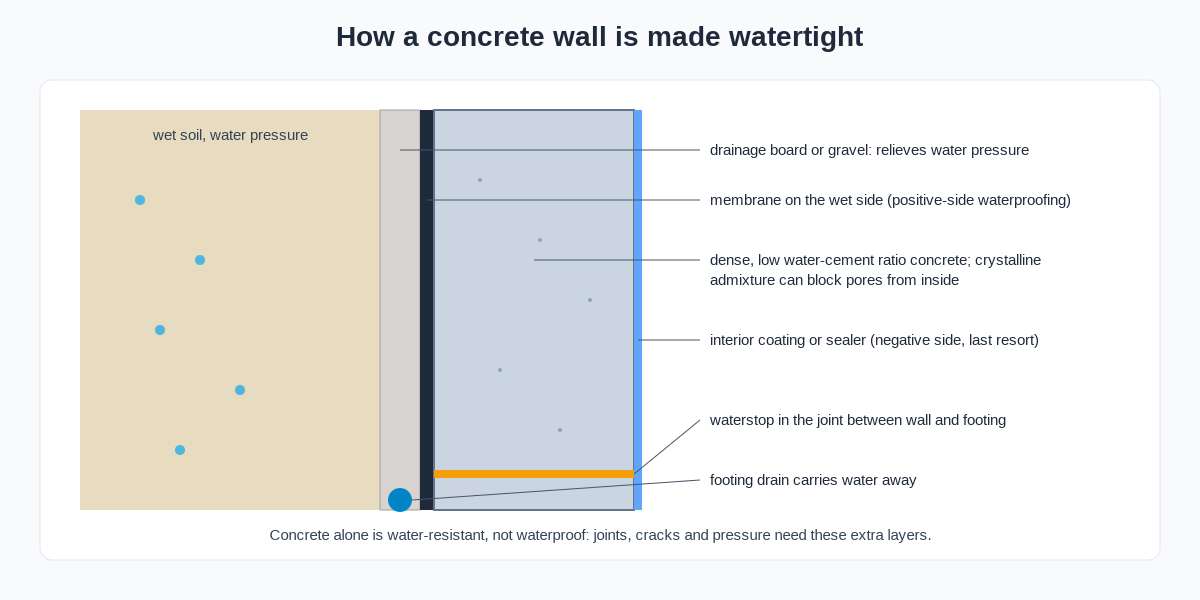
True waterproof concrete structures, like water tanks, reservoirs, pools, basements below the water table and tunnels, use several defenses at once:
- Low-permeability mix: the base of waterproof concrete is a low water-cement ratio, often 0.45 or lower, with supplementary materials such as fly ash, slag or silica fume, produces dense concrete with fewer connected pores.
- Integral waterproofing admixtures: crystalline admixtures react with moisture to grow crystals that fill pores and fine cracks; hydrophobic pore-blocking admixtures make the pore walls water-repellent. These can make the concrete itself highly water-resistant.
- Crack control: reinforcement, joint planning and good curing keep cracks small; designers of water-retaining structures limit crack widths.
- Waterstops: in waterproof concrete walls, PVC, rubber or swelling strips cast across construction joints block water paths through joints.
- Membranes and coatings: sheet membranes, liquid-applied membranes, bentonite clay panels or cementitious coatings on the wet side.
- Drainage: footing drains, drainage boards and gravel relieve water pressure so less water presses on the concrete.
Water-retaining waterproof concrete structures such as tanks and treatment plants are designed under standards like ACI 350, which sets tighter limits on cracking and permeability than ordinary buildings. Many tanks also use an internal liner, as in the photo below.
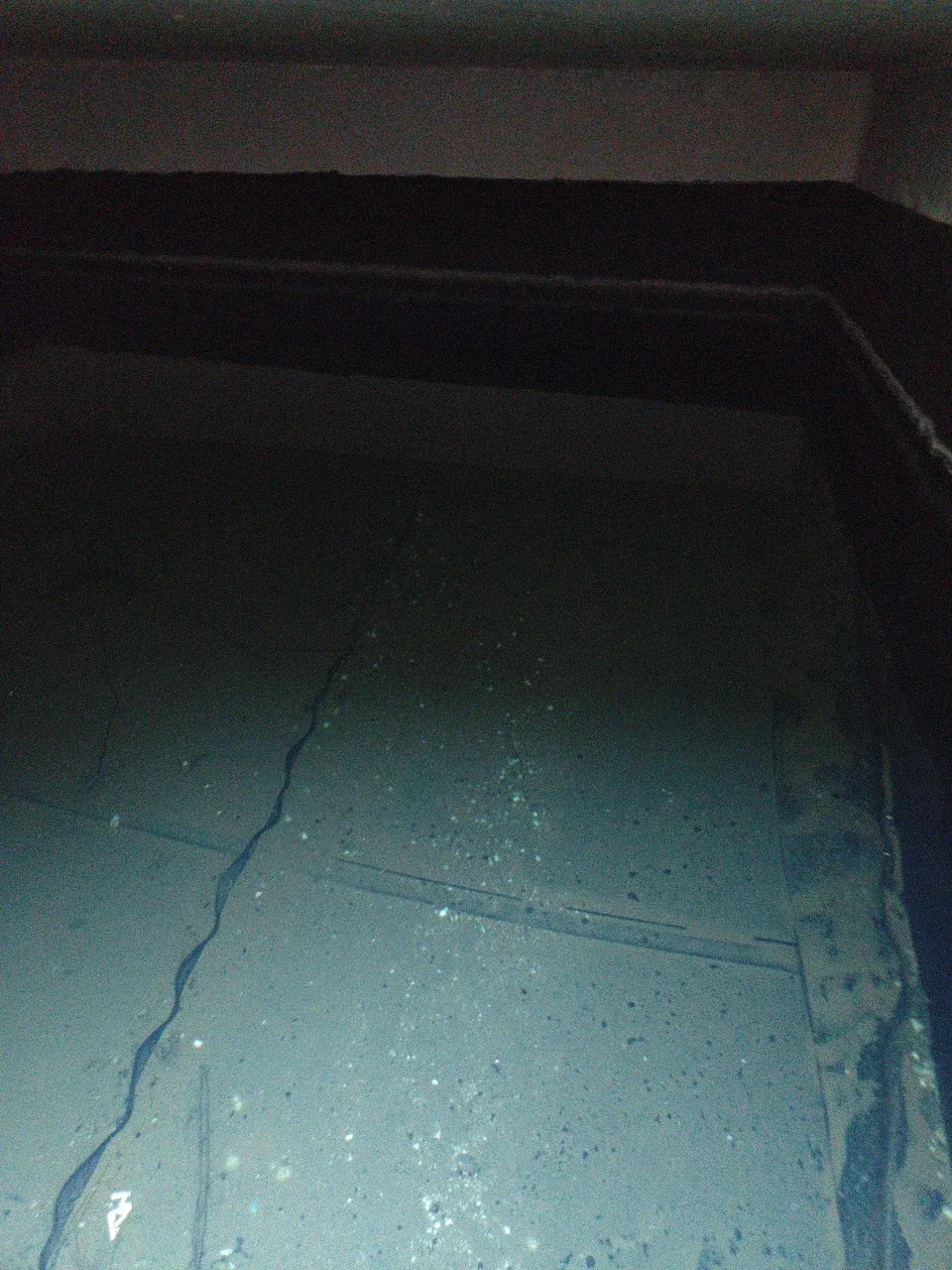
Photo: Wateraus1, Wikimedia Commons, CC BY-SA 4.0
Damp-Proofing vs Waterproofing Basements
Building codes distinguish damp-proofing from waterproofing. Damp-proofing, usually a bituminous coating on the outside of basement walls, slows moisture and vapor from damp soil but does not resist water under pressure. The International Residential Code requires at least damp-proofing on below-grade walls around living space, and waterproofing where a high water table or other conditions create hydrostatic pressure. Waterproofing uses membranes or coatings designed to bridge small cracks and resist pressure, often with drainage boards and footing drains. If you are building a basement in wet soil, ask for waterproofing, not just damp-proofing. For moisture rising through slabs, see concrete moisture barrier.
Waterproof Sealant for Concrete: Types and Uses
For existing slabs and walls, a waterproof sealant for concrete can reduce water entry, but the right product depends on the problem:
- Silane and siloxane penetrating water repellents: the most common waterproof concrete sealant outdoors; they soak into the surface and make pores water-repellent while still letting vapor out. Excellent for driveways, walks, walls and garage floors against rain and deicing salts. Not designed for water under pressure.
- Acrylic and other film-forming sealers: form a thin surface film that repels water and stains and enhances appearance. Good for patios and decorative concrete; they wear and need renewal. See how to seal concrete.
- Crystalline waterproofing coatings: a waterproof sealant for concrete in the form of cement-based slurries brushed onto damp concrete that grow crystals into the pores. Used on basement walls, tanks and pits, including on the inside face.
- Cementitious waterproof coatings: polymer-modified cement coatings for walls, tanks and planters.
- Elastomeric and liquid membranes: polyurethane, rubberized asphalt, acrylic or polyurea coatings that bridge cracks; used on decks, roofs, foundations and planters.
- Joint and crack sealants: flexible polyurethane or silicone sealants for joints, and epoxy or polyurethane injection for cracks.
When buying a concrete sealant, waterproof claims on the label should be read carefully: a water repellent keeps rain from soaking in but will not stop a leaking basement wall, while a crystalline or membrane system is designed for wet conditions.
Fixing Leaks in Concrete
- Fix the water source first: gutters, downspouts and grading that send water toward the foundation cause most basement leaks.
- Inject cracks: polyurethane foam injection seals actively leaking cracks; epoxy injection bonds structural cracks.
- Plug active leaks: hydraulic cement sets in minutes, even with water flowing.
- Seal joints: clean and seal cove joints and slab joints with suitable sealant.
- Coat walls: a crystalline waterproof concrete sealant or or cementitious coatings on the inside reduce seepage; exterior membranes and drains are the more permanent fix.
- Install interior drainage: perimeter drains and a sump pump manage water that cannot be stopped.
Water-Resistant vs Waterproof Concrete
The words get used loosely, so it helps to pin them down. Water-resistant means a material slows water down: rain beads up or soaks in only a little, and water under no pressure takes a long time to pass through. Waterproof means water does not pass through at all under the conditions the material is designed for, including water pressing against it. A good driveway slab is water-resistant. A basement wall below the water table, a water tank or a swimming pool has to be built as waterproof concrete, because water is pushing on it all the time and any leak is a failure.
So when someone asks "is concrete waterproof", the honest answer is that ordinary concrete is water-resistant and waterproof concrete is something you design and build on purpose. The concrete mix is only part of it. Joints, cracks, penetrations and the way the work is cured matter just as much, and in most homes a membrane or coating does the final job.
Why the Water-Cement Ratio Decides How Porous Concrete Is
If you want to know is concrete porous enough to cause problems, look first at how much water went into the mix. Cement needs a water-cement ratio of only about 0.25 to hydrate, but concrete is usually placed at 0.45 to 0.60 or more so it can be pumped, spread and finished. Every bit of extra water that later evaporates leaves a pore behind. Research summarized by the Portland Cement Association shows that permeability rises sharply once the water-cement ratio goes above about 0.50, and that concrete at 0.40 can be many times less permeable than concrete at 0.60.
That is why specifications for waterproof concrete call for low water-cement ratios, often 0.40 to 0.45, with plasticizers or superplasticizers to keep the mix workable. Adding water at the truck to make the concrete easier to place is the fastest way to ruin it. Good curing matters too: concrete that dries out in the first days never completes hydration near the surface, so the top layer stays more porous. For more on the mix itself, see concrete mix ratio and concrete admixtures.
How to Test Whether Your Concrete Lets Water In
You do not need a lab to get a rough idea of how porous a slab or wall is. The simplest check is a water drop test: sprinkle some water on the surface and watch. If it beads up and sits there, the surface is sealed or dense. If it darkens the concrete and soaks in within a minute or two, the surface is open and would benefit from a waterproof concrete sealant. The same test tells you when an old sealer has worn out.
For moisture coming through a slab from below, tape a square of clear plastic sheet tightly to the floor and leave it for a day or two. Condensation under the plastic or a darker patch of concrete means moisture is moving up through the slab. Flooring installers use more precise methods, such as the calcium chloride moisture emission test (ASTM F1869) and in-slab relative humidity probes (ASTM F2170), before laying wood, vinyl or carpet. A slab with high moisture readings needs a moisture mitigation system, not just a surface sealer.
For walls, look for efflorescence, damp patches after rain, peeling paint, and a musty smell. These all show water passing through concrete that is not waterproof. Tracking where the dampness appears, along the floor joint, at cracks, around pipes or across the whole wall, tells you which fix is likely to work.
Integral Waterproofing Admixtures
The most thorough way to make waterproof concrete is to treat the concrete itself rather than only its surface. Integral admixtures are added at the batch plant, so the whole thickness of the wall or slab resists water. ACI calls these permeability-reducing admixtures and splits them into two groups.
Crystalline admixtures contain chemicals that react with water and cement by-products to form insoluble crystals in the pores and fine cracks. When a hairline crack opens later and water gets in, the reaction can start again and partly seal it, which is why these products are often described as self-healing. They are used in tanks, basements, elevator pits, parking decks and tunnels. Hydrophobic or pore-blocking admixtures line the pores with water-repellent compounds, so capillary suction is greatly reduced. They work well against absorption and dampness but are not usually relied on alone against water under strong pressure.
Integral admixtures typically add a modest amount to the cost per cubic yard of concrete. On a basement or tank that cost is small compared with digging out and membraning a leaking wall later. They do not replace good joint details: a waterproof concrete wall can still leak through an untreated construction joint, a tie hole or a crack wider than the admixture can seal.
Waterproof Concrete for Basements
Basements are where most homeowners first ask is concrete waterproof, usually after finding a wet floor. Waterproofing a basement can be done from two sides. Positive-side waterproofing goes on the outside of the wall, the side the water comes from. A membrane there is pressed against the wall by the water, which is the strongest arrangement, and it keeps water out of the concrete altogether. It is easiest to do during construction, before backfilling; on an existing home it means excavating around the foundation, which is expensive.
Negative-side waterproofing goes on the inside face. The water reaches the concrete first and the coating has to hold it back from inside. Crystalline coatings and some cementitious coatings are designed to work this way because they bond into the concrete rather than sitting on top. Paint-like coatings and ordinary sealers often blister and peel when water pushes from behind. A negative-side waterproof sealant for concrete can reduce seepage through the wall face but will not fix leaks at the cove joint where wall meets floor, which is the most common leak path in basements.
For many existing basements the most reliable answer is water management: fix gutters and grading, then add an interior perimeter drain and sump pump to collect what comes through. The concrete does not become waterproof, but the water is controlled. For new construction, waterproof concrete best practice is a dense mix, a waterstop at the footing joint, an exterior membrane with drainage board, and a footing drain.
Waterproof Concrete for Tanks, Ponds, Fountains and Planters
Water tanks, cisterns, fish ponds, fountains and planters all hold water against concrete on purpose. Larger tanks are built as waterproof concrete structures with careful crack control, waterstops and often a liner or coating. Smaller projects at home usually rely on a waterproof concrete sealant or coating. For a pond or fountain, a cementitious or crystalline coating rated for potable water or fish is a common choice, though many pond builders simply use a flexible liner. For planters, a waterproof concrete sealant on the inside keeps water from wicking through the walls and causing efflorescence and stains on the outside; leave the drainage holes open so the planter does not become a tank.
Any coating used where water will be drunk or fish will live should carry a certification for that use, such as NSF/ANSI 61 for drinking water contact. Check this on the product data sheet before you buy.
Pools and Showers
Concrete and gunite pool shells are not waterproof concrete by themselves either. The shell is dense shotcrete or gunite, and the finish, plaster, pebble, tile or paint, provides the waterproof surface. Many builders also add a waterproofing layer under tile. See shotcrete vs gunite for how pool shells are built. In bathrooms, a concrete or mortar shower pan needs a membrane, either a sheet or liquid-applied product, because water and mortar alone will leak into the subfloor over time.
Choosing a Waterproof Concrete Sealant by Location
Whether a concrete sealant waterproof claim holds up depends on where it goes. Here is a simple way to choose.
Driveways, walks and outdoor slabs: a penetrating silane or siloxane water repellent is usually the best waterproof sealant for concrete outdoors. It keeps rain and salty slush from soaking in, which reduces freeze-thaw damage and scaling, and it does not make the surface slippery or change its look much. Expect it to last several years. See concrete sealer.
Patios and decorative concrete: an acrylic waterproof concrete sealant gives a wet look and stain resistance and also sheds water. It needs reapplying every few years. For stamped or colored work, see how to color concrete.
Garage floors: a penetrating waterproof concrete sealant stops oil and water soaking in; an epoxy or polyaspartic coating gives a fully sealed, easy-clean surface. Coatings need a dry slab, so test for moisture first.
Basement walls and floors: crystalline or cementitious waterproofing coatings for seepage; injection for leaking cracks; drainage for water under pressure. A clear sealer from a hardware store is rarely enough here.
Balconies, roof decks and planters: an elastomeric or liquid-applied membrane that bridges cracks and can take foot traffic or be covered by tile.
Is Concrete Porous Enough to Need Sealing?
Almost always, yes, at least outdoors. Is concrete porous in a way you can see? Usually not, but the water drop test shows it. Any slab that gets rain, snow, deicing salt, oil drips or sprinkler water lasts longer with a waterproof concrete sealant, because water carrying salts and dirt into the pores is what drives scaling, spalling and staining. Indoors, a basement floor that will stay bare may not need anything, while one that will get flooring needs a moisture test and possibly a moisture barrier coating. So is concrete waterproof enough to leave bare? For a dry interior slab, often; for anything outdoors or below grade, a waterproof sealant for concrete or a proper waterproof concrete system is worth the cost.
One more point when reading labels: a concrete sealant waterproof claim usually means the product repels water at the surface, not that it turns the slab into waterproof concrete. Look for the test data on the product sheet, such as water absorption reduction percentages, and for wording about hydrostatic pressure if you need a product for a basement or tank. If the sheet does not mention pressure, assume it is a water repellent only.
How to Apply a Waterproof Sealant for Concrete
Most failures of a waterproof concrete sealant come from poor preparation rather than a bad product. Start by cleaning the surface well: remove dirt, oil, old peeling sealer and efflorescence with a degreaser, pressure washer or etching product as the manufacturer recommends. Repair cracks and spalls first; see how to fix cracks in concrete. Let the concrete dry for the time the label says, often 24 to 48 hours after washing, unless the product is designed for damp surfaces, as crystalline coatings are.
New concrete usually needs to cure for about 28 days before most sealers go on, though some penetrating sealers can be applied earlier. Apply in the temperature range on the label, usually above 50 degrees Fahrenheit and with no rain expected for a day. A penetrating waterproof sealant for concrete goes on with a low-pressure sprayer or roller until the surface is evenly wet but not puddled; film-forming sealers go on in two thin coats rather than one thick one, which can trap solvent and turn cloudy. Keep traffic off for the time stated, typically a day for foot traffic and longer for cars.
How Long a Waterproof Concrete Sealant Lasts
An acrylic waterproof concrete sealant commonly lasts 1 to 3 years outdoors. Silane and siloxane penetrating sealers often last 5 to 10 years, because they sit inside the concrete and do not wear off with traffic. Epoxy and polyaspartic floor coatings can last 10 years or more indoors. Crystalline treatments become part of the concrete and are considered permanent, though cracks that form later may still need attention. Repeat the water drop test each year; when water starts soaking in again, it is time to reseal.
What Waterproofing Concrete Costs
Prices vary by region and product, but typical ranges help with planning. A penetrating waterproof sealant for concrete on a driveway or patio costs roughly $0.15 to $0.50 per square foot in materials for DIY, or about $1 to $3 per square foot hired out. Crystalline coatings for basement walls run a few dollars per square foot installed. Crack injection is usually priced per crack, often several hundred dollars each. Exterior basement waterproofing with excavation, membrane and drains is the most expensive option, often many thousands of dollars for a house, while interior drain and sump systems usually cost less. Integral admixtures for new waterproof concrete add a fraction of the total concrete cost. See concrete repair cost for related pricing.
Common Mistakes
The most common mistake is expecting a clear waterproof concrete sealant to stop a basement leak. Sealers repel water at the surface; they do not hold back water under pressure. The second is painting over damp walls with ordinary paint, which peels within months. Others include adding water to the mix on site, skipping the waterstop at the wall-footing joint, sealing new concrete too early, applying film sealers too thick, and ignoring gutters and grading that send water to the foundation in the first place. Waterproof concrete is the result of getting the water source, the mix, the joints and the protective layers right together.
Frequently Asked Questions
Is concrete waterproof?
No. Concrete is water-resistant but porous. It can be made watertight with dense mixes, admixtures, waterstops, membranes and drainage.
Is concrete porous?
Yes. It contains a network of tiny capillary pores, typically around 10 to 20 percent of its volume, plus cracks and joints.
What is the best waterproof concrete sealant?
For outdoor slabs, silane or siloxane penetrating sealers; for basements and tanks, crystalline coatings or membranes; for cracks, injection products.
Can you make concrete waterproof?
Yes, as a system: low water-cement ratio, integral waterproofing admixtures, crack control, waterstops at joints, and membranes or coatings with drainage.
Sources
- American Concrete Institute: ACI 212.3R permeability-reducing admixtures and ACI 350 environmental structures
- International Code Council: 2021 IRC Section R406, foundation damp-proofing and waterproofing
- Portland Cement Association: permeability and durability of concrete
- U.S. EPA: mold and moisture in homes
Related Guides
- Shotcrete vs gunite — sprayed concrete for pools and walls
- Pervious concrete — permeable paving that drains rainwater
- Concrete core drilling — coring holes, bits, scanning and cost
- Micro cement floor — seamless microcement flooring over tile or concrete
- Concrete splash blocks — downspout splash blocks and drainage
- Concrete storm shelters — storm cellars and tornado shelters
- Concrete culvert — concrete pipe and box culverts
- Concrete pool — construction, gunite and costs
- How to paint cinder blocks — block filler, paint and prep
- Concrete decking — concrete decks vs wood
- Concrete floor coverings — flooring options over slabs
- Concrete keyways — footing keyways and keyed joints
- Roof cement and concrete roofs — flashing repairs, concrete tiles and tile replacement
- Concrete foundations — slab, crawl space and basement types and a volume calculator
- Concrete wall crack repair — injection, sealants and when cracks are structural
- Concrete board — backer board for shower walls and tile floors, installation and waterproofing
- Hydraulic concrete — hydraulic cement for leaks and concrete for dams, canals and tanks