
Wet Concrete: How Liquid Concrete Works From Mixer to Hard Slab
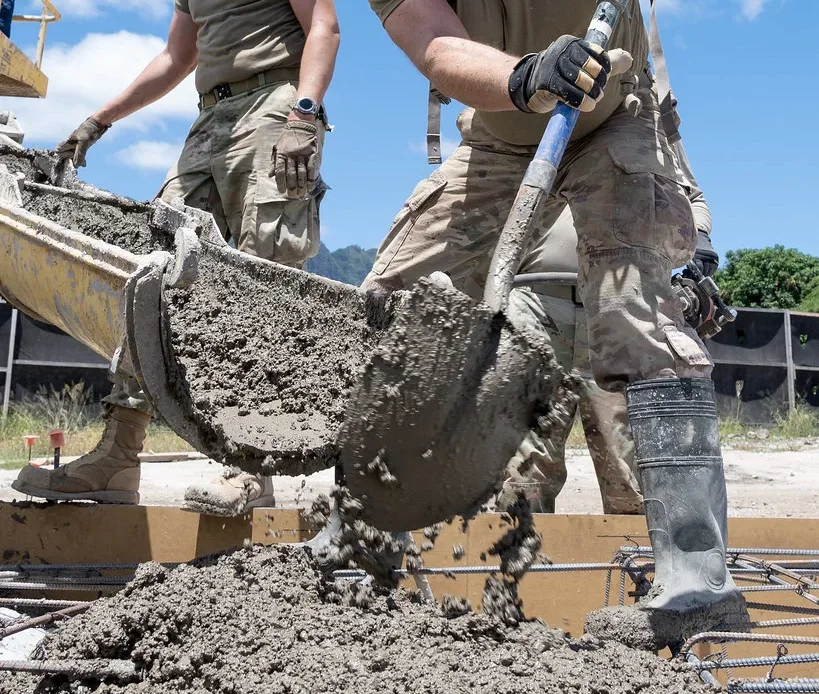
Photo: NCCITIZENAIRMAN (U.S. Air National Guard), Flickr, Public Domain Mark (cropped)
Quick Answer
Wet concrete, also called fresh, plastic or liquid concrete, is the mix of cement, water, sand and gravel before it hardens. How does concrete work? Concrete does not dry out to harden; the cement reacts chemically with water in a process called hydration, forming crystals that bind the sand and stone into rock-like material. Wet concrete stays workable for about 1 to 2 hours, sets in roughly 4 to 8 hours at 70°F, can be walked on after about 24 hours, and reaches its design strength at 28 days. It weighs about 4,000 pounds per cubic yard. Adding extra water makes wet concrete easier to place but weaker, so workability should come from the mix design or admixtures instead. Wet concrete is also caustic, with a pH of about 12 to 13, and can burn skin.
Every concrete driveway, sidewalk and foundation began as a few tons of heavy, gray, flowing wet concrete, like the load sliding down the truck chute in the photo above. For a short window, liquid concrete can be shaped into almost anything; a few hours later it is solid, and in a month it is stronger than many natural stones. Understanding how wet concrete behaves during that window is the key to placing, finishing and curing it well.
This guide explains how concrete works, what wet concrete is made of, how long it stays workable, slump and water, setting and hardening times, weight, flowable and self-consolidating liquid concrete, safety, footprints and accidents, rain, and cleanup. For the difference between cement and concrete, see cement vs concrete.
What Is Wet Concrete Made Of?
A typical cubic yard of wet concrete contains roughly:
Coarse aggregate: about 1,700 to 1,900 pounds of gravel or crushed stone, usually 3/4 to 1 inch maximum size.
Fine aggregate: about 1,100 to 1,400 pounds of sand. See concrete sand.
Cementitious material: about 450 to 650 pounds of Portland cement, often with some fly ash or slag.
Water: about 30 to 40 gallons, or 250 to 330 pounds.
Air: about 1 to 2 percent entrapped air, or 5 to 8 percent entrained air in freeze-thaw mixes.
Admixtures: small amounts of chemicals that change how the wet concrete behaves, such as water reducers, retarders, accelerators and air entrainers. See concrete admixtures.
The cement and water form a paste that coats every grain of sand and stone. In wet concrete, the paste acts as a lubricant, letting the mix flow; once it hardens, it acts as glue.
How Does Concrete Work? The Chemistry of Hardening
The most common misunderstanding about wet concrete is that it hardens by drying, like mud. It does not. Concrete hardens through hydration, a chemical reaction between cement and water.
Cement minerals. Portland cement is made mostly of calcium silicates, plus calcium aluminates and iron compounds, formed when limestone and clay are heated in a kiln.
Reaction with water. When water is added, these minerals dissolve and react, forming calcium silicate hydrate (C-S-H), a gel of tiny, tangled fibers, along with calcium hydroxide crystals. C-S-H is the main source of concrete's strength.
Interlocking growth. As hydration continues, the C-S-H grows into the spaces between grains, binding the sand and stone together. The wet concrete stiffens, sets, and then hardens.
Heat. Hydration releases heat. In thick foundations, the center of the concrete can get very warm, which is why engineers control mix temperature in mass pours.
Water is consumed, not evaporated. Hydration needs water. If wet concrete dries out too fast, hydration stops early and the concrete is weaker and dusty at the surface. That is why curing, keeping concrete moist, matters so much. See how long does concrete take to cure.
Because concrete works by chemistry rather than drying, it can even harden underwater, which is how bridge piers and marine structures are built.
Workability and Slump: How Wet Should Concrete Be?
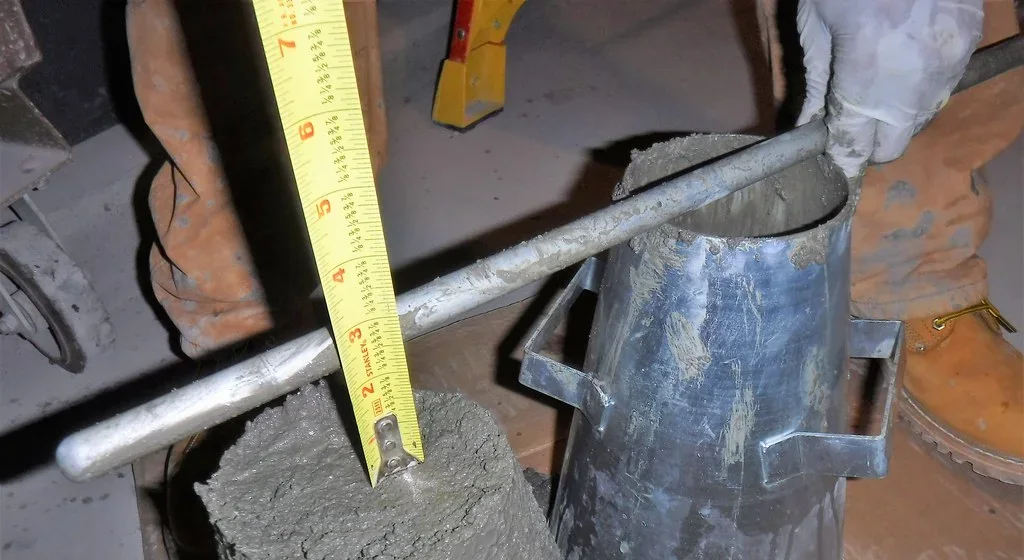
Photo: MTA C&D - East Side Access, Flickr, CC BY 2.0 (cropped)
Workability describes how easily wet concrete can be placed, consolidated and finished. The usual field measure is the slump test, shown above: a metal cone is filled with wet concrete, rodded, and lifted, and the drop in height of the concrete is measured with a tape. Typical slumps are:
1 to 3 inches: stiff mixes for curbs, slipform paving and some footings.
3 to 5 inches: most slabs, driveways, patios and walls.
5 to 7 inches: pumped concrete and congested reinforcement, usually with water reducers.
Flowing concrete, 7 inches or more: made with superplasticizers.
See concrete slump for the test procedure.
Why Adding Water to Wet Concrete Is a Problem
It is tempting to add water to wet concrete that seems too stiff. A little extra water makes it easier to pour and finish, but it also raises the water-cement ratio, which directly lowers strength and durability. As a rough rule, each extra gallon of water per cubic yard adds about an inch of slump and costs a few hundred psi of strength, while increasing shrinkage, cracking, dusting and scaling. Ready-mix tickets usually allow a set amount of water to be added on site; anything beyond that should be approved. If wetter concrete is needed, order a higher slump from the plant, made with water-reducing admixtures that add flow without weakening the mix.
Liquid Concrete: Flowable and Self-Consolidating Mixes
The term liquid concrete is often used for wet concrete in general, but it also describes special mixes that truly flow like a thick liquid:
Self-consolidating concrete (SCC). A highly fluid mix made with superplasticizers and viscosity modifiers that flows into forms and around dense reinforcement without vibration, while the stone stays suspended. It is measured by slump flow, the diameter it spreads to, typically 18 to 30 inches. SCC is used for architectural walls, precast products and congested columns.
Flowable fill. A low-strength liquid concrete, also called controlled low-strength material, used to fill trenches, abandoned pipes and voids. It flows into place and can be dug out later.
Self-leveling underlayment. A pourable cement-based liquid concrete product that spreads into a flat surface to level floors before flooring. See self-leveling concrete.
Grout. Fluid cement grout fills voids in block walls, under machinery and around anchors.
How Long Does Concrete Stay Wet?
At about 70°F, a normal ready-mix concrete follows roughly this timeline:
0 to 90 minutes: workable. Wet concrete can be placed, vibrated, screeded and floated. ASTM C94 calls for ready-mix to be discharged within 90 minutes of batching unless the buyer allows more time.
2 to 4 hours: initial set. The concrete stiffens and can no longer be reworked easily, but it can still be finished. Bleed water disappears from the surface.
4 to 8 hours: final set. The concrete is hard enough to resist a fingernail lightly and can bear careful finishing equipment.
24 to 48 hours: light foot traffic.
7 days: about 65 to 70 percent of design strength; cars on driveways.
28 days: design strength.
Heat shortens every step, sometimes by half on a hot, windy day; cold lengthens them dramatically. Below about 50°F, setting slows a lot, and wet concrete must not freeze before it reaches about 500 psi. See temperature to pour concrete.
How Much Does Wet Concrete Weigh?
Normal-weight wet concrete weighs about 145 to 150 pounds per cubic foot, or roughly 3,900 to 4,050 pounds per cubic yard. A full 10-yard ready-mix truck carries about 20 tons of wet concrete. Lightweight concrete made with expanded shale or clay weighs about 90 to 115 pounds per cubic foot. Wet concrete puts that full weight on formwork as fluid pressure, which is why wall forms need strong ties and bracing. See how much does a yard of concrete weigh.
Wet Concrete Safety
Chemical burns. Wet concrete is strongly alkaline, around pH 12 to 13. Prolonged contact, such as concrete in a boot or soaking through pants at the knee, causes serious chemical burns that may not hurt until hours later. Wear waterproof gloves and boots, tuck pants into boots, and wash skin with clean water right away. See can concrete burn.
Eyes. Splashes of wet concrete can damage eyes; wear safety glasses and flush with water for at least 15 minutes if exposed.
Heavy lifting. Wet concrete is very heavy; shovel and wheel in manageable loads.
Forms and pumps. Form failures and pump hose whipping are serious hazards during placement.
Footprints, Handprints and Accidents in Wet Concrete
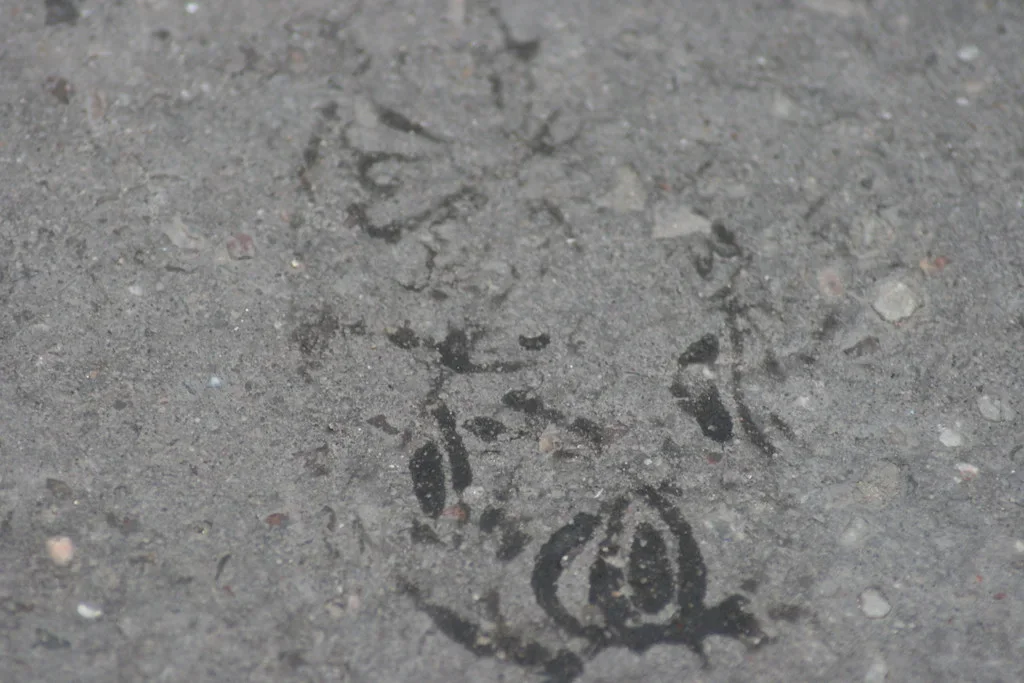
Photo: quinn.anya, Flickr, CC BY-SA 2.0
The sandal print above was left by someone who stepped in wet concrete, and it will stay there for the life of the sidewalk. If a person, pet or animal steps in fresh concrete:
Within the first hour or two: the concrete is still plastic. Fill the print with a little wet concrete or paste from the surface, then float and trowel or broom it to match.
After initial set: it is harder to blend in. Small marks can sometimes be smoothed with a margin trowel and a little water and paste, but the texture will differ slightly.
After hardening: the print is permanent unless the surface is ground or resurfaced.
To prevent accidents, block off fresh concrete with caution tape, barriers or sawhorses for at least 24 hours, and keep pets inside.
Rain on Wet Concrete
Rain on concrete that has just been placed can wash out cement paste, raise the water-cement ratio at the surface, and leave pitting and weak, dusty surfaces. Cover fresh concrete with plastic if rain comes before it sets, and avoid working rain water into the surface. Once the concrete has set, typically after 4 to 8 hours, light rain does little harm and can even help curing. See can you pour concrete in the rain.
Cleaning Up Wet Concrete
Tools and mixers. Rinse immediately, before the concrete sets, into a washout area, not a storm drain.
Skin. Wash with clean water and a pH-neutral soap; do not use acid.
Clothes. Rinse wet concrete out promptly; set concrete may not come out.
Cars and windows. Rinse splatters with plenty of water while wet. Dried splatters may need a concrete dissolver made for vehicle paint.
Leftover wet concrete. Pour it into simple forms for stepping stones or onto plastic, then dispose of it once hard. See concrete disposal.
Placing Wet Concrete Correctly
How wet concrete is handled in the first hour decides much of its final quality:
Prepare everything first. Forms braced, base compacted and dampened, reinforcement on chairs, tools and crew ready before the truck arrives.
Place it close to its final position. Wet concrete should be deposited where it will stay, not dragged or pushed long distances, which separates the stone from the paste.
Do not drop it from great heights. Free falls of more than a few feet can cause segregation, especially through reinforcement; use chutes, tremies or pump hoses to place it lower.
Place in layers in walls. Fill wall and column forms in lifts of about 12 to 24 inches, vibrating each lift into the one below so there are no cold joints.
Consolidate. Vibrate formed concrete to release trapped air, and avoid over-vibrating, which pulls paste to the surface. See concrete vibrator.
Strike off and float quickly. Screed and bull float slabs right after placement, while the wet concrete is still fully plastic.
Bleed Water and Finishing Wet Concrete
After wet concrete is placed and floated, the heavier sand and stone settle and a thin sheen of water rises to the surface. This is bleed water. Finishing operations such as edging, jointing and troweling must wait until the bleed water has evaporated and the sheen is gone. Troweling bleed water back into the surface weakens the top layer and causes dusting, scaling and delamination. On hot, windy days, the surface may dry faster than water can bleed up, causing plastic shrinkage cracks; an evaporation retarder sprayed on the surface helps. See types of concrete finishes.
Hot and Cold Weather Effects on Wet Concrete
Hot weather. Above about 85 to 90°F, wet concrete loses slump quickly, sets fast and is prone to cracking. Pour early in the morning, keep materials and the subgrade cool and damp, order retarders, use sunshades and windbreaks, and start curing as soon as finishing ends. ACI 305 covers hot weather concreting.
Cold weather. Below about 40°F, wet concrete sets slowly and can freeze before gaining strength. Order heated concrete with accelerators, never pour on frozen ground, and cover with insulated blankets. ACI 306 covers cold weather concreting. See pouring concrete in cold weather.
Wind and sun. Even at mild temperatures, wind and direct sun increase surface evaporation and plastic cracking.
Testing Wet Concrete on Site
On commercial and public projects, technicians test wet concrete as it arrives to make sure it matches the specification:
Slump (ASTM C143) for workability.
Air content (ASTM C231 or C173) for freeze-thaw durability, typically 5 to 8 percent for exterior concrete in cold climates.
Temperature (ASTM C1064), usually required to be between about 50 and 90°F.
Unit weight (ASTM C138) to check yield and consistency.
Strength cylinders (ASTM C31) cast from wet concrete and broken in a lab at 7 and 28 days. See concrete cylinder test.
Mixing Wet Concrete by Hand or Mixer
For small jobs, wet concrete is mixed from bagged concrete or from cement, sand and gravel:
1. Add about three quarters of the water to the wheelbarrow, tub or mixer.
2. Add the dry mix gradually while mixing.
3. Add the remaining water a little at a time until the wet concrete has an oatmeal-like consistency that holds its shape in a ridge without crumbling or running.
4. Mix thoroughly for about 3 to 5 minutes until there are no dry pockets.
5. Place within about 30 to 60 minutes, sooner in heat.
An 80 pound bag of concrete needs about 3 to 4 quarts of water and makes about 0.6 cubic feet of wet concrete. See how to mix concrete.
Common Wet Concrete Problems
Segregation. Stone separates from paste because of overly wet concrete, long drops, over-vibration or dragging. It leaves honeycombed, weak areas.
Excessive bleeding. Too much water rising to the surface, from wet mixes or poor sand grading, leading to weak, dusty tops.
Cold joints. When new wet concrete is placed against concrete that has already set, a weak seam forms. Plan pours to avoid delays.
Plastic shrinkage cracks. Short, random cracks that appear on the surface while the concrete is still plastic, caused by rapid evaporation.
Slump loss. Wet concrete stiffening in the truck from heat or long waits. Ask for retarders or more water reducer instead of adding water.
False set. Occasionally wet concrete stiffens early and then loosens again with remixing; it is a cement chemistry issue, not true setting.
The Wet Look: Sealers That Make Concrete Look Wet
Wet concrete also has a design meaning. Many homeowners like the darker, richer color concrete shows when it is wet, especially on stamped, colored and exposed-aggregate surfaces. Film-forming acrylic sealers, often sold as wet-look sealers, give hardened concrete that same glossy, deepened appearance permanently. They need reapplication every 2 to 3 years outdoors and can be slippery when wet, so slip-resistant additives are often mixed in for patios and pool decks. Penetrating sealers, by contrast, leave the natural dry look. See concrete sealer.
Ordering Wet Concrete From a Ready-Mix Plant
When you order wet concrete, the supplier needs a few details:
Volume. Calculate cubic yards from length, width and thickness, and add about 5 to 10 percent for uneven subgrade and spillage. Running short mid-pour causes cold joints.
Strength. Usually 3,000 psi for footings and walls, 3,500 to 4,000 psi for slabs and driveways, and 4,000 to 4,500 psi with air entrainment for exterior concrete in freeze-thaw climates.
Slump. Usually 4 to 5 inches for flatwork; more if pumping.
Aggregate size and admixtures. Pea-gravel mixes for line pumps, fiber for crack control, accelerators in cold weather, retarders in hot weather.
Delivery details. Time, access for a heavy truck, and how far the chute must reach. Trucks typically allow about 5 to 7 minutes per yard for unloading before charging waiting time.
Short loads under about 4 to 5 yards often carry a small-load fee. See concrete slab cost for pricing.
Can Wet Concrete Be Retempered or Reused?
Retempering means adding water or admixture to wet concrete that has stiffened in the truck to restore workability. ASTM C94 allows a limited amount of water to be added on arrival if the mix design leaves room for it, followed by thorough mixing. Beyond that, adding water to stiffening concrete is a bad idea: the concrete is already partly hydrated, and extra water weakens it significantly. Concrete that has passed initial set should not be used for structural work. Leftover wet concrete returned to the plant is often used to make blocks, barriers or recycled aggregate.
How Concrete Works After It Hardens
Hydration does not stop at 28 days. As long as there is moisture and unhydrated cement, concrete keeps gaining strength slowly for months and years. That is why curing matters: concrete kept moist for the first 7 days can be up to about 50 percent stronger than concrete allowed to dry out immediately. Once hardened, concrete is very strong in compression, crushing at thousands of psi, but weak in tension, about one tenth as strong. That is why concrete cracks when it shrinks or bends, and why steel reinforcement is added to carry tension. Understanding how concrete works, as a strong but brittle material that needs water to harden and steel to bend, explains nearly every rule of concrete construction, from curing to control joints. See rebar in concrete and why does concrete crack.
Protecting Wet Concrete in the First 24 Hours
Once wet concrete is placed and finished, the next day decides much of its durability. Start curing right away with a spray-on curing compound, wet burlap, plastic sheeting or a gentle water mist, keeping the surface damp without washing it. Shield the slab from direct sun and strong wind in hot weather, and cover it with insulated blankets if temperatures will drop near freezing overnight. Keep people, pets, bikes and vehicles off with tape or barriers. Avoid leaning lumber, tools or wheelbarrows on the edges, which are the weakest part of a young slab. Cut control joints as soon as the surface can be sawed without raveling, usually within 6 to 18 hours. These simple steps let the cement keep hydrating, so the wet concrete you placed in the morning becomes the strong, durable slab you planned. See concrete curing compound.
Frequently Asked Questions
Can you add water to wet concrete?
Only a limited amount allowed by the mix design, usually on arrival. Extra water weakens wet concrete and increases cracking; use admixtures for more flow.
How long can wet concrete sit in the truck?
ASTM C94 calls for discharge within about 90 minutes of batching, or sooner in hot weather, unless the buyer approves more time or retarders are used.
What happens if wet concrete freezes?
If wet concrete freezes before reaching about 500 psi, ice crystals disrupt the paste and can permanently weaken the surface or the whole slab. Protect it with blankets or heat.
Does wet concrete harden underwater?
Yes. Because concrete hardens by hydration, not drying, it sets underwater. Special mixes and tremie pipes are used to place it without washing out the cement.
How does concrete work?
Cement reacts with water through hydration, forming crystals that glue sand and stone together. It hardens by chemical reaction, not by drying.
How long does wet concrete take to dry?
It sets in about 4 to 8 hours, supports foot traffic in about a day, and reaches design strength in 28 days. Hot weather speeds this up and cold weather slows it down, so wet concrete poured in late fall may need several extra days before it is ready for traffic.
Is liquid concrete the same as wet concrete?
Usually, yes. The term also describes very fluid mixes such as self-consolidating concrete, flowable fill and self-leveling products.
Is wet concrete dangerous to touch?
Brief contact is usually harmless if washed off, but prolonged contact causes chemical burns. Wear waterproof gloves and boots, keep wet concrete off your knees and out of your boots, and rinse any splashes off your skin with clean water as soon as you can.
Sources
- Portland Cement Association: how concrete is made and cement hydration
- ASTM C94: standard specification for ready-mixed concrete
- National Ready Mixed Concrete Association: Concrete in Practice series
- OSHA: working safely with concrete and cement
Related Guides
- Hydraulic concrete — hydraulic cement for leaks and concrete for dams, canals and tanks
- Concrete canoe — how a concrete boat floats and the ASCE competition