
Roller Compacted Concrete (RCC): What It Is, Uses, Placement and Cost
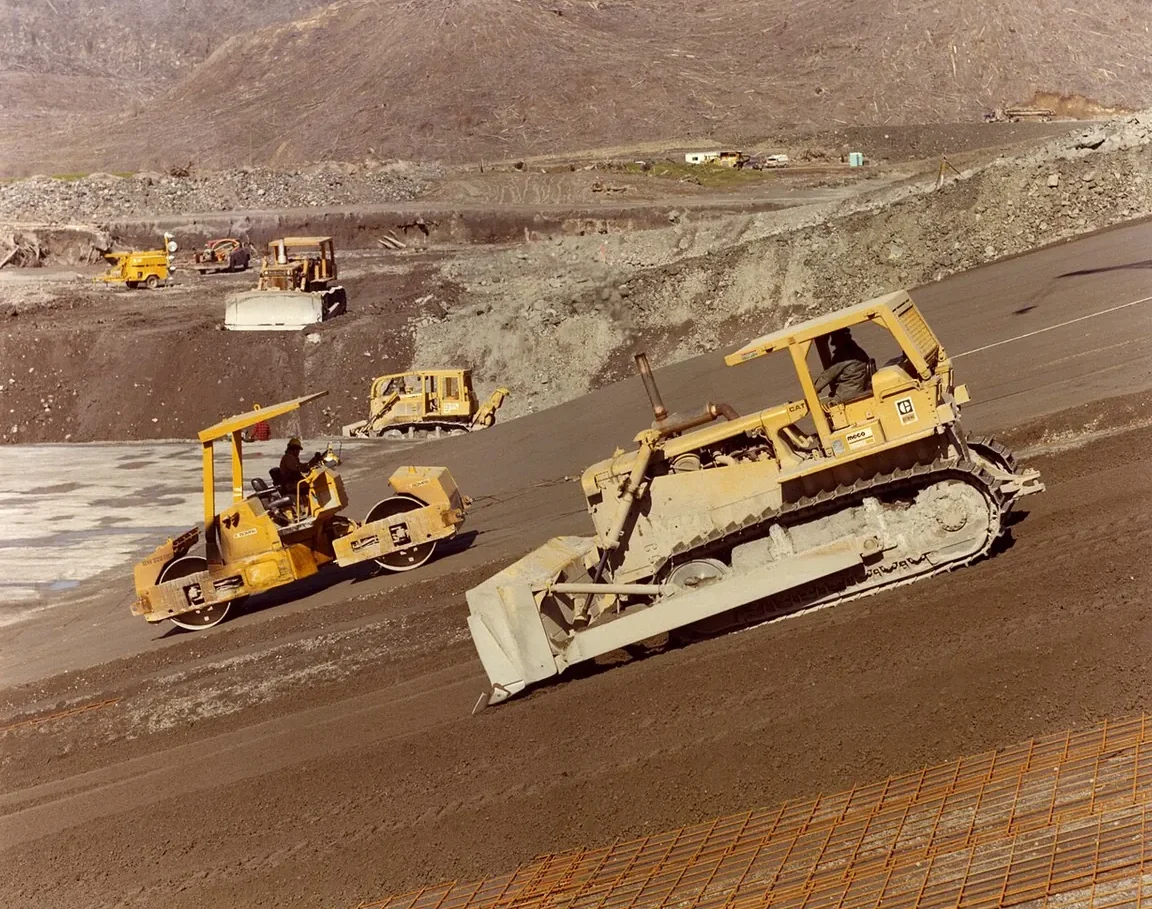
Photo: US Army Corps of Engineers, Portland District (public domain), Wikimedia Commons (cropped)
Quick Answer
Roller compacted concrete (RCC) is a very stiff, zero-slump concrete that is spread with an asphalt-type paver or a dozer and compacted with vibratory rollers, instead of being poured into forms and finished. It uses the same basic ingredients as ordinary concrete, cement, aggregate and water, but with less water and paste. RCC reaches high strength, often 4,000 to 6,000 psi or more, needs no forms, dowels or steel, and can be placed very quickly. It is used for heavy-duty pavements such as industrial yards, ports, distribution centers, parking lots and streets, and for dams and spillways. Roller compacted concrete pavements typically cost 15 to 40 percent less than conventional concrete pavement, roughly $30 to $60 per square yard depending on thickness.
Roller compacted concrete combines the strength and durability of concrete with the speed and equipment of asphalt paving. It was first used widely for dams in the 1980s, where engineers realized that a dry concrete mix spread and rolled like earth fill could be placed far faster and more cheaply than traditional mass concrete. The same idea spread to heavy-duty pavements, and today RCC is used across North America and around the world for log yards, ports, intermodal terminals, warehouses, highways shoulders and city streets. The photo above shows the dam method: a dozer spreads a layer of roller compacted concrete on a spillway while a vibratory roller compacts the previous strip.
This guide explains what roller compacted concrete is, how its mix differs from ordinary concrete, how it is placed and compacted, RCC pavements and RCC dams, its advantages and limitations compared with conventional concrete and asphalt, surface and joint details, and typical costs.
What Is Roller Compacted Concrete?
Roller compacted concrete is concrete with a consistency similar to damp gravel. It has zero slump: a cone of RCC does not sag at all. Because it is so stiff, it cannot be poured or vibrated with handheld vibrators like normal concrete. Instead, it is dumped, spread to the desired thickness, and densified by heavy vibratory rollers, much like compacting a granular base or asphalt. As the roller passes, the paste fills the voids between the aggregate particles and the mix becomes dense and strong. Once compacted, roller compacted concrete hardens through normal cement hydration and develops strength comparable to, or greater than, conventional paving concrete.
The key difference is not the ingredients but the proportions and the placement method. RCC typically contains about 10 to 17 percent cementitious material by weight of dry materials, often including fly ash or slag, well-graded aggregate with a maximum size of about 3/4 inch for pavements, and just enough water to allow compaction. No forms, reinforcing steel, dowels or finishing are needed. See what is concrete made of and concrete mix ratio.
Roller Compacted Concrete Mix Design
Mix design for roller compacted concrete is based on compaction rather than workability. The aggregate gradation is carefully controlled, usually a dense, well-graded blend similar to a high-quality base course, so the particles pack tightly and leave few voids for paste to fill. The water content is chosen near the optimum moisture content from a compaction test, the same test used for soils, to reach maximum density. Too much water and the mix becomes soft and ruts under the roller; too little and it does not compact fully. Cement content is chosen to reach the required strength, commonly 4,000 to 5,000 psi compressive strength for pavements and lower for dam interiors. Supplementary materials such as fly ash, slag and silica fume improve workability, long-term strength and durability. For freeze-thaw exposure, RCC pavements rely on high strength and low permeability, because entraining air in such a dry mix is difficult, though air-entraining admixtures designed for RCC are available. See concrete aggregate and concrete admixtures.
How Roller Compacted Concrete Is Placed
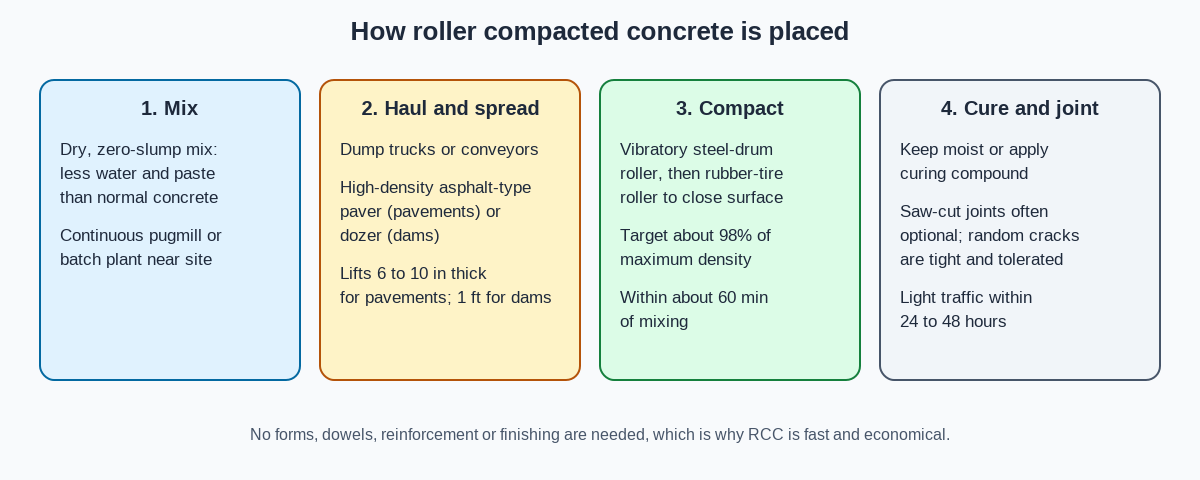
1. Prepare the base. For pavements, a firm, well-compacted subgrade and granular base provide uniform support. The base is graded and moistened before placement.
2. Mix. Roller compacted concrete is usually produced in a continuous pugmill mixer or a central batch plant near the site, because the dry mix must be placed quickly and does not travel well in drum trucks.
3. Haul. Dump trucks deliver the mix to the paver or spreading area; on dams, conveyors and dozers are common.
4. Spread. For pavements, a high-density asphalt-type paver places the RCC in lifts usually 4 to 10 inches thick, pre-compacting it with heavy screeds. Thicker pavements are placed in two lifts, the second within about an hour so the layers bond. For dams, dozers spread lifts about 1 foot thick.
5. Compact. Heavy vibratory steel-drum rollers compact the RCC, typically to at least 98 percent of the maximum laboratory density, checked on site with a nuclear density gauge. A rubber-tire roller often follows to knead and close the surface. Compaction must be completed within about 60 to 90 minutes of mixing, before the cement begins to set.
6. Joints. Fresh joints between paving lanes are made by placing the adjacent lane within the allowed time; cold joints are cut vertical and wetted before the next lane is placed. Contraction joints may be saw cut, or the pavement may be left to crack naturally into tight, widely spaced cracks.
7. Cure. The surface is kept moist with water or sealed with a curing compound for about seven days. Light traffic can often use the pavement within a day or two. See concrete curing compound.
RCC Pavements
Roller compacted concrete pavements are designed for heavy loads and harsh use. Typical applications include port container yards, intermodal rail terminals, log and lumber yards, distribution centers and truck parking, landfill and recycling facility roads, mining haul roads, military airfield aprons and tank trails, highway shoulders, low-speed streets, and parking lots. RCC pavements resist heavy wheel loads, point loads from container stacks, and spills of oil and fuel that would soften asphalt. Thickness typically ranges from 5 to 10 inches for commercial lots and streets and up to 12 to 18 inches or more for ports and heavy industrial yards.
The surface of roller compacted concrete is coarser and more open than troweled concrete, similar in look to a tight asphalt surface. For low-speed traffic and industrial use, that texture is fine. For higher-speed roads, a thin asphalt overlay or diamond grinding gives a smoother ride, and surface treatments can improve appearance. See concrete flatwork and asphalt parking lot cost.
RCC Dams
Roller compacted concrete revolutionized dam construction. Traditional mass concrete dams were built in blocks with forms and cooling systems, slowly and at high cost. RCC dams are built by spreading and rolling continuous horizontal layers across the full width of the dam, much like an embankment dam, but with the strength of concrete. The method allows very fast construction, lower cement content and less heat buildup, and has been used for hundreds of dams worldwide, as well as for spillways, overtopping protection on embankment dams, and stepped spillways where the stepped faces dissipate water energy. The spillway in the first photo was built with roller compacted concrete. Facing systems, such as precast panels or conventional concrete placed against forms, give dams a durable, watertight upstream face.
Advantages and Limitations
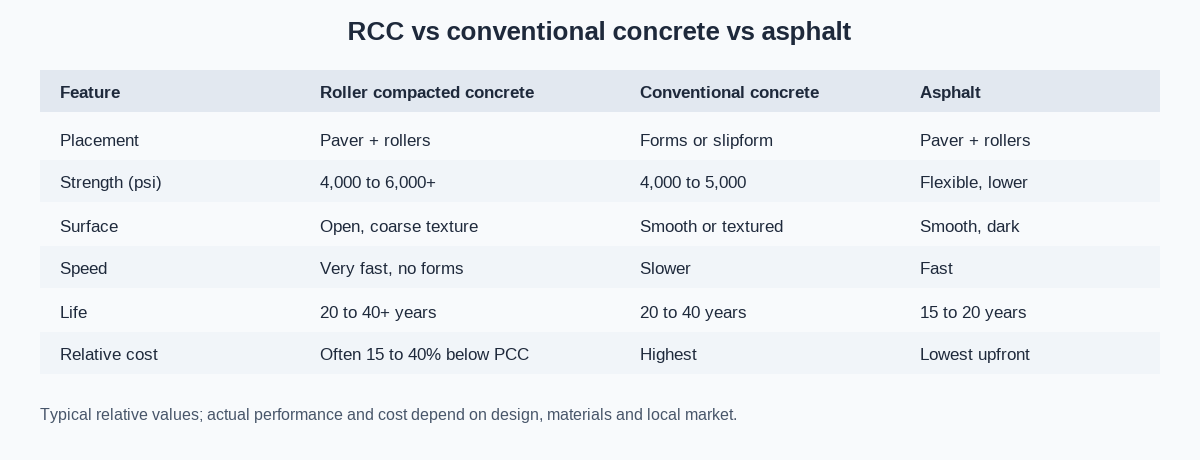
Advantages. RCC is fast to build, with no forms, steel or finishing; it reaches high strength and carries heavy loads; it resists rutting, fuel spills and high temperatures better than asphalt; it has a long life with low maintenance; it uses less cement and water per unit volume than conventional concrete; it can open to traffic quickly; and it is often 15 to 40 percent less expensive than conventional concrete pavement.
Limitations. The surface is coarse and less smooth than troweled concrete; edges are harder to compact and may need special attention; it needs specialized equipment and experienced crews; freeze-thaw durability depends on strength and density rather than easy air entrainment; it is best for large, open areas rather than small, complex shapes; and its ride quality may need an overlay or grinding for higher-speed roads.
A Short History of Roller Compacted Concrete
The idea of compacting a lean concrete mix with rollers goes back many decades: dry, lean concrete was used as a base under roads in Europe in the early twentieth century, and soil-cement, a related material, has been rolled into roads and dam facings since the 1930s. Modern roller compacted concrete took off in the 1970s and 1980s, first in dams. Engineers building dams in the United States, Japan and elsewhere showed that a zero-slump concrete, delivered by trucks and conveyors, spread by dozers and compacted with vibratory rollers in thin layers, could be placed many times faster than conventional mass concrete at much lower cost. Willow Creek Dam in Oregon, completed in 1982, is often cited as the first major RCC dam in the US. In the same period, roller compacted concrete pavements were developed for log sorting yards in the Pacific Northwest and for military facilities, where heavy equipment destroyed asphalt. Since then, RCC has spread to ports, intermodal yards, industrial plants, highway shoulders and city streets, and to hundreds of dams around the world.
Quality Control for Roller Compacted Concrete
Because roller compacted concrete depends on compaction rather than slump, quality control focuses on moisture, density and timing. Before construction, laboratories determine the optimum moisture content and maximum density of the mix, and test cylinders or cores for strength. A test section is often built to confirm that the paver, rollers and crew can achieve the required density, smoothness and joint quality. During placement, technicians check the moisture of the mix at the plant, measure in-place density with a nuclear density gauge behind the rollers, and record the time from mixing to compaction. Cores taken after curing confirm thickness and strength. Surface smoothness is checked with straightedges or profilers. Because RCC sets as fast as ordinary concrete but cannot be reworked once stiff, the whole operation, from plant to roller, must be coordinated so that each load is compacted within the allowed time. See concrete cylinder test and concrete core drilling.
Designing Roller Compacted Concrete Pavements
Roller compacted concrete pavements are designed with the same principles as conventional concrete pavements. Engineers consider the traffic, especially the heaviest wheel and axle loads and how often they occur, the strength of the subgrade and base, the flexural strength of the RCC, and the climate. For light commercial parking lots, roller compacted concrete may be 5 to 6 inches thick; for city streets and truck lots, 6 to 8 inches; and for ports, log yards and heavy industrial areas, 10 to 18 inches or more, sometimes in two lifts. Design software and guides from cement and concrete industry groups provide thickness charts for common loads. Drainage is important: water trapped under any pavement weakens the base, so RCC pavements are sloped to shed water and may include edge drains. Where the open texture of roller compacted concrete is not acceptable, designers specify a thin asphalt surface course on top, creating a composite pavement with the strength of concrete and the ride of asphalt.
Surface Texture and Appearance
The surface of roller compacted concrete looks somewhat like a fine, tight asphalt surface in gray. Some coarse aggregate may show, and edges and joints may be slightly rougher than troweled concrete. For industrial yards, ports and storage areas, this is perfectly acceptable and provides good traction. For parking lots and streets, contractors can improve the surface by using a high-density paver, careful rolling patterns, a finer aggregate blend near the surface, or by diamond grinding after curing. Thin overlays of asphalt or bonded concrete are used on higher-speed roads. Pavement markings and paint adhere well to RCC once it has cured. See pavement paint.
Durability of Roller Compacted Concrete
Well-built roller compacted concrete pavements are very durable. Their high strength and low water content give a dense, low-permeability concrete that resists wear, chemical spills and heavy loads. In freeze-thaw climates, durability has historically been a concern because entraining air in a zero-slump mix is difficult, but RCC with high strength, low absorption and good compaction has performed well in many cold regions, and newer admixtures can entrain air in RCC. Deicing salts can scale the surface of any concrete, so good compaction and curing are important. Cracks in roller compacted concrete pavements tend to be tight and well spaced, and load is transferred across them by aggregate interlock, so they often need little maintenance beyond sealing. Many RCC pavements have performed for 20 to 40 years or more with minimal repair. See does salt damage concrete.
Roller Compacted Concrete vs Asphalt
Asphalt is the main competitor to roller compacted concrete for parking lots, yards and roads, and both are placed with similar equipment. Asphalt is smoother, easier to patch, and usually cheaper upfront in markets where oil prices are low, but it softens in heat, ruts under heavy loads, is damaged by fuel and oil spills, and needs sealcoating and resurfacing every few years. Roller compacted concrete costs about the same or somewhat more upfront in many markets, but it does not rut, resists spills and heat, reflects more light, which can reduce lighting needs and heat island effects, and typically needs far less maintenance over its life. For heavy-duty and industrial uses, life-cycle cost comparisons often favor RCC. See asphalt concrete paving and blacktop versus concrete.
Equipment for Roller Compacted Concrete
Placing roller compacted concrete takes a specific set of equipment. Production is usually from a continuous pugmill mixer, which blends aggregate, cement, fly ash and water in a steady stream and can produce hundreds of tons per hour, or from a central batch plant with a twin-shaft or pan mixer suited to dry mixes; ordinary drum ready-mix trucks struggle to discharge zero-slump RCC. Dump trucks or end-dump trailers haul the mix, covered in hot or windy weather to prevent drying. A high-density paver, similar to an asphalt paver but with heavy tamping and vibrating screeds, spreads roller compacted concrete to the required thickness and pre-compacts it, so less rolling is needed and the surface is smoother. Ten to twelve ton double-drum vibratory rollers do most of the compaction, and a pneumatic rubber-tire roller often finishes the surface. Smaller rollers and plate compactors handle edges and tight areas. Water trucks, saws for joints, and nuclear density gauges complete the setup. For dams, dozers, conveyors and large vibratory rollers are used instead of pavers.
Joints and Cracking in RCC Pavements
Like all concrete, roller compacted concrete shrinks as it cures and will crack. Because RCC has less water and paste than conventional concrete, it shrinks less, and cracks tend to form farther apart, often every 30 to 70 feet if not controlled. Owners can choose to let the pavement crack naturally, which is common in industrial yards, ports and log yards where appearance matters little and the tight cracks transfer load through aggregate interlock. For parking lots and streets where appearance matters, contractors saw cut contraction joints at regular spacing, often 15 to 25 feet, shortly after compaction, using early-entry saws. Construction joints between paving lanes and between days of work need careful treatment: fresh joints are made by placing the next lane within the allowed time so the two bond; cold joints are cut back to a vertical face of fully compacted concrete and moistened before new roller compacted concrete is placed against them. Joints can be sealed to keep water and debris out. See control joints in concrete and concrete expansion joints.
Sustainability of Roller Compacted Concrete
Roller compacted concrete has several environmental advantages. It typically uses less cement per cubic yard than conventional paving concrete and often includes fly ash or slag, industrial byproducts that reduce the carbon footprint of the mix. It needs no steel reinforcement, dowels or forms, saving material and waste. Its light gray surface reflects more sunlight than asphalt, reducing heat buildup in parking lots and yards and lowering lighting needs at night. Its long life and low maintenance reduce the materials and energy used for repairs over time. And because it can be built quickly, it shortens construction disruption on busy sites. At the end of its life, RCC can be crushed and recycled as aggregate, like other concrete. See crushed concrete and pervious concrete.
Maintaining RCC Pavements
Roller compacted concrete pavements need little maintenance. Keep drains clear so water does not pond on or under the pavement. Seal cracks and joints periodically to keep out water and debris, especially in freeze-thaw climates where water in cracks can freeze. Repair any surface raveling or spalls at edges with concrete patching materials. Clean up fuel and oil spills promptly, even though roller compacted concrete resists them far better than asphalt. Repaint markings as needed, and inspect the pavement each year after winter for any areas where water collects or edges have raveled, so small repairs can be made before they spread. With this simple care, RCC pavements can serve for decades under heavy traffic.
Choosing a Contractor for Roller Compacted Concrete
Because roller compacted concrete depends on specialized equipment and tight timing, contractor experience matters more than for many paving jobs. Look for contractors who have completed RCC projects of similar size and use, and ask to visit pavements they placed several years ago. Ask what mixing plant they will use and how far it is from the site, what paver and rollers they own, how they handle joints and edges, how they control moisture and density, and how they will cure the pavement. Many owners require a test section before full production. Some asphalt contractors have added roller compacted concrete to their services because the paving equipment is similar, while some concrete contractors partner with asphalt crews. For public projects, specifications from transportation agencies and industry guides set the requirements for materials, density, strength and smoothness. A well-qualified contractor and a clear specification are the best guarantee that roller compacted concrete performs as expected.
Is Roller Compacted Concrete Right for Your Project?
Roller compacted concrete is a strong option for large, open paved areas that carry heavy loads, such as truck yards, warehouses, ports, industrial plants, bus depots, storage lots and municipal streets, especially where asphalt has rutted or needs frequent repair. It is less suited to small residential driveways, complex shapes with many curves and fixtures, or areas where a very smooth, decorative finish is required. For projects of a few thousand square yards or more, it is worth asking engineers and contractors to price roller compacted concrete alongside asphalt and conventional concrete, and to compare life-cycle costs over 20 to 30 years.
Roller Compacted Concrete Cost
Costs depend on thickness, project size, local materials and access to a mixing plant. Roller compacted concrete pavements commonly cost about $30 to $60 per square yard (roughly $3.50 to $7 per square foot) for typical commercial thicknesses, with heavy industrial pavements costing more. That is often 15 to 40 percent less than conventional concrete pavement of equal strength, and in some markets competitive with asphalt on a first-cost basis, with lower maintenance over the life of the pavement. Larger projects benefit most because of mobilization costs for pugmills, pavers and rollers; on small jobs of a few hundred square yards, the cost of bringing in the plant and equipment can make roller compacted concrete more expensive than asphalt or conventional concrete. Owners can sometimes share mobilization by combining several areas into one project, or by timing the work with other paving nearby. RCC dam costs vary widely with size and site. See concrete cost per square foot and asphalt vs concrete driveway cost.
Frequently Asked Questions
What is roller compacted concrete used for?
Heavy-duty pavements such as ports, industrial yards, distribution centers, parking lots and streets, and dams and spillways.
Is roller compacted concrete strong?
Yes, often 4,000 to 6,000 psi or more, comparable to or stronger than conventional paving concrete.
Does RCC need reinforcement?
No. RCC pavements and dams are normally built without reinforcing steel or dowels.
Is roller compacted concrete cheaper than asphalt?
Sometimes on first cost, depending on the market; over its life RCC usually costs less because it needs less maintenance.
Can I use RCC for a home driveway?
It is possible but uncommon, because RCC needs large equipment and a plant; it is most economical for large areas.
Sources
- American Concrete Institute: ACI 327R guide to roller-compacted concrete pavements; ACI 207.5R RCC for dams
- Portland Cement Association: roller-compacted concrete
- FHWA: concrete pavement technology, RCC
- US Army Corps of Engineers: roller-compacted concrete dams
Related Guides
- Hydraulic concrete — hydraulic cement for leaks and concrete for dams, canals and tanks