
Epoxy Concrete Repair: Using Epoxy for Concrete Cracks, Spalls and Broken Pieces
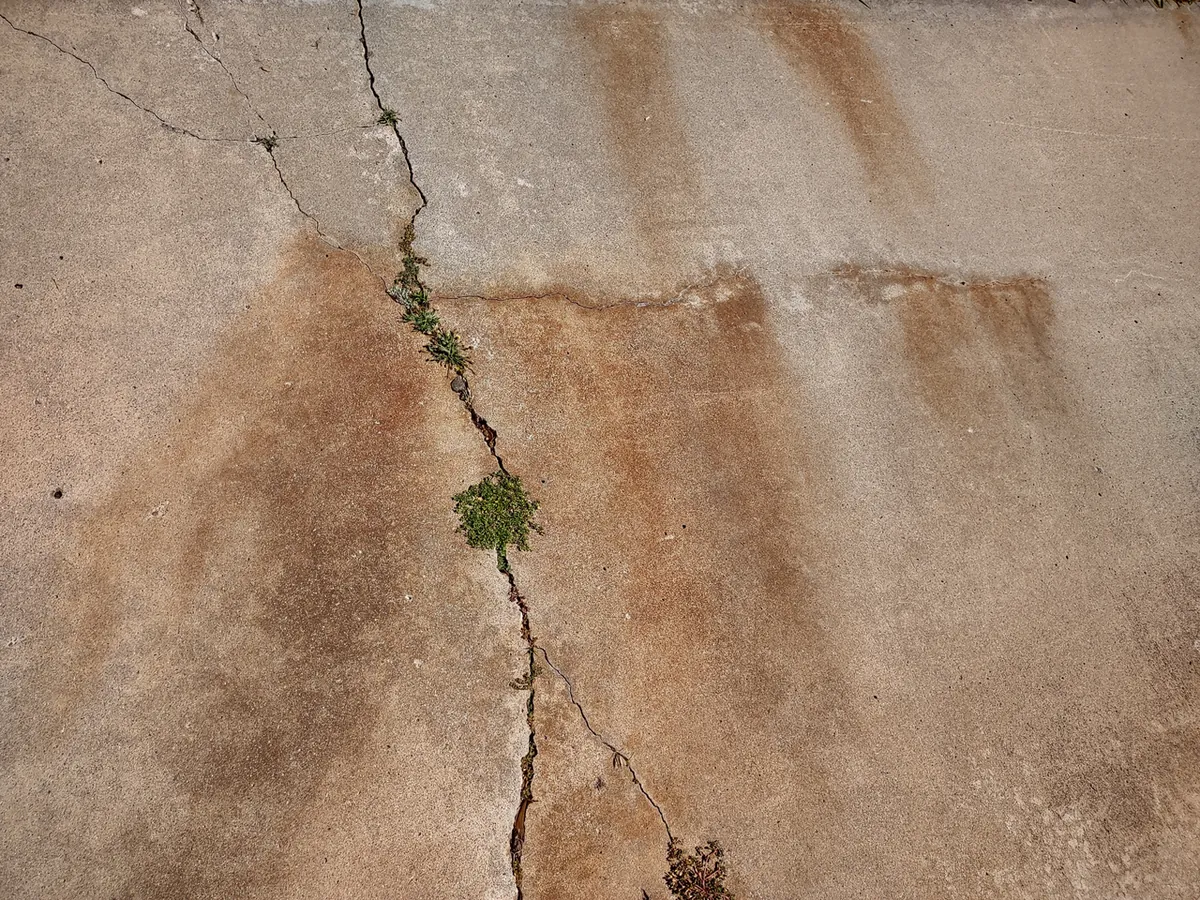
Photo: Wikimedia Commons user, Rust stains from cracks in concrete, CC BY-SA 4.0.
Quick Answer
Epoxy concrete repair uses a two-part epoxy resin to fill, glue or rebuild damaged concrete. Epoxy is the right choice for cracks that are dry and no longer moving, for structural cracks in walls and slabs, for gluing broken pieces back on, and for fast, strong patches on garage and shop floors. It is rigid, so it is not a good choice for cracks that open and close with the seasons, such as most driveway cracks; use a flexible sealant there. For small jobs, use an epoxy crack filler for concrete in a dual cartridge or an epoxy gel. For deeper structural cracks, low-pressure epoxy injection fills the crack all the way through. DIY kits often cost $20 to $100; professional injection commonly runs about $400 to $1,500 per crack.
Epoxy has a reputation as the strongest way to fix concrete, and in the right place it is. A properly done epoxy repair can bond two sides of a crack together so firmly that, if the concrete is loaded again, it breaks somewhere else instead of at the repair. That strength is exactly why epoxy is the wrong choice in some places: a crack that still moves needs something that can move with it.
This guide explains when to use epoxy to fix concrete and when not to, the different epoxy products (crack fillers, gels, mortars and injection kits), how to repair concrete with epoxy step by step, what epoxy concrete repair costs, and the most common reasons epoxy repairs fail.
What Is Epoxy Concrete Repair?
Epoxy is a two-part material: a resin and a hardener. When they are mixed, a chemical reaction turns the liquid or paste into a hard, solid plastic that sticks very strongly to clean, dry concrete. For concrete repair, epoxy comes in several forms:
- Low-viscosity liquid epoxy that flows into fine cracks, used for injection and gravity-feeding into floor cracks.
- Epoxy gel or paste that stays where you put it, used for vertical cracks, cap seals and bonding pieces.
- Epoxy mortar, epoxy mixed with sand or a special filler, used to patch spalls, holes and broken edges.
- Epoxy crack filler kits in dual cartridges that mix the two parts in a nozzle as you squeeze.
Concrete repair epoxy is different from the epoxy floor coatings used on garage floors, although the chemistry is related. Coatings are thin layers over the whole floor; repair epoxies fill and bond. Our guide to concrete coating cost covers coatings.
When to Use Epoxy for Concrete Cracks
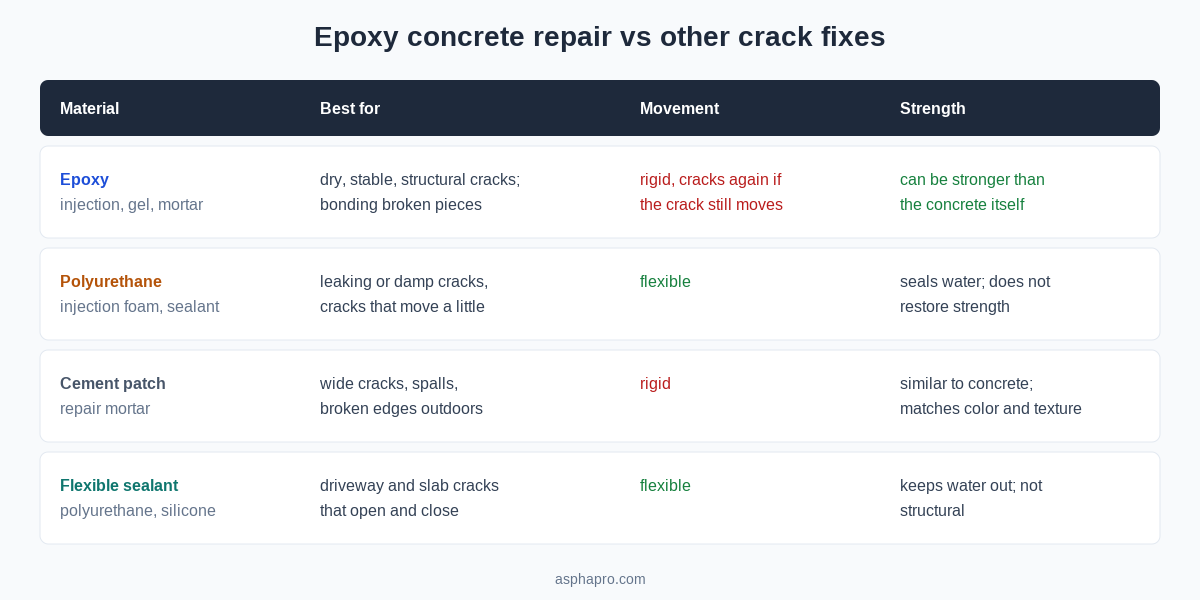
Use epoxy for concrete cracks when:
- The crack is dormant. It has stopped growing and does not open and close with temperature or load. Mark the ends and check over a few months if you are not sure.
- The crack is dry. Most epoxies need dry concrete to bond. Injecting epoxy into wet or leaking cracks is a leading cause of failed structural crack repairs.
- You need strength back. Structural cracks in walls, beams, columns and slabs can have much of their strength restored by epoxy injection, according to the American Concrete Institute's field guide.
- You are gluing a piece back. A broken step corner or curb piece can be bonded back on with epoxy gel.
- You want a strong, fast floor patch. Epoxy crack fillers and mortars cure quickly and resist abrasion on garage and shop floors.
When Not to Use Epoxy to Fix Concrete
- Moving cracks. Rigid epoxy in a crack that keeps moving will crack again right beside the repair. Driveway and sidewalk cracks usually move with the seasons; seal them with a flexible sealant. See our guide on fixing cracks in concrete driveway slabs.
- Leaking basement cracks. If water is coming through, polyurethane injection, which reacts with water and stays flexible, is usually the better choice.
- Joints. Control and expansion joints are meant to move. Never fill them with rigid epoxy outdoors.
- Wide outdoor areas in strong sun. Many epoxies yellow or chalk in UV light and expand differently from concrete with temperature, which can cause thin epoxy patches on outdoor slabs to debond.
- Without fixing the cause. If a wall is still being pushed in by soil, epoxy alone will not stop it.
Types of Epoxy Crack Filler for Concrete
| Product | Use | Typical crack size |
|---|---|---|
| Thin gravity-feed epoxy | Hairline floor cracks, sealing before coatings | Hairline to about 1/8 in. |
| Epoxy crack filler in dual cartridge | Floor and slab cracks, small repairs | About 1/16 to 1/4 in., or wider with sand |
| Epoxy gel or paste | Vertical cracks, cap seals, bonding broken pieces | Surface sealing and bonding |
| Epoxy injection kit | Structural cracks in walls and slabs | Very fine to about 1/4 in. |
| Epoxy mortar | Spalls, holes, broken edges, ramps | Patches from thin to a few inches deep |
Most hardware stores carry at least one epoxy crack filler kit and one epoxy gel, while specialty concrete suppliers stock injection kits, structural gels and epoxy mortars in larger sizes. If you are not sure which you need, take a photo of the crack and its width to the counter. The labels vary from brand to brand: an epoxy concrete crack filler, a concrete crack filler epoxy, and an epoxy crack filler for concrete are usually the same kind of product. What matters is the viscosity (thin to flow into cracks, or thick to stay in place), the pot life (how long you have to work), and whether the product is rated for structural use.
How to Repair Concrete With Epoxy: Floor and Slab Cracks
This is the most common DIY epoxy concrete repair: filling cracks in a garage, basement or shop floor before a coating, or just to stop them from chipping.
Step 1: Check that the crack is stable and dry
Make sure the crack is not growing and not damp. On a basement floor, tape a piece of plastic over the crack for a day; if the concrete under it darkens, there is moisture coming up and epoxy may not bond well.
Step 2: Clean and open the crack
Remove dirt, oil, old sealers and loose concrete. On floors, many pros chase the crack with a grinder and a narrow diamond blade to open it to a clean, uniform width, then vacuum it thoroughly. Epoxy bonds only to clean concrete; dust is the most common cause of failure.
Step 3: Fill
For narrow cracks, use a thin epoxy and let it soak in, adding more until it stays full. For wider cracks, fill the crack with clean, dry sand to about 1/4 inch below the top and then saturate it with epoxy, or use a thicker epoxy crack filler. Concrete crack repair epoxy kits in dual cartridges are easy for this: squeeze a bead into the crack, letting the mixing nozzle blend the two parts.
Step 4: Level and finish
Overfill slightly. Once the epoxy has hardened, grind or scrape it flush with the floor. If the floor will be coated, lightly sand the repair so the coating sticks.
Step 5: Let it cure
Cure time depends on the product and temperature, from under an hour for fast-setting fillers to a day or more for standard epoxies. Cold temperatures slow epoxy a lot; most need the concrete and air above about 50°F.
Concrete Crack Repair Epoxy Injection: How Pros Do It
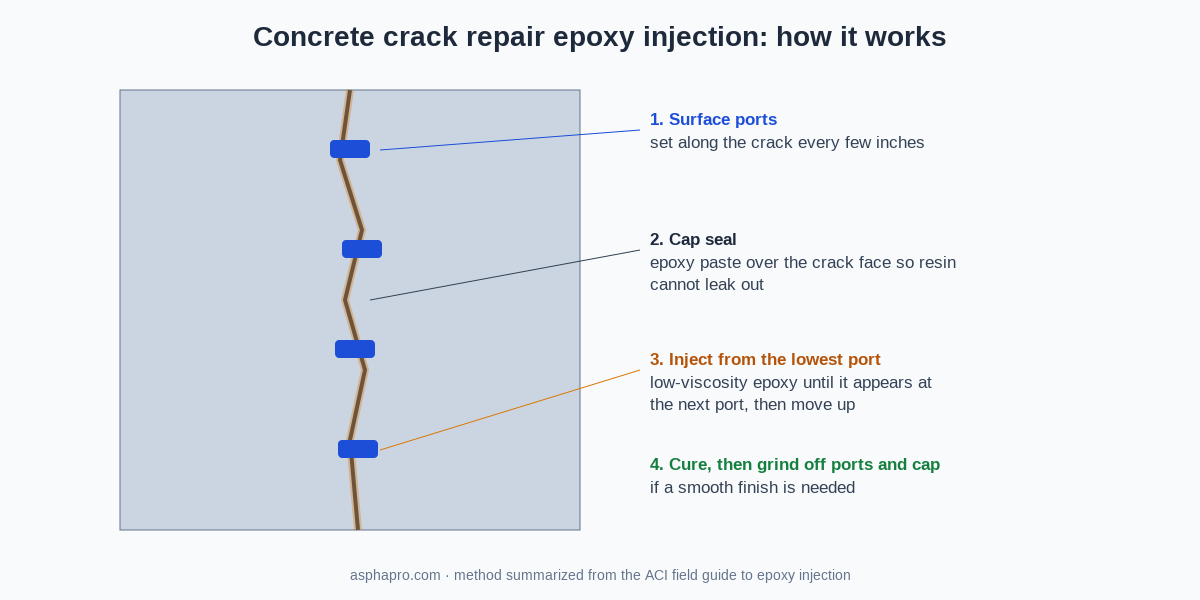
Epoxy injection is used for structural cracks that go through a wall or slab. It is the method described in the American Concrete Institute's field guide to structural crack repair by epoxy injection, and it is what most foundation repair companies use for dry, stable cracks. The basic steps are:
- Clean the crack surface and confirm it is dry and stable.
- Mount injection ports along the crack, usually every few inches to about a foot apart depending on the crack and the wall thickness.
- Cap seal the crack on the surface with epoxy paste between the ports, so the injected resin cannot escape. On walls you can reach from both sides, both faces are sealed.
- Inject low-viscosity epoxy starting at the lowest port, using steady low pressure, until resin appears at the next port. Then cap that port and move to the next one.
- Let it cure, then remove the ports and grind off the cap seal if a smooth finish is wanted.
Homeowner epoxy injection kits for foundation walls use the same idea with small cartridges. They can work well on single, accessible, dry cracks in poured concrete walls. For long, wide or multiple cracks, horizontal cracks, bowing walls, or anything you are not sure about, have a professional look at it first.
Using Epoxy to Fix Concrete Steps, Curbs and Broken Edges
Epoxy is excellent for gluing a broken piece of concrete back in place, such as a step corner, a piece of curb or the edge of a countertop:
- Clean both broken faces with a wire brush and let them dry.
- Dry-fit the piece to make sure it seats properly.
- Apply an epoxy gel rated for concrete bonding to both faces.
- Press the piece in place and hold or brace it while the epoxy sets.
- Fill any gaps with epoxy mortar or a cement patch, and clean off squeeze-out before it hardens.
If the piece is missing, rebuild the edge with epoxy mortar or a polymer-modified repair mortar inside a simple board form. Our guide to fixing broken concrete steps walks through that.
Epoxy Mortar for Spalls and Holes
Epoxy mortar is epoxy mixed with sand or a special aggregate. It is very strong, bonds well, and cures quickly, which makes it popular for repairing spalls on industrial floors, loading docks, ramps and anchor bolt holes. For outdoor slabs, cement-based repair mortars are usually a better match, because they expand and contract with temperature more like the surrounding concrete. See our guide to spalling concrete for spall repair steps.
How to Choose a Concrete Repair Epoxy
Product labels are full of numbers. These are the ones that matter when you pick a concrete repair epoxy:
- Viscosity. Thin, water-like epoxies flow into hairline cracks and are used for injection and gravity feeding. Gels and pastes stay put on walls and ceilings and are used for bonding and cap seals. Pick thin for fine cracks and thick for wide cracks, vertical surfaces and gluing.
- Pot life and working time. This is how long the mixed epoxy stays usable. Fast-setting products may give you only a few minutes; standard products often give 20 minutes or more. Mix small batches if the pot life is short.
- Cure time. How long until you can walk or drive on it, or grind it. Fast products are convenient for floors; slower products often penetrate cracks better.
- Minimum temperature. Most epoxies need concrete and air above about 50°F. Some winter-grade products cure at lower temperatures.
- Moisture tolerance. Standard epoxies need dry concrete. Some are rated for damp surfaces; none should be used to stop actively running water.
- Structural rating. For cracks in walls, beams and slabs that carry load, use a product rated for structural crack repair and follow its specification.
Concrete Epoxy Repair on Foundation Walls
Many homeowners first think about concrete epoxy repair when they see a crack in a poured concrete basement wall. Vertical shrinkage cracks in poured walls are common and are often a good fit for epoxy injection if they are dry. Here is how to decide:
- Dry, vertical crack, under about 1/8 inch, not growing: a good DIY or professional candidate for epoxy injection, which seals it and bonds the wall back together.
- Crack that leaks water: usually better handled with polyurethane injection, which reacts with water and stays flexible.
- Horizontal crack, stair-step crack in block, or wall bowing inward: a sign of soil pressure. Do not just fill it; have a foundation professional or engineer evaluate the wall.
- Crack wider than about 1/4 inch or with one side offset: get it evaluated before repair.
Epoxy can restore much of the wall's strength at the crack, but it cannot stop the forces that caused it. If the wall is still moving, it will crack again nearby. For block walls, epoxy injection is less effective because the hollow cores swallow the resin; other repair methods are used there.
Concrete Epoxy for Cracks in Countertops and Decorative Concrete
Small cracks in concrete countertops, tabletops and decorative pieces are often filled with a clear or tinted epoxy. Using concrete epoxy for cracks in these places gives a strong, almost invisible repair when the epoxy is tinted to match and then sanded and sealed with the rest of the surface. Many countertop makers stock a slurry or epoxy filler for this. Because countertops are indoors and protected from freeze-thaw and strong sun, epoxy holds up well. See our guide to concrete countertops for care and repair.
DIY or Professional Epoxy Concrete Repair?
Epoxy concrete repair you can usually do yourself:
- Filling cracks and small holes in garage, basement and shop floors.
- Gluing broken corners of steps and curbs back on.
- Setting anchor bolts and threaded rod in concrete with anchoring epoxy.
- Injecting a single, short, dry vertical crack in a poured basement wall with a homeowner kit.
Epoxy repairs better left to professionals:
- Structural cracks in beams, columns, balconies, retaining walls and load-bearing slabs.
- Long or multiple foundation cracks, and any crack with signs of ongoing movement.
- Leaking cracks, where the right material may not be epoxy at all.
- Large areas of spalling on structures, which need engineering.
A pro brings injection equipment that controls pressure, experience reading cracks, and usually a warranty against leaks or reopening.
A Worked Example: Cracked Garage Floor Before Coating
A two-car garage floor has three shrinkage cracks, each about 1/8 inch wide and 10 to 15 feet long, plus a few small pop-outs. The cracks have not changed in years, and the owner plans an epoxy floor coating.
- Grind or etch the floor as the coating system requires, and chase each crack with a diamond blade to a clean, even width.
- Vacuum the cracks and holes thoroughly.
- Fill the cracks with an epoxy crack filler from dual cartridges, overfilling slightly. Fill pop-outs with epoxy mortar.
- After curing, grind the repairs flush and vacuum again.
- Apply the floor coating over the whole floor.
Materials for the repairs might cost about $60 to $150 for roughly 40 feet of crack, depending on the product. The control joints are left open or filled with a flexible joint filler so the coating does not crack along them.
What Epoxy Concrete Repair Costs
| Job | Typical cost |
|---|---|
| Epoxy crack filler (dual cartridge) | About $15 to $40 per cartridge |
| DIY epoxy injection kit for one wall crack | Often about $40 to $100 |
| Epoxy mortar or patch kit | About $30 to $100 or more, depending on size |
| Professional epoxy or polyurethane injection | About $400 to $1,500 per crack |
| Hairline slab crack repair by a pro | About $250 to $800 per crack |
The professional ranges come from HomeGuide's cracked slab foundation repair cost guide and match our concrete repair cost guide. Prices rise with crack length, wall thickness, access and whether excavation or exterior waterproofing is also needed.
Why Epoxy Concrete Repairs Fail
- Moisture. Wet or damp concrete keeps standard epoxies from bonding.
- Dirty surfaces. Dust, oil and old sealers stop the bond.
- Wrong crack. A moving crack breaks a rigid epoxy repair, or cracks right beside it.
- Bad mixing. Epoxy needs the exact ratio and thorough mixing; unmixed resin stays soft.
- Cold temperatures. Epoxy cures slowly or incompletely in cold conditions.
- Incomplete injection. If the epoxy does not fill the full depth, the crack is still open inside.
- Ignoring the cause. Soil pressure, settlement or water will crack the wall again.
Epoxy vs Polyurethane vs Cement for Concrete Repair
Choosing epoxy for concrete repair comes down to the job:
- Epoxy: strongest bond, rigid, needs dry stable cracks. Best for structural cracks, bonding pieces and tough indoor floor patches.
- Polyurethane injection: flexible and water-reactive. Best for stopping leaks in basement wall cracks.
- Flexible polyurethane or silicone sealant: best for outdoor slab cracks and joints that move. See how to repair concrete cracks.
- Cement-based repair mortar: best for spalls and wide cracks outdoors where you want the patch to look and behave like concrete.
Anchoring Epoxy: Another Kind of Concrete Repair Epoxy
Epoxy is also used to set rebar, threaded rod and anchor bolts into holes drilled in concrete. Anchoring epoxy comes in large dual cartridges and is pumped into a clean, dust-free hole before the rod is pushed in with a twist. It is common when repairing broken railings, re-anchoring posts, adding dowels to tie a new slab to an old one, or replacing anchor bolts that pulled out. The same rules apply as for crack repair: the hole must be clean and usually dry, the mix must be complete, and the epoxy must cure fully before the anchor is loaded. Our guide to types of concrete anchors compares adhesive anchors with mechanical ones.
How Long Does an Epoxy Concrete Repair Last?
Indoors, a well-done epoxy repair in a stable crack can last for the life of the slab or wall. Outdoors, the life depends on movement, sun and freeze-thaw. Epoxy that is protected from strong sunlight and used only in cracks that no longer move can last many years. Epoxy in a moving crack may fail within a season or two, usually by cracking along one edge. Inspect repairs once a year, and if a crack reopens next to an epoxy repair, treat it as a moving crack and switch to a flexible sealant.
Safety When Working With Epoxy
Epoxy resins and hardeners can irritate skin and eyes, and repeated skin contact can cause allergic sensitization. Wear nitrile gloves and safety glasses, work in a ventilated area, and read the safety data sheet. Mixed epoxy heats up as it cures, especially in large batches, so mix only what you can use within the pot life. Grinding cured epoxy and concrete creates dust; use dust control and a respirator. Clean tools with the solvent the label lists before the epoxy hardens, and let leftover mixed epoxy cure fully before you throw it away.
Epoxy Concrete Repair on Garage and Shop Floors
Garage floors are where most homeowners first use epoxy for concrete repair. Cracks, small spalls and pop-outs can be filled with an epoxy crack filler before an epoxy or polyaspartic coating goes down, so the coating has a smooth, solid base. A few tips:
- Repair cracks and holes first, then grind or etch the whole floor for the coating.
- Check that the epoxy filler is compatible with your coating; many coating systems sell their own crack filler.
- Leave control joints open, or fill them with a flexible joint filler, not rigid epoxy, if the slab moves.
- Feather and sand repairs flush so they do not show through the coating.
Frequently Asked Questions
Is epoxy good for concrete cracks?
Yes, for cracks that are dry and no longer moving, especially structural cracks and indoor floor cracks. For cracks that open and close with the seasons, use a flexible sealant instead.
How do you repair concrete with epoxy?
Clean and dry the crack or damaged area, mix the epoxy exactly as directed, fill or inject it, let it cure, and grind it flush. For broken pieces, coat both faces with epoxy gel and press them together.
What is the best epoxy crack filler for concrete?
For floors, a low-viscosity epoxy or a dual-cartridge epoxy crack filler works well. For walls and structural cracks, use an epoxy injection kit or a professional injection system. Choose one rated for your crack width and temperature.
Can you use epoxy to fix concrete outdoors?
Yes, for stable cracks and bonding pieces, but avoid rigid epoxy in moving cracks and joints, and use UV-stable products or cover epoxy repairs that will be in strong sun.
How long does epoxy concrete crack repair take to cure?
It depends on the product and temperature, from under an hour for fast-setting fillers to a day or more for standard epoxies. Cold weather slows curing significantly.
How much does epoxy concrete repair cost?
DIY materials typically cost $20 to $100. Professional epoxy or polyurethane injection commonly runs about $400 to $1,500 per crack.
Is concrete epoxy crack repair stronger than concrete?
A properly done epoxy injection can bond the crack so well that the concrete breaks somewhere else under load, but only if the crack was clean, dry and completely filled.
Sources
- American Concrete Institute: RAP-1 Structural Crack Repair by Epoxy Injection
- Concrete Network: Crack Injection
- HomeGuide: Cracked Slab Foundation Repair Cost
- For Construction Pros: How to Select the Right Concrete Crack Repair Option
- U.S. General Services Administration: Types of Cracks in Concrete and Typical Causes
Related Guides
- Concrete patching compound guide — which concrete patch or repair mortar to use
- Concrete garage floor repair — cracks, pits, spalls and sunken slabs
- Cold joint concrete — what a cold joint is and how to prevent it
- Concrete adhesive — epoxy, construction adhesive and bonding agents
- Concrete pool — construction, gunite and costs
- Epoxy for concrete — floor coatings, garages and outdoors
- Concrete restoration — repair process, methods and cost
- Concrete wall crack repair — injection, sealants and when cracks are structural
- Hydraulic concrete — hydraulic cement for leaks and concrete for dams, canals and tanks