
Natural Pool Cost: What a Natural Swimming Pool Costs to Build and Run
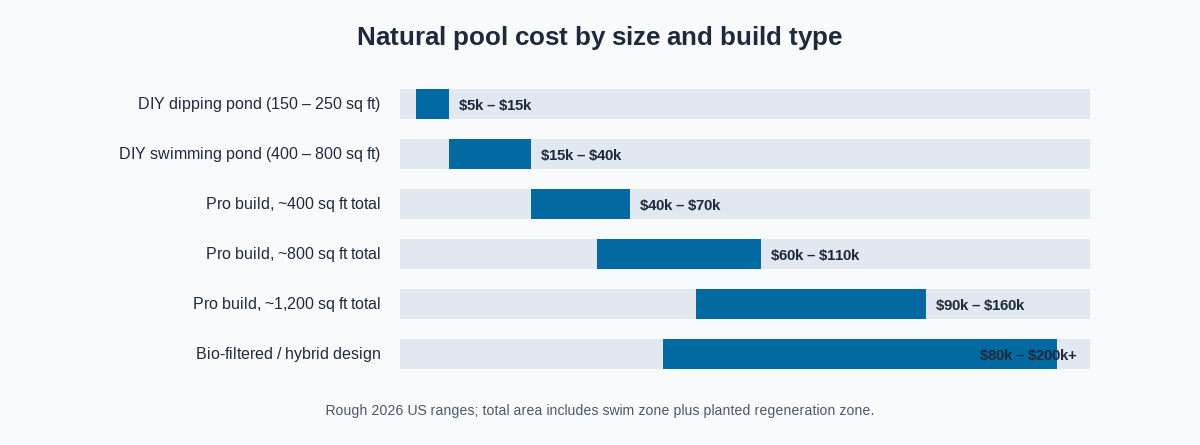
Chart: Asphapro.com
Quick Answer
The typical natural pool cost is about $15,000 to $40,000 for a DIY natural swimming pool and $50,000 to $120,000 or more for a professionally designed and built one. Small DIY dipping ponds can cost as little as $5,000 to $15,000, while large or bio-filtered designs can pass $150,000. The main costs are excavation, the liner, walls and stonework, pumps and filtration, gravel and plants, and decking. Running costs are low, often $300 to $1,200 a year, since there are no chlorine or heating bills in most designs.
A natural pool, also called a natural swimming pool or swimming pond, uses plants, gravel and beneficial bacteria to keep water clean instead of chlorine. It has a swimming zone and a planted regeneration zone, often of similar size, connected so that water flows through the plants and back. Natural pools are popular in Europe and growing in North America among owners who want chemical-free water and a pool that looks like part of the landscape. They also attract dragonflies, frogs and birds, turning the pool into a year-round garden feature.
This guide breaks down natural pool cost by size and build type, what drives the price, running costs and how the natural pool cost compares with a chlorine pool over time. For the building process itself, see our guide on how to build a natural pool.
Natural Pool Cost at a Glance
- DIY dipping pond (150 to 250 sq ft): $5,000 to $15,000.
- DIY natural swimming pool (400 to 800 sq ft): $15,000 to $40,000.
- Professional build, about 400 sq ft total: $40,000 to $70,000.
- Professional build, about 800 sq ft total: $60,000 to $110,000.
- Professional build, about 1,200 sq ft total: $90,000 to $160,000.
- Bio-filtered or hybrid designs: $80,000 to $200,000 or more.
Square footage here includes both the swim zone and the regeneration zone. A natural pool with a 400 sq ft swim area may need another 300 to 400 sq ft of planting, so the total natural pool cost reflects a larger footprint than a chlorine pool with the same swimming space.
Natural Pool Cost Breakdown
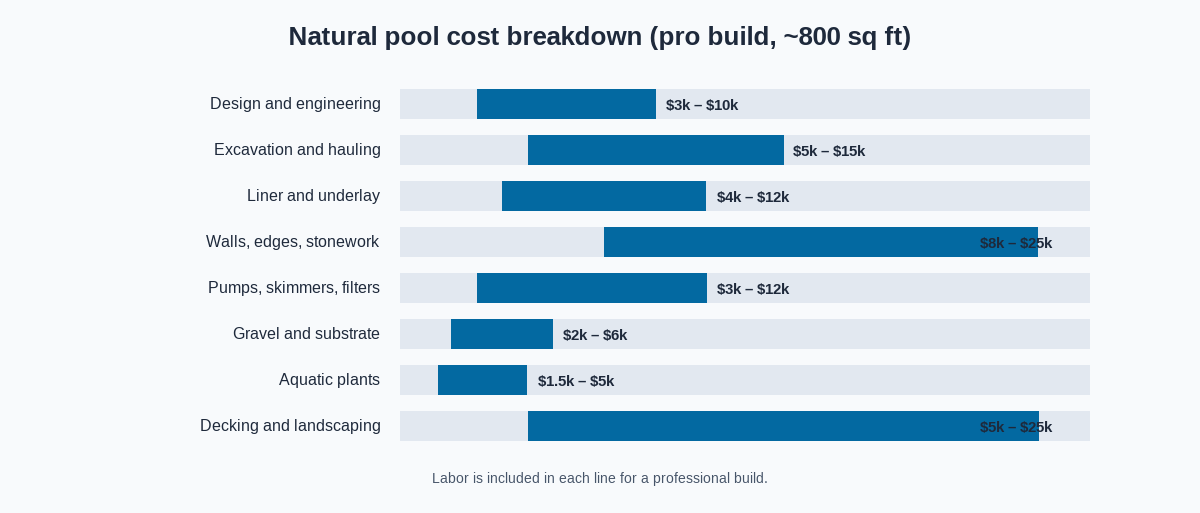
Chart: Asphapro.com
Design and Engineering: $3,000 to $10,000
Natural pools need careful design to balance the swim zone, plant zone, water flow and nutrient control. Specialist designers charge for site visits, drawings and plant plans. Good design is the best way to keep natural pool cost under control, since mistakes such as a plant zone that is too small lead to green water and expensive fixes later.
Excavation and Hauling: $5,000 to $15,000
Natural pools are often larger in footprint than chlorine pools, with deep swim zones of 5 to 8 feet and shallow terraced plant zones. Excavation, hauling spoil and grading add a big share of the natural pool cost. Rocky soil, high groundwater and poor access raise the price.
Liner and Underlay: $4,000 to $12,000
Most natural pools use a fish-safe EPDM rubber or PVC liner over a thick geotextile underlay. Liner cost depends on area and thickness. Some designs use concrete or shotcrete shells, which add significantly to natural pool cost.
Walls, Edges and Stonework: $8,000 to $25,000
The wall between the swim zone and plant zone, edge details, steps, capillary barriers and natural stone borders take time and materials. Large boulders, stone walls and custom steps push this part of the natural pool cost higher.
Pumps, Skimmers and Filtration: $3,000 to $12,000
Most modern natural pools use an energy-efficient pump, a skimmer, distribution pipes under the gravel, and often a phosphate filter or bio filter. Hybrid designs with separate filter beds or mechanical filtration cost more.
Gravel, Substrate and Plants: $3,500 to $11,000
Washed, low-nutrient gravel fills the regeneration zone, and aquatic plants are set at different depths. Native plants and smaller starter plants keep this part of the natural pool cost down.
Decking and Landscaping: $5,000 to $25,000
Wood or composite decks, stone paths, seating areas and surrounding planting finish the project. These can be phased to spread the natural pool cost over time.
What Affects Natural Pool Cost?
Size. Larger pools need more excavation, liner, gravel and plants. Because the plant zone must grow with the swim zone, natural pool cost rises quickly with size.
Design type. Pond-style pools that rely mainly on plants cost less per square foot but need more space. Hybrid designs with mechanical and biological filters need less plant area but more equipment.
Materials. EPDM liners and gravel are cheaper than concrete shells and stone walls.
Site conditions. Slopes, rock, groundwater and poor access all raise natural pool cost.
DIY or professional. Doing some or all of the work yourself can cut natural pool cost by 40 to 70%.
Location. Few contractors in North America specialize in natural pools, so travel and specialist rates can add to the price.
Running Costs
Natural pools are cheap to run. The pump is the main expense, usually $10 to $40 a month in electricity. There are no chlorine, shock or acid costs. Phosphate filter media costs $50 to $200 a year. Plants need trimming and occasional replacement. Many owners spend $300 to $1,200 a year in total, compared with $1,500 to $3,500 for a typical chlorine pool.
Natural Pool Cost vs Chlorine Pool Over 20 Years
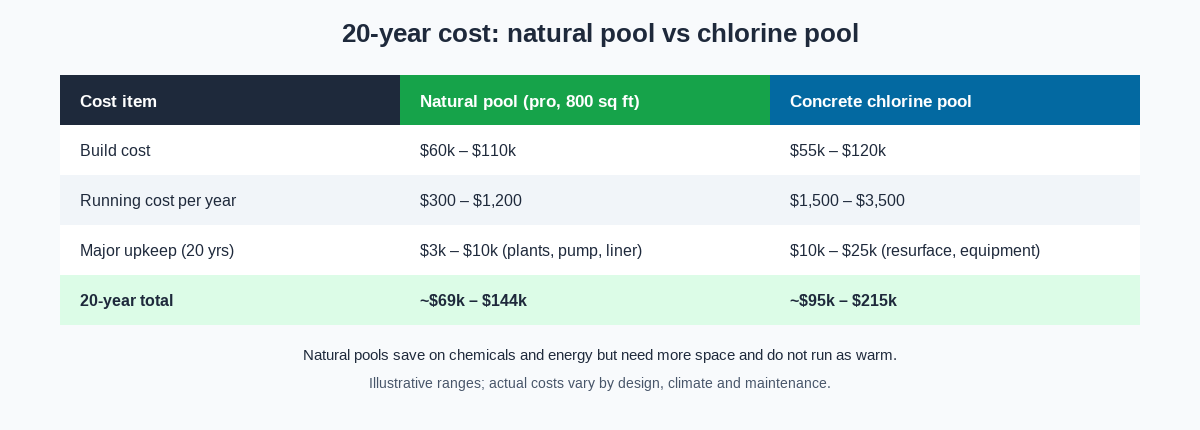
Chart: Asphapro.com
The upfront natural pool cost for a professional build is similar to a concrete chlorine pool. Over 20 years, lower running costs and fewer major repairs can make the natural pool cheaper overall, though it needs more space and the water is not heated in most designs. The chart shows illustrative totals for an 800 square foot natural pool and a typical concrete pool.
Photo: CMatula, Wikimedia Commons, CC BY-SA 4.0
DIY Natural Pool Cost in Detail
Building it yourself is the biggest way to lower natural pool cost. A typical DIY swimming pond with a 14 x 28 foot swim zone and a similar-sized plant zone might include: mini excavator rental and an operator for a few days ($2,000 to $6,000), spoil hauling ($500 to $3,000), geotextile underlay ($800 to $2,000), a 45 mil EPDM liner ($3,000 to $7,000), blocks or sandbags for the separating wall ($1,000 to $3,000), stone for edges ($1,000 to $5,000), a pump, skimmer and pipes ($1,000 to $3,500), a phosphate filter ($300 to $1,500), washed gravel ($1,500 to $4,000), aquatic plants ($800 to $2,500), and a simple timber deck and ladder ($2,000 to $6,000). That brings a DIY natural pool cost to roughly $15,000 to $40,000, plus many weekends of work.
DIY builders save most on labor but take on the risk of mistakes. Paying a designer for a plan, even if you build it yourself, adds $1,000 to $5,000 to the natural pool cost but greatly improves the odds of clear water.
Natural Pool Cost by Liner Type
The waterproofing method has a large effect on natural pool cost. EPDM rubber liners are flexible, fish-safe and long-lasting, often 20 to 30 years or more, and cost about $1 to $2 per square foot for the material. PVC liners are cheaper but less durable in sunlight. Reinforced polyethylene liners are strong and light. Concrete or shotcrete shells give a more permanent, formal pool and allow steep walls, but can double the shell portion of the natural pool cost. Some designs mix methods, with a concrete swim zone and a liner in the planted zone.
Natural Pool Cost for Converting an Existing Pool
Converting a chlorine pool to a natural pool can save on excavation, since the swim zone already exists. Typical conversion natural pool cost ranges from about $20,000 to $60,000 or more, depending on whether the regeneration zone is built beside the pool, in a separate pond connected by pipes, or by turning the shallow end into a planted area. Work may include draining, adding a submerged wall, building the plant zone, installing new pumps and pipes, and adding gravel and plants. Concrete pools are easier to convert than vinyl or fiberglass. Ask a specialist to assess your pool, since some shapes and sites are not suited to conversion.
Natural Pool Cost of Plants
Plants are a smaller part of natural pool cost but are essential for clear water. Small plugs and bare-root plants cost $3 to $10 each; larger potted marginal plants cost $10 to $40; water lilies cost $25 to $80 each. A typical plant zone of 300 to 400 square feet may need 150 to 400 plants, costing $800 to $5,000. Buying small starter plants and letting them fill in over a season or two keeps the natural pool cost down. Native species often cost less and grow better than imported ornamentals.
Natural Pool Cost by Region
Natural pool cost varies by region, mainly because of labor rates and the number of specialist builders. In parts of Europe, where natural pools are common, competition and experience keep prices predictable. In North America, specialist builders are fewer, so travel costs and design fees can add to the price. Areas with rocky soil or high groundwater, such as parts of New England, face higher excavation costs. Warm southern climates need larger or more engineered plant zones to handle algae, which can raise natural pool cost. Cold northern climates need hardy plants and designs that handle ice.
Natural Pool Cost and Heating
Most natural pools are not heated, which keeps running costs low. Heating a natural pool much above about 80 °F encourages algae and can upset the balance of the system. Some owners add solar heating or a heat pump for spring and fall, adding $3,000 to $8,000 to natural pool cost and more in running costs. A sunny, sheltered site and a dark liner help warm the water naturally. Shallow swim areas warm faster but also encourage more algae, so design matters.
Hidden Natural Pool Costs
Several items can add to natural pool cost if they are not planned. Building permits and engineering for large excavations may cost $500 to $3,000. A safety fence or barrier is required in most areas and costs $2,000 to $8,000. Electrical work for pumps and lighting adds $1,000 to $4,000. Water to fill a large pool may cost $200 to $1,500, and filling with low-phosphate water may require testing or trucked water. Lawn repair after excavation can cost $500 to $3,000. Planning for these items gives a more accurate total natural pool cost.
Natural Pool Cost: Worked Examples
Example 1: small DIY dipping pond. A couple builds a 10 x 14 foot pond with a 4.5 foot deep center and a planted shelf. Excavation rental $1,200, liner and underlay $1,800, stone edges $1,500, pump and skimmer $900, gravel $600, plants $700 and a small deck $1,800. Total natural pool cost: about $8,500.
Example 2: DIY natural swimming pool. An owner builds a 14 x 28 foot swim zone with a 14 x 20 foot plant zone. Total DIY natural pool cost, including design help: about $29,000.
Example 3: professional hybrid pool. A family hires a specialist to build a 16 x 36 foot swim zone with a separate bio filter bed and a smaller planted area. With decking, landscaping and fencing, the natural pool cost comes to about $125,000.
How to Lower Natural Pool Cost
Choose a simple shape with gentle curves, which uses liner more efficiently. Keep the swim zone to the size you really need. Build on a flat, accessible site. Use an EPDM liner rather than concrete. Do some of the work yourself, such as planting, gravel and decking. Buy small plants and let them grow. Phase the project, building the pool first and adding decks and landscaping later. Get several quotes and ask what each includes. These steps can lower natural pool cost by thousands of dollars without hurting water quality.
Is the Natural Pool Cost Worth It?
For owners who want chemical-free swimming, enjoy gardening and wildlife, and have space for a planted zone, the natural pool cost is often worth it. Running costs are low, the pool doubles as a garden feature year-round, and the water feels soft. For owners who want warm, crystal-clear water, a small footprint, or a pool that resale buyers will recognize, a conventional pool may be a better fit. Visiting a natural pool and talking to owners is the best way to decide whether the natural pool cost matches what you will get from it.
Natural Pool Cost vs a Garden Pond
A garden pond and a natural pool look similar but are built differently. Ponds are shallower, often have fish, and are not designed for swimming. A natural swimming pool needs a deep, plant-free swim zone, a properly sized regeneration zone, steady circulation and careful nutrient control. That is why natural pool cost is far higher than the cost of a garden pond of similar area. Trying to swim in a pond that was not designed for it often leads to murky water and disappointment.
Build Timeline
A professionally built natural pool usually takes four to ten weeks of site work, depending on size, design and weather, plus several weeks of design and permitting beforehand. Excavation and shaping take one to two weeks. Walls, edges and the capillary barrier take another one to two weeks. Laying underlay and liner can take a few days with a skilled crew. Plumbing, gravel and planting take one to two weeks, and decking and landscaping can take longer. After filling, the water usually needs several weeks to a full season to settle, as plants establish and the biological balance develops. DIY builds often stretch over a summer or two. Spring is the best time to plant, so many projects are timed to finish planting in late spring or early summer.
Yearly Maintenance Tasks and Their Cost
Maintenance for a natural pool is different from a chlorine pool but not difficult. In spring, clean the skimmer and pre-filter, check the pump, remove dead plant material and top up the water. In summer, skim leaves, remove string algae by hand, check the water level and clean filters as needed. In fall, cut back plants, remove fallen leaves quickly and net the pond if large trees are nearby. In winter, in cold climates, the pool can stay full and the pump is usually turned off and drained. Most owners spend a few hours a month on these tasks. If you hire a specialist for spring and fall service, expect $300 to $1,000 a year. Phosphate filter media and replacement plants add $100 to $400. These modest costs are a big part of why the long-term cost of a natural pool is attractive.
Safety and Fencing
Natural pools are just as dangerous for young children as chlorine pools, and the water may be less clear, making it harder to see the bottom. Most local codes require the same barriers as for any pool: a fence at least 4 feet high with a self-closing, self-latching gate. Budget for fencing as part of the project. Design the swim zone edges to be clearly marked and stable, with a ladder or steps for easy exit. Keep the plant zone separate from the swim zone so swimmers do not wander into soft, planted areas. See pool fence cost.
Choosing a Natural Pool Builder
Because natural pools are specialized, choose a builder with real experience. Ask to see finished natural pools, ideally ones that are several years old, and talk to their owners about water quality and maintenance. Ask how the builder sizes the plant zone, what filtration they use, which liner they install and what warranty they offer on the liner and workmanship. Check that the builder understands local permit and barrier rules. A clear written quote listing design, excavation, liner, walls, pumps, gravel, plants, decking and fencing lets you compare offers and see where your money goes.
Water Testing
Natural pools do not need daily chemical testing, but periodic tests help. Phosphate and nitrate tests show whether nutrients are under control. pH and alkalinity tests show whether the water is stable. Some owners send water samples to a lab once or twice a season to check bacteria levels, which costs $30 to $100 per test. Public natural pools in Europe follow strict testing rules, and private owners can borrow the same approach for peace of mind.
Natural Pool Cost per Square Foot
Looking at natural pool cost per square foot of total water area helps compare quotes. Professional builds usually land between about $100 and $175 per square foot of total pond area, including both the swim and plant zones, with hybrid designs and stone-heavy finishes at the upper end. DIY builds often come in at $30 to $60 per square foot. Because the plant zone is part of the total, the natural pool cost per square foot of usable swimming area is higher, often $150 to $300. When comparing with a chlorine pool, look at both numbers: total area tells you about site impact, while swim area tells you about usable space.
Natural Pool Cost and Home Value
A natural pool can add appeal for buyers who value sustainable, chemical-free living and garden design, especially in areas where natural pools are known. In other markets, some buyers may see it as a pond and worry about maintenance. Few pools of any kind return their full cost at sale, and the natural pool cost is best judged by the enjoyment you get from it over the years. Keeping clear records of the design, liner warranty and maintenance helps future buyers understand the pool. See how much value does a pool add to a home.
Financing the Natural Pool Cost
Because a professional natural pool cost is similar to a conventional pool, financing options are the same: home equity loans and lines of credit, personal or pool loans, and sometimes builder financing. Phasing the project is another way to spread the natural pool cost, for example building the pool and plant zone first and adding decks, lighting and landscaping in later years. See how to finance a pool.
Questions to Ask Before You Commit
Before committing to a natural pool, ask yourself a few questions. Do you have space for a plant zone as large as the swim zone? Are you comfortable with water that looks like a clear lake rather than a blue pool? Will you enjoy trimming plants and skimming leaves? Is your site sunny but not baking hot, and away from trees and fertilized lawns? If the answers are yes, a natural pool can be a rewarding choice that pays you back in low running costs and a beautiful garden.
Natural Pool Cost: Key Points
- DIY natural pools cost about $15,000 to $40,000; pro builds $50,000 to $120,000+.
- Excavation, liner, stonework and filtration are the biggest costs.
- Running costs are low, about $300 to $1,200 a year.
- Over 20 years, a natural pool can cost less than a chlorine pool.
Frequently Asked Questions
Is a natural pool cheaper than a regular pool?
Upfront, a professional natural pool costs about the same as a concrete chlorine pool. Running costs are much lower, since there are no chlorine, shock or heating bills in most designs, so the total over 20 years is often lower.
How much does a small natural pool cost?
About $5,000 to $15,000 for a DIY dipping pond, or $40,000 or more for a small professionally built natural swimming pool, depending on site and finishes.
Do natural pools need a pump?
Most modern designs use a small, energy-efficient pump to circulate water through the gravel and plant roots, which keeps the water clearer and helps the system handle more swimmers.
How long does a natural pool last?
Well-built natural pools can last decades. EPDM liners often last 20 to 30 years or more, pumps 8 to 15 years, and plants are replaced or divided as needed.
Can I convert my pool to a natural pool?
Yes, often for $20,000 to $60,000 or more, depending on how the regeneration zone is added and how much of the old pool can be reused.
Do natural pools add home value?
It depends on buyers and the local market; some love the chemical-free, natural look, while others prefer a familiar chlorine pool.
Sources
- EPA: Nutrient pollution sources
- Royal Horticultural Society: Wildlife ponds
- US Department of Energy: Swimming pool pumps
- CPSC: Pool and spa safety